Deportation Defense Attorney in Orlando: Know Your Rights
October 10, 2026
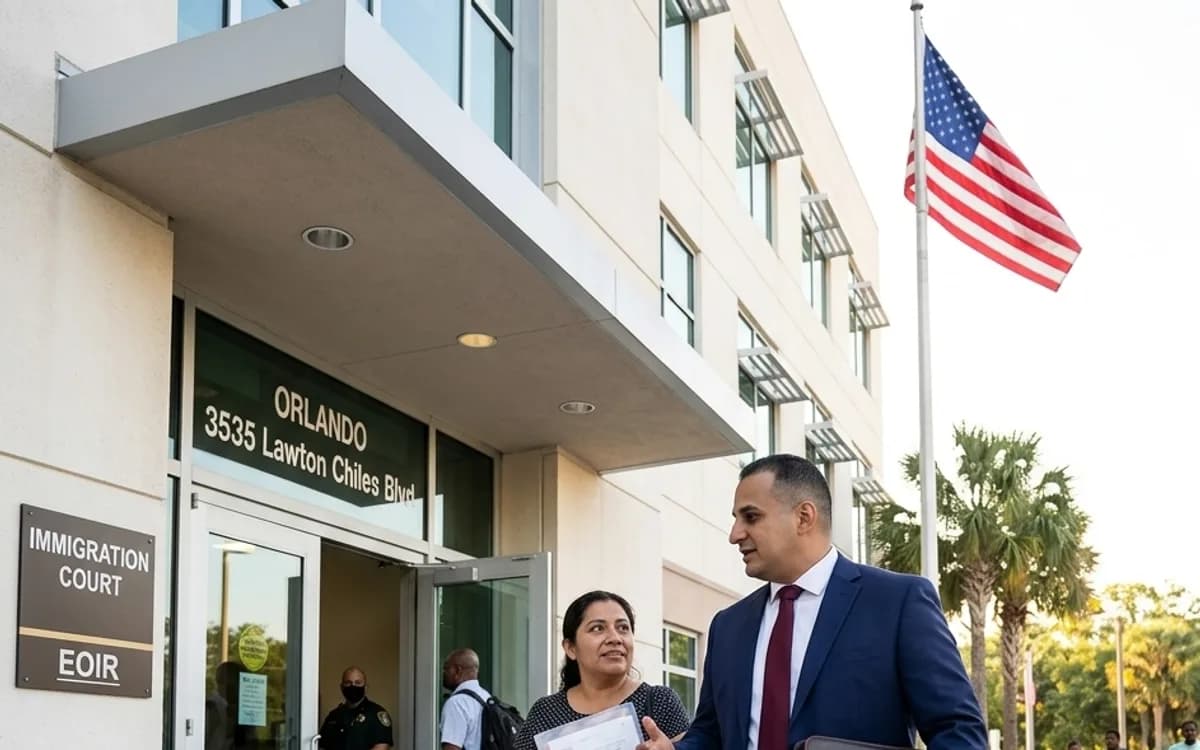
Page last reviewed October 2026. A Notice to Appear arrived in the mail, or ICE Enforcement and Removal Operations already has someone you love in custody out of the Orlando sub-office. Either way, a clock started that you did not set and cannot pause by waiting.
This page walks through what actually happens next inside Orlando Immigration Court, not the version that sounds reassuring on a flyer. If you are reading this at 11 p.m. trying to decide whether this is serious: it is, and the hearing date on that notice is real.
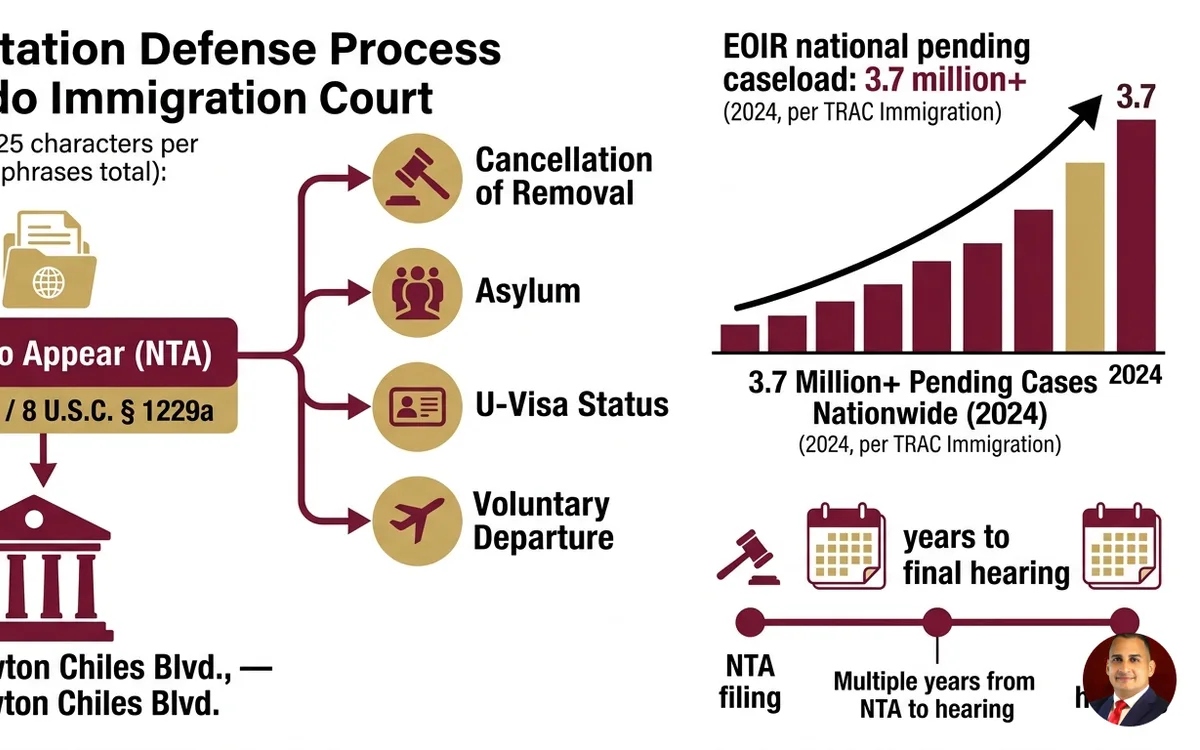
Deportation defense means contesting a Notice to Appear in Orlando Immigration Court (3535 Lawton Chiles Blvd.) under INA § 240, 8 U.S.C. § 1229a. Relief options include cancellation of removal, asylum, U-visa status, or voluntary departure. Nationally, EOIR's pending caseload topped 3.7 million in 2024, per TRAC Immigration, meaning most Orlando cases take years to reach a final hearing.
The Hard Truth
The Backlog Works Against You, Not for You
Nationwide, immigration courts had more than 3.7 million pending cases as of 2024, according to TRAC Immigration at Syracuse University (TRAC Immigration Court Backlog Tool). That number has grown faster than EOIR has hired judges. At Orlando Immigration Court, 3535 Lawton Chiles Blvd., individual merits hearings are now scheduled roughly two to five years out from the first master calendar date, consistent with the Orlando-specific wait times TRAC tracks court by court.
A longer wait is not automatically good news. Evidence goes stale. Witnesses move, lose contact, or lose their own status before the hearing date arrives. A case built on strong facts in 2024 can look weaker in 2028 if no one preserved the record in the meantime.
Outcomes are also not evenly distributed. TRAC's judge-by-judge data (TRAC Immigration Judge Reports) shows asylum grant rates across immigration judges ranging from under 10% to over 90%, a gap driven mostly by which judge is assigned, not by any single fact in your case. No attorney, including ours, can promise a result before a judge rules. What we can tell you is what the law requires at each stage, and what the Orlando docket actually looks like in practice.
What Happens If You Wait
What Missing a Step Actually Costs
If you miss a scheduled hearing at Orlando Immigration Court, the judge can issue an in absentia removal order under 8 U.S.C. § 1229a(b)(5), even if you never received the notice because you moved and did not update your address with EOIR. Reopening that order only works if you move fast: 8 C.F.R. § 1003.23(b)(4)(ii) gives you 180 days to reopen for 'exceptional circumstances,' with no deadline at all if you can show you never got proper notice, but you have to prove it with filings, not an explanation at your next check-in.
Deadlines inside the case matter as much as the hearing date itself. Asylum applications generally must be filed within one year of arrival under 8 U.S.C. § 1158(a)(2)(B), with narrow exceptions. An appeal to the Board of Immigration Appeals must be filed within 30 days of the immigration judge's decision under 8 C.F.R. § 1003.38(b); miss it, and the removal order becomes final.
Waiting also changes your immigration history in ways you cannot undo later. Unlawful presence of 180 days to one year triggers a 3-year reentry bar, and one year or more triggers a 10-year bar, under 8 U.S.C. § 1182(a)(9)(B). A green card holder who accepts voluntary departure on a removable DUI charge without reviewing other options may be giving up eligibility for cancellation of removal they did not know they had. None of these clocks pause because you are still deciding whether to call a lawyer.
Step-by-Step Process
What Actually Happens, Step by Step
1. The Notice to Appear and ICE Custody Decisions
Removal proceedings start when ICE or USCIS files a Notice to Appear (Form I-862) with the Orlando Immigration Court under 8 C.F.R. § 1003.14. If ICE Enforcement and Removal Operations has detained a family member, the first practical question is custody: whether to request a bond hearing before an immigration judge, since ICE's own custody decision is not the final word.
2. The Master Calendar Hearing
This is not the trial. A master calendar hearing at Orlando Immigration Court is a short docket call, usually 5 to 15 minutes, where the judge confirms your address, reads the allegations in the NTA, takes pleadings (admit or deny the facts alleged), and sets deadlines for any application for relief. Several of these can occur before a case moves to an individual hearing.
3. Deciding What Relief to Request
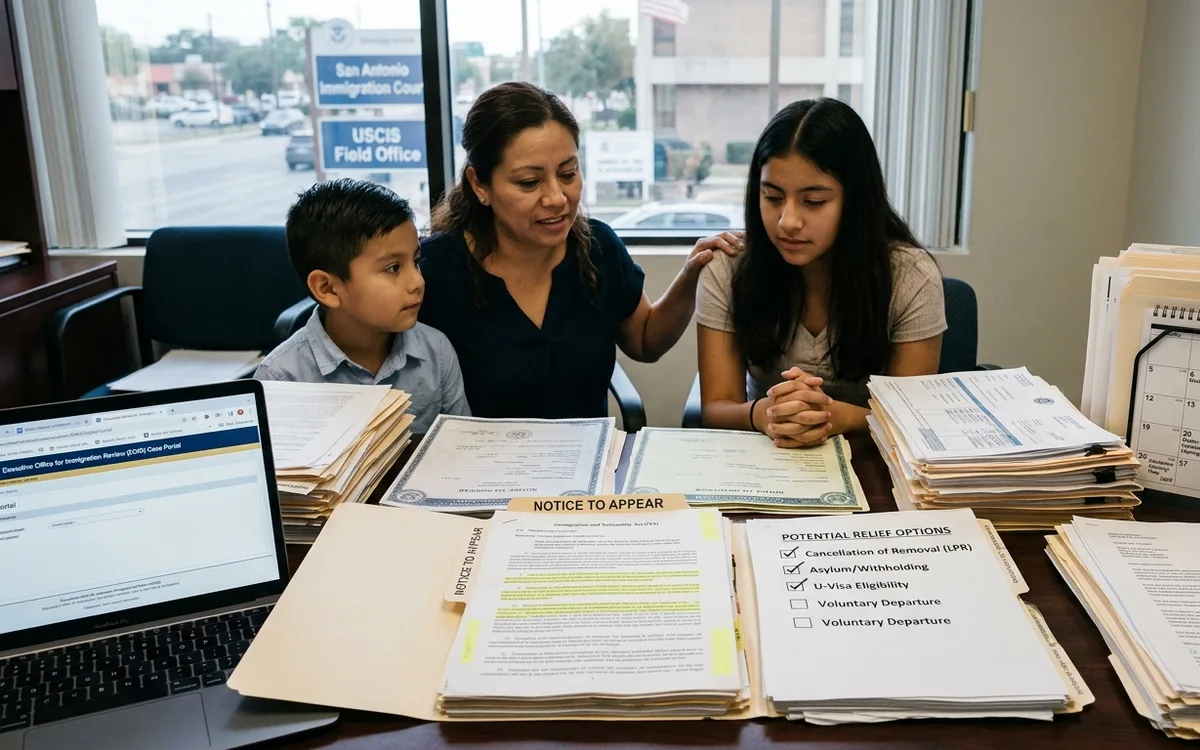
Depending on the facts, that might mean cancellation of removal for someone with 10 years of continuous presence and a qualifying relative, asylum for someone fleeing persecution, U-visa status for a crime victim who cooperated with police, a VAWA self-petition for a survivor of abuse by a U.S. citizen or LPR spouse, or voluntary departure when no relief applies. Each has its own form, filing deadline, and evidentiary burden; see the comparison below.
4. The Individual (Merits) Hearing
This is the actual trial. You and any witnesses testify, the government attorney cross-examines, and the judge rules on the application for relief based on the record built at the hearing and in the filings leading up to it. Orlando's current scheduling means this hearing is typically set two to five years after the first master calendar date.
5. Appeal or Compliance
If the judge denies relief, you have 30 days to appeal to the Board of Immigration Appeals under 8 C.F.R. § 1003.38(b). If the BIA also denies the appeal, a petition for review can go to the U.S. Court of Appeals for the Eleventh Circuit, the circuit covering Florida, within 30 days under 8 U.S.C. § 1252(b)(1). If relief is granted, the judge's order sets the next step, such as applying for adjustment of status.
A Real-World Example
A Composite Example: How One Orlando Case Actually Moved Through the Court
The following is a composite built from common fact patterns, not a real client, and the outcome is left open because every case turns on its own record.
Marisol (a composite name) overstayed a tourist visa by several years and was placed in removal proceedings after a traffic stop in Orange County led to a license check that flagged her status. She received a Notice to Appear by mail and had six weeks before her first master calendar hearing.
At the master calendar hearing, her attorney entered pleadings, admitted the factual allegations about her entry and overstay, and identified cancellation of removal as the likely form of relief given her years of continuous presence and a U.S.-citizen child with a documented medical condition. The judge set a filing deadline for the EOIR-42B application and scheduled briefing.
Marisol's individual hearing was set for roughly three years later, consistent with Orlando's current docket. In the meantime, her attorney gathered medical records, school records, tax filings, and letters, since the hardship standard requires evidence a judge can weigh, not just a narrative. Her case is still pending; this page does not predict what the judge will decide.
About the Attorney Handling Removal Defense Cases
William J. Vasquez is licensed by the North Carolina State Bar and admitted to practice before the U.S. Courts of Appeals for the Fourth, Fifth, and Eleventh Circuits. He is not licensed by the Florida Bar. His work on Orlando cases is federal immigration practice before the Executive Office for Immigration Review and the Board of Immigration Appeals, which does not require state-specific bar admission under 8 C.F.R. § 1292.1.
His Eleventh Circuit admission matters directly for Orlando clients: if a case is denied at the BIA level, a petition for review from an Orlando case goes to the Eleventh Circuit, the same circuit covering Florida. He has spent years handling removal defense matters on the EOIR docket, including master calendar and individual hearings, bond hearing requests, and BIA appeals.
Our team does not quote success rates or promise an outcome before a judge rules, for the reasons described above in the backlog and grant-rate data. What we commit to is handling your filings directly, attorney to client, rather than routing intake through a call center.
Key Terms Explained
Key Terms Used on This Page
Notice to Appear (NTA): The charging document (Form I-862) that starts removal proceedings, listing the allegations against you, filed with the Orlando Immigration Court under 8 C.F.R. § 1003.14.
Master Calendar Hearing: A short initial hearing where the judge takes pleadings and sets deadlines; it is not where evidence is presented or a final decision is made.
Individual (Merits) Hearing: The full hearing where testimony and evidence are presented and the judge decides the application for relief.
Cancellation of Removal: Relief under INA § 240A, 8 U.S.C. § 1229b, that can stop removal for certain long-term residents, split into LPR and non-LPR categories with different eligibility rules.
Asylum: Protection under INA § 208, 8 U.S.C. § 1158, for someone who cannot return home due to persecution based on race, religion, nationality, political opinion, or membership in a particular social group.
U-Visa: Status for victims of certain crimes who assisted law enforcement, capped at 10,000 principal petitions per fiscal year under 8 U.S.C. § 1184(p)(2).
VAWA Self-Petition: A path to lawful status for certain spouses, children, or parents abused by a U.S. citizen or lawful permanent resident, filed without the abuser's knowledge.
Voluntary Departure: An order letting someone leave the U.S. on their own within a set period instead of being formally removed, which avoids some but not all reentry bars.
Bond Hearing: A hearing before an immigration judge to request release from ICE custody while a case is pending.
BIA Appeal: A written appeal of an immigration judge's decision to the Board of Immigration Appeals, due within 30 days under 8 C.F.R. § 1003.38(b).
In Absentia Order: A removal order entered when someone fails to appear for a hearing, issued under 8 U.S.C. § 1229a(b)(5).
ERO (Enforcement and Removal Operations): The ICE division managing detention, check-ins, and removal logistics, including the Orlando sub-office.
Frequently Asked Questions
Frequently Asked Questions
Q: How much does an Orlando deportation defense attorney cost? A: Fees vary by case complexity, whether the case involves detention, and which form of relief is being filed. Most immigration attorneys, including ours, charge a flat fee set after reviewing your Notice to Appear and immigration history rather than an hourly rate. Ask for a written fee agreement before paying anything.
Q: How long does a removal case take from the Notice to Appear to a final decision? A: In Orlando, expect roughly two to five years from the first master calendar hearing to the individual merits hearing, based on current EOIR scheduling patterns tracked by TRAC Immigration. Detained cases move faster, often in weeks to months, because detained dockets are prioritized.
Q: Can a green card holder be deported after a DUI conviction in Florida? A: A single DUI is usually not an automatic deportable offense, but a DUI involving injury, a prior aggravated felony, or multiple convictions can trigger removability under INA § 237(a)(2). Each case depends on the specific statute of conviction and sentence, so an immigration review before entering any plea matters.
Q: What is the difference between voluntary departure and a removal order? A: Voluntary departure lets you leave the U.S. on your own within a set time and generally avoids the same bars as a formal removal order, but you must actually depart by the deadline or it converts into a removal order with added penalties under 8 U.S.C. § 1229c. A removal order can trigger a 5, 10, or 20-year reentry bar depending on the circumstances, under 8 U.S.C. § 1182(a)(9)(A).
Q: Can I reopen my case if I missed my Orlando Immigration Court hearing? A: Yes, under narrow conditions. You generally have 180 days to file a motion to reopen for exceptional circumstances under 8 C.F.R. § 1003.23(b)(4)(ii), or no deadline at all if you can show you never received proper notice. You need to file the motion with evidence, such as proof of an address change submitted to EOIR or hospital records, not just an explanation.
Q: Does checking in at the ICE ERO Orlando sub-office affect my pending case? A: A scheduled check-in itself does not change your case status, but ERO can use it to review compliance, request documents, or in some circumstances take custody. Bring a copy of your most recent court filings and any pending application receipt to every check-in.
Q: Are DACA recipients at risk of removal if they receive a Notice to Appear? A: DACA provides deferred action, not a defense to removal, so a DACA recipient who receives an NTA still needs an independent form of relief, such as adjustment of status through a qualifying family petition if eligible. DACA's own status remains subject to ongoing federal litigation, which can affect renewal processing timelines.
Q: What documents do I need for a consultation about my case? A: Bring the Notice to Appear or any EOIR hearing notice, your passport or other identity documents, any prior immigration filings such as Form I-94 or visa stamps, and documentation of time in the U.S. such as leases, pay stubs, or school records. For family-based relief, bring marriage certificates, birth certificates, and proof of the qualifying relative's status.
Q: What happens if I cannot afford a private attorney for my removal case? A: Immigration court proceedings do not include a government-appointed attorney, since removal is a civil, not criminal, proceeding, but EOIR maintains a list of free and low-cost legal service providers for each court, including Orlando. Ask the court clerk or check the list posted at the Orlando Immigration Court for current nonprofit providers.
Clients contacting our office after receiving a Notice to Appear consistently describe the same starting point: confusion about what the document means and whether the hearing date is real. Our reviews reflect how we handle that first conversation, explaining the Orlando court process in plain terms before discussing fees. We do not publish outcome statistics, because immigration case results depend on facts a review cannot capture, consistent with Florida Bar guidance on unverifiable claims. What clients can verify independently is how we communicate: direct attorney contact rather than a call center, and a written explanation of each filing deadline in their case.
Reading this page is not the same as having the filing deadlines in your specific Notice to Appear calculated for you. The forms and relief options above apply differently depending on when you entered the U.S., your criminal history, if any, and who your qualifying relatives are.
If you or a family member has a hearing date at Orlando Immigration Court, a pending ICE detainer out of the Orange County Jail, or a scheduled check-in at the ERO Orlando sub-office, schedule a consultation with our deportation defense team to review the Notice to Appear and map out which filing deadlines apply before the next hearing date arrives.
- Cancellation of Removal Defense
- Asylum Attorney Orlando
- U-Visa Petitions
- VAWA Self-Petitions
- Bond Hearing Requests
- BIA Appeals
- DACA Renewal Assistance
- Meet William J. Vasquez