New York Deportation Defense: Your Rights, Explained
October 10, 2026

A Notice to Appear showed up in the mail, or Immigration and Customs Enforcement took someone you love into custody and transferred them to the Buffalo Federal Detention Facility in Batavia. Either way, you are now staring at a court date inside a system most people never learn about until it reaches them personally.
What happens next depends on specifics: how the person entered the country, their criminal history if any, how long they have lived here, and whether a form of relief exists under the Immigration and Nationality Act. There is no single answer that applies to every case filed at 26 Federal Plaza or Varick Street.
There is, however, a deadline already running. A hearing date, a bond request, or a 30-day window to appeal a judge's order, these clocks start the day the government acts, not the day you feel ready to deal with it.
A deportation defense attorney represents respondents in Immigration Court (EOIR) proceedings under INA § 240, filing responses to a Notice to Appear, requesting bond redetermination, pursuing relief such as asylum, cancellation of removal, or a motion to reopen, and appealing adverse decisions to the Board of Immigration Appeals within the 30-day deadline set by 8 C.F.R. § 1003.38(b).
The Hard Truth
The New York Immigration Court backlog is not an abstraction. Nationally, EOIR carried more than 3.7 million pending cases as of late 2024, per TRAC Immigration at Syracuse University, and New York's docket alone accounts for more than 190,000 of them. An individual hearing, the actual proceeding where a judge rules on asylum or cancellation of removal, is commonly scheduled two to four years after the first master calendar hearing, per TRAC's case-processing time data.
That wait cuts both ways. It gives you time to build a record, but it also means a detained respondent can sit at Batavia, which holds roughly 650 people on an average day per ICE's published detention facility list, for months while a bond motion works through the system.
One more fact worth saying plainly: our attorney is admitted to the North Carolina State Bar and to the Fourth, Fifth, and Eleventh Circuit Courts of Appeals, not the Second Circuit that covers New York. Immigration Court and BIA practice is federal and does not require state-specific admission, so that does not block representation before the immigration judge or the Board. It does mean that if a case needs to go beyond the BIA to a federal circuit court petition for review, that step requires counsel admitted to the Second Circuit, something we tell clients directly rather than leave unsaid.
What Happens If You Wait
Miss the hearing date on your Notice to Appear and the judge can order removal in absentia, without you present, the same day. Reopening that order later requires a motion filed within 180 days if the ground is lack of notice, or within 90 days for most other grounds, under INA § 240(b)(5)(C) and § 240(c)(7)(C)(i). After that window closes, the legal path narrows sharply.
The 30-day deadline to appeal an immigration judge's removal order to the BIA, set by 8 C.F.R. § 1003.38(b), does not pause for a lost job, a hospital stay, or a transferred detention facility. File one day late and the Board can dismiss the appeal without reaching the merits.
Asylum carries its own clock. INA § 208(a)(2)(B) requires the application within one year of arrival, with narrow exceptions for changed or extraordinary circumstances that you must prove, not simply claim. Wait past that deadline without a filed Form I-589 and supporting evidence, and asylum may be off the table entirely, regardless of how strong the underlying claim is.
Step-by-Step Process
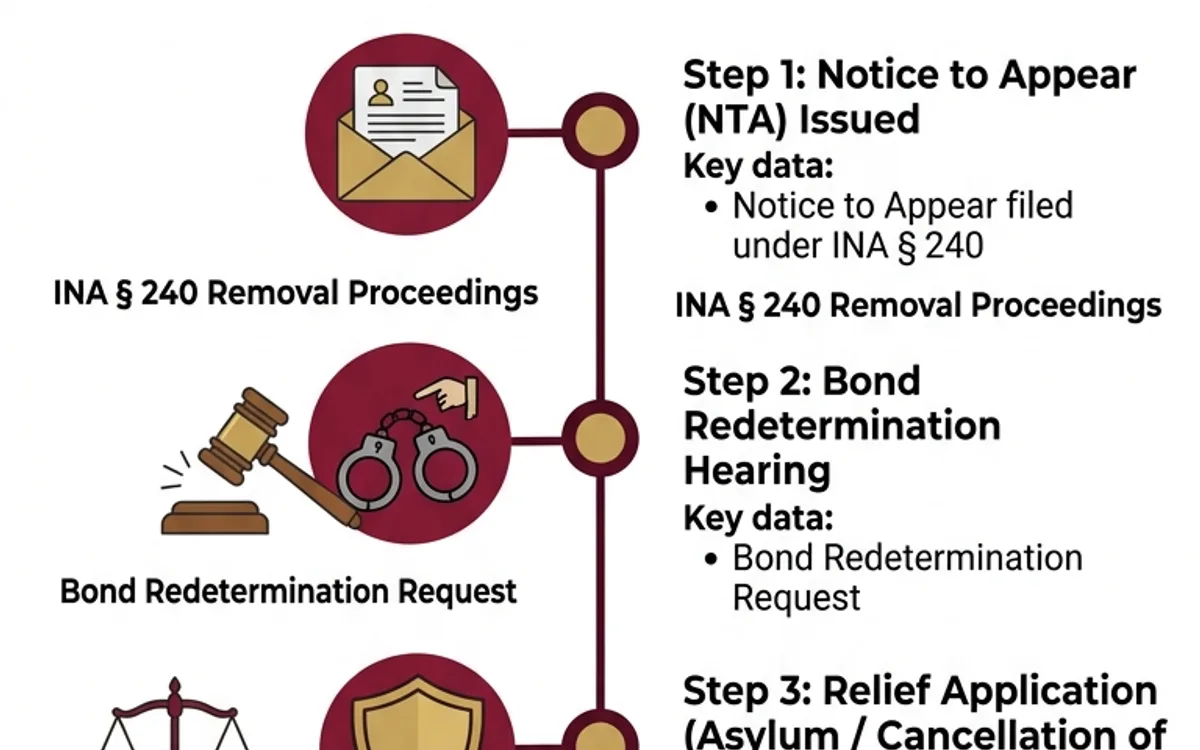
Initial review. Because our office is based in Florida, most New York respondents meet with us by phone or video first, to go over the Notice to Appear (Form I-862), the charge under the Immigration and Nationality Act, and any custody status.
First master calendar hearing. Non-detained cases are typically calendared at 26 Federal Plaza; detained cases run through the Varick Street docket. The judge confirms identity, takes pleadings, and sets filing deadlines; this is not the trial.
Bond redetermination, if detained. A separate motion to the immigration judge, independent of the removal case, unless a mandatory detention ground under INA § 236(c) applies. ICE's New York Field Office can transfer custody, including to Batavia, while this motion is pending.
Relief application filed through EOIR's electronic filing system (ECAS). This could be an I-589 for asylum, an EOIR-42A or 42B for cancellation of removal, or a motion to terminate if the Notice to Appear is defective under Pereira v. Sessions, 585 U.S. 198 (2018).
Individual hearing. The merits trial, where the judge hears testimony and rules on the relief requested. Current New York dockets commonly schedule this two to four years after the master calendar hearing, per TRAC Immigration data.
Decision and appeal. If the judge denies relief, a Notice of Appeal to the BIA is due within 30 days under 8 C.F.R. § 1003.38(b). A timely appeal generally triggers an automatic stay of removal under 8 C.F.R. § 1003.6.
Beyond the BIA. An adverse BIA decision can be challenged by petition for review to the federal circuit court covering the immigration court, the Second Circuit for New York cases. That filing requires counsel admitted to that specific circuit.
Parallel options. At any stage, a request for prosecutorial discretion can be submitted to ICE Enforcement and Removal Operations' New York Field Office, separate from the court proceeding itself.
A Real-World Example
Consider a composite respondent, call him Carlos, picked up during a routine check-in with ICE and transferred to the Buffalo Federal Detention Facility in Batavia. His family in Queens had thirty minutes' notice before the transfer.
The first step was not the removal case itself. It was a bond redetermination request filed with the immigration judge assigned to the Batavia detained docket, separate from the underlying Notice to Appear proceeding. That motion required proof of community ties, a sponsor's address, and evidence of his ability to appear for future hearings.
While the bond request moved forward, Carlos's removal case proceeded on the non-detained docket at Varick Street, where the government had charged him under INA § 212(a)(6)(A)(i) for entering without inspection. His attorney reviewed the Notice to Appear itself for a defect under Pereira v. Sessions, since a notice omitting the time or place of the first hearing can support a motion to terminate or a later motion to reopen.
At the master calendar hearing, pleadings were entered and the judge set a filing deadline for an application for cancellation of removal under INA § 240A(b)(1), given Carlos's ten years of continuous presence and a U.S. citizen child. The individual hearing, where that application would actually be decided, was calendared more than two years out. That gap reflects the current docket, not anything unusual about his filing.
William J. Vasquez represents respondents in removal proceedings before the Executive Office for Immigration Review and the Board of Immigration Appeals. He is admitted to the North Carolina State Bar and to the Fourth, Fifth, and Eleventh Circuit Courts of Appeals. Because EOIR and BIA practice is federal under 8 C.F.R. § 1292.1, any attorney in good standing with a single U.S. state bar can represent clients before an immigration judge or the Board nationwide, including on dockets at 26 Federal Plaza, Varick Street, and the Batavia detained docket, regardless of whether that attorney holds a New York state law license.
That authority has a real limit, and we state it at intake rather than after the fact. If a case needs a petition for review filed with the Second Circuit Court of Appeals after an adverse BIA decision, that step requires counsel admitted to that specific circuit, which is not currently among our admissions.
Vasquez has spent years focused on federal immigration matters, including bond litigation, cancellation of removal, asylum, and motions practice before EOIR. That experience shapes how a case gets built from the first master calendar hearing forward. It is not a promise about how any particular judge will rule.
Key Terms Explained
Notice to Appear (NTA): Form I-862, issued by ICE, that charges a noncitizen as removable and starts proceedings under INA § 240.
Master Calendar Hearing: A short procedural hearing where the judge confirms identity, takes pleadings, and sets deadlines. It is not the trial.
Individual Hearing: The merits hearing where the judge takes testimony and rules on requested relief, such as asylum or cancellation of removal.
EOIR: The Executive Office for Immigration Review, the Department of Justice agency that operates immigration courts and the BIA.
BIA: The Board of Immigration Appeals, the administrative body that reviews immigration judge decisions.
Cancellation of Removal: A form of relief under INA § 240A that, if granted, lets certain long-term residents or lawful permanent residents avoid removal and obtain or retain status.
Withholding of Removal: Relief under INA § 241(b)(3) that blocks removal to a specific country based on a clear probability of persecution, a higher standard than asylum, with no path to a green card.
In Absentia Order: A removal order entered when a respondent fails to appear for a scheduled hearing, issued under INA § 240(b)(5).
Bond Redetermination: A separate hearing before an immigration judge to set or lower bond for a detained respondent, unless barred by mandatory detention under INA § 236(c).
ECAS: EOIR's electronic case access system, used to file motions and applications in immigration court.
Petition for Review: An appeal of a final BIA decision filed with the federal circuit court covering the immigration court that heard the case.
Frequently Asked Questions
Q: What is the first deadline after I receive a Notice to Appear in New York? A: The Notice to Appear (Form I-862) lists your first master calendar hearing date at 26 Federal Plaza or Varick Street. Missing it can result in an in absentia removal order under INA § 240(b)(5), so confirm the date and venue through the EOIR automated case line (1-800-898-7180) or the online portal right away.
Q: How long does a deportation case take in New York Immigration Court? A: Individual hearings are commonly scheduled two to four years after the first master calendar hearing, per TRAC Immigration's case-processing data reported through late 2024. Detained cases move faster because EOIR prioritizes custody dockets, often resolving within months.
Q: Can I reopen a removal order I missed? A: Yes, within limits. A motion based on lack of proper notice must be filed within 180 days of the order under INA § 240(b)(5)(C), while most other grounds require filing within 90 days under INA § 240(c)(7)(C)(i).
Q: Does a prior criminal conviction end my case automatically? A: No, but it changes which relief is available and whether bond is possible. Certain convictions trigger mandatory detention under INA § 236(c) or bar cancellation of removal under INA § 240A(a)(3), so the specific statute of conviction and sentence matter.
Q: What happens if the immigration judge denies my case? A: You generally have 30 days from the written decision to file a Notice of Appeal with the BIA under 8 C.F.R. § 1003.38(b). If the BIA also denies relief, further review goes to the Second Circuit Court of Appeals for New York-based proceedings.
Q: How does bond work for someone detained at Batavia? A: A detained respondent can request a bond redetermination hearing, separate from the removal case itself, unless a mandatory detention ground under INA § 236(c) applies. ICE's New York Field Office can also transfer custody between facilities while the request is pending, which can delay scheduling.
Q: What does it cost to fight a deportation case? A: Immigration defense is billed as a flat fee or hourly arrangement tied to the relief sought and the stage of proceedings, never a contingency fee, since there is no monetary recovery in a removal case. Ask for a written fee agreement that lists the specific filings covered, such as a bond motion, asylum application, or BIA appeal.
Q: Is there still time to apply for asylum if it has been over a year since I arrived? A: Possibly. INA § 208(a)(2)(B) sets a one-year filing deadline, but exceptions exist for changed circumstances affecting eligibility or extraordinary circumstances that caused the delay, which must be documented, not just asserted.
Q: Can ICE still deport me while my appeal is pending? A: Filing a timely Notice of Appeal with the BIA generally triggers an automatic stay of removal under 8 C.F.R. § 1003.6, meaning ICE cannot execute the order while the appeal is pending, with limited exceptions for certain criminal or national security grounds.
Clients describe our communication style more often than any single case detail: direct answers about deadlines, plain explanations of what a master calendar hearing actually is, and honest statements about what the current backlog means for scheduling. Reviews consistently mention responsiveness between hearings, when a family's biggest fear is simply not knowing what happens next.
We do not publish case outcomes or approval statistics. Removal proceedings turn on facts specific to each respondent, an individual judge's decision, and a federal regulatory standard, not a pattern from someone else's case.
Reading about deadlines and forms is not the same as having someone confirm which ones apply to your specific Notice to Appear, your custody status, and your criminal history, if any. A consultation is where that gets sorted out, before a filing deadline passes.
If you or a family member has a hearing date at 26 Federal Plaza, Varick Street, or is detained at the Buffalo Federal Detention Facility, schedule a consultation with our immigration team to review the Notice to Appear, the custody status, and what relief may be available under current law. Call or request a consultation online before the next hearing date arrives.
- Asylum and Withholding of Removal Defense
- Bond Redetermination Hearings for Detained Immigrants
- Board of Immigration Appeals (BIA) Representation
- Cancellation of Removal for Lawful Permanent Residents and Non-Permanent Residents
- Attorney William J. Vasquez Profile
- Schedule an Immigration Consultation