Cuban Adjustment Act Green Card: Know Your Path and Rights
October 10, 2026
You were paroled into the United States, or inspected and admitted, and you have now passed the one-year mark the Cuban Adjustment Act requires. Somewhere between CBP One, the CHNV parole program, and a possible expedited removal referral at the border, you lost track of exactly which document controls your case. You have heard this law is different, built specifically for Cuban nationals, faster than ordinary adjustment of status. You have also heard parole rules changed in 2024 and 2025, and you are not sure whether your specific entry still counts.
That instinct to double-check is reasonable, given how narrow the fact pattern actually is. The Cuban Adjustment Act (Pub. L. No. 89-732, codified as a note to 8 U.S.C. § 1255) applies to a specific set of circumstances, and small details in your parole record — a revocation, a gap in custody status, a non-Cuban spouse on the same application — change the analysis. Before you file anything, those details need to be checked against your actual I-94 and parole documents.
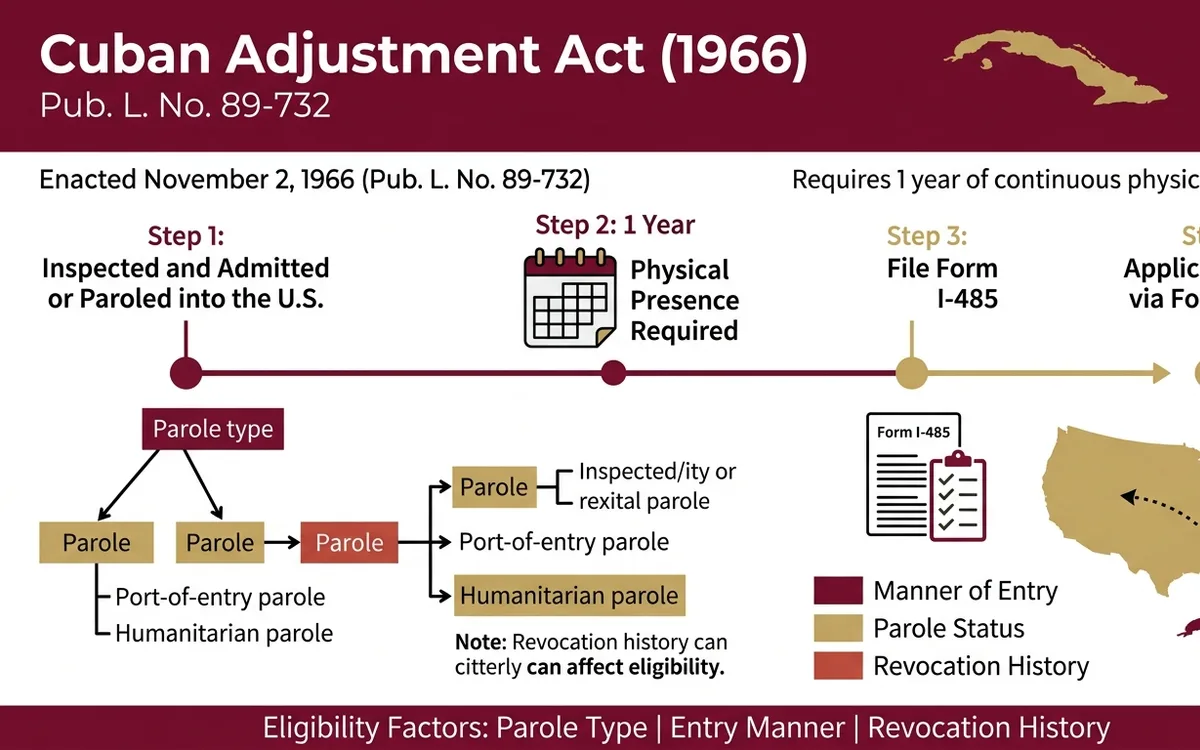
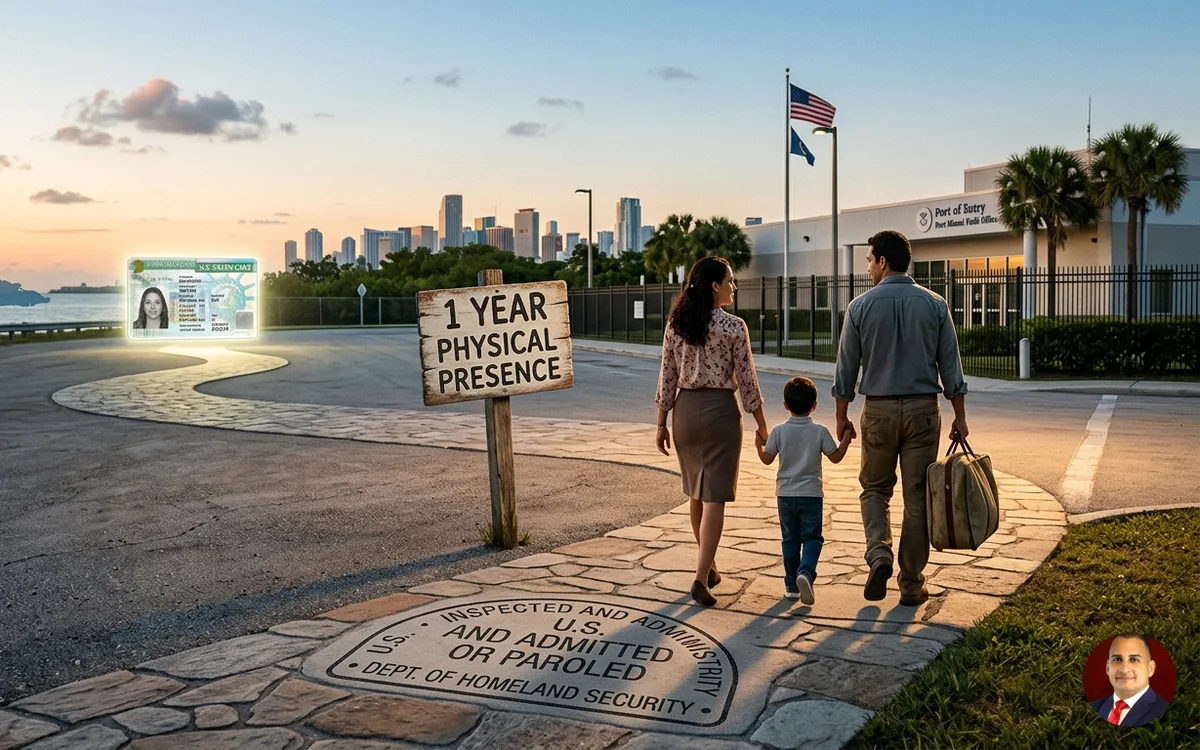
The Cuban Adjustment Act (Pub. L. No. 89-732, Nov. 2, 1966) lets a Cuban native or citizen who was inspected and admitted or paroled into the US, and has been physically present for one year, apply for a green card using Form I-485. Parole type, revocation history, and manner of entry all affect eligibility and must be reviewed individually.
The Hard Truth
Generous on Paper, Still Scrutinized in Practice
Congress built the CAA in 1966 as a standing exception to ordinary immigration law, and it remains one of the few paths where one year of physical presence can lead to a green card. But USCIS still has to find that you were, in the statute's words, 'inspected and admitted or paroled,' and that finding gets contested more often than it used to. CBP One appointments, CHNV parole, and parole granted after an expedited removal referral all create different paper trails, and those paper trails don't all satisfy the statute the same way.
The Eleventh Circuit addressed this directly in Cruz-Miguel v. Holder, 650 F.3d 1297 (11th Cir. 2011), holding that parole status under the CAA turns on the specific custody and parole determination CBP actually made — an applicant's own belief that they were lawfully let in doesn't control. The Board of Immigration Appeals reached a related conclusion in Matter of Artigas, 23 I&N Dec. 99 (BIA 2001), which defines what counts as parole for CAA purposes. If your parole was later revoked, or if your file shows an expedited removal referral before the parole grant, your eligibility is not automatic, and USCIS can deny the I-485 on that basis alone.
DHS has also paused and restarted CHNV parole decisions more than once since August 2024 while reviewing sponsor applications for fraud (per USCIS's CHNV parole processes page, uscis.gov, updated 2024). None of that changes the CAA itself, but it means the parole document you are relying on may draw more scrutiny at your interview than it would have two years ago.
What Happens If You Wait
What Delay Actually Costs You Under This Law
Your parole document has an expiration date printed on your I-94, generally one to two years from the date of parole (per CBP's parole admission procedures, 8 C.F.R. § 212.5). If that date passes before you file Form I-485, you do not lose CAA eligibility automatically, but you do lose your parole status, and losing parole status can put you in removal proceedings before an immigration judge rather than in front of a USCIS officer at a field office.
Filing in removal proceedings is still possible under 8 C.F.R. § 1245.13, but it moves on a slower, higher-stakes track. The case shifts from an interview-based process at the Miami Field Office to a courtroom docket at Miami Immigration Court, 333 S. Miami Ave, and a denial there is appealed to the Board of Immigration Appeals, then, if necessary, to the Eleventh Circuit under Federal Rule of Appellate Procedure 15. That is a longer path than the one Congress built for a one-year adjustment.
There is also a cost tied to the calendar outside your own file. USCIS raised the Form I-485 filing fee to $1,440 effective April 1, 2024 (8 C.F.R. § 103.7(b)(1)(i)), folding the former $85 biometrics fee into that total. Fee schedules change again periodically, and filing sooner, once your one-year presence is actually confirmed, locks in the rule set and the fee in effect on your filing date.
Step-by-Step Process
How a Cuban Adjustment Act Case Actually Moves Through USCIS
Step 1: Confirm your manner of entry and calculate the one-year clock. The one-year period runs from your date of parole or admission. It isn't measured from your application date, and if your CBP encounter date differs from your release date, the release date is what counts. For a port-of-entry humanitarian parole, that is the date on your I-94. For CBP One parole, use the date of your scheduled parole appointment; the date you booked the appointment doesn't matter.
Step 2: Gather the parole record. You need your I-94 (available at i94.cbp.dhs.gov), your parole letter if one was issued, and any notice of an expedited removal referral if your entry involved one. USCIS evaluates these specific documents under USCIS Policy Manual, Volume 7, Part O — they matter far more than how you remember or describe your entry.
Step 3: File Form I-485, plus Form I-485 Supplement CU if a spouse or child who is not a Cuban native or citizen is adjusting derivatively. The current filing fee is $1,440 per applicant (8 C.F.R. § 103.7(b)(1)(i), effective April 1, 2024), with no separate biometrics fee. A derivative spouse or child is coded CU7; the principal applicant is coded CU6.
Step 4: Attend biometrics. USCIS schedules this at an Application Support Center near your address of record, typically a few weeks after filing.
Step 5: Attend the interview. Most Cuban nationals in South Florida are interviewed at the USCIS Miami Field Office (Kendall), 11893 SW 143rd Court, Miami, FL 33186, or the USCIS Tampa Field Office, 5524 West Cypress Street, Tampa, FL. As recently published on the USCIS Check Case Processing Times tool, I-485 adjudication at South Florida field offices has run roughly 8 to 16 months from filing to decision; confirm the current range for your specific office before relying on it, since it shifts quarterly.
Step 6: Decision, or a path forward if denied. If USCIS denies the I-485 and you are not already in removal proceedings, a Notice to Appear can follow, moving the case to Miami Immigration Court. If the denial happens inside removal proceedings, the immigration judge decides the CAA application under 8 C.F.R. § 1245.13, and a denial there goes to the Board of Immigration Appeals, then to the Eleventh Circuit by petition for review under Federal Rule of Appellate Procedure 15. For context on how this fits into adjustment of status generally, see our page on adjustment of status and the Form I-485 process. If your parole has already lapsed, our removal defense page covers what happens next.
A Real-World Example
A Composite Example: How a Parole-Based CAA Case Actually Proceeds
Consider a composite applicant, call him Yoan, a Cuban national who entered the United States through a CBP One appointment at a land port of entry in 2023, then relocated to Miami-Dade County. Fourteen months after his parole date, he brought his I-94 and parole letter to a consultation, believing the one-year clock had already run in his favor.
A review of his file showed something his intake paperwork had not mentioned: CBP had briefly placed him into expedited removal processing before issuing the parole grant that same day. That detail matters under Cruz-Miguel v. Holder, because the parole determination is what starts the CAA clock regardless of the earlier removal processing, and the two events had to be sorted out on the record before filing anything.
Once the parole date was confirmed and documented, the next steps were straightforward paperwork: preparing Form I-485, confirming no non-Cuban derivative family members needed Supplement CU, and timing the filing to his confirmed one-year anniversary. His biometrics appointment was scheduled roughly three weeks after filing, and his interview was set at the Miami Field Office several months later. This composite stops there, at the interview stage, because what happens next depends entirely on facts specific to each applicant.
William J. Vasquez handles Cuban Adjustment Act cases as part of the firm's federal immigration practice. He is admitted to the North Carolina State Bar and to the bar of the Fourth, Fifth, and Eleventh Circuit Courts of Appeals, including the Eleventh Circuit, which covers appeals arising from Miami Immigration Court and the USCIS field offices serving South Florida. Immigration proceedings before USCIS, the Executive Office for Immigration Review, and the Board of Immigration Appeals are federal matters, so standing to appear in them depends on federal immigration-bar admission rather than a Florida state law license.
His practice on CAA matters focuses on manner-of-entry analysis: reading a client's I-94, parole letter, and any removal-processing history against the statute and the case law before a single form gets filed. Read more about his background on his attorney bio page.
Key Terms Explained
Cuban Adjustment Act (CAA): A 1966 federal law (Pub. L. No. 89-732, codified as a note to 8 U.S.C. § 1255) letting a native or citizen of Cuba who was inspected and admitted or paroled into the US, and physically present for at least one year, apply for a green card.
Parole: CBP or USCIS permission to enter or remain in the US temporarily without being formally admitted. Parole is documented on Form I-94 and defined for CAA purposes in Matter of Artigas, 23 I&N Dec. 99 (BIA 2001).
Form I-94: The official arrival/departure record showing the date and category of a person's entry, parole, or admission. Available online at i94.cbp.dhs.gov.
Form I-485, Supplement CU: A supplemental form filed alongside Form I-485 for a spouse or child adjusting derivatively through a Cuban spouse or parent, when that spouse or child is not themselves a native or citizen of Cuba.
CU6 / CU7: USCIS class-of-admission codes printed on the resulting green card. CU6 marks the principal CAA applicant; CU7 marks a derivative spouse or child.
Physical presence: The one-year period the CAA requires, measured from the date of parole or admission to the date Form I-485 is filed or adjudicated. An earlier border encounter date does not start this clock.
Motion to reopen / Petition for review: A motion to reopen asks the same decision-maker (USCIS or an immigration judge) to reconsider a denial based on new facts or law. A petition for review under Federal Rule of Appellate Procedure 15 asks the Eleventh Circuit Court of Appeals to review a final BIA decision arising out of removal proceedings.
Frequently Asked Questions
Q: How much does it cost to file for a green card under the Cuban Adjustment Act? A: The Form I-485 filing fee is $1,440 per applicant as of April 1, 2024 (8 C.F.R. § 103.7(b)(1)(i)), with the former separate biometrics fee now included. A derivative spouse or child filing Form I-485 Supplement CU pays the same base I-485 fee as the principal applicant.
Q: How long does USCIS take to decide a Cuban Adjustment Act case? A: Processing time depends on the field office handling your interview. As recently published on the USCIS Check Case Processing Times tool, I-485 adjudication at South Florida field offices has run roughly 8 to 16 months from filing to decision; check the current range for your specific office before planning around it.
Q: I entered through a CBP One appointment. Does that count as parole under the CAA? A: Generally yes, CBP One parole creates the same kind of parole record as port-of-entry humanitarian parole, and the one-year clock starts on the date of actual parole rather than the date you booked the appointment. Whether it satisfies the statute in your case still depends on your specific I-94 and any removal processing that happened the same day.
Q: My parole was later revoked. Can I still adjust under the Cuban Adjustment Act? A: A parole revocation that occurs before you file Form I-485 can affect your eligibility, since USCIS looks at your parole status at the time of filing and interview. This takes a document-by-document review of your case rather than a general answer.
Q: My spouse is not Cuban. Can they still get a green card through my Cuban Adjustment Act case? A: Yes, a spouse or child who is not a native or citizen of Cuba can adjust derivatively by filing Form I-485 with Supplement CU, and is coded CU7 if that adjustment is approved, but the marriage or parent-child relationship must exist before the principal applicant's adjustment is granted.
Q: What happens if USCIS denies my Cuban Adjustment Act application? A: If you are not already in removal proceedings, USCIS can issue a Notice to Appear, moving your case to immigration court, where the judge decides the CAA application under 8 C.F.R. § 1245.13. A denial by the immigration judge can be appealed to the Board of Immigration Appeals and, after that, to the Eleventh Circuit by petition for review under Federal Rule of Appellate Procedure 15.
Clients who work with the firm on immigration matters can leave reviews on the firm's Google Business Profile and Avvo listing, both linked from the firm's contact page. Reviews posted through 2025 describe direct communication about document requirements and realistic explanations of how long each USCIS step takes, rather than predictions about results.
We do not publish a win rate or success percentage for Cuban Adjustment Act cases. Case outcomes depend on facts specific to each applicant's entry and parole record, and that isn't something anyone can responsibly reduce to a number in advance.
Before you decide whether to call, it helps to know what a consultation on a Cuban Adjustment Act case actually involves: a review of your I-94, parole letter, and any removal-processing notices, followed by a plain explanation of where your one-year clock stands and what filing today would require. That review does not commit you to anything beyond the conversation.
If you have your I-94 and parole documents in hand and want to know where your Cuban Adjustment Act case actually stands, schedule a consultation with our immigration team to review your entry record and one-year calculation before you file Form I-485. Call our office or request a consultation through our immigration services page for an answer grounded in your actual documents.
- Adjustment of Status: /immigration/adjustment-of-status
- Form I-485 Process: /immigration/i-485-adjustment-of-status-process
- Removal Defense: /immigration/removal-defense
- Attorney Bio: William J. Vasquez: /attorneys/william-j-vasquez
- Schedule an Immigration Consultation: /immigration/consultation