Court Vacates Visa Ban: What It Means for Your Pending Case
October 10, 2026
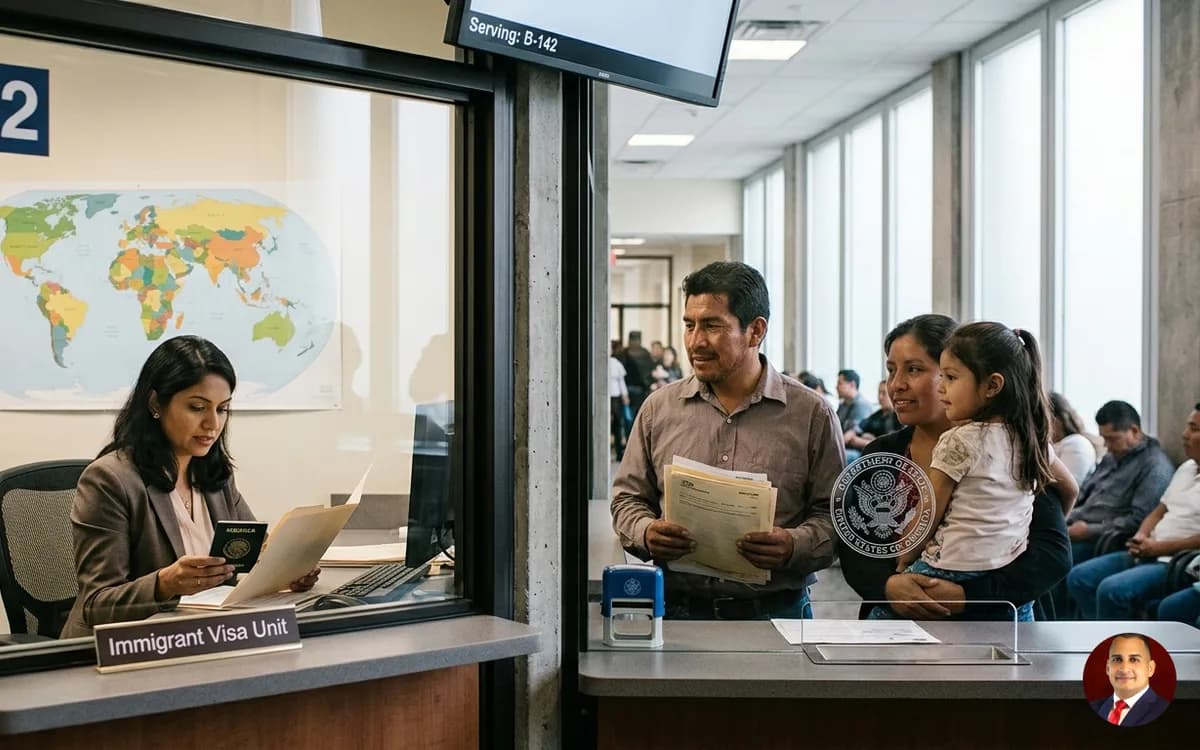
You read the headline and felt two things at once: relief, then suspicion. A federal judge just struck down a ban that had frozen immigrant visa interviews for people from 75 countries, and somewhere in your family, someone has been waiting for a visa number under an I-130 or I-140 petition since before the ban took effect. The ruling is real, but it won't put an approval letter in your inbox tomorrow.
This ruling matters directly if your case has been stuck at the National Visa Center or sitting in 'administrative processing' limbo at a U.S. consulate for months. It also raises new questions: does your case move automatically, do you need to do anything yourself, and how long will the backlog actually take to clear?
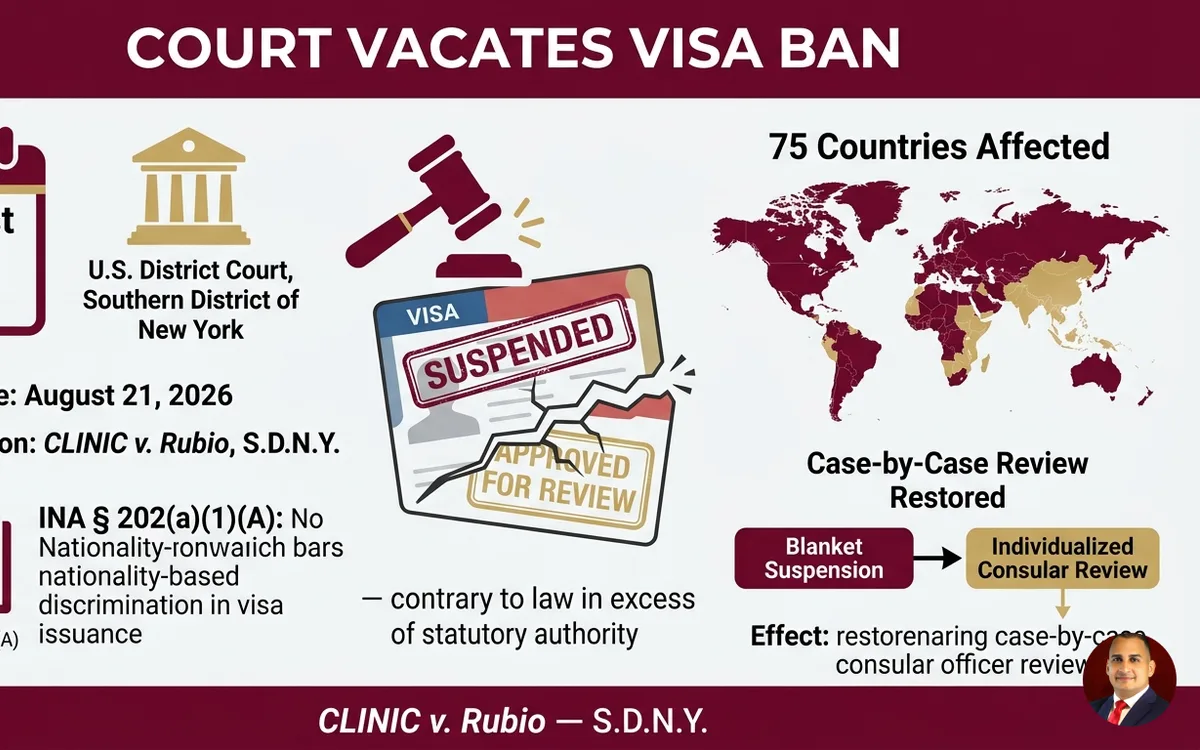
On August 21, 2026, a federal judge in the Southern District of New York ruled that a Trump-era policy suspending immigrant visa processing for applicants from 75 countries was 'contrary to law and in excess of statutory authority' (CLINIC v. Rubio). The ruling restores consular officers' case-by-case review under INA § 202(a)(1)(A), which bars nationality-based discrimination in visa issuance.
The Hard Truth
The Hard Truth About What This Ruling Does and Doesn't Do
Vacating the ban does not erase the underlying backlog. For every month the 75-country suspension was in effect, cases did not disappear, they queued. U.S. District Judge Jeannette Vargas ruled on August 21, 2026 that the policy was 'contrary to law and in excess of statutory authority' because Congress, not the State Department, holds exclusive authority under 8 U.S.C. § 1152(a)(1)(A) to set nondiscrimination rules for immigrant visa issuance, while consular officers retain case-by-case discretion under that same framework (CLINIC v. Rubio, partial summary judgment order, Aug. 21, 2026).
That discretion cuts both ways. A consular officer can now schedule your interview or resume administrative processing, but the same officer can also deny a case on its individual merits or request additional evidence under INA § 221(g). Vacatur restores the process, not the outcome of any single visa application.
This decision is also a partial summary judgment, so the broader lawsuit is not fully resolved. The ruling could still be narrowed, appealed, or clarified in further proceedings, and as of this writing the government has not published a timeline for working through the frozen cases (per colorado.edu, Aug. 31, 2026).
What Happens If You Wait
What Happens If You Wait and Do Nothing
Waiting has a real cost, and it is not the same for every visa category. Diversity Visa selectees face the tightest deadline: federal regulation requires the visa to be issued by September 30 of the fiscal year in which you were selected, with no extension for litigation delays (22 C.F.R. § 42.33(a)(1)). A ruling that lands in late August gives you weeks, not months, to get an interview scheduled and completed before that deadline closes permanently.
Family-based cases carry a different risk: aging out. Under the Child Status Protection Act, a child's age for visa purposes is locked in by a formula tied to when a petition was filed and approved, not by when a court happens to lift a suspension. A child who was close to turning 21 when the ban began loses a little more of that window with each additional week of delay.
Employment-based cases run on their own clock too. A labor certification approved by the Department of Labor is generally valid for only 180 days before the underlying I-140 petition loses its basis (20 C.F.R. § 656.30(b)). Whether that clock kept running while your visa number sat frozen is worth finding out now, rather than waiting to see what the government does next — checking your status is the only way to know whether the window already closed.
Step-by-Step Process
Step-by-Step: What To Do If Your Case Is Stuck
Check your case status through the Consular Electronic Application Center at ceac.state.gov using your NVC case number. This shows whether your file is 'documentarily complete,' in 'administrative processing,' or 'ready for interview.'
Call the National Visa Center at 603-334-0700, or submit an inquiry through the State Department's online contact form, if your status has not changed in the last 60 days. Ask directly whether your case was part of the suspended processing and whether it has been returned to the regular queue.
Gather updated supporting documents. Police certificates, medical exams, and some I-864 financial affidavits expire after a set period, and a stale document can delay your interview even after the suspension is lifted.
When your case shows no movement and your wait exceeds standard processing times published in the State Department's monthly Visa Bulletin, consider whether a federal mandamus action under 28 U.S.C. § 1361 is appropriate. A mandamus suit asks a court to order the agency to act on a delayed case; it does not ask the court to approve your visa. Our mandamus litigation page explains how that process works in more detail.
Talk with an attorney who handles federal consular-processing delays before filing anything in federal court. A case stuck for an unusually long time calls for a different strategy than a case still moving through the ordinary backlog.
A Real-World Example
A Composite Example: How a Stuck Case Moves Through This Process
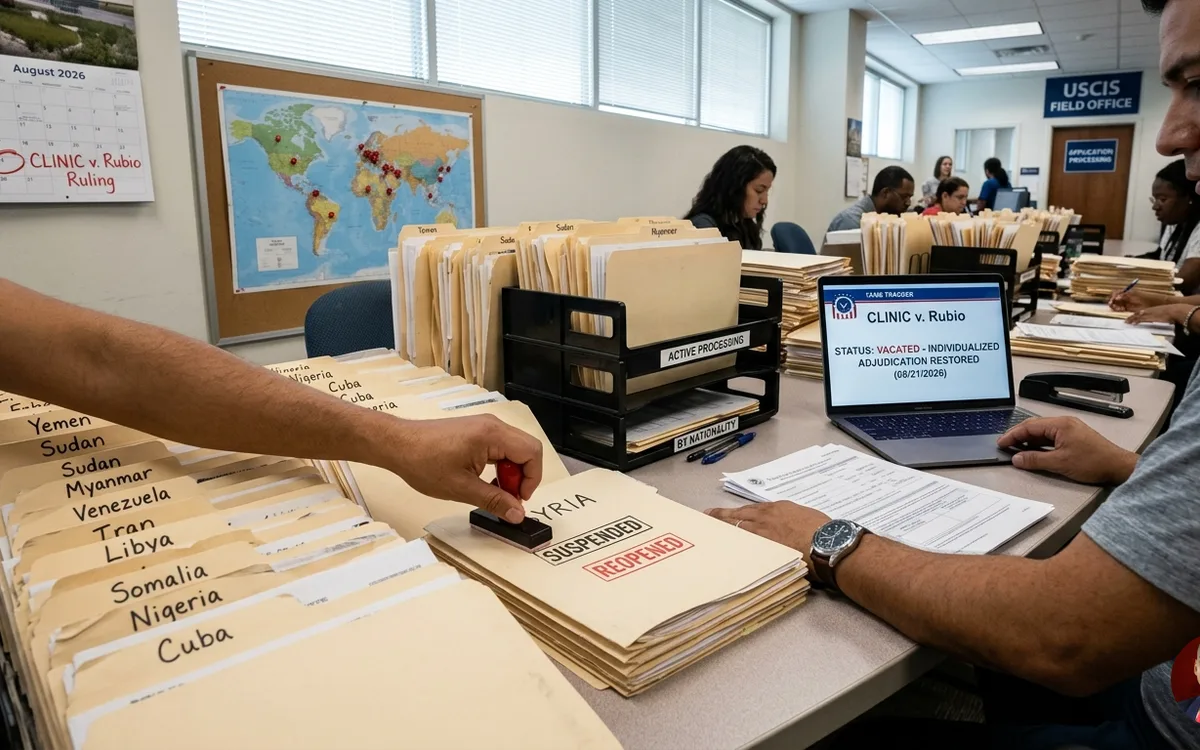
Consider a composite, illustrative case, not an actual client. A Florida resident filed an I-130 petition for a sibling living in one of the 75 affected countries in 2023. USCIS approved the petition, the case moved to the National Visa Center, and it sat in administrative processing once the nationality-based suspension took effect. The petitioner checked the CEAC portal every few weeks and saw no change in status for over a year.
After the August 21, 2026 ruling in CLINIC v. Rubio, the petitioner's attorney submitted a status inquiry to the NVC referencing the vacated policy and asked for confirmation that the case had returned to standard processing. The consulate acknowledged the inquiry and indicated the case would be reviewed in the order received, alongside other cases queued during the suspension. As of this writing, the case remains in administrative processing while the consulate works through its backlog, and no interview date has been set.
This is what the process typically looks like at this stage: a status check, an inquiry, an acknowledgment, and a wait that depends on how many other cases are ahead of yours — not a guarantee of a particular interview date or decision on the visa.
About the Attorney Reviewing This Page
William J. Vasquez is admitted to the North Carolina State Bar and to the U.S. Courts of Appeals for the Fourth, Fifth, and Eleventh Circuits. His federal immigration practice covers matters before USCIS, the National Visa Center, the Executive Office for Immigration Review, and the Board of Immigration Appeals. Immigration proceedings are federal, so any attorney with federal immigration-bar standing may represent clients nationwide before USCIS, EOIR, and the BIA regardless of state bar membership; this page, including its discussion of consular processing and the CLINIC v. Rubio litigation, addresses federal immigration law only, not Florida state-court practice.
This page was last reviewed on October 8, 2026. For more on his background and federal court admissions, see his full attorney profile.
Key Terms Explained
Glossary of Terms Used on This Page
National Visa Center (NVC): The U.S. Department of State office that processes immigrant visa petitions after USCIS approval and before a consular interview; cases are tracked at ceac.state.gov.
Consular processing: Applying for an immigrant visa at a U.S. embassy or consulate abroad, as opposed to adjustment of status, which happens inside the United States through USCIS.
Vacatur: A court's act of setting aside a government policy or decision, as Judge Vargas did to the nationality-based visa suspension on August 21, 2026.
Partial summary judgment: A ruling that resolves some, but not all, claims in a lawsuit without a full trial, issued when the court finds no genuine factual dispute on those specific claims (Fed. R. Civ. P. 56).
Administrative processing: Additional review after a consular interview, often citing INA § 221(g), before a visa is issued or denied, with no fixed deadline.
Writ of mandamus: A lawsuit filed under 28 U.S.C. § 1361 asking a federal court to compel an agency to act on a duty it has unreasonably delayed, such as adjudicating a long-pending visa case.
INA § 202(a)(1)(A) (8 U.S.C. § 1152(a)(1)(A)): The statute barring discrimination in immigrant visa issuance based on nationality, place of birth, or place of residence.
Frequently Asked Questions
Q: Does the August 2026 ruling automatically restart my frozen visa case? A: Not automatically. The court vacated the policy that suspended processing, but the National Visa Center and individual consulates still have to work through the backlog of queued cases, and the ruling sets no deadline for doing so.
Q: Does this ruling affect pending I-130 or I-485 adjustment-of-status cases filed with USCIS? A: CLINIC v. Rubio addresses consular immigrant visa processing abroad, not adjustment of status filed inside the United States with USCIS. If your case is an I-485 adjustment rather than a consular immigrant visa, this ruling does not change your USCIS process directly.
Q: How much does a mandamus lawsuit cost, and how long does it take? A: Attorney fees for a federal mandamus action vary by firm and case complexity, so ask for a written fee agreement before filing. Timelines vary too, but it is common for a case to move, either through agency action after the suit is filed or through further court proceedings, within several months to about a year, depending on the court's docket.
Q: Could filing a mandamus lawsuit hurt my case instead of helping it? A: A mandamus suit asks a court to order the agency to make a decision, not to order a particular outcome, and the agency can still deny the visa after it acts. An attorney who reviews your file's processing history and the specific reason for delay can help you weigh whether filing makes sense versus continuing to wait.
Q: How do I check the status of my case at the National Visa Center? A: Log in to the Consular Electronic Application Center at ceac.state.gov with your NVC case number, or call the NVC at 603-334-0700 if your status has not changed in more than 60 days.
What Clients and Peers Say
Clients who come to us after months of silence from the National Visa Center often start the conversation the same way: nobody would tell them what was actually happening with their file. Peer attorneys and former clients describe our communication as direct, specific about what stage a case is in, and clear about what a filing can and cannot accomplish. We do not quote success rates or predict visa outcomes, because a consular officer's decision on an individual application is never something a law firm can guarantee.
Reviews of our immigration practice, available through Google and Avvo, consistently reference responsiveness and a willingness to explain federal procedure in plain language instead of legal shorthand.
A court ruling tells you the process is open again; figuring out where your case actually stands is the work that comes next. The next useful step is matching the specific posture of your file — documentarily complete, administrative processing, or stuck before an interview was ever scheduled — to the right move instead of guessing.
Talk to Our Team About Your Case
Families with an immigrant visa case frozen at the National Visa Center or stuck in administrative processing at a consulate should schedule a consultation with our team to review the NVC file and determine whether a status inquiry or a federal mandamus action is the right next step. Contact our office to set up a federal immigration consultation focused on consular-processing delays, or start with our mandamus litigation page to understand the process before you call.
- /immigration/mandamus-lawsuit-visa-delays
- /immigration/consular-processing-delays
- /attorneys/william-j-vasquez
- /immigration/adjustment-of-status
- /contact