Choosing an Immigration Lawyer in Orlando: What Actually Matters
October 10, 2026
A notice came in the mail with a hearing date you don't recognize, or a green card renewal has been sitting at USCIS for ten months, or a call came from a detention facility in Florida that you weren't prepared for. You typed 'best immigration law firm in Orlando' because you need a real answer, not a slogan. Here is the honest one: no firm can prove it is the best, and Florida's own advertising rules say so. What you can check, in the next ten minutes, is whether a firm actually does the specific thing your case needs.
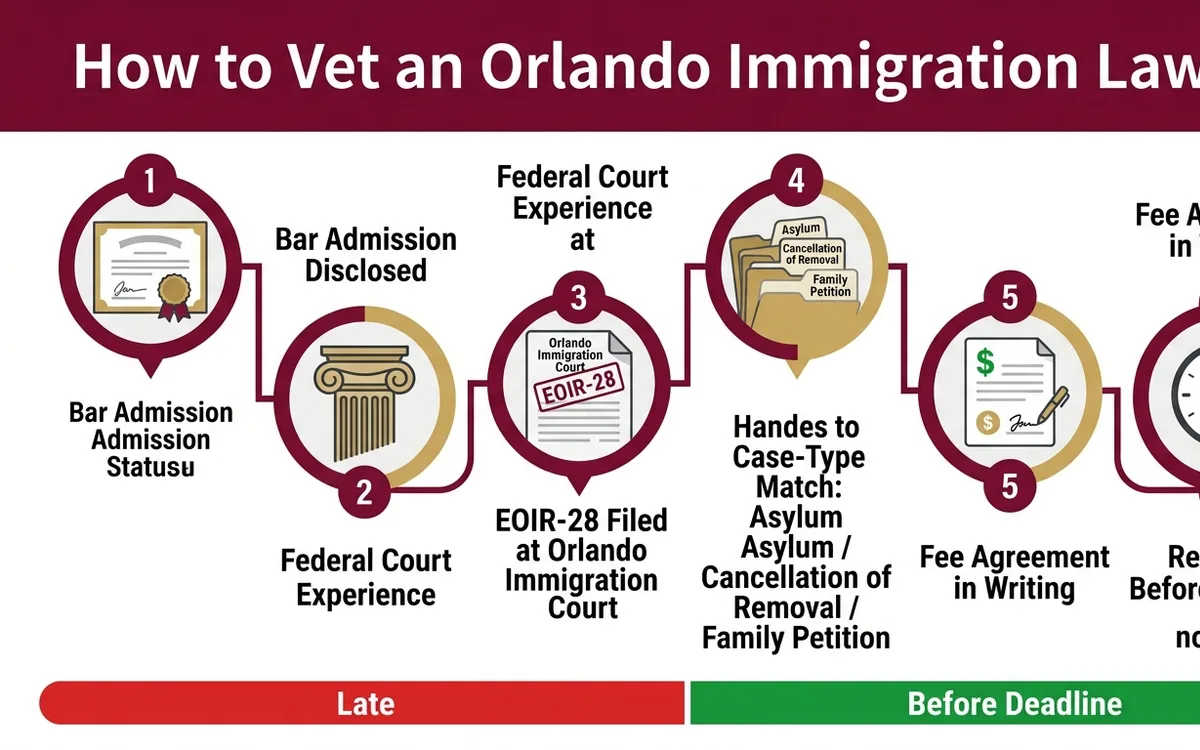
The best immigration lawyer in Orlando is one who discloses their bar admission and federal court experience, has filed Form EOIR-28 appearances at the Orlando Immigration Court, handles your specific case type (asylum, cancellation of removal, family petitions), charges a flat or hourly fee in writing, and responds before your deadline, not after it.
The Hard Truth
Last checked June 2025: Florida Rule of Professional Conduct 4-7.13(b)(2) bars attorneys from advertising success rates or past results, because immigration outcomes are not objectively verifiable the way a bar exam score is. Any firm telling you its win rate is already asking you to trust something it isn't allowed to prove.
The backlog is the real obstacle, not a firm's marketing copy. TRAC Immigration's court backlog tool (trac.syr.edu/immigration, accessed June 2025) tracks pending caseloads at every immigration court in the country, including Orlando, and in recent years the gap between a master calendar hearing and a final individual hearing there has routinely run one to three years. USCIS's own processing-time reports (egov.uscis.gov/processing-times) show similarly long waits for green card and naturalization applications filed through the USCIS Orlando Field Office at 9403 Tradeport Drive.
No attorney, however experienced, moves that queue faster than the court or USCIS allows. What a firm controls is whether your filing is correct the first time, whether every deadline inside that wait gets met, and whether you get a straight answer about where your case actually sits.
What Happens If You Wait
Every week you wait to confirm who is handling your filing is a week closer to a deadline that does not bend. If you are in removal proceedings and miss a scheduled hearing at the Orlando Immigration Court, the judge can order removal in absentia under 8 U.S.C. § 1229a(b)(5) (INA § 240(b)(5)), without you present and often without a clear path back into the case.
Asylum has its own clock. Under 8 U.S.C. § 1158(a)(2)(B) (law.cornell.edu/uscode/text/8/1158), an application generally must be filed within one year of your last arrival in the United States, and missing it can mean the claim is barred before a judge ever hears the facts, absent a narrow exception.
Green card holders filing to remove conditions on residency face a similar wall: 8 C.F.R. § 216.4 (ecfr.gov) requires Form I-751 within the 90 days before the two-year card expires, and filing late without a documented reason can trigger loss of status. A biometrics appointment missed at the Orlando Field Office without rescheduling in advance can likewise stall or close an otherwise viable application. None of these consequences wait for you to finish comparing law firms.
Step-by-Step Process
The path depends on whether you are in removal proceedings or filing directly with USCIS, and the two tracks rarely overlap until late in a case.
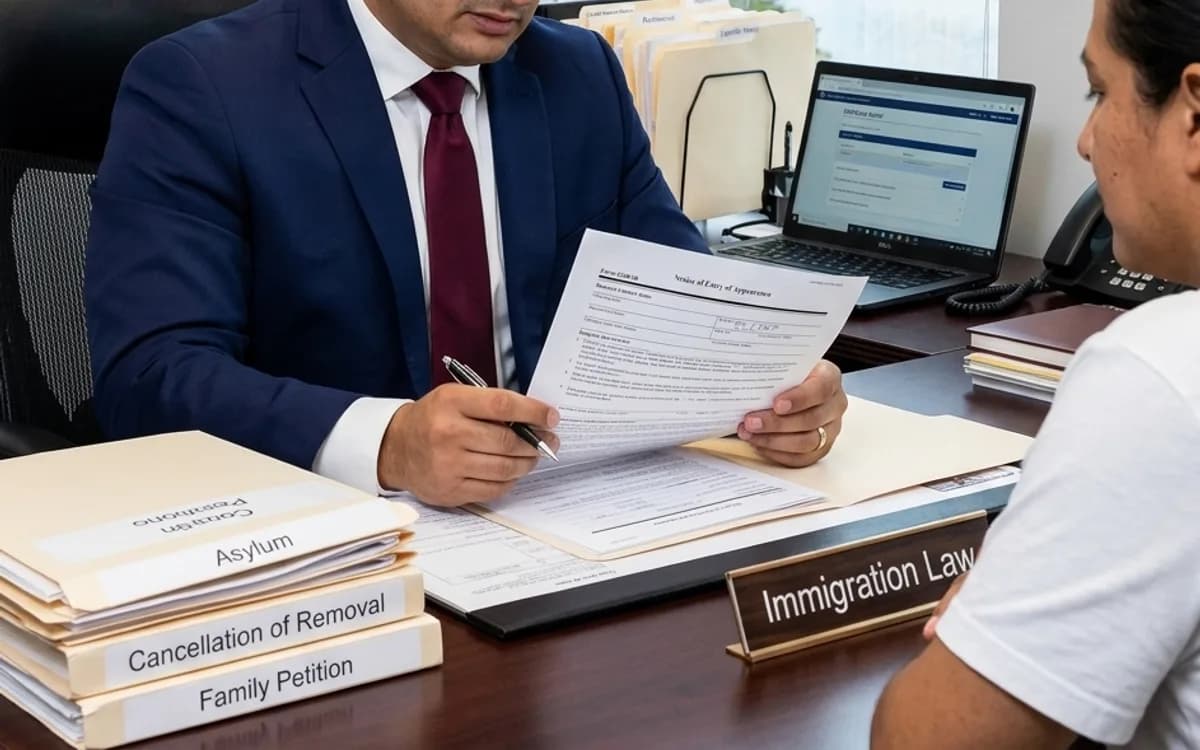
If you received a Notice to Appear (NTA), an attorney enters the case by filing Form EOIR-28 electronically through the EOIR Courts & Appeals System (ECAS), as required by the EOIR Immigration Court Practice Manual (justice.gov/eoir/electronic-filing-ecas). That filing has to happen before the attorney can speak for you at a hearing.
The first hearing is a master calendar hearing at the Orlando Immigration Court, typically five to fifteen minutes, where the judge confirms your identity, takes pleadings on the NTA's allegations, and sets a schedule. It is not the trial. If you are seeking cancellation of removal under 8 U.S.C. § 1229b (INA § 240A, law.cornell.edu/uscode/text/8/1229b), the judge sets a later individual hearing where evidence and testimony are presented, and where issues like the stop-time rule from Pereira v. Sessions, 138 S. Ct. 2105 (2018), can affect whether you qualify based on continuous physical presence.
If your case runs through USCIS instead, filings route to the appropriate service center or lockbox first, with biometrics and, for many categories, an interview scheduled at the USCIS Orlando Field Office, 9403 Tradeport Drive. A denial at that stage can sometimes be appealed to the Board of Immigration Appeals (BIA), and from there, a small number of cases proceed to a petition for review before the U.S. Court of Appeals for the Eleventh Circuit, which covers Florida.
A Real-World Example
Consider a composite example based on common Orange County cases. Call her Marisol. A traffic stop led to an NTA, and she had a master calendar hearing date three weeks out before she contacted an attorney.
Step one was filing Form EOIR-28 through ECAS to enter an appearance at the Orlando Immigration Court, which had to happen before anyone could appear on her behalf. Step two was pulling her entry records and prior filings to check whether she had a plausible basis for relief from removal, in her case a possible cancellation of removal claim under 8 U.S.C. § 1229b, which requires ten years of continuous physical presence among other elements.
At the master calendar hearing, the judge took pleadings, confirmed the allegations in the NTA, and set an individual hearing roughly a year out, consistent with current court scheduling patterns reported by EOIR. In the months between, the work included gathering tax records, school records for her children, and country-condition documentation, and preparing her to testify.
Her case is still pending as of this writing, with the individual hearing on the court's calendar. That is the realistic shape of a removal defense case: a long middle with real deadlines inside it, not a quick resolution.
William J. Vasquez handles federal immigration matters, including cases arising from the Orlando Immigration Court and the USCIS Orlando Field Office. Immigration proceedings before EOIR and USCIS are federal, so appearing in them depends on federal immigration-bar standing and does not require a Florida state bar license; under 8 C.F.R. § 1292.1, an attorney licensed in good standing in any U.S. state bar, which he holds through the North Carolina State Bar, can represent clients before EOIR and USCIS nationwide.
For the narrow set of cases that go further, a denial by the Board of Immigration Appeals can lead to a petition for review in federal court. Petitions arising from the Orlando Immigration Court route through the U.S. Court of Appeals for the Eleventh Circuit, and he is admitted to practice there.
He is a member of the American Immigration Lawyers Association's Central Florida Chapter. His background and case history are detailed on his attorney biography page. He does not hold a Florida state bar license, and nothing here describes Florida state-court representation, which immigration practice does not involve in any event.
Key Terms Explained
Notice to Appear (NTA): the charging document that starts removal proceedings and lists the allegations against you.
EOIR: the Executive Office for Immigration Review, the Department of Justice agency that runs immigration courts and the Board of Immigration Appeals.
ECAS: the EOIR Courts & Appeals System, the electronic filing portal now required for appearances and motions in immigration court.
Form EOIR-28: the Notice of Entry of Appearance as Attorney, filed to represent someone before an immigration court.
Master Calendar Hearing: a short initial hearing, usually five to fifteen minutes, where the judge takes pleadings and sets a schedule; it is not the merits hearing.
Individual Hearing: the merits hearing where evidence and testimony are presented and the judge decides the request for relief.
Cancellation of Removal: relief under 8 U.S.C. § 1229b that can allow certain people to keep status despite being in removal proceedings, subject to specific eligibility requirements.
Stop-Time Rule: the rule, addressed in Pereira v. Sessions, governing when an NTA stops the clock on continuous physical presence calculations.
BIA: the Board of Immigration Appeals, which reviews immigration judge decisions.
Petition for Review: a filing in a U.S. Court of Appeals challenging a final BIA decision.
Biometrics: the fingerprint, photo, and signature appointment USCIS requires for most applications, usually at a local Application Support Center.
Form I-751: the Petition to Remove Conditions on Residence, filed by conditional permanent residents within 90 days before their two-year card expires.
Frequently Asked Questions
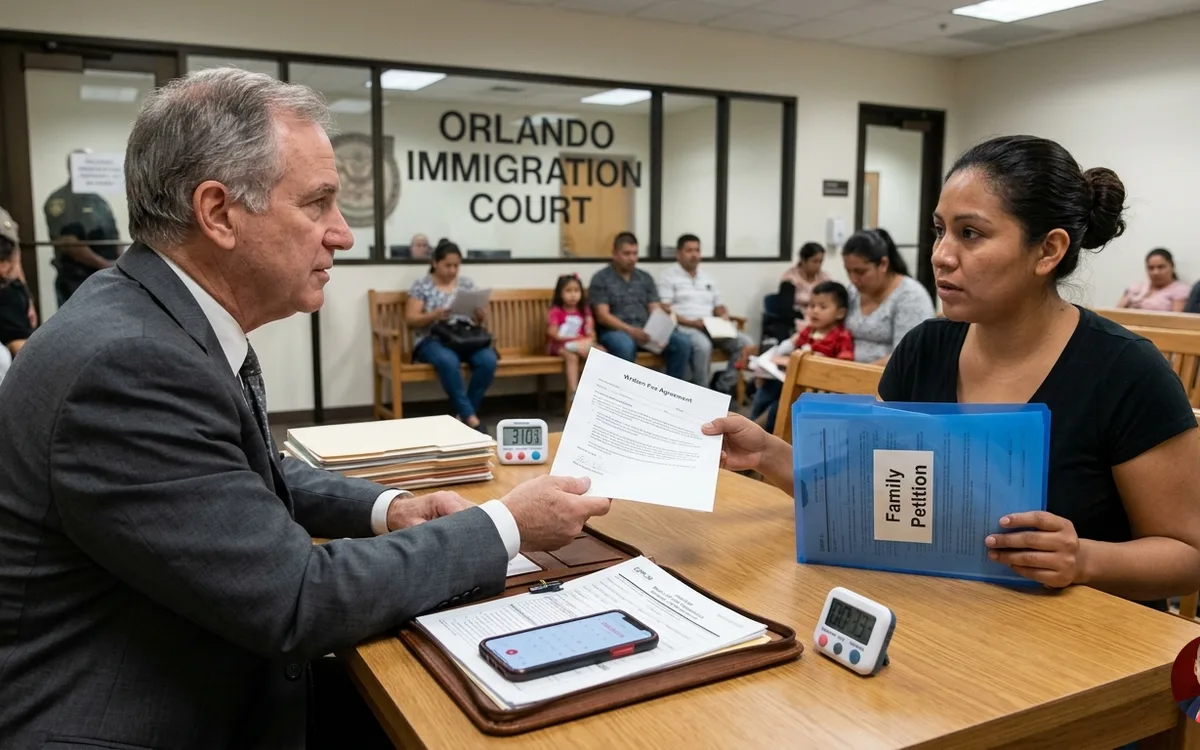
Q: How much does an immigration attorney in Orlando typically charge? A: Immigration cases are billed as a flat fee for a defined scope of work or hourly, never on a contingency basis, since there is no monetary recovery to share in an immigration matter. Ask for the fee structure in writing before signing an engagement letter, and confirm whether USCIS filing fees are included or billed separately.
Q: What happens during an initial consultation? A: An attorney reviews your documents, including any NTA, prior USCIS notices, or green card, and identifies which forms, deadlines, and court or agency apply to your situation. Expect to leave with a clear next step and a realistic timeline, not a guarantee about how the case will end.
Q: How long does my case actually take? A: It depends on the track. An affirmative asylum application filed directly with USCIS can take well over a year for an interview; a removal defense case at the Orlando Immigration Court commonly runs one to three years between the master calendar hearing and a final decision, based on current EOIR scheduling data (justice.gov/eoir/workload-and-adjudication-statistics).
Q: What documents should I bring to a consultation? A: Bring every immigration document you have: passport, prior visas, the NTA if you received one, your green card if applicable, prior USCIS notices, and any court paperwork. If you do not have something, come anyway; an attorney can often request copies from USCIS or the court directly.
Q: How do I check the status of my case at the Orlando Immigration Court? A: Call the EOIR automated case information hotline at 1-800-898-7180 or check the online case status system at acis.eoir.justice.gov using your alien registration number. Both are free and available without an attorney.
Q: What happens if I already missed my asylum filing deadline or a court hearing? A: Missing the one-year asylum deadline under 8 U.S.C. § 1158(a)(2)(B) is not automatically fatal; narrow exceptions exist for changed or extraordinary circumstances, but they have to be argued and documented. Missing a scheduled hearing can result in an in-absentia removal order under 8 U.S.C. § 1229a(b)(5), though a motion to reopen is sometimes available depending on the facts.
Q: Do you provide services in Spanish or other languages? A: Immigration court proceedings include interpreters provided by EOIR at no cost to you, and USCIS interviews can also be conducted with an interpreter. Confirm directly with any firm which languages their staff speaks and whether interpretation is arranged in advance for a consultation.
Q: How does U visa certification work for crime victims in Orlando? A: A U visa petition requires law enforcement certification on Form I-918 Supplement B confirming you were helpful in investigating or prosecuting a qualifying crime; in Orange County, this generally means submitting the certification request to the agency that handled your case, such as the Orange County Sheriff's Office. Certification processing time varies by agency and is separate from USCIS's own processing time for the underlying petition.
Before hiring any firm, check sources you don't have to take our word for: the relevant state bar's public license lookup, the firm's Google Business Profile, and its listing in the American Immigration Lawyers Association directory (ailalawyer.com). Pay attention to how a firm responds to negative reviews, not just the star count, since that shows how they communicate when something goes wrong.
We do not publish success rates or case outcomes, including here, because Florida Rule 4-7.13(b)(2) prohibits advertising immigration results as if they were objectively verifiable statistics. What we can tell you is how we operate: direct attorney involvement in EOIR-28 filings, written fee agreements, and a policy of returning calls on active deadlines within one business day.
None of this replaces a conversation about your specific papers, your specific court date, or your specific deadline. The information above tells you what to check and what to expect. The next step is matching that against your own file.
If you have an NTA, a pending USCIS filing, or a hearing date at the Orlando Immigration Court and need to know where things stand, schedule a consultation with our immigration team. Call or use our online scheduling page to set a time, and bring the documents listed above. We handle removal defense and cancellation of removal, asylum applications, family-based petitions, and naturalization matters connected to the Orlando Immigration Court and the USCIS Orlando Field Office.