Orlando Immigration Court Asylum Attorney: Know Your Rights
October 10, 2026
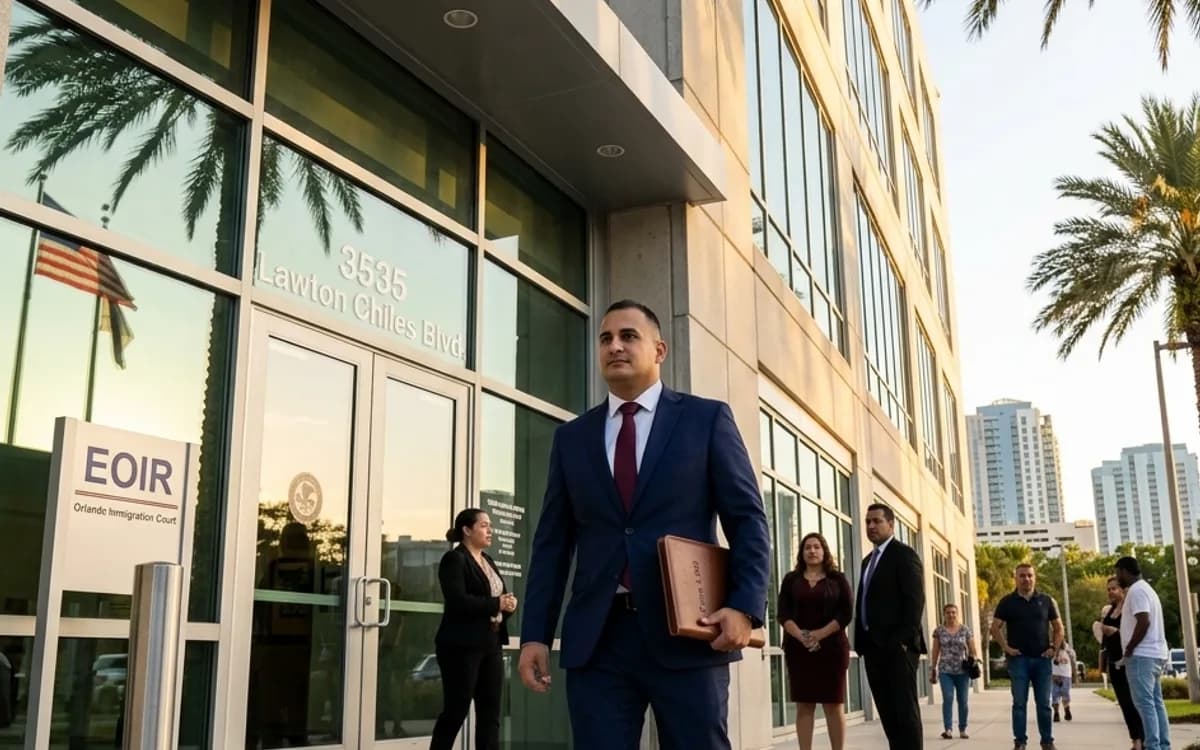
You got a notice in the mail, or ICE picked you up, and now a date is sitting on your calendar for Orlando Immigration Court at 3535 Lawton Chiles Blvd. Maybe you passed a credible fear interview at a detention facility and don't know what happens next. Maybe the one-year deadline to file for asylum already feels impossible to meet. You are not required to face a judge in that courtroom alone, and the clock did not stop when you stopped reading the paperwork.
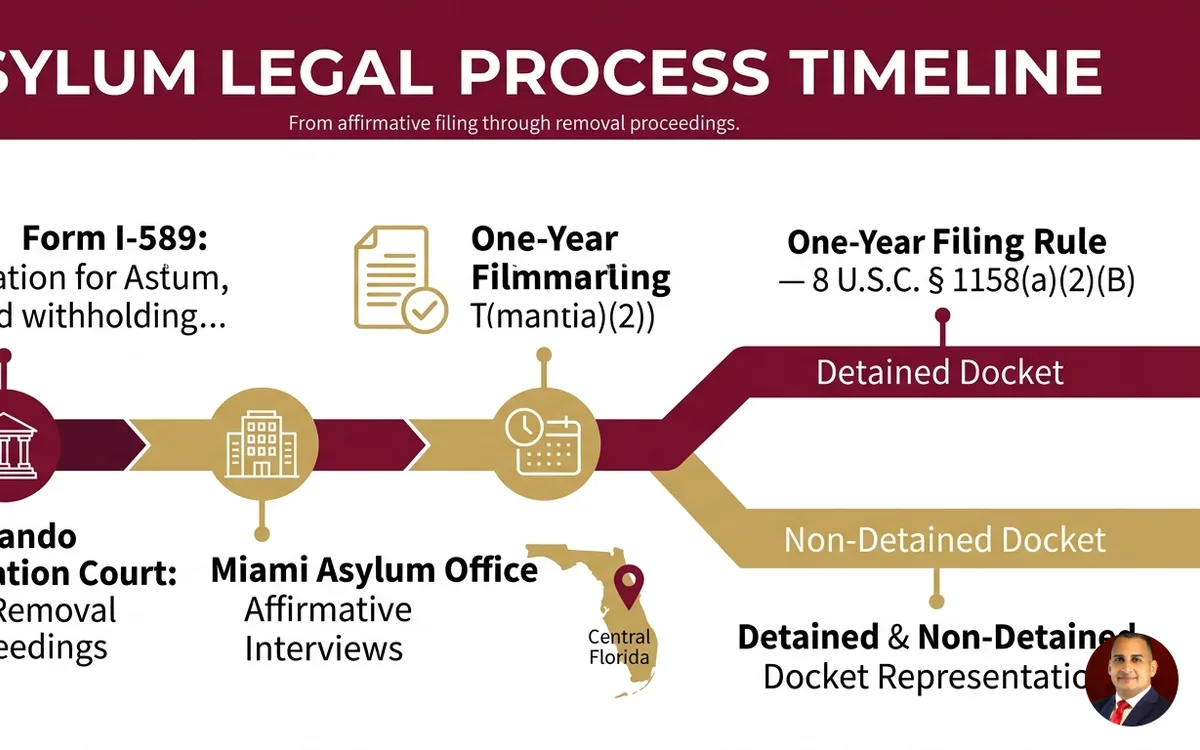
An asylum attorney near the Orlando Immigration Court (3535 Lawton Chiles Blvd.) represents clients in removal proceedings before EOIR, coordinates with the Miami Asylum Office for affirmative interviews, and files Form I-589 under the one-year filing rule at 8 U.S.C. § 1158(a)(2)(B). Representation covers detained and non-detained dockets.
The Hard Truth
What the Numbers Say About Asylum Cases in Orlando
Most asylum cases do not move quickly, and most do not end with asylum. EOIR's FY2023 Statistics Yearbook put the national immigration court backlog at roughly 3 million pending cases, and Orlando's docket is part of that count. TRAC Immigration at Syracuse University, using FY2023 EOIR data, reported asylum denial rates above 70% in several recent years, with wide variation by individual judge.
Affirmative numbers are not better. USCIS's Asylum Division FY2024 workload report counted more than 1.6 million affirmative asylum applications pending nationwide, and Miami Asylum Office interview wait times commonly run past two years for applications filed outside the agency's last-in-first-out fast lane. These figures reflect the most recent published data as of this page's last update in March 2025, and they change as EOIR and USCIS release new reports.
None of this means a case cannot be approved. INA § 208 and 8 C.F.R. § 1208.13 set the legal standard: a well-founded fear of persecution on account of race, religion, nationality, political opinion, or membership in a particular social group. What it means is that timeline promises are not honest, and a case built on weak documentation of that standard is unlikely to survive either venue.
What Happens If You Wait
What Happens If You Wait
Missing the one-year filing deadline under 8 U.S.C. § 1158(a)(2)(B) does not just weaken a case, it can end it. An immigration judge can deny asylum outright for untimely filing unless you prove changed circumstances or extraordinary circumstances under 8 C.F.R. § 1208.4(a), and that proof has to be filed with the application, not promised later.
Missing a scheduled hearing is worse. Under INA § 240(b)(5), a judge can order removal in absentia if you do not appear, and reopening that order later requires showing you did not receive proper notice, a narrow exception courts apply strictly. If you were transferred from Orange County Jail or a Baker County facility into the Orlando docket, a missed check-in or an address change the court never received can trigger that same order before you know a hearing happened.
Delay also closes doors that are open today. A pending Form I-589 is one of the few paths to a work permit under 8 C.F.R. § 274a.12(c)(8), but the 150-day asylum clock that makes that possible only runs once the application is actually filed and considered complete. Every week an application sits unfiled is a week added to the wait for work authorization, not a week saved. For readers already in removal proceedings, our removal defense page covers what happens after an NTA is issued, a step that often runs on the same clock as the asylum deadline.
Step-by-Step Process
From Notice to Appear to a Merits Hearing: The Orlando Process
1. Service of the Notice to Appear (NTA). DHS files the NTA with EOIR, which puts your case on the Orlando Immigration Court docket at 3535 Lawton Chiles Blvd. If DHS detained you at an Orange County Jail or Baker County facility after a credible fear interview, your first hearing may be scheduled before you are transferred to the Orlando courtroom in person or by video.
2. Master calendar hearing. This is not the trial. It is a short procedural hearing, typically 5 to 15 minutes, where the judge confirms your identity and address, takes pleadings on the NTA's factual allegations, and sets a deadline for filing Form I-589 if you intend to seek asylum.
3. Filing Form I-589. The application is filed with the court (defensive asylum) following the EOIR Immigration Court Practice Manual, Chapter 3 e-filing (ECAS) rules, or with USCIS (affirmative asylum) if you are not yet in removal proceedings. Central Florida affirmative applicants are interviewed by the Miami Asylum Office, not by Orlando Immigration Court staff.
4. Biometrics and background checks. USCIS schedules an Application Support Center appointment after filing; this applies to both affirmative and defensive filers and must generally be completed before a merits hearing can be held.
5. Individual (merits) hearing. This is the actual trial of the asylum claim: testimony, cross-examination, documentary evidence on country conditions, and often expert witnesses. Current Orlando scheduling, per EOIR's FY2023 Statistics Yearbook, runs these hearings well over a year after the master calendar hearing in most cases.
6. Decision and appeal. A denial can be appealed to the Board of Immigration Appeals within 30 days under 8 C.F.R. § 1003.1(b). A BIA denial can be challenged by a petition for review filed with the U.S. Court of Appeals for the Eleventh Circuit, since Orlando Immigration Court sits within that circuit. Our BIA appeals page covers what that filing requires and what it does not change about the underlying record.
A Real-World Example
A Composite Example: How One Case Moves Through the System
Consider a composite, not a real client: a woman referred to Orlando Immigration Court after a credible fear interview at a South Florida detention facility. Her NTA alleges she entered without inspection. At her first master calendar hearing, held by video from Baker County, the judge confirms her address, enters pleadings contesting certain factual allegations, and sets a 60-day deadline to file Form I-589.
Her attorney gathers police reports, medical records, and a declaration describing the basis of her fear, then files the I-589 through ECAS before the deadline, attaching a brief addressing Matter of A-B-, 27 I&N Dec. 316 (A.G. 2018), because her claim involves harm from a private actor rather than the government directly. The court schedules biometrics, then sets an individual hearing date roughly 18 months out, consistent with current Orlando docket conditions.
At the individual hearing, she testifies, her attorney examines a country-conditions expert, and DHS counsel cross-examines both witnesses. The judge takes the matter under advisement rather than ruling from the bench, which is common when the record includes expert testimony. This composite stops there: the point is the sequence, not a result, because no two records or judges produce the same decision on the same facts.
About the Attorney Handling Your Case
William J. Vasquez is admitted to the North Carolina State Bar and to the United States Court of Appeals for the Eleventh Circuit, the federal appellate court that reviews petitions for review from Board of Immigration Appeals decisions arising out of Orlando Immigration Court. Immigration court and USCIS matters are federal, and under 8 C.F.R. § 1292.1 any attorney admitted and in good standing with a U.S. state bar may represent clients before EOIR and USCIS nationwide, regardless of where that bar is located. His authority to appear in Orlando Immigration Court and before USCIS's Orlando Field Office rests on this federal standing, not on a Florida state-bar license, which he does not hold and does not claim.
He has spent years representing respondents in removal proceedings and asylum applicants at both the affirmative and defensive stage, including cases venued specifically at Orlando Immigration Court and interviews scheduled through the Miami Asylum Office. One recurring pattern he has seen across Central Florida dockets: respondents who miss the one-year filing deadline because they did not know an exception existed, not because they had no case to make. That pattern, more than any single file, shapes how our office handles intake on new asylum matters: check the deadline first, build the record second.
For background on his full practice areas and admissions, see his attorney bio page.
Key Terms Explained
Key Terms Used on This Page
Notice to Appear (NTA): The charging document DHS files with EOIR to begin removal proceedings, listing the factual allegations and the charge of removability.
Master calendar hearing: A short, non-evidentiary hearing where the immigration judge confirms basic facts, takes pleadings, and sets filing deadlines; not the hearing where evidence is argued.
Individual (merits) hearing: The evidentiary hearing where testimony, documents, and expert evidence are presented and the judge decides the application.
Credible fear interview: A screening interview, usually conducted in detention, to determine whether a noncitizen has a significant possibility of establishing eligibility for asylum; a positive finding refers the case to Orlando Immigration Court for full proceedings.
Form I-589: The USCIS/EOIR Application for Asylum and for Withholding of Removal, the single form used to apply for asylum, withholding of removal, and protection under the Convention Against Torture.
Particular social group: One of five protected grounds under INA § 208; a group defined by an immutable or fundamental characteristic, further shaped by Matter of A-B-, 27 I&N Dec. 316 (A.G. 2018), for claims involving private-actor harm.
EOIR: The Executive Office for Immigration Review, the Department of Justice agency that administers Orlando Immigration Court and all immigration courts nationwide.
BIA: The Board of Immigration Appeals, the administrative body that reviews immigration judge decisions under 8 C.F.R. § 1003.1(b).
ECAS: EOIR's electronic case access and filing system, governed by Chapter 3 of the EOIR Immigration Court Practice Manual, used to file documents including Form I-589 in pending court cases.
Frequently Asked Questions
Q: Where is Orlando Immigration Court located and does it handle asylum cases? A: Orlando Immigration Court is located at 3535 Lawton Chiles Blvd., Orlando, FL, and is part of EOIR, the federal agency that hears defensive asylum claims filed by respondents already in removal proceedings.
Q: What is the difference between affirmative and defensive asylum in Central Florida? A: Affirmative asylum is filed with USCIS before removal proceedings start, and Central Florida applicants are interviewed by the Miami Asylum Office; defensive asylum is filed with the immigration judge at Orlando Immigration Court after DHS has already placed someone in removal proceedings.
Q: Can I still apply for asylum if it has been more than one year since I arrived? A: Yes, in limited situations. 8 C.F.R. § 1208.4(a) allows the one-year deadline under 8 U.S.C. § 1158(a)(2)(B) to be excused for changed circumstances affecting eligibility or extraordinary circumstances that caused the delay, but the exception must be argued and documented, not assumed.
Q: What happens if I was transferred from Orange County Jail to Orlando Immigration Court? A: Your case stays on the Orlando docket once DHS files the NTA with that court, even if you are later moved between detention facilities; address and facility changes must be reported to the court in writing to avoid an in absentia removal order under INA § 240(b)(5).
Q: Is asylum the same as withholding of removal or CAT protection? A: No. All three forms of relief are requested on Form I-589, but they carry different standards of proof, different benefits, and different bars to eligibility, summarized in the comparison table above.
Clients who work with our office on Orlando Immigration Court and Miami Asylum Office cases consistently describe the same two things: direct access to the attorney handling their filing, and plain answers about what a given hearing date actually means. We do not publish star ratings or outcome statistics here, because asylum decisions turn on facts specific to each record, not on a firm's track record. What we can tell you is what past clients have told us matters most: knowing the next deadline, and knowing someone reviewed the file before it was due.
If you already have a hearing date at Orlando Immigration Court, or a biometrics appointment through the Miami Asylum Office, the file in front of you has specific deadlines attached to it right now. Reading about the process in general terms is a start. Matching it against your actual NTA, your actual filing deadline, and your actual documentation is the next step, and it is not one most people can finish alone at 11pm with a government notice in hand.
Schedule a consultation to review your Orlando Immigration Court or Miami Asylum Office case with our office. Bring your Notice to Appear, any USCIS or EOIR correspondence, and a list of dates already on your calendar, and we will go through your filing deadline, your venue, and your next required step before you leave the call. Call or use our consultation scheduling page to set a time.
- Removal Defense
- BIA Appeals
- Credible Fear Interviews
- Attorney William J. Vasquez
- Schedule a Consultation