Arizona Green Card Lawyer: Protect Your Path to Permanent Residency
October 10, 2026
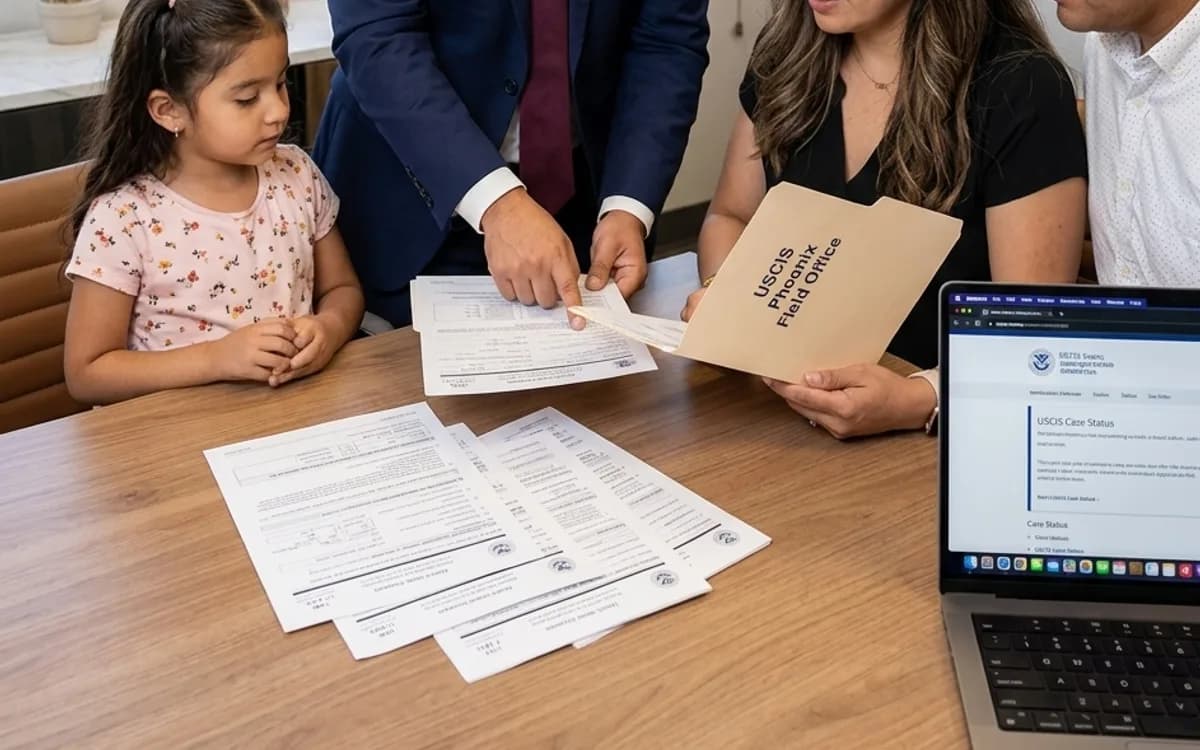
The notice came by mail or popped up in your USCIS online account, and now you are staring at legal language you never expected to need. Maybe it is a Request for Evidence on your spouse's I-130 petition. Maybe your conditional green card expires in four months and you are separated, divorced, or still married but unsure how to file Form I-751 alone. Arizona has no walk-in USCIS attorney office that will sit down with you in person at the counter and explain any of this.
That gap is real, and it is also survivable. Family-based and employment-based green card cases move through the same federal system whether you live in Tucson, Mesa, Phoenix, or anywhere else in the country, because immigration law is federal, not state law. A lawyer admitted to practice before USCIS and the Executive Office for Immigration Review can represent you from outside Arizona under 8 C.F.R. § 1292.1, filing your case, responding to the USCIS Phoenix Field Office, and preparing you for your biometrics appointment and interview.
This page was last reviewed in October 2026 against current USCIS Phoenix Field Office processing times and the Fiscal Year 2027 Visa Bulletin cycle.
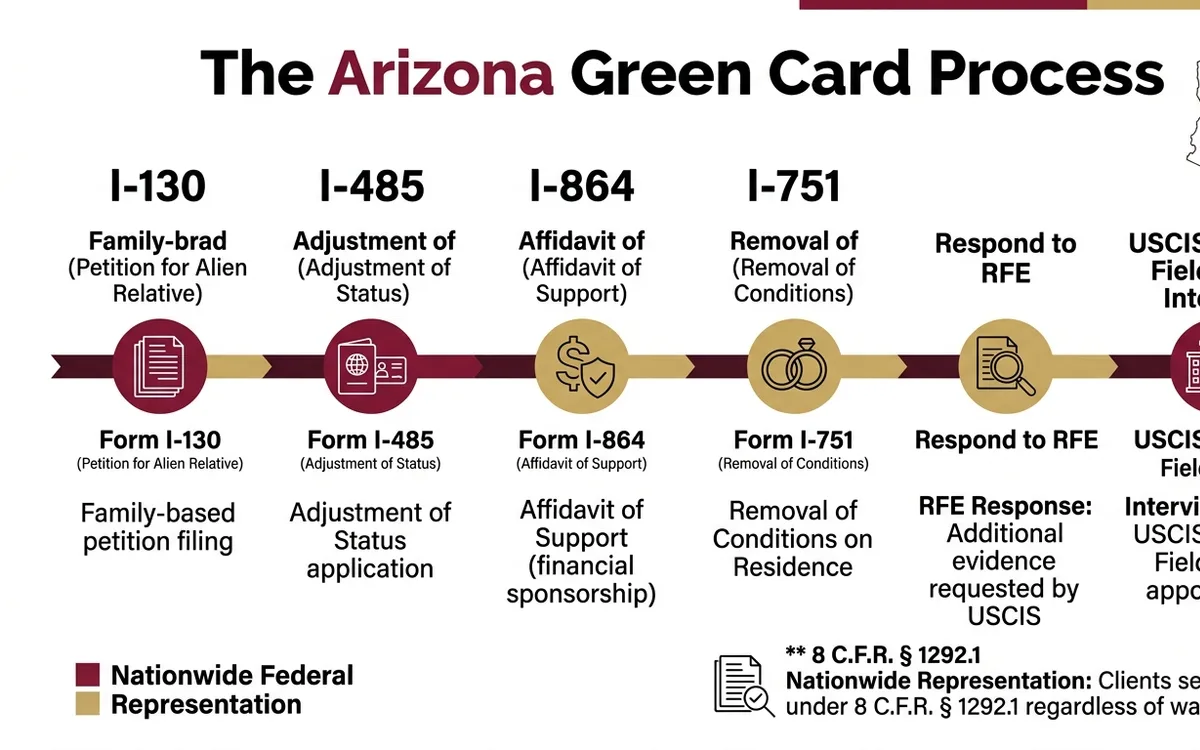
An Arizona green card lawyer helps family- and employment-based applicants file Form I-130, I-485, I-864, or I-751 with USCIS, respond to Requests for Evidence, and prepare for interviews at the USCIS Phoenix Field Office. Our firm represents Arizona-based clients nationwide under federal immigration jurisdiction (8 C.F.R. § 1292.1), without a walk-in Arizona office.
The Hard Truth
The Backlog Is Real, and No One Can Promise You a Fast Case
The USCIS Phoenix Field Office is currently processing I-485 adjustment cases for spouses of U.S. citizens in roughly 8 to 14 months, per USCIS Processing Times data for the Phoenix office (check.uscis.gov, Fiscal Year 2027 cycle). Employment-based categories tied to a backlogged priority date can take years longer, because your case cannot move past the Visa Bulletin's final action date no matter how complete your filing is. If your category is not current this month, filing I-485 earlier does not fix that; it only puts the application on file while you wait.
An attorney cannot make USCIS schedule your interview sooner, waive a required biometrics appointment, or guarantee approval. What an attorney can do is reduce the number of unforced errors: an incomplete I-864 affidavit of support, a missing certified translation, an inconsistent answer at the interview. Those errors are what turn a 10-month case into a 2-year case with a Request for Evidence or a Notice of Intent to Deny attached.
If your case involves a prior removal order, an old criminal charge, unlawful presence, or a misrepresentation issue, adjustment of status may not be available to you at all without first resolving that ground of inadmissibility, often through an I-601A provisional waiver or, in contested cases, through removal defense in Phoenix Immigration Court before EOIR. Say that plainly up front, because finding it out at the interview is worse.
What Happens If You Wait
What Waiting Actually Costs You
If you hold a conditional two-year green card from marriage, Form I-751 must be filed in the 90-day window before your card expires, per 8 C.F.R. § 216.4(a)(1). Miss that window without a documented good-cause extension and USCIS can terminate your conditional status automatically, placing you in removal proceedings before the Phoenix Immigration Court.
A Request for Evidence carries its own deadline stated on the notice itself, generally 30 to 87 days depending on the type of request, per USCIS Policy Manual, Volume 1, Part E, Chapter 6. Miss it and USCIS can deny the underlying I-485 without further notice, closing a case that may have taken a year to build.
Delay has other costs that do not show up on a form. Unlawful presence of more than 180 days can trigger a 3-year bar, and more than one year can trigger a 10-year bar, under INA § 212(a)(9)(B), if you ever leave the country before fixing your status. A child who is approaching 21 can age out of a parent's petition under the Child Status Protection Act calculation if the case sits unfiled too long. None of these consequences require a hearing to take effect; they happen automatically, on the calendar, whether or not you were paying attention.
Step-by-Step Process
How an Arizona Green Card Case Actually Moves Through the System
Step 1: Confirm the category and filing order. Family-based and employment-based cases follow different sequencing rules. The table below shows how each path typically runs.
| Family-Based (e.g., spouse of U.S. citizen) | Employment-Based (e.g., EB-2, EB-3) | |
|---|---|---|
| First filing | Form I-130 (often filed concurrently with I-485 for immediate relatives) | PERM labor certification, then Form I-140 |
| Visa availability check | Immediate relatives of U.S. citizens: no Visa Bulletin wait; other family categories: priority date must be current | Priority date must be current per the Visa Bulletin's Dates for Filing or Final Action chart |
| Adjustment filing | Form I-485 with Form I-864 affidavit of support | Form I-485 once the priority date is current; I-864 only if a relative is also petitioning |
| Typical sequence length | Can run 8 to 14 months end to end for immediate relatives | Often 2 to 5+ years depending on country of birth and category backlog |
Applicants who qualify for a national-interest employment path may also consider an EB-2 National Interest Waiver petition, which skips the labor certification step entirely.
Step 2: File with USCIS or begin consular processing. If you are inside the U.S. and otherwise eligible, your attorney files Form I-485 under INA § 245(a) (8 U.S.C. § 1255). If you are outside the U.S., or have an inadmissibility ground that needs to be cleared first, the case instead routes through the National Visa Center in Portsmouth, NH, for consular processing.
Step 3: Biometrics. USCIS schedules an Application Support Center appointment, generally within 3 to 6 weeks of filing based on current Phoenix and Tucson ASC scheduling data (USCIS Processing Times, Fiscal Year 2027). Arizona applicants attend in person at the Phoenix or Tucson ASC location; this step cannot be done remotely.
Step 4: Respond to any Request for Evidence. A common RFE at this stage targets Form I-864, often because the sponsor's income falls below 125% of the Federal Poverty Guidelines under 8 C.F.R. § 213a.2, requiring a joint sponsor.
Step 5: Interview at the USCIS Phoenix Field Office. Most family-based cases require an in-person interview under 8 C.F.R. § 245.6. Some cases qualify for an interview waiver under current USCIS discretionary criteria, but this is decided case by case and is never guaranteed.
Step 6: Decision, or appeal if denied. A denial of adjustment of status is not always the end. Depending on the ground for denial, review may be available through a motion to reopen, a new filing, or, in removal proceedings, an appeal to the Board of Immigration Appeals under 8 C.F.R. § 1003.1(d). If the case is paired with detention, a bond hearing may need to be requested separately before the immigration judge.
A Real-World Example
A Composite Example: Concurrent I-130/I-485 Filing With an I-864 RFE
This is a composite scenario built from common fact patterns, not a real client, and it does not predict or promise any result in your case.
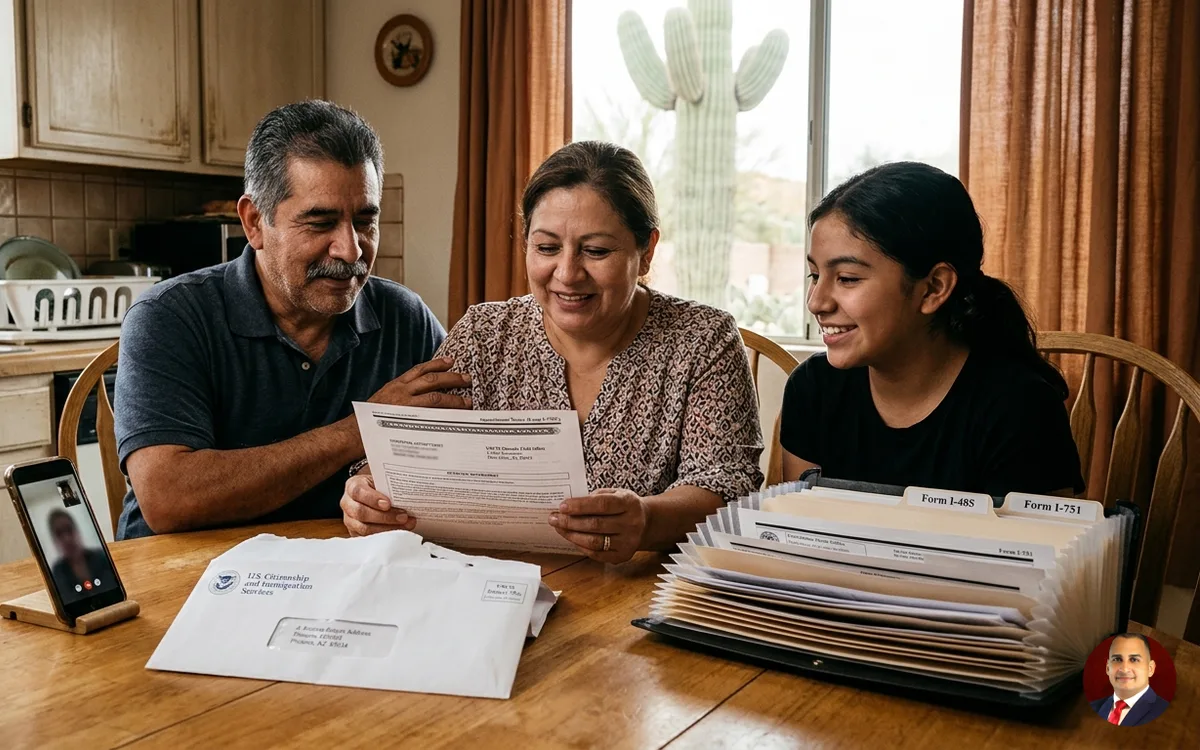
A Tucson-based client we will call Rosa married a U.S. citizen and wanted to file for permanent residence as quickly as possible. Because she was an immediate relative, her attorney filed Form I-130 and Form I-485 concurrently, along with Form I-864 signed by her husband as the primary sponsor. Within a few weeks, USCIS scheduled her biometrics appointment at the Tucson Application Support Center.
Two months later, USCIS issued a Request for Evidence on the I-864, because her husband's reported income fell below 125% of the federal poverty guideline for their household size. The response required a joint sponsor's affidavit, tax transcripts, and an employment letter, assembled and filed before the deadline printed on the RFE notice. That kind of RFE is one of the most common reasons an otherwise strong case stalls, which is why reviewing the I-864 math before filing, not after, is the better sequence when it is possible.
From there, the case proceeded to an interview at the USCIS Phoenix Field Office, where an officer reviewed the marriage evidence, the financial documents, and asked both spouses questions separately and together. What happens after that interview, approval, a second Request for Evidence, or referral for further review, depends on the specific facts of each case and is never something an attorney can predict in advance.
William J. Vasquez represents clients in federal immigration matters, including family-based and employment-based adjustment of status, consular processing, and proceedings before the Executive Office for Immigration Review and the Board of Immigration Appeals. He is admitted to the North Carolina State Bar and holds federal admission before the Fourth, Fifth, and Eleventh Circuit Courts of Appeals, with authority to appear before USCIS and EOIR nationwide under 8 C.F.R. § 1292.1, which governs who may practice in immigration proceedings regardless of state bar admission.
That federal standing is what allows our team to represent Arizona-based clients in I-130, I-485, I-864, and I-751 matters without a physical Arizona office. His authority covers federal immigration practice specifically; it does not extend to representation in Arizona state courts, which play no role in immigration cases in any event, since immigration is handled exclusively through USCIS, EOIR, and the federal circuit courts.
For his full practice history and case focus areas, see his attorney bio page.
Key Terms Explained
Terms Used on This Page
Adjustment of Status (AOS) — The process of applying for a green card from inside the United States using Form I-485, under INA § 245(a) (8 U.S.C. § 1255), without needing to leave for a consular interview.
Consular Processing — The alternative path for applicants outside the U.S., filed as Form DS-260 through the National Visa Center in Portsmouth, NH, ending in an interview at a U.S. consulate abroad.
Form I-130, Petition for Alien Relative — Filed by a U.S. citizen or lawful permanent resident to establish a qualifying family relationship with the immigrant relative.
Form I-485, Application to Register Permanent Residence or Adjust Status — The core green card application filed with USCIS.
Form I-864, Affidavit of Support — A legally enforceable contract in which a sponsor agrees to support the immigrant at or above 125% of the Federal Poverty Guidelines, per 8 C.F.R. § 213a.2.
Form I-751, Petition to Remove Conditions on Residence — Filed by conditional residents from marriage-based cases, generally within the 90 days before the 2-year card expires, under 8 C.F.R. § 216.4(a)(1).
Request for Evidence (RFE) — A USCIS notice asking for additional documentation before a decision can be made, with a response deadline printed on the notice itself.
Priority Date — The date a petition was filed, used to determine an applicant's place in line under the monthly Visa Bulletin for backlogged categories.
Concurrent Filing — Submitting Form I-130 and Form I-485 at the same time, available only when the immigrant's category is immediately current, as it generally is for immediate relatives of U.S. citizens.
Application Support Center (ASC) — The USCIS location, including sites in Phoenix and Tucson, where applicants complete biometrics (fingerprints and photo).
Board of Immigration Appeals (BIA) — The administrative body that reviews certain immigration judge and USCIS decisions on appeal, under 8 C.F.R. § 1003.1(d).
EB-2 National Interest Waiver (NIW) — An employment-based path that waives the standard labor certification requirement for applicants whose work serves a specific national interest. See our EB-2 NIW page.
I-601A Provisional Unlawful Presence Waiver — Filed before leaving for a consular interview to waive certain unlawful-presence bars in advance, reducing time spent separated from family abroad. See our I-601A waiver page.
Frequently Asked Questions
Q: How much does an Arizona green card lawyer cost for an I-130/I-485 case? A: Fees vary by case complexity, whether a joint sponsor or waiver is needed, and whether the case is filed concurrently or in stages. Ask for a written fee structure before signing an engagement letter, and confirm what USCIS filing fees (paid separately to USCIS, not the attorney) apply to your specific forms.
Q: How long does the entire green card process take from Arizona? A: For an immediate relative of a U.S. citizen filing concurrently, current USCIS Phoenix Field Office data shows roughly 8 to 14 months end to end (USCIS Processing Times, Fiscal Year 2027 cycle). Employment-based and other family categories depend on your priority date and the monthly Visa Bulletin, and can run several years.
Q: Do I need to travel to Arizona if my lawyer is based in Florida? A: You do not need to visit a law office in Arizona, since immigration practice is federal and consultations can be handled remotely. You will still need to appear in person in Arizona for your biometrics appointment at the Phoenix or Tucson Application Support Center and for your USCIS interview.
Q: What happens if I get a Request for Evidence on my I-864 affidavit of support? A: USCIS typically issues this RFE when the sponsor's income falls below 125% of the Federal Poverty Guidelines (8 C.F.R. § 213a.2) for the household size. The usual fix is adding a joint sponsor who meets the income requirement, supported by tax transcripts and an employment letter, filed before the deadline on the notice.
Q: Can I appeal a denied green card application? A: It depends on why it was denied. Some denials allow a motion to reopen or reconsider with USCIS; denials issued in the context of removal proceedings can be appealed to the Board of Immigration Appeals under 8 C.F.R. § 1003.1(d).
Q: I am a DACA recipient who married a U.S. citizen in Arizona. Can I adjust status? A: DACA status alone does not grant eligibility, but marriage to a U.S. citizen may open an adjustment path depending on your manner of entry and any prior unlawful presence. This is a case-by-case eligibility question that should be reviewed before filing, since an improperly filed case can create new risk.
Q: What is an interview waiver, and can I get one at the Phoenix Field Office? A: USCIS has discretion to waive the in-person interview for certain straightforward cases, based on current agency criteria that change over time. It is not something you can request directly, and most marriage-based cases are still interviewed in person.
Q: My conditional green card is expiring and I am now divorced. What do I file? A: You generally file Form I-751 with a request for a good-faith marriage waiver instead of the standard joint filing, within the same 90-day pre-expiration window under 8 C.F.R. § 216.4(a)(1), along with evidence the marriage was entered into in good faith.
Q: Do I need a lawyer if my employer is sponsoring me for a green card? A: Employment-based cases involve PERM labor certification or an I-140 petition with its own evidentiary requirements, and errors at that stage can delay the case by months or years. Many applicants in H-2A and other employment categories choose representation specifically because the filing sequence is unforgiving of mistakes.
Q: Can I apply for citizenship right after I get my green card? A: Generally, lawful permanent residents must wait 5 years (3 years if married to and living with a U.S. citizen spouse) before filing Form N-400 for naturalization, per INA § 316 and § 319. Conditions on a 2-year conditional card must also be removed via Form I-751 before that clock matters for most marriage-based cases.
Clients who work with our team describe clear communication about what stage their case is at and what document is due next, which matters most in a process built around deadlines that do not bend. We do not publish star ratings or outcome statistics on this page, because a green card approval depends on facts specific to each applicant, not on how many other cases a firm has filed. What we can offer is a transparent account of where your case stands at the USCIS Phoenix Field Office or the National Visa Center at any given time, and direct attorney involvement in reviewing your I-485, I-130, I-864, or I-751 filing before it goes out the door.
If you are holding an RFE notice, a biometrics appointment letter, or a conditional green card with an expiration date you have been avoiding, the next step is the same: find out exactly what the deadline on that document requires, and whether your current filing can still meet it. That is a conversation worth having before the window closes, not after.
Schedule a consultation to review your I-130, I-485, I-864, or I-751 filing with our team before a deadline passes. We represent Arizona-based applicants nationwide in federal immigration matters, from initial filing through USCIS Phoenix Field Office interviews, Requests for Evidence, and appeals to the Board of Immigration Appeals when needed.
- /immigration/i-601a-provisional-waiver
- /immigration/eb2-niw-waiver
- /immigration/consular-processing
- /immigration/removal-defense
- /immigration/bond-hearings
- /immigration/i-751-removal-of-conditions
- /attorneys/william-vasquez