Afraid to Go to Immigration Court? Your Rights in Florida
October 10, 2026
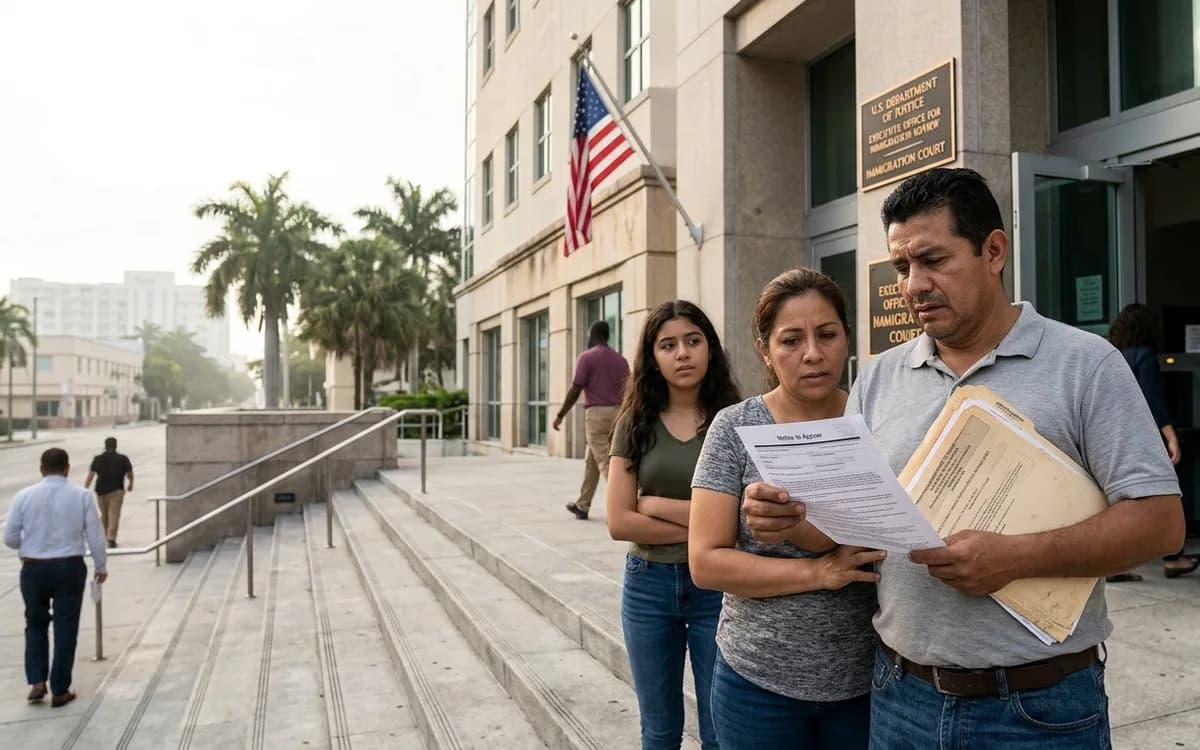
You Got a Notice. Now You're Afraid to Go.
Maybe a letter arrived from the Executive Office for Immigration Review telling you to appear in Miami or Orlando Immigration Court. Maybe someone told you DHS is now threatening to fine people thousands of dollars just for showing up to their own hearing. Either way, you are weighing two fears against each other: what happens if you go, and what happens if you don't.
That fear is not irrational. Immigrant Justice researchers reported in 2025 that DHS has begun deterring immigrants from attending their own hearings while floating civil penalties as high as $18,000 for those who don't (per Immigrant Justice). The pressure is real. So is the danger of skipping court without a plan.
This page was last updated in October 2026, reviewing that 2025 report alongside the federal rules that actually govern missed hearings and civil penalties.
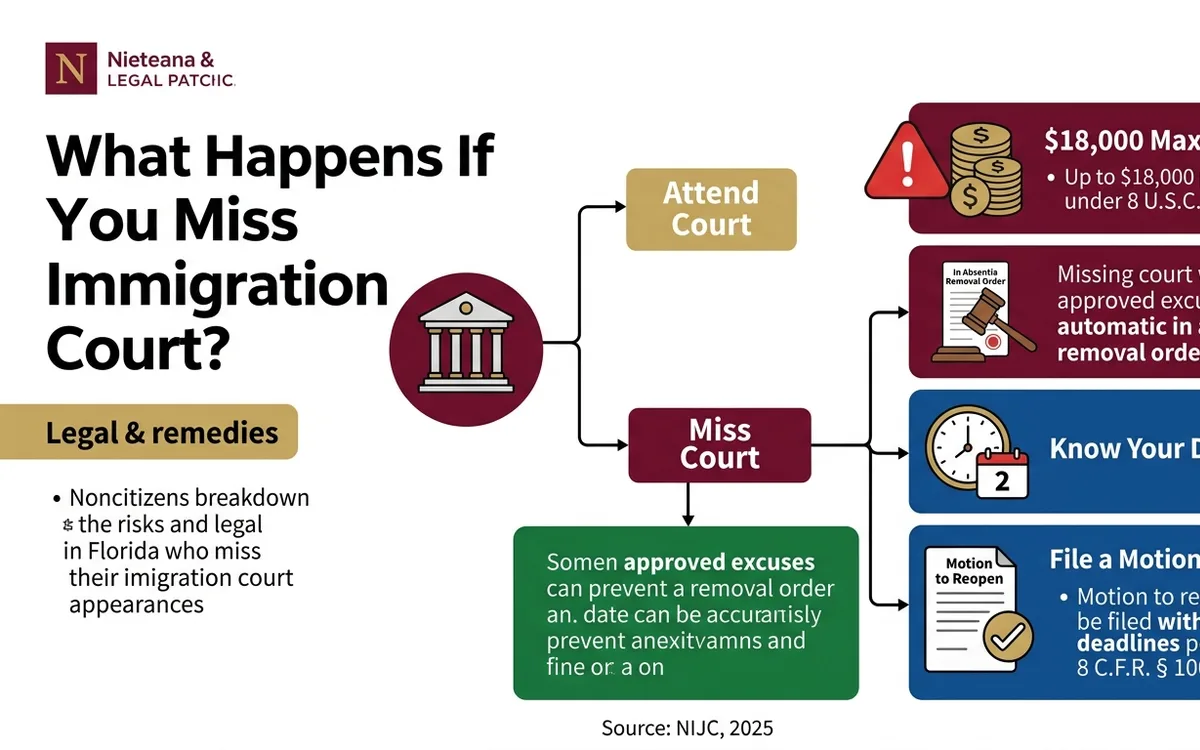
DHS has signaled it may fine noncitizens up to $18,000 for missing immigration court under 8 U.S.C. § 1229a(b)(7) (per NIJC, 2025). Missing court without an approved excuse also triggers an in absentia removal order. You can still fight both: file a motion to reopen within deadlines set by 8 C.F.R. § 1003.23(b).
The Hard Truth
The Hard Truth About Skipping Your Hearing
An immigration judge does not need you in the room to order your removal. If you fail to appear and DHS shows the court mailed or delivered proper notice, the judge can enter an in absentia removal order the same day, under 8 C.F.R. § 1003.26. That order carries the same legal weight as one issued after a full hearing with testimony and evidence.
Fear is not a defense the court recognizes on its own. "I was scared ICE would be at the courthouse" is not, by itself, grounds to reopen your case later. The judge looks for something narrower: did you actually receive legally adequate notice of the hearing, or did something outside your control, like hospitalization or a documented attorney error, keep you from appearing. Vague anxiety about enforcement does not meet either standard alone, though it may factor into a broader exceptional-circumstances argument your attorney builds with evidence.
What Happens If You Wait
What Doing Nothing Actually Costs You
An in absentia order does not sit quietly. Once entered, it authorizes ICE to take you into custody and deport you without any further hearing, and it can surface at a traffic stop, an ICE check-in, or a routine ISAP (Intensive Supervision Appearance Program) appointment. If you are already enrolled in ISAP, missing a required check-in on top of missing court compounds the problem: it signals noncompliance on two systems DHS is watching at once.
The clock on fixing this also runs out. A motion to reopen based on "exceptional circumstances" must generally be filed within 180 days of the in absentia order, under 8 C.F.R. § 1003.23(b)(4)(ii). Miss that window with the wrong kind of claim, and your remaining options narrow to grounds that carry no deadline, like proving you never received proper notice in the first place under Pereira v. Sessions, 585 U.S. 198 (2018). Waiting to see if DHS actually follows through on the $18,000 fine does not pause any of these deadlines.
Step-by-Step Process
How to Respond: Step by Step in Florida Immigration Court
Step 1: Confirm what the court actually decided
Call the EOIR automated case information line or check your case status online before doing anything else. This is free and requires only your Alien Registration Number (A-Number). Our guide to checking your EOIR case status walks through the automated line and the online portal.
Step 2: Get the written order
If a judge entered an in absentia removal order, request the written order from the Miami Immigration Court (333 S. Miami Ave, Miami, FL) or Orlando Immigration Court (3505 Lake Lynda Dr, Orlando, FL), whichever had jurisdiction over your case. The exact entry date starts your filing clock.
Step 3: Identify your ground for reopening
There are two main paths: arguing you never received proper legal notice (no deadline, but you must show the Notice to Appear was defective under Pereira v. Sessions), or arguing exceptional circumstances kept you from appearing (180-day deadline under 8 C.F.R. § 1003.23(b)(4)(ii)). The evidence required differs sharply between the two; see the comparison below.
Step 4: File the motion to reopen with EOIR
The motion goes to the same immigration court that entered the order, following the format in the EOIR Immigration Court Practice Manual, Chapter 4. It must include a brief, supporting evidence, and in most cases a proposed application for the relief you are seeking, such as asylum, cancellation of removal, or adjustment of status.
Step 5: Request a stay of removal if ICE already has your file
Filing the motion does not automatically stop deportation. If ICE has already flagged you for removal, you may need a separate, emergency motion for a stay alongside the motion to reopen.
Step 6: If denied, consider a BIA appeal
An immigration judge's denial of a motion to reopen can be appealed to the Board of Immigration Appeals within 30 days of the decision, under 8 C.F.R. § 1003.38(b). Our BIA appeals overview covers that process and its filing requirements in more detail.
A Real-World Example
What This Looks Like in Practice
Consider a composite, illustrative scenario built from the kinds of cases immigration attorneys see regularly, not any real client. A respondent living in Miami-Dade County received a Notice to Appear by mail, but the document listed no specific hearing date, only "a date to be set." Months later, a second notice with an actual date arrived at an old address the respondent had moved away from.
The respondent never saw the second notice and did not appear. The Miami Immigration Court entered an in absentia removal order. When the respondent later retained counsel, the attorney pulled the full record from the court, requested the written order, and reviewed both notices against the address history on file with USCIS.
The attorney argued that the combination of a deficient initial NTA and improper address notice meant the respondent never received legally adequate notice, under Pereira v. Sessions. The motion to reopen was filed on that ground, with the address documentation attached as supporting evidence.
What happens next depends on the judge's review of the filing, DHS's response, and whether the court schedules further proceedings. A motion like this can take anywhere from several weeks to a few months to be decided, and the filing itself guarantees nothing. The point of walking through these steps is to show what the process actually involves, not to promise where it ends.
Who Handles These Motions
William J. Vasquez is admitted to the North Carolina State Bar and to the Fourth, Fifth, and Eleventh Circuit Courts of Appeals, and he practices before the Executive Office for Immigration Review and U.S. Citizenship and Immigration Services. Immigration proceedings are federal matters: under 8 C.F.R. § 1292.1, any attorney licensed and in good standing in a single U.S. state bar can represent clients before EOIR and the Board of Immigration Appeals nationwide, regardless of which state that license is in. His work on motions to reopen and in absentia removal orders is federal immigration practice, not Florida state-court representation.
You can review his full attorney profile and case focus areas before deciding whether to schedule a consultation.
Key Terms Explained
Key Terms Used on This Page
In absentia removal order: A removal order entered by an immigration judge when a respondent fails to appear for a scheduled hearing, issued under 8 C.F.R. § 1003.26, provided DHS establishes that proper notice was given.
Notice to Appear (NTA): The charging document that starts removal proceedings. Under Pereira v. Sessions, 585 U.S. 198 (2018), an NTA missing the specific time or place of the hearing may not properly trigger certain legal deadlines or satisfy notice requirements.
Motion to reopen: A formal request asking the immigration court to reconsider a prior order, typically because of new evidence, lack of notice, or exceptional circumstances, governed by 8 C.F.R. § 1003.23(b).
Exceptional circumstances: A legal standard under 8 C.F.R. § 1003.23(b)(4)(ii) covering serious, documented reasons for missing a hearing, such as hospitalization or a documented attorney error, narrower than general fear or scheduling conflicts.
ISAP (Intensive Supervision Appearance Program): An ICE-administered alternative-to-detention program requiring regular check-ins, home visits, or electronic monitoring for certain noncitizens in removal proceedings.
Board of Immigration Appeals (BIA): The administrative appellate body within EOIR that reviews immigration judges' decisions, including denials of motions to reopen.
Frequently Asked Questions
Q: Is DHS's $18,000 fine for missing immigration court actually being enforced? A: As of a 2025 report from the National Immigrant Justice Center, DHS has signaled it intends to use the civil penalty authority in 8 U.S.C. § 1229a(b)(7) to fine people who miss hearings, but enforcement is not uniform (per Immigrant Justice). Check the specific notice or order in your own case before assuming a fine applies.
Q: What happens if I miss my immigration court hearing in Miami or Orlando? A: The judge can enter an in absentia removal order the same day if DHS shows you received proper notice, under 8 C.F.R. § 1003.26. You can ask the court to reopen the case, but only within specific deadlines and on specific legal grounds.
Q: How long does a motion to reopen take to be decided? A: Timelines vary by court and by whether DHS opposes the motion. It commonly takes several weeks to a few months for an immigration judge to rule, though a pending stay request can affect the pace.
Q: What if my motion to reopen is denied? A: You can appeal the denial to the Board of Immigration Appeals within 30 days, under 8 C.F.R. § 1003.38(b). If the BIA also denies it, further review may be available through a federal circuit court petition, which carries its own strict deadline and requires the filing attorney to be admitted to that specific circuit.
Q: Can I check my immigration court case status without a lawyer? A: Yes. EOIR's automated case information line and online case status tool are free and require only your A-Number. Our EOIR case status guide walks through both.
Q: Does ICE's ISAP check-in program affect my court deadlines? A: ISAP check-ins and immigration court hearings are separate obligations, but missing both at once makes your case look like a pattern of noncompliance to the court and to DHS. Keep documentation of every ISAP appointment you attend, even while your court situation is unresolved.
Q: What does it cost to have an attorney file a motion to reopen? A: Fees vary by the complexity of the record and the number of grounds being argued. Our office can give you a specific range during a consultation after reviewing your notice history and court file.
What Clients Say About Working With Our Team
Clients come to us after receiving a notice they didn't understand or after missing a hearing they didn't know had been rescheduled. What they describe afterward is less about outcome and more about process: getting a straight answer about deadlines, seeing their actual court file for the first time, and understanding what a filing would involve before deciding whether to move forward.
We do not publish outcome statistics or win rates. No accurate aggregate figure exists for cases this individualized, and the rules we practice under prohibit treating one as a trust signal. What we can tell you is what every consultation covers: your notice history, your filing options, and the realistic timeline for each.
Before You Decide What to Do Next
Reading this page is a reasonable first step, not the last one. If you already have a hearing date, a missed hearing, or an in absentia order in hand, the facts of your specific notice, how it was delivered, to what address, and when, usually decide which legal argument is even available to you. That is not something a general article can evaluate for you.
Talk to Our Office About Your Notice or Order
If you have a pending hearing, a missed court date, or an in absentia removal order from Miami or Orlando Immigration Court, bring the paperwork to a consultation with our office. We will review your notice history, identify which motion to reopen grounds actually apply to your situation, and explain the realistic deadlines before you decide how to proceed. Schedule a consultation with our immigration team to go over your specific documents.

- /attorneys/william-j-vasquez
- /immigration/bia-appeals
- /resources/check-eoir-case-status
- /contact