Visa Bulletin Predictions 2026: Florida Priority Dates &
Navigating the U.S. immigration system can be complex, especially with the ever-changing Visa Bulletin. For those in Gainesville and across Florida seeking to understand their immigration journey in 2026, deciphering priority dates and predicting wait times is crucial. This guide provides an in-depth look at what to expect from the Visa Bulletin throughout 2026, offering clarity on family-sponsored and employment-based categories. We'll cover key predictions, how to track your progress, and why expert legal guidance from Florida Immigration Lawyers is essential for your application.

The Visa Bulletin forecasts visa availability based on demand and annual limits. For Florida residents in 2026, understanding priority dates is key to predicting green card eligibility and wait times. Movement is often slow, but specific categories may see advancements, making expert legal advice crucial for accurate interpretation and timely application.
- Visa Bulletin predictions for 2026 guide green card eligibility for Florida residents.
- Priority dates are crucial for tracking your place in line for a visa.
- Wait times vary significantly by visa category and country of chargeability.
- Regularly check the official bulletin from travel.state.gov for updates.
- Expert legal advice is vital for navigating complex predictions and requirements.
Imagine planning your future in Florida, building a life, or expanding your business, only to find your immigration journey depends on a cryptic chart published monthly. For many in Gainesville and across Florida, the U.S. Visa Bulletin is that critical roadmap. It dictates when you can finally move forward with your green card application.
Navigating the complexities of the Visa Bulletin, especially when looking ahead to 2026, requires careful attention to detail. Understanding priority dates, predicting wait times, and staying informed about potential shifts in visa availability are essential for anyone pursuing permanent residency in the United States. This article aims to demystify the Visa Bulletin for 2026, focusing on its impact on Florida residents and providing actionable insights for family-sponsored and employment-based categories.
Florida's dynamic immigration landscape, coupled with evolving federal policies, makes understanding these predictions more critical than ever. Whether you are in Miami, Orlando, Tampa, or Gainesville, your immigration strategy needs to be precise. For personalized guidance on your immigration path, call Florida Immigration Lawyers at 1-844-967-3536 for a free consultation. Our team serves clients throughout Florida, including Gainesville and surrounding communities.
Understanding the Visa Bulletin and Its Impact on Florida Immigrants in 2026
What is the Visa Bulletin?
The Visa Bulletin is a monthly publication by the U.S. Department of State that provides information on the availability of immigrant visas. It essentially tells you whether your green card application can proceed based on your visa category and country of origin. This bulletin is critical for individuals seeking to adjust their status within the U.S. or apply for an immigrant visa through consular processing abroad.
The bulletin's purpose is to ensure that the number of immigrant visas issued each fiscal year does not exceed the annual numerical limits established by Congress in the Immigration and Nationality Act (INA). Specifically, INA Section 203 (8 U.S.C. § 1153) sets these limits for various family-sponsored and employment-based categories. Without the Visa Bulletin, the system would quickly become overwhelmed, leading to uncontrolled backlogs.
For those living in Florida, the Visa Bulletin directly impacts your ability to move forward. Your eligibility to file Form I-485, Application to Register Permanent Residence or Adjust Status, or to receive an immigrant visa abroad, hinges on your priority date becoming current. This is why closely monitoring the official travel.state.gov Visa Bulletin is a monthly necessity.
Key Factors Influencing 2026 Visa Bulletin Predictions
Several critical factors influence the movement of priority dates in the Visa Bulletin. These factors collectively determine whether a particular visa category advances, retrogresses, or remains stagnant. Understanding them is crucial for setting realistic expectations for 2026.
Firstly, the annual numerical limits set by Congress for each visa category and per-country limits play a significant role. When demand from a specific country, such as India or China, far exceeds the available visas, severe backlogs occur. This often leads to long wait times, sometimes spanning decades, for applicants from those nations.
Secondly, the rate of USCIS processing and National Visa Center (NVC) processing can influence the bulletin. If USCIS processes a large number of applications, it can consume available visa numbers more quickly, potentially leading to retrogression in future bulletins. Conversely, slower processing might allow dates to advance.
Thirdly, legislative changes or presidential actions, though less common, can drastically alter visa availability. While no major immigration overhaul is definitively predicted for 2026, ongoing political discussions and administrative priorities can always shift the landscape. The broader political climate in Florida and nationwide can sometimes influence processing speeds and policy interpretations, even if not directly changing the law.
Finally, the demand for visas, particularly in employment-based categories, fluctuates with economic conditions. A strong economy in Florida and across the U.S. might increase demand for skilled workers, impacting EB-2 and EB-3 categories. Conversely, economic downturns could reduce demand, potentially allowing dates to advance more quickly. All these elements make Visa Bulletin predictions 2026 a complex exercise.
Navigating Priority Dates and Anticipated Wait Times for Florida Residents
Your priority date is arguably the most important piece of information you need to track your immigration progress. It is generally the date USCIS or the Department of State received your properly filed immigrant petition (Form I-130 for family-based or Form I-140 for employment-based). This date establishes your place in line for a limited number of visas.
The Visa Bulletin displays two key charts: the Final Action Dates chart and the Dates for Filing chart. The Final Action Dates indicate when a visa number is actually available for issuance. The Dates for Filing chart allows some applicants to file their adjustment of status application earlier, even if a final visa is not yet available. USCIS announces monthly which chart applicants residing in the U.S. should use for filing.
Anticipated wait times for green cards in 2026 will continue to vary dramatically based on your visa category and country of chargeability. Family-sponsored categories (F1, F2A, F2B, F3, F4) generally have longer wait times than employment-based categories, especially for applicants from countries with high demand like Mexico, China, India, and the Philippines. Even within Florida, residents from these countries face similar national backlogs.
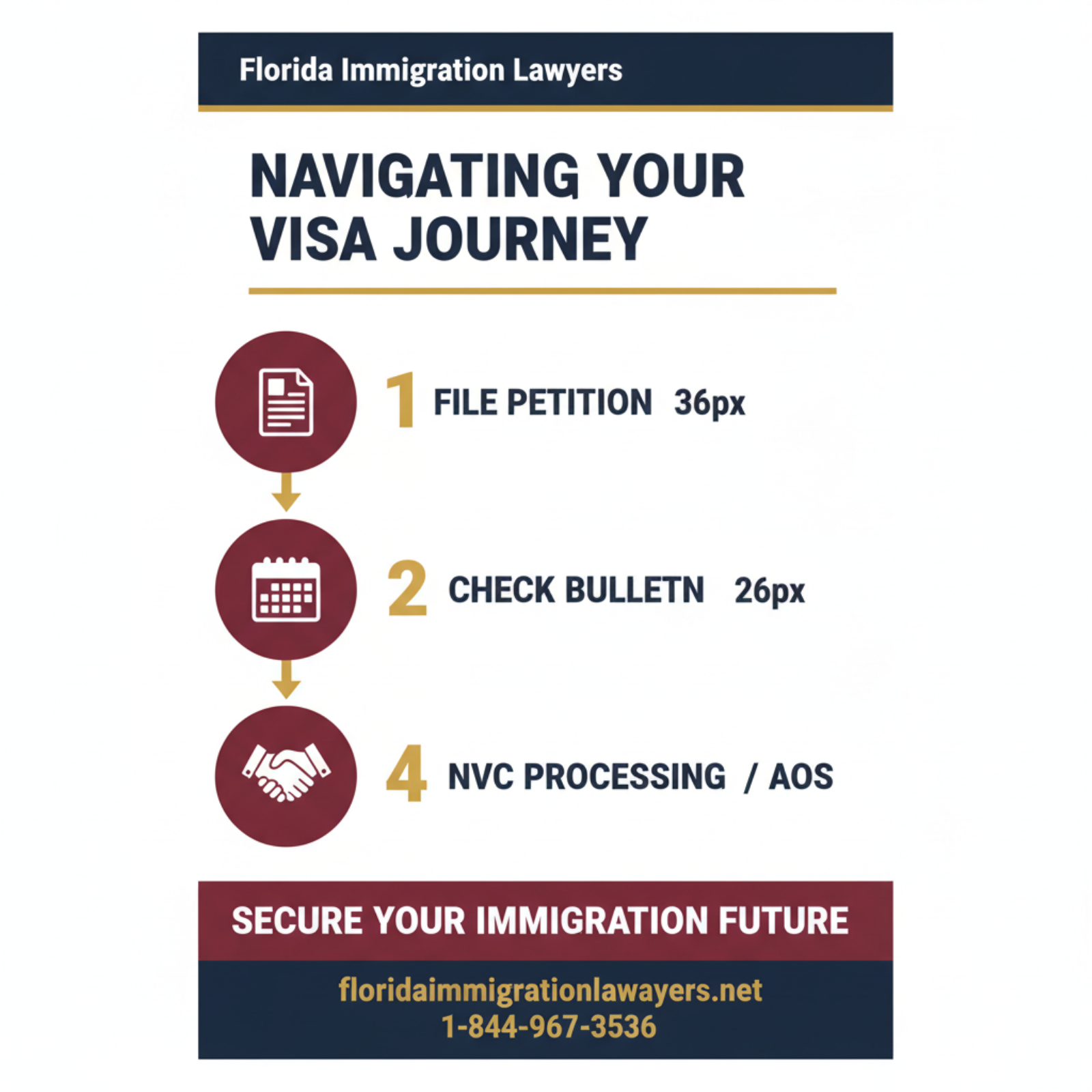
Step-by-Step Guide: How to Track Your Visa Bulletin Progress
Understanding the Visa Bulletin can feel daunting, but following a structured approach makes it manageable. This guide will help you interpret the bulletin and determine your next steps, particularly for those in Florida.
-
Identify Your Visa Category: First, determine whether your petition is family-sponsored or employment-based. Know your specific preference category, such as F1 (unmarried sons and daughters of U.S. citizens), F2A (spouses and minor children of LPRs), EB-1 (priority workers), EB-2 (professionals with advanced degrees), or EB-3 (skilled workers, professionals, and other workers). This information is crucial for pinpointing the relevant section of the Visa Bulletin.
-
Locate Your Priority Date: Your priority date is typically the date your immigrant petition (Form I-130, I-140, or I-360) was properly filed and received by USCIS. You can find this date on your I-797 approval notice. Make sure you have this exact date readily available.
-
Check the Latest Visa Bulletin: Each month, visit the official travel.state.gov website for the most recent Visa Bulletin. Look for the month and year that corresponds to the bulletin you are reviewing. For instance, if you are checking in March 2026, you will look for the March 2026 Visa Bulletin.
-
Find Your Country of Chargeability: Your country of chargeability is usually your country of birth, not necessarily your current nationality or country of residence. This is important because some countries have specific backlogs and different priority date movements.
-
Compare Your Priority Date: Within the Visa Bulletin, you will see two main charts: "Final Action Dates for Family-Sponsored Preference Cases" and "Dates for Filing Family-Sponsored Preference Applications," and similar charts for employment-based cases. Locate your visa category and country in both charts. Compare your personal priority date to the date listed in the charts. If your priority date is earlier than the date shown, you may be eligible to proceed.
-
Understand "Current" and "C" Designations: If the bulletin shows "C" or "Current" for your category and country, it means that a visa number is immediately available for all eligible applicants in that group. If your priority date is on or before the listed date, you can move to the next step of your application process.
-
Consult the USCIS Website: For applicants residing within the United States who are filing for Adjustment of Status (Form I-485), USCIS typically announces on its website which chart (Final Action Dates or Dates for Filing) should be used for the upcoming month. This announcement is usually made within a week of the Visa Bulletin's release and is crucial for Florida residents planning to file their I-485.
-
Seek Legal Counsel: If your priority date becomes current, or if you have questions about interpreting the bulletin, contact an experienced immigration attorney. They can help you determine your next steps, whether it's filing an Adjustment of Status application with the USCIS Tampa Field Office, the USCIS Orlando Field Office, or preparing for consular processing through the National Visa Center. An attorney can also help you understand the nuances of the Visa Bulletin April 2026 predictions or any other month's bulletin.
Key Visa Bulletin Predictions for Family-Sponsored Categories in 2026
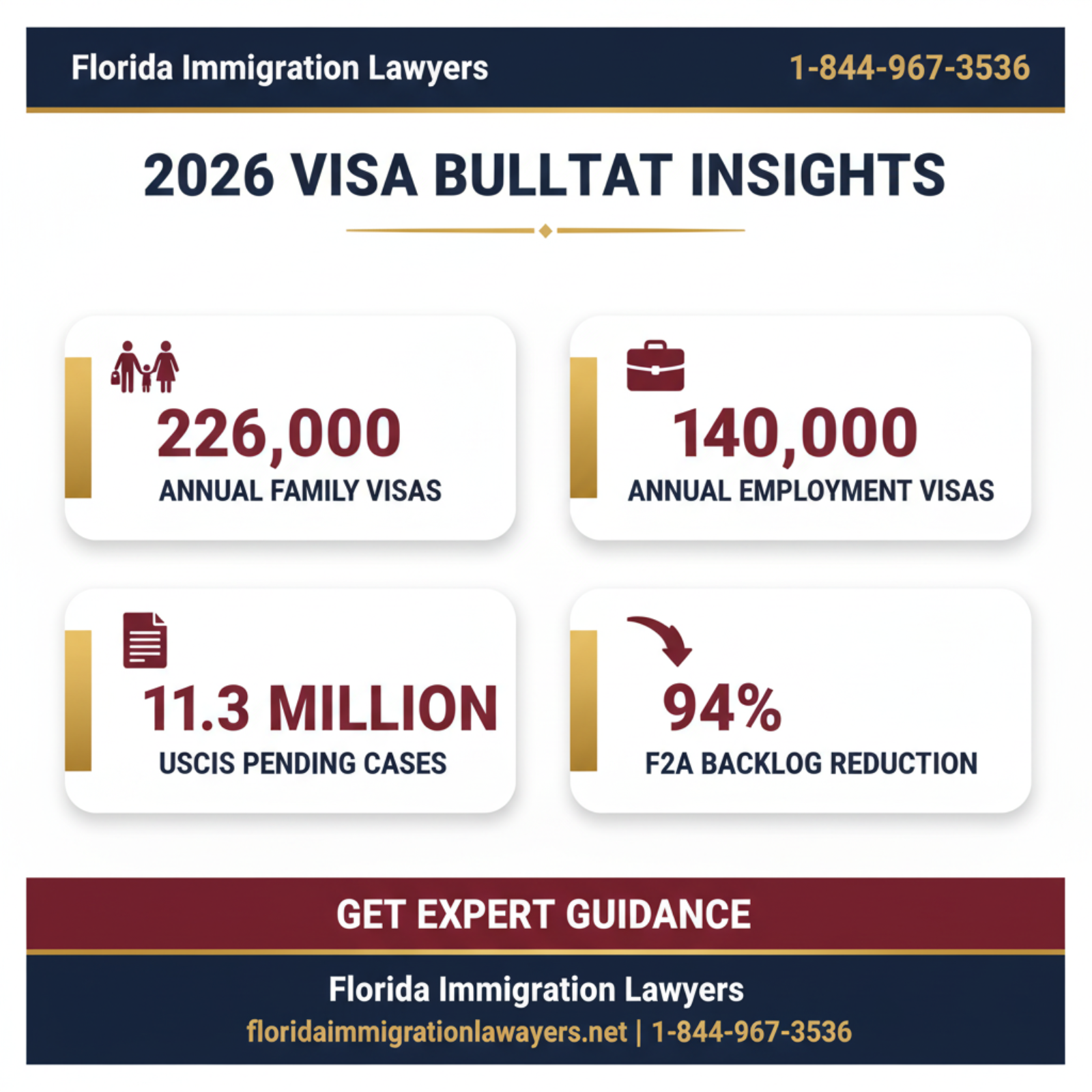
Family-sponsored immigration remains a cornerstone of the U.S. system, allowing citizens and lawful permanent residents to reunite with relatives. However, these categories often face significant backlogs due to high demand and annual numerical limits. For Florida families, understanding the Visa Bulletin predictions 2026 for these categories is paramount.
The F1 category (unmarried sons and daughters of U.S. citizens) and F4 category (brothers and sisters of U.S. citizens) are expected to continue experiencing lengthy wait times, particularly for applicants from Mexico, the Philippines, India, and China. Movement in these categories is typically slow, with advancements often measured in weeks or a few months at best, rather than years.
The F2A category (spouses and minor children of lawful permanent residents) generally sees more favorable movement, sometimes even becoming current for most countries. However, this can fluctuate. For those in Florida seeking to bring their immediate family members, closely monitoring the F2A dates in 2026 will be vital. Retrogression is always a possibility if demand outstrips supply, as seen in previous years.
F2B (unmarried sons and daughters, age 21 or older, of lawful permanent residents) and F3 (married sons and daughters of U.S. citizens) also typically face substantial backlogs. While the Visa Bulletin March 2026 might show some minor advancements, significant leaps are unlikely without legislative changes. These categories are often heavily impacted by per-country limits, leading to disparate wait times for applicants from different nations.
It is important for Florida families to remember that these are general predictions. The actual movement in the Visa Bulletin for 2026 can be influenced by various factors, including visa usage rates, administrative efficiencies, and unforeseen global events. Consulting with an attorney specializing in family immigration can provide tailored advice based on your specific situation.
Employment-Based Visa Bulletin Outlook for Florida Businesses and Professionals in 2026
Employment-based immigration is crucial for Florida's economy, attracting skilled professionals and investors. The Visa Bulletin categorizes these into five preferences (EB-1 to EB-5). The outlook for 2026 shows continued challenges, especially for high-demand countries.
EB-1 (priority workers: extraordinary ability, outstanding professors/researchers, multinational executives/managers) typically remains current for most countries, including those with high demand. This trend is expected to continue into 2026, offering a faster path to permanent residency for eligible individuals. Florida businesses seeking top talent often utilize this category.
EB-2 (professionals with advanced degrees or exceptional ability) and EB-3 (skilled workers, professionals, and other workers) are where significant backlogs exist for applicants from India and China. While other countries may see more rapid advancement, Indian and Chinese nationals face extensive wait times. The Visa Bulletin May 2026 predictions and subsequent months will likely show continued slow movement for these groups.
The per-country limits heavily affect the EB-2 and EB-3 categories. Even if there are unused visas in other categories, they are often not fully transferable to alleviate the backlogs in these high-demand countries. This creates a bottleneck that significantly extends priority dates for many skilled professionals working in Florida's tech, healthcare, and finance sectors.
EB-4 (certain special immigrants: religious workers, broadcasters, etc.) and EB-5 (immigrant investors) also have their own specific dynamics. EB-5, in particular, has seen fluctuations and legislative changes, and its dates can move independently. For Florida businesses considering foreign investment or individuals pursuing this path, staying updated on the EB-5 section of the Visa Bulletin 2026 is essential. Expert legal advice is invaluable for business immigration strategies.
Essential Document Checklist for Green Card Applications in Florida
Once your priority date becomes current, or when you are eligible to file your application, having all necessary documents prepared is critical. An incomplete submission can lead to delays, Requests for Evidence (RFEs), or even denial. This checklist provides a general overview of documents typically required for Adjustment of Status (I-485) or Consular Processing. Always refer to the specific instructions for your visa category and situation.
- Form I-485, Application to Register Permanent Residence or Adjust Status: Required if you are applying from within the U.S.
- Form I-130 or I-140, Petition for Alien Relative or Immigrant Worker: Proof of approval (I-797 approval notice) is necessary.
- Birth Certificate: A certified copy of your birth certificate, translated if not in English.
- Marriage Certificate (if applicable): For spouses of U.S. citizens or LPRs, and other family-based categories.
- Passport: Copies of your passport's biographic page, visa stamp pages, and all entry/exit stamps.
- Form I-94, Arrival/Departure Record: Proof of lawful entry and current immigration status. This can be printed from the CBP website.
- Form I-864, Affidavit of Support: Required for most family-based cases, ensuring the applicant will not become a public charge.
- Form I-693, Report of Medical Examination and Vaccination Record: Completed by a USCIS-approved civil surgeon. This must be sealed.
- Police Clearances: For consular processing, you will typically need police certificates from any country you have lived in for a certain period since age 16.
- Photos: Recent passport-style photographs meeting USCIS specifications.
- Employment Verification Letters: For employment-based cases, letters from current and previous employers confirming your experience and qualifications.
- Academic Transcripts and Degrees: Proof of your educational background, particularly for employment-based categories requiring specific qualifications.
- Proof of Bona Fide Marriage: For spousal petitions, extensive evidence demonstrating the authenticity of your marriage (e.g., joint bank accounts, leases, photos).
- Criminal History Records: If you have any arrests or convictions, certified court dispositions are required.
Timeline, Processing Expectations, and Cost Factors for 2026 Applications
General Processing Timelines and Factors Affecting Them
The total time it takes to get a green card in 2026 can range from several months to many years, depending on your specific circumstances. This includes the time it takes for your petition (I-130 or I-140) to be approved, for your priority date to become current, and for your adjustment of status (I-485) or consular processing to be completed. USCIS processing times vary by service center and field office. For example, the USCIS Tampa Field Office or Orlando Field Office handles many interviews for Florida residents.
You can check estimated processing times on the USCIS website. However, these are estimates and can change frequently. Factors that can affect your timeline include the completeness of your application, responses to Requests for Evidence (RFEs), attendance at interviews, and background checks. Complex cases or those requiring waivers can significantly extend processing durations. While some may ask, "Is USCIS moving faster in 2026?" the reality is that processing speeds are dynamic and can fluctuate based on caseloads and resource allocation.
Understanding the Cost Factors and Fees
Applying for a green card involves various fees that applicants in Florida should be prepared for. These typically include filing fees for the immigrant petition (Form I-130 or I-140), the adjustment of status application (Form I-485), biometric services, and the Affidavit of Support (Form I-864), if applicable. The National Visa Center (NVC) also charges fees for immigrant visa applications and affidavits of support during consular processing.
Additionally, you will incur costs for the required medical examination by a USCIS-approved civil surgeon, which can vary by provider. Attorney fees, if you choose to hire legal counsel, are another significant cost factor. It is important to note that specific filing fee amounts are subject to change by USCIS and are generally published on their website or in the Code of Federal Regulations, specifically 8 CFR § 103.7. We do not provide specific fee amounts here as they can be updated. Budgeting for these expenses is an important part of your immigration planning.
Do not navigate this complex process alone. The Visa Bulletin can be challenging to interpret, and its predictions impact your future. Contact Florida Immigration Lawyers today for expert assistance, ensuring your application is prepared correctly and submitted on time.
Common Mistakes to Avoid
The immigration process is filled with potential pitfalls that can lead to significant delays or even denials. Avoiding these common mistakes is crucial for a successful outcome in Florida.
-
Misinterpreting the Visa Bulletin: Confusing the "Dates for Filing" chart with the "Final Action Dates" chart is a frequent error. This can lead to filing your Adjustment of Status application too early or too late, resulting in rejection or missed opportunities. Always verify which chart USCIS instructs to use for the month.
-
Missing Your Priority Date: Failing to regularly check the monthly Visa Bulletin means you could miss the window when your priority date becomes current. This oversight can lead to substantial delays in your green card application, as visa numbers are limited and can retrogress.
-
Filing Incomplete Applications: Submitting forms without all required documentation or with errors is a common mistake. This often triggers Requests for Evidence (RFEs), which prolong processing times, or can lead to outright denials if not addressed properly. Double-check every form and attachment.
-
Not Updating Contact Information: USCIS and the National Visa Center (NVC) send important notices, RFEs, and interview schedules by mail. Failing to update your address with them promptly can cause you to miss critical deadlines or crucial appointments, potentially jeopardizing your case.
-
Assuming Self-Sufficiency for Complex Cases: Believing you can handle the intricate legal requirements of immigration law without professional help, especially for complicated situations. Immigration law is constantly evolving, and a minor error or misunderstanding can have significant, long-lasting consequences.
-
Ignoring Legal Changes: Immigration laws, policies, and procedures are subject to change. What was true last year may not be true in 2026. Staying informed about these changes, which an experienced attorney can help with, is vital to maintaining compliance and eligibility.
-
Not Preparing for Interviews: Underestimating the importance of a thorough interview preparation can lead to misunderstandings, inconsistencies, or misrepresentations during your USCIS field office interview (e.g., at the Tampa or Orlando office) or consular interview. Be ready to answer questions about your application truthfully and consistently.
-
Overlooking Medical Exam Requirements: Failing to complete the medical examination with a USCIS-approved civil surgeon or submitting an outdated or improperly sealed report can delay your application. Ensure all vaccinations are up-to-date as required.
-
Providing Inconsistent Information: Discrepancies between different forms, previous applications, or statements made during interviews can raise red flags for immigration officers. This can lead to further scrutiny, requests for additional evidence, or even accusations of misrepresentation.
-
Waiting Too Long to Seek Advice: Procrastinating on consulting an immigration lawyer once your priority date approaches, if you receive an RFE, or if you encounter any issues. Early intervention by an attorney is often key to resolving problems efficiently and achieving successful outcomes.
When to Call a Lawyer
While this article provides general information about the Visa Bulletin and its 2026 predictions, your individual case is unique. There are specific scenarios where the expertise of an immigration attorney, like those at Florida Immigration Lawyers, becomes indispensable. It's often asked, "Does the Visa Bulletin predict future availability?" While it offers a snapshot and trends, an attorney can help interpret these trends for your specific situation.
You should consider calling a lawyer if your priority date becomes current. An attorney can help you swiftly and accurately prepare and file your Adjustment of Status application (Form I-485) or guide you through the consular processing steps. This ensures all documentation is correct and submitted on time to avoid delays.
Legal assistance is also crucial if you have a complex family situation, a previous visa denial, a criminal record, or a history of overstays. These factors can complicate your application significantly, potentially leading to inadmissibility issues that only an experienced attorney can help navigate. For those facing deportation defense, immediate legal counsel is paramount.
Warning signs like receiving a Request for Evidence (RFE), a Notice of Intent to Deny (NOID), or an interview notice for a potentially problematic case, are strong indicators to seek legal help. An attorney can help you respond appropriately, prepare for interviews, and advocate on your behalf. Questions like "What are the new immigration changes for 2026?" are best addressed by legal professionals who stay abreast of evolving laws and policies.
Florida Immigration Lawyers offers comprehensive services for family-based and employment-based visas, asylum, citizenship, and general immigration matters. We understand the unique challenges faced by immigrants in Gainesville and across Florida. Our attorneys can provide tailored advice, represent you in dealings with USCIS or immigration courts (such as those in Orlando or Miami), and help you achieve your immigration goals. Visit our attorneys page to learn more about our team.
About Florida Immigration Lawyers
Florida Immigration Lawyers is a leading immigration law firm dedicated to serving individuals, families, and businesses across the entire state of Florida. Our mission is to provide compassionate, effective, and results-driven legal representation for all immigration matters. We understand the profound impact immigration decisions have on our clients' lives and futures.
Our experienced team specializes in a wide range of immigration services, including family-sponsored visas, employment-based visas, green card applications, adjustment of status, consular processing, naturalization and citizenship, asylum, and deportation defense. Whether you are navigating the complexities of the Visa Bulletin, seeking to unite with family, or protecting your right to stay in the U.S., we are here to help.
We believe in personalized attention and clear communication, guiding you through every step of the legal process. Our commitment to our clients is unwavering, offering transparent advice and strategic solutions tailored to your unique circumstances. We pride ourselves on being accessible and responsive to your needs.
For immediate assistance or to schedule your free consultation, please call us at 1-844-967-3536. You can also learn more about our services and team by visiting our website: https://www.floridaimmigrationlawyers.net. We are available 24/7 to answer your questions and provide the expert legal support you deserve. Serving all of Florida, including Gainesville, we are your trusted partners in immigration law.
Sources and References
- U.S. Citizenship and Immigration Services (USCIS)
- U.S. Department of State - Visa Bulletin
- Executive Office for Immigration Review (EOIR)
- 8 U.S.C. Chapter 12 - Immigration and Nationality Act (INA)
- INA Section 203 (8 U.S.C. § 1153) - Preference Visas
- 8 CFR § 103.7 - Fees
- USCIS Policy Manual
This article provides general legal information and is not intended as legal advice. Every case is unique, and outcomes depend on specific facts and circumstances. Contact an attorney for advice about your particular situation.
The journey through the U.S. immigration system, especially understanding the nuances of the Visa Bulletin, requires precision and expert legal insight. Don't leave your future to chance. Let Florida Immigration Lawyers be your trusted partner. Call us today at 1-844-967-3536 for a free, confidential consultation. Se Habla Español - Estamos aquí para ayudarle.
Do Not Navigate This Process Alone
Our experienced immigration attorneys are ready to fight for you. Get a free, confidential consultation today.
Se Habla Español
Frequently Asked Questions
Florida Immigration Lawyers
Immigration Attorney | Founder, Vasquez Law Firm
U.S. Air Force veteran and immigration attorney with thousands of cases resolved. J.D., NCCU School of Law. AILA member. Admitted to the 4th, 5th, and 11th Circuit Courts.
Available 24/7 - Free Evaluations
Related Legal Services
Our Florida immigration attorneys can help you with business immigration, asylum protection and deportation defense. Call today at 1-844-967-3536 for a free consultation.
Related Links
Related Topics
Free Legal Consultation
Discuss your case with our experienced attorneys. We're available 24/7.
Se Habla Español - Estamos aquí para ayudarle.
Related Articles
Immigration Interview Preparation Tips for Florida
Preparing for an immigration interview in Florida involves understanding USCIS procedures, gathering necessary documents, and practicing common interview questions. This guide provides essential tips for success. Contact Florida Immigration Lawyers for expert assistance and a free consultation.
H-2A Visa Guide for Florida Agricultural Workers | VLF Florida
Discover how the H-2A visa program can assist Florida growers in hiring temporary agricultural workers. Learn about eligibility, application process, and legal support available. Contact Florida Immigration Lawyers for a free consultation.
Immigration Bond Hearing in Florida: What You Need to Know
Navigating an immigration bond hearing in Florida can be daunting. Learn the process, necessary documents, and how legal guidance can aid your case. Contact Florida Immigration Lawyers at 1-844-967-3536 for expert assistance.
Understanding VAWA Self-Petition for Abused Spouses in Florida
Explore the VAWA self-petition process for abused spouses in Florida. Learn about eligibility, steps to file Form I-360, and resources available in Fort Lauderdale. Call Florida Immigration Lawyers at 1-844-967-3536 for a free consultation.