Visa Bulletin October 2025 Florida: Essential Immigration
The Visa Bulletin October 2025 is a crucial publication for immigrants in Florida, detailing the availability of green cards for family-sponsored and employment-based categories. It marks the beginning of the new fiscal year, providing essential dates that determine when applicants can file for adjustment of status or receive their immigrant visas. Understanding the distinction between Final Action Dates and Dates for Filing Applications is paramount for timely application submission. This comprehensive guide explains how the Visa Bulletin impacts Florida residents, outlines step-by-step application procedures, highlights common mistakes to avoid, and details when to seek expert legal assistance. Florida Immigration Lawyers is dedicated to helping you navigate these complex updates and offers free consultations.

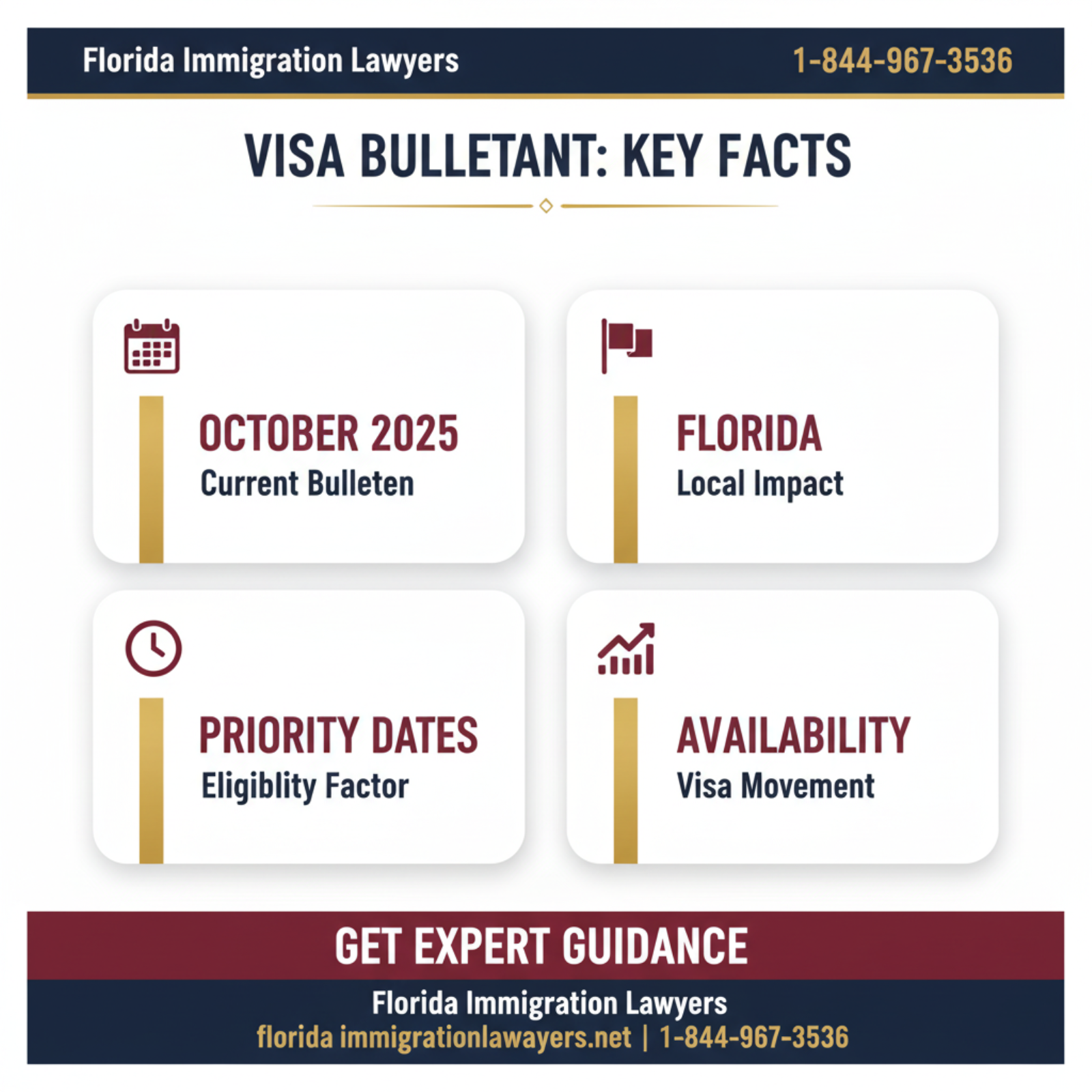
The Visa Bulletin October 2025 provides critical updates on immigrant visa availability for family-sponsored and employment-based categories, marking the start of the new fiscal year. It details "Final Action Dates" and "Dates for Filing Applications," guiding individuals in Florida on when they can proceed with their green card applications. Understanding these dates is crucial for timely and successful immigration processes.
- The October Visa Bulletin commences the new fiscal year for immigrant visa numbers.
- It distinguishes between Final Action Dates and Dates for Filing, impacting eligibility.
- Family-sponsored and employment-based categories have specific priority dates.
- Green card applicants in Florida must monitor these dates closely.
- Consulting an immigration lawyer is vital for interpreting complex bulletin changes.
Visa Bulletin October 2025 Florida: Essential Immigration Update
Are you an aspiring immigrant in Florida, eagerly awaiting your chance to secure a green card? Do you find yourself constantly checking for updates on your immigration journey? The annual release of the Visa Bulletin is a pivotal moment for thousands of individuals and families across our state, especially for those in Fort Lauderdale and surrounding areas. It dictates the pace and possibility of achieving your American dream.
The Visa Bulletin October 2025 is particularly significant as it ushers in the new fiscal year, setting the tone for immigrant visa availability. Understanding this complex document is not just about knowing dates; it's about strategizing your next steps, avoiding delays, and ensuring your application is processed efficiently. For many, it represents hope and a clear path forward.
This comprehensive guide from Florida Immigration Lawyers will demystify the October 2025 Visa Bulletin, explaining its components, how it impacts family-sponsored and employment-based green card applicants in Florida, and what actions you should take. We are here to help you navigate these crucial updates. If you have questions about your specific situation, do not hesitate to call Florida Immigration Lawyers at 1-844-967-3536 for a free consultation.
Understanding the Visa Bulletin October 2025: Your Guide to Immigrant Visa Availability
The Visa Bulletin is a monthly publication by the U.S. Department of State that provides information on the availability of immigrant visas. It outlines "priority dates" for various visa categories, determining when applicants can move forward with their permanent residency applications. The Visa Bulletin October 2025 is the first bulletin of the new fiscal year, typically from October 1st to September 30th.
For individuals seeking to immigrate to the United States, especially from vibrant communities like Fort Lauderdale, Miami, or Orlando, these dates are paramount. They affect both those applying for an immigrant visa through consular processing abroad and those seeking adjustment of status within the U.S. The bulletin's purpose is to ensure that the number of immigrant visas issued each year does not exceed the limits set by Congress under the Immigration and Nationality Act (INA).
Final Action Dates vs. Dates for Filing Applications
The Visa Bulletin presents two charts for most categories: "Final Action Dates" and "Dates for Filing Applications." Understanding the distinction between these is critical for your immigration journey. USCIS determines monthly which chart applicants should use for filing their adjustment of status applications (Form I-485).
- Final Action Dates: These are the dates when an immigrant visa is actually available for a specific applicant. Your priority date must be current according to this chart for your green card to be approved. This means your visa number is ready to be issued.
- Dates for Filing Applications: This chart allows certain applicants to file their adjustment of status applications (Form I-485) earlier, even if a final visa is not yet available. This can be a significant advantage, as it allows you to initiate the process, obtain work authorization, and travel permits sooner. USCIS announces on its website which chart to use for I-485 filings.
Always check the USCIS website for the specific month to confirm which chart (Final Action Dates or Dates for Filing) applies to your Form I-485 submission. This is a crucial step for all Florida residents planning their next move in the immigration process.
Impact on Florida Residents and USCIS Processing
Florida is a diverse state with a significant immigrant population, and the Visa Bulletin directly impacts many families and businesses here. The availability of immigrant visas can influence everything from family reunification to the ability of businesses to hire essential foreign workers. USCIS field offices in Florida, such as those in Miami, Orlando, and Tampa, process thousands of adjustment of status applications annually, making these dates highly relevant to our local community.
When visa numbers become current, it can lead to an increase in application filings at these local USCIS offices. This emphasizes the importance of preparing your application thoroughly and accurately. Florida Immigration Lawyers regularly monitors these changes to provide timely and precise advice to our clients.
Family-Sponsored Immigration Categories and Dates for October 2025
Family-sponsored immigration allows U.S. citizens and lawful permanent residents (green card holders) to petition for certain relatives to come to or remain in the United States permanently. The Visa Bulletin October 2025 will detail the movement of priority dates for these categories. These categories are subject to annual numerical limits, which often leads to backlogs, especially for certain countries.
Understanding your specific family preference category is vital for tracking your place in line. The Immigration and Nationality Act (INA) establishes these categories, each with varying wait times. For detailed guidance on your family's specific situation, our firm specializes in family immigration matters.
- First Preference (F1): Unmarried sons and daughters of U.S. citizens.
- Second Preference (F2A): Spouses and children (unmarried, under 21) of lawful permanent residents.
- Second Preference (F2B): Unmarried sons and daughters (21 years of age or older) of lawful permanent residents.
- Third Preference (F3): Married sons and daughters of U.S. citizens.
- Fourth Preference (F4): Brothers and sisters of U.S. citizens.
Historically, categories like F4 can have very long wait times, sometimes extending over a decade for applicants from countries with high demand. The Visa Bulletin October 2025 will show whether these dates have advanced, retrogressed, or remained stagnant for each preference category and country of chargeability.
For example, if you are a U.S. citizen in Fort Lauderdale petitioning for your married son, you would fall under the F3 category. You would need to check the F3 chart for your son's country of birth to see if his priority date is current. Staying informed about these monthly updates is crucial for planning your family's future.
Navigating Employment-Based Green Card Petitions in Florida
Employment-based immigration offers a pathway to permanent residency for individuals with specific skills, education, or investment capital. Florida's growing economy, particularly in sectors like tourism, technology, and healthcare, relies on a diverse workforce. The Visa Bulletin October 2025 is equally important for those seeking green cards through employment, as it dictates the availability of these visas.
Similar to family-sponsored categories, employment-based visas are divided into preferences, each with specific requirements and numerical limitations. These categories are defined by statute, primarily INA 203(b), and have varying backlogs depending on the preference and the applicant's country of birth. Our firm handles a wide range of business immigration cases.
- First Preference (EB-1): Priority workers, including individuals with extraordinary ability, outstanding professors/researchers, and multinational executives/managers. This category typically has the shortest wait times.
- Second Preference (EB-2): Professionals holding advanced degrees or individuals with exceptional ability, and National Interest Waiver (NIW) recipients.
- Third Preference (EB-3): Skilled workers, professionals, and other workers. This category often experiences significant backlogs.
- Fourth Preference (EB-4): Certain special immigrants, including religious workers and broadcasters.
- Fifth Preference (EB-5): Immigrant investors who make significant investments in U.S. businesses.
Many foreign workers in Florida, from medical professionals in Miami to tech innovators in Orlando, rely on these categories. The Visa Bulletin October 2025 will indicate the movement of priority dates, which can significantly impact their ability to file an I-485 application or receive an immigrant visa. The EB-1 category is generally considered the "fastest" among employment-based options due to its high demand for highly skilled individuals and often being current for most countries.
It is essential for both employers and employees in Florida to monitor these dates. A strategic approach to filing, potentially considering alternative visa options or seeking a National Interest Waiver, can be beneficial. A knowledgeable immigration attorney can help you determine the best course of action based on your qualifications and the current bulletin.
Step-by-Step Guide to Filing Your Adjustment of Status Application
Once your priority date becomes current according to the "Dates for Filing Applications" chart (or "Final Action Dates" if USCIS directs), you may be eligible to file your Form I-485, Application to Register Permanent Residence or Adjust Status. This is a crucial step for many individuals in Florida seeking to become lawful permanent residents without leaving the U.S. This process can be complex, and errors can lead to significant delays or denials.
Here is a generalized step-by-step guide. Remember, your specific situation may require additional forms or steps. Consulting with Florida Immigration Lawyers is highly recommended to ensure accuracy and completeness.
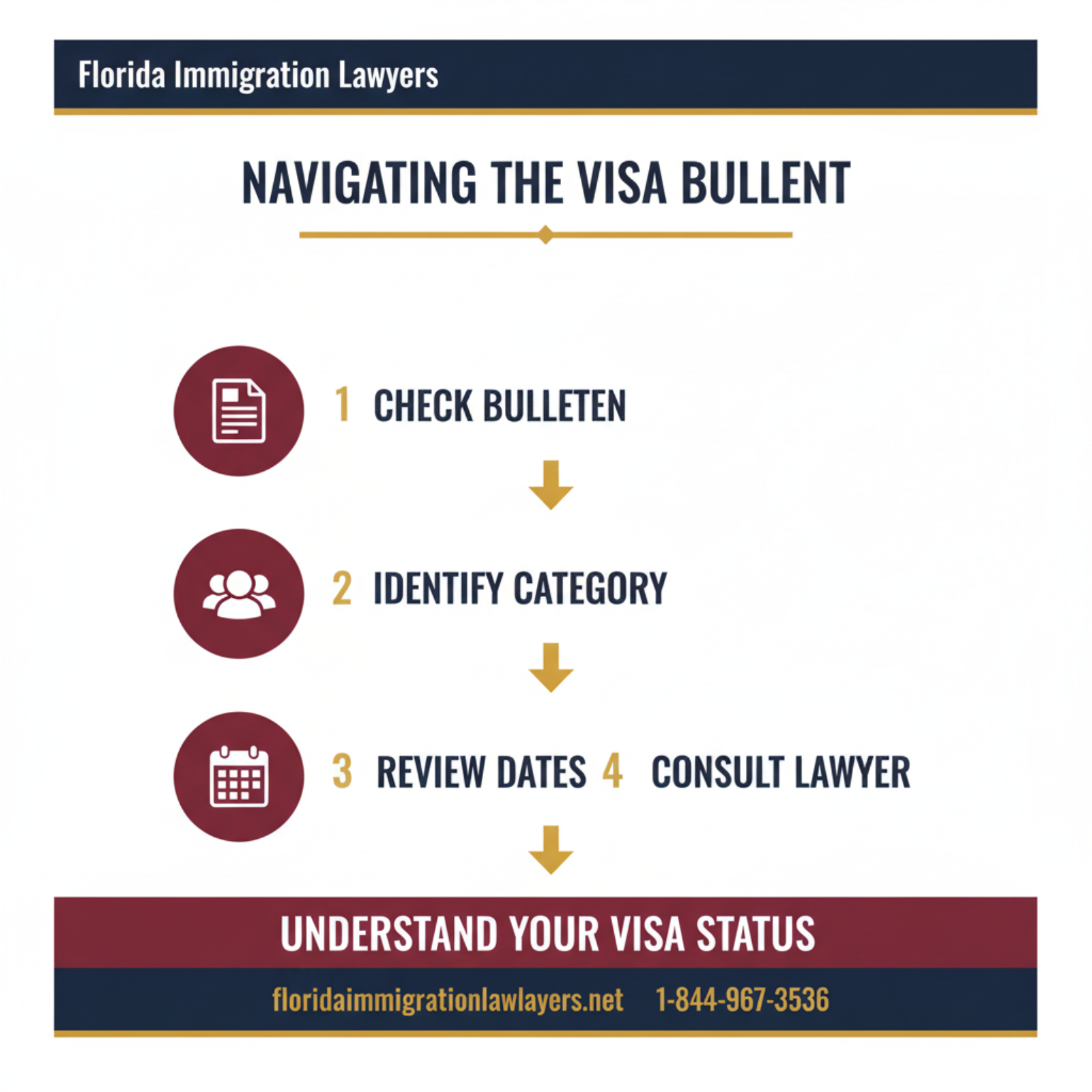
- Confirm Visa Availability: Regularly check the U.S. Department of State Visa Bulletin and the USCIS website for that month's specific guidance on which chart to use for I-485 filings. Your priority date must be current for your specific visa category and country of chargeability.
- Gather Required Documents: Collect all necessary supporting documentation, including birth certificates, marriage certificates, financial documents, medical examination results, and previous immigration records. Refer to the detailed checklist below.
- Complete All Necessary Forms: Prepare Form I-485, Application to Register Permanent Residence or Adjust Status. You will also typically need to file Form I-765 (Application for Employment Authorization) and Form I-131 (Application for Travel Document) concurrently. Other forms, such as Form I-864 (Affidavit of Support) or Form I-693 (Report of Medical Examination), are also usually required.
- Undergo a Medical Examination: Schedule and complete a medical examination with a USCIS-approved civil surgeon. The sealed results (Form I-693) must be submitted with your application or as requested by USCIS.
- Pay Filing Fees: Ensure all correct filing fees are included. USCIS fees can change, so always check the latest fees on the official USCIS website before submitting your application. Do not send cash.
- Submit Your Application Package: Mail your complete application package to the correct USCIS lockbox facility. The specific address depends on the forms you are filing and where you reside in Florida. Double-check the USCIS website for current mailing addresses.
- Attend Biometrics Appointment: After filing, USCIS will send you an appointment notice for biometrics (fingerprints, photos, signature). This typically occurs at an Application Support Center (ASC) in Florida, such as those in Fort Lauderdale, Miami, or Tampa.
- Attend Interview (If Required): Many adjustment of status applicants will be scheduled for an interview at a local USCIS field office. This is your opportunity to answer questions about your application and eligibility. An attorney can prepare you for this interview or even attend with you.
- Receive Decision: USCIS will notify you of their decision. If approved, you will receive your green card in the mail. If denied, it is crucial to consult with an attorney immediately to understand your options, which may include filing a motion to reconsider or appeal.
Document Checklist for Adjustment of Status (Form I-485)
A comprehensive and accurate submission of documents is paramount for a successful adjustment of status application. Missing or incorrect documents can lead to Requests for Evidence (RFEs) or even denial. This checklist provides a general overview of commonly required documents. Always refer to the specific instructions for each form and the USCIS website for the most up-to-date requirements.
- Form I-485, Application to Register Permanent Residence or Adjust Status
- Copy of Form I-797, Approval Notice for Immigrant Petition (e.g., I-130, I-140, I-360, I-526)
- Two passport-style photos
- Copy of government-issued identification with photo (e.g., passport identity page)
- Copy of birth certificate
- Copy of visa page from your passport (if applicable)
- Copy of Form I-94, Arrival/Departure Record (front and back)
- Proof of lawful entry to the U.S.
- Certified copies of court records (if you have any arrests or convictions)
- Form I-693, Report of Medical Examination and Vaccination Record (in a sealed envelope from the civil surgeon)
- Form I-864, Affidavit of Support (for family-based petitions, and some employment-based)
- Proof of sponsor's U.S. citizenship or lawful permanent residency (for Form I-864)
- Sponsor's federal income tax returns and W-2s (for Form I-864)
- Form I-765, Application for Employment Authorization (optional, if you want to work while your I-485 is pending)
- Form I-131, Application for Travel Document (optional, if you want to travel outside the U.S. while your I-485 is pending)
- Marriage certificate (if applicable)
- Divorce decrees or death certificates for previous marriages (if applicable)
- All applicable filing fees
Organizing these documents meticulously is crucial. Consider creating a checklist for your own records and making copies of everything you submit. A Florida immigration lawyer can help you compile a complete and accurate packet.
Timeline and Processing Expectations for Florida USCIS Filings
The timeline for green card applications can vary significantly, influenced by your visa category, country of origin, the specific USCIS service center processing your case, and the current workload. While the Visa Bulletin October 2025 gives you a green light to file, actual processing times can extend for many months or even years.
USCIS provides estimated processing times on its website, which are updated regularly. These times are general estimates and not guarantees. For applicants in Florida, cases are typically processed by one of the USCIS service centers (e.g., Nebraska, Texas, California, Vermont) or at a local field office if an interview is required. The Miami Field Office, for instance, handles a large volume of adjustment of status interviews.
Factors Influencing Processing Times:
- Visa Category Backlogs: Family-sponsored categories, especially F3 and F4, often have long backlogs, meaning even after filing, you might wait years for a final visa number to become available.
- Country of Chargeability: Certain countries, such as China, India, Mexico, and the Philippines, face higher demand and thus longer wait times due to per-country limits.
- Completeness of Application: Any missing information or errors in your submission will lead to RFEs, significantly delaying your case.
- USCIS Workload: The overall volume of applications and available resources at USCIS directly impact processing speeds.
- Policy Changes: Immigration policies can change, affecting processing priorities and efficiency.
For example, while an EB-1 petition might be processed relatively quickly if the dates are current, an F4 petition for a sibling from Mexico could take well over a decade to reach a final action date. It's important to set realistic expectations and continuously monitor your case status online using the receipt number provided by USCIS.
While we cannot guarantee specific outcomes or timelines, Florida Immigration Lawyers can help you understand the current processing climate and what to expect. We advise our clients in Fort Lauderdale and throughout Florida to be patient but also proactive in responding to any USCIS requests.
Cost Factors and Fee Breakdown for Visa Applications
Pursuing an immigrant visa or adjustment of status involves various fees that can add up. It is essential to budget for these costs to avoid delays in your application process. The fees are set by USCIS and the Department of State and are subject to change. Always verify the latest fee schedule on the official USCIS website (uscis.gov/forms/our-fees) before submitting any payment.
We cannot provide specific fee amounts here due to their fluctuating nature, but we can outline the general categories of costs you should anticipate:
- Filing Fees for Petitions: The initial petition (e.g., Form I-130 for family-based, Form I-140 for employment-based) has a separate filing fee, typically paid by the petitioner.
- Form I-485 Adjustment of Status Fee: This is a significant fee for the principal applicant and each derivative applicant. It often includes the biometrics fee.
- Biometrics Services Fee: This fee covers the cost of fingerprinting and background checks. It is often bundled with the I-485 fee.
- Medical Examination Fees: The cost of the required medical exam (Form I-693) is paid directly to the civil surgeon. These fees vary by provider and are not paid to USCIS.
- Attorney Fees: Legal representation is an investment in the accuracy and efficiency of your application. While not mandatory, hiring an experienced immigration lawyer can save you time, reduce stress, and prevent costly mistakes. Florida Immigration Lawyers offers competitive rates and transparent fee structures.
- Translation Fees: If any of your supporting documents are not in English, you will need to provide certified translations, incurring additional costs.
- Postage and Courier Fees: Costs associated with mailing your application package and any subsequent correspondence.
It is crucial to submit the correct fees with your application. Incorrect payments are a common reason for application rejection or delay. Always pay with a check or money order drawn on a U.S. bank or financial institution, payable to "U.S. Department of Homeland Security." Never send cash. Plan your budget carefully and consult with your attorney to understand all potential costs involved in your Florida immigration journey.
Navigating the complexities of the Visa Bulletin October 2025 and the entire immigration process requires precise attention to detail and a deep understanding of evolving laws. Do not navigate this process alone. For personalized guidance and expert representation, contact Florida Immigration Lawyers today.
Common Mistakes to Avoid When Applying for an Immigrant Visa
The immigration process is fraught with potential pitfalls that can lead to significant delays, requests for evidence (RFEs), or even outright denials. Avoiding these common mistakes is crucial for a smooth and successful application, especially for those in Florida relying on the Visa Bulletin October 2025.
- Misinterpreting the Visa Bulletin: Not understanding the difference between "Final Action Dates" and "Dates for Filing Applications," or misreading your priority date, can lead to filing too early (rejection) or too late (missed opportunity). Always confirm with the USCIS website for the correct chart to use.
- Incomplete or Incorrect Forms: Failing to fill out every section of a form, using outdated versions, or making typographical errors can cause your application to be returned or rejected. USCIS forms are frequently updated, so always download the latest version from their official site.
- Missing Supporting Documentation: Submitting an application without all required evidence, such as birth certificates, marriage licenses, or financial records, will almost certainly result in an RFE, significantly prolonging the process.
- Incorrect Filing Fees: Sending an incorrect payment amount, using an expired check, or failing to pay the correct entity can lead to your application being returned. Always double-check the current fee schedule on the USCIS website.
- Failing to Disclose All Information: Omitting details about past arrests, immigration violations, or previous marriages, even if seemingly minor, can be considered misrepresentation and lead to severe consequences, including permanent bars. Honesty is always the best policy.
- Submitting Untranslated Documents: Any document not in English must be accompanied by a complete and certified English translation. Failing to do so will result in an RFE.
- Missing Deadlines: Not responding to RFEs or other USCIS notices by the specified deadline can lead to the denial of your application. Keep meticulous records and respond promptly.
- Traveling Outside the U.S. Without Advance Parole: If you have a pending adjustment of status application, leaving the U.S. without an approved Advance Parole document (Form I-131) can be considered abandonment of your I-485 application, preventing your re-entry.
- Not Updating Address Changes: Failing to inform USCIS of a change of address (Form AR-11) can lead to missed notices and appointments, jeopardizing your case.
- Ignoring Public Charge Rule Updates: While the 2019 public charge rule was rescinded, applicants must still demonstrate they are not likely to become a public charge, primarily through the Affidavit of Support (Form I-864). Understanding current guidelines is important.
- Not Seeking Legal Counsel: Attempting to navigate the complex immigration system without the guidance of an experienced attorney often leads to avoidable errors and increased stress. An attorney can spot issues before they become problems.
By being diligent and seeking professional assistance, you can significantly reduce the risk of these common errors and improve the likelihood of a positive outcome for your green card application in Florida.
When to Call a Florida Immigration Lawyer
While this guide provides general information, immigration law is incredibly nuanced and individual circumstances vary greatly. The Visa Bulletin October 2025 offers dates, but its interpretation and application to your unique case can be challenging. Knowing when to seek professional legal assistance can be the difference between success and significant setbacks.
You should consider contacting Florida Immigration Lawyers if any of the following scenarios apply to you:
- Complex Priority Date Issues: If your priority date is close to being current, or if you are unsure how to interpret the Visa Bulletin for your specific category and country of chargeability.
- Previous Immigration Denials or Issues: If you have a history of visa denials, overstays, previous deportations, or any other immigration violations.
- Criminal History: Even minor arrests or convictions can have severe immigration consequences. A lawyer can assess the impact and advise on waivers or defense strategies.
- Complicated Family Situations: If you have complex family structures, previous marriages, or difficulties obtaining necessary documentation for family-sponsored petitions.
- Employment-Based Challenges: If your employer needs guidance, if you are changing employers, or if you have questions about specific employment-based categories like EB-1, EB-2, or EB-3.
- Requests for Evidence (RFEs) or Notices of Intent to Deny (NOIDs): Receiving these notices indicates a problem with your application that requires a precise and timely response.
- Concerns about Public Charge or Inadmissibility: If you have doubts about meeting financial requirements or if there are any grounds of inadmissibility that might affect your case.
- Seeking to Adjust Status from a Non-Immigrant Visa: Ensuring you meet all eligibility requirements for adjustment of status and haven't violated the terms of your previous visa.
- Desire for Peace of Mind: The immigration process is stressful. Having an experienced attorney from Florida Immigration Lawyers by your side provides invaluable peace of mind, ensuring every step is handled correctly.
Our experienced team at Florida Immigration Lawyers serves clients across Florida, including Fort Lauderdale, Miami, and Orlando. We are dedicated to protecting your rights and guiding you through every stage of your immigration journey. We understand the local context and the specific challenges faced by immigrants in our state. Do not wait until a problem arises; proactive legal counsel is your best defense.
About Florida Immigration Lawyers
Florida Immigration Lawyers is a leading immigration law firm dedicated to serving individuals, families, and businesses across the entire state of Florida. With a deep understanding of U.S. immigration laws and policies, our experienced attorneys provide compassionate yet tenacious representation for a wide range of immigration matters.
We believe in providing personalized attention to each client, understanding that every immigration journey is unique. Our commitment is to offer strategic legal solutions tailored to your specific needs, helping you navigate the complexities of the immigration system with confidence.
Our Services Include:
- Family-Sponsored Visas and Green Cards
- Employment-Based Visas and Green Cards
- Deportation Defense
- Asylum and Refugee Claims
- Naturalization and Citizenship
- Visa Applications and Waivers
- Adjustment of Status
- Consular Processing
Why Choose Florida Immigration Lawyers?
- Expertise: Our attorneys are highly knowledgeable in all facets of immigration law.
- Client-Centered Approach: Your goals are our priority, and we keep you informed every step of the way.
- Local Insight: We understand the specific nuances of immigration processes within Florida, including local USCIS offices and courts.
- Accessibility: We are available 24/7 to address your urgent concerns.
- Free Consultations: We offer a free initial consultation to discuss your case and outline your options.
Let us be your trusted legal partner in achieving your immigration goals. Contact us today. Our dedicated attorneys are ready to assist you.
Phone: 1-844-967-3536
Website: https://www.floridaimmigrationlawyers.net
Available: 24/7
Consultations: Free
Sources and References
- U.S. Citizenship and Immigration Services (USCIS) - Official website for forms, fees, and policy guidance.
- U.S. Department of State - Visa Bulletin - Official source for monthly visa bulletin releases.
- Executive Office for Immigration Review (EOIR) - Information on immigration courts and BIA decisions.
- 8 U.S.C. Chapter 12 - Immigration and Nationality Act (INA) - The primary body of immigration law.
- INA Section 203 - Preference Immigrant Visas.
- INA Section 245 - Adjustment of Status of Nonimmigrant to That of Person Admitted for Permanent Residence.
- 8 CFR Part 245 - Adjustment of Status to That of Person Admitted for Permanent Residence.
This article provides general legal information and is not intended as legal advice. Every case is unique, and outcomes depend on specific facts and circumstances. Contact an attorney for advice about your particular situation. Immigration laws are subject to frequent changes, and the information provided here may not reflect the most current legal developments.
The journey to obtaining a green card in Florida can be complex, but you don't have to face it alone. Whether you're navigating the Visa Bulletin October 2025 or require assistance with any other immigration matter, Florida Immigration Lawyers is here to provide the expert legal support you need. Take the first step towards your permanent residency by calling us for a free, confidential consultation.
Call Florida Immigration Lawyers today at 1-844-967-3536. Se Habla Español - Estamos aquí para ayudarle.
Do Not Navigate This Process Alone
Our experienced immigration attorneys are ready to fight for you. Get a free, confidential consultation today.
Se Habla Español
Frequently Asked Questions
Florida Immigration Lawyers
Immigration Attorney | Founder, Vasquez Law Firm
U.S. Air Force veteran and immigration attorney with thousands of cases resolved. J.D., NCCU School of Law. AILA member. Admitted to the 4th, 5th, and 11th Circuit Courts.
Available 24/7 - Free Evaluations
Related Legal Services
Our Florida immigration attorneys can help you with free immigration consultation, experienced immigration attorneys and business immigration. Call today at 1-844-967-3536 for a free consultation.
Related Links
Related Topics
Free Legal Consultation
Discuss your case with our experienced attorneys. We're available 24/7.
Se Habla Español - Estamos aquí para ayudarle.
Related Articles
EB-5 Investor Green Card in Florida: Key Insights | VLF Florida
Explore how the EB-5 investor green card program can help you start a new life in Florida. Learn about the benefits, processes, and common pitfalls of this investment immigration path. Call 1-844-967-3536 for expert guidance.
E-2 Visa for Florida Business Investors | VLF Florida
Learn how the E-2 investor visa can help you start a business in Naples, Florida. We cover eligibility, application steps, common mistakes, and when to seek legal help. Contact Florida Immigration Lawyers for a free consultation.
VAWA Immigration Relief: Support in Florida | VLF Florida
Explore VAWA immigration relief options for abuse victims in Hollywood, Florida. Learn about eligibility, application steps, and common mistakes to avoid. Contact Florida Immigration Lawyers for a free consultation.
EB-5 Investor Green Card in Florida: A Comprehensive Guide
Learn how the EB-5 investor green card program can help you gain U.S. residency through investment in Florida. Discover key steps, common mistakes, and when to seek legal advice. Call Florida Immigration Lawyers at 1-844-967-3536 for a free consultation.