Visa Bulletin October 2025 Florida: Your Essential
The Visa Bulletin for October 2025 is crucial for anyone pursuing immigration in Florida. It marks the start of a new fiscal year, detailing "Final Action Dates" and "Dates for Filing Applications" for family-sponsored and employment-based visas. This guide from Florida Immigration Lawyers breaks down how to interpret the bulletin, navigate the application process, and avoid common mistakes. Learn about essential documents, processing times, and cost factors specific to Florida residents. Whether you are in Jacksonville, Miami, or Orlando, understanding these updates is vital for your green card journey. Contact us for expert legal support and a free consultation.

The **Visa Bulletin for October 2025** details the availability of immigrant visas for family-sponsored and employment-based categories, marking the start of the new fiscal year. It provides crucial "Final Action Dates" and "Dates for Filing Applications," guiding individuals in Florida on when they can submit their green card applications or have their cases finalized. Understanding these dates is vital for your immigration journey.
Key Takeaways:
- The October 2025 Visa Bulletin sets the stage for the new fiscal year's visa availability.
- It distinguishes between "Final Action Dates" and "Dates for Filing Applications."
- These dates determine when you can file or finalize your green card application.
- Retrogression or advancement in dates can significantly impact your timeline.
- Consulting an experienced Florida immigration lawyer is crucial for accurate interpretation.
Are you an aspiring immigrant in Florida, eagerly anticipating your opportunity to live and work permanently in the United States? The **Visa Bulletin October 2025** holds critical information that could significantly impact your immigration journey. Understanding this monthly publication from the U.S. Department of State is not just important-it is essential for anyone navigating the complex world of U.S. immigration. For many families and professionals across Florida, from Jacksonville to Miami, the October Visa Bulletin marks the beginning of a new fiscal year and often brings significant changes to visa availability.
This comprehensive guide from Florida Immigration Lawyers will demystify the **Visa Bulletin October 2025**, explaining what it means for you and your family here in the Sunshine State. We will break down the key sections, discuss how to interpret the dates, and outline the steps you need to take. Navigating immigration law can be challenging, but with the right information and legal support, your path to a green card can become clearer. If you have questions or need personalized guidance, **call Florida Immigration Lawyers at 1-844-967-3536 for a free consultation** today.
Understanding the Visa Bulletin and Its Importance for Florida Immigration
The U.S. Department of State issues the Visa Bulletin every month. This bulletin summarizes the availability of immigrant visas for various preference categories and countries. It is a vital tool for anyone seeking a green card through family sponsorship or employment. For individuals and families throughout Florida, staying informed about the **Visa Bulletin October 2025** is a cornerstone of effective immigration planning.
The Visa Bulletin categorizes immigrant visas into family-sponsored and employment-based preferences. Each category has a limited number of visas available each fiscal year, which runs from October 1st to September 30th. When the demand for visas exceeds the supply for a particular category or country, a "cut-off date" is established. This date indicates that only applicants with a "priority date" earlier than the cut-off date can proceed with their applications.
For Florida residents, understanding these dates is crucial. The state is home to a diverse immigrant population, and many individuals are directly affected by the movements of the Visa Bulletin. Whether you are in Orlando, Tampa, or a smaller community, the dates published in the **U.S. Visa Bulletin October 2025** can determine when your application can be filed or approved.
The October bulletin is particularly significant because it kicks off the new fiscal year. This often means a fresh allocation of visas, which can lead to advancements in cut-off dates for some categories. However, it can also bring about retrogression if demand is exceptionally high. Our firm, Florida Immigration Lawyers, closely monitors these updates to provide timely advice to our clients regarding general immigration matters.
Navigating the Visa Bulletin: A Step-by-Step Guide for Florida Residents
Interpreting the **Visa Bulletin October 2025** can seem daunting at first. However, by following a clear process, you can understand its implications for your specific situation. This guide will walk you through how to read and apply the information presented in the bulletin. This knowledge is essential for anyone pursuing **immigrant visa processing Florida**.
-
Locate Your Visa Category: The bulletin is divided into two main sections: Family-Sponsored Preferences and Employment-Based Preferences. Identify the subcategory that applies to your petition, such as F1, F2A, EB-1, EB-2, or EB-3.
For instance, if your U.S. citizen parent filed a petition for you as an unmarried son or daughter, you would look under the F1 category. -
Find Your Country of Chargeability: After identifying your category, locate your country of birth. The bulletin lists different cut-off dates for various countries, particularly those with high demand like China, India, Mexico, and the Philippines.
Always check country-specific dates, as they may differ from the "All Chargeability Areas Except Those Listed" column. -
Understand "Final Action Dates" (Chart A) and "Dates for Filing Applications" (Chart B): The Visa Bulletin presents two crucial charts.
- Chart A: Final Action Dates: This chart indicates when USCIS can make a final decision on your green card application (Form I-485, Adjustment of Status) or when the Department of State can issue an immigrant visa. Your priority date must be earlier than the date listed in Chart A for final approval eligibility.
- Chart B: Dates for Filing Applications: This chart indicates when applicants can file their adjustment of status application with USCIS. USCIS decides each month whether applicants should use Chart A or Chart B for filing Form I-485. Always consult the USCIS website for their specific monthly guidance.
Knowing which chart USCIS has authorized for use is critical for Florida applicants to submit their applications correctly. -
Determine Your Priority Date: Your priority date is typically the date your immigrant petition (Form I-130 for family-based, Form I-140 for employment-based) was properly filed with USCIS. This date determines your position in the visa queue.
Refer to your Form I-797, Approval Notice, as it usually contains your priority date. -
Compare Your Priority Date to the Cut-Off Dates:
- If your priority date is earlier than Chart A's "Final Action Date" for your category and country, your case is current and eligible for final processing.
- If your priority date is earlier than Chart B's "Dates for Filing Applications" and USCIS authorizes Chart B, you may be eligible to file your Form I-485.
- If your priority date is later than both dates, you must wait for it to become current.
This comparison is the core step in understanding your **green card eligibility updates**. -
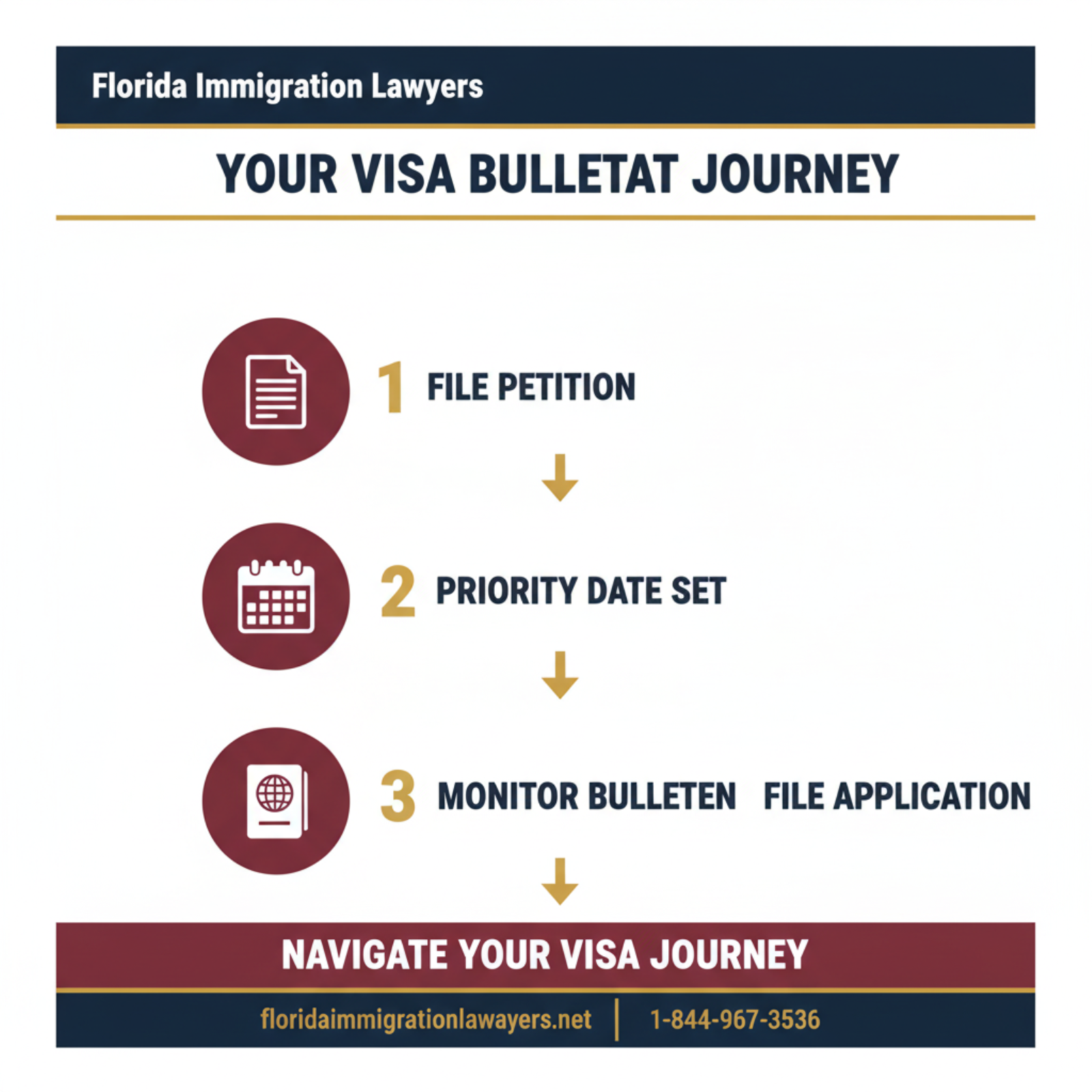
Monitor Monthly Updates: The Visa Bulletin is subject to monthly changes. Dates can advance, retrogress, or remain stable. Consistent monitoring is essential for effective immigration strategy.
Florida Immigration Lawyers can assist you in staying updated on these crucial changes.
Essential Documents for Your Visa Application in Florida
Preparing a thorough and accurate set of documents is paramount for any immigration application, especially when navigating the **Visa Bulletin October 2025**. A missing or incorrect document can lead to significant delays or even a denial. Whether you are applying for an immigrant visa at a U.S. consulate abroad or adjusting your status within the United States, proper documentation is key. This list provides a general overview of documents typically required.
- Valid Passport (at least six months beyond your intended stay)
- Original Birth Certificate (with certified translation, if not in English)
- Original Marriage Certificate (with certified translation, if applicable)
- Divorce or Death Certificates (if applicable, for previous marriages)
- Police Certificates (from your country of nationality and any country lived in for 6+ months since age 16)
- Court and Prison Records (if any criminal history exists)
- Military Records (if applicable)
- Photocopies of all submitted civil documents
- Form I-864, Affidavit of Support (from petitioner and any joint sponsors, with supporting financial documents like tax returns, W-2s, employment letters)
- Medical Examination Report (Form I-693) from a USCIS-approved civil surgeon in Florida
- Two identical passport-style photographs
- Form I-485, Application to Register Permanent Residence or Adjust Status (if adjusting status in the U.S.)
- Copy of approved Form I-130 or Form I-140 petition
- Form I-797, Approval Notice for your underlying petition
- Proof of relationship with the petitioner (e.g., photos, joint bank accounts for family-based petitions)
- Employment verification letters, educational degrees, and professional licenses (for employment-based petitions)
USCIS or the Department of State may request additional documents based on your specific case. Maintaining organized records and having copies of everything you submit is a best practice for all **family preference categories** and employment petitions.
Visa Bulletin Processing Times and Expectations for Florida Applicants
Understanding the **Visa Bulletin October 2025** is just one piece of the puzzle; managing expectations regarding processing times is equally important. While the bulletin tells you *when* you can apply or be approved, the actual duration of the process can vary widely. For individuals throughout Florida, from Miami to Tallahassee, patience and proactive engagement are crucial.
Several factors influence how long your immigrant visa or adjustment of status application will take. These include the specific visa category, your country of chargeability, the workload at the USCIS service center or consular post, and the completeness of your application. The October bulletin sets the stage, but the journey continues months, or even years, beyond that initial date.
- USCIS Processing Times: For adjustment of status applications (Form I-485) filed within the U.S., USCIS publishes average processing times for each service center. These times are estimates and can fluctuate significantly. You can check these on the USCIS website.
- National Visa Center (NVC) Processing: If you are applying for an immigrant visa through consular processing abroad, your approved petition first goes to the NVC. The NVC collects all necessary documents and fees before scheduling your interview at a U.S. embassy or consulate. This stage can add several months to the overall timeline.
- Interview Scheduling: Once your priority date is current and all documents are submitted, you will be scheduled for an interview. For adjustment of status, this is typically at a USCIS field office in Florida, such as the Jacksonville or Orlando office. For consular processing, it is at a U.S. embassy or consulate in your home country.
- Administrative Processing: Some cases may undergo "administrative processing" after the interview, which can involve additional security checks. This can further extend the processing time, sometimes by several months or even longer.
It is important to remember that the **Visa Bulletin October 2025** provides eligibility dates, not guaranteed approval dates. The entire process, from initial petition filing to final green card in hand, can span several years, especially for oversubscribed categories. Our immigration lawyers at Florida Immigration Lawyers can help you understand realistic timelines based on current trends and your specific circumstances.
Understanding Visa Application Costs and Fees in Florida
The financial aspect of immigration is a significant consideration for many individuals and families in Florida. Understanding the various fees associated with your visa application is essential for proper financial planning. While the **Visa Bulletin October 2025** dictates eligibility, these fees are a separate but equally important component of the process. Please note that filing fees are subject to change, and we recommend checking the official USCIS website for the most current amounts.
Here is a general breakdown of potential costs:
- USCIS Filing Fees: This includes fees for petitions (Form I-130, I-140) and adjustment of status applications (Form I-485). The I-485 fee often includes biometric services.
- Work Authorization (EAD) and Travel Document (Advance Parole) Fees: If filed concurrently with Form I-485, these fees may be waived or included, depending on current USCIS policy.
- Medical Examination Fees: All adjustment of status applicants must undergo a medical examination by a USCIS-approved civil surgeon. The cost varies by provider in Florida but is mandatory.
- Affidavit of Support Fees: There is typically no separate fee for filing Form I-864, Affidavit of Support, but the petitioner must meet specific income requirements.
- Immigrant Visa Processing Fee (for Consular Processing): If applying through a U.S. consulate abroad, the Department of State charges an immigrant visa processing fee.
- USCIS Immigrant Fee: Most applicants must pay a USCIS Immigrant Fee after visa approval and before U.S. entry, covering green card production.
- Legal Fees: Hiring an experienced immigration attorney, such as those at Florida Immigration Lawyers, is an investment that can significantly improve your chances of success and reduce stress. We offer competitive rates and transparent billing for our services in Florida.
It is crucial to budget for these expenses. While some fees are fixed, others, like medical exams and legal fees, can vary. We strongly advise against cutting corners on legal representation. The complexities of immigration law, especially concerning the **Visa Bulletin October 2025** and its nuances, warrant professional guidance.
Frequently Asked Questions about the Visa Bulletin
Understanding the **Visa Bulletin October 2025** often leads to common questions regarding timelines, eligibility, and processing. Here are answers to some of the most frequently asked questions from individuals in Florida.
Which employment-based green card is fastest?
Generally, the fastest employment-based green card categories are EB-1 (for extraordinary ability individuals, outstanding professors/researchers, and multinational executives/managers) and sometimes EB-2 or EB-3. For many, EB-1 is often "current," meaning no visa backlog. However, eligibility for EB-1 is very stringent. The speed also depends on your country of chargeability and the specific demand in any given year, as reflected in the **U.S. Visa Bulletin October 2025**.
Is USCIS moving faster in 2025?
Whether USCIS is moving faster in 2025 depends on various factors, including staffing levels, budget, and the volume of applications received. While USCIS continually works to improve efficiency, processing times can fluctuate significantly. The **Visa Bulletin October 2025** itself does not directly indicate USCIS processing speed but rather visa availability. You can check the current average processing times for specific forms and service centers on the official USCIS website. It is always wise to prepare for potential delays and file a complete, accurate application.
What is the October visa bulletin?
The October Visa Bulletin is the first Visa Bulletin of the new fiscal year (which runs from October 1st to September 30th). It is highly anticipated because the start of a new fiscal year often brings a fresh allocation of immigrant visas. This can lead to significant movements in cut-off dates, potentially allowing more applicants, including those in Florida, to file their adjustment of status applications or have their green cards finalized. The **Visa Bulletin October 2025** will outline the "Final Action Dates" and "Dates for Filing Applications" for family-sponsored and employment-based categories for the fiscal year 2026.
Why is the visa bulletin not moving?
The Visa Bulletin may not move, or even retrogress (move backward), for several reasons. The primary reason is high demand for visas in a particular category or country exceeding the annual supply. When more people apply than there are visas available, a backlog forms, and the cut-off dates either remain stagnant or move backward to keep the number of applicants within the annual limits. This is particularly common for countries like China, India, Mexico, and the Philippines due to high immigration volumes. Policy changes, processing backlogs, and unforeseen global events can also impact the movement of the **Visa Bulletin October 2025** and subsequent bulletins.
The journey through immigration can be filled with uncertainties and complex legal requirements. Do not navigate this process alone. Understanding the **Visa Bulletin October 2025** and its impact on your case requires expert knowledge. **Contact Florida Immigration Lawyers today** for dedicated support and peace of mind. Our team is ready to assist you.
Common Mistakes to Avoid When Following the Visa Bulletin
Navigating the immigration process, particularly with the ever-changing **Visa Bulletin October 2025** updates, can be fraught with potential pitfalls. Avoiding these common mistakes can save you significant time, money, and emotional distress. For those in Florida pursuing their immigration goals, being proactive and meticulous is key.
-
Misinterpreting Priority Dates: Many applicants confuse their filing date with their priority date or fail to correctly identify which chart (A or B) USCIS is using. This can lead to premature filing or missing a crucial window.
Consequence: Your application may be rejected, returned, or cause significant delays. -
Not Monitoring the Bulletin Monthly: The Visa Bulletin is dynamic. Dates can advance, retrogress, or remain static. Relying on outdated information can mean missing your window to file or expecting an approval that is not yet possible.
Consequence: You could miss the optimal time to file your adjustment of status application, delaying your green card by months or even years. -
Filing with Incorrect or Incomplete Documents: Even if your priority date is current, an application with missing forms, insufficient evidence, or errors will be rejected or issued a Request for Evidence (RFE). This applies to all **immigrant visa processing Florida** cases.
Consequence: Delays, additional costs, and potential denial if not addressed properly. -
Failing to Update Your Address with USCIS: If you move within Florida or to another state, failing to update your address with USCIS can result in missed notices, RFEs, or interview appointments.
Consequence: Your application could be denied for "abandonment" without you ever knowing there was an issue. -
Ignoring Medical Exam Requirements: The medical examination (Form I-693) must be completed by a USCIS-approved civil surgeon and submitted within a specific timeframe. Failing to do so, or having an expired exam, can halt your application.
Consequence: Delays or rejection of your application. -
Not Understanding the Financial Requirements (Affidavit of Support): The petitioner must demonstrate sufficient income to support the applicant. Errors in Form I-864 or insufficient supporting financial documentation can lead to an RFE or denial.
Consequence: Significant delays as you gather additional financial evidence or seek a joint sponsor. -
Attempting to Self-Represent in Complex Cases: While some simple cases might seem manageable, the nuances of immigration law, especially with the **Visa Bulletin October 2025** and specific country quotas, are complex.
Consequence: Costly errors, missed opportunities, and a higher risk of denial. -
Not Responding Promptly to RFEs or NOIDs: If USCIS issues a Request for Evidence (RFE) or a Notice of Intent to Deny (NOID), you have a limited time to respond. Missing this deadline is detrimental.
Consequence: Automatic denial of your application.
When to Call a Lawyer
The intricacies of U.S. immigration law, particularly regarding the **Visa Bulletin October 2025** and its specific application to your unique case, often require professional legal guidance. While this article provides general information, your individual circumstances can present unique challenges. Florida Immigration Lawyers are here to provide the tailored advice you need.
You should consider calling an immigration lawyer in Florida if:
- Your Priority Date is Approaching or Current: If the **Visa Bulletin October 2025** shows your priority date becoming current, or if it is already current, you need to act quickly and correctly. An attorney can ensure your application is filed accurately and promptly.
- You Have a Complex Case: This includes situations involving previous deportations, criminal history, prior visa denials, or complex family relationships. These factors require expert legal analysis.
- You Received a Request for Evidence (RFE) or Notice of Intent to Deny (NOID): These notices indicate that USCIS has concerns about your application. Responding effectively requires a deep understanding of immigration law and strategy.
- You Are Unsure Which Chart to Use: USCIS often switches between Chart A and Chart B for filing. An attorney can clarify which chart applies to your situation for the **U.S. Visa Bulletin October 2025**.
- You Are Confused by the Visa Bulletin: If the terminology, categories, or country-specific dates in the **Visa Bulletin October 2025** are unclear to you, seeking legal counsel is a wise step.
- You Need Help with Document Preparation: Ensuring all required documents are correctly gathered, translated, and submitted can be overwhelming. An attorney can streamline this process.
- You Are Considering Different Visa Options: An attorney can help you explore all available **green card eligibility updates** and determine the best path forward for you and your family in Florida.
Florida Immigration Lawyers offers comprehensive services for immigrants across Florida, including those in Jacksonville, Orlando, Tampa, and Miami. We specialize in family-based immigration, employment-based visas, adjustment of status, and deportation defense. Our experienced team is dedicated to protecting your rights and guiding you through every step of the immigration process.
About Florida Immigration Lawyers
**Florida Immigration Lawyers** is a premier law firm dedicated to serving the diverse immigrant communities across the entire state of Florida. With a deep understanding of U.S. immigration law and a compassionate approach, we provide exceptional legal representation to individuals and families pursuing their American dream. Our firm is committed to delivering personalized and effective solutions for all your immigration needs, from navigating the **Visa Bulletin October 2025** to complex deportation defense cases.
Our Services Include:
- Family-Based Immigration: Guiding U.S. citizens and permanent residents through the process of bringing family members to the U.S.
- Employment-Based Visas: Assisting professionals, skilled workers, and investors in obtaining work visas and green cards.
- Adjustment of Status: Helping eligible individuals apply for permanent residency within the United States.
- Consular Processing: Preparing and assisting clients with immigrant visa interviews at U.S. consulates abroad.
- Deportation Defense: Vigorously defending clients facing removal proceedings in immigration court.
- Citizenship and Naturalization: Supporting eligible permanent residents in their journey to become U.S. citizens.
- Asylum and Refugee Status: Providing dedicated representation for those seeking protection in the U.S.
Why Choose Florida Immigration Lawyers?
- Experienced Attorneys: Our team possesses extensive knowledge and experience in all facets of immigration law.
- Client-Centered Approach: We prioritize your needs and provide clear, consistent communication throughout your case.
- Bilingual Services: Se Habla Español – our team is fully equipped to serve our Spanish-speaking clients effectively.
- Comprehensive Support: From initial consultation to final resolution, we are with you every step of the way.
- Serving All of Florida: No matter where you are in Florida – Jacksonville, Miami, Orlando, Tampa, Tallahassee, or anywhere else – we are here to help.
Do not face the complexities of immigration law alone. **Contact Florida Immigration Lawyers** today for a free consultation. We are available 24/7 to answer your questions and provide the legal support you deserve. Call us at **1-844-967-3536** or visit our website at https://www.floridaimmigrationlawyers.net.
Sources and References
- U.S. Citizenship and Immigration Services (USCIS) - Visa Bulletin Information
- U.S. Department of State - Visa Bulletin
- Executive Office for Immigration Review (EOIR)
- 8 U.S.C. Chapter 12 - Immigration and Nationality Act (INA)
- 8 C.F.R. Part 245 - Adjustment of Status to that of Person Admitted for Permanent Residence
- INA § 203 - Preference System
- INA § 245 - Adjustment of Status of Nonimmigrant to That of Person Admitted for Permanent Residence
This article provides general legal information and is not intended as legal advice. Every case is unique, and outcomes depend on specific facts and circumstances. Immigration laws are subject to frequent change. Contact an attorney for advice about your particular situation.
Understanding the **Visa Bulletin October 2025** is a critical step, but it is just one part of a much larger and often intricate immigration process. Do not leave your future to chance. For expert guidance, compassionate support, and a clear path forward, trust the dedicated team at Florida Immigration Lawyers. We are here to help you navigate every challenge and pursue your immigration goals in Florida. **Call us today for a free consultation at 1-844-967-3536.** Se Habla Español - Estamos aquí para ayudarle.
Do Not Navigate This Process Alone
Our experienced immigration attorneys are ready to fight for you. Get a free, confidential consultation today.
Se Habla Español
Or leave your details and we’ll call you:
Free Evaluation in 24 Hours
Or talk to us right now
AI voice assistant — available 24/7
FreeFrequently Asked Questions

William J. Vásquez
Founding Attorney · Vasquez Law Firm
U.S. Air Force veteran and immigration attorney with years of hands-on U.S. immigration experience. J.D., NCCU School of Law. AILA member. Admitted to the 4th, 5th, and 11th Circuit Courts.
Available 24/7 - Free Evaluations
Reviewed for legal accuracy by William J. Vásquez
Licensed in North Carolina; U.S. immigration is federal practice.
Related Legal Services
Our Florida immigration attorneys can help you with experienced immigration attorneys, business immigration and asylum protection. Call today at 1-844-967-3536 for a free consultation.
Related Links
Related Topics
Free Legal Consultation
Discuss your case with our experienced attorneys. We're available 24/7.
Se Habla Español - Estamos aquí para ayudarle.
Related Articles
Dual Citizenship Lawyer: Navigating Delays in Florida
Facing citizenship delays in Florida can be challenging, but understanding the process and knowing your options is key. Learn how a dual citizenship lawyer can assist you in navigating N-400 processing and USCIS backlogs in Hialeah.
"ina § 208(a)(2)" One-Year Filing Deadline: Florida Asylum
Discover the importance of the "ina § 208(a)(2)" one-year filing deadline for asylum seekers in Florida. Learn about the steps, documents needed, and common mistakes to avoid in your asylum application process.
DV-2027 Registration Period: Your Green Card Lottery Guide
The DV-2027 Diversity Visa (DV) lottery offers a unique pathway to permanent residency for individuals from countries with historically low immigration rates to the U.S. Expected to open in Fall 2025, the registration period requires strict adherence to eligibility criteria, including country of birth and specific education or work experience. This guide from Florida Immigration Lawyers covers the step-by-step application process, essential documents, critical timelines, and associated costs. We highlight common mistakes to avoid and explain when legal counsel is indispensable, especially for residents in Florida. Understanding the nuances of the green card lottery is vital for a successful application. Contact us for expert guidance on your DV-2027 journey.
Blake Doughty: T Visa Eligibility for Florida Trafficking
For victims of human trafficking in Florida, like Blake Doughty, the T visa offers a critical pathway to safety and legal status. This comprehensive guide details the eligibility requirements, including demonstrating severe forms of trafficking, physical presence in the U.S. due to trafficking, and cooperation with law enforcement. Learn about the multi-step application process, the essential documents needed, and the typical timelines and costs involved in 2026. We also highlight common mistakes to avoid and when it's crucial to seek expert legal assistance. Florida Immigration Lawyers provides compassionate and dedicated support for T visa applicants across the state, ensuring victims receive the protection and resources they deserve. Contact us for a free consultation to understand your options and secure your future.