Visa Bulletin October 2025 Florida: What Immigrants Need
The October 2025 Visa Bulletin holds critical information for immigrants in Florida, influencing Green Card availability for family-sponsored and employment-based categories. This guide from Florida Immigration Lawyers breaks down the bulletin's components, including Final Action Dates and Dates for Filing, and explains how to interpret your priority date. We cover essential documents, processing timelines, and cost factors, offering a step-by-step approach for residents in St. Petersburg and across the state. Learn to avoid common mistakes and understand when to seek legal counsel to navigate the complexities of USCIS processing. Contact our experienced immigration lawyers for personalized assistance.
Navigating the Visa Bulletin: A Step-by-Step Guide for Florida Residents
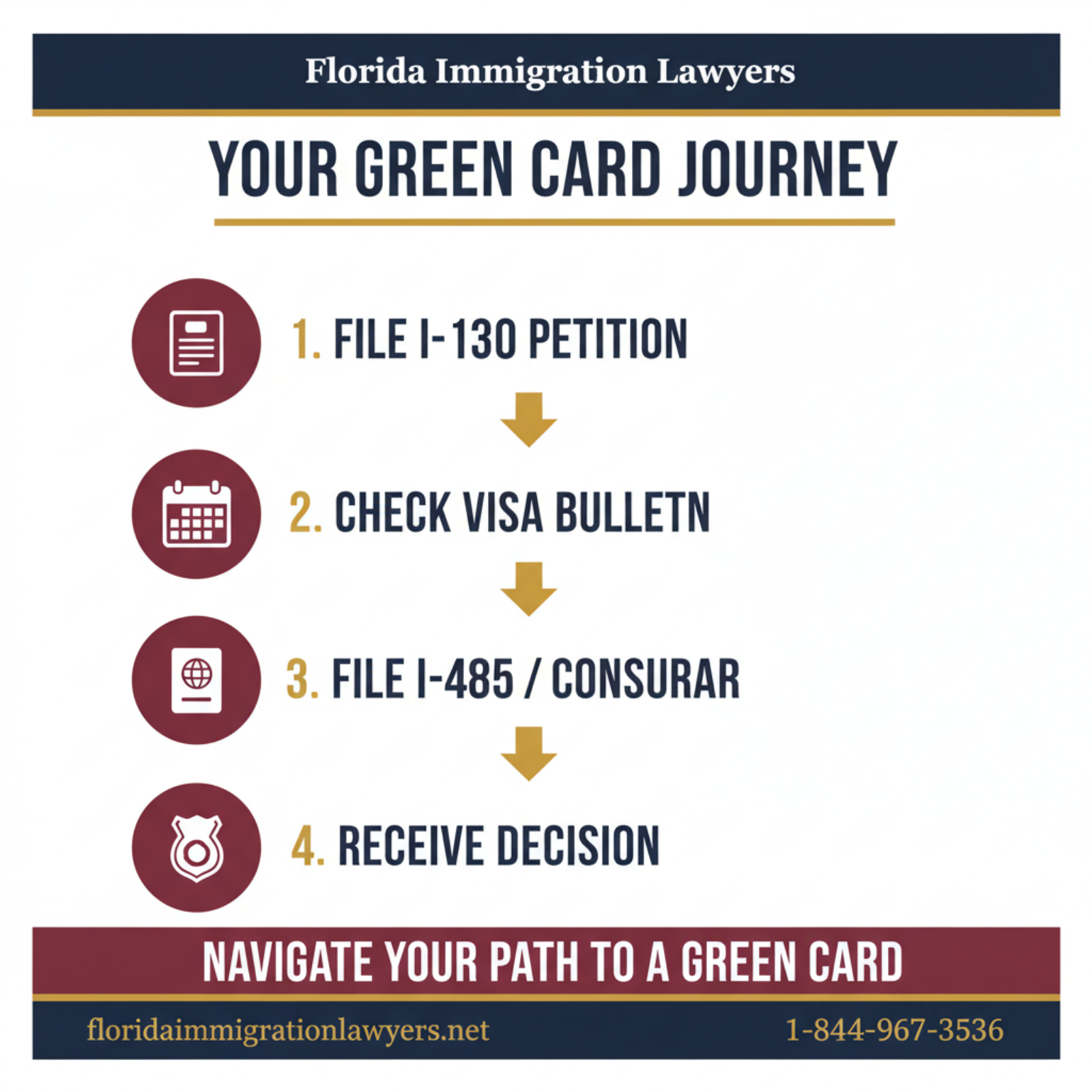
Interpreting the Visa Bulletin October 2025 and determining your next steps can be challenging. Here's a step-by-step guide to help you understand how it applies to your situation, especially if you are pursuing **adjustment of status USCIS** in Florida:
-
Check the Latest Visa Bulletin: Always refer to the official U.S. Department of State website (travel.state.gov) for the most current bulletin. The Visa Bulletin October 2025 will be released in the preceding month, typically around the middle of September 2025.
-
Identify Your Visa Category: Determine whether your petition is family-sponsored or employment-based. Within these broad categories, there are specific preferences: F1 (unmarried adult sons/daughters of U.S. citizens), F2A (spouses and minor children of Green Card holders), F2B (unmarried adult sons/daughters of Green Card holders), F3 (married sons/daughters of U.S. citizens), F4 (brothers/sisters of U.S. citizens). For employment-based, categories include EB-1, EB-2, EB-3, EB-4, and EB-5. Many individuals in Florida pursue these pathways, making **family-based immigration Florida** and **employment-based visas Florida** common applications.
-
Locate Your Country of Chargeability: This is generally your country of birth, not necessarily your current country of residence. Visa numbers are allocated based on per-country limits, so this detail is critical.
-
Find Your Priority Date: Your priority date is established when your immigrant petition (Form I-130 for family-based or Form I-140 for employment-based) was properly filed and accepted by USCIS. This date is printed on the I-797 receipt notice you received.
-
Compare Your Priority Date with the Bulletin's Dates: Look at the chart (Final Action Dates or Dates for Filing Applications, as designated by USCIS) for your specific category and country. If your priority date is earlier than the date listed in the bulletin, your date is considered "current." This means you may be eligible to proceed with your application. If a "C" is listed, it means current, and visas are available for all qualified applicants in that category.
-
Determine Your Next Steps: If your priority date is current, you can either file Form I-485, Application to Register Permanent Residence or Adjust Status, if you are already in the U.S., or proceed with consular processing at a U.S. embassy or consulate abroad. This is where an experienced **immigration lawyer Florida** becomes invaluable. They can help you prepare and submit your application accurately. Learn more about our immigration services here.
Essential Documents for Your Visa Application
Whether you're pursuing **family-based immigration Florida** or an **employment-based visa Florida**, having all your documents in order is essential for a smooth process. An incomplete application can lead to delays or even denial. Here's a general checklist of documents typically required:
- Valid passport and birth certificate for the applicant and any qualifying family members.
- Form I-485, Application to Register Permanent Residence or Adjust Status (if adjusting status in the U.S.).
- Form I-130, Petition for Alien Relative, or Form I-140, Immigrant Petition for Alien Worker, along with approval notice (I-797).
- Medical examination report (Form I-693) completed by a USCIS-approved civil surgeon.
- Affidavit of Support (Form I-864) from the petitioner, demonstrating financial ability to support the applicant.
- Financial documents of the petitioner, such as tax returns, W-2s, and employment verification.
- Proof of relationship for family-based petitions (marriage certificates, birth certificates).
- Educational and employment history for employment-based petitions.
- Police certificates from all countries where you have lived for six months or more since age 16.
- Certified copies of court and prison records, if applicable.
- Two passport-style photographs.
- Form I-94, Arrival-Departure Record (if applicable).
This list is not exhaustive, and specific requirements vary based on your visa category and individual circumstances. For comprehensive guidance on gathering your documents for **family-based immigration Florida**, visit our dedicated page on family immigration.
Visa Bulletin Timelines: What to Expect in Florida
Understanding the processing timelines for your immigration application, especially after your priority date becomes current according to the Visa Bulletin October 2025, is crucial for planning your future in Florida. While the bulletin indicates when a visa number is available, the actual time it takes for USCIS or a U.S. consulate to process your application can vary significantly.
For those adjusting status within the U.S., processing times for Form I-485 depend on the specific USCIS field office and service center handling your case. Florida has several USCIS field offices, including Miami, Orlando, and Tampa, each with its own workload and processing pace. You can check current estimated processing times on the USCIS website. Factors that can delay processing include requests for evidence (RFEs), background checks, and the scheduling of interviews.
For consular processing, the timeline involves coordination with the National Visa Center (NVC) and the U.S. embassy or consulate abroad. Once your priority date is current, the NVC will collect all necessary documents before forwarding your case for an interview. This stage can also involve waiting periods. It is important to respond promptly to all requests for information to avoid unnecessary delays.
Historically, movement in the Visa Bulletin can be unpredictable. While the Visa Bulletin October 2025 may show promising advancements, subsequent bulletins (e.g., **Visa Bulletin November 2025** or **Visa Bulletin December 2025**) could see retrogression or minimal movement. This is often due to high demand in certain categories or countries. Staying informed about these trends, perhaps even looking at **Visa Bulletin November 2025 predictions**, can help you anticipate potential changes and adjust your plans accordingly.
Understanding Immigration Costs and Fees
Pursuing a Green Card through the **Visa Bulletin October 2025** involves various costs that applicants in Florida need to consider. These fees are subject to change and vary depending on the specific forms required for your application. It's important to budget for these expenses to ensure a smooth application process.
The primary costs include USCIS filing fees for petitions and applications. For example, filing Form I-130 (Petition for Alien Relative), Form I-140 (Immigrant Petition for Alien Worker), and Form I-485 (Application to Register Permanent Residence or Adjust Status) each incur separate fees. These fees are set by USCIS and can be found on their official website. Always check the most current fee schedule before filing, as fees are periodically updated.
Beyond USCIS fees, you will also need to account for the cost of the mandatory medical examination (Form I-693) conducted by a USCIS-approved civil surgeon. These costs are paid directly to the civil surgeon's office and are not regulated by USCIS. Additionally, if you are pursuing consular processing, there will be visa application fees paid to the Department of State. You can find more information on these fees at travel.state.gov.
Finally, attorney fees for legal representation are a significant but often invaluable part of the overall cost. While not mandatory, securing the services of an experienced **immigration lawyer Florida** can prevent costly mistakes, ensure your application is complete and accurate, and provide peace of mind throughout the process. A lawyer can help you understand the nuances of the Visa Bulletin October 2025 and advocate on your behalf.
Do not navigate this process alone. The complexities of immigration law, especially concerning the Visa Bulletin October 2025 and your eligibility, require guidance. Contact Florida Immigration Lawyers today to ensure your application is handled correctly and efficiently. Our team is ready to assist you.
Common Mistakes to Avoid When Interpreting the Visa Bulletin
Misinterpreting the Visa Bulletin October 2025 or making errors in your application can lead to significant delays, requests for evidence (RFEs), or even denial. Here are some common mistakes to avoid:
-
Misinterpreting Your Priority Date: Many applicants confuse their filing date with their priority date. Your priority date is set when your petition (I-130 or I-140) was properly received by USCIS, not when you submit your I-485. Failing to correctly identify your priority date can lead to premature or delayed filing.
-
Not Checking Both Charts: USCIS sometimes directs applicants to use the Dates for Filing chart, while other times it's the Final Action Dates chart. Always check the USCIS website for their monthly guidance on which chart to use for **adjustment of status USCIS** applications. Using the wrong chart means your application could be rejected.
-
Delaying Filing When Current: If your priority date becomes current according to the Visa Bulletin October 2025, act promptly. Visa numbers are limited, and retrogression (when dates move backward) can occur in subsequent months like the **Visa Bulletin November 2025** or **Visa Bulletin December 2025**. Missing your window can mean waiting for months or even years longer.
-
Incorrectly Identifying Your Visa Category: Applying under the wrong family-sponsored or employment-based category can lead to immediate rejection or extensive delays as USCIS attempts to reclassify your case. Ensure you understand the specific requirements for your category.
-
Ignoring Country-Specific Limits: Visa numbers are allocated by country. Even if your category seems current, high demand from your country of birth can create longer backlogs. Always look at your specific country's column in the bulletin.
-
Not Consulting an Immigration Lawyer: The bulletin's complexities and the overall immigration process are best navigated with professional legal advice. An experienced **immigration lawyer Florida** can provide clarity and ensure compliance. This is especially true if you face a potential **deportation defense** issue due to an error. Learn how we can help with deportation defense.
-
Submitting Incomplete or Incorrect Documents: Even minor omissions or errors in your application forms or supporting documents can trigger an RFE, significantly delaying your case, or even leading to a denial. Double-check everything.
-
Failing to Respond to RFEs Promptly: If USCIS issues a Request for Evidence, respond completely and within the specified deadline. Ignoring an RFE or providing insufficient information can result in denial of your application.
-
Assuming the Bulletin Will Always Move Forward: Visa Bulletin dates can retrogress, meaning they move backward, or remain stagnant for months. This unpredictability means you cannot assume continuous forward movement. Check the bulletin monthly.
-
Not Tracking Future Bulletins: While the Visa Bulletin October 2025 is key, you must continue to monitor subsequent bulletins like the **Visa Bulletin November 2025** or **Visa Bulletin December 2025** to stay updated on any changes that might affect your case, including potential retrogression or further advancements.
When to Call a Florida Immigration Lawyer
While this guide provides general information about the Visa Bulletin October 2025, immigration law is incredibly nuanced. There are many scenarios where the expertise of a Florida immigration lawyer is not just helpful, but essential. Our team at Florida Immigration Lawyers is dedicated to providing personalized legal counsel to individuals and families across the state, including those in **St. Petersburg** and surrounding areas.
You should consider calling a lawyer if:
- Your priority date is current, and you are unsure about the next steps for filing your adjustment of status application or consular processing.
- You have a complex case, such as a prior visa denial, a history of overstaying, or any criminal record.
- You are unsure which visa category applies to you or how to interpret your priority date correctly.
- You have received a Request for Evidence (RFE) or a Notice of Intent to Deny (NOID) from USCIS.
- You are dealing with an employment-based petition, such as EB-2 or EB-3, which often involves intricate requirements and documentation.
- You need assistance with family-based petitions, ensuring all relationships are properly documented and all requirements for **family-based immigration Florida** are met.
- You are concerned about potential retrogression in future bulletins like **Visa Bulletin November 2025** and want to explore all possible options.
Our attorneys at Florida Immigration Lawyers have extensive experience navigating the complexities of immigration law. We can help you understand your options, prepare your application with precision, and represent your interests before USCIS or in immigration court. Don't leave your future to chance. Let us provide the clear, compassionate guidance you deserve.
About Florida Immigration Lawyers
Florida Immigration Lawyers is an immigration law firm dedicated to serving individuals and families throughout the entire state of Florida. Our mission is to provide legal representation and compassionate guidance to those navigating the often-challenging U.S. immigration system. We understand the profound impact immigration matters have on our clients' lives and are committed to achieving the strongest possible outcomes.
Our comprehensive services cover a wide array of immigration needs, including family-based visas, employment-based visas, Green Card applications, citizenship and naturalization, asylum, and deportation defense. Whether you are seeking to reunite with family, pursue professional opportunities, or find safety in the U.S., our skilled attorneys are here to advocate for you.
Why choose Florida Immigration Lawyers? We pride ourselves on our deep legal knowledge, personalized approach, and unwavering dedication to our clients. We offer transparent communication, strategic planning, and aggressive representation. We serve all of Florida, from Tallahassee to Key West, ensuring that quality legal assistance is accessible to everyone.
We are available 24/7 to address your urgent legal concerns and offer free consultations to help you understand your options without financial commitment. Our bilingual team is ready to assist you in English and Spanish. Contact us today to start your immigration journey with confidence. Visit our website at Vasquez Law Firm or call us directly at 1-844-YO-PELEO.
Frequently Asked Questions About the Visa Bulletin
Is USCIS moving faster in 2025?
The pace of USCIS processing times is subject to various factors, including workload, staffing levels, and policy changes. While the Visa Bulletin October 2025 may indicate new visa availability, it doesn't directly mean USCIS is moving faster for all cases. Some categories may see quicker adjudication, while others experience continued backlogs. It's best to check the specific processing times for your form and service center on the USCIS website regularly.
What is the October visa bulletin?
The October Visa Bulletin is the first bulletin of the new fiscal year (which runs from October 1 to September 30). It summarizes the availability of immigrant visa numbers for the month of October for both "Final Action Dates" and "Dates for Filing Applications." It's highly anticipated because it often signals potential changes or new movements in priority dates for various Green Card categories, impacting thousands of applicants globally and in Florida.
Which date is the visa bulletin released every month?
The U.S. Department of State typically releases the Visa Bulletin around the second or third week of the preceding month. So, the Visa Bulletin October 2025 would generally be released in mid-September 2025. It's advisable to check the official travel.state.gov website for the exact publication date each month.
Why is the visa bulletin not moving?
The Visa Bulletin may not move, or may even retrogress (move backward), for several reasons. These include high demand in specific visa categories or from certain countries, reaching the annual numerical limits set by Congress for that fiscal year, or administrative processing backlogs. When demand exceeds the available supply of visas, dates can stall or reverse to manage the queue of eligible applicants, a common occurrence in many **Green Card processing Florida** categories.
Sources and References
- U.S. Citizenship and Immigration Services (USCIS)
- U.S. Department of State - Visa Bulletin
- Executive Office for Immigration Review (EOIR)
- 8 U.S.C. Chapter 12 - Immigration and Nationality Act (INA)
- Immigration and Nationality Act Section 201 (8 U.S.C. § 1151) - Worldwide Level of Immigrant Visas
- Immigration and Nationality Act Section 203 (8 U.S.C. § 1153) - Allocation of Immigrant Visas
- 8 CFR Part 204 - Immigrant Petitions
This article provides general legal information and is not intended as legal advice. Every case is unique, and outcomes depend on specific facts and circumstances. Contact an attorney for advice about your particular situation.
The Visa Bulletin October 2025 is more than just a list of dates; it's a roadmap for your immigration journey. Understanding its implications and acting strategically is paramount to achieving your goals in Florida. Don't let uncertainty delay your future. Our dedicated team at Florida Immigration Lawyers is here to provide the guidance and support you need every step of the way. Call us today at 1-844-YO-PELEO for a free consultation. Se Habla Español - Estamos aquí para ayudarle.
Do Not Navigate This Process Alone
Our experienced immigration attorneys are ready to fight for you. Get a free, confidential case review today.
Se Habla Español
Or leave your details and we’ll call you:
We will call you back within 24 hours
Free evaluation · Private and confidential · Se habla español
Helping Florida immigrant families since 2011
Or talk to us right now

AI voice assistant — available 24/7
FreeFrequently Asked Questions

William J. Vásquez
Founding Attorney · Vasquez Law Firm
U.S. Air Force veteran and immigration attorney with years of hands-on U.S. immigration experience. J.D., NCCU School of Law. AILA member. Admitted to the 4th, 5th, and 11th Circuit Courts.
Available 24/7 - Free Evaluations
Reviewed for legal accuracy by William J. Vásquez
Licensed in North Carolina; U.S. immigration is federal practice.
Related Legal Services
Our Florida immigration attorneys can help you with free immigration consultation, business immigration and deportation defense. Call today at 1-844-YO-PELEO for a free case review.
Related Links
Related Topics
Free Legal Case Review
Discuss your case with our experienced attorneys. We're available 24/7.
Se Habla Español - Estamos aquí para ayudarle.
Related Articles
EB-5 Investor Green Card in Florida: A 2026 Guide
Explore how to obtain an EB-5 investor green card in Florida. Learn about the investment requirements, processes, and benefits of participating in this program. Discover how Florida's economic landscape can be an ideal setting for your investment. Contact Florida Immigration Lawyers for a free case review.
Certificate of Eligibility for Expungement in Florida 2026
For non-U.S. citizens in Florida, understanding how a state expungement impacts immigration status is critical. A certificate of eligibility for expungement in Florida allows a criminal record to be sealed or expunged under state law. However, federal immigration agencies often disregard such state-level relief, still considering the original criminal offense as a conviction for immigration purposes. This can have severe implications for visa applications, green card eligibility, naturalization, and even lead to deportation. This guide clarifies the Florida expungement process, its limited effect on federal immigration law, and key steps to protect your status in 2026. Learn about common mistakes, required documents, timelines, and when to seek expert legal counsel from Florida Immigration Lawyers to navigate these complex issues effectively.
What to Expect at Your First Immigration Consultation in Orlando
What happens at a first immigration consultation in Orlando, which documents to bring, and how to prepare for questions about visas, green cards, citizenship and court cases.
U Visa for Crime Victims in Florida: A 2026 Guide
For non-citizen crime victims in Florida, the U visa offers a critical pathway to safety and legal status. This specialized immigration relief is available to individuals who have suffered substantial physical or mental abuse as a result of certain criminal activities and have been, or are willing to be, helpful to law enforcement in the investigation or prosecution of those crimes. Understanding the eligibility criteria, the intricate application process with USCIS, and the vital role of law enforcement certification is paramount for a successful application. This guide provides a detailed overview for 2026, including step-by-step instructions, expected timelines, and cost considerations, emphasizing the importance of legal assistance to navigate the complexities and avoid common pitfalls. Florida Immigration Lawyers stands ready to assist victims across the state, ensuring they receive the protection and justice they deserve.