USCIS Green Card Removal Proceedings Florida: Expert Legal
Navigating USCIS green card removal proceedings in Florida can be incredibly stressful, especially for conditional permanent residents. If your Form I-751, Petition to Remove Conditions on Residence, is denied, or if you face allegations of marriage fraud or criminal issues, you could be placed in deportation proceedings before an immigration judge. This comprehensive guide covers the intricacies of conditional residency, the I-751 process, essential documentation, and common mistakes to avoid. We delve into the timeline and potential costs involved, emphasizing the critical importance of expert legal representation. Florida Immigration Lawyers stands ready to defend your rights and guide you through every step, ensuring you have the best possible chance to protect your future in Florida. Learn when to seek legal counsel and how our dedicated team can make a difference in your case. Don't risk your residency; understand your options and act decisively.

USCIS green card removal proceedings in Florida address conditional permanent residents whose I-751 petitions are denied, or those facing allegations of fraud, criminal activity, or marriage dissolution. These proceedings aim to determine if a non-citizen should be removed from the U.S. Legal representation is critical to navigate the complex immigration court system and defend your right to remain in the country.
- Conditional green cards require an I-751 petition to remove conditions.
- Denial of I-751 or other issues can lead to removal proceedings.
- Immigration court defense is crucial for your future in Florida.
- Expert legal assistance can significantly impact your case outcome.
Imagine building a life in the sunny state of Florida, establishing roots, and planning your future, only to face the daunting threat of losing your green card and being removed from the country. This terrifying scenario becomes a reality for many conditional permanent residents when they encounter issues with their USCIS green card removal proceedings in Florida. Whether it's a denied Form I-751, Petition to Remove Conditions on Residence, allegations of fraud, or other complex immigration challenges, the process can be overwhelming and fraught with anxiety.
This comprehensive guide will demystify USCIS green card removal proceedings in Florida, offering clarity on conditional residency, the I-751 process, potential pitfalls, and how to effectively defend your right to remain in the United States. We will cover everything from the initial stages of conditional residency to the intricacies of immigration court. Understanding your rights and the legal pathways available is the first step toward securing your future.
Do not face this challenging journey alone. Your residency in Florida is too important to leave to chance. Call Florida Immigration Lawyers at 1-844-967-3536 for a free consultation today. Our experienced attorneys are ready to provide the dedicated legal support you need.
Understanding USCIS Green Card Removal Proceedings in Florida
USCIS green card removal proceedings are formal legal actions initiated by the U.S. government to determine if a non-citizen should be removed, or deported, from the United States. For conditional permanent residents in Florida, these proceedings most commonly arise when there are problems with removing the conditions on their green card.
This situation typically involves individuals who obtained their green card through marriage to a U.S. citizen or lawful permanent resident, or through an investment visa, and were initially granted conditional permanent resident status for two years.
What is Conditional Permanent Residence?
Conditional permanent residence is a temporary status granted to certain immigrants to ensure the validity of their marriage or investment. For marriage-based green cards, if you were married for less than two years when your green card was approved, you receive a conditional green card valid for two years. This is governed by Immigration and Nationality Act (INA) Section 216 (8 U.S.C. § 1186a).
The purpose of this conditional period is to allow USCIS to verify that the marriage was entered into in good faith and not solely to circumvent immigration laws. At the end of the two years, you must file a petition to remove these conditions to obtain full, permanent resident status.
How Removal Proceedings Begin for Conditional Residents
For conditional permanent residents, removal proceedings often begin after the denial of their Form I-751, Petition to Remove Conditions on Residence. USCIS may deny this petition for several reasons, including:
- Failure to File on Time: If the I-751 is not filed within the 90-day window before the conditional green card expires.
- Insufficient Evidence: Lack of compelling proof that the marriage was bona fide.
- Marriage Fraud Allegations: If USCIS suspects the marriage was entered into solely for immigration benefits.
- Divorce or Annulment: If the marriage ends before the conditions are removed, requiring a waiver.
- Criminal Convictions: Certain criminal offenses can lead to inadmissibility or deportability, even for green card holders.
- Misrepresentation: Any false statements made during the immigration process.
When an I-751 petition is denied, USCIS typically issues a Notice to Appear (NTA) to the conditional resident. This NTA initiates formal removal proceedings in immigration court. In Florida, these proceedings are handled by immigration courts located in cities like Miami, Orlando, and Pompano Beach, which fall under the jurisdiction of the Executive Office for Immigration Review (EOIR).
Facing removal proceedings means you will appear before an Immigration Judge, who will decide whether you can remain in the U.S. This is a critical stage where skilled legal representation is indispensable. Our team at Florida Immigration Lawyers is ready to provide robust immigration defense.
Navigating the I-751 Petition and Beyond: A Step-by-Step Guide
The process of removing conditions on your green card, and potentially defending against removal, involves several key stages. Understanding each step is vital for a successful outcome.
-
Filing Form I-751, Petition to Remove Conditions on Residence
If you obtained conditional permanent residence through marriage, you must file Form I-751 jointly with your U.S. citizen or permanent resident spouse within the 90-day period immediately preceding the expiration date of your conditional green card. If your marriage has ended, or you experienced abuse, you may be eligible to file with a waiver.
-
USCIS Review and Interview
After filing, you will typically receive a receipt notice extending your conditional status, followed by a biometrics appointment. USCIS may issue a Request for Evidence (RFE) if they need more documentation, or schedule an interview. The interview assesses the bona fides of your marriage.
-
Decision on I-751
USCIS will then make a decision. If approved, you will receive a new 10-year green card. If USCIS intends to deny your petition, they may issue a Notice of Intent to Deny (NOID), giving you a chance to respond. A denial, however, usually leads directly to removal proceedings.
-
Issuance of Notice to Appear (NTA)
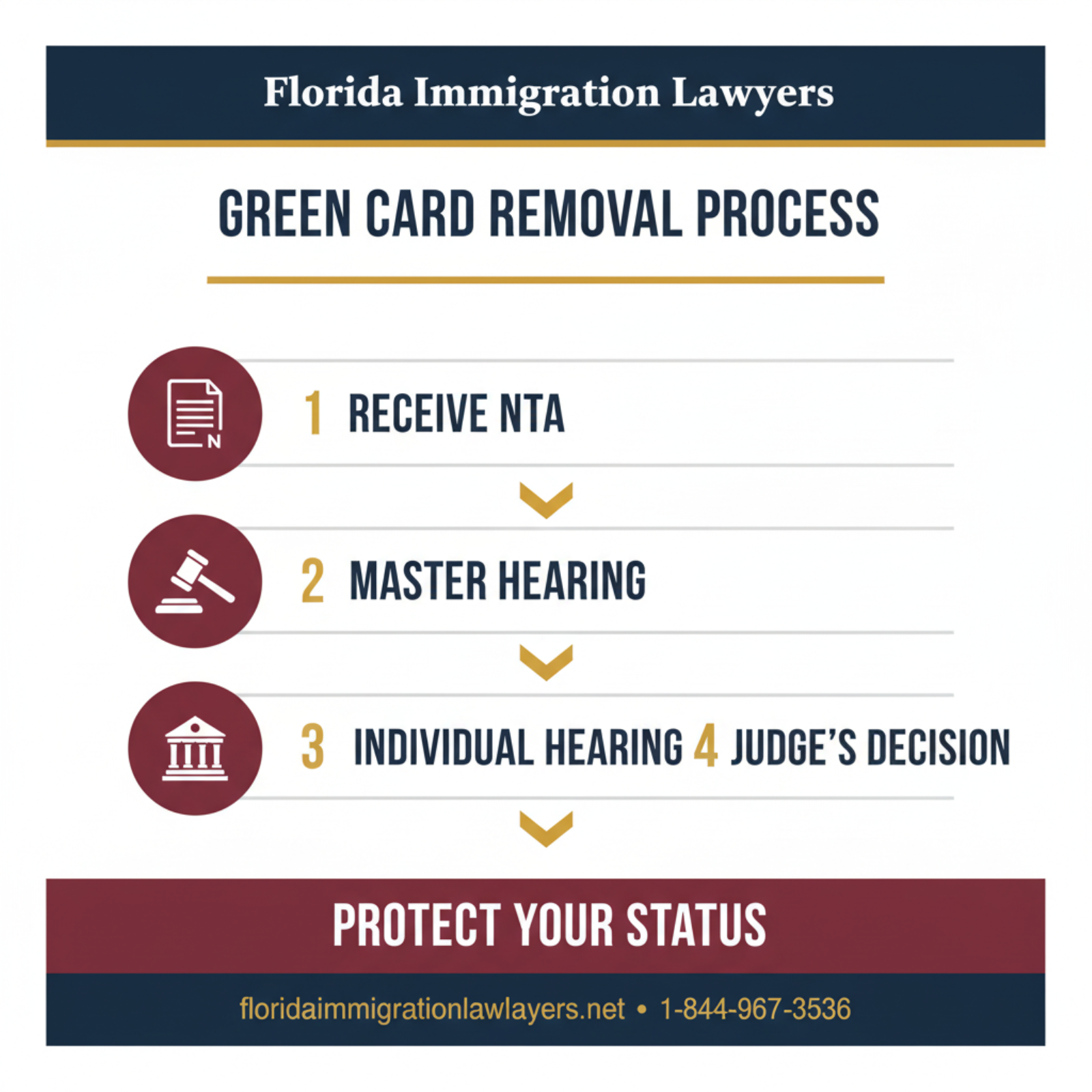
If your I-751 is denied, USCIS will generally issue an NTA, referring your case to an immigration court. The NTA specifies the grounds for removal and the charges against you. This document formally begins your removal proceedings.
-
Immigration Court Proceedings
Your case will then proceed through the immigration court system. This typically involves a Master Calendar Hearing, where you appear before an Immigration Judge to state your plea and identify forms of relief. This is followed by an Individual Hearing, which is a full trial where evidence is presented, and witnesses may testify. During these hearings, our Florida immigration lawyers can present a strong family immigration defense.
-
Appeals Process
If the Immigration Judge orders you removed, you may have the option to appeal the decision to the Board of Immigration Appeals (BIA). Further appeals can sometimes be made to a federal circuit court. Each stage of this process has strict deadlines and complex legal requirements.
Essential Documents for Your Green Card Removal Case
Successfully navigating USCIS green card removal proceedings in Florida hinges on presenting a robust case supported by comprehensive documentation. Gathering all necessary evidence is paramount, especially when arguing for the bona fides of your marriage or eligibility for a waiver.
Here is a checklist of documents typically required:
- Form I-751, Petition to Remove Conditions on Residence: The properly completed and signed form.
- USCIS Filing Fee: Proof of payment for the I-751 and biometrics fee.
- Copy of Your Conditional Green Card: Both front and back.
- Proof of Bona Fide Marriage (if filing jointly):
- Joint bank account statements, credit card statements.
- Joint leases or mortgages, property deeds.
- Birth certificates of children born to the marriage.
- Affidavits from friends, family, and employers attesting to the bona fides of the marriage.
- Utility bills in both names, joint insurance policies (health, life, auto).
- Photos of the couple together over time (family events, vacations).
- Tax returns filed jointly.
Step-by-Step Process Guide - Divorce Decree or Annulment (if filing with a waiver): If the marriage ended.
- Evidence of Abuse or Extreme Hardship (if filing with a waiver): Police reports, medical records, court orders, psychological evaluations, affidavits.
- Criminal Records and Disposition Documents: For any arrests or convictions, even if expunged. This is crucial for deportation defense.
- Personal Statement: A detailed narrative explaining your situation, especially if filing with a waiver.
- Any Previous Immigration Filings: Copies of I-130, I-485, etc.
Timeline and Processing Expectations for Conditional Residency
The timeline for USCIS green card removal proceedings in Florida can vary significantly depending on several factors, including the complexity of your case, the volume of applications at USCIS service centers, and the specific immigration court's caseload.
I-751 Processing Times
After filing your Form I-751, you will typically receive a receipt notice within a few weeks. This notice usually extends your conditional resident status for a period, often 24 or 48 months, allowing you to continue working and traveling. However, the actual processing time for the I-751 itself can range from several months to over two years. You can check current processing times on the USCIS website by selecting Form I-751 and your specific service center.
NTA and Immigration Court Dates
If your I-751 is denied and an NTA is issued, the wait for your first Master Calendar Hearing in immigration court can also be lengthy due to significant backlogs. In Florida, individuals might wait several months to over a year for their initial court appearance. Individual Hearings, which are essentially trials, are scheduled even further out, sometimes years after the Master Calendar Hearing.
It is crucial to be aware that these timelines are estimates and can change. Missing any deadlines or court dates can have severe consequences, including an order of removal in absentia. Staying informed and having legal counsel to track your case is essential.
Cost Factors and Fees in Green Card Removal Proceedings
Understanding the financial aspects of USCIS green card removal proceedings in Florida is important for effective planning. There are generally two main categories of costs: government filing fees and legal fees.
USCIS Filing Fees
When filing Form I-751, USCIS requires a filing fee and a biometrics fee. These fees are set by the government and are subject to change. It is important to consult the official USCIS website or your attorney for the most current fee schedule. If you are eligible for a fee waiver, you may be able to apply, but eligibility is strict.
Legal Fees for Representation
The cost of legal representation varies widely depending on the complexity of your case, the specific services required, and the experience of your attorney. An attorney's fees might cover: initial consultation, preparation and filing of the I-751 petition and supporting documents, representation at USCIS interviews, preparation for and representation at Master Calendar and Individual Hearings in immigration court, and any potential appeals.
While legal fees represent an investment, the value of experienced legal counsel in removal proceedings cannot be overstated. An attorney can significantly increase your chances of a favorable outcome and protect your ability to remain in Florida. Many firms, including Florida Immigration Lawyers, offer a free initial consultation to discuss your case and provide an estimate of legal costs.
Do not navigate this complex process alone. The stakes are incredibly high when facing USCIS green card removal proceedings in Florida. Contact Florida Immigration Lawyers today to protect your future in Florida.
Common Mistakes to Avoid in Your Florida Green Card Case
Navigating USCIS green card removal proceedings in Florida is complex, and even minor errors can have significant consequences. Avoiding these common mistakes is crucial for protecting your conditional permanent residency.
-
Failing to File Form I-751 on Time
The I-751 petition must be filed within the 90-day window before your conditional green card expires. Missing this deadline can lead to the automatic termination of your conditional status and the initiation of removal proceedings. Always mark your calendar and seek legal advice well in advance.
-
Submitting Inadequate Documentation for Bona Fide Marriage
USCIS requires substantial evidence to prove your marriage is genuine. Failing to provide a wide range of joint documents, such as bank statements, leases, utility bills, and photos, can lead to RFEs or even denial, triggering removal proceedings.
-
Ignoring Requests for Evidence (RFEs) or Interview Notices
If USCIS sends an RFE or schedules an interview, it is imperative to respond promptly and thoroughly. Ignoring these notices or providing incomplete responses can result in the denial of your I-751 petition.
-
Misrepresenting Facts or Committing Fraud
Any false statements or attempts to commit marriage fraud can lead to severe penalties, including a permanent bar from the U.S. and criminal charges. Always be truthful and transparent in all immigration matters.
-
Not Disclosing All Criminal History
Even minor arrests or convictions, including those that were expunged, must be disclosed to USCIS. Failure to do so can be considered misrepresentation and lead to inadmissibility or deportability, even for green card holders.
-
Leaving the U.S. During Proceedings Without Permission
If you are in removal proceedings, leaving the U.S. without obtaining advance parole or other specific permission can be interpreted as abandoning your case or your residency, potentially leading to an automatic order of removal.
-
Failing to Update Your Address with USCIS and EOIR
It is your responsibility to inform both USCIS and the immigration court (EOIR) of any address changes. Missing crucial notices, RFEs, or court dates because they were sent to an old address can result in an order of removal in absentia.
-
Appearing in Immigration Court Without Legal Counsel
Immigration court is a complex legal environment. Representing yourself against a government attorney without legal training puts you at a significant disadvantage and drastically reduces your chances of a successful outcome.
-
Assuming an Approved I-751 Waiver is Automatic
While waivers for divorce, abuse, or extreme hardship exist, they are not automatic. You must still provide strong, compelling evidence to support your waiver application. Each waiver has specific legal criteria that must be met.
-
Not Understanding Grounds for Deportation
Many green card holders are unaware of the various grounds that can lead to deportation, such as certain criminal offenses or violations of immigration law. Ignorance of the law is not a defense in immigration court.
-
Poor Interview Preparation
Whether for your I-751 or in immigration court, interviews require careful preparation. Appearing nervous, inconsistent, or unable to answer questions clearly can raise red flags for immigration officers or judges.
-
Falling Victim to Notarios or Unlicensed Practitioners
In Florida, as elsewhere, individuals posing as immigration experts (notarios) can offer unauthorized and often harmful legal advice. Always seek advice from licensed attorneys to avoid irreparable damage to your case.
When to Call a Florida Immigration Lawyer
The complexities of USCIS green card removal proceedings in Florida demand professional legal guidance. Knowing when to seek an attorney can be the difference between securing your residency and facing deportation. We recommend contacting Florida Immigration Lawyers if you encounter any of the following scenarios:
- You receive a Notice of Intent to Deny (NOID) or a denial of your Form I-751 petition.
- You have been issued a Notice to Appear (NTA) and are facing immigration court proceedings.
- You are a conditional resident and your marriage has ended in divorce or annulment, requiring you to file an I-751 waiver.
- You have experienced domestic violence or abuse and need to file an I-751 waiver based on that experience.
- You have any criminal history, no matter how minor, that could impact your immigration status.
- USCIS alleges marriage fraud or misrepresentation in your case.
- You are seeking asylum or other forms of relief from removal during court proceedings.
- You are pursuing citizenship and have concerns about your prior immigration history.
- Your employer needs assistance with business immigration matters that intersect with your personal status.
- You simply have questions about your conditional green card status or the I-751 process.
Our attorneys serve clients throughout Florida, including West Palm Beach and surrounding areas. We are committed to providing personalized and effective legal strategies. Visit our attorneys page to learn more about our team, or contact us directly for assistance.
Frequently Asked Questions (FAQs) About Green Card Removal Proceedings
Facing USCIS green card removal proceedings can raise many questions. Here are answers to some common inquiries related to conditional permanent residence and potential deportation in Florida.
Is ICE deporting people with green cards?
Yes, unfortunately, individuals with green cards, whether conditional or permanent, can face deportation (removal) by U.S. Immigration and Customs Enforcement (ICE). This typically occurs if they commit certain crimes, engage in fraud, or fail to remove conditions on their green card. A green card does not grant absolute immunity from removal, making strong legal defense essential.
What happens if you marry a U.S. citizen and then divorce?
If you marry a U.S. citizen and divorce before the conditions on your green card are removed (i.e., before your 2-year conditional period ends and your I-751 is approved), you generally cannot file Form I-751 jointly with your spouse. Instead, you will need to file Form I-751 with a waiver. Common waivers include divorce/annulment, domestic violence, or extreme hardship if you were to be removed from the U.S. This is a complex legal path that requires strong evidence and legal guidance.
What is the 2-year rule for green cards?
The "2-year rule" refers to the period of conditional permanent residence. If you received your green card based on a marriage that was less than two years old at the time of approval, your green card is valid for only two years. To obtain a 10-year permanent green card, you must file Form I-751, Petition to Remove Conditions on Residence, within the 90-day period immediately before your conditional green card expires. Failure to file on time can lead to the termination of your status and removal proceedings.
Can you get a green card if you have diabetes?
Generally, having diabetes itself is not a disqualifying factor for obtaining a green card. U.S. immigration law has specific health-related grounds for inadmissibility, primarily focusing on communicable diseases of public health significance (such as active tuberculosis) and certain physical or mental disorders that pose a threat to the property, safety, or welfare of the applicant or others. Diabetes, especially when managed, typically does not fall under these categories. However, it's always best to consult an immigration attorney if you have any medical condition that you believe might be a concern.
About Florida Immigration Lawyers
Florida Immigration Lawyers is a leading immigration law firm dedicated to serving individuals and families across the entire state of Florida. With years of specialized experience in immigration law, our firm understands the unique challenges and anxieties that immigrants face, particularly when dealing with complex issues like USCIS green card removal proceedings in Florida.
Our team of highly skilled and compassionate attorneys provides comprehensive legal services, including family immigration, deportation defense, asylum claims, naturalization, and business immigration. We are committed to offering personalized attention and strategic advocacy tailored to the specific needs of each client.
Why choose Florida Immigration Lawyers? We pride ourselves on our deep legal expertise, unwavering commitment to our clients, and a proven track record of success. We offer transparent communication and work tirelessly to protect your rights and help you achieve your immigration goals. Your future in Florida is our priority.
We are available 24/7 to answer your questions and provide support. We offer free consultations to help you understand your options without financial commitment. Serving all of Florida, including West Palm Beach, Miami, Orlando, and beyond. Contact us today.
Phone: 1-844-967-3536
Website: https://www.floridaimmigrationlawyers.net
Sources and References
- U.S. Citizenship and Immigration Services (USCIS)
- USCIS Form I-751, Petition to Remove Conditions on Residence
- USCIS Check Case Processing Times
- Executive Office for Immigration Review (EOIR)
- Immigration and Nationality Act (INA) Section 216 (8 U.S.C. § 1186a) - Conditional Permanent Resident Status
- 8 CFR Part 216 - Conditional Basis of Lawful Permanent Residence
- 8 U.S.C. Chapter 12 - Immigration and Nationality Act
This article provides general legal information and is not intended as legal advice. Every case is unique, and outcomes depend on specific facts and circumstances. Contact an attorney for advice about your particular situation.
The journey through USCIS green card removal proceedings in Florida can be daunting, but you do not have to face it alone. Florida Immigration Lawyers are here to provide the experienced, compassionate, and dedicated legal representation you deserve. Let us help you navigate the complexities of immigration law and protect your future in the United States.
Contact Florida Immigration Lawyers today for a free consultation. Call us at 1-844-967-3536. Se Habla Español - Estamos aquí para ayudarle.
Do Not Navigate This Process Alone
Our experienced immigration attorneys are ready to fight for you. Get a free, confidential consultation today.
Se Habla Español
Frequently Asked Questions
Florida Immigration Lawyers
Immigration Attorney | Founder, Vasquez Law Firm
U.S. Air Force veteran and immigration attorney with thousands of cases resolved. J.D., NCCU School of Law. AILA member. Admitted to the 4th, 5th, and 11th Circuit Courts.
Available 24/7 - Free Evaluations
Related Legal Services
Our Florida immigration attorneys can help you with family immigration services, immigration practice areas and free immigration consultation. Call today at 1-844-967-3536 for a free consultation.
Related Links
Related Topics
Free Legal Consultation
Discuss your case with our experienced attorneys. We're available 24/7.
Se Habla Español - Estamos aquí para ayudarle.
Related Articles
U Visa for Crime Victims in Coral Springs, Florida
Discover how the U visa can provide immigration relief for crime victims in Coral Springs, Florida. This blog covers eligibility, application processes, and common pitfalls to avoid. Contact Florida Immigration Lawyers for expert guidance.
DACA Renewal Florida 2026 Guide for Dreamers | VLF Florida
For thousands of young individuals, Deferred Action for Childhood Arrivals (DACA) provides a vital pathway to live and work legally in the United States. If you are a DACA recipient in Florida, preparing for your 2026 renewal is a critical step to maintain your protected status. This comprehensive guide from Florida Immigration Lawyers details the step-by-step process, essential documents, timelines, and cost factors. We also highlight common mistakes to avoid and specific scenarios when legal counsel is indispensable. Our aim is to provide clarity and empower you with the necessary information for a successful DACA renewal. Do not navigate this complex process alone; our experienced team is ready to assist you every step of the way.
DACA Renewal Guide for Dreamers in Florida 2026 | VLF Florida
Renew your DACA in Florida for 2026 with our comprehensive guide. From gathering documents to understanding costs, we cover it all. Contact Florida Immigration Lawyers for a free consultation and support through this process.
Know Your Immigration Rights in Florida | VLF Florida
Explore your immigration rights in Florida and learn how to protect yourself during ICE encounters. Florida Immigration Lawyers can help you navigate these challenges. Call 1-844-967-3536 for a free consultation.
