USCIS Green Card Removal Proceedings Florida: Expert Guide
Understanding USCIS green card removal proceedings in Florida is crucial for conditional permanent residents. This guide from Florida Immigration Lawyers details the I-751 petition to remove conditions, including step-by-step instructions, essential documents, processing times, and cost factors. Learn about joint filing requirements, available waivers, and common mistakes to avoid that could lead to termination of status. We also address frequently asked questions and explain when to seek expert legal assistance to safeguard your permanent residency in Florida.

USCIS green card removal proceedings Florida primarily refer to the process of removing conditions on a marriage-based green card (Form I-751) or, less commonly, actual removal (deportation) actions. Conditional permanent residents must file Form I-751 within 90 days before their green card expires to avoid automatic termination of status and potential deportation. This complex process requires careful documentation and adherence to strict deadlines.
- Conditional green cards are typically valid for two years.
- File Form I-751 to remove conditions within the 90-day window.
- Insufficient evidence or late filing can lead to loss of status.
- Waivers for joint filing are available in specific circumstances.
- Consulting an experienced Florida immigration lawyer is highly recommended.
Navigating the complex world of immigration law can feel overwhelming, especially when your permanent residency is at stake. Many individuals in Florida, particularly in vibrant communities like Hialeah, receive a conditional green card after marriage to a U.S. citizen or lawful permanent resident. This initial green card is valid for only two years, and the journey to full, unconditional permanent residency requires a crucial step: filing a petition to remove these conditions.
However, what happens if this process goes awry, or if you face challenges that could lead to your conditional status being terminated? This comprehensive guide from Florida Immigration Lawyers will walk you through everything you need to know about **USCIS green card removal proceedings Florida**, focusing on the I-751 petition to remove conditions. We will cover the process, required documents, timelines, costs, and common pitfalls to avoid. If you are concerned about your status, do not hesitate. Call Florida Immigration Lawyers at 1-844-967-3536 for a free consultation.
Understanding Conditional Permanent Residence in Florida
When you obtain a green card based on a marriage to a U.S. citizen or lawful permanent resident, and that marriage is less than two years old at the time your green card is approved, USCIS grants you conditional permanent resident status. This means your green card is valid for a temporary, two-year period.
The purpose of this conditional period, established by the Immigration and Nationality Act (INA) § 216, is for USCIS to verify the legitimacy of your marriage. The U.S. government wants to ensure that the marriage was entered into in good faith, not solely to obtain immigration benefits.
For individuals across Florida, from Miami to Orlando, Tampa to Jacksonville, understanding this distinction is vital. Your conditional status is not full permanent residency. You must take specific action to remove these conditions and secure your long-term future in the United States.
Eligibility for I-751: Joint Filing and Waivers
The primary way to remove the conditions on your green card is by filing Form I-751, Petition to Remove Conditions on Residence. This petition is typically filed jointly by both spouses. You and your petitioning spouse must demonstrate that your marriage was and continues to be bona fide.
However, life circumstances can change. USCIS understands this, offering waivers for the joint filing requirement in certain situations. These waivers are crucial for many conditional residents in Florida facing difficult personal circumstances.
You may be eligible for a waiver if your marriage ended in divorce or annulment, if your spouse died, or if you or your child were subjected to extreme cruelty or abuse by your U.S. citizen or lawful permanent resident spouse. Each waiver category has specific evidentiary requirements that must be met.
The I-751 Petition Process: A Step-by-Step Guide for Florida Residents
Successfully navigating the I-751 process is critical to avoiding **USCIS green card removal proceedings Florida**. Here is a detailed, step-by-step guide for conditional residents:
-
Determine Your Filing Category and Eligibility: First, confirm you are within the 90-day window before your conditional green card expires. If you are filing jointly, ensure your marriage is still intact and bona fide. If not, assess if you qualify for a waiver of the joint filing requirement (e.g., divorce, abuse, death of spouse).
-
Gather All Required Documentation: This is perhaps the most critical step. Collect extensive evidence proving the bona fides of your marriage. This includes joint financial documents, evidence of cohabitation, birth certificates of children born to the marriage, and affidavits from friends and family. A comprehensive **I-751 documents checklist** is essential.
-
Complete Form I-751, Petition to Remove Conditions on Residence: Fill out the form accurately and completely. Any errors or omissions can lead to delays or rejections. Be meticulous with every section, providing truthful and consistent information.
-
Pay the Required Filing Fees: USCIS charges a filing fee for Form I-751 and a separate biometric services fee. These fees are subject to change, so always check the latest amounts on the USCIS website. The **removal of conditions green card fee** must be paid correctly to avoid processing delays.
-
Mail Your Petition to USCIS: Send your completed Form I-751, all supporting documents, and the correct fees to the appropriate USCIS Lockbox facility. The address depends on the delivery method (USPS vs. private courier). Always send your package with tracking and delivery confirmation.
-
Receive a Receipt Notice and Extension Letter: After USCIS receives your petition, you will get Form I-797C, Notice of Action. This notice serves as your receipt and typically extends your conditional permanent resident status, along with your expiring green card, for a specific period (often 24-48 months) while your case is pending. This allows you to continue working and traveling.
-
Attend Your Biometrics Appointment: USCIS will schedule you for a biometrics appointment at an Application Support Center (ASC) in Florida, such as those in Hialeah, Miami, or Orlando. At this appointment, your fingerprints, photograph, and signature will be taken for background checks.
-
Prepare for a Potential Interview: While many I-751 petitions are approved without an interview, USCIS may schedule one, especially for waiver cases or if they have questions about the marriage. If an interview is scheduled at a USCIS field office in Florida (e.g., Miami, Tampa), both spouses (if filing jointly) must attend and be prepared to answer questions about their marriage.
-
Receive a Decision from USCIS: After reviewing all evidence and conducting any necessary interviews, USCIS will make a decision. If approved, you will receive a new 10-year unconditional green card. If denied, your conditional status will be terminated, and you may be placed into **USCIS green card removal proceedings Florida** before an immigration judge at an immigration court in Florida, such as the Miami Immigration Court.
Essential Documents for Your I-751 Petition in Florida
A strong I-751 petition hinges on compelling evidence. The more proof you can provide of a bona fide marriage, the better your chances of a smooth approval. Here is a general **I-751 documents checklist**:
- Copy of your conditional green card (front and back).
- Copy of your marriage certificate.
- Birth certificates of any children born to your marriage.
- Joint bank statements, credit card statements, and investment accounts.
- Joint utility bills (electricity, water, gas, internet) showing shared residence.
- Lease agreements, mortgage statements, or property deeds showing joint ownership or tenancy.
- Joint tax returns (filed together for the years you have been married).
- Insurance policies (health, life, auto, home) listing each other as beneficiaries.
- Photographs of you and your spouse together over time, with family, and at events.
- Affidavits from friends, family, and employers attesting to the legitimacy of your marriage.
- Travel itineraries and tickets for trips taken together.
- Any other evidence demonstrating commingling of financial resources or shared marital life.
- If filing a waiver: divorce decree, death certificate, police reports, medical records, or other evidence supporting the waiver claim.
USCIS Processing Times and Expectations for Florida Cases
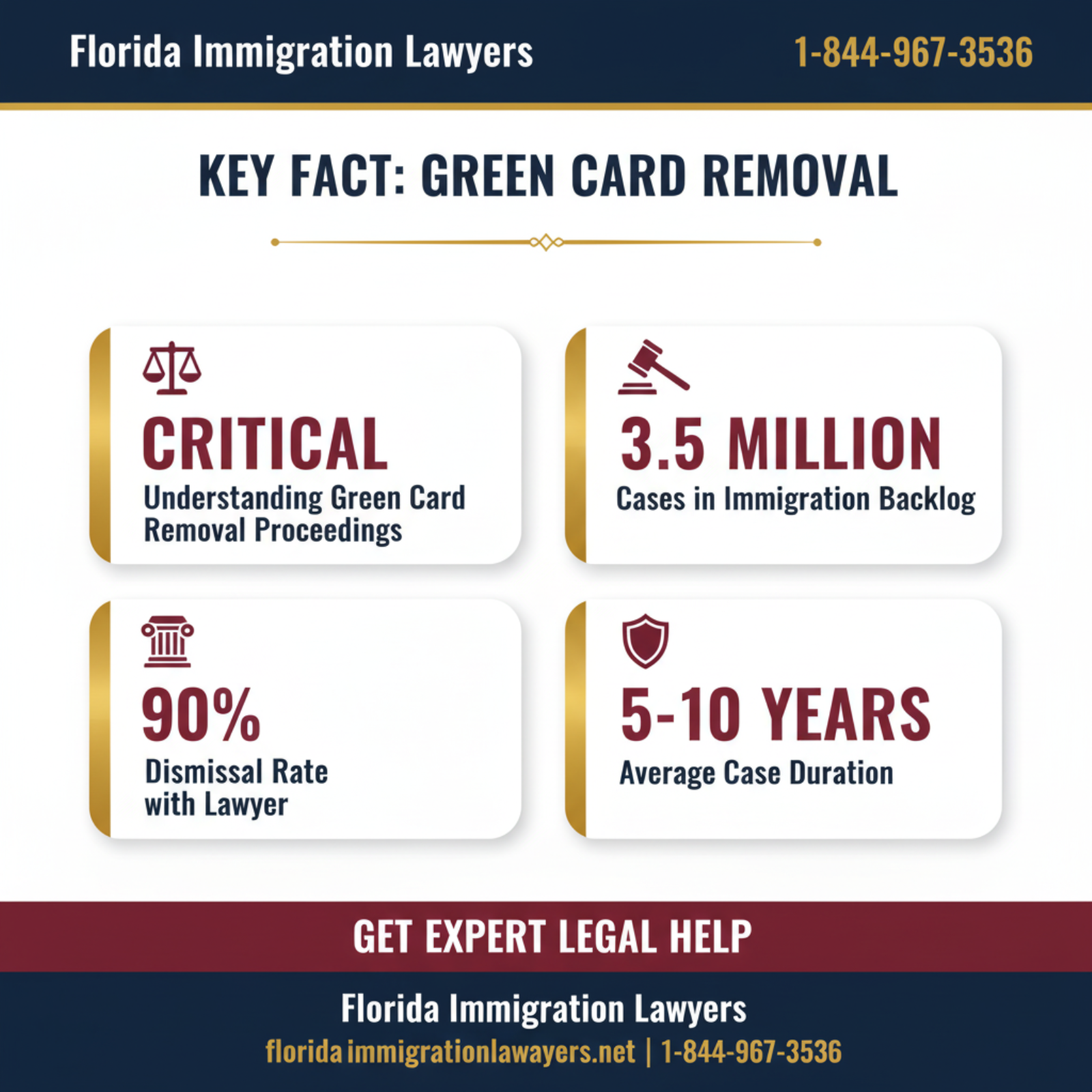
The **I-751 removal of conditions processing time** can vary significantly. It is common for cases to take anywhere from 12 to 24 months, or even longer in some instances. These timelines are estimates and can fluctuate based on USCIS caseloads, policy changes, and the complexity of individual cases.
During this waiting period, your receipt notice (Form I-797C) serves as proof of your extended status. This is crucial for employment, travel, and other legal purposes. Always carry this notice with your expired conditional green card.
You can check the general processing times for Form I-751 on the USCIS website. While there isn't a specific **USCIS removal order lookup** for I-751 petitions, you can track your case status online using your receipt number. If your case experiences significant delays, you may consider contacting USCIS or seeking assistance from a **Florida immigration lawyer**.
Cost Factors and Fee Breakdown for Removing Conditions
Understanding the financial aspects of removing conditions is important for planning. The total cost involves government filing fees and potentially legal fees if you choose to hire an attorney.
The **removal of conditions green card fee** consists of:
- Form I-751 Filing Fee: This is the primary fee for submitting your petition.
- Biometric Services Fee: A separate fee for the collection of your fingerprints and photograph.
It is critical to note that USCIS fees are subject to change. Always verify the current fee schedule on the official USCIS website before submitting your application. Incorrect fee amounts can lead to your petition being rejected and returned, causing significant delays.
Beyond government fees, consider the cost of legal representation. While not mandatory, an experienced immigration lawyer can be invaluable, especially for complex cases or waivers. Legal fees vary depending on the complexity of your case and the services required. A reputable firm like Florida Immigration Lawyers offers transparent fee structures and can discuss these costs during your free consultation.
Do not navigate this process alone. Contact Florida Immigration Lawyers today.
Common Mistakes to Avoid in Conditional Green Card Cases
Avoiding critical errors can save you from severe consequences, including the termination of your conditional status and potential **USCIS green card removal proceedings Florida**. Here are common mistakes:
-
Filing Too Late or Not At All: The most critical mistake is failing to file Form I-751 within the 90-day window before your conditional green card expires. Consequences: Automatic termination of status and initiation of removal proceedings.
-
Insufficient Evidence of Bona Fide Marriage: Submitting a petition with weak or inadequate proof that your marriage is genuine. Consequences: Request for Additional Evidence (RFE), interview, or denial, leading to removal proceedings.
-
Not Updating Your Address with USCIS: Failing to inform USCIS of any address changes. Consequences: Missing important notices, RFEs, or interview appointments, which can lead to denial and removal proceedings.
-
Errors or Inconsistencies on Form I-751: Providing incorrect information or inconsistent details across your application and supporting documents. Consequences: Delays, RFEs, or denial, raising red flags for USCIS.
-
Missing Your Biometrics Appointment or Interview: Failing to attend scheduled appointments without proper rescheduling. Consequences: Denial of your petition and possible placement into removal proceedings.
-
Misunderstanding Waiver Eligibility: Assuming you don't qualify for a waiver after divorce or abuse, or filing a waiver without sufficient evidence. Consequences: Incorrect filing, denial, and potential removal from the U.S.
-
Not Disclosing Criminal History: Failing to disclose any criminal arrests or convictions, even minor ones. Consequences: Grounds for inadmissibility or deportability, leading to severe immigration consequences.
-
Traveling Internationally Without Valid Proof of Status: Traveling outside the U.S. without your I-797C receipt notice and expired green card. Consequences: Difficulty re-entering the U.S., as proof of status is essential.
-
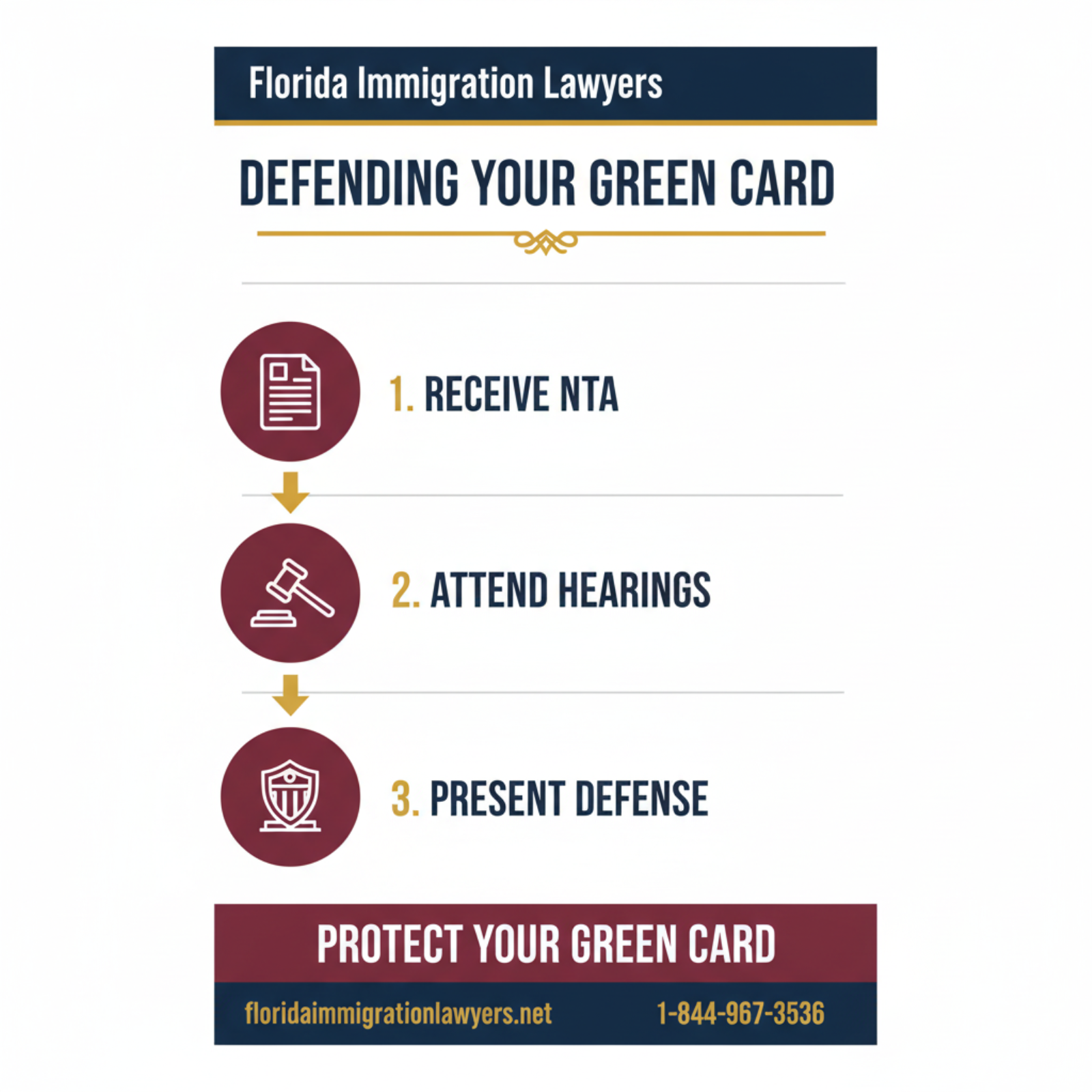
Ignoring a Notice to Appear (NTA): If USCIS denies your I-751, you will likely receive an NTA, placing you into **USCIS green card removal proceedings Florida** before an immigration judge. Ignoring this notice is catastrophic. Consequences: An in absentia removal order, making it extremely difficult to return to the U.S.
-
Attempting to Handle a Complex Case Alone: Especially for waiver cases, or if you have a criminal record or previous immigration issues. Consequences: Mistakes that could be easily avoided with legal counsel, leading to denial.
When to Call a Florida Immigration Lawyer
While some straightforward I-751 cases may seem manageable on your own, the stakes are incredibly high. The risk of errors leading to **USCIS green card removal proceedings Florida** makes legal counsel invaluable. You should strongly consider contacting Florida Immigration Lawyers if any of the following apply to your situation:
- Your Marriage Has Ended: If you are divorced, separated, or your spouse has passed away, you will need to file a waiver. These cases are highly complex and require strong legal arguments and extensive evidence.
- You Have Been Subjected to Abuse: If you or your child experienced abuse or extreme cruelty, a waiver based on battered spouse or child provisions is available. This is a sensitive area where experienced legal guidance is crucial.
- You Have a Criminal Record: Any arrests or convictions, even minor ones, can complicate your I-751 petition and potentially lead to inadmissibility or deportability. An attorney can assess the impact and help mitigate risks.
- You Filed Late: If you missed the 90-day filing window, you must demonstrate good cause for the late filing. This requires a compelling explanation and supporting evidence.
- You Received a Request for Evidence (RFE) or Notice of Intent to Deny (NOID): These notices indicate that USCIS has concerns about your petition. An attorney can help you understand the issues and prepare a robust response.
- You Received a Notice to Appear (NTA): This means USCIS has terminated your conditional status and initiated **removal proceedings**. You will need immediate and aggressive deportation defense representation at the Miami Immigration Court or other Florida immigration courts.
- You Have Other Immigration Issues: Past visa overstays, previous denials, or other immigration complexities warrant professional legal advice.
- You Simply Want Peace of Mind: Even in seemingly straightforward cases, the expertise of a skilled attorney can ensure your petition is perfectly prepared, maximizing your chances of approval and minimizing stress. Our firm also handles family immigration and business immigration matters.
About Florida Immigration Lawyers
Florida Immigration Lawyers is a leading law firm dedicated to providing exceptional immigration legal services to individuals and families across the Sunshine State. With a deep understanding of U.S. immigration law and a compassionate approach, we are committed to helping our clients achieve their immigration goals.
Our experienced team specializes in a wide range of immigration matters, including green card petitions, asylum, deportation defense, citizenship applications, and complex **USCIS green card removal proceedings Florida**. We pride ourselves on offering personalized attention, strategic advice, and vigorous advocacy for every client.
Why choose Florida Immigration Lawyers? We offer free consultations, are available 24/7 to address your urgent concerns, and serve all of Florida, including Hialeah, Miami, Orlando, and Tampa. Our bilingual team is ready to assist you in English and Spanish, ensuring clear communication and understanding throughout your legal journey. Trust us to be your dedicated advocates in the intricate landscape of immigration law. Visit https://www.floridaimmigrationlawyers.net or call us at 1-844-967-3536.
Addressing Common Questions About Green Card Removal Proceedings
Here are answers to some frequently asked questions regarding green card removal proceedings and conditional residency:
-
Is ICE deporting people with green cards? Yes, under certain circumstances, even lawful permanent residents (green card holders) can face removal (deportation) proceedings. This typically occurs if they commit certain crimes, violate immigration laws, or, in the case of conditional residents, fail to remove the conditions on their green card successfully. Conditional residents are particularly vulnerable if their I-751 petition is denied.
-
What happens if you marry a U.S. citizen and then divorce? If your marriage ends in divorce or annulment before you file your I-751, or while it's pending, you can still file Form I-751 with a request for a waiver of the joint filing requirement. You must demonstrate that your marriage was entered into in good faith, not to circumvent immigration laws, and that the divorce occurred. This is a complex waiver that requires substantial evidence and often legal assistance.
-
What is the 2-year rule for green cards? The 2-year rule refers to the conditional permanent resident status granted to spouses of U.S. citizens or lawful permanent residents if their marriage is less than two years old when the green card is approved. This conditional status is valid for two years. Before it expires, the couple (or the individual, if filing a waiver) must file Form I-751 to remove the conditions and obtain a 10-year unconditional green card.
-
Can you get a green card if you have diabetes? Generally, having diabetes alone is not a ground for inadmissibility or denial of a green card, including the removal of conditions. Immigration medical exams primarily screen for communicable diseases of public health significance and certain physical or mental disorders that could pose a risk. However, specific complications or severe cases that might impact one's ability to care for oneself or pose a public health risk could be reviewed on a case-by-case basis. This question is more relevant for the initial green card application rather than the I-751 process.
Sources and References
- U.S. Citizenship and Immigration Services (USCIS) - Form I-751, Petition to Remove Conditions on Residence
- U.S. Citizenship and Immigration Services (USCIS) Policy Manual
- Executive Office for Immigration Review (EOIR) - Miami Immigration Court
- 8 U.S.C. § 1186a - Conditional permanent resident status for certain alien spouses and sons and daughters
- Immigration and Nationality Act (INA) § 216
- 8 CFR § 216 - Conditional permanent resident status for certain alien spouses and sons and daughters
This article provides general legal information and is not intended as legal advice. Every case is unique, and outcomes depend on specific facts and circumstances. Contact an attorney for advice about your particular situation.
Do not let the complexities of **USCIS green card removal proceedings Florida** threaten your future in the United States. Our dedicated team at Florida Immigration Lawyers is here to provide the expert guidance and robust representation you need. We understand the nuances of immigration law and are committed to protecting your rights. For a free, confidential consultation, call us today at 1-844-967-3536. Se Habla Español - Estamos aquí para ayudarle.
Do Not Navigate This Process Alone
Our experienced immigration attorneys are ready to fight for you. Get a free, confidential consultation today.
Se Habla Español
Frequently Asked Questions
Florida Immigration Lawyers
Immigration Attorney | Founder, Vasquez Law Firm
U.S. Air Force veteran and immigration attorney with thousands of cases resolved. J.D., NCCU School of Law. AILA member. Admitted to the 4th, 5th, and 11th Circuit Courts.
Available 24/7 - Free Evaluations
Related Legal Services
Our Florida immigration attorneys can help you with immigration practice areas, free immigration consultation and experienced immigration attorneys. Call today at 1-844-967-3536 for a free consultation.
Related Links
Related Topics
Free Legal Consultation
Discuss your case with our experienced attorneys. We're available 24/7.
Se Habla Español - Estamos aquí para ayudarle.
Related Articles
VAWA Self-Petition Florida: Abused Spouses Immigration Guide
For abused spouses in Florida, the VAWA self-petition offers a critical pathway to legal immigration status without the abuser's cooperation. This comprehensive guide details the eligibility requirements, the step-by-step process of filing Form I-360, essential documentation, and expected timelines. Learn how to gather evidence, draft a compelling personal statement, and understand the costs and potential fee waivers. We also highlight common mistakes to avoid and explain when seeking legal counsel from Florida Immigration Lawyers is invaluable. This process is designed to empower survivors to achieve safety, independence, and a secure future, free from the fear of deportation.
Immigration Bond Hearing Florida: Get Released from ICE Detention
Facing an immigration bond hearing in Florida can be daunting, especially for families in Kissimmee, Orlando, and Miami. This comprehensive guide demystifies the process, explaining what an immigration bond hearing entails, who is eligible, and the crucial steps to take. We detail the essential documents required, outline timelines and cost factors, and highlight common mistakes to avoid. Discover why experienced legal representation from Florida Immigration Lawyers is vital to navigate this complex system and secure release from ICE detention. Understand your rights and learn how to present a strong case for bond.
Understanding the Child Status Protection Act in Florida
The Child Status Protection Act helps families in Florida prevent their children from aging out of immigration eligibility. Learn how it works and what steps to take if you're in Miami or elsewhere in Florida.
Dual Citizenship Guide for Florida Residents | VLF Florida
Explore the essentials of obtaining dual citizenship in Florida. Learn the benefits, challenges, and steps involved. Contact Florida Immigration Lawyers for expert guidance.