USCIS Green Card Removal Proceedings Florida: Your Expert Guide
For conditional green card holders in Florida, understanding USCIS green card removal proceedings and the I-751 petition is critical. Failure to remove conditions can lead to deportation. This guide details the step-by-step process for filing Form I-751, essential documentation, processing timelines, and cost factors. We also cover common mistakes to avoid and specific scenarios when legal counsel from Florida Immigration Lawyers is indispensable. With heightened immigration enforcement in Florida, expert legal assistance from our St. Petersburg-focused firm is vital to protect your status. Learn how to navigate these challenges and secure your permanent residency.
Quick Answer: USCIS green card removal proceedings typically refer to the process of ending a conditional permanent resident's status, often due to failure to remove conditions on a two-year green card, or to broader deportation processes. For conditional residents in Florida, this usually involves filing Form I-751, Petition to Remove Conditions on Residence. Failure to properly file or qualify can lead to removal proceedings before an immigration judge. Seeking legal counsel is critical to protect your status.
- Conditional green cards require filing Form I-751 to remove conditions.
- Missing the filing deadline can trigger removal proceedings.
- Complex cases, like divorce or criminal issues, need legal waivers.
- Florida has active immigration enforcement; expert legal defense is vital.
- Consult Florida Immigration Lawyers for a strong defense and guidance.
Obtaining a green card is a life-changing achievement, offering stability and a path to a future in the United States. However, for many, this journey begins with a conditional green card, particularly if your status was granted through marriage to a U.S. citizen for less than two years, or as an investor. These conditional green cards come with an expiration date, and failing to remove these conditions can put your immigration status at risk, potentially leading to USCIS green card removal proceedings in Florida.
The thought of losing your hard-earned status can be incredibly stressful and confusing. You might be wondering about the steps involved in removing conditions, what happens if your circumstances change, or how to navigate the complex legal landscape. In Florida, with its active immigration enforcement, understanding your rights and obligations is more important than ever. Our goal with this comprehensive guide is to demystify the process of removing conditions on your green card and explain what to do if you find yourself facing removal proceedings.
We will walk you through the specifics of Form I-751, the critical petition used to remove conditions, discuss common challenges, and outline the importance of legal representation. Whether you are in St. Petersburg, Miami, Orlando, or anywhere else in the Sunshine State, our firm is here to support you. Do not face this complex legal challenge alone. Call Florida Immigration Lawyers at 1-844-967-3536 for a free consultation to discuss your specific situation and learn how we can help protect your future in Florida.
Understanding USCIS Green Card Removal Proceedings in Florida
A conditional green card is issued for two years and is primarily given to individuals who obtained their permanent resident status through marriage to a U.S. citizen or lawful permanent resident, and the marriage was less than two years old on the day they received their green card. It is also issued to certain investor immigrants. The purpose of this conditional period is for USCIS to verify the legitimacy of the marriage or investment.
The term "USCIS green card removal proceedings Florida" can refer to two distinct but related concepts. First, it refers to the process of removing the conditions on a two-year conditional green card. Failure to successfully complete this process will lead to the termination of your conditional resident status. Second, and more gravely, it refers to the formal legal process, known as deportation or removal proceedings, where the U.S. government seeks to revoke a non-citizen's legal right to remain in the country. This can happen if you fail to remove your conditions, commit certain crimes, or violate immigration laws.
In Florida, the stakes are particularly high. Recent operations, such as "Operation Tidal Wave," and partnerships between state law enforcement and ICE through programs like 287(g), highlight a heightened focus on immigration enforcement across the state. This means that any misstep in your immigration process, including issues with your conditional green card, could potentially lead to serious consequences, including detention and formal removal proceedings. It is crucial to be proactive and ensure all your immigration filings are accurate and timely.
A conditional permanent resident holds nearly all the same rights and responsibilities as a permanent resident. However, the conditional nature means your status is temporary until you prove that the basis for your green card is legitimate and ongoing. This is why the process of removing conditions is so vital for your continued residency in the United States.
The I-751 Petition: Removing Conditions on Your Green Card
The primary method for a conditional permanent resident to remove the conditions on their green card is by filing Form I-751, Petition to Remove Conditions on Residence. This form must generally be filed jointly by the conditional resident and the petitioning spouse or investor within the 90-day period immediately preceding the second anniversary of when the conditional resident status was granted. Missing this critical window can have severe repercussions.
The purpose of Form I-751 is to demonstrate to USCIS that the marriage or investment that led to your conditional green card was entered into in good faith and remains valid. For marriage-based conditional residents, you must provide substantial evidence of a bona fide marriage, proving that you and your spouse established a life together and did not enter the marriage solely for immigration benefits. For investor immigrants, you must show that your investment met all requirements and created the necessary jobs.
Step-by-Step Guide to Filing Form I-751 in 2026
Navigating the I-751 process can be complex, but following these steps can help ensure a smoother experience:
- Determine Your Eligibility and Filing Category: Most conditional residents file jointly with their spouse. However, if your marriage ended in divorce, your spouse is deceased, or you were subjected to abuse, you may be eligible for a waiver of the joint filing requirement. Understanding which category applies to you is the first critical step.
- Gather Comprehensive Supporting Documentation: This is arguably the most important step. You must collect extensive evidence to prove the legitimacy of your marriage or investment. For marriage-based petitions, this includes joint financial documents, shared property, children's birth certificates, and affidavits. For investor petitions, this involves detailed business records and proof of job creation.
- Complete Form I-751 Accurately: Fill out every section of the form completely and truthfully. Any omissions or errors can cause delays or even lead to a denial. Ensure all questions are answered, and pay close attention to the instructions provided by USCIS.
- Prepare the Filing Fees: USCIS requires a filing fee for Form I-751, along with a separate biometrics fee. These fees are subject to change, so always check the official USCIS website for the most current amounts. Do not send cash; typically, personal checks, money orders, or cashier's checks are accepted.
- Assemble and Mail Your Petition Packet: Organize your documents neatly, ideally with a cover letter and tabs for different sections of evidence. Make copies of everything you send for your records. Mail the complete package to the correct USCIS lockbox facility as specified in the Form I-751 instructions.
- Receive Your Receipt Notice and Status Extension: After USCIS receives your petition, you will receive Form I-797C, Notice of Action. This notice serves as a receipt and typically extends your conditional permanent resident status for a specified period (often 24 months) while your petition is pending. This notice, along with your expired green card, serves as proof of your continued legal status.
- Attend Your Biometrics Appointment: USCIS will send you an appointment notice for biometrics collection (fingerprints, photograph, and signature) at an Application Support Center (ASC). This is a mandatory step.
- Prepare for a Potential Interview: While not all I-751 petitioners are interviewed, USCIS reserves the right to schedule an interview, especially if there are concerns about the bona fides of the marriage or if you filed a waiver. If an interview is scheduled, both spouses (if filing jointly) must attend.
- Receive a Decision: After reviewing your petition and any interview, USCIS will issue a decision. If approved, you will receive a new 10-year permanent resident card. If denied, your conditional status will be terminated, and you will likely be placed in removal proceedings.
Required Documentation for I-751
The strength of your I-751 petition heavily relies on the evidence you provide. USCIS wants to see proof of a shared life and a legitimate relationship. Here is a general checklist of documents you should consider including:
- Copy of your conditional green card (front and back).
- Copy of your marriage certificate.
- Birth certificates of any children born during the marriage.
- Joint bank account statements (checking, savings, credit cards).
- Joint utility bills (electricity, water, gas, internet).
- Leases or mortgages showing joint residency or ownership.
- Joint tax returns (federal and state) for the conditional period.
- Insurance policies (health, auto, life) listing each other as beneficiaries.
- Vehicle titles or registrations showing joint ownership.
- Affidavits from friends, family, and employers attesting to the bona fides of your marriage.
- Photographs of you and your spouse together over time, with family, and at significant events.
- Travel itineraries and tickets for trips taken together.
- Any other documents proving the commingling of your lives and finances.
If you are filing a waiver, additional documentation will be required, such as divorce decrees, police reports, medical reports, or evidence of extreme hardship.
Navigating Timelines and Processing Expectations for I-751 in 2026
The processing times for Form I-751 can vary significantly. In 2026, applicants in Florida, like those elsewhere, should expect a waiting period that can range from several months to over two years. USCIS publishes estimated processing times on its website, which are regularly updated. These times are for general guidance only and can be influenced by various factors.
Factors that can impact your I-751 processing time include the volume of applications received by USCIS, the complexity of your case (e.g., joint filing versus a waiver), the thoroughness of your initial submission, and whether an interview is required. USCIS field offices in Florida, such as those in Miami, Orlando, and Tampa, handle interviews and local reviews, which can add to the processing duration.
While your I-751 is pending, the receipt notice (Form I-797C) extends your conditional permanent resident status. This means you maintain your legal status, work authorization, and ability to travel internationally, provided you carry your expired green card and the I-797C notice. It is essential to keep these documents safe and readily accessible.
If your case remains pending for an extended period, you may be able to schedule an InfoPass appointment or contact USCIS to inquire about your status. However, patience is often necessary with these applications. Having a well-prepared application from the outset can help prevent unnecessary delays or requests for additional evidence.
Cost Factors and Fee Breakdown for Removing Green Card Conditions
Understanding the financial aspects of removing conditions on your green card is crucial for proper planning. The costs primarily consist of USCIS filing fees and potential legal fees if you choose to hire an attorney. It is important to remember that USCIS fees are subject to change, so always verify the current amounts on the official USCIS website before filing.
- USCIS Filing Fee for Form I-751: This is the base fee for processing your petition.
- Biometrics Services Fee: A separate fee is required for your biometrics appointment, which covers the cost of collecting your fingerprints, photograph, and signature.
- Attorney Fees: Hiring an experienced immigration attorney, such as those at Florida Immigration Lawyers, involves legal fees. These fees cover the attorney's expertise in preparing your petition, gathering evidence, responding to USCIS requests, and representing you if an interview is required. While an additional cost, legal representation can significantly increase your chances of success and reduce stress.
- Ancillary Costs: You may incur other minor costs, such as fees for obtaining certified copies of documents (e.g., marriage certificates, divorce decrees), translation services if documents are not in English, and postage for mailing your application.
While the fees can seem substantial, they are an investment in your continued legal status in the United States. Attempting to save money by filing an incomplete or incorrect petition can lead to far greater costs down the line, including potential denial and the expense of fighting removal proceedings. Always budget for these costs and plan accordingly.
Do not navigate this complex process alone. The legal requirements and potential pitfalls of conditional green card removal can be overwhelming. Contact Florida Immigration Lawyers today to ensure your petition is handled with precision and care, protecting your future in Florida.
Common Mistakes to Avoid in Conditional Green Card Cases
Successfully removing conditions from your green card requires meticulous attention to detail and a thorough understanding of immigration law. Many applicants make common mistakes that can jeopardize their status. Here are 7-12 critical errors to avoid:
- Filing Form I-751 Late: This is one of the most common and detrimental mistakes. The petition must be filed within the 90-day window before your conditional green card expires. Filing even one day late can result in USCIS rejecting your petition and initiating removal proceedings against you. There are very limited exceptions for late filings, requiring compelling circumstances.
- Submitting Insufficient Evidence: A weak application with inadequate documentation is a primary reason for denials. USCIS requires substantial proof of a bona fide marriage or investment. Simply submitting a marriage certificate is not enough. Failing to provide a wide array of joint documents demonstrating a shared life will raise red flags.
- Ignoring USCIS Requests for Evidence (RFE): If USCIS sends you an RFE, it means they need more information or clarification. Failing to respond fully and on time will almost certainly lead to a denial. Take every RFE seriously and provide all requested documents promptly.
- Failing to Update Your Address with USCIS: If you move, you are legally required to inform USCIS of your new address within 10 days. Failure to do so can result in you missing critical notices, such as biometrics appointments or interview notices, leading to denial or even removal proceedings in absentia.
- Misrepresenting Facts or Committing Fraud: Any attempt to misrepresent facts, provide false information, or commit fraud during the I-751 process will lead to an immediate denial, severe legal penalties, and potentially a permanent bar from receiving any future immigration benefits. Honesty and accuracy are paramount.
- Not Seeking Legal Counsel for Waiver Cases: If you are filing a waiver of the joint filing requirement (e.g., due to divorce, abuse, or extreme hardship), your case is inherently more complex. Attempting to navigate these sensitive and legally nuanced situations without an experienced immigration attorney significantly reduces your chances of approval.
- Traveling Internationally Without Proper Documentation: While your I-797C receipt notice extends your status, you must carry both the notice and your expired conditional green card when traveling. Without these, you may face difficulties re-entering the United States, especially at busy ports of entry in Florida.
- Having Unresolved Criminal History Issues: Certain criminal convictions, even minor ones, can make you ineligible to remove conditions or can trigger removal proceedings. It is crucial to disclose any criminal history to your attorney, as it will likely be discovered by USCIS or ICE.
- Assuming an Interview is Not Necessary: While many I-751 cases are approved without an interview, USCIS can request one at any time. Assuming you won't be interviewed and therefore not preparing for one is a mistake. Be ready to discuss your marriage or investment in detail.
- Not Preparing for the Interview: If an interview is scheduled, you and your spouse (if applicable) must be well-prepared. Review your submitted evidence, be consistent in your answers, and be ready to answer questions about your relationship or investment. Inconsistent answers can lead to suspicion.
When to Call an Immigration Lawyer in St. Petersburg, Florida
While some straightforward I-751 cases can be filed without legal assistance, many situations warrant the expertise of an experienced immigration lawyer. Given the complexities of immigration law and the severe consequences of errors, consulting with a legal professional, particularly in a high-enforcement state like Florida, is often the wisest course of action.
You should consider contacting Florida Immigration Lawyers if any of the following scenarios apply to your conditional green card case:
- Divorce or Annulment: If your marriage ended before you could file the I-751 jointly, you will need to file a waiver. This is a complex legal process that benefits immensely from legal guidance.
- Abuse or Extreme Cruelty: If you or your child were subjected to abuse by your U.S. citizen or permanent resident spouse, you may be eligible for a waiver. Our compassionate attorneys can help you navigate this sensitive situation.
- Death of Petitioning Spouse: If your spouse passed away, you can also file a waiver. An attorney can ensure you meet all requirements.
- Extreme Hardship: If the termination of your conditional status would result in extreme hardship, you may qualify for a waiver. Proving extreme hardship is a high legal bar that requires compelling evidence and strong legal arguments.
- Late Filing: If you missed the 90-day filing window, an attorney can assess if you have a valid reason for the delay and help you prepare a compelling argument for a late filing.
- Criminal History: Any past arrests or convictions can significantly complicate your immigration case and potentially lead to removal proceedings. An attorney can evaluate your record and advise on the best course of action.
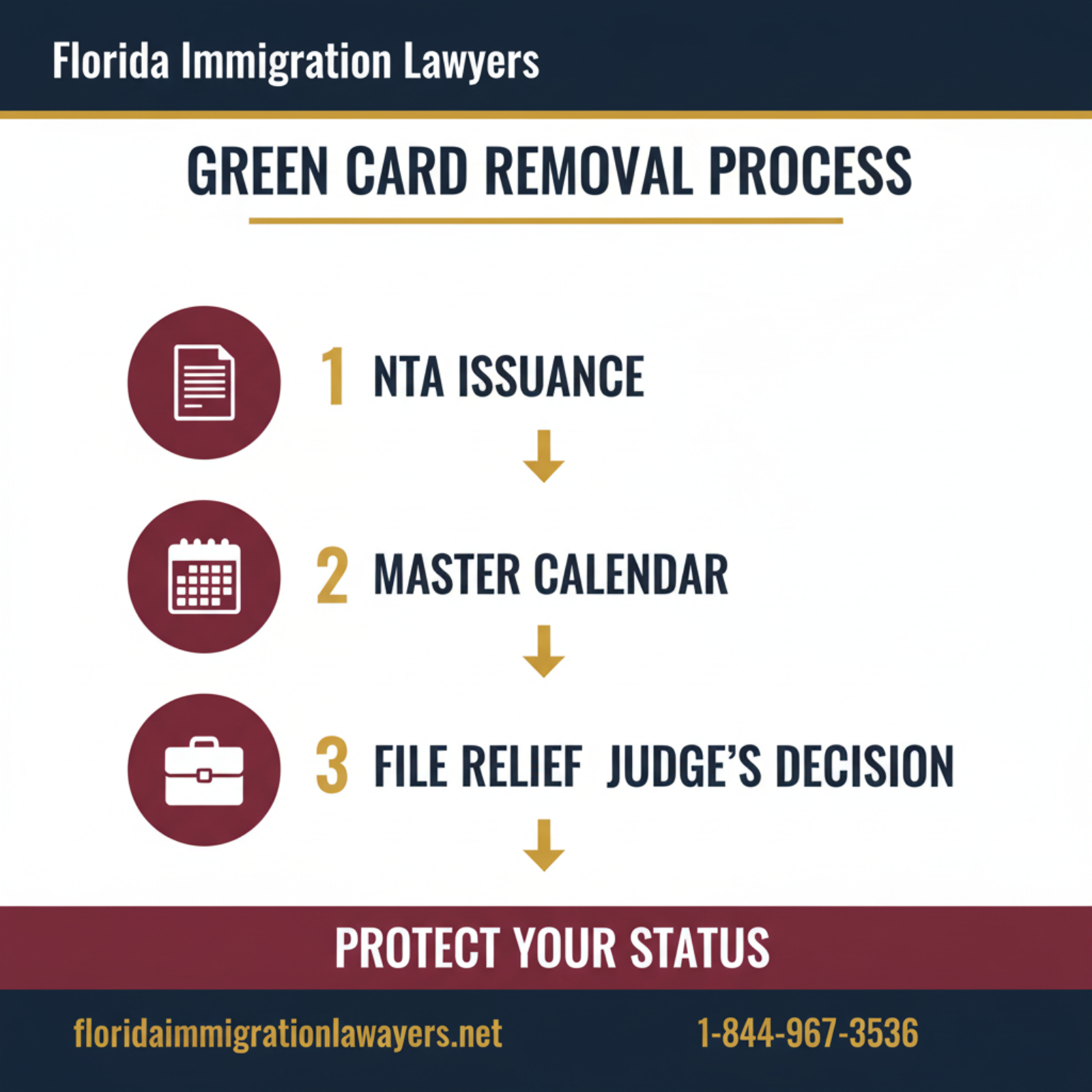
- Notice to Appear (NTA): If you receive an NTA, it means USCIS intends to place you in removal proceedings before an immigration judge. This is a serious situation where immediate legal representation is essential to defend your right to remain in the U.S.
- Complex Evidence: If your evidence of a bona fide marriage is not straightforward or if you have unique circumstances that make proving your case difficult, an attorney can help strategize and present your case effectively.
- Previous Immigration Violations: Any prior immigration issues, such as overstays or misrepresentations, can complicate your I-751 and put you at risk.
At Florida Immigration Lawyers, we specialize in helping individuals in St. Petersburg and throughout Florida navigate challenging immigration processes. We understand the nuances of conditional green card removal and deportation defense. Our team is dedicated to providing robust legal representation to protect your status and secure your future. Do not wait for a problem to escalate; proactive legal advice can make all the difference.
Frequently Asked Questions (FAQs) About Green Card Removal
Is ICE deporting people with green cards?
Yes, unfortunately, lawful permanent residents (green card holders) can be placed in removal proceedings and deported from the United States under certain circumstances. This is not a common occurrence for all green card holders, but it can happen if you commit certain crimes, engage in fraud, abandon your residency, or violate specific immigration laws. With increased enforcement efforts in Florida, it is more critical than ever for green card holders to understand their rights and responsibilities.
What happens if you marry a U.S. citizen and then divorce?
If you obtained a conditional green card through marriage and then divorce your U.S. citizen spouse before the conditions are removed, you generally cannot file Form I-751 jointly. However, you may be eligible to file a waiver of the joint filing requirement. This waiver allows you to petition USCIS on your own to remove the conditions, typically by demonstrating that your marriage was entered into in good faith but terminated through divorce. This is a complex process that greatly benefits from legal assistance.
Why are green cards being revoked?
Green cards can be revoked for several reasons. For conditional residents, failure to file Form I-751 to remove conditions, or if USCIS determines the marriage or investment was fraudulent, are common causes. For all green card holders, other reasons include committing certain criminal offenses (especially "crimes involving moral turpitude" or "aggravated felonies"), abandoning your U.S. residency, engaging in security threats, or misrepresenting facts on immigration applications. Each situation is unique and subject to specific legal definitions.
Can a green card holder be deported without due process?
No, a green card holder cannot be deported without due process of law. Lawful permanent residents have significant due process rights under U.S. law. If the government seeks to deport you, you are entitled to a hearing before an immigration judge. During these removal proceedings, you have the right to be represented by an attorney, present evidence, call witnesses, and appeal an adverse decision. It is crucial to exercise these rights and seek legal counsel immediately if you receive a Notice to Appear (NTA).
ABOUT Florida Immigration Lawyers
Florida Immigration Lawyers is a leading immigration law firm dedicated to serving individuals and families across the entire state of Florida. With a deep understanding of U.S. immigration laws and a strong commitment to our clients, we provide expert legal representation for a wide range of immigration matters.
Our experienced attorneys offer comprehensive services, including family-based immigration, business immigration, deportation defense, asylum claims, naturalization, and the complex process of removing conditions on green cards. We pride ourselves on delivering personalized attention and strategic solutions tailored to meet the unique needs of each client.
Why choose Florida Immigration Lawyers? We are available 24/7 to address your urgent immigration concerns. We offer free consultations to help you understand your options without financial commitment. Our team is bilingual, fluent in both English and Spanish, ensuring clear and effective communication. We serve all of Florida, from St. Petersburg to Miami, Orlando to Jacksonville, providing compassionate and aggressive advocacy for your rights.
Your immigration journey is our priority. Let us put our knowledge and dedication to work for you. Contact us today to learn how we can help. Phone: 1-844-967-3536. Website: https://www.floridaimmigrationlawyers.net.
Sources and References
- U.S. Citizenship and Immigration Services (USCIS)
- USCIS Form I-751, Petition to Remove Conditions on Residence
- Executive Office for Immigration Review (EOIR)
- 8 U.S.C. § 1186a - Conditional permanent resident status for certain alien spouses and sons and daughters
- 8 U.S.C. § 1229a - Removal proceedings
- 8 CFR § 216.4 - Petition to remove the conditional basis of lawful permanent residence for alien spouses and sons and daughters
- Immigration and Nationality Act (INA) sections, as amended
This article provides general legal information and is not intended as legal advice. Every case is unique, and outcomes depend on specific facts and circumstances. Contact an attorney for advice about your particular situation.
Facing USCIS green card removal proceedings in Florida or the complex process of removing conditions can be daunting. Do not jeopardize your future by attempting to navigate these critical legal matters without professional guidance. The experienced immigration attorneys at Florida Immigration Lawyers are ready to provide the dedicated and knowledgeable representation you need.
Protect your status and secure your future in the United States. We offer free, confidential consultations to discuss your case and outline a clear path forward. Call Florida Immigration Lawyers today at 1-844-967-3536 to schedule your free consultation. Se Habla Español - Estamos aquí para ayudarle.
Frequently Asked Questions
Florida Immigration Lawyers
Legal Team
Our experienced attorneys at Florida Immigration Lawyers have been serving clients across Florida for over 20 years. We specialize in immigration, personal injury, criminal defense, workers compensation, and family law.