Citizenship Interview Tips Florida: Your 2026 Guide to Naturalization Success
Prepare for your U.S. citizenship interview in Florida with this comprehensive 2026 guide. Learn essential tips for the English and civics tests, understand document requirements, and avoid common mistakes. This article provides a step-by-step preparation plan for naturalization success, focusing on the St. Petersburg area. Discover how Florida Immigration Lawyers can provide invaluable legal support, ensuring a confident journey to becoming a U.S. citizen. Get ready for your naturalization interview with expert advice.
The citizenship interview is a crucial step in becoming a U.S. citizen. To pass, prepare thoroughly by studying U.S. history and government, practicing English, and organizing all required documents. Be honest, confident, and seek legal guidance from an experienced immigration lawyer.
- Study English and Civics extensively.
- Organize all necessary documents.
- Be honest and confident during the interview.
- Seek legal counsel for complex cases.
- Understand the process is multifaceted.
Introduction: Mastering Your Florida Citizenship Interview in 2026
Are you on the path to becoming a U.S. citizen in Florida? The citizenship interview can be one of the most nerve-wracking yet exciting steps in your naturalization journey. For many aspiring citizens in St. Petersburg and across the Sunshine State, preparing for this interview is paramount. This comprehensive guide, updated for 2026, will equip you with essential tips and insights to confidently navigate your naturalization interview. We understand the significance of this moment for you and your family. Call Florida Immigration Lawyers at 1-844-967-3536 for a free consultation to discuss your specific case.
Understanding the Naturalization Interview Process in Florida
The naturalization interview is a mandatory step for most individuals seeking U.S. citizenship. During this interview, a USCIS officer will review your N-400 application, test your English proficiency, and assess your knowledge of U.S. history and government (civics). This process ensures you meet all eligibility requirements for naturalization under the Immigration and Nationality Act (INA).
The interview typically takes place at a USCIS field office, such as the one serving the St. Petersburg area. Understanding the structure and expectations is your first step towards success. The officer will verify information, ask about your good moral character, and confirm your allegiance to the United States.
Step-by-Step Guide to Your Citizenship Interview Preparation
Preparing effectively for your USCIS interview tips in Florida can significantly boost your confidence and chances of success. Follow this detailed guide to ensure you cover all crucial aspects.
-
Review Your N-400 Application Thoroughly:
Ensure every answer is accurate and truthful. The USCIS officer will use your application as the basis for many questions. Any discrepancies or inconsistencies could lead to delays or further scrutiny.
-
Prepare for the English Test:
The English test has three components: reading, writing, and speaking. Your ability to communicate in English is assessed throughout the entire interview.
- Speaking: The officer will assess your ability to understand and respond to questions in English. Practice speaking about your life, work, and reasons for applying for citizenship.
- Reading: You will be asked to read one out of three sentences correctly. Practice reading sentences from the official USCIS vocabulary list.
- Writing: You will be asked to write one out of three sentences correctly. Practice writing sentences related to civics and U.S. history.
-
Master the Civics Test:
The civics test consists of 10 questions from a list of 100 possible citizenship test questions. You must answer 6 out of 10 questions correctly to pass.
- Study all 100 official questions and answers provided by USCIS. Focus on understanding the concepts, not just memorizing facts.
- Utilize online resources for citizenship practice test questions and answers to simulate the actual test. Many resources include US Citizenship Test practice quizzes to help you prepare.
- For applicants 65 years or older and who have been a lawful permanent resident for at least 20 years, a modified test with 20 questions is available with different passing criteria.
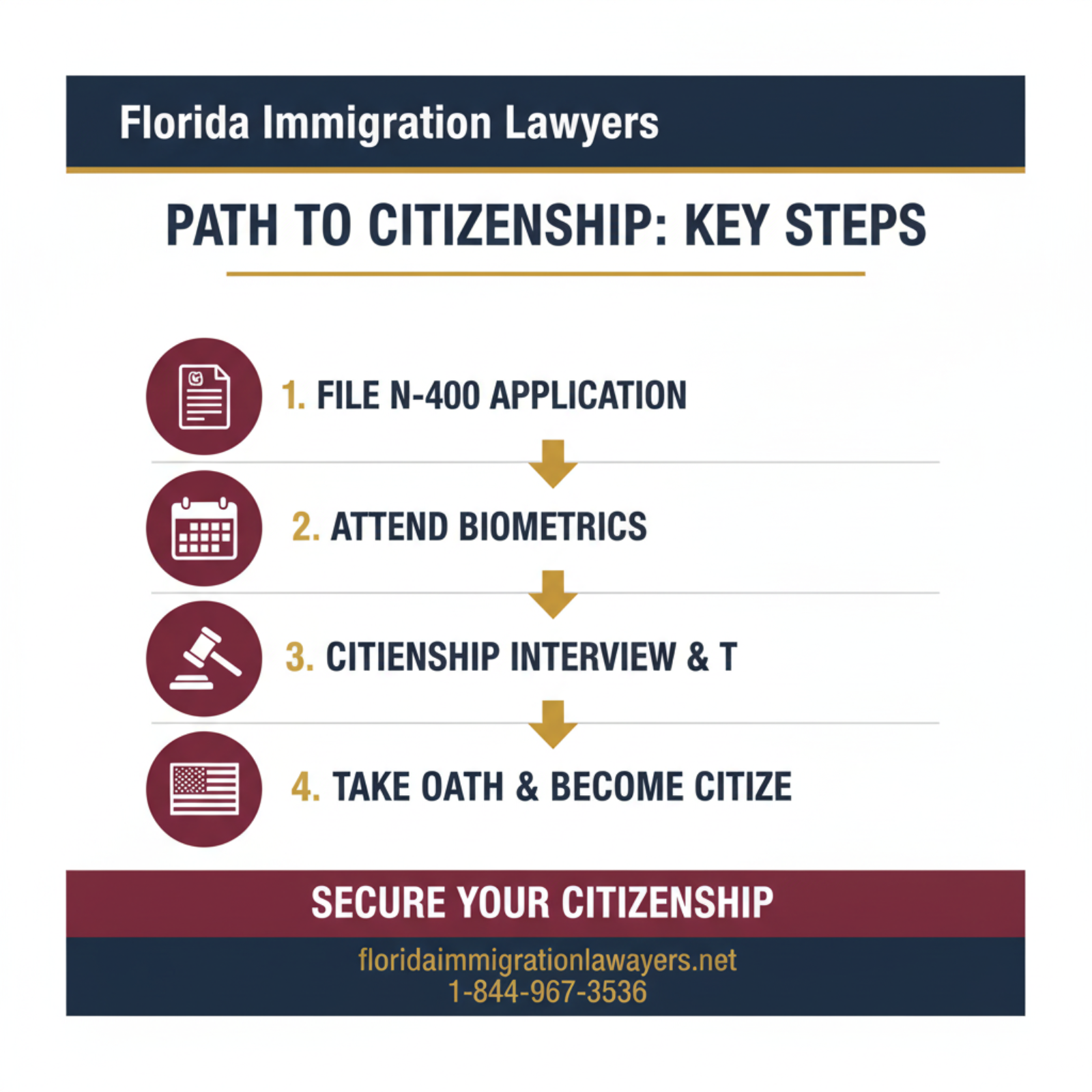
Step-by-Step Process Guide -
Gather All Required Documents:
Collect original documents and copies as specified in your interview notice. This includes identification, travel documents, and supporting evidence for your N-400 answers. We will elaborate on this in the next section.
-
Practice Answering Personal Questions:
Be prepared to answer questions about your background, family, residence, employment, and any trips outside the U.S. The officer will also ask about your moral character and allegiance to the U.S. Be ready to explain any gaps in your history or unusual circumstances.
-
Understand the Oath of Allegiance Ceremony:
After passing the interview, you will typically attend an Oath of Allegiance ceremony. This is the final legal step to becoming a U.S. citizen. You will surrender your Green Card and receive your Certificate of Naturalization at this ceremony.
Essential Document Checklist for Your USCIS Interview
Bringing a complete and organized set of documents to your naturalization interview is critical. Missing documents can cause significant delays or even necessitate a second interview. Always bring originals and copies.
- Your interview appointment notice.
- Your Green Card (Permanent Resident Card).
- State-issued identification (driver's license or state ID card).
- All passports, current and expired, for all international travel during the eligibility period.
- Travel history documentation, including entry/exit stamps.
- Original birth certificates of your children (if applicable).
- Marriage certificate (if applicable).
- Divorce decrees or annulment records (if applicable), for all previous marriages.
- Court records for any arrests, citations, or detentions, even if charges were dismissed or expunged. This is especially important given the recent "Operation Tidal Wave" context in Florida, emphasizing scrutiny on legal compliance.
- Proof of selective service registration (for male applicants aged 18-26 who resided in the U.S.).
- Evidence of financial support for dependents (if applicable), such as child support orders.
- Proof of tax filing for the past five years (or three years if married to a U.S. citizen and applying under the three-year rule).
- Any additional documents specifically requested by USCIS in your interview notice or through a Request for Evidence (RFE).
Timeline and Processing Expectations for Naturalization
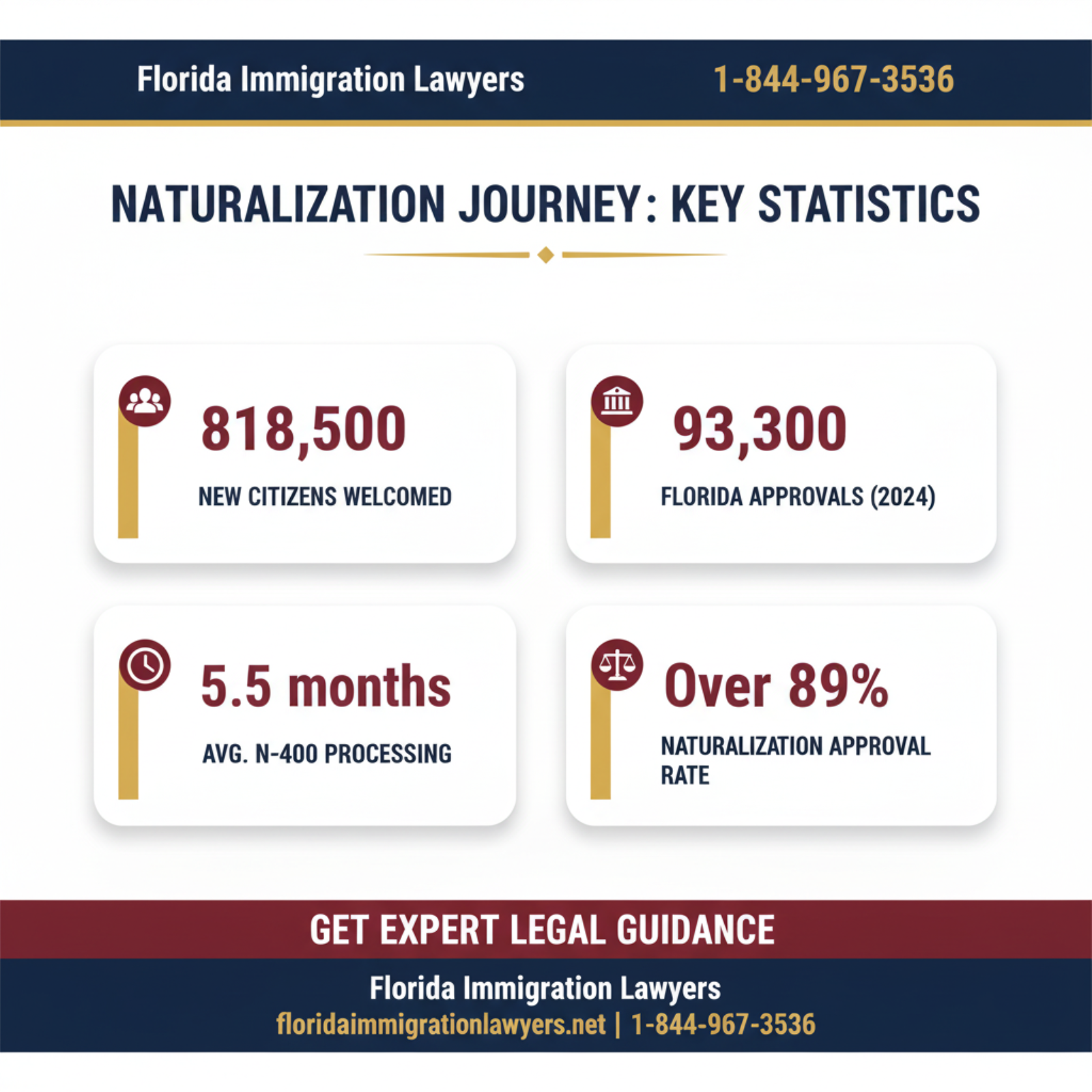
The processing time for naturalization applications (Form N-400) can vary significantly. While USCIS aims for efficiency, several factors influence the timeline. These factors include the volume of applications, staffing levels at your local USCIS field office (e.g., Orlando or Tampa, which serve St. Petersburg), and the complexity of your individual case.
Typically, from filing Form N-400 to the Oath of Allegiance ceremony, the process can take anywhere from 8 to 24 months, or even longer in some cases. You can check the current processing times on the USCIS website. It's important to remember that these are estimates, and your experience may differ based on various unforeseen circumstances.
Cost Factors and Fee Breakdown for U.S. Citizenship
Pursuing U.S. citizenship involves various costs beyond just the application fee. While specific fee amounts are subject to change by USCIS, understanding the categories of expenses is important for your financial planning.
The primary cost is the USCIS filing fee for Form N-400, Application for Naturalization, which generally includes the biometrics fee. USCIS may offer fee waivers for eligible low-income applicants who meet specific federal poverty guidelines. Additionally, you might incur costs for:
- Gathering required documents (e.g., obtaining certified copies of birth certificates, marriage licenses, or court records from various agencies).
- Translation services if any of your supporting documents are not in English. Official certified translations are typically required.
- Photography for passport-style photos, which must meet strict USCIS specifications.
- Legal fees if you choose to hire a Florida immigration lawyer to assist with your application and interview preparation. While not mandatory, legal representation can be invaluable, especially for complex or challenging cases.
Do not navigate this complex process alone. The journey to U.S. citizenship is significant, and having experienced legal guidance can make all the difference. Contact Florida Immigration Lawyers today to ensure your application is strong and your preparation is thorough.
Common Mistakes to Avoid During Your Citizenship Interview
Avoiding these common pitfalls can help ensure a smoother citizenship interview experience. Many applicants, especially those in St. Petersburg and other Florida cities, can benefit from being aware of these issues.
-
Lying or Providing False Information:
Any misrepresentation, even minor, can lead to a denial and potentially severe immigration consequences, including removal proceedings. Always be truthful and consistent with your N-400 application. This is a severe offense under 8 U.S.C. § 1425.
-
Failing to Disclose Criminal History:
Even minor arrests, citations, or expunged records must be disclosed. USCIS has access to your criminal background. Hiding information can be considered a lack of good moral character, leading to denial and potential deportation.
-
Inadequate English Proficiency:
Failing the English reading, writing, or speaking tests is a common reason for denial. Practice regularly, immerse yourself in English, and consider English as a Second Language (ESL) classes if needed.
-
Insufficient Civics Knowledge:
Not being able to answer 6 out of 10 civics questions correctly will result in a failed test. Dedicate ample time to studying the 100 civics questions and their context.
-
Arriving Late or Unprepared:
Punctuality and having all required documents organized are crucial. Late arrival can lead to rescheduling, and missing documents can cause significant delays or even a Notice of Intent to Deny.
-
Lack of Understanding of Your N-400 Application:
The officer will ask questions directly from your application. If you don't remember what you wrote or provide conflicting answers, it raises red flags. Review your application thoroughly before the interview to ensure familiarity.
-
Not Adhering to the "Good Moral Character" Requirement:
This is a fundamental eligibility requirement under INA § 316(a)(3). Certain actions, such as habitual drunkenness, drug offenses, or failure to support dependents, can demonstrate a lack of good moral character and lead to denial.
When to Call a Florida Immigration Lawyer
While many individuals successfully navigate the naturalization process independently, certain situations warrant the expertise of a seasoned Florida immigration lawyer. Our team at Florida Immigration Lawyers is dedicated to assisting aspiring citizens in St. Petersburg and throughout Florida.
You should consider contacting us if:
- You have a complex immigration history, including previous visa denials, asylum applications, or deportation proceedings.
- You have any arrests, convictions, or legal issues, even if they seem minor or were expunged. These can significantly impact your good moral character assessment.
- You have spent significant time outside the U.S. or have concerns about meeting the continuous residence and physical presence requirements.
- You have questions about the "good moral character" requirement or potential eligibility issues that are unclear to you.
- You are concerned about your English proficiency or ability to pass the civics test and need strategic preparation.
- You simply want the peace of mind that comes with professional legal guidance, ensuring all steps are followed correctly.
- You received a Request for Evidence (RFE) or a Notice of Intent to Deny (NOID) from USCIS.
Our experienced attorneys can review your case, prepare your application, help you gather necessary documents, and even accompany you to your naturalization interview. We are here to advocate for your best interests and guide you through every stage.
About Florida Immigration Lawyers
Florida Immigration Lawyers is a leading law firm dedicated to providing exceptional immigration legal services across the entire state of Florida. With years of experience and a deep understanding of U.S. immigration law, our compassionate attorneys are committed to helping individuals and families achieve their American dreams. We specialize in various immigration matters, including:
- General Immigration Services
- Citizenship and Naturalization
- Family-Based Immigration
- Deportation Defense
- Asylum Claims
- Business Immigration
Why choose Florida Immigration Lawyers? Our firm offers personalized attention, strategic legal advice, and a relentless dedication to our clients. We understand the complexities and emotional toll of immigration processes. We are available 24/7 for free consultations to discuss your case. Our knowledgeable attorneys are fluent in Spanish, ensuring clear communication and culturally appropriate representation. We serve clients in St. Petersburg, Miami, Orlando, Tampa, and all other Florida communities. Let us be your trusted legal partner on your journey to a new life in the U.S.
Sources and References
- U.S. Citizenship and Immigration Services (USCIS) - Naturalization Test
- U.S. Citizenship and Immigration Services (USCIS) - Form N-400, Application for Naturalization
- Executive Office for Immigration Review (EOIR)
- 8 U.S.C. Chapter 12 - Immigration and Nationality Act (INA)
- INA § 316(a)(3) - Good Moral Character
- 8 U.S.C. § 1425 - False Statements and Fraudulent Acts in Naturalization Proceedings
This article provides general legal information and is not intended as legal advice. Every case is unique, and outcomes depend on specific facts and circumstances. Contact an attorney for advice about your particular situation.
Your dream of U.S. citizenship is within reach. Don't leave your naturalization interview to chance. For expert guidance and dedicated representation, contact Florida Immigration Lawyers today. Call us at 1-844-967-3536 for a free consultation. Se Habla Español - Estamos aquí para ayudarle.
Frequently Asked Questions
Florida Immigration Lawyers
Legal Team
Our experienced attorneys at Florida Immigration Lawyers have been serving clients across Florida for over 20 years. We specialize in immigration, personal injury, criminal defense, workers compensation, and family law.