USCIS Green Card Removal Proceedings in Florida: Your 2026
Facing USCIS green card removal proceedings in Florida can be incredibly stressful. This 2026 guide from Florida Immigration Lawyers provides vital information on the I-751 petition to remove conditions, common mistakes to avoid, and what to do if you receive a Notice to Appear. Learn about processing times, required documents, and when expert legal help is essential. Our team serves Kissimmee and all of Florida, offering free consultations to protect your permanent residency. Understand your rights and navigate this complex process with confidence.

USCIS green card removal proceedings are formal legal actions initiated by the U.S. government to determine if a non-citizen, often a conditional permanent resident, should lose their status and face deportation. For conditional green card holders in Florida, these proceedings typically arise from a denial of the Form I-751, Petition to Remove Conditions on Residence. Navigating this complex process requires understanding the legal grounds and presenting compelling evidence to maintain your residency.
- Conditional green card holders must file Form I-751 to remove conditions.
- Failure to file or a denial can lead to **USCIS green card removal proceedings**.
- These proceedings are held in immigration courts, such as those in Orlando or Miami, Florida.
- Strong legal representation is crucial for defending against removal and protecting your status.
- Understanding the process and gathering robust evidence are key to a successful outcome.
USCIS Green Card Removal Proceedings in Florida: Your 2026 Guide
Imagine the uncertainty of living in Florida with a conditional green card, knowing your permanent residency hinges on a crucial application. The thought of facing USCIS green card removal proceedings can be daunting, bringing immense stress and fear for your future in the United States.
Many conditional permanent residents in Kissimmee and across Florida find themselves in this challenging situation. They may be unsure about the Form I-751 process or what to do if their petition to remove conditions is denied. This comprehensive guide aims to demystify these proceedings, offering clarity and actionable insights for 2026.
Understanding the intricacies of conditional permanent residency and the potential for removal is vital. We will walk you through the process, common pitfalls, and how to protect your status. If you or a loved one are concerned about USCIS green card removal proceedings, do not wait.
Call Florida Immigration Lawyers at 1-844-967-3536 for a free consultation. Our experienced attorneys are ready to provide the guidance you need.
Understanding USCIS Green Card Removal Proceedings in Florida
A conditional green card, also known as a conditional permanent resident (CPR) card, is typically issued to individuals who obtained their green card through marriage to a U.S. citizen or lawful permanent resident, and the marriage was less than two years old at the time of approval. Investor visa recipients also receive conditional green cards. This status is temporary, lasting two years.
The purpose of a conditional green card is to ensure the marriage or investment is bona fide and not solely for immigration benefits. Before the two-year period expires, conditional residents must apply to remove these conditions. Failure to do so, or a denial of their application, can trigger USCIS green card removal proceedings.
Removal proceedings are formal legal actions initiated by the Department of Homeland Security (DHS) to deport a non-citizen from the United States. These proceedings occur in immigration courts, such as those located in Orlando and Miami, Florida. An Immigration Judge (IJ) presides over these cases, determining whether an individual is removable under U.S. immigration law.
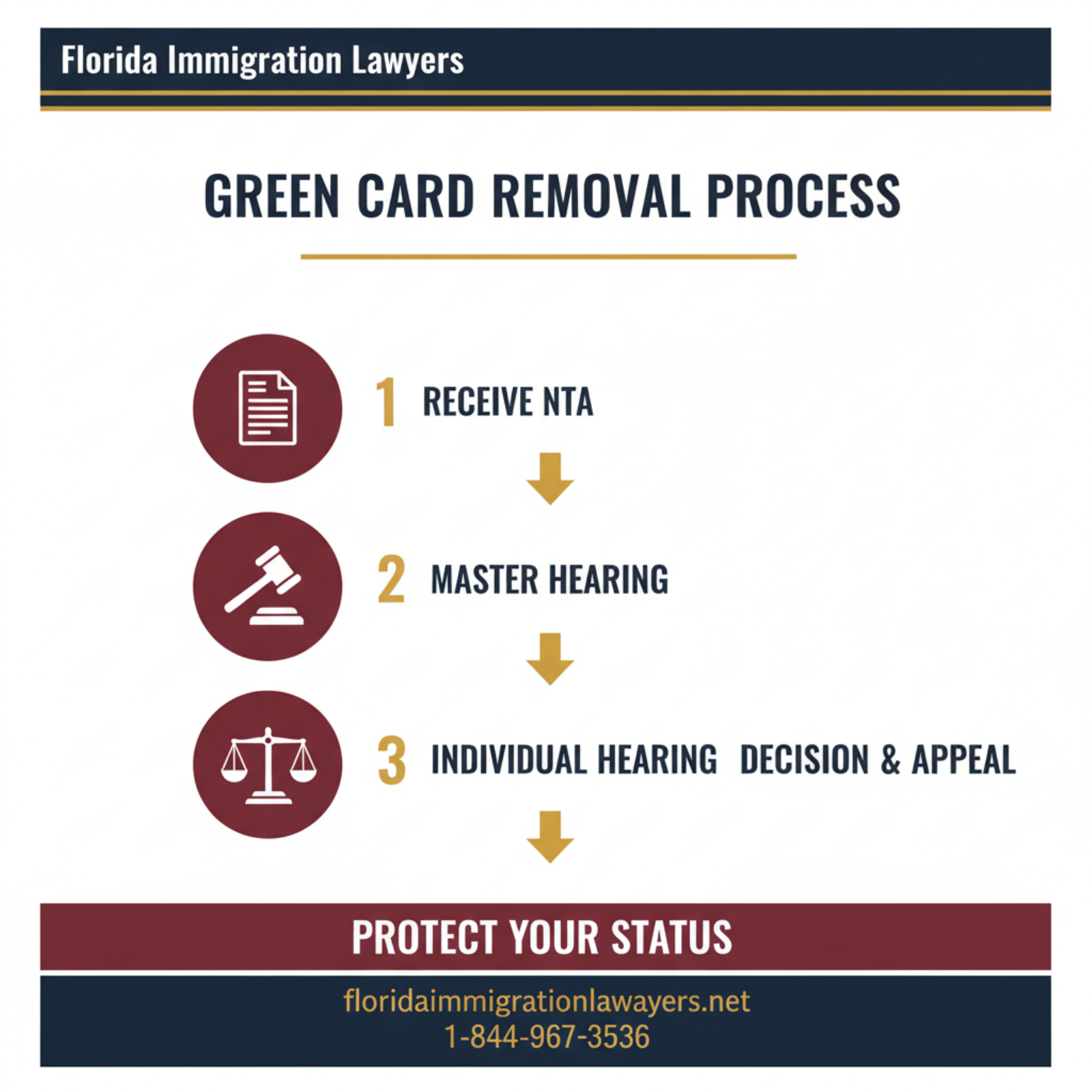
For conditional residents, removal proceedings often begin if USCIS denies their Form I-751, Petition to Remove Conditions on Residence. In such cases, USCIS typically issues a Notice to Appear (NTA), formally charging the individual as removable. The burden of proof then shifts to the applicant in court to demonstrate they meet the requirements to remove the conditions.
These proceedings can be complex and intimidating, often involving intricate legal arguments and extensive documentation. Understanding the specific grounds for removal and your rights is paramount. Florida Immigration Lawyers are well-versed in these challenges and can represent you effectively.
The I-751 Petition to Remove Conditions: Your Step-by-Step Guide
The Form I-751, Petition to Remove Conditions on Residence, is your primary tool to transition from conditional to permanent resident status. A successful filing is critical to avoid USCIS green card removal proceedings. Here is a step-by-step guide for applicants in Florida:
-
Determine Eligibility and Filing Method: Most conditional residents file jointly with their petitioning spouse. However, if your marriage ended in divorce, annulment, your spouse passed away, or you experienced abuse, you may be eligible to file a waiver to remove conditions without your spouse. Understanding your specific situation is the first crucial step.
-
Gather Comprehensive Documentation: The core of your I-751 petition is proving your marriage was entered into in good faith. You must collect extensive evidence of your shared life. This includes joint financial records, shared property, children's birth certificates, and affidavits from friends and family. The more evidence you provide, the stronger your case.
-
Complete Form I-751 Accurately: Fill out the entire Form I-751, Petition to Remove Conditions on Residence, meticulously. Any errors or omissions can lead to delays or even a denial. Ensure all questions are answered honestly and completely. If you are filing a waiver, be sure to select the correct reason on the form and provide supporting evidence.
-
File with USCIS within the Window: For joint filers, the I-751 must be filed within the 90-day period immediately preceding the expiration date on your conditional green card. If you are filing a waiver, you may be able to file at any time after receiving conditional resident status, especially in cases of abuse or death of a spouse. Send your completed petition, supporting documents, and fees to the correct USCIS service center.
-
Attend Biometrics Appointment: After filing, USCIS will send you a receipt notice and an appointment notice for biometrics (fingerprints, photos, and signature). This appointment is mandatory. Failing to attend without rescheduling can jeopardize your application. These appointments typically take place at an Application Support Center (ASC) in Florida.
-
Respond to Requests for Evidence (RFEs): USCIS may issue an RFE if they need more information or clarification. It is critical to respond to an RFE promptly and thoroughly, providing all requested documents within the specified timeframe. Ignoring an RFE can lead to a denial of your I-751 petition and potential **USCIS green card removal proceedings**.
-
Prepare for an Interview (if required): While not all I-751 petitioners are interviewed, USCIS reserves the right to call you and your spouse (for joint filers) for an interview. This is an opportunity for an immigration officer to verify the bona fides of your marriage. Prepare by reviewing your submitted documents and practicing answering questions about your relationship.
-
Receive Decision: USCIS will send you a written decision. If approved, you will receive a new 10-year permanent resident card. If denied, USCIS will typically issue a Notice to Appear (NTA), placing you in **USCIS green card removal proceedings** before an Immigration Judge.
Essential Documents for Conditional Green Card Removal
A well-organized and comprehensive set of documents is vital for a successful I-751 petition. This evidence helps USCIS confirm the legitimacy of your marriage or the validity of your waiver claim. For those in Kissimmee, gathering these documents carefully can significantly strengthen your case and help avoid USCIS green card removal proceedings.
Here is a checklist of documents typically required:
- Form I-751, Petition to Remove Conditions on Residence: The properly completed and signed form.
- Copy of Your Conditional Green Card: Provide copies of both the front and back of your Form I-551.
- Copy of Your Marriage Certificate: If applicable, to prove the legal union.
- Birth Certificates of Children: Copies of birth certificates for any children born of your marriage, if applicable.
- Evidence of Joint Residency: This includes joint leases or mortgages, property deeds, utility bills, and correspondence addressed to both spouses at the same address.
- Evidence of Commingled Finances: Joint bank account statements, joint credit card statements, tax returns filed jointly, joint insurance policies (health, life, auto), and evidence of shared investments.
- Affidavits from Friends and Family: Sworn statements from individuals who know you and your spouse, attesting to the bona fide nature of your marriage. These should include their full name, address, date and place of birth, and details about how they know you and your spouse.
- Photographs: A selection of photos of you and your spouse together over time, including with family and friends, on trips, and at significant events. Date and caption these photos.
- Travel Itineraries and Tickets: Evidence of joint travel and vacations.
- Evidence of Gifts and Cards: Sent between spouses or received jointly.
- Police Clearances: If you have any arrests or criminal history, even if charges were dropped or expunged, you must provide certified court dispositions.
- Waiver Documentation (if applicable): If you are filing a waiver, provide specific evidence supporting your claim (e.g., divorce decree, death certificate, police reports, medical records, or affidavits from counselors for abuse cases; evidence of extreme hardship for that type of waiver).
- Translated Documents: Any document not in English must be accompanied by a certified English translation.
Timeline and Processing Expectations for I-751 in 2026 Florida
The processing time for Form I-751, Petition to Remove Conditions on Residence, can vary significantly. In 2026, applicants in Florida should anticipate that processing times will continue to fluctuate based on USCIS workload, policy changes, and the complexity of individual cases. It is crucial to manage your expectations and stay informed.
Generally, I-751 processing can take anywhere from 12 to 36 months, or even longer in some instances. You can check the current estimated processing times for your specific service center on the USCIS website. Remember that these are estimates and not guarantees.
What happens if your conditional green card expires while your I-751 is pending? Upon filing, USCIS will issue a receipt notice (Form I-797C, Notice of Action). This notice typically extends your conditional permanent resident status for a specified period, often 24 or 48 months, allowing you to continue working and traveling while your petition is processed. It is crucial to carry this notice with your expired conditional green card.
Factors that can impact your processing timeline include: the completeness of your initial application, the need for a Request for Evidence (RFE), and whether an interview is required. Cases involving waivers or complex issues, such as a criminal history, may take longer. If your I-751 is denied, you will likely be placed in USCIS green card removal proceedings, which will add a new and lengthy legal process.
For individuals in Kissimmee and other Florida communities, staying updated on USCIS processing times and being prepared for potential delays is essential. Consulting with an immigration attorney can help you understand realistic expectations and strategize effectively.
Cost Factors and Fee Breakdown for I-751 Petitions
Understanding the financial aspects of filing Form I-751 is an important part of the planning process. While USCIS fees are subject to change, it is essential to budget for these costs. Please note that specific fee amounts should always be verified on the official USCIS website before filing, as they can be updated annually.
The primary cost associated with the I-751 petition is the USCIS filing fee. This fee covers the processing of your application. Additionally, there is a separate biometrics services fee, which covers the cost of fingerprinting and background checks. These two fees are typically paid together when you submit your I-751 package.
As of early 2026, these fees generally total several hundred dollars. USCIS does not typically offer fee waivers (Form I-912) for the I-751 petition, unlike some other immigration forms. Therefore, applicants must be prepared to pay the full amount.
Beyond the government fees, you should also consider potential attorney fees if you choose to hire legal representation. While not mandatory, an experienced immigration lawyer can significantly enhance your chances of success, especially in complex cases or if you anticipate USCIS green card removal proceedings. Attorney fees vary based on the complexity of your case and the services required.
Additional costs might include fees for obtaining certified copies of documents (e.g., marriage certificates, birth certificates, court dispositions), translation services for any non-English documents, and postage for mailing your application. It is advisable to send your application via certified mail with a return receipt to track delivery.
Do not navigate this process alone. The stakes are too high to risk a denial that could lead to USCIS green card removal proceedings. Contact Florida Immigration Lawyers today to ensure your I-751 petition is handled correctly and efficiently.
Common Mistakes to Avoid in Conditional Green Card Removal Proceedings
The path to permanent residency can be filled with potential pitfalls. Avoiding common mistakes is crucial to prevent delays, denials, and ultimately, USCIS green card removal proceedings. Be vigilant and meticulous in your application process, especially for the Form I-751.
-
Failing to File on Time: The most critical mistake is missing the 90-day filing window before your conditional green card expires. Filing late without a valid excuse can lead to your petition being rejected and an NTA being issued, initiating removal proceedings.
-
Insufficient Evidence: Submitting an I-751 with inadequate proof of a bona fide marriage is a common reason for RFEs or denials. You must provide compelling evidence that your marriage is genuine and not solely for immigration purposes. USCIS requires comprehensive documentation of your shared life.
-
Incomplete or Inaccurate Forms: Errors, omissions, or inconsistencies on Form I-751 can cause significant delays or outright rejection. Double-check every field, ensure all required sections are completed, and that your answers are truthful and consistent with your supporting documents.
-
Ignoring Requests for Evidence (RFEs): If USCIS sends an RFE, it means they need more information. Failing to respond comprehensively or within the deadline will almost certainly result in a denial, directly leading to USCIS green card removal proceedings.
-
Attending Interview Unprepared: If an interview is scheduled, being unprepared can raise red flags. Review your petition and supporting documents, and be ready to answer questions about your relationship and shared life. Consistency is key.
-
Not Disclosing All Information: Withholding information, especially about prior arrests, criminal history, or previous immigration violations, is a serious error. USCIS will uncover this information, and it can lead to allegations of fraud or misrepresentation, making your case much harder to win.
-
Filing Jointly After Divorce/Separation: If your marriage has ended, attempting to file a joint I-751 is inappropriate and will be denied. You must pursue a waiver based on divorce, abuse, or extreme hardship. Misrepresenting your marital status can have severe consequences.
-
Assuming Automatic Approval: The I-751 process is not a formality; it requires diligence and a strong presentation of evidence. Do not assume that because your initial green card was approved, the removal of conditions will be automatic. USCIS scrutinizes these petitions carefully.
-
Not Seeking Legal Counsel for Complex Cases: If you have a criminal history, multiple marriages, prior immigration issues, or your marriage is ending, attempting to navigate the I-751 process alone is risky. An attorney can identify potential problems and strategize solutions.
-
Traveling Internationally Without Proof of Status: While your I-751 is pending, your conditional green card may expire. You must carry your I-797C receipt notice, which serves as temporary proof of status and work authorization, when traveling. Without it, you may face issues re-entering the U.S.
-
Ignoring a Notice to Appear (NTA): If you receive an NTA, it means you have been placed in USCIS green card removal proceedings. Ignoring it will lead to an order of removal in absentia, making it extremely difficult to return to the U.S. You must appear in immigration court.
-
Misunderstanding Waiver Options: If your marriage is no longer viable, knowing your waiver options (divorce/annulment, abuse, extreme hardship) is critical. Failing to correctly apply for a waiver when eligible can lead to denial and removal proceedings.
Addressing Your Questions: FAQ on Green Card Removal
Many common questions arise when dealing with conditional green cards and the potential for removal. Here are answers to some of the most frequently asked questions, specifically addressing concerns relevant to USCIS green card removal proceedings in Florida.
What happens if you marry a U.S. citizen and then divorce?
If you marry a U.S. citizen and then divorce before the conditions on your green card are removed, you can still apply to remove the conditions. You would file Form I-751 with a waiver based on the termination of the marriage. You must demonstrate that the marriage was entered into in good faith, not solely for immigration purposes, despite its dissolution. This is a complex waiver, and you will need robust evidence to prove your marriage was legitimate at its inception. Florida Immigration Lawyers can help you gather and present this evidence effectively.
What is the 2-year rule for green cards?
The 2-year rule refers to the duration of conditional permanent resident status. If you received your green card through marriage and were married for less than two years at the time your green card was approved, USCIS grants you conditional residency for two years. This means your green card will expire after two years. To become a permanent resident, you must file Form I-751 within the 90-day window before its expiration to remove the conditions. Failure to do so can lead to USCIS green card removal proceedings.
Is the US government deporting green card holders?
Yes, lawful permanent residents, including green card holders, can be placed in USCIS green card removal proceedings and potentially deported from the United States. This can happen for various reasons, including certain criminal convictions, immigration fraud, failure to remove conditions on a green card (as discussed), or national security grounds. While green card holders have more rights than undocumented immigrants, they are not immune to deportation. It is a legal process that requires strong defense, especially in Florida immigration courts.
Can you get a green card if you have diabetes?
Generally, having diabetes alone is not a disqualifying medical condition for a green card. U.S. immigration law outlines specific medical grounds of inadmissibility, primarily focusing on communicable diseases of public health significance, mental disorders with associated harmful behavior, and drug abuse or addiction. Diabetes typically does not fall into these categories unless it leads to complications that pose a public health risk or make an individual likely to become a public charge. You will undergo a medical examination by a USCIS-approved civil surgeon who will assess your overall health. For specific concerns regarding medical conditions, it is always best to consult with an immigration attorney and your healthcare provider.
When to Call a Florida Immigration Lawyer for USCIS Green Card Removal Proceedings
Navigating the complexities of conditional green card removal and potential USCIS green card removal proceedings can be overwhelming. The stakes are incredibly high, and a misstep could lead to losing your right to live and work in the U.S. Knowing when to seek professional legal help is crucial. Florida Immigration Lawyers are here to assist you.
You should consider contacting an experienced immigration attorney immediately if:
- Your Form I-751 Petition is Denied: A denial typically means you will receive a Notice to Appear (NTA), placing you directly in removal proceedings before an Immigration Judge in Orlando or Miami.
- You Receive a Notice to Appear (NTA): This is the formal document initiating removal proceedings. Do not ignore it. You need immediate legal representation to prepare your defense and appear in court.
- You Need to File a Waiver: If your marriage ended in divorce or annulment, your spouse passed away, or you experienced abuse, you will need to file a waiver with your I-751. These waivers are often complex and require strong evidence and legal argumentation.
- You Have a Complex Case History: This includes prior arrests, criminal convictions, previous immigration violations, or multiple marriages. These factors can significantly complicate your I-751 or removal proceedings.
- You are Unsure About Documentation or Eligibility: If you are struggling to gather sufficient evidence, are uncertain about your eligibility for a waiver, or simply feel overwhelmed by the paperwork, an attorney can provide clarity and guidance.
- You Are Required to Attend an Interview: While an attorney cannot testify for you, they can prepare you thoroughly for your I-751 interview and attend with you to ensure your rights are protected.
Our attorneys at Florida Immigration Lawyers understand the nuances of immigration law, particularly regarding conditional green cards and deportation defense. We serve clients throughout Florida, including Kissimmee, Orlando, and Miami, offering strategic advice and robust representation to help you protect your future.
About Florida Immigration Lawyers
Florida Immigration Lawyers is a leading immigration law firm dedicated to serving individuals and families across the entire state of Florida. With a deep commitment to our clients and a comprehensive understanding of U.S. immigration law, we strive to provide exceptional legal representation and compassionate guidance.
Our firm specializes in a wide range of immigration services, including family-based immigration, business immigration, asylum claims, naturalization and citizenship, and aggressive deportation defense. We understand that every immigration journey is unique and often challenging, which is why we tailor our strategies to meet your specific needs and goals.
Why choose Florida Immigration Lawyers? We pride ourselves on our client-focused approach, extensive legal knowledge, and unwavering dedication to achieving the best possible outcomes. Our team is available 24/7 to address your concerns, offering free consultations to discuss your case and explore your legal options. Se Habla Español.
When your future in the United States is at stake, you need a trusted advocate by your side. Contact Florida Immigration Lawyers today for reliable, experienced, and empathetic legal support.
Sources and References
- U.S. Citizenship and Immigration Services (USCIS)
- Executive Office for Immigration Review (EOIR)
- U.S. Department of State - Bureau of Consular Affairs
- 8 U.S.C. Chapter 12 - Immigration and Nationality Act (INA)
- 8 U.S.C. § 1186a - Conditional permanent resident status for certain alien spouses and sons and daughters
- 8 U.S.C. § 1182(a)(1) - Inadmissible aliens - Health-related grounds
- 8 CFR Part 216 - Conditional basis of lawful permanent residence
- USCIS Policy Manual, Volume 6, Part C, Chapter 2 - Conditional Residence
- Orlando Immigration Court - Part of the Executive Office for Immigration Review
This article provides general legal information and is not intended as legal advice. Every case is unique, and outcomes depend on specific facts and circumstances. Contact an attorney for advice about your particular situation.
Do not let the fear of USCIS green card removal proceedings paralyze you. Take control of your immigration future. Our dedicated team at Florida Immigration Lawyers is ready to provide the expert legal guidance and representation you deserve.
Call us today at 1-844-967-3536 for a free, confidential consultation. Se Habla Español - Estamos aquí para ayudarle.
Do Not Navigate This Process Alone
Our experienced immigration attorneys are ready to fight for you. Get a free, confidential consultation today.
Se Habla Español
Frequently Asked Questions
Florida Immigration Lawyers
Immigration Attorney | Founder, Vasquez Law Firm
U.S. Air Force veteran and immigration attorney with thousands of cases resolved. J.D., NCCU School of Law. AILA member. Admitted to the 4th, 5th, and 11th Circuit Courts.
Available 24/7 - Free Evaluations
Related Legal Services
Our Florida immigration attorneys can help you with experienced immigration attorneys, business immigration and asylum protection. Call today at 1-844-967-3536 for a free consultation.
Related Links
Related Topics
Free Legal Consultation
Discuss your case with our experienced attorneys. We're available 24/7.
Se Habla Español - Estamos aquí para ayudarle.
Related Articles
SIJS Florida: Special Immigrant Juvenile Status Guide
Special Immigrant Juvenile Status (SIJS) in Florida provides a vital pathway to lawful permanent residency for children who have experienced abuse, neglect, or abandonment. This complex process involves obtaining a specific order from a Florida state juvenile court and then petitioning USCIS for immigration relief. Understanding the detailed eligibility criteria, navigating state court proceedings, and meticulously preparing federal immigration forms are crucial steps. Florida Immigration Lawyers specializes in guiding vulnerable minors and their guardians through every phase of the SIJS application, from securing the initial state court order to obtaining a Green Card. We offer expert legal counsel, ensuring all requirements are met and protecting children's rights across Florida. Contact us for a free consultation.
Immigration Bond Hearing Florida: Secure Release from Detention
Facing an immigration bond hearing in Florida can be one of the most stressful experiences for individuals and their families. When a loved one is detained by ICE, understanding the path to their release is paramount. This detailed guide from Florida Immigration Lawyers explains the entire process, from initial detention and bond eligibility to preparing for your hearing and securing release. We cover essential documents, timelines, cost factors, and common mistakes to avoid. With offices serving all of Florida, including Hialeah, our expert attorneys are ready to provide the compassionate and effective legal representation you need to navigate these complex challenges. Learn how strong legal advocacy can make a difference in securing freedom from detention.
Immigration Rights in Florida: Know Your Legal Protections
Navigating immigration law in Florida can be complex, especially when facing potential encounters with Immigration and Customs Enforcement (ICE). This comprehensive guide empowers you with essential immigration rights, detailing your legal protections and what to do if you or a loved one are stopped or detained. Learn how to protect yourself, avoid critical mistakes, and understand the crucial role of legal counsel in safeguarding your future in Florida. From Homestead to Miami, knowing your rights is your first line of defense against deportation and legal challenges. Contact Florida Immigration Lawyers for a free consultation.
Unlawful Presence Waiver in Florida: A Guide | VLF Florida
Discover how the unlawful presence waiver can help immigrants in Florida. Learn about eligibility, application steps, and common mistakes to avoid. Contact Florida Immigration Lawyers for a free consultation.
