USCIS Application Support Center (ASC) Jacksonville:
This comprehensive guide for 2026 details the functions of USCIS offices in Florida, focusing on the USCIS Application Support Center (ASC) in Jacksonville and key Field Office locations like Miami, Orlando, and Tampa. Learn about biometrics appointments, interview preparation, and the critical role of these facilities in your immigration process. We cover essential document checklists, typical processing timelines, and cost factors, offering crucial advice for residents in West Palm Beach and across the state. Understanding the distinction between ASCs for biometrics and Field Offices for interviews is vital. Discover common mistakes to avoid and when to seek expert legal counsel to protect your rights and ensure a smooth application journey. Florida Immigration Lawyers is your trusted partner for navigating complex immigration matters.

Navigating the U.S. Citizenship and Immigration Services (USCIS) process in Florida, especially regarding the USCIS Application Support Center (ASC) in Jacksonville, requires understanding specific functions and procedures. As of 2026, ASCs like the one in Jacksonville primarily handle biometrics collection-fingerprints, photos, and signatures-essential for identity verification across various immigration applications. They do not conduct interviews or process general inquiries. Field Offices, located in cities like Miami, Orlando, and Tampa, manage interviews and complex case resolutions. All appointments are mandatory and scheduled directly by USCIS. Engaging with a knowledgeable immigration attorney is crucial to ensure proper preparation and adherence to all requirements for your case.
- USCIS ASC Jacksonville focuses solely on biometrics collection.
- USCIS Field Offices in Florida (Miami, Orlando, Tampa) handle interviews and complex cases.
- All appointments are mandatory and scheduled by USCIS via official notices.
- Always bring your appointment notice (Form I-797C) and valid photo identification.
- Legal counsel is highly recommended for navigating the complex immigration system.
Navigating the intricate landscape of U.S. immigration can often feel overwhelming, particularly when dealing with various government agencies and their specific roles. For individuals and families in Florida, understanding the functions and locations of USCIS offices, including the USCIS Application Support Center (ASC) in Jacksonville, is a critical step in their immigration journey. Whether you are applying for a green card, naturalization, or another immigration benefit, knowing where to go, what to expect, and how to prepare can significantly impact your case's progression.
This comprehensive guide, updated for 2026, will demystify the roles of different USCIS facilities across Florida, with a special focus on the Jacksonville ASC and other vital field office locations. We will cover everything from scheduling appointments to understanding typical processing times and avoiding common pitfalls. Our goal is to provide clear, actionable information to help you confidently manage your immigration process in Florida. Do not navigate this complex process alone. For personalized guidance and expert legal representation, call Florida Immigration Lawyers at 1-844-967-3536 for a free consultation today.
What is the USCIS Application Support Center (ASC) in Jacksonville, Florida, and What Services Does it Offer?
The USCIS Application Support Center (ASC) in Jacksonville, Florida, primarily handles biometrics collection, including fingerprints, photographs, and signatures for various immigration applications. As of 2026, it does not process interviews or general inquiries; its main function is to support the application process by gathering essential identity verification data. Appointments are mandatory and scheduled by USCIS.
The Jacksonville ASC is a vital component of the USCIS system, specifically designed to streamline the collection of biometric data. When you submit an application, such as Form I-485 for Adjustment of Status or Form N-400 for Naturalization, USCIS will typically send you a Form I-797C, Notice of Action, scheduling your biometrics appointment at your nearest ASC. For residents in and around Jacksonville, this will likely be the Jacksonville facility. This appointment is mandatory, and failing to attend can lead to delays or even denial of your application. The biometrics collected are used for background checks and to verify your identity, a crucial step in ensuring national security and preventing fraud within the immigration system.
It is important to distinguish the role of an ASC from a USCIS Field Office. An ASC like the USCIS Application Support Center (ASC) in Jacksonville is not equipped to answer case-specific questions, accept new applications, or conduct interviews. Its staff are trained specifically for biometric data collection. Any questions about your case status, eligibility, or application requirements should be directed to the USCIS Contact Center or addressed through your legal counsel. Preparing thoroughly for your ASC appointment means bringing your appointment notice, a valid photo ID, and any other documents specified in the notice. Understanding this distinction is key to efficiently navigating the immigration process in Florida.
Learn more about immigration services in Florida.Where are the Main USCIS Field Office Locations in Florida for 2026?
As of 2026, the primary USCIS Field Office locations in Florida are situated in Miami, Orlando, and Tampa. These offices are responsible for conducting immigration interviews, processing naturalization ceremonies, and handling complex case inquiries. Unlike ASCs, Field Offices offer a broader range of services requiring direct interaction with USCIS officers. Appointments are generally required.
Florida is a populous state with a significant immigrant community, necessitating multiple USCIS facilities. Beyond the ASCs, the state hosts three major Field Offices that serve different regions. The Miami Field Office is particularly significant for residents in South Florida, including those in West Palm Beach, Fort Lauderdale, and the greater Miami area. It handles a high volume of adjustment of status interviews, family-based petitions, and naturalization applications for a diverse population. The Orlando Field Office serves Central Florida, including cities like Kissimmee and Daytona Beach, which also have substantial immigrant communities. The Tampa Field Office covers the west coast and central-west regions of Florida, providing services to applicants from Tampa, St. Petersburg, and surrounding areas.
These Field Offices are where crucial decisions about your immigration future are often made. At these locations, you might attend an interview for a green card, a citizenship test, or a naturalization ceremony. They also handle Infopass appointments (though largely replaced by online tools and the USCIS Contact Center) for urgent matters that cannot be resolved online or by phone. Knowing which Field Office serves your area is important, as jurisdiction is typically based on your residential address. Always verify your assigned Field Office and confirm any appointment details directly with USCIS or through your legal representative. Proper preparation for these interactions is paramount, as they can significantly impact your case outcome.
Explore your path to U.S. citizenship.How Do I Schedule and Prepare for a USCIS Appointment in Florida?
Scheduling a USCIS appointment, especially for biometrics at an ASC or an interview at a Field Office in Florida, is typically initiated by USCIS sending an appointment notice (Form I-797C, Notice of Action) after you file an application. For other needs, you may need to call the USCIS Contact Center or use the online tools available. Preparation involves gathering all required documents and arriving punctually.
Most USCIS appointments, whether for biometrics at an ASC like the USCIS Application Support Center (ASC) in Jacksonville or for an interview at a Field Office, are scheduled automatically by USCIS. After you file an application, you will receive a Form I-797C, Notice of Action, which specifies the date, time, and location of your appointment. It is crucial to read this notice carefully and ensure you understand all instructions. If you need to reschedule an appointment, you must follow the instructions on the notice or contact the USCIS Contact Center immediately. Rescheduling is not guaranteed and may delay your case.
Document Checklist for Your USCIS Appointment:
To ensure a smooth appointment, whether for biometrics or an interview, always bring the following:
- Your original appointment notice (Form I-797C, Notice of Action).
- A valid form of photo identification (e.g., passport, state driver's license, or state identification card).
- Any supporting documents specifically requested in your appointment notice or for your interview.
- A copy of the application or petition you filed, along with any supporting evidence you submitted.
- For interviews, original copies of all documents submitted with your application, plus any updated information.
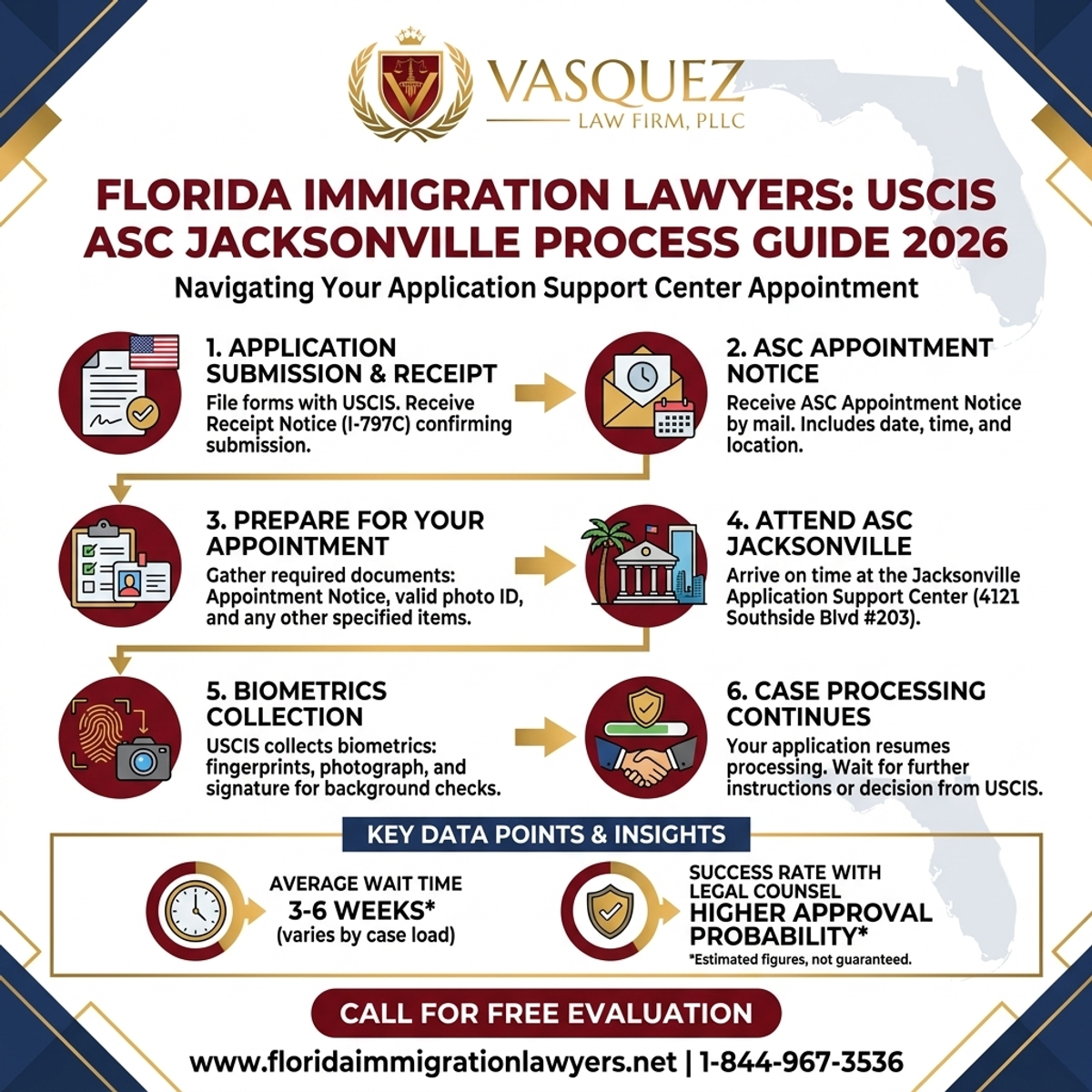
Step-by-Step Process — USCIS Application Support Center (ASC) Jacksonville: Florida 2026 Guide
Arriving early for your appointment is always advisable to allow for security checks and to ensure you are not rushed. Dress appropriately and be prepared to answer questions truthfully and thoroughly. For interviews, practicing your answers and understanding the scope of questioning can be beneficial. Legal representation at interviews can provide significant support and ensure your rights are protected.
Timeline and Processing Expectations for USCIS Applications (as of 2026):
Understanding the general timeline can help manage expectations, though individual cases vary significantly.
| Stage | Typical Timeframe (As of 2026) | Notes |
|---|---|---|
| Application Filing | N/A | Varies by form type; initial submission starts the clock. |
| Biometrics Appointment Notice | 3-8 weeks after filing | USCIS mails Form I-797C; check your address. |
| Biometrics Appointment | 1-2 weeks after notice | Must attend promptly at the assigned ASC. |
| Interview Notice | 3-12 months after biometrics | Varies greatly by case type, Field Office workload, and current policies. |
| Interview | 1-3 months after notice | Prepare thoroughly; may be waived for some cases. |
| Decision | Days to several months after interview | Some decisions are made on the spot, others take time for review. |
Understanding the Role of the West Palm Beach Area in Florida's Immigration Landscape.
West Palm Beach, a vibrant city in Palm Beach County, holds a significant position within Florida's broader immigration landscape. While there isn't a dedicated USCIS Field Office or ASC directly within West Palm Beach, residents primarily utilize the USCIS facilities in Miami and to a lesser extent, Orlando for their immigration needs. The large and diverse immigrant population in South Florida, including a substantial community in West Palm Beach, frequently engages with family-based immigration processes, adjustment of status, and naturalization. According to recent demographic data, Palm Beach County continues to see significant growth in its foreign-born population, reflecting the ongoing need for accessible immigration services.
For individuals residing in West Palm Beach, their primary point of contact for interviews and complex case resolutions will be the Miami Field Office. This necessitates travel and thorough preparation to ensure all appointments are met. The importance of reliable legal counsel for West Palm Beach residents cannot be overstated. An experienced immigration attorney can help prepare applications, advise on required documentation, and represent clients at interviews, mitigating the challenges associated with navigating distant USCIS facilities. The firm of Florida Immigration Lawyers actively serves clients throughout Palm Beach County, providing dedicated support for a wide range of immigration matters, from visa applications to complex deportation defense cases. We understand the unique needs of the community and are committed to offering accessible and effective legal solutions.
Moreover, local community organizations and support networks in West Palm Beach play a crucial role in assisting immigrants, offering resources for language acquisition, cultural integration, and basic legal aid referrals. However, for specific legal advice and representation regarding USCIS applications, consulting with a qualified attorney remains the most reliable path. Understanding the specific legal framework, such as provisions under the Immigration and Nationality Act (INA), is vital for successful outcomes. For example, eligibility for adjustment of status under INA § 245 requires careful review of individual circumstances, a task best handled by legal professionals.
Navigate complex family immigration cases with expert help.What Are the Typical Cost Factors and Fees Associated with USCIS Applications in 2026?
The costs associated with USCIS applications in 2026 are multifaceted, primarily comprising filing fees, biometrics fees, and potentially other expenses like medical examinations and attorney fees. While USCIS filing fees are set by the agency and subject to change, the overall financial commitment can be significant. It is always critical to check the official USCIS website for the most current fee schedule before filing any application to avoid delays due to incorrect payments.
USCIS fees vary widely depending on the type of application or petition. For instance, an application for adjustment of status (Form I-485) typically includes the biometrics fee, while a petition for a nonimmigrant worker (Form I-129) has a different structure. These fees are non-refundable, regardless of the outcome of your case, making accuracy in filing and eligibility assessment paramount. Beyond government fees, applicants often incur costs for required medical examinations conducted by USCIS-approved civil surgeons, which can range from a few hundred dollars to more. Additionally, photography services for passport-style photos and translation services for non-English documents add to the overall expense.
Cost Factors and Fee Breakdown for USCIS Applications (as of 2026):
It is important to note that attorney fees are separate from government fees and vary based on the complexity of the case and the services required.
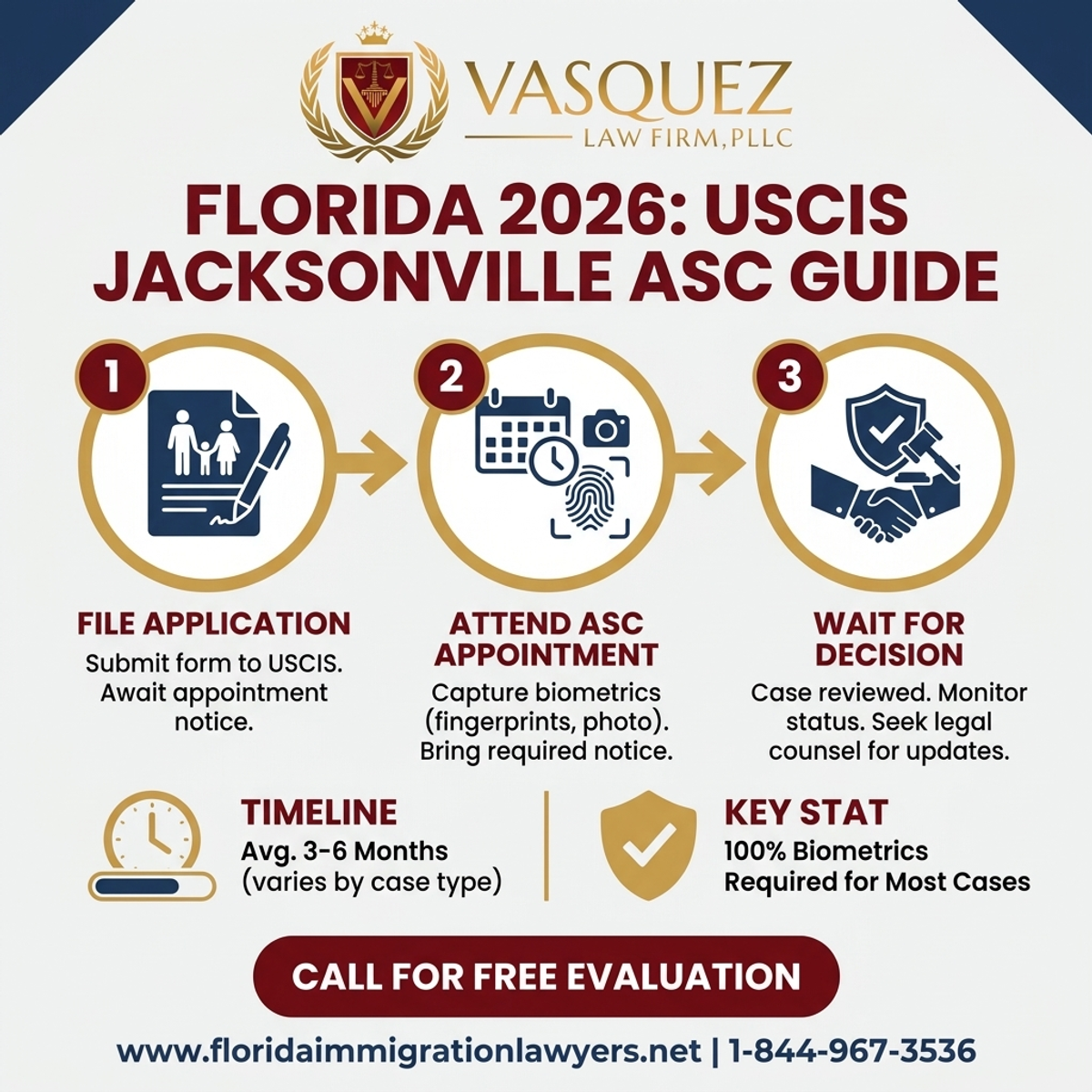
Key Statistics — USCIS Application Support Center (ASC) Jacksonville: Florida 2026 Guide
| Item | Typical Fee Range (As of 2026) | Notes |
|---|---|---|
| USCIS Filing Fee | Varies significantly by form (e.g., I-485, N-400) | Check the USCIS website for the most current fees before filing. |
| Biometrics Fee | Included in most filing fees | A separate fee for some older forms or specific services. |
| Medical Exam Fee | $200-$500+ (paid to civil surgeon) | Required for most adjustment of status applications. |
| Attorney Fees | $X,XXX - $XX,XXX+ | Depends on case complexity, attorney experience, and scope of services. |
| Document Translation Fees | Varies by document length and language | Required for any document not in English. |
| Photography Services | $10-$20 per set | For passport-style photos needed for applications. |
The decision to invest in legal representation is one of the most significant cost factors, yet it can offer immense value. An experienced immigration lawyer can prevent costly mistakes, streamline the application process, and advocate on your behalf, potentially saving you time and money in the long run. Florida Immigration Lawyers offers transparent fee structures and free consultations to discuss your specific needs and provide clear expectations regarding costs.
Navigating Immigration Court and Deportation Defense in Florida.
While USCIS offices handle immigration benefits and applications, the Executive Office for Immigration Review (EOIR) oversees the nation's immigration court system. In Florida, there are several immigration courts, including those in Miami, Orlando, and Pompano Beach, where individuals face removal (deportation) proceedings. Understanding the distinction between USCIS and EOIR is critical, as they operate under different legal frameworks and administrative procedures. USCIS is part of the Department of Homeland Security (DHS) and focuses on affirmative benefits, while EOIR is part of the Department of Justice and handles adversarial proceedings.
For individuals in Florida facing removal proceedings, the stakes are incredibly high, and the process is often complex and intimidating. An immigration judge, not a USCIS officer, presides over these cases. Common reasons for removal proceedings include visa overstays, criminal convictions, or unlawful entry. Defending against deportation requires a deep understanding of immigration law, including provisions outlined in 8 U.S.C. Chapter 12 of the Immigration and Nationality Act. Legal strategies might involve seeking asylum, cancellation of removal, or adjustment of status, depending on individual circumstances and eligibility under specific INA sections.
The presence of a skilled immigration attorney is indispensable in immigration court. An attorney can present evidence, cross-examine witnesses, file necessary motions, and argue legal points on your behalf, significantly improving your chances of a favorable outcome. Florida Immigration Lawyers has extensive experience in deportation defense, representing clients in all Florida immigration courts. We understand the nuances of the law and are dedicated to protecting your rights and helping you explore every available defense. For more information on the immigration court system, visit the Executive Office for Immigration Review (EOIR) website.
Get expert deportation defense in Florida.Do not navigate this process alone. The complexities of immigration law, the specific requirements for each application, and the potential for severe consequences make expert legal guidance invaluable. Contact Florida Immigration Lawyers today for a free consultation to discuss your case and ensure your journey through the U.S. immigration system is handled with precision and care.
Common Mistakes to Avoid When Dealing with USCIS in Florida
Navigating the immigration system can be fraught with potential pitfalls. Avoiding these common mistakes can save you significant time, money, and stress, and increase your chances of a successful outcome.
- Missing or Rescheduling Appointments Without Proper Notice: Failing to attend a biometrics appointment at the USCIS Application Support Center (ASC) in Jacksonville or an interview at a Field Office without proper rescheduling can lead to delays, denials, or even the closure of your case. Always follow instructions on your Form I-797C.
- Submitting Incomplete or Incorrect Forms: A common reason for Requests for Evidence (RFEs) or denials is submitting forms with missing information or incorrect answers. Every question must be answered truthfully and completely.
- Lack of Proper Supporting Documentation: USCIS requires specific evidence to support your claims. Failing to provide all necessary documents, or submitting uncertified copies when originals are required, can lead to significant delays.
- Providing False or Misleading Information: Any attempt to deceive USCIS can result in severe penalties, including a permanent bar from future immigration benefits. Always be truthful in your applications and interviews.
- Not Updating Your Address with USCIS: If you move, you must notify USCIS within 10 days using Form AR-11, Alien's Change of Address Card. Failure to do so can mean missing critical notices and appointment letters.
- Ignoring Requests for Evidence (RFEs) or Notices of Intent to Deny (NOIDs): These notices require a timely and comprehensive response. Ignoring them will almost certainly lead to a denial of your application.
- Traveling Internationally Without Proper Advance Parole: If you have a pending adjustment of status application, leaving the U.S. without an approved Advance Parole document (Form I-131) can result in the abandonment of your application and inability to re-enter.
- Assuming All USCIS Offices Offer the Same Services: As detailed, ASCs and Field Offices have distinct functions. Going to the wrong office for a specific inquiry will be unproductive.
- Not Checking the Official USCIS Website for Updates: Immigration laws, policies, and fees are subject to change. Relying on outdated information can lead to errors. Always consult USCIS.gov for the latest guidelines.
- Failing to Understand Legal Nuances: Many immigration processes have complex eligibility requirements, such as those related to continuous residence for naturalization under INA § 316. Misinterpreting these can lead to application denial.
- Not Seeking Legal Counsel for Complex Cases: While some simple cases might be manageable independently, any complexity (e.g., criminal history, previous denials, unique family situations) warrants professional legal advice.
When to Call a Lawyer for Your Immigration Case in Florida
While the information provided by USCIS is extensive, the application of immigration law to individual circumstances can be highly complex. There are specific scenarios where the expertise of an immigration lawyer from Florida Immigration Lawyers becomes not just helpful, but absolutely essential. You should consider calling an attorney if:
- You have a criminal record, even minor offenses, which can impact your eligibility for certain benefits.
- Your previous immigration applications have been denied, or you have received a Request for Evidence (RFE) or Notice of Intent to Deny (NOID).
- You are facing deportation or removal proceedings in an immigration court in Florida.
- Your case involves complex family relationships, such as adoptions, stepchildren, or specific marriage-based petitions with potential red flags.
- You are seeking asylum or refugee status, which involves highly sensitive and detailed legal arguments.
- Your employer-sponsored visa or green card application requires navigating intricate business immigration laws.
- You have concerns about your eligibility based on past entries, overstays, or other violations of immigration law.
- You simply feel overwhelmed by the process, timelines, and documentation requirements.
Florida Immigration Lawyers understands the nuances of U.S. immigration law and the specific challenges faced by individuals and families across Florida, including those in West Palm Beach and Jacksonville. We offer comprehensive legal services, from initial consultations and application preparation to representation in interviews and court proceedings. Our dedicated team is committed to providing compassionate, effective advocacy to help you achieve your immigration goals.
About Florida Immigration Lawyers
Florida Immigration Lawyers is a leading law firm dedicated to providing comprehensive and compassionate immigration legal services throughout the entire state of Florida. With a deep understanding of federal immigration laws and their specific application within the Florida context, our experienced attorneys are committed to helping individuals, families, and businesses navigate the complexities of the U.S. immigration system. We pride ourselves on offering personalized attention, strategic advice, and vigorous representation to every client.
Our firm handles a wide array of immigration matters, including family-based petitions, employment visas, naturalization and citizenship applications, asylum claims, and aggressive deportation defense. We understand the profound impact immigration decisions have on our clients' lives and are dedicated to achieving the best possible outcomes. Available 24/7, Florida Immigration Lawyers offers free consultations to discuss your case and provide clear, actionable legal strategies. We serve all of Florida, ensuring that expert legal help is always within reach. Contact us today at 1-844-967-3536 or visit our website at https://www.floridaimmigrationlawyers.net to schedule your free consultation.
Sources and References
- U.S. Citizenship and Immigration Services (USCIS)
- Executive Office for Immigration Review (EOIR)
- U.S. Department of State
- 8 U.S.C. Chapter 12 - Immigration and Nationality Act (INA)
- INA § 245 - Adjustment of Status of Nonimmigrant to That of Person Admitted for Permanent Residence
- INA § 316 - Requirements for Naturalization
- 8 CFR Part 103 - Powers and Duties of Service Officers; Availability of Records
- USCIS Policy Manual
Related services: asylum and refugee protection, immigration waivers, humanitarian protection programs, DACA renewal and applications.
This article provides general legal information and is not intended as legal advice. Every case is unique, and outcomes depend on specific facts and circumstances. Contact an attorney for advice about your particular situation.
Your immigration journey in Florida deserves the highest level of legal expertise and support. Whether you are dealing with the USCIS Application Support Center (ASC) in Jacksonville, a Field Office in Miami, or navigating complex court proceedings, Florida Immigration Lawyers is here to help. Our compassionate and knowledgeable team is ready to guide you through every step. Do not delay in seeking the professional advice you need. Call us now at 1-844-967-3536 for a free consultation. Se Habla Espanol - Estamos aqui para ayudarle.
Do Not Navigate This Process Alone
Our experienced immigration attorneys are ready to fight for you. Get a free, confidential consultation today.
Se Habla Español
Or leave your details and we’ll call you:
Free Evaluation in 24 Hours
Or talk to us right now
AI voice assistant — available 24/7
FreeFrequently Asked Questions

William J. Vásquez
Founding Attorney · Vasquez Law Firm
U.S. Air Force veteran and immigration attorney with years of hands-on U.S. immigration experience. J.D., NCCU School of Law. AILA member. Admitted to the 4th, 5th, and 11th Circuit Courts.
Available 24/7 - Free Evaluations
Reviewed for legal accuracy by William J. Vásquez
Licensed in North Carolina; U.S. immigration is federal practice.
Related Legal Services
Our Florida immigration attorneys can help you with citizenship and naturalization, family immigration services and immigration practice areas. Call today at 1-844-967-3536 for a free consultation.
Related Links
Related Topics
Free Legal Consultation
Discuss your case with our experienced attorneys. We're available 24/7.
Se Habla Español - Estamos aquí para ayudarle.
Related Articles
Military Naturalization Expedited in Florida Bases
Explore military naturalization options for families at Florida bases, including parole in place benefits in Miami. Learn how to expedite your application with expert guidance from Florida Immigration Lawyers.
Immigration Lawyer Orlando Free Consultation 2026
Discover how an immigration lawyer in Orlando can help you through a free consultation. Learn about the services offered, costs, and recent immigration policy updates affecting your case.
Dual Citizenship Lawyer: Navigating Naturalization in
For many immigrants in Hialeah, Florida, dual citizenship offers both opportunity and security. Navigating this process involves understanding eligibility, legal requirements, and the benefits of consulting a dual citizenship lawyer. This guide provides comprehensive insights into obtaining dual citizenship, from eligibility to documentation and when to seek legal advice. Call Florida Immigration Lawyers at 1-844-967-3536 for a free consultation.
USCIS Application Support Center (ASC) Jacksonville: 2026
The USCIS Application Support Center (ASC) in Jacksonville, Florida, is crucial for biometric data collection, a mandatory step for various immigration benefits like Green Cards and naturalization. This guide explains the ASC's role, how to prepare for appointments, and distinguishes it from broader USCIS Field Offices. We cover timelines, potential costs, and common mistakes to avoid, emphasizing the importance of accurate documentation and timely responses. For complex situations or any concerns regarding your immigration process in Florida, consulting an experienced attorney is highly recommended to ensure compliance and protect your rights. Florida Immigration Lawyers are ready to assist with expert legal advice.