Unlawful Presence Waiver Florida: I-601A Provisional Guide 2026
The I-601A Provisional Waiver offers a crucial pathway for individuals in Florida facing inadmissibility due to unlawful presence. This guide from Florida Immigration Lawyers details the eligibility requirements, a step-by-step application process, and essential documentation needed for 2026. Learn how to demonstrate extreme hardship to a qualifying relative and avoid common mistakes that could jeopardize your application. With a focus on Hialeah and the broader Florida community, we emphasize the importance of expert legal guidance to navigate this complex immigration process successfully. Understand processing times, cost factors, and when to seek professional help to ensure a smooth journey towards lawful permanent residency. Contact us for a free consultation.
An unlawful presence waiver Florida, specifically the I-601A Provisional Waiver, allows certain individuals present in the U.S. without authorization to apply for a waiver of inadmissibility before leaving for their immigrant visa interview abroad. This process helps families remain together and minimizes the time spent outside the U.S., provided they meet specific eligibility criteria, including demonstrating extreme hardship to a qualifying U.S. citizen or LPR relative.
- The I-601A waiver addresses inadmissibility due to unlawful presence.
- Applicants must be in the U.S. and have an approved immigrant petition.
- Demonstrating extreme hardship to a qualifying relative is crucial.
- Approval allows waiver processing before leaving the U.S. for the visa interview.
- Consulting an experienced Florida immigration lawyer is highly recommended.
Unlawful Presence Waiver Florida: I-601A Provisional Guide 2026
Imagine building a life in Hialeah, Florida, raising your family, and contributing to your community. Then, the possibility of permanent residency arises, but a past period of unlawful presence threatens to separate you from your loved ones. This is a common and deeply stressful situation for many Florida families.
Fortunately, the U.S. government offers a pathway for certain individuals to overcome inadmissibility due to unlawful presence: the I-601A Provisional Waiver. This crucial immigration tool allows eligible applicants to seek a waiver while still in the United States, minimizing the time they spend separated from their families during the immigrant visa process.
In 2026, navigating the complexities of the unlawful presence waiver Florida process requires precise legal guidance. This comprehensive guide from Florida Immigration Lawyers will walk you through everything you need to know about the I-601A Provisional Waiver. We will cover eligibility, the application process, required documents, and common pitfalls to avoid.
Our goal is to demystify this critical process for you and your family in Florida. Do not face this challenge alone. Call Florida Immigration Lawyers at 1-844-967-3536 for a free consultation and let our experienced team help you understand your options and pursue your path to permanent residency.
Understanding Unlawful Presence and the I-601A Provisional Waiver in Florida
Unlawful presence refers to the time an individual spends in the United States without being admitted or paroled, or after the expiration of a period of authorized stay. Accruing more than 180 days of unlawful presence can trigger severe immigration consequences, specifically a bar to re-entry.
Individuals who accrue more than 180 days but less than one year of unlawful presence and then depart the U.S. are generally barred from re-entering for three years. If they accrue one year or more of unlawful presence and then depart, they face a ten-year bar. This is stipulated under Section 212(a)(9)(B) of the Immigration and Nationality Act (INA), also known as 8 U.S.C. § 1182(a)(9)(B).
The I-601A Provisional Waiver was established to mitigate the harsh impact of these bars, particularly on U.S. citizen and lawful permanent resident (LPR) family members. It allows certain eligible individuals to apply for a waiver of inadmissibility while they are still physically present in the United States.
This means you do not have to leave the country and risk being stuck abroad for years while your waiver is processed. For families across Florida, from Hialeah to Miami, Orlando, and Tampa, this provides immense relief and reduces the stress of family separation.
The I-601A provisional waiver is specifically designed for individuals who are inadmissible only due to unlawful presence. If you have other grounds of inadmissibility, such as certain criminal offenses or misrepresentations, you may need a different type of waiver, such as the I-601 waiver, which typically requires you to depart the U.S. to apply.
Who Qualifies for an Unlawful Presence Waiver?
The I-601A waiver is for individuals who meet specific criteria. Generally, you must be the beneficiary of an approved immediate relative immigrant visa petition (Form I-130, Petition for Alien Relative), and your qualifying relative must be a U.S. citizen or lawful permanent resident. This process is often sought by spouses, parents, and unmarried children of U.S. citizens or LPRs.
Understanding whether you meet the definition of a qualifying relative waiver is paramount. The law requires you to demonstrate that your U.S. citizen or LPR spouse or parent would suffer "extreme hardship" if you were denied admission to the United States. This is often the most challenging aspect of the application.
Eligibility Requirements for the I-601A Provisional Waiver in 2026
To be eligible for the I-601A provisional waiver, applicants must satisfy several strict requirements. These criteria are designed to ensure that the waiver is granted only in appropriate circumstances, balancing the need for family unity with immigration enforcement.
First, you must be physically present in the United States at the time of filing your Form I-601A. This is a fundamental aspect of the "provisional" nature of the waiver, allowing you to remain with your family during much of the process.
Second, you must be 17 years of age or older. This age requirement ensures that applicants are mature enough to understand the implications of the waiver process and associated legal commitments.
Third, you must be the beneficiary of an approved immigrant visa petition. This typically involves an approved Form I-130, Petition for Alien Relative, filed by a U.S. citizen or lawful permanent resident spouse, parent, or sometimes child. This establishes your underlying eligibility for an immigrant visa.
Fourth, you must be seeking an immigrant visa as an immediate relative of a U.S. citizen or a lawful permanent resident. This includes spouses, unmarried children under 21, and parents of U.S. citizens, as well as spouses and unmarried children of LPRs. The waiver is not generally available for other preference categories.
Fifth, you must be inadmissible to the United States solely based on unlawful presence. If you have other grounds of inadmissibility, such as criminal convictions, previous deportations, or material misrepresentations, the I-601A waiver will not cover those. You would need to address those issues separately, potentially with a traditional I-601 waiver.
Sixth, you must demonstrate that your U.S. citizen or LPR spouse or parent would suffer "extreme hardship" if you were denied admission to the United States. This is a high legal standard and requires compelling evidence of severe medical, financial, psychological, or other burdens on your qualifying relative.
Finally, you must be scheduled for an immigrant visa interview at a U.S. embassy or consulate abroad. The provisional waiver is designed to be processed before this interview, allowing you to attend with the assurance that your unlawful presence inadmissibility has been provisionally waived.
Step-by-Step Guide to Applying for Your I-601A Waiver in 2026
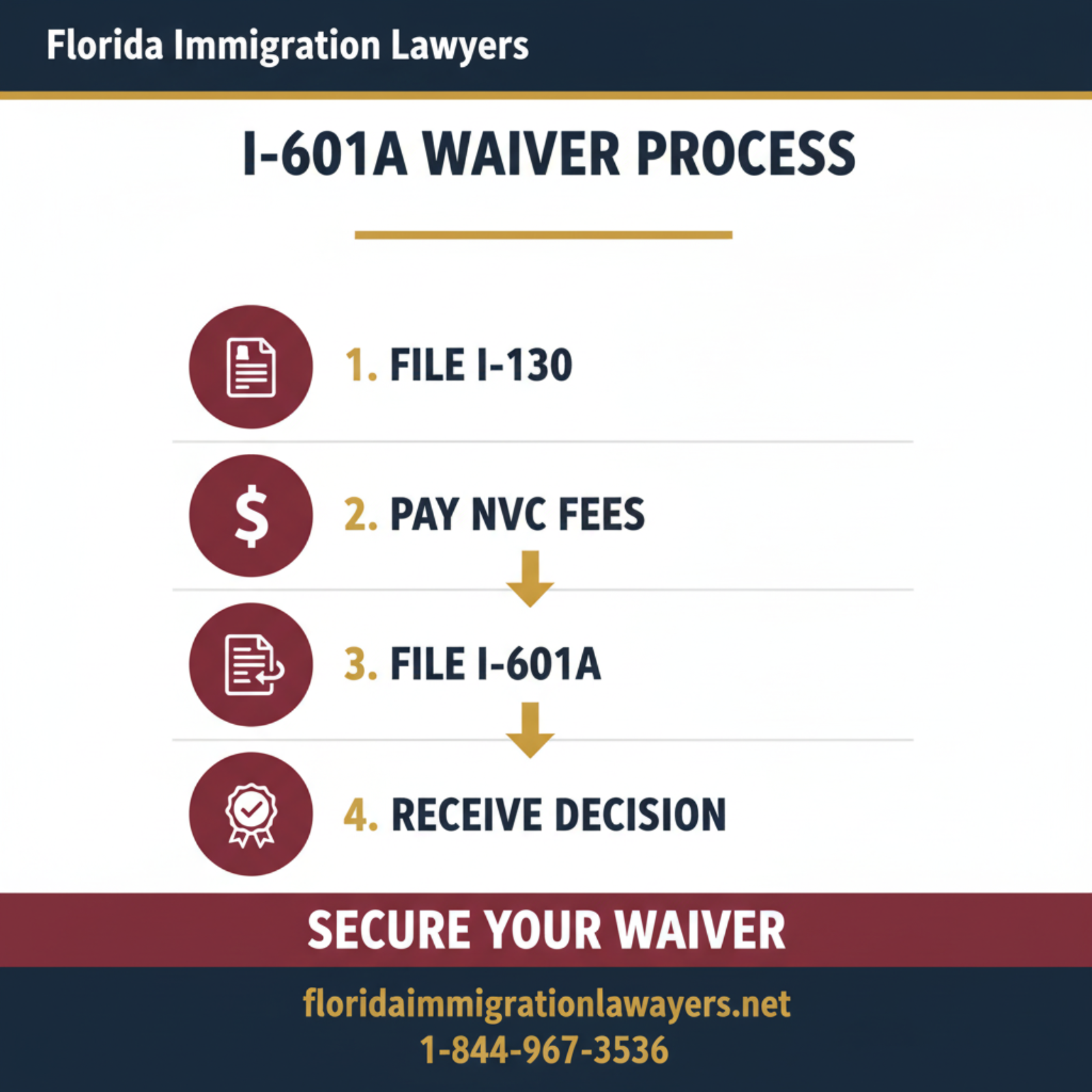
Applying for an unlawful presence waiver Florida can be a complex journey, but breaking it down into manageable steps makes it clearer. Here is a simplified guide to the I-601A provisional waiver process:
-
Step 1: File an Immigrant Petition: The first step is typically for your U.S. citizen or LPR relative to file an immigrant visa petition on your behalf. For immediate relatives, this is usually Form I-130, Petition for Alien Relative. This petition must be approved by USCIS before you can apply for the I-601A waiver.
Once approved, if you are an immediate relative of a U.S. citizen, your visa category is immediately available. If you are a relative of an LPR, you will need to wait for your visa priority date to become current.
-
Step 2: Receive Notification of Interview and Pay Fees: After your immigrant petition is approved and your visa category is current, the National Visa Center (NVC) will notify you. They will instruct you to pay the immigrant visa processing fees and submit required civil documents. At this stage, your visa interview will be scheduled at a U.S. embassy or consulate abroad.
It is crucial not to depart the U.S. before your I-601A is approved. Leaving prematurely could trigger the unlawful presence bar without a waiver in place.
-
Step 3: File Form I-601A, Application for Provisional Unlawful Presence Waiver: Once you have received notice of your scheduled immigrant visa interview and have paid your fees, you can file Form I-601A with U.S. Citizenship and Immigration Services (USCIS). This application must include comprehensive evidence demonstrating extreme hardship to your qualifying U.S. citizen or LPR spouse or parent.
Accurate and thorough documentation is key at this stage. Any errors or omissions can lead to delays or even denial.
-
Step 4: Attend Biometrics Appointment: After filing Form I-601A, USCIS will send you an appointment notice for biometrics collection. You will need to attend this appointment at a designated Application Support Center (ASC) in Florida, such as those near Miami or Orlando, to have your fingerprints, photograph, and signature taken.
Step-by-Step Process Guide This data is used for background checks and identity verification. Missing this appointment without rescheduling can jeopardize your application.
-
Step 5: Receive I-601A Decision: USCIS will review your application and evidence. If approved, you will receive an approval notice for your provisional waiver. This approval is conditional on you departing the U.S. and attending your immigrant visa interview.
If denied, you may need to consult with an attorney to understand the reasons for denial and explore potential next steps, which could include refiling or appealing, depending on the circumstances.
-
Step 6: Attend Consular Interview Abroad: With your I-601A approval in hand, you will travel to the U.S. embassy or consulate abroad for your immigrant visa interview. The consular officer will review your case, confirm your eligibility, and issue your immigrant visa.
Upon returning to the U.S. with your new immigrant visa, you will be admitted as a lawful permanent resident. The time spent outside the U.S. for this final step is typically very brief, often just a few days.
Essential Documents for Your Provisional Waiver Application
A well-prepared I-601A provisional waiver application relies heavily on comprehensive and compelling documentation. Gathering these documents can be time-consuming, so it is best to start early and organize everything meticulously. Here is a checklist of commonly required documents:
- Approved Immigrant Petition: A copy of the approval notice for your Form I-130 (or other qualifying petition).
- Proof of U.S. Citizenship or LPR Status for Qualifying Relative: Copies of your qualifying relative's U.S. passport, birth certificate, naturalization certificate, or Green Card (Form I-551).
- Proof of Relationship: Marriage certificate for spouses, birth certificates for parents/children.
- Evidence of Extreme Hardship: This is the most critical part. It requires detailed documentation proving that your qualifying relative would suffer extreme hardship if you were unable to return to the U.S. This can include:
- Medical Hardship: Medical records, doctor's letters, evidence of ongoing treatment, prescriptions for qualifying relative.
- Financial Hardship: Bank statements, tax returns, mortgage statements, rental agreements, utility bills, evidence of financial dependency, job loss risk.
- Psychological Hardship: Letters from therapists or psychologists detailing the emotional and mental impact on the qualifying relative, especially if they have diagnosed conditions.
- Educational Hardship: School records, evidence of special needs for children, impact on qualifying relative's education or children's education.
- Country Conditions: Information about conditions in your home country that would make your qualifying relative's relocation there difficult or impossible.
- Affidavits: Sworn statements from family members, friends, employers, and community leaders attesting to your character and the hardship your absence would cause.
- Applicant's Identification Documents: Copies of your passport, birth certificate, and any previous visas or immigration documents.
- Proof of Physical Presence in the U.S.: Utility bills, leases, employment records, school records, bank statements showing you have been continuously present in the U.S. since a certain date.
- Criminal Records (if any): Certified copies of court dispositions for any arrests or convictions, even if expunged. Full disclosure is vital.
- Marriage Certificate and Divorce Decrees (if applicable): For all prior marriages for both applicant and qualifying relative.
- Photographs: Passport-style photographs of the applicant.
- Translations: Any documents not in English must be accompanied by a certified English translation.
I-601A Provisional Waiver Processing Time and Expectations for 2026
One of the most common questions our clients in Florida ask is about the provisional waiver processing time. USCIS processing times for Form I-601A can fluctuate significantly based on various factors, including the volume of applications, staffing levels, and policy changes.
While we cannot provide exact timelines, USCIS generally updates its processing times on its website, which can give you an estimate. As of early 2026, applicants can typically expect processing to take several months, and in some cases, over a year. It is important to remember that these are estimates, and your individual case may vary.
Factors that can influence your processing time include the complexity of your case, the thoroughness of your documentation, and whether USCIS needs to issue a Request for Evidence (RFE). An RFE will inevitably extend your processing time.
Once your I-601A is approved, the final step involves a brief trip abroad for your consular interview. This part of the process is typically very quick, often just a few days, allowing you to return to Florida swiftly as a lawful permanent resident.
It is important to manage your expectations and prepare for potential delays. During this waiting period, it is crucial to maintain your legal status if you have any, and to avoid any actions that could jeopardize your application, such as leaving the U.S. without approval.
Costs and Fees Associated with the I-601A Waiver
Understanding the financial aspects of the unlawful presence waiver Florida process is essential for planning. The total cost involves several components, including government filing fees and legal fees.
First, there is the USCIS filing fee for Form I-601A itself. This fee is subject to change, so it is crucial to check the most current fee schedule on the USCIS website before filing. Additionally, there is a separate biometrics fee required for your fingerprinting appointment.
Beyond the government fees, you will need to consider the cost of legal representation. While not legally required, hiring an experienced immigration attorney from Florida Immigration Lawyers is highly recommended. Our fees cover the expert preparation of your application, meticulous gathering of evidence, drafting of legal arguments, and guidance through every step of the process.
Other potential costs may include fees for obtaining certified copies of documents, translations, medical examinations (if required by the consulate), and travel expenses for your biometrics appointment and the final consular interview abroad. While we do not provide specific fee amounts here, we offer transparent pricing during your initial consultation.
Investing in legal assistance can significantly increase your chances of approval and help you avoid costly mistakes that could lead to delays or denials. Many clients find that the peace of mind and successful outcome outweigh the legal fees.
Do not navigate this process alone. Contact Florida Immigration Lawyers today. Our dedicated team is here to provide the expert guidance you need for your I-601A waiver application.
Common Mistakes to Avoid When Filing Your I-601A Waiver
The I-601A Provisional Waiver process is unforgiving of errors. Even small mistakes can lead to significant delays, requests for evidence, or outright denial. Being aware of these common pitfalls can help you avoid them:
-
Incomplete or Inaccurate Forms: Failing to fill out every section of Form I-601A accurately and completely. USCIS often rejects applications with missing information or incorrect answers, leading to lost time and refiling.
Consequence: Delayed processing, rejection, or denial of your application.
-
Insufficient Evidence of Extreme Hardship: This is the most frequent reason for denial. Applicants often provide general statements instead of concrete, well-documented evidence of severe medical, financial, or psychological hardship to their qualifying relative.
Consequence: Denial of the waiver, requiring you to remain outside the U.S. for years or explore other, often more difficult, immigration options.
-
Misunderstanding Eligibility Criteria: Applying for the I-601A when you are not actually eligible, perhaps due to other grounds of inadmissibility not covered by this waiver (e.g., criminal history, prior deportations).
Consequence: Automatic denial and wasted filing fees and time.
-
Failing to Disclose Criminal History: Omitting any arrests or convictions, no matter how minor or old, or if they were expunged. USCIS has access to extensive databases.
Consequence: Charges of misrepresentation, which can lead to permanent bars from the U.S. and denial of all future immigration benefits.
-
Leaving the U.S. Before Waiver Approval: Departing the United States before your I-601A provisional waiver is approved automatically triggers the unlawful presence bar, making you inadmissible upon re-entry.
Consequence: You will be stuck outside the U.S. and unable to return for 3 or 10 years, or until a traditional I-601 waiver is approved (which cannot be filed from inside the U.S. in most cases).
-
Not Updating Contact Information: Failing to notify USCIS of any address changes. Important notices and RFEs can be missed, leading to abandonment of your application.
Consequence: Missed appointments, missed RFEs, and potential denial of your application without your knowledge.
-
Missing Deadlines: Not responding to Requests for Evidence (RFEs) or other USCIS notices within the specified timeframe.
Consequence: Automatic denial of your application.
-
Submitting Unorganized Documentation: Sending a disorganized stack of documents without proper labeling or an index. This makes it difficult for USCIS officers to review your case efficiently.
Consequence: Delays, RFEs, or a negative impression that could lead to a denial.
-
Assuming All Inadmissibility Grounds Are Waived: Believing the I-601A covers all reasons for inadmissibility. It specifically addresses only unlawful presence. Other grounds require separate waivers.
Consequence: You may arrive at your consular interview only to find you are still inadmissible on other grounds, leading to denial of your visa.
-
Not Preparing for the Consular Interview: Even with an approved I-601A, the consular officer at the interview abroad has the final say. Not being prepared to answer questions about your case can lead to issues.
Consequence: Potential denial of your immigrant visa, despite the approved waiver.
When to Call Florida Immigration Lawyers for Your I-601A Waiver
While this guide provides a comprehensive overview, the nuances of immigration law, especially concerning the unlawful presence waiver Florida, are best navigated with professional legal assistance. Florida Immigration Lawyers stands ready to assist you.
You should consider contacting our firm immediately if any of the following scenarios apply to your situation:
- Complex Hardship Cases: If demonstrating "extreme hardship" feels overwhelming, or if your qualifying relative's hardship is not immediately obvious. We specialize in building strong hardship arguments.
- Prior Immigration Issues: If you have any history of deportation, removal proceedings (deportation defense), previous visa denials, or other immigration violations.
- Criminal History: Even minor arrests or charges can complicate your case. Our attorneys can assess the impact of any criminal record on your eligibility.
- Uncertainty About Eligibility: If you are unsure whether you meet all the strict requirements for the I-601A waiver. We can provide a clear assessment of your eligibility.
- Need for Expedited Processing: While not guaranteed, an attorney can help ensure your application is submitted perfectly, minimizing delays.
- Language Barriers: If English is not your first language, our bilingual team can ensure clear communication throughout the process.
- Any Doubts or Concerns: If you feel overwhelmed or have any questions about the process, it is always best to consult with an expert.
Our experienced attorneys at Florida Immigration Lawyers understand the specific challenges faced by immigrants in Hialeah and across Florida. We are dedicated to providing compassionate and effective legal representation for all aspects of immigration law, including family immigration and waivers.
We will meticulously prepare your application, gather robust evidence of extreme hardship, and represent your best interests before USCIS and the National Visa Center. Our goal is to help you achieve your dream of lawful permanent residency with minimal stress and maximum efficiency.
About Florida Immigration Lawyers
Florida Immigration Lawyers is a premier immigration law firm dedicated to serving individuals and families across the entire state of Florida. With a deep understanding of U.S. immigration laws and a commitment to our clients, we strive to provide exceptional legal representation and guidance.
Our firm specializes in a wide range of immigration services, including family-based petitions, employment visas, asylum applications, deportation defense, citizenship and naturalization, and various waivers. We understand the profound impact immigration matters have on our clients' lives and approach each case with empathy, diligence, and strategic insight.
Why choose Florida Immigration Lawyers? We offer a client-centered approach, transparent communication, and a proven track record of success. Our attorneys are passionate advocates who stay abreast of the latest legal developments to provide the most current and effective advice. We are available 24/7 to address your urgent concerns and offer free, no-obligation consultations to help you understand your legal options.
Let Florida Immigration Lawyers be your trusted partner on your immigration journey. Contact us today at 1-844-967-3536 or visit our website at https://www.floridaimmigrationlawyers.net to schedule your free consultation. We are here to help you achieve your immigration goals in Florida.
Sources and References
- U.S. Citizenship and Immigration Services (USCIS) - I-601A Provisional Unlawful Presence Waiver
- Immigration and Nationality Act (INA) Section 212(a)(9)(B) - 8 U.S.C. § 1182(a)(9)(B)
- 8 Code of Federal Regulations (CFR) Part 212 - Documentary Requirements: Nonimmigrants; Waivers; Admission of Certain Inadmissible Aliens; Parole
- U.S. Department of State - National Visa Center (NVC)
This article provides general legal information and is not intended as legal advice. Every case is unique, and outcomes depend on specific facts and circumstances. Contact an attorney for advice about your particular situation.
Navigating the I-601A Provisional Waiver process is a critical step towards securing your future in the United States. With the right legal support, you can confidently pursue your path to permanent residency.
Do not let the complexities of immigration law deter you. Call Florida Immigration Lawyers today at 1-844-967-3536 for a free consultation. Se Habla Español - Estamos aquí para ayudarle.
Frequently Asked Questions
Florida Immigration Lawyers
Legal Team
Our experienced attorneys at Florida Immigration Lawyers have been serving clients across Florida for over 20 years. We specialize in immigration, personal injury, criminal defense, workers compensation, and family law.