U Visa for Crime Victims in Florida: Your Path to Safety
The U visa offers vital immigration relief for crime victims in Florida who have suffered substantial abuse and are helpful to law enforcement. This guide from Florida Immigration Lawyers details eligibility, the application process, required documents, and processing times for 2026. Learn about qualifying crimes, the critical role of law enforcement certification, and how family members can also benefit. We emphasize the importance of legal counsel to navigate the complexities, avoid common mistakes, and secure a path to safety and legal status. Discover how our firm, serving all of Florida, including Coral Springs, can advocate for you. Contact us for expert assistance.

The U visa offers crucial immigration relief for crime victims in Florida who have suffered substantial physical or mental abuse and are helpful to law enforcement in the investigation or prosecution of certain qualifying crimes. This humanitarian visa provides temporary legal status, work authorization, and a potential pathway to permanent residency for eligible individuals and their qualifying family members, fostering safety and justice in communities like Coral Springs.
- U visas protect victims of specific serious crimes.
- Applicants must assist law enforcement in investigations.
- Certification from a qualifying agency is mandatory.
- It provides temporary status and a path to a Green Card.
- Legal guidance significantly enhances application success.
Introduction: Finding Hope After Crime as an Immigrant in Florida
Experiencing a crime is a traumatic event, and for immigrants in Florida, the fear of deportation or lack of legal status can add an overwhelming layer of vulnerability. You might feel isolated, unsure of your rights, or hesitant to report what happened to authorities. However, specific protections exist under U.S. immigration law designed to help you, the victim, find safety and justice.
One such vital protection is the U nonimmigrant status, commonly known as the U visa. This unique visa offers a lifeline to victims of certain crimes who have suffered significant harm and are willing to cooperate with law enforcement in their investigations. It acknowledges your courage and contribution to community safety, offering a pathway to legal status and stability.
This comprehensive guide from Florida Immigration Lawyers will walk you through everything you need to know about the U visa for crime victims in Florida in 2026. We will cover eligibility, the application process, required documentation, and what to expect regarding timelines. Our goal is to empower you with knowledge and provide a clear understanding of your options. If you or a loved one are a victim of crime in Florida and need assistance, do not hesitate. Call Florida Immigration Lawyers at 1-844-967-3536 for a free consultation today.
Understanding the U Visa for Crime Victims in Florida
The U visa was established by Congress to strengthen the ability of law enforcement agencies to investigate and prosecute crimes, while simultaneously offering protection to immigrant victims. It provides a humanitarian form of relief, recognizing that victims, regardless of their immigration status, deserve safety and the opportunity to heal without fear.
Specifically, the U visa is available to individuals who have been victims of certain criminal activities, have suffered substantial physical or mental abuse as a result of the crime, and possess information about the crime. Crucially, they must be helpful, have been helpful, or are likely to be helpful to a certifying law enforcement agency in the investigation or prosecution of the criminal activity. This includes agencies at the federal, state, or local level, such as the Coral Springs Police Department or the Broward County Sheriff's Office.
For many undocumented immigrants in Florida, including those in vibrant communities like Coral Springs, Fort Lauderdale, or Miami, the U visa represents a critical opportunity. It allows victims to come forward without fear of immigration consequences, thereby making our communities safer for everyone. Understanding the specific criteria is the first step towards securing this vital protection.
What Crimes Qualify for a U Visa? Eligibility Requirements in 2026
Not all crimes qualify for a U visa. The law specifically lists certain criminal activities that make a victim eligible. These crimes generally involve severe harm or exploitation. Understanding this list is crucial for determining your eligibility.
According to the Immigration and Nationality Act (INA) Section 101(a)(15)(U), qualifying criminal activities include, but are not limited to: abduction, abusive sexual contact, blackmail, domestic violence, extortion, false imprisonment, female genital mutilation, hostage taking, incest, involuntary servitude, kidnapping, murder, obstruction of justice, peonage, perjury, prostitution, rape, sexual assault, sexual exploitation, slave trade, stalking, torture, trafficking, and unlawful criminal restraint. Attempted versions of these crimes, as well as conspiracy or solicitation to commit them, also qualify. This list is outlined in 8 U.S.C. § 1101(a)(15)(U)(iii).
Beyond the type of crime, you must demonstrate that you have suffered substantial physical or mental abuse as a direct result of the qualifying criminal activity. This abuse can be documented through medical records, psychological evaluations, police reports, and personal statements. Furthermore, you must possess information about the crime and be willing to assist law enforcement. Your cooperation is a cornerstone of the U visa program.
The Role of Law Enforcement Certification
A critical component of the U visa requirements is obtaining certification from a qualifying law enforcement agency. This certification, typically Form I-918, Supplement B, "U Nonimmigrant Status Certification," confirms that you were a victim of a qualifying crime and were helpful, are being helpful, or are likely to be helpful in the investigation or prosecution of that crime. Without this certification, your U visa petition cannot proceed.
Qualifying agencies include federal, state, or local law enforcement agencies, prosecutors, judges, or other authorities that have criminal investigative or prosecutorial authority. In Florida, this could be the local police department, county sheriff's office, State Attorney's Office, or even federal agencies like the FBI or ICE. Securing this certification can sometimes be challenging, requiring skilled legal advocacy to navigate bureaucratic hurdles and ensure your cooperation is properly recognized.
Indirect Victims and Family Members
The U visa not only provides relief to the direct victim but also offers derivative status to certain qualifying family members. This means that your spouse, children (unmarried and under 21), and in some cases, parents or unmarried siblings under 18, may also be eligible for U nonimmigrant status, even if they were not direct victims of the crime. This provision ensures that families can remain together and find safety collectively.
For indirect victims, the process requires demonstrating the familial relationship and proving that the qualifying family member would suffer extreme hardship if they were not allowed to remain in the United States. This broad protection underscores the humanitarian intent of the U visa program, allowing entire families to rebuild their lives in safety.
Step-by-Step Guide: Applying for a U Visa in Florida
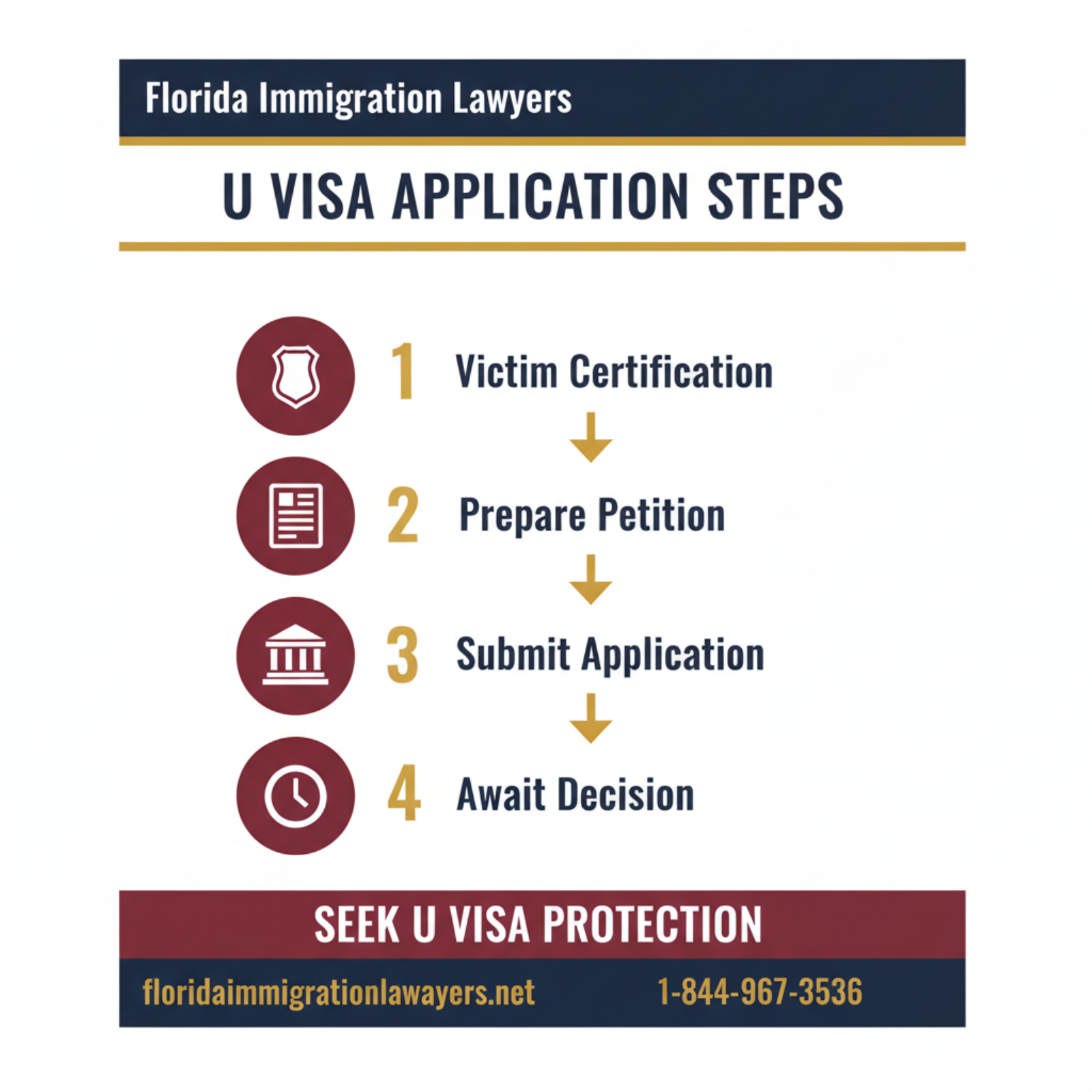
The U visa application process can be complex and lengthy, requiring meticulous attention to detail. Here is a general step-by-step guide to help you understand what to expect in 2026:
-
Victimization and Reporting: The process begins with you being a victim of a qualifying crime in Florida and reporting it to the appropriate law enforcement agency. It is crucial to cooperate fully with investigators from the outset.
-
Obtain Law Enforcement Certification (Form I-918, Supplement B): This is arguably the most critical step. You must request and obtain a signed certification from the law enforcement agency that investigated or prosecuted the crime. This form verifies your helpfulness. An experienced immigration attorney can assist in communicating with law enforcement to secure this document.
-
File Form I-918, Petition for U Nonimmigrant Status: Once you have the certification, you will prepare and file Form I-918, Petition for U Nonimmigrant Status, along with all supporting documentation, to U.S. Citizenship and Immigration Services (USCIS). This includes a personal statement detailing the crime and its impact on you, as well as evidence of your helpfulness. You may also file Form I-765, Application for Employment Authorization, concurrently to seek work authorization.
-
Attend Biometrics Appointment: After filing, USCIS will send you a notice to attend a biometrics appointment at an Application Support Center (ASC). Here, your fingerprints, photograph, and signature will be collected for background checks.
Step-by-Step Process Guide -
Receive Prima Facie Determination and Work Authorization: Due to the annual cap on U visas, USCIS first reviews petitions for a "prima facie" determination. If your petition is found to be bona fide and meets initial requirements, you may be granted deferred action and work authorization while you await a final decision on the U visa waiting list. This is a significant relief, offering temporary legal status and the ability to work legally.
-
Placement on the U Visa Waiting List: Because only 10,000 U visas are issued each fiscal year, eligible applicants are placed on a waiting list after a positive prima facie determination. The length of the U visa waiting list can vary, but it often spans several years. During this time, you typically maintain deferred action and work authorization.
-
Final Adjudication and Adjustment of Status: Once a U visa becomes available and your priority date is current, USCIS will conduct a final review of your petition. If approved, you will receive U nonimmigrant status for four years. After three years in U status, you may be eligible to apply for lawful permanent resident status (a Green Card) by filing Form I-485, Application to Register Permanent Residence or Adjust Status, provided you meet all other eligibility criteria.
Essential Document Checklist for Your U Visa Application
A complete and well-organized application package is crucial for a successful U visa petition. Missing documents or insufficient evidence can lead to delays or even denial. Here is a general U visa requirements checklist of documents you will typically need:
- Form I-918, Petition for U Nonimmigrant Status
- Form I-918, Supplement B, U Nonimmigrant Status Certification (signed by a certifying official)
- Personal statement detailing the crime, the harm suffered, and your helpfulness to law enforcement
- Evidence of the qualifying criminal activity (e.g., police reports, court documents, newspaper articles)
- Evidence of substantial physical or mental abuse (e.g., medical records, psychological evaluations, counseling reports, affidavits from doctors or therapists)
- Evidence of your helpfulness to law enforcement (e.g., police reports, court transcripts, letters from prosecutors, witness statements)
- Proof of identity and nationality (e.g., passport, birth certificate, national ID)
- For derivative family members: Form I-918, Supplement A, Petition for Qualifying Family Member of U-1 Recipient, and evidence of familial relationship (e.g., marriage certificate, birth certificates)
- Form I-765, Application for Employment Authorization (optional, but highly recommended)
- Any necessary waivers of inadmissibility (Form I-192, Application for Advance Permission to Enter as a Nonimmigrant)
Gathering all these documents can be daunting. An experienced immigration attorney from Florida Immigration Lawyers can help you compile a robust application package, ensuring all necessary evidence is included and properly presented.
U Visa Processing Time and Expectations in 2026
Understanding the U visa processing time is essential for managing expectations. It is important to note that the U visa process is known for its lengthy timelines, primarily due to the annual cap and the high volume of applications received by USCIS.
Currently, after filing your petition, USCIS typically takes several months to issue a receipt notice and schedule your biometrics appointment. The review for a prima facie determination can take approximately 12-18 months. If you receive a positive prima facie determination, you will be granted deferred action and work authorization (if you filed Form I-765). This interim status provides significant relief, allowing you to live and work legally while awaiting a final decision.
However, the most significant waiting period often comes from the annual cap. There are only 10,000 principal U visas available each federal fiscal year (October 1st to September 30th). Once this cap is reached, eligible applicants are placed on a waiting list. The current waiting list for a final U visa approval can extend for several years, sometimes five years or more, depending on the volume of applications and congressional action. While on the waiting list, you maintain your deferred action status and can continue to renew your work permit.
It is crucial to remain patient and continue to comply with all immigration laws during this waiting period. Florida Immigration Lawyers stays updated on the latest processing trends and can provide you with the most current information and strategic advice throughout your journey.
Cost Factors and Fee Breakdown for U Visa Petitions
When considering a U visa application, it is important to understand the associated costs. While the Form I-918, Petition for U Nonimmigrant Status, itself generally does not have a filing fee, there are other potential expenses that you should anticipate.
One common fee is for Form I-765, Application for Employment Authorization, if you choose to apply for a work permit concurrently or later. However, many U visa applicants are eligible for a fee waiver for the I-765 and other related forms, especially given the humanitarian nature of the petition. Your attorney can help you determine if you qualify for such waivers.
Beyond government filing fees, you should consider legal fees for an experienced immigration attorney. While not mandatory, legal representation significantly increases your chances of success. Attorneys assist with gathering complex documentation, drafting compelling personal statements, communicating with law enforcement for certification, and responding to USCIS requests for evidence. These fees vary based on the complexity of your case and the services required. Additionally, there might be costs for medical examinations (if required for adjustment of status later), translation services for foreign documents, and obtaining official records.
Florida Immigration Lawyers understands the financial challenges many crime victims face. We offer transparent fee structures and can discuss payment options during your free consultation. Investing in legal expertise can save you time, stress, and potential costly errors in the long run.
Do not navigate this complex and sensitive process alone. The stakes are too high. Contact Florida Immigration Lawyers today to ensure your rights are protected and your application is handled with the utmost care and expertise. We are here to help you every step of the way.
Common Mistakes to Avoid in Your U Visa Application
The U visa application process is highly detailed, and even minor errors can lead to significant delays or outright denial. Being aware of common pitfalls can help you avoid them:
-
Failing to Obtain Law Enforcement Certification: This is the most critical document. Without a signed Form I-918, Supplement B, from a qualifying agency, your petition will be rejected. Many applicants struggle with this step, highlighting the need for legal assistance.
-
Incomplete or Inconsistent Information: Submitting an application with missing forms, incomplete sections, or conflicting information can lead to Requests for Evidence (RFEs) or denial. Ensure all details are accurate and consistent across all documents.
-
Insufficient Evidence of Harm or Helpfulness: Simply stating you were harmed or helped is not enough. You must provide concrete evidence, such as medical records, police reports, and detailed personal statements, to substantiate your claims. Vague or unsubstantiated claims weaken your case.
-
Missing Deadlines: Failing to respond to RFEs or other USCIS notices within the specified timeframe can result in the abandonment or denial of your application. Keep meticulous track of all communication and deadlines.
-
Misrepresenting Facts: Any attempt to provide false information on your application can lead to severe immigration consequences, including findings of fraud and permanent bars from immigration benefits. Always be truthful and transparent.
-
Not Disclosing Criminal History or Prior Immigration Violations: Even minor infractions or past immigration issues must be disclosed. While these may be waived for U visa applicants, failing to disclose them can be a basis for denial. An attorney can help determine if a waiver is necessary.
-
Attempting to Apply Without Legal Counsel: The complexity of U visa law, the specific evidence required, and the communication with law enforcement often make self-representation risky. An experienced attorney can navigate these challenges effectively.
When to Call Florida Immigration Lawyers: Your Advocates in Coral Springs and Across Florida
While this guide provides general information, every U visa case is unique. The nuances of immigration law, combined with the sensitive nature of crime victimization, make professional legal guidance invaluable. You should strongly consider contacting Florida Immigration Lawyers if any of the following apply to your situation:
- You are unsure if the crime you experienced qualifies for a U visa.
- You are struggling to obtain the necessary law enforcement certification (Form I-918, Supplement B).
- You have a complex criminal history or prior immigration violations that might affect your eligibility.
- You need assistance gathering comprehensive evidence of harm and helpfulness.
- You fear deportation or other immigration consequences if you report the crime.
- You need help preparing a compelling personal statement or communicating with USCIS.
- You wish to include qualifying family members in your petition.
- You have received a Request for Evidence (RFE) from USCIS.
- You are located in Coral Springs, Miami, Tampa, Orlando, or anywhere else in Florida and need local expertise.
Our experienced immigration attorneys at Florida Immigration Lawyers are dedicated to protecting your rights and helping you secure the immigration relief you deserve. We understand the challenges faced by crime victims and offer compassionate, strategic legal representation. Let us be your trusted advocates in this journey toward safety and stability. We also assist with family-based immigration matters and other complex cases.
About Florida Immigration Lawyers
Florida Immigration Lawyers is a leading law firm dedicated to providing exceptional immigration legal services to individuals and families across the state of Florida. With a deep understanding of U.S. immigration law and a commitment to our clients, we offer compassionate and effective representation in a wide range of immigration matters.
Our services include assistance with U visas, asylum claims, deportation defense, family-based petitions, citizenship applications, and business immigration. We pride ourselves on our client-focused approach, ensuring that each case receives personalized attention and strategic guidance. We believe everyone deserves a chance at a better life, and we work tirelessly to make that a reality for our clients.
Why choose us? We are available 24/7 to address your urgent needs, offer free initial consultations, and serve clients throughout all of Florida. Our team is bilingual, fluent in both English and Spanish, ensuring clear communication and culturally sensitive support. Visit our website at https://www.floridaimmigrationlawyers.net or call us directly at 1-844-967-3536 to learn how we can assist you.
Sources and References
- U.S. Citizenship and Immigration Services (USCIS) - U Nonimmigrant Status
- U.S. Citizenship and Immigration Services (USCIS) - Form I-918, Petition for U Nonimmigrant Status
- Executive Office for Immigration Review (EOIR) - U.S. Immigration Laws
- 8 U.S.C. Chapter 12 - Immigration and Nationality Act (INA)
- INA Section 101(a)(15)(U) - Defines U Nonimmigrant Status
- 8 CFR 214.14 - Regulations Governing U Nonimmigrant Status
This article provides general legal information and is not intended as legal advice. Every case is unique, and outcomes depend on specific facts and circumstances. Contact an attorney for advice about your particular situation.
Secure Your Future: Contact Florida Immigration Lawyers Today
If you are a crime victim in Florida and believe you may be eligible for a U visa, the time to act is now. Protecting your rights and securing your future requires experienced legal guidance. Our dedicated team at Florida Immigration Lawyers is ready to provide the compassionate and effective representation you need.
We understand the challenges and fears you face. Let us help you navigate the complexities of the U visa process with confidence. Don't let fear or uncertainty prevent you from seeking the justice and safety you deserve. Call Florida Immigration Lawyers at 1-844-967-3536 for a free, confidential consultation. Se Habla Español - Estamos aquí para ayudarle.
Do Not Navigate This Process Alone
Our experienced immigration attorneys are ready to fight for you. Get a free, confidential consultation today.
Se Habla Español
Frequently Asked Questions
Florida Immigration Lawyers
Immigration Attorney | Founder, Vasquez Law Firm
U.S. Air Force veteran and immigration attorney with thousands of cases resolved. J.D., NCCU School of Law. AILA member. Admitted to the 4th, 5th, and 11th Circuit Courts.
Available 24/7 - Free Evaluations
Related Legal Services
Our Florida immigration attorneys can help you with family immigration services, immigration practice areas and free immigration consultation. Call today at 1-844-967-3536 for a free consultation.
Related Links
Related Topics
Free Legal Consultation
Discuss your case with our experienced attorneys. We're available 24/7.
Se Habla Español - Estamos aquí para ayudarle.
Related Articles
VAWA Self-Petition Florida: Abused Spouses Immigration Guide
For abused spouses in Florida, the VAWA self-petition offers a critical pathway to legal immigration status without the abuser's cooperation. This comprehensive guide details the eligibility requirements, the step-by-step process of filing Form I-360, essential documentation, and expected timelines. Learn how to gather evidence, draft a compelling personal statement, and understand the costs and potential fee waivers. We also highlight common mistakes to avoid and explain when seeking legal counsel from Florida Immigration Lawyers is invaluable. This process is designed to empower survivors to achieve safety, independence, and a secure future, free from the fear of deportation.
Immigration Bond Hearing Florida: Get Released from ICE Detention
Facing an immigration bond hearing in Florida can be daunting, especially for families in Kissimmee, Orlando, and Miami. This comprehensive guide demystifies the process, explaining what an immigration bond hearing entails, who is eligible, and the crucial steps to take. We detail the essential documents required, outline timelines and cost factors, and highlight common mistakes to avoid. Discover why experienced legal representation from Florida Immigration Lawyers is vital to navigate this complex system and secure release from ICE detention. Understand your rights and learn how to present a strong case for bond.
Understanding the Child Status Protection Act in Florida
The Child Status Protection Act helps families in Florida prevent their children from aging out of immigration eligibility. Learn how it works and what steps to take if you're in Miami or elsewhere in Florida.
Dual Citizenship Guide for Florida Residents | VLF Florida
Explore the essentials of obtaining dual citizenship in Florida. Learn the benefits, challenges, and steps involved. Contact Florida Immigration Lawyers for expert guidance.
