TPS to Green Card Pathway in Florida: 2026 Guide
Navigating the pathway from TPS to a green card in Florida can be complex. This guide covers the latest news for Hondurans in 2026 and offers a detailed overview of the adjustment of status process. Learn about eligibility, steps, costs, and common mistakes to avoid. Call Florida Immigration Lawyers for personalized legal assistance.

- Eligibility varies by individual circumstances.
- Requires adjustment of status through USCIS.
- Orlando, Florida has specific USCIS offices and resources.
- Legal assistance can streamline the process and avoid common pitfalls.
Introduction
For many Hondurans with Temporary Protected Status (TPS) in Florida, the journey to obtaining a green card represents a significant step towards a more stable future. Navigating the complex U.S. immigration system can be daunting, especially when transitioning from TPS to permanent residency. This article explores the current pathways available in 2026, focusing on Orlando and the broader Florida region. If you're considering this transition, call Florida Immigration Lawyers at 1-844-967-3536 for a free consultation.
The transition from a temporary status like TPS to permanent residency is not just a legal process; it's a profound personal journey for individuals and families seeking stability, security, and a sense of belonging. For Honduran TPS holders in Florida, this path is particularly meaningful, offering the promise of a life free from the constant uncertainty of temporary protections. Florida, with its diverse communities and significant immigrant population, serves as a crucial hub for many individuals pursuing this dream, making localized legal expertise invaluable.
Understanding the nuances of U.S. immigration law, particularly the specific requirements for adjusting status from TPS, is paramount. The legal landscape is constantly evolving, making up-to-date information and expert guidance indispensable. This comprehensive guide aims to demystify the process, providing clarity on eligibility, necessary documentation, timelines, and potential challenges. Our goal is to empower you with the knowledge needed to confidently pursue your green card, ensuring you are well-prepared for each stage of this life-changing endeavor.
What is the Latest News on TPS for Hondurans in 2026?
As of 2026, the U.S. has continued to extend TPS for Hondurans, providing temporary relief from deportation and work authorization. This status does not automatically lead to a green card but allows recipients to live and work legally in the U.S. while seeking a more permanent solution, such as adjustment of status.
Recent developments include increased advocacy for more permanent solutions for TPS holders, as highlighted by the American Immigration Lawyers Association's push for protective measures against deportation. These extensions reflect ongoing humanitarian concerns in Honduras, often related to natural disasters, political instability, or widespread violence, which prevent safe return. While these extensions offer a crucial lifeline, they also underscore the need for a more definitive pathway to permanent residency for long-term residents who have built lives and contributed to American society.
The political climate surrounding immigration policy continues to be dynamic. While some legislative efforts have sought to create broader pathways for TPS holders, none have fully materialized into comprehensive reform by 2026. Therefore, the current strategy for most Honduran TPS holders in Florida remains focused on leveraging existing immigration avenues, such as family-based petitions or employment-based sponsorships, to transition to a green card. Staying informed about legislative proposals and policy changes is vital, but equally important is understanding the established legal routes available today. For personalized advice on how these broader developments might impact your specific case, contacting Florida Immigration Lawyers is highly recommended.
How to Transition from TPS to a Green Card in Florida
Transitioning from TPS to a green card involves adjusting your immigration status through USCIS. As of 2026, eligible TPS holders must meet specific criteria, including having a valid entry into the U.S. and an available immigrant visa.
- File Form I-485, Application to Register Permanent Residence or Adjust Status.
- Attend a biometrics appointment at a designated USCIS office in Florida.
- Participate in an interview with an immigration officer.
- Receive a decision on your application.
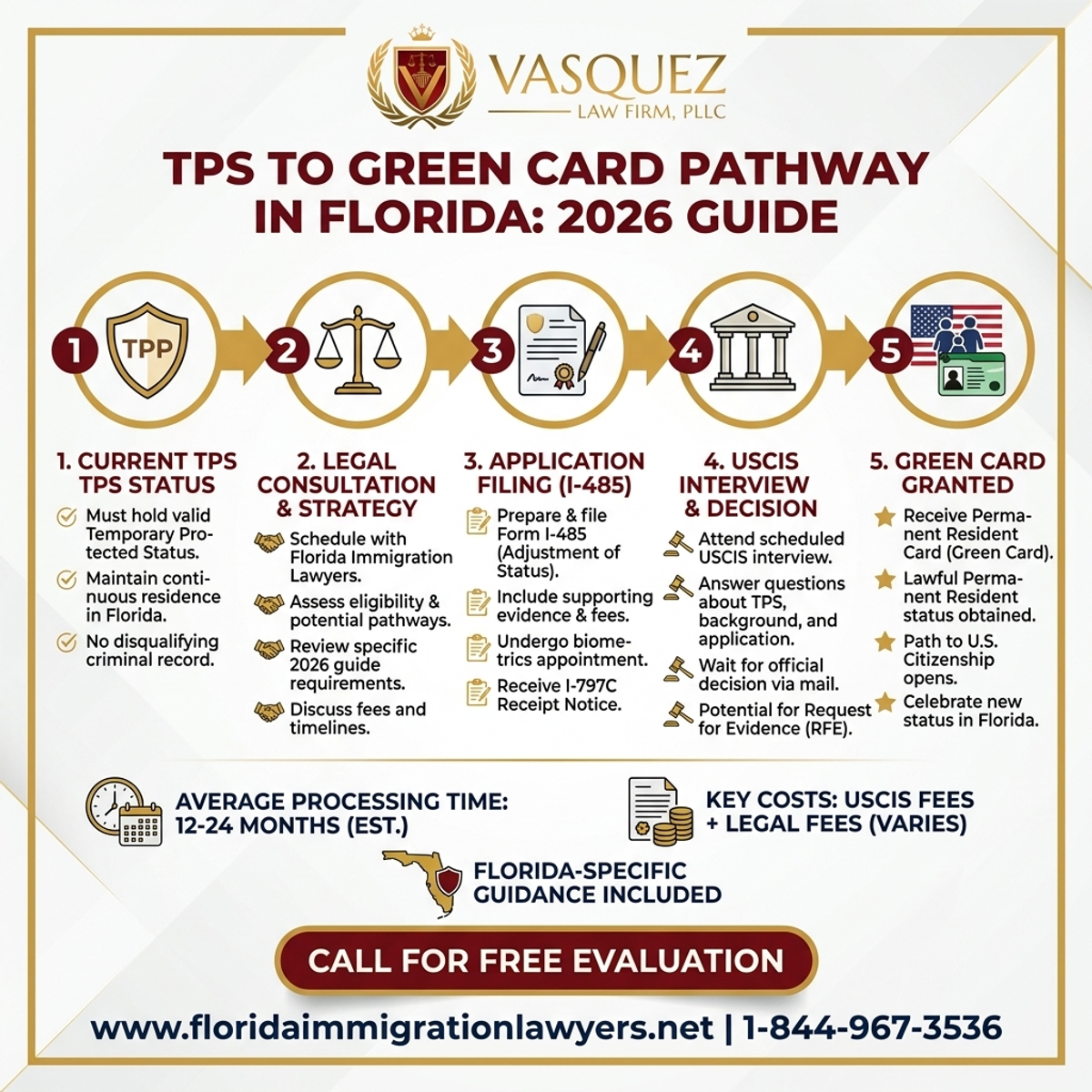
Step-by-Step Process — TPS to Green Card Pathway in Florida: 2026 Guide
Each step requires detailed documentation and adherence to legal guidelines set by the Immigration and Nationality Act.
A critical component for TPS holders seeking adjustment of status is the requirement of "lawful entry." While TPS grants a lawful presence, it does not always confer lawful admission. However, a significant development in recent years, particularly following the *Matter of Z-R-Z-C-* decision, has clarified that TPS beneficiaries who were inspected and admitted, even if their status later became unlawful, generally meet the lawful entry requirement for adjustment of status. Those who entered without inspection (EWI) typically face greater hurdles and may need to explore alternative pathways or waivers, which often require leaving the U.S. and applying for an immigrant visa abroad – a complex and risky process. It is crucial to accurately determine your entry status with the help of an experienced attorney from Florida Immigration Lawyers.
Beyond lawful entry, an underlying immigrant visa petition is almost always necessary. This means a qualifying U.S. citizen or lawful permanent resident relative must file a Form I-130, Petition for Alien Relative, on your behalf, or an employer must file a Form I-140, Immigrant Petition for Alien Worker. The availability of an immigrant visa depends on your preference category and country of chargeability (usually your country of birth), as visa numbers can be backlogged for certain categories. Once an immigrant visa becomes available (indicated by the Visa Bulletin published by the Department of State), you can then concurrently file or proceed with your Form I-485 application. This dual requirement—lawful entry and an available visa—forms the bedrock of a successful adjustment of status application for TPS holders.
Document Checklist for TPS to Green Card Adjustment
- Completed Form I-485
- Proof of TPS status (e.g., Form I-821 approval notice)
- Evidence of lawful entry (e.g., I-94 form)
- Medical examination record (Form I-693)
- Supporting affidavits and documentation of continuous residence
Ensure all documents are accurately completed to avoid delays or denials.
Beyond the primary forms, USCIS requires a comprehensive set of supporting documents to verify your identity, eligibility, and admissibility. For Form I-485, every question must be answered truthfully and completely. For proof of TPS status, include all approval notices for Form I-821, Application for Temporary Protected Status, as well as any Employment Authorization Documents (EADs) issued under TPS. These documents collectively demonstrate your lawful presence in the U.S. and history under the TPS program.
Evidence of lawful entry, such as an I-94 Arrival/Departure Record, is paramount. If you entered with a visa, your I-94 will reflect this. For those who may have initial lawful entry but later fell out of status, the *Matter of Z-R-Z-C-* precedent can be critical. If you do not have an I-94 or are unsure of your entry record, an attorney can help you request it or determine if other forms of evidence are acceptable. The medical examination (Form I-693) must be conducted by a USCIS-approved civil surgeon and submitted in a sealed envelope. This examination assesses your health and ensures you do not have any communicable diseases or conditions that would render you inadmissible. Supporting affidavits from credible individuals and other documentation, such as utility bills, lease agreements, employment records, and tax returns, are vital to establish continuous residence and good moral character.
It’s not enough to just gather the documents; they must be organized, accurately translated if in a foreign language (with a certified translation), and submitted according to USCIS guidelines. Any discrepancies or missing information can lead to a Request for Evidence (RFE), significantly prolonging your case, or even a denial. Before submitting your application, a thorough review by an experienced immigration lawyer from Florida Immigration Lawyers can prevent costly errors and ensure your application is as strong as possible.
Timeline and Processing Expectations in 2026
| Stage | Typical Timeframe | Notes |
|---|---|---|
| Initial Application | 6-12 months | Varies by individual case and USCIS workload |
| Biometrics Appointment | 1-2 months after filing | Required for identity verification |
| Interview Scheduling | 4-8 months after biometrics | May vary based on USCIS office backlog |
| Final Decision | 2-6 months after interview | Dependent on case complexity |
Processing times can vary, so consulting with an attorney can provide more personalized estimates.
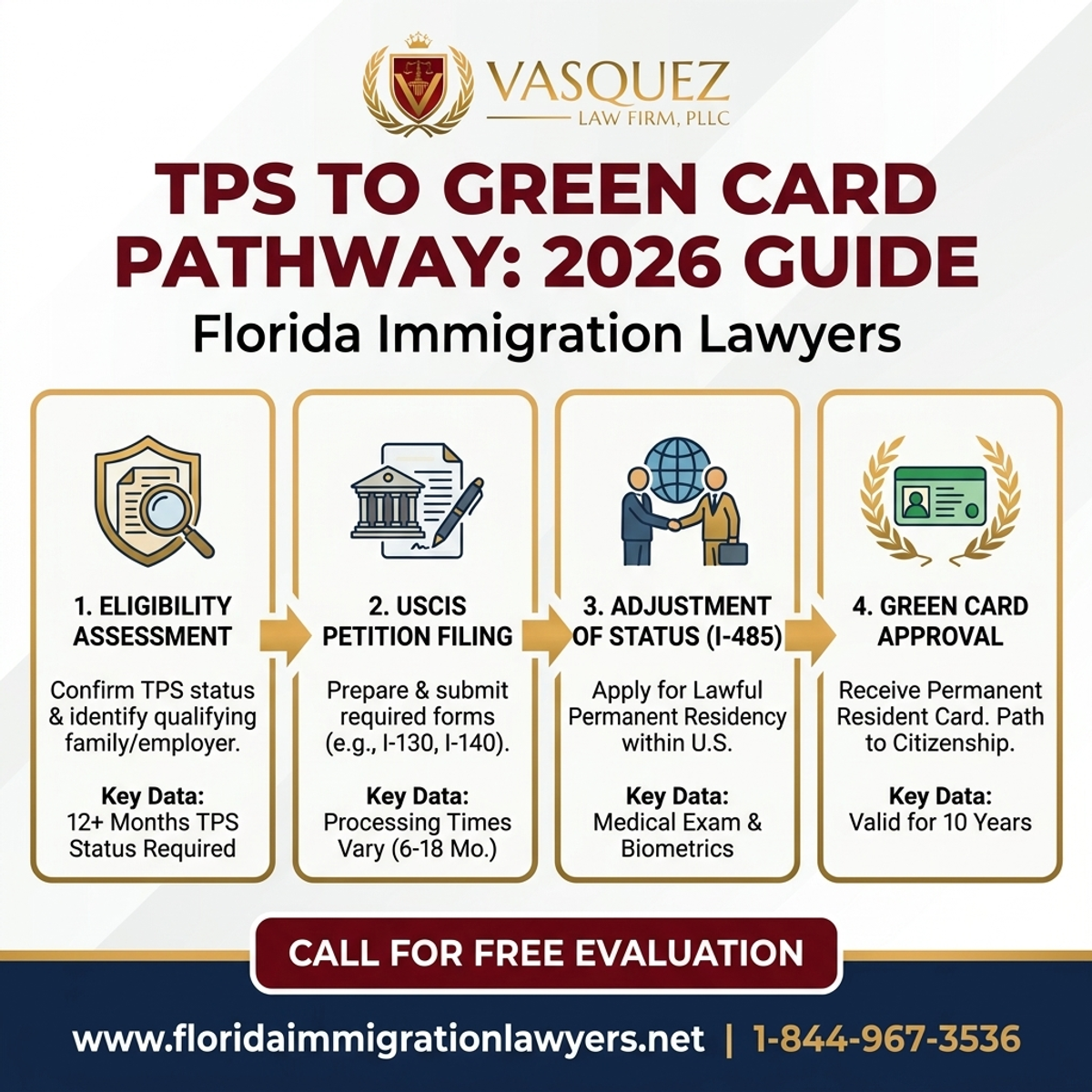
Key Statistics — TPS to Green Card Pathway in Florida: 2026 Guide
While the table provides general estimates, it's crucial to understand that these are averages and individual cases can deviate significantly. Factors such as the specific USCIS service center handling your case, the volume of applications, staffing levels, and the complexity of your personal history (e.g., criminal records, prior immigration issues) all play a role in determining the actual processing duration. For instance, an application that requires a Request for Evidence (RFE) will naturally take longer as USCIS waits for your response and then reviews it.
Applicants should regularly monitor their case status online using the receipt number provided by USCIS. While this offers a general overview, it often lacks detailed insights. Your attorney can help you interpret status updates and, if necessary, inquire with USCIS on your behalf if processing times extend beyond published estimates. It's also important to be prepared for potential delays and maintain patience throughout the process. The journey from TPS to a green card is often a marathon, not a sprint, and having realistic expectations can help manage the stress associated with waiting. Florida Immigration Lawyers can provide guidance on managing expectations and understanding the current processing trends relevant to Florida residents.
Cost Factors and Fee Breakdown
| Item | Typical Fee | Notes |
|---|---|---|
| Form I-485 Filing Fee | Varies | Check current USCIS fee schedule |
| Biometrics Fee | Varies | Required for applicants aged 14-79 |
| Medical Examination | Varies by provider | Ensure USCIS-certified doctor |
| Legal Assistance | Varies | Consult with an immigration attorney |
Costs can change; staying informed on USCIS updates is crucial.
Do not navigate this process alone. Contact Florida Immigration Lawyers today.
Understanding the financial aspects of adjusting status is an important part of preparation. USCIS fees are subject to change, typically every few years, so always refer to the official USCIS website or consult with your attorney for the most current fee schedule. The Form I-485 fee covers the adjudication of your application for permanent residency. The biometrics fee supports the collection of your fingerprints, photograph, and signature, which are used for background checks and identity verification. The medical examination fee is paid directly to the civil surgeon and covers the costs of the physical exam, required vaccinations, and lab tests.
For individuals facing financial hardship, USCIS may offer fee waivers for certain forms, though eligibility criteria are strict. It's essential to determine if you qualify and to submit a Form I-912, Request for Fee Waiver, along with supporting documentation. While the costs can seem substantial, especially when combined with legal fees, viewing this as an investment in your future and the stability of your family is often helpful. Legal assistance, though an additional cost, is often invaluable in preventing costly mistakes, navigating complex issues, and ultimately increasing the likelihood of a successful outcome. Florida Immigration Lawyers offers transparent fee structures and can discuss payment options during your free consultation at 1-844-967-3536.
Common Mistakes to Avoid in the TPS to Green Card Process
- Failing to maintain continuous residence in the U.S., which can jeopardize eligibility.
- Incorrectly filling out Form I-485, leading to delays or denials.
- Not attending the biometrics appointment, resulting in case closure.
- Missing the interview appointment or being unprepared, affecting outcomes.
- Failing to provide sufficient evidence of lawful entry.
- Ignoring changes in TPS status or related immigration laws.
- Not consulting with an attorney for complex cases.
Navigating the complex immigration system is fraught with potential pitfalls, and even minor errors can have significant consequences, ranging from delays to outright denials. Being aware of these common mistakes is the first step toward avoiding them.
- Failing to maintain continuous residence: While TPS provides lawful status, any prolonged departure from the U.S. without proper advance parole can break your continuous residence, which is often a requirement for adjustment of status. Always consult an attorney before any international travel.
- Incorrectly filling out Form I-485: This form is extensive and requires meticulous attention to detail. Any missing information, inconsistent answers, or errors can trigger a Request for Evidence (RFE) or even a Notice of Intent to Deny (NOID). It's crucial to review every section carefully and ensure all supporting documentation is correctly referenced.
- Not attending the biometrics appointment: This appointment is mandatory for identity verification and background checks. Missing it without rescheduling can lead to USCIS considering your application abandoned and potentially closing your case. Always keep track of appointment notices and notify USCIS immediately if you cannot attend for a valid reason.
- Missing the interview appointment or being unprepared: The interview is a critical stage where an immigration officer will verify the information in your application. Failing to appear will likely result in a denial. Being unprepared, lacking original documents, or providing inconsistent answers can also jeopardize your case. Practice answering potential questions and organize all your documents beforehand.
- Failing to provide sufficient evidence of lawful entry: As discussed, lawful entry is a cornerstone for adjustment of status for TPS holders. If your initial entry was not inspected and admitted, or if you cannot adequately prove it, your application will likely be denied. This is a common point of confusion and often requires legal expertise to resolve.
- Ignoring changes in TPS status or related immigration laws: Immigration law is dynamic. TPS extensions, new court rulings (like *Matter of Z-R-Z-C-*), or changes in USCIS policy can directly impact your eligibility or the process itself. Staying informed, ideally through an immigration attorney, is essential to adapt your strategy as needed.
- Not consulting with an attorney for complex cases: While some straightforward cases might be manageable, any history of criminal offenses, prior immigration violations, misrepresentations, or extended periods of unlawful presence makes legal representation indispensable. An attorney can identify potential inadmissibility grounds and help prepare waivers or arguments to overcome them.
- Submitting an incomplete application: Sending an application packet without all required forms, fees, or initial evidence is a common mistake. USCIS will reject incomplete applications, causing significant delays as you resubmit. Always use the official USCIS checklist and double-check everything before mailing.
- Failing to disclose all relevant information: It is critical to be completely truthful and disclose all pertinent information on your application, including any past arrests, even if charges were dropped, or prior immigration history. Omissions or misrepresentations can lead to findings of fraud or misrepresentation, resulting in permanent bars from immigration benefits.
By being diligent and proactive, and by seeking professional guidance from Florida Immigration Lawyers, you can significantly reduce the risk of these common errors and pave a smoother path towards your green card.
When to Call a Lawyer
Complex cases, such as those involving criminal records or prior immigration violations, should prompt immediate consultation with an attorney. Warning signs include receiving a Request for Evidence (RFE) from USCIS or a Notice of Intent to Deny (NOID). At Florida Immigration Lawyers, we offer free consultations to discuss your unique situation and guide you through the process.
While the path to a green card from TPS can seem straightforward on paper, many situations introduce complexities that necessitate expert legal intervention. Beyond criminal records—which can range from minor misdemeanors to serious felonies, each with different immigration consequences—other red flags include past deportations or removal orders, multiple entries without inspection, prior asylum applications, or any history of immigration fraud or misrepresentation. These issues can trigger grounds of inadmissibility, requiring complex waivers or specialized legal arguments that are virtually impossible to navigate without professional help.
Receiving a Request for Evidence (RFE) or a Notice of Intent to Deny (NOID) from USCIS is a clear signal that your case requires immediate legal attention. An RFE means USCIS believes your application is missing crucial information or evidence, or that the submitted evidence is insufficient. A NOID is even more serious, indicating that USCIS intends to deny your application unless you can provide compelling reasons and evidence to persuade them otherwise. In both scenarios, a skilled immigration attorney can help you understand the specific concerns of USCIS, gather the necessary documentation, and craft a robust legal response within the strict deadlines, significantly increasing your chances of a favorable outcome. Don't wait until it's too late; proactive engagement with Florida Immigration Lawyers can make all the difference.
About Florida Immigration Lawyers
Florida Immigration Lawyers is a leading firm dedicated to providing expert legal guidance across all aspects of immigration law. Our services include family immigration, deportation defense, and citizenship applications. With a commitment to serving the entire state of Florida, including Orlando, we offer 24/7 support and free consultations. Call us at 1-844-967-3536 or visit our website at
Sources and References
- U.S. Citizenship and Immigration Services (USCIS)
- Executive Office for Immigration Review (EOIR)
- U.S. Department of State - Bureau of Consular Affairs
- Immigration and Nationality Act (INA), 8 U.S.C. Chapter 12
Do Not Navigate This Process Alone
Our experienced immigration attorneys are ready to fight for you. Get a free, confidential consultation today.
Se Habla Español
Frequently Asked Questions

William J. Vásquez
Founding Attorney · Vasquez Law Firm
U.S. Air Force veteran and immigration attorney with years of hands-on U.S. immigration experience. J.D., NCCU School of Law. AILA member. Admitted to the 4th, 5th, and 11th Circuit Courts.
Available 24/7 - Free Evaluations
Reviewed for legal accuracy by William J. Vásquez
Licensed in North Carolina; U.S. immigration is federal practice.
Related Legal Services
Our Florida immigration attorneys can help you with immigration practice areas, free immigration consultation and experienced immigration attorneys. Call today at 1-844-967-3536 for a free consultation.
Related Links
Related Topics
Free Legal Consultation
Discuss your case with our experienced attorneys. We're available 24/7.
Se Habla Español - Estamos aquí para ayudarle.
Related Articles
Dual Citizenship Lawyer: Understanding Your Options in
Considering dual citizenship while pursuing naturalization in Florida? The USCIS citizenship interview is a critical step, and understanding its intricacies is key to success. This guide provides comprehensive tips for preparing for your naturalization interview, covering everything from document checklists to common mistakes to avoid. Learn about the process, estimated timelines for 2026, and how an experienced dual citizenship lawyer in Florida can provide invaluable assistance. Florida Immigration Lawyers offers expert guidance for residents across the state, ensuring you are well-prepared for every stage of your journey to U.S. citizenship.
Green Card Holders Issued New Warning: Renewal in Florida
Green card holders in Florida must renew their cards timely to avoid complications. Learn about the renewal process, including form I-90, processing times, and common pitfalls.
Immigration Lawyer Orlando Free Consultation: 2026 Guide
For those seeking an immigration lawyer in Orlando, navigating the U.S. immigration system can be daunting. Florida Immigration Lawyers offers free consultations to help you understand your options for family visas, employment petitions, deportation defense, and naturalization. This comprehensive guide details common immigration services, provides a step-by-step process, outlines essential documents, and explains typical timelines and costs for 2026. Learn how to avoid common mistakes and when to seek professional legal help to protect your future in Florida. Our firm serves clients across Orlando, Gainesville, Miami, and throughout the state, providing expert, bilingual support.
I-601 Waiver Lawyer Florida: Your 2026 Inadmissibility Guide
Facing inadmissibility to the U.S. can be daunting, but an I-601 waiver offers a pathway forward for many individuals in Florida. This comprehensive guide, updated for 2026, delves into the intricacies of the I-601 waiver, explaining who qualifies, the critical requirement of proving "extreme hardship" to a U.S. citizen or LPR relative, and the step-by-step application process. We cover essential documentation, typical processing timelines, and cost considerations, highlighting the importance of avoiding common mistakes. Florida Immigration Lawyers provides expert legal assistance across the state, from Tampa to Miami, ensuring your application is meticulously prepared and strategically presented. Discover how our experienced attorneys can help you overcome inadmissibility and achieve your immigration goals.