I-601 Waiver Lawyer Florida: Your 2026 Inadmissibility Guide
Facing inadmissibility to the U.S. can be daunting, but an I-601 waiver offers a pathway forward for many individuals in Florida. This comprehensive guide, updated for 2026, delves into the intricacies of the I-601 waiver, explaining who qualifies, the critical requirement of proving "extreme hardship" to a U.S. citizen or LPR relative, and the step-by-step application process. We cover essential documentation, typical processing timelines, and cost considerations, highlighting the importance of avoiding common mistakes. Florida Immigration Lawyers provides expert legal assistance across the state, from Tampa to Miami, ensuring your application is meticulously prepared and strategically presented. Discover how our experienced attorneys can help you overcome inadmissibility and achieve your immigration goals.

An I-601 waiver lawyer in Florida specializes in helping individuals overcome grounds of inadmissibility to the U.S. As of 2026, navigating these complex immigration laws requires expert legal counsel, especially when proving “extreme hardship” to a qualifying U.S. citizen or lawful permanent resident relative. A Florida-based attorney can guide you through the detailed application process, gather crucial evidence, and represent your interests before USCIS, significantly increasing your chances of a successful outcome.
- An I-601 waiver addresses specific grounds of inadmissibility, such as fraud or misrepresentation.
- Applicants must demonstrate “extreme hardship” to a qualifying U.S. citizen or LPR spouse or parent.
- The process is complex and often requires extensive documentation and legal strategy.
- Working with an experienced immigration lawyer in Florida is crucial for success.
- Processing times can vary, but thorough preparation is key to avoiding delays.
Navigating the intricate landscape of U.S. immigration law can feel overwhelming, especially when you or a loved one faces a finding of inadmissibility. This is a common hurdle for many aspiring immigrants in Florida, where diverse communities seek to establish a new life. If you've been deemed inadmissible to the United States, whether due to past immigration violations, criminal history, or other issues, an I-601 waiver lawyer Florida can be your most vital ally. This comprehensive guide will explain what an I-601 waiver is, who qualifies, the application process, and why expert legal representation from Florida Immigration Lawyers is essential for a successful outcome in 2026 and beyond.
Understanding the nuances of inadmissibility and the specific requirements for an I-601 waiver is critical. Florida Immigration Lawyers stands ready to provide the dedicated and knowledgeable legal support you need. Our team understands the unique challenges faced by immigrants across Tampa, Orlando, Miami, and all of Florida. Don't let a complex legal process stand between you and your American dream. Call Florida Immigration Lawyers at 1-844-967-3536 for a free consultation today and let us help you explore your options.
What is an I-601 Waiver and Who Needs It in Florida?
An I-601 waiver, officially known as the Application for Waiver of Grounds of Inadmissibility, is a crucial immigration tool designed to forgive certain issues that would otherwise prevent an individual from entering or remaining in the United States. In Florida, many immigrants find themselves facing inadmissibility due to a variety of reasons, ranging from immigration fraud or misrepresentation (under INA 212(a)(6)(C)) to certain criminal convictions or unlawful presence in the U.S. This waiver allows eligible individuals to request a pardon for these specific infractions, clearing the path toward obtaining a green card or other immigration benefits. It's a lifeline for families who would face severe separation if the waiver were not granted.
Essentially, an I-601 waiver is required when an applicant for a visa or adjustment of status has been found inadmissible by U.S. Citizenship and Immigration Services (USCIS) or a consular officer. The types of inadmissibility covered by the I-601 waiver are specific. They include certain criminal grounds, health-related grounds, immigration fraud or misrepresentation, alien smuggling, and certain forms of unlawful presence. For example, if you overstayed a visa and then left the U.S., triggering a 3-year or 10-year bar, or if you previously misrepresented facts to gain an immigration benefit, an I-601 waiver might be necessary. The key is demonstrating that denying your admission would result in "extreme hardship" to a qualifying U.S. citizen or lawful permanent resident spouse or parent. This concept of "extreme hardship" is central to the I-601 waiver process and requires compelling evidence and detailed arguments, which an experienced Florida immigration attorney can help you prepare.
Understanding Extreme Hardship for I-601 Waivers in 2026
To qualify for an I-601 waiver, applicants must demonstrate "extreme hardship" to a qualifying relative, typically a U.S. citizen or lawful permanent resident (LPR) spouse or parent. As of 2026, USCIS evaluates extreme hardship on a case-by-case basis, considering a wide range of factors. This is not merely inconvenience or emotional difficulty; it requires a showing of suffering beyond what is normally expected when a family is separated. The qualifying relative must prove that they would suffer exceptionally if the applicant is denied entry to the U.S. or forced to remain abroad.
USCIS considers both the hardship the qualifying relative would face if they remained in the U.S. without the applicant and the hardship they would experience if they relocated to the applicant's home country. Factors include the qualifying relative's health issues requiring specialized care, financial burdens, loss of employment, educational disruption for children, psychological impact, cultural assimilation difficulties in a foreign country, and community ties in the U.S. For instance, a U.S. citizen spouse in Tampa suffering from a chronic illness requiring ongoing treatment might argue extreme hardship if their immigrant spouse, the primary caregiver, is denied. The burden of proof is high, and applicants must submit extensive documentation, including medical records, financial statements, affidavits, and expert psychological evaluations. Florida Immigration Lawyers has significant experience in building robust extreme hardship arguments tailored to the specific circumstances of families in Florida, ensuring all relevant factors are meticulously presented to USCIS.
What is the I-601 Waiver Application Process in Florida?
The I-601 waiver application process in Florida involves several critical steps, typically beginning after an individual has been found inadmissible during a visa interview at a U.S. consulate abroad or during an adjustment of status application within the U.S. The exact procedure depends on whether the applicant is applying for an immigrant visa (consular processing) or adjusting status in the U.S.
For those applying from abroad, the I-601 waiver is generally filed after the consular officer determines inadmissibility. For those adjusting status in the U.S., the waiver can often be filed concurrently with the adjustment application or after an inadmissibility finding. The process requires meticulous attention to detail and a comprehensive understanding of USCIS requirements. An experienced I-601 waiver lawyer Florida from our firm can guide you through each stage, from initial assessment to final decision, ensuring all forms are correctly completed and supporting evidence is compellingly presented. We work closely with clients across Florida, including those attending interviews at the USCIS field office in Orlando or Miami, or consular interviews abroad.
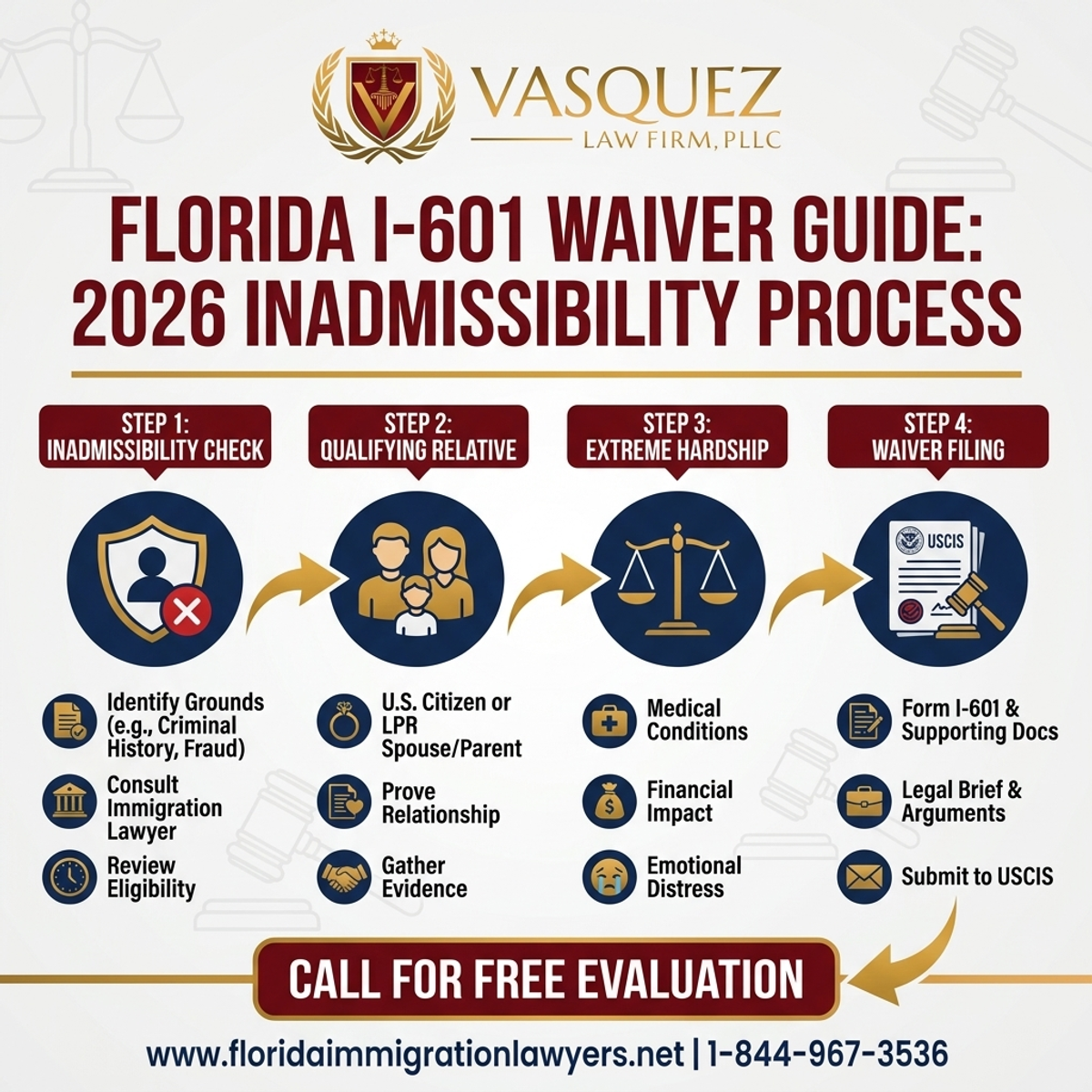
Step-by-Step Process — I-601 Waiver Lawyer Florida: Your 2026 Inadmissibility Guide
- Initial Assessment: Determine the specific grounds of inadmissibility and confirm eligibility for an I-601 waiver. This involves reviewing your immigration history and any relevant criminal records.
- Gathering Evidence for Extreme Hardship: Collect extensive documentation demonstrating the "extreme hardship" to your U.S. citizen or LPR spouse or parent. This includes medical records, financial documents, psychological evaluations, and affidavits.
- Completing Form I-601: Accurately fill out Form I-601, Application for Waiver of Grounds of Inadmissibility. This form is critical and must be completed without errors.
- Preparing a Legal Brief: Your attorney will draft a persuasive legal brief that outlines your eligibility, articulates the extreme hardship, and cites relevant immigration laws and precedents, such as provisions under 8 U.S.C. § 1182 (INA 212).
- Filing the Application: Submit the completed Form I-601, all supporting documents, and the required filing fee to the appropriate USCIS service center or consular office. As of 2026, check USCIS.gov for the most current filing location and fee.
- Responding to RFEs: If USCIS issues a Request for Evidence (RFE), your attorney will help you prepare a timely and comprehensive response to address any deficiencies.
- Decision: USCIS will review your application and issue a decision. If approved, the grounds of inadmissibility are waived, allowing you to proceed with your immigration process.
What Documents Do I Need for an I-601 Waiver in 2026?
To successfully file an I-601 waiver application in 2026, you must submit a comprehensive packet of documents that clearly demonstrates your eligibility and the "extreme hardship" to your qualifying relative. Missing or incomplete documentation is a common reason for denials or requests for evidence (RFEs), leading to significant delays. Preparing this evidence meticulously is a cornerstone of a strong I-601 waiver case, particularly for families in Florida seeking to remain together. Your I-601 waiver lawyer Florida will help you compile and organize these vital records, ensuring every piece of evidence supports your claim effectively.
The documentation required extends beyond basic identity papers; it delves into the personal, financial, medical, and emotional aspects of your qualifying relative's life. This is where the "extreme hardship" claim is built, requiring a compelling narrative supported by objective evidence. For example, if a U.S. citizen spouse in Orlando has a child with special educational needs, documentation from the school and medical professionals would be critical. Similarly, a qualifying parent in Miami who relies on the applicant for financial support would need to provide detailed financial records. Our firm emphasizes the importance of a well-organized and thoroughly documented application to present the strongest possible case to USCIS.
- Form I-601: The completed and signed Application for Waiver of Grounds of Inadmissibility.
- Proof of Relationship: Marriage certificate, birth certificates, and other documents proving your relationship to the qualifying U.S. citizen or LPR spouse or parent.
- Qualifying Relative's Status: Copy of the U.S. citizen's birth certificate, passport, or naturalization certificate; or LPR's green card.
- Affidavits of Hardship: Detailed, sworn statements from the qualifying relative describing the extreme hardship they would face if you were denied. Include statements from other family members, friends, or community leaders.
- Medical Records: If hardship is health-related, provide comprehensive medical diagnoses, treatment plans, prescriptions, and letters from doctors.
- Psychological Evaluations: Professional assessments detailing the emotional and psychological impact of separation on the qualifying relative.
- Financial Documents: Bank statements, tax returns, pay stubs, mortgage statements, utility bills, and evidence of debts to show financial dependence or hardship.
- Educational Records: If applicable, school enrollment, performance records, and letters from school officials detailing special needs or disruptions.
- Country Conditions Information: Evidence of difficult conditions in your home country (e.g., lack of medical care, political instability, economic hardship) if the qualifying relative would relocate.
- Police Clearances: From all countries where you have resided.
- Court Records: Certified copies of any criminal court dispositions, even if charges were dismissed.
- Immigration Records: Copies of previous visa applications, I-94 records, and any notices from USCIS or immigration courts (e.g., from EOIR).
How Long Does an I-601 Waiver Take to Process in Florida?
The processing time for an I-601 waiver can vary significantly based on several factors, including the USCIS service center handling your case, the complexity of your application, and the volume of petitions they are processing. As of 2026, applicants in Florida should anticipate a waiting period that can range from several months to over a year. There is no single, fixed timeline, and USCIS processing times are subject to change. It is crucial to monitor the official USCIS website for the most up-to-date estimates. A well-prepared and thoroughly documented application, guided by an experienced I-601 waiver lawyer Florida, can help minimize potential delays by reducing the likelihood of Requests for Evidence (RFEs).
Factors that can influence processing times include the specific grounds of inadmissibility being waived, the quality and completeness of the evidence submitted, and whether the waiver is filed concurrently with another application (like adjustment of status). For instance, a waiver related to simple unlawful presence might be processed faster than one involving complex criminal history. Our firm advises clients in Tampa, Fort Lauderdale, and throughout Florida to be patient but proactive. While we cannot guarantee specific timelines, our role is to ensure your application is as robust as possible, anticipating potential issues and addressing them pre-emptively. This proactive approach is vital in managing expectations and striving for the most efficient resolution possible.
| Stage | Typical Timeframe (As of 2026) | Notes |
|---|---|---|
| Application Preparation | 2-4 months | Gathering documents, affidavits, evaluations, and drafting legal brief with attorney. |
| USCIS Receipt Notice | 1-2 weeks after filing | Confirmation that USCIS has received your Form I-601. |
| Initial Review & Biometrics | 1-3 months | USCIS reviews for completeness; biometrics appointment scheduled. |
| Request for Evidence (RFE) (If applicable) | Variable (30-90 days to respond) | USCIS requests additional information; stops processing clock until response. |
| Adjudication & Decision | 6-18 months (after all documents received) | USCIS reviews all evidence and makes a final decision. |
| Post-Approval (Consular Processing) | Variable (depending on consulate) | If approved, applicant proceeds with immigrant visa interview abroad. |
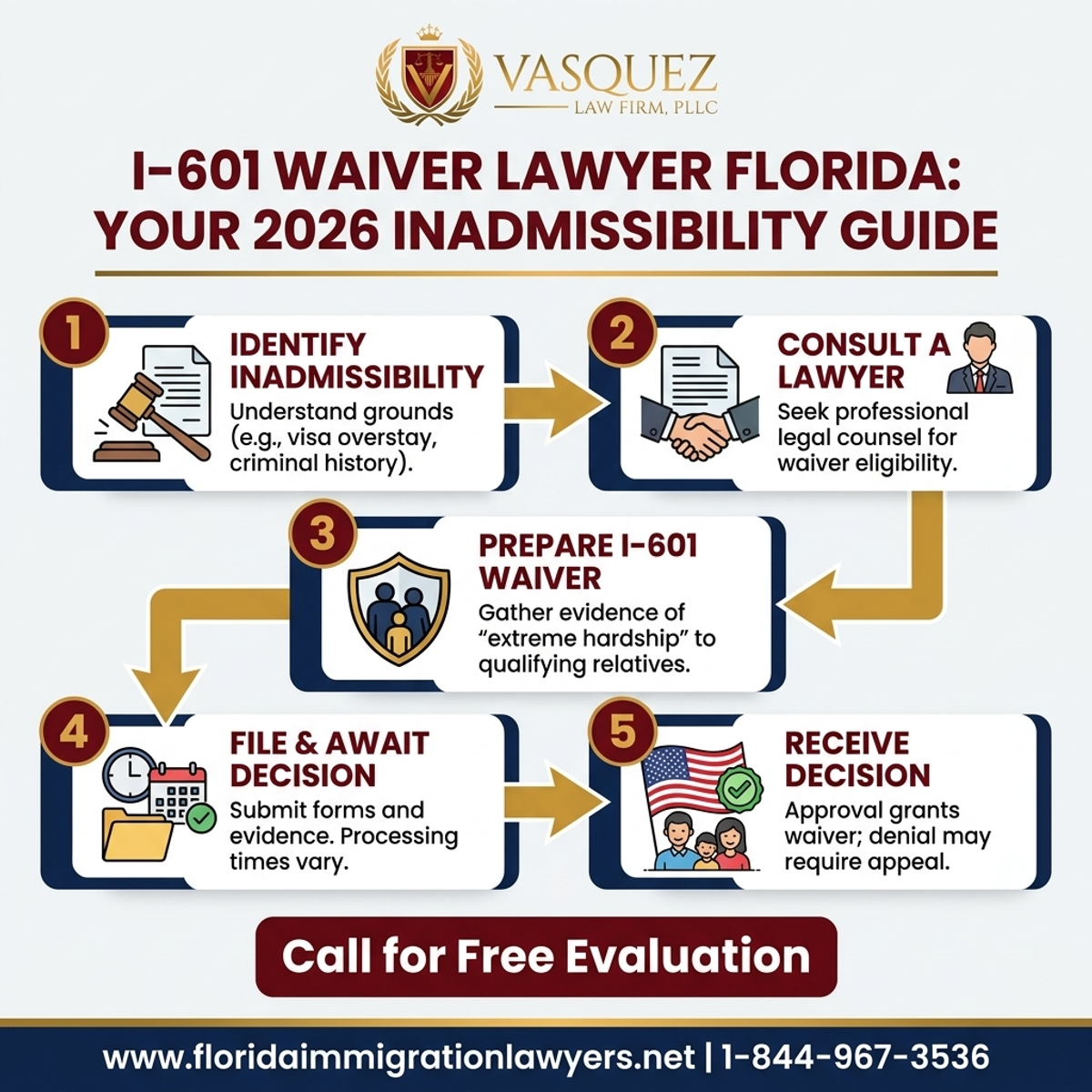
Key Statistics — I-601 Waiver Lawyer Florida: Your 2026 Inadmissibility Guide
Cost Factors and Fees for I-601 Waivers in Florida
Understanding the financial aspects of an I-601 waiver is crucial for planning your immigration journey in Florida. The total cost involves both government filing fees and attorney fees, and these can vary. As of 2026, USCIS filing fees are subject to change, so always consult the official USCIS website or your attorney for the most current amounts. It's important to budget for these fees, as they are non-refundable, regardless of the outcome of your application. While the government fees are standardized, attorney fees for an I-601 waiver lawyer Florida can vary based on the complexity of the case, the experience of the lawyer, and the amount of work involved in preparing a compelling "extreme hardship" argument.
Beyond the direct filing fees, applicants should also consider potential costs for gathering supporting evidence. This might include fees for medical examinations, psychological evaluations, translation services for foreign documents, and obtaining certified court records or police clearances. These ancillary costs can add up, making a clear financial plan essential. Florida Immigration Lawyers offers transparent fee structures and will discuss all potential costs with you upfront during your free consultation. We believe in providing clear guidance so you can make informed decisions without unexpected financial burdens. Investing in experienced legal representation for an I-601 waiver is an investment in your future and your family's stability in Florida.
| Item | Typical Fee (As of 2026) | Notes |
|---|---|---|
| USCIS Form I-601 Filing Fee | Consult USCIS website for current fee | Mandatory government fee; non-refundable. |
| Attorney Legal Fees | Varies significantly | Covers legal research, document preparation, brief writing, client communication, and representation. |
| Medical Examination Fees | Varies by provider | Required if health-related inadmissibility is a factor or for adjustment of status. |
| Psychological Evaluation Fees | Varies by professional | Highly recommended for strong "extreme hardship" claims. |
| Document Translation Fees | Varies by length/language | For any non-English documents submitted. |
| Record Request Fees | Varies by agency | For obtaining police clearances, court records, etc. |
| Postage/Shipping | Minor | For sending applications and supporting documents. |
Do not navigate this complex process alone. The stakes are too high, and the legal requirements are too intricate for an unassisted application. Contact Florida Immigration Lawyers today at 1-844-967-3536 for a free consultation to discuss your I-601 waiver options. Our experienced team is dedicated to providing the highest level of legal support.
Common Mistakes to Avoid with Your I-601 Waiver Application
Applying for an I-601 waiver is a detailed legal process where even minor errors can lead to significant delays or outright denials. Avoiding these common pitfalls is crucial for applicants in Florida seeking a successful outcome. An experienced I-601 waiver lawyer Florida can help you sidestep these issues, protecting your application from common mistakes.
- Failing to Establish "Extreme Hardship": Many applicants underestimate the legal standard for "extreme hardship." It requires more than mere inconvenience; it demands a compelling demonstration of suffering beyond typical family separation. Insufficient evidence or weak arguments are common.
- Incomplete or Incorrect Forms: Errors on Form I-601, such as missing signatures, incorrect dates, or unanswered questions, lead to rejections or RFEs, prolonging the process.
- Lack of Sufficient Supporting Evidence: Submitting only a few letters or basic documents is often not enough. A strong application requires extensive, diverse evidence (medical, financial, psychological, educational) to corroborate the hardship claims.
- Not Addressing All Grounds of Inadmissibility: If you have multiple grounds of inadmissibility, you must apply for a waiver for each. Failing to waive every ground will result in denial, even if one is approved.
- Failing to Provide Certified Translations: Any document not in English must be accompanied by a certified English translation. Submitting untranslated documents will cause delays.
- Ignoring Minor Criminal Offenses: Even seemingly minor arrests or convictions must be disclosed and properly documented with certified court dispositions. Omitting this can lead to fraud allegations.
- Missing Deadlines: Failing to respond to an RFE or other USCIS notices within the specified timeframe can lead to the denial of your application without further review.
- Poor Organization of Application Packet: A disorganized application makes it difficult for USCIS officers to review your case efficiently, potentially leading to misunderstandings or requests for clarification.
- Not Consulting an Attorney Early: Many applicants attempt to file on their own, only realizing the complexity after receiving an RFE or denial. Early legal intervention can prevent many common errors.
- Submitting Outdated Information: Ensure all documents, especially financial and medical records, are current and reflect the most up-to-date situation of the qualifying relative.
When to Call a Florida I-601 Waiver Lawyer
The decision to seek legal counsel is often the most critical step in an I-601 waiver application. Given the high stakes and the intricate legal requirements, it's almost always advisable to consult an experienced I-601 waiver lawyer Florida. You should definitely call Florida Immigration Lawyers if any of the following scenarios apply to your situation:
- You have been found inadmissible by USCIS or a consular officer, and you are unsure of the specific grounds or your eligibility for a waiver.
- Your case involves complex criminal history, multiple immigration violations, or allegations of fraud or misrepresentation (INA 212(a)(6)(C)(i)).
- You need to demonstrate "extreme hardship" to a qualifying U.S. citizen or LPR spouse or parent, and you are struggling to gather compelling evidence or articulate your case effectively.
- You have received a Request for Evidence (RFE) from USCIS and need assistance in preparing a thorough and timely response.
- You are concerned about potential delays, denials, or the overall complexity of the immigration process, especially if you are facing a 3-year or 10-year bar due to unlawful presence (INA 212(a)(9)(B)).
- You want to ensure your application is meticulously prepared, legally sound, and presented in the strongest possible light to maximize your chances of approval.
Florida Immigration Lawyers possesses the expertise and experience to navigate even the most challenging I-601 waiver cases. We serve clients across all of Florida, including Tampa, Miami, Orlando, and Jacksonville, providing personalized legal strategies and compassionate support. Don't face this critical legal hurdle alone. Let our dedicated team advocate for your future. We are here to help you understand your options and pursue the best possible outcome.
About Florida Immigration Lawyers
Florida Immigration Lawyers is a leading immigration law firm dedicated to serving individuals and families across the entire state of Florida. With a deep understanding of U.S. immigration law and a commitment to our clients, we provide comprehensive legal services tailored to your unique needs. Our experienced attorneys specialize in a wide range of immigration matters, including I-601 waivers, family-based immigration, asylum, deportation defense, and citizenship applications. We pride ourselves on our empathetic approach, clear communication, and unwavering dedication to achieving positive outcomes for our clients.
Our firm understands the profound impact immigration issues have on individuals and their families. We offer personalized attention, strategic legal advice, and robust representation throughout every stage of your case. Whether you are in Tampa, seeking guidance on an I-601 waiver, or in Miami needing assistance with a complex family petition, our team is equipped to help. We are available 24/7 for your convenience and offer free consultations to discuss your immigration needs. Choose Florida Immigration Lawyers for trusted advocacy and a partner who genuinely cares about your journey to a secure future in the United States. Learn more about our team at our attorneys page or contact us directly.
Sources and References
- U.S. Citizenship and Immigration Services (USCIS) - Form I-601, Application for Waiver of Grounds of Inadmissibility
- USCIS Policy Manual - Volume 9, Waivers
- Executive Office for Immigration Review (EOIR)
- 8 U.S.C. § 1182 - Immigration and Nationality Act (INA) Section 212
- 8 CFR Part 212 - Documentary Requirements: Nonimmigrants; Waivers; Admission of Certain Inadmissible Aliens; Parole
- INA Section 212(a)(6)(C)(i) - Misrepresentation of Material Fact
- INA Section 212(a)(9)(B) - Unlawful Presence
- U.S. Department of State - Waivers of Ineligibility
Related services: immigration practice areas, business immigration.
This article provides general legal information and is not intended as legal advice. Every case is unique, and outcomes depend on specific facts and circumstances. Contact an attorney for advice about your particular situation. Immigration laws are complex and subject to change; always verify current regulations.
If you or a loved one needs assistance with an I-601 waiver or any other immigration matter in Florida, don't hesitate to seek professional legal guidance. Our dedicated team at Florida Immigration Lawyers is here to help you navigate the complexities of immigration law. Contact us today for a free consultation at 1-844-967-3536. Se Habla Español - Estamos aquí para ayudarle.
If you need legal assistance, learn more about Florida immigration legal team, or call us at 1-844-967-3536 for a free consultation.
Do Not Navigate This Process Alone
Our experienced immigration attorneys are ready to fight for you. Get a free, confidential consultation today.
Se Habla Español
Frequently Asked Questions

William J. Vásquez
Founding Attorney · Vasquez Law Firm
U.S. Air Force veteran and immigration attorney with thousands of cases resolved. J.D., NCCU School of Law. AILA member. Admitted to the 4th, 5th, and 11th Circuit Courts.
Available 24/7 - Free Evaluations
Reviewed for legal accuracy by William J. Vásquez
Licensed in North Carolina; U.S. immigration is federal practice.
Related Legal Services
Our Florida immigration attorneys can help you with business immigration, asylum protection and deportation defense. Call today at 1-844-967-3536 for a free consultation.
Related Links
Related Topics
Free Legal Consultation
Discuss your case with our experienced attorneys. We're available 24/7.
Se Habla Español - Estamos aquí para ayudarle.
Related Articles
Immigration Lawyer Orlando Free Consultation: 2026 Guide
For those seeking an immigration lawyer in Orlando, navigating the U.S. immigration system can be daunting. Florida Immigration Lawyers offers free consultations to help you understand your options for family visas, employment petitions, deportation defense, and naturalization. This comprehensive guide details common immigration services, provides a step-by-step process, outlines essential documents, and explains typical timelines and costs for 2026. Learn how to avoid common mistakes and when to seek professional legal help to protect your future in Florida. Our firm serves clients across Orlando, Gainesville, Miami, and throughout the state, providing expert, bilingual support.
Why Is Form N-600 Taking So Long? Florida Delays Explained
Delays with Form N-600 can be frustrating. Learn about common causes such as incomplete documentation and USCIS backlogs, and how to resolve them, especially in Florida. Contact Florida Immigration Lawyers for expert assistance.
Dual Citizenship Lawyer: A Florida Naturalization Interview
Becoming a U.S. citizen is a transformative step, often linked to dual citizenship aspirations. This 2026 guide offers essential naturalization interview tips for Floridians, including those in Gainesville. Learn what to expect during your USCIS interview, critical documents to prepare, and how to master the English and Civics tests. We also cover common mistakes to avoid and when a dual citizenship lawyer from Florida Immigration Lawyers can provide invaluable assistance. Prepare confidently for your journey to U.S. citizenship with expert guidance.
Re-Entry Permit for Green Card Holders in Florida 2026
Understand how to secure a re-entry permit as a green card holder in Florida. Learn the application process, avoid common mistakes, and maintain your LPR status while traveling abroad.