SIJS Florida: Special Immigrant Juvenile Status Guide for Minors
Special Immigrant Juvenile Status (SIJS) in Florida provides a vital pathway to lawful permanent residency for minors who have suffered abuse, neglect, or abandonment. This guide details the eligibility requirements, the two-step application process involving state juvenile courts and USCIS, and essential documentation needed. Learn about processing timelines, potential costs, and common pitfalls to avoid. Our expert Florida immigration lawyers are dedicated to assisting vulnerable children in West Palm Beach and throughout Florida, helping them secure a Green Card and a safe future. Discover how our firm can offer compassionate and effective legal representation for SIJS cases.
Special Immigrant Juvenile Status (SIJS) in Florida provides a pathway to lawful permanent residency for undocumented minors who have been abused, neglected, or abandoned by one or both parents. This status requires a state court order finding that reunification with a parent is not viable and that it is not in the child's best interest to return to their country of origin. The process is complex, involving both state and federal immigration systems, but offers critical protection for vulnerable children.
- SIJS protects minors who have experienced abuse, neglect, or abandonment.
- It requires a specific order from a Florida state juvenile court.
- The process involves filing Form I-360 with USCIS and potentially Form I-485.
- Eligibility is based on age, marital status, and a qualifying state court order.
- Seeking legal guidance is essential for navigating this intricate process effectively.
Navigating the complex world of immigration law can be particularly challenging for young individuals. If you are a minor in Florida who has experienced abuse, neglect, or abandonment, or if you are caring for such a child, you may be wondering about pathways to legal protection and stability. Special Immigrant Juvenile Status (SIJS) offers a critical lifeline for many vulnerable children across our state, from West Palm Beach to Miami, Orlando, and beyond.
This comprehensive guide from Florida Immigration Lawyers will walk you through what SIJS is, who is eligible, the step-by-step application process, and what to expect. We understand the sensitive nature of these cases and are committed to helping you or the minor in your care find safety and a brighter future in Florida. Do not face this journey alone; our dedicated team is here to provide the compassionate legal support you need. Call Florida Immigration Lawyers at 1-844-967-3536 for a free consultation today.
Understanding Special Immigrant Juvenile Status (SIJS) in Florida
Special Immigrant Juvenile Status (SIJS) is a provision under U.S. immigration law designed to protect undocumented children in the United States who cannot be reunited with one or both parents due to abuse, neglect, or abandonment. It provides a pathway for these children to obtain a Green Card, offering them stability and protection.
The intent behind SIJS is clear: to safeguard children who have suffered severe harm and for whom returning to their home country or reuniting with abusive parents is not in their best interest. This status recognizes the unique vulnerabilities of these young individuals, many of whom have endured significant trauma before arriving in Florida.
In Florida, the process for obtaining SIJS involves a crucial two-step approach. First, you must secure an order from a Florida state juvenile court. This court must make specific findings about the child's situation. Second, you will file a petition with U.S. Citizenship and Immigration Services (USCIS) based on that state court order.
The state court order is fundamental. It must declare that the child is dependent on the court or has been placed in the custody of an agency or person appointed by the court. Crucially, it must also find that reunification with one or both parents is not possible due to abuse, neglect, abandonment, or a similar basis under Florida state law, and that it is not in the child's best interest to return to their country of origin. These findings are critical for the federal SIJS petition.
Florida's courts, particularly in areas like West Palm Beach and the broader South Florida region, handle many cases involving unaccompanied minors and children in need of protection. Our firm has extensive experience working with these state courts to obtain the necessary judicial orders for SIJS eligibility. We understand the nuances of Florida's juvenile justice system and how it intersects with federal immigration law to protect children.
Eligibility Requirements for SIJS in Florida
To be eligible for Special Immigrant Juvenile Status (SIJS) in Florida, several key criteria must be met. These requirements are derived from federal law, specifically the Immigration and Nationality Act (INA) Section 101(a)(27)(J), and are applied through the lens of Florida state juvenile court findings.
Age and Marital Status
Firstly, the applicant must be under 21 years old at the time the Form I-360, Petition for Amerasian, Widow(er), or Special Immigrant, is filed. Additionally, the applicant must be unmarried. These are strict requirements set by federal immigration law, and any deviation can result in ineligibility for SIJS benefits. It is important to consider the filing date carefully to ensure these conditions are met.
State Court Order Findings
The most critical component of SIJS eligibility is obtaining a qualifying order from a Florida state juvenile court. This order must include specific findings:
- The child has been declared dependent on a juvenile court located in Florida or has been placed in the custody of a state agency, department, or individual appointed by a state court. This often involves the Department of Children and Families (DCF) in Florida, or a similar entity.
- Reunification with one or both of the child's parents is not viable due to abuse, neglect, abandonment, or a similar basis under Florida state law. This finding directly addresses the harm the child has suffered.
- It is not in the child's best interest to return to their country of origin or last habitual residence. This protects children from being sent back to dangerous or unsuitable environments.
These findings require careful presentation of evidence to the state court. Our attorneys at Florida Immigration Lawyers are adept at navigating Florida's judicial system to help secure these vital orders. We understand the specific legal standards required by judges in West Palm Beach and other Florida jurisdictions for such determinations.
Presence in the United States
While not explicitly stated as a standalone requirement, the child must generally be present in the United States to petition for SIJS. The state court's jurisdiction over the child typically implies their presence within Florida. It is important to note that the child does not need to have entered the U.S. legally to be eligible for SIJS.
Understanding these eligibility criteria is the first step toward securing SIJS. Given the interplay between state and federal law, seeking legal counsel is highly recommended. Our firm can help assess your specific situation and guide you through each requirement.
The SIJS Application Process: A Step-by-Step Guide for Florida Minors
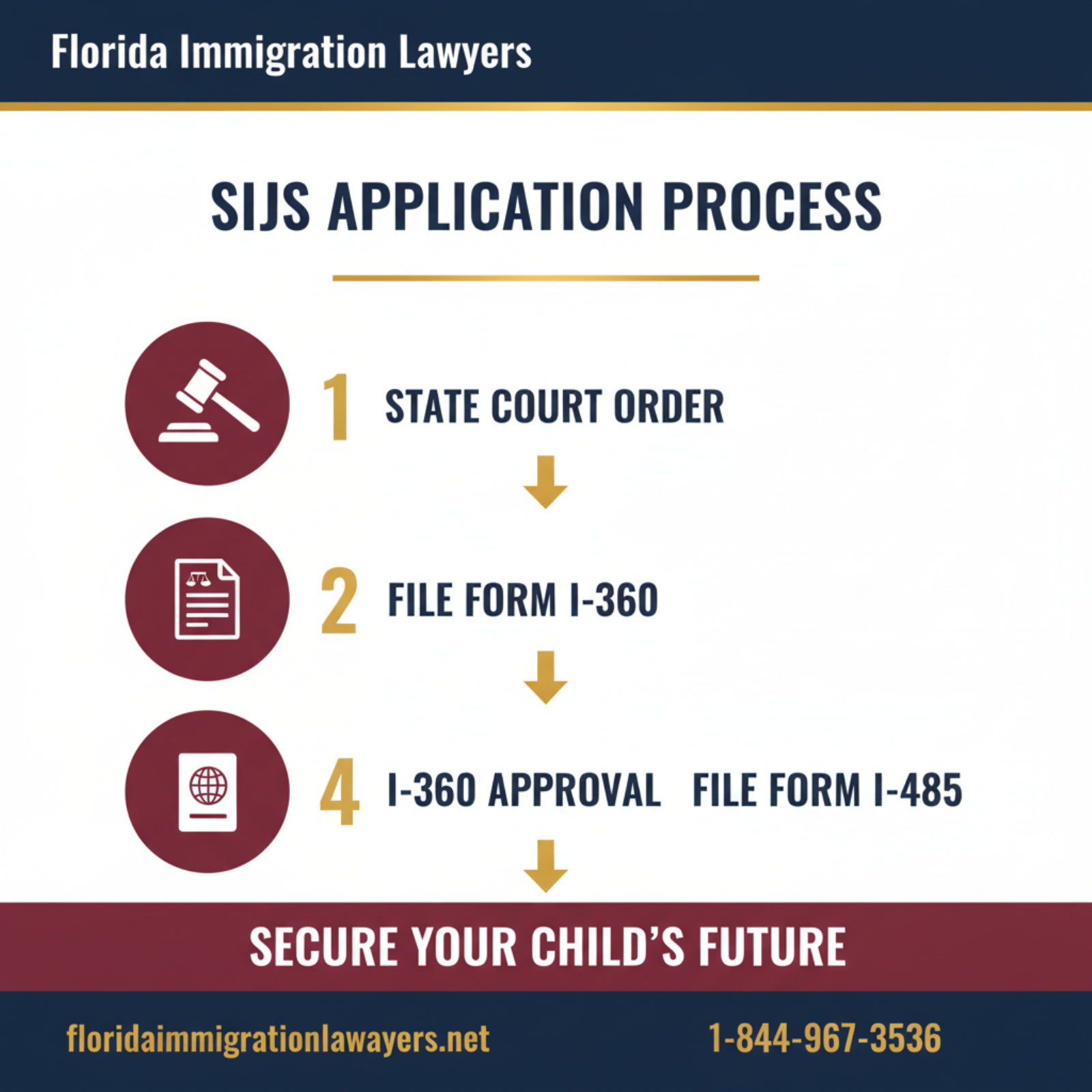
The process of obtaining Special Immigrant Juvenile Status (SIJS) in Florida is multifaceted, requiring careful attention to both state and federal legal requirements. Here is a step-by-step guide to help you understand the journey:
-
Obtain a Qualifying State Court Order: This is the crucial first step. You must initiate proceedings in a Florida state juvenile court, such as a dependency court in West Palm Beach or other Florida counties. The court must issue an order containing the specific findings required for SIJS eligibility. These findings include a determination that the child is dependent on the court or in court-ordered custody, that reunification with one or both parents is not viable due to abuse, neglect, or abandonment, and that it is not in the child's best interest to return to their country of origin. This step often involves working with child welfare agencies and presenting compelling evidence to the court.
-
File Form I-360, Petition for Amerasian, Widow(er), or Special Immigrant: Once you have the state court order, the next step is to file Form I-360 with U.S. Citizenship and Immigration Services (USCIS). This petition formally requests SIJS classification. You must include the certified state court order and other supporting documents proving eligibility, such as birth certificates, identity documents, and evidence of the child's age and marital status. USCIS will review this petition to ensure all federal requirements are met.
-
Attend Biometrics Appointment: After filing Form I-360, USCIS will send a notice for a biometrics appointment at an Application Support Center (ASC). This appointment is for collecting fingerprints, photographs, and signatures, which are used for background checks and identity verification. Minors, accompanied by a responsible adult, must attend this appointment.
-
Wait for I-360 Approval: USCIS will process your Form I-360. Processing times can vary significantly depending on caseloads at service centers. During this period, USCIS may issue a Request for Evidence (RFE) if they need additional information or clarification. An approval of Form I-360 grants the child SIJS classification.
Step-by-Step Process Guide -
File Form I-485, Application to Register Permanent Residence or Adjust Status: Once the Form I-360 is approved, and an immigrant visa number is available, the child can apply for a Green Card by filing Form I-485. This form allows eligible individuals to adjust their status to lawful permanent resident while remaining in the U.S. Along with Form I-485, you will typically file Form I-765 for an Employment Authorization Document (EAD or work permit) and Form I-131 for Advance Parole (travel document), if desired. These applications are crucial for minors seeking Green Cards.
-
Attend Adjustment of Status Interview (if required): In some cases, USCIS may require an interview for the Form I-485 application. The child, accompanied by their attorney and a responsible adult, would attend this interview at a local USCIS office, such as the one in Miami or Orlando. The purpose is to verify information and ensure continued eligibility. USCIS processing times for I-485 applications can be lengthy, and the SIJ visa backlog can impact when a visa number becomes available.
-
Receive Green Card: Upon approval of the Form I-485, the child will officially become a lawful permanent resident of the United States and will receive their Green Card by mail. This is the culmination of the SIJS process, providing them with legal status and a pathway to a secure future in Florida.
Essential Documents for Your SIJS Petition in Florida
Preparing a thorough and accurate set of documents is vital for a successful Special Immigrant Juvenile Status (SIJS) petition in Florida. Missing or incorrect documentation can cause significant delays or even lead to a denial. Here is a checklist of essential documents you will typically need:
- Certified Copy of State Juvenile Court Order: This is the single most important document. It must be a certified copy from the Florida state court (e.g., dependency court in West Palm Beach) containing all the required findings for SIJS eligibility.
- Form I-360, Petition for Amerasian, Widow(er), or Special Immigrant: Properly completed and signed.
- Proof of Identity and Age: This includes the child's birth certificate (original or certified copy, with certified translation if not in English), passport, or other government-issued identification.
- Proof of Unmarried Status: A declaration from the child or other evidence confirming they are unmarried.
- Photographs: Two passport-style photographs of the child, meeting USCIS specifications.
- Proof of Custody/Guardianship (if applicable): Documents showing who has legal custody or guardianship of the child in Florida, especially if not a parent.
- Affidavits from Witnesses: Statements from individuals (e.g., social workers, teachers, family members) who can attest to the abuse, neglect, or abandonment, and the child's best interests.
- Evidence of Abuse, Neglect, or Abandonment: This can include police reports, medical records, school records, reports from child protective services (like Florida's DCF), and testimony.
- Translator's Certification: For any documents not in English, a certified English translation and a certificate from the translator attesting to the accuracy and their competency to translate.
- Form G-28, Notice of Entry of Appearance as Attorney or Accredited Representative: If you are represented by a Florida immigration lawyer, this form must be included.
For the subsequent Form I-485 application for a Green Card, you will need additional documents, including:
- Form I-485, Application to Register Permanent Residence or Adjust Status.
- Copy of I-360 Approval Notice.
- Form I-693, Report of Medical Examination and Vaccination Record: Completed by a USCIS-approved civil surgeon in Florida.
- Proof of continuous physical presence in the U.S. (if applicable for adjustment).
- Affidavit of Support (Form I-864): While not always required for SIJS, it may be beneficial or requested in certain circumstances to show the child will not become a public charge.
- Form I-765 (Application for Employment Authorization) and Form I-131 (Application for Travel Document): If seeking an I-360 work authorization or travel permit.
Organizing these documents can be overwhelming, especially for minors and their caregivers. Working with an experienced Florida immigration lawyer ensures that your petition is complete and accurate, minimizing potential delays. Our team at Florida Immigration Lawyers will meticulously review your case and prepare all necessary documentation for submission to USCIS.
Navigating SIJS Timelines and Processing Expectations in Florida
The timeline for obtaining Special Immigrant Juvenile Status (SIJS) and ultimately a Green Card can vary significantly. It is important to have realistic expectations regarding processing times, as both state court proceedings and federal immigration applications involve multiple stages.
State Court Proceedings
The first step, obtaining the qualifying state court order in Florida, can take several months to over a year. This depends on the specific court's caseload (e.g., in West Palm Beach, Miami, or Orlando), the complexity of the child's case, the availability of evidence, and the need for various hearings. Our attorneys work diligently to expedite this process while ensuring all necessary findings are made correctly by the court.
USCIS Processing for Form I-360
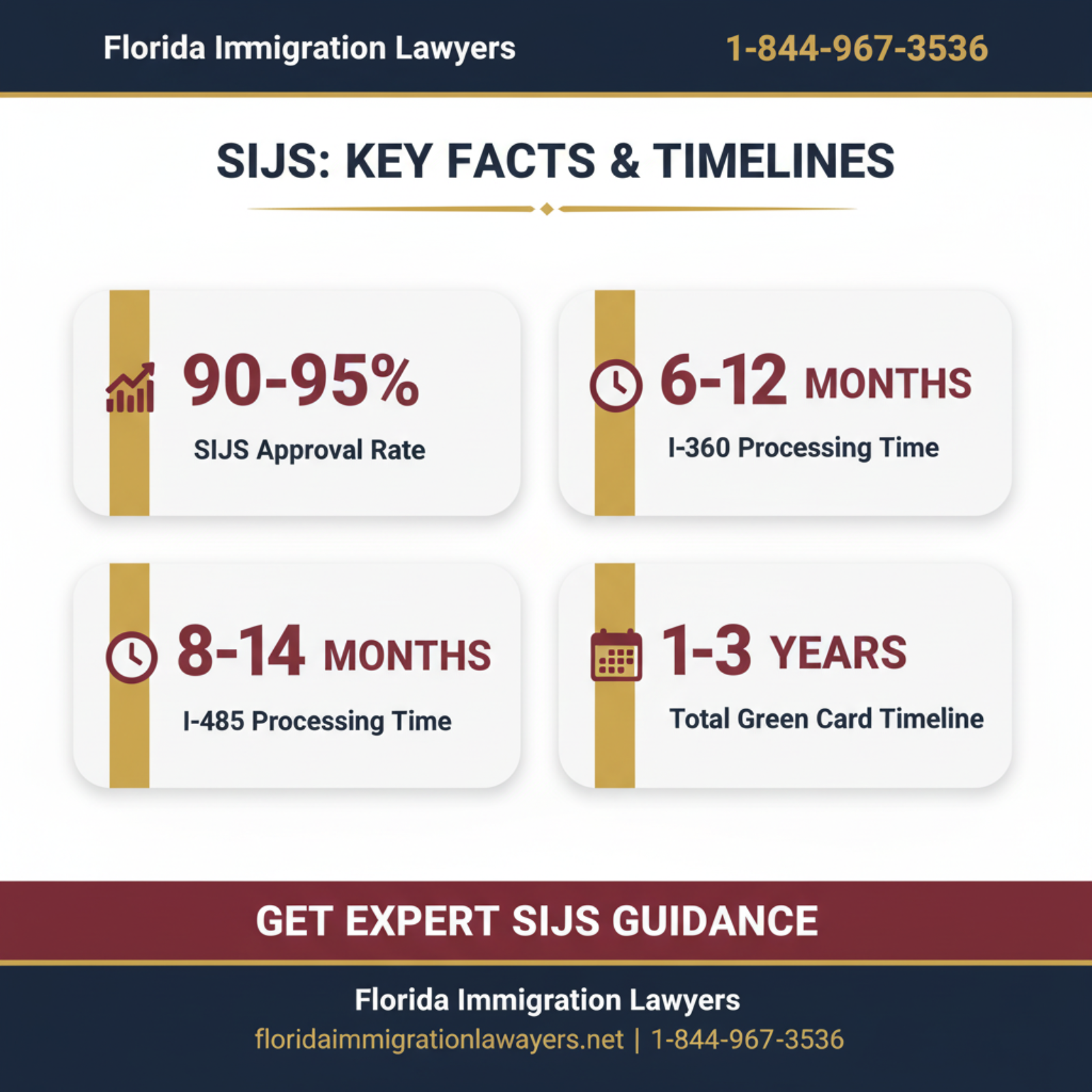
After the state court order is secured, filing Form I-360 with USCIS is the next major step. USCIS processing times for Form I-360 can range from several months to over a year, depending on the specific service center handling the petition and current caseloads. You can check estimated processing times on the USCIS website. An I-360 work authorization is often sought concurrently with the Green Card application.
Visa Bulletin and Green Card Availability
A critical factor affecting the overall timeline for a Green Card for minors under SIJS is the visa bulletin. While SIJS is an immediate relative petition, a backlog for certain categories of SIJS applicants (specifically those born in El Salvador, Guatemala, Honduras, and Mexico) has emerged. This is known as the SIJ visa backlog. This means that even after your I-360 is approved, you may have to wait for a visa number to become available before you can file or have your I-485 application approved. The Department of State's Visa Bulletin provides monthly updates on visa availability.
Adjustment of Status (Form I-485) Processing
Once an immigrant visa number is available, the Form I-485, Application to Register Permanent Residence or Adjust Status, can be filed or processed. Processing times for I-485 applications vary widely, often taking one to three years or more. Factors include the specific USCIS field office (e.g., Miami, Tampa), the complexity of the case, and whether an interview is required. During this time, applicants may be eligible for an I-360 work authorization.
Given these variable timelines, patience and consistent follow-up are essential. Our Florida Immigration Lawyers team provides regular updates and strategically plans each step to minimize delays. We understand the urgency for children seeking Green Cards and work tirelessly on your behalf.
Do not navigate this process alone. Contact Florida Immigration Lawyers today to ensure your SIJS application is handled with expertise and care. We are committed to protecting the future of vulnerable minors in Florida.
Understanding the Costs Associated with SIJS in Florida
Pursuing Special Immigrant Juvenile Status (SIJS) involves various costs, and it's important to understand these financial aspects upfront. While some fees may be waived for minors, others are typically required. These costs can be broadly categorized into government filing fees and legal fees.
Government Filing Fees (as of 2026)
USCIS charges fees for various forms submitted as part of the SIJS process. For Form I-360, Petition for Amerasian, Widow(er), or Special Immigrant, there is generally no filing fee for SIJS applicants. This is a significant relief for many vulnerable minors. However, other forms associated with the Green Card application typically do have fees:
- Form I-485, Application to Register Permanent Residence or Adjust Status: This form has a filing fee, which may include a biometrics fee.
- Form I-765, Application for Employment Authorization: This form, often filed concurrently with I-485 to obtain an I-360 work authorization, also has a filing fee.
- Form I-131, Application for Travel Document: If you wish to travel outside the U.S. while your Green Card application is pending, this form has a fee.
- Form I-693, Report of Medical Examination and Vaccination Record: The fee for the medical examination is paid directly to the civil surgeon and varies by provider in Florida.
It is important to note that USCIS fees are subject to change, and specific fee waiver eligibility can apply to certain forms for individuals facing financial hardship. Our team can help determine if you qualify for any fee waivers.
Legal Fees
Engaging an experienced Florida immigration lawyer is highly recommended for SIJS cases due to their complexity. Legal fees cover the attorney's time and expertise in:
- Assessing eligibility and strategizing the case.
- Preparing and filing the initial state court petition in Florida (e.g., in West Palm Beach).
- Representing the minor in state court proceedings.
- Preparing and filing Form I-360 with USCIS, including all supporting documentation.
- Responding to Requests for Evidence (RFEs) from USCIS.
- Preparing and filing Form I-485, I-765, and I-131.
- Representing the minor at biometrics appointments and interviews (if required).
- Communicating with USCIS and monitoring case progress.
Legal fees vary based on the complexity of the case and the services required. Florida Immigration Lawyers offers transparent fee structures and provides free consultations to discuss your options. We believe that every child deserves protection, regardless of their financial situation, and we strive to make our services accessible to those in need of Green Cards for minors.
Common Mistakes to Avoid When Applying for SIJS
Applying for Special Immigrant Juvenile Status (SIJS) is a detailed process where even minor errors can lead to significant delays or denial. Avoiding these common mistakes is crucial for a successful outcome for minors seeking Green Cards in Florida:
-
Failing to Obtain a Proper State Court Order: The state court order is the foundation of an SIJS petition. A common mistake is obtaining an order that does not include all the specific findings required by federal immigration law, such as a clear statement about reunification not being viable or that it's not in the child's best interest to return to their home country. Without these precise findings, USCIS will deny the I-360 petition.
-
Missing Age or Marital Status Requirements: SIJS applicants must be under 21 and unmarried when Form I-360 is filed. Filing too late, or if the minor marries, will lead to automatic ineligibility. This is a strict statutory requirement.
-
Submitting Incomplete or Incorrect Forms: USCIS forms are complex. Errors, omissions, or failure to sign forms can result in rejection or Requests for Evidence (RFEs), prolonging the process. An I-360 work authorization cannot be processed without a properly filed Green Card application.
-
Lack of Sufficient Supporting Evidence: Beyond the state court order, strong evidence of identity, age, and the circumstances of abuse, neglect, or abandonment is critical. Failing to provide comprehensive documentation or providing uncertified translations can weaken the case.
-
Not Responding to RFEs or NOIDs in Time: USCIS may send a Request for Evidence (RFE) or a Notice of Intent to Deny (NOID). Failing to respond adequately or within the specified timeframe will almost certainly lead to a denial of the SIJS petition.
-
Ignoring the Visa Bulletin/SIJ Visa Backlog: For certain nationalities, there is a significant SIJ visa backlog. Filing Form I-485 before a visa number is available can lead to rejection or indefinite delays. Understanding the Visa Bulletin is crucial.
-
Failing to Attend Biometrics or Interviews: Missing scheduled appointments without proper rescheduling can be detrimental. These are mandatory steps for identity verification and case review.
-
Assuming Eligibility Without Legal Review: The SIJS criteria are specific. What might seem like abuse or neglect in general terms may not meet the legal definitions required for SIJS. A professional assessment is vital.
-
Not Maintaining Current Contact Information with USCIS: Moving without updating your address with USCIS can cause you to miss important notices, RFEs, or approval letters, potentially leading to case abandonment. This is especially important for minor immigration cases.
-
Attempting to Navigate the Process Alone: The interplay between Florida state juvenile law and federal immigration law is highly complex. Without legal guidance, many individuals make errors that could be avoided. This is a common pitfall for those trying to get Green Cards for minors.
Frequently Asked Questions About SIJS in Florida
Can a minor get a Green Card through SIJS if they entered illegally?
Yes, one of the significant benefits of Special Immigrant Juvenile Status (SIJS) is that it waives many grounds of inadmissibility, including unlawful entry. A minor may be eligible for a Green Card through SIJS even if they entered the U.S. without inspection. This is a critical protection for many unaccompanied minors in Florida.
How long does it take to get a Green Card for a minor via SIJS?
The total time varies significantly. The state court process can take several months to over a year. USCIS processing for Form I-360 can also take several months to over a year. Furthermore, for some nationalities, there is an SIJ visa backlog, which means waiting for a visa number to become available before the Green Card (I-485) can be approved. Overall, the process can span several years.
What is the SIJ visa backlog, and how does it affect applications?
The SIJ visa backlog occurs when the demand for SIJS visas from certain countries (primarily El Salvador, Guatemala, Honduras, and Mexico) exceeds the annual limit set by law. If you are from one of these countries, even after your I-360 is approved, you must wait for your priority date to become current according to the Visa Bulletin before you can apply for or finalize your Green Card. This can add years to the overall processing time for a Green Card for minors.
Can I get a work permit (I-360 work authorization) while my SIJS case is pending?
Yes, once your Form I-360 is approved and you have filed Form I-485 (Application to Register Permanent Residence or Adjust Status), you can concurrently file Form I-765, Application for Employment Authorization. This allows you to obtain a work permit while your Green Card application is pending, providing crucial support for older minors.
What happens if I turn 21 during the SIJS process?
To be eligible for SIJS, you must be under 21 years old when your Form I-360 is filed. If you file before your 21st birthday, your eligibility is generally preserved, even if you turn 21 during the processing of the I-360 or I-485. However, it is always best to file as early as possible to avoid any potential issues related to age-outs.
When to Call a Florida Immigration Lawyer for SIJS Assistance
Given the intricate nature of Special Immigrant Juvenile Status (SIJS) cases, seeking legal counsel from an experienced Florida immigration lawyer is not just beneficial-it's often essential. The interplay between state juvenile law and federal immigration regulations is complex, and missteps can have severe consequences for a minor's future.
You should contact Florida Immigration Lawyers if you are considering SIJS for yourself or a child in your care, especially if any of the following scenarios apply:
- You are unsure about eligibility: The criteria for SIJS are specific. An attorney can assess the facts of your case, including the circumstances of abuse, neglect, or abandonment, and determine if they meet the legal requirements for SIJS.
- You need to navigate Florida state courts: Obtaining the critical state court order requires familiarity with Florida's juvenile dependency system. Our attorneys in West Palm Beach and across Florida have experience securing these specific judicial findings.
- You have complex family dynamics: Cases involving parents who are difficult to locate, have criminal records, or are uncooperative can complicate the process. A lawyer can help strategically address these challenges.
- You are facing an SIJ visa backlog: If the minor is from a country subject to the SIJ visa backlog, understanding the implications for the Green Card application and knowing when to file Form I-485 is critical.
- You have received a Request for Evidence (RFE) or Notice of Intent to Deny (NOID): These notices from USCIS indicate that there are issues with your application. A lawyer can help you craft a comprehensive and timely response to prevent denial.
- You need assistance with an I-360 work authorization: Our firm can guide you through the process of obtaining an Employment Authorization Document (EAD) while your SIJS Green Card application is pending.
- You are concerned about age-out issues: As minors approach their 21st birthday, timing becomes critical. An attorney can help ensure all filings are completed before the age limit is reached.
Florida Immigration Lawyers has a proven track record of successfully assisting vulnerable minors and their caregivers throughout Florida. We understand the unique challenges faced by immigrant children and are dedicated to providing compassionate, effective legal representation. Our services extend to all of Florida, including West Palm Beach, Miami, Orlando, and Tampa, offering free consultations 24/7. We are here to help you secure a Green Card for minors and ensure their safety and future.
About Florida Immigration Lawyers
Florida Immigration Lawyers is a leading law firm dedicated to providing exceptional immigration legal services across the entire state of Florida. With offices and a strong presence throughout the region, including West Palm Beach, we are committed to helping individuals and families navigate the complexities of U.S. immigration law.
Our experienced team of attorneys specializes in a wide range of immigration matters, from family-based petitions and business immigration to asylum, deportation defense, and citizenship applications. We pride ourselves on offering personalized, compassionate, and results-driven representation, understanding that every case represents a unique human story.
Why choose Florida Immigration Lawyers? Our firm stands out due to our deep understanding of both federal immigration law and the specific nuances of Florida's legal landscape. We offer free consultations, are available 24/7, and our bilingual staff ensures that language is never a barrier to receiving quality legal advice. We are committed to protecting your rights and achieving the best possible outcome for your immigration journey, including complex Special Immigrant Juvenile Status cases for minors.
Your future in Florida is our priority. Contact us today to learn how we can assist you. Visit our website at https://www.floridaimmigrationlawyers.net or call us directly at 1-844-967-3536.
Sources and References
- U.S. Citizenship and Immigration Services (USCIS) - Special Immigrant Juveniles
- U.S. Department of State - Visa Bulletin
- Executive Office for Immigration Review (EOIR)
- Immigration and Nationality Act (INA) Section 101(a)(27)(J)
- 8 U.S.C. § 1101(a)(27)(J) - Definition of Special Immigrant
- 8 CFR § 204.11 - Special Immigrant Juveniles
- Florida Statutes Title V. Judicial Branch § 39.5075 - Special Immigrant Juvenile Status; findings by dependency court.
This article provides general legal information and is not intended as legal advice. Every case is unique, and outcomes depend on specific facts and circumstances. Contact an attorney for advice about your particular situation. Immigration laws are subject to frequent change. Information presented herein is current as of 2026-03-20.
Securing Special Immigrant Juvenile Status (SIJS) can be a life-changing opportunity for vulnerable minors in Florida, offering them protection and a path to a stable future. While the process is challenging, you do not have to face it alone. Our dedicated team at Florida Immigration Lawyers is here to guide you every step of the way, providing expert legal counsel and unwavering support for those seeking Green Cards for minors.
Protect your future or the future of a child in your care. Contact Florida Immigration Lawyers today for a free, confidential consultation. Call us at 1-844-967-3536. Se Habla Español - Estamos aquí para ayudarle.
Need help with Immigration?
Our Florida immigration attorneys offer free consultations. Call today or schedule online.
Frequently Asked Questions
Florida Immigration Lawyers
Legal Team
Our experienced attorneys at Florida Immigration Lawyers have been serving clients across Florida for over 20 years. We specialize in immigration, personal injury, criminal defense, workers compensation, and family law.