Dual Citizenship Florida: Navigating U.S. Immigration in 2026
Explore the comprehensive guide to dual citizenship in Florida for 2026. This article demystifies U.S. immigration laws, explaining the naturalization process and how individuals can potentially hold two passports. Learn about eligibility requirements, the step-by-step application process, essential documents, expected timelines, and associated costs. We also highlight common mistakes to avoid and crucial scenarios when legal assistance from an experienced Florida immigration lawyer is indispensable. Discover how Florida Immigration Lawyers can assist you in navigating these complexities, offering expert guidance and free consultations for residents across Florida, including Gainesville.
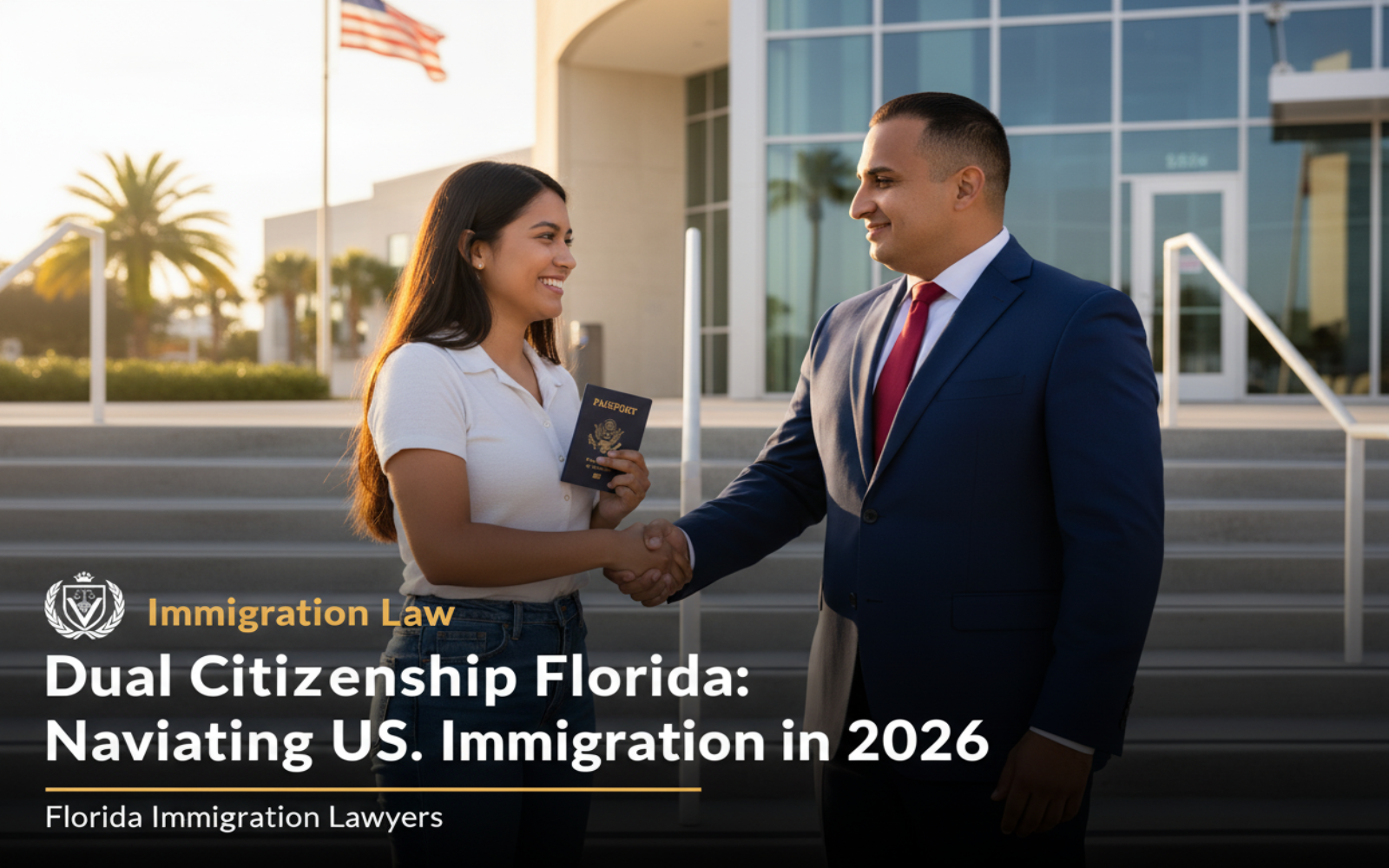
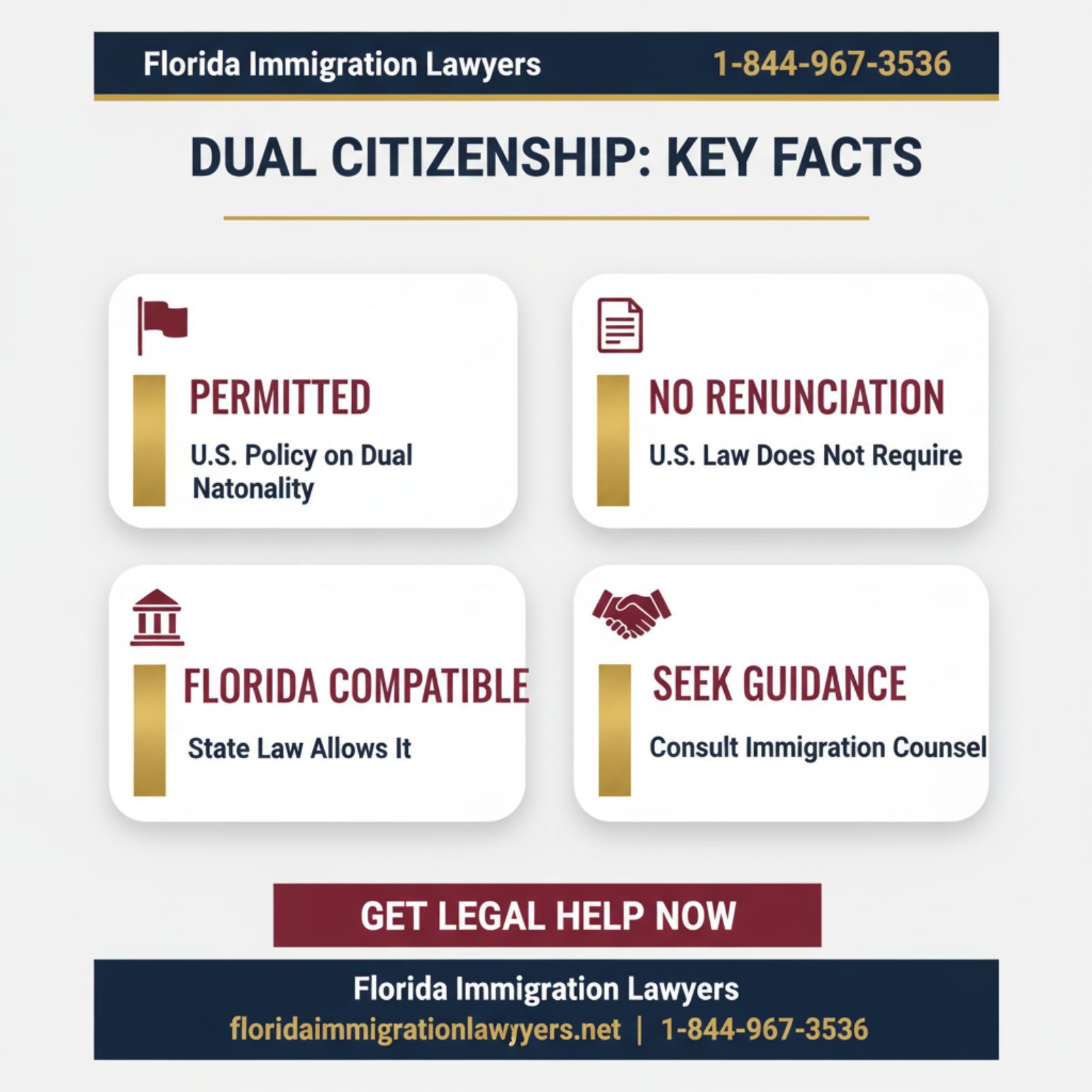
Dual citizenship, or dual nationality, means a person is a citizen of two countries simultaneously. The U.S. generally permits dual citizenship, meaning you typically do not have to renounce your prior nationality when becoming a U.S. citizen, especially if your home country also allows it. This status offers various benefits but also carries responsibilities, requiring careful navigation of complex immigration laws.
- The U.S. generally permits its citizens to hold dual nationality.
- Acquiring U.S. citizenship through naturalization does not always require renouncing your original citizenship.
- Benefits include increased travel flexibility and expanded rights in both nations.
- Understanding the laws of both countries is crucial for maintaining dual citizenship.
- Seeking legal guidance from an experienced immigration attorney is highly recommended.
Are you an immigrant in Gainesville, Florida, dreaming of a future with expanded opportunities, perhaps even holding two passports? The concept of dual citizenship can seem complex, shrouded in myths and misunderstandings. Many individuals in Florida wonder if they can become a U.S. citizen without giving up their ties to their home country. This article aims to demystify dual nationality, providing a clear, comprehensive guide for those navigating the intricate path to U.S. citizenship while potentially retaining their original nationality.
Understanding the nuances of Florida immigration laws in conjunction with federal regulations is crucial. Whether you're considering the naturalization process or exploring derivative citizenship, knowing your options and obligations is paramount. We will explore what dual citizenship entails, how it's acquired, and the benefits it offers. We will also address common concerns and provide actionable steps to help you on your journey in 2026 and beyond.
Don't navigate this significant legal journey alone. For personalized guidance and to understand your specific eligibility for dual citizenship, call Florida Immigration Lawyers at 1-844-967-3536 for a free consultation. Our experienced team serves clients across all of Florida, including Gainesville, and is ready to assist you.
Understanding Dual Citizenship and U.S. Policy
Dual citizenship, also known as dual nationality, occurs when an individual is recognized as a citizen by two different countries simultaneously. This status allows a person to enjoy the rights and privileges of both nations, such as holding two passports, voting in both countries, and receiving protection from both governments.
Contrary to popular belief, U.S. law generally permits its citizens to hold dual nationality. The U.S. government does not require a person to choose between U.S. citizenship and another foreign nationality. While the Oath of Allegiance for naturalization includes a clause to "absolutely and entirely renounce and abjure all allegiance and fidelity to any foreign prince, potentate, state, or sovereignty," the U.S. Supreme Court has recognized that this oath does not necessarily require an individual to perform an overt act of renunciation of their prior citizenship. Instead, it is understood as a renunciation of political allegiance, not legal citizenship status. This interpretation aligns with the U.S. Department of State's guidance on dual nationality, which clarifies that the U.S. does not legally prohibit dual nationality.
However, it is vital to understand that while the U.S. permits dual citizenship, your other country of nationality may not. Some countries have strict laws against dual nationality and may require you to renounce their citizenship upon acquiring another. This is why understanding the laws of both nations is critical when pursuing dual citizenship.
How Dual Citizenship is Acquired in Florida
Acquiring dual citizenship typically happens through several pathways. The most common include birthright citizenship, derivative citizenship through parents, or through the process of naturalization. For many immigrants in Florida, naturalization is the primary route to U.S. citizenship, which may then lead to dual nationality if their birth country permits it.
For example, a child born in the U.S. to foreign parents automatically acquires U.S. citizenship by birth (jus soli). If their parents are citizens of a country that also grants citizenship based on parentage (jus sanguinis), the child may be a dual citizen from birth. Similarly, a child born abroad to U.S. citizen parents may acquire U.S. citizenship at birth, while also retaining the citizenship of their birth country.
The process of naturalization, which involves applying to become a U.S. citizen after meeting specific residency and other requirements, is often the path for foreign nationals living in Florida. Throughout this process, applicants will work with U.S. Citizenship and Immigration Services (USCIS), which is the federal agency responsible for administering immigration and naturalization benefits. Even after successfully completing naturalization, an individual's original citizenship may remain intact, leading to dual citizenship.
Step-by-Step Guide to U.S. Naturalization for Florida Residents
For many residents seeking dual citizenship in Florida, the path involves first becoming a U.S. citizen through naturalization. This process is governed by the Immigration and Nationality Act (INA), specifically 8 U.S.C. § 1427 for general naturalization requirements. Here is a simplified step-by-step guide:
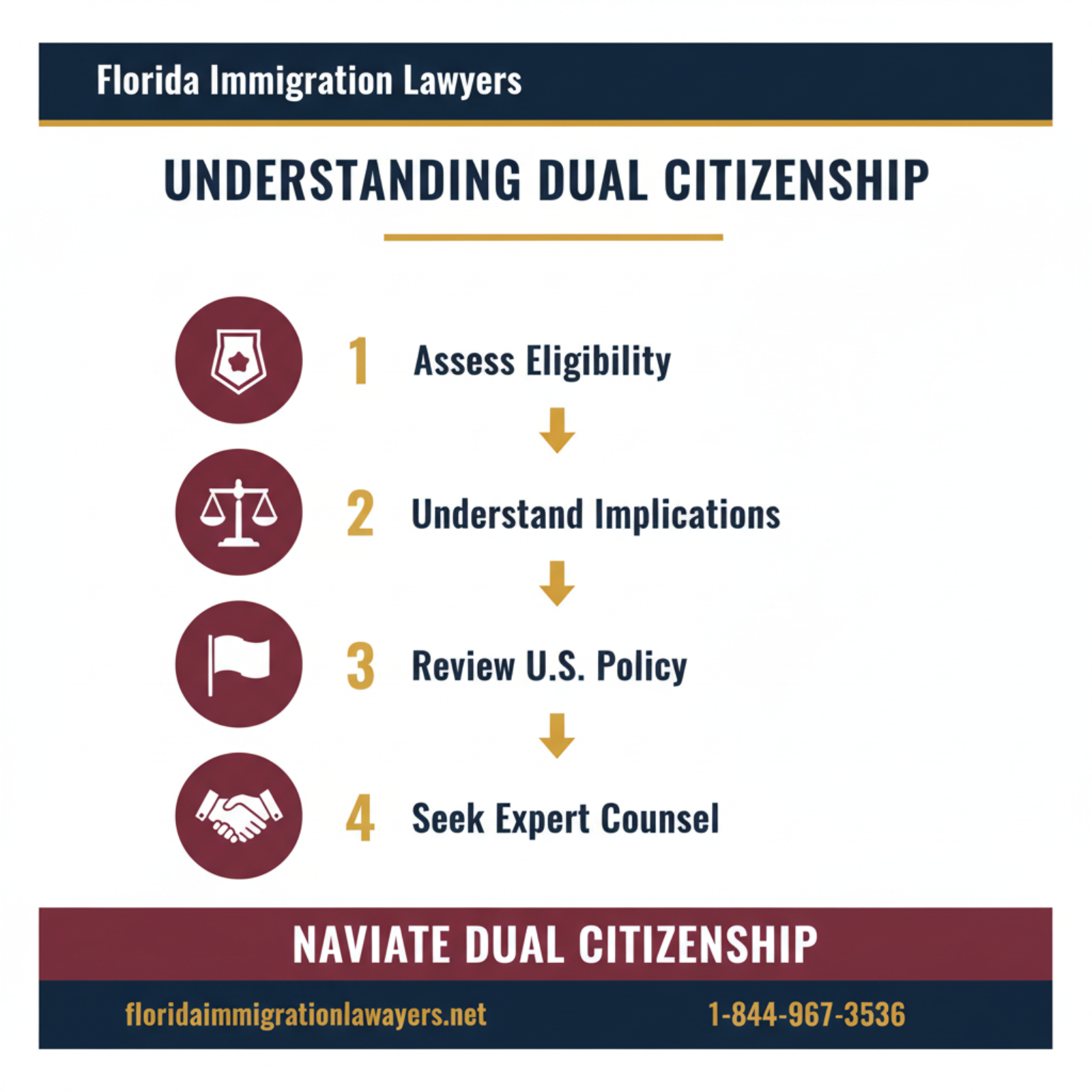
- Determine Your Eligibility: Before applying, you must meet several key requirements. Generally, you must be 18 years or older, be a lawful permanent resident (green card holder) for at least five years (or three years if married to a U.S. citizen), have continuous residence and physical presence in the U.S., demonstrate good moral character, be able to read, write, and speak basic English, and have a knowledge of U.S. history and government. You must also be willing to take the Oath of Allegiance. These requirements are outlined in INA Section 316 (8 U.S.C. § 1427).
- Prepare Form N-400, Application for Naturalization: This is the primary form for applying for U.S. citizenship. You will need to provide detailed personal information, residency history, employment history, family details, and answers to questions about your good moral character and allegiance. Accuracy is paramount, as any discrepancies can cause delays or even lead to denial. Gathering all necessary supporting documents is a critical part of this step.
- Gather Supporting Documents: Collect all required documents, such as copies of your green card, marriage certificate (if applicable), tax returns, selective service registration, and any arrest records or court dispositions. Ensure you have originals and copies as specified by USCIS. We will detail these further in the document checklist section.
- Submit Your Application and Pay Fees: File Form N-400 along with all supporting documents and the applicable filing fee and biometric services fee to the correct USCIS lockbox facility. You can find the most current fees and filing addresses on the USCIS website. Incorrect fees or filing at the wrong address can lead to your application being rejected.
- Attend Biometrics Appointment: After USCIS accepts your application, you will receive an appointment notice for biometrics collection at a local Application Support Center (ASC). This involves taking your fingerprints, photograph, and signature, which are used for background checks.
- Complete the Naturalization Interview: You will be scheduled for an interview with a USCIS officer. During this interview, the officer will review your N-400 application, test your English proficiency (reading, writing, speaking), and administer a civics test on U.S. history and government. You will also be asked questions to confirm your good moral character and eligibility. This is a critical step in the naturalization process.
- Receive a Decision and Attend the Oath of Allegiance Ceremony: If your application is approved, you will receive a notice for the Oath of Allegiance ceremony. This is the final step where you officially become a U.S. citizen. You will take the oath, surrender your Permanent Resident Card, and receive your Certificate of Naturalization. It's at this point that your journey to dual citizenship, if permitted by your other country, is complete.
Essential Document Checklist for Naturalization
Preparing a thorough set of documents is vital for a smooth naturalization application. Missing or incorrect documents can cause significant delays. Here is a general checklist for aspiring U.S. citizens in Florida:
- Copy of your Permanent Resident Card (Green Card), front and back.
- Copies of all current and expired passports and travel documents.
- Copies of your marriage certificate, divorce decrees, or spouse's death certificate (if applicable).
- Copies of birth certificates for all children (if applicable).
- Proof of selective service registration (for male applicants aged 18-26 at time of residency).
- Certified court dispositions, arrest records, or police reports for any arrests or detentions, even if charges were dropped or dismissed.
- Tax transcripts or returns for the past five years (or three years if married to a U.S. citizen).
- Proof of payment of child support or alimony (if applicable).
- Original or certified copies of any documents translated from a foreign language into English.
- Medical certifications for disability exceptions to the English and civics tests (Form N-648, if applicable).
- Two identical passport-style photographs (if filing a paper application).
Always check the USCIS website for Form N-400 instructions for the most up-to-date and complete list of required documents, as requirements can change.
Timeline and Processing Expectations for Dual Citizenship in Florida
The timeline for obtaining U.S. citizenship through naturalization, and thus potentially dual citizenship, can vary significantly. Processing times are influenced by factors such as the volume of applications, the specific USCIS field office (e.g., Orlando, Miami, Tampa, Jacksonville, or other offices serving Gainesville), and the complexity of your individual case.
Generally, from the date of filing Form N-400 to the Oath of Allegiance ceremony, the process can take anywhere from 8 to 24 months, or sometimes longer. USCIS provides an online tool to check current processing times by form type and field office location. For instance, processing times at the USCIS Orlando Field Office, which serves many Central Florida residents including Gainesville, might differ from those in Miami.
Here’s a typical breakdown of the naturalization timeline:
- Application Submission to Biometrics Appointment: 1-3 months
- Biometrics Appointment to Interview: 4-12 months
- Interview to Decision: Immediate to several months (some decisions are made on the spot, others require further review)
- Decision to Oath Ceremony: 1-6 weeks
Delays can occur due to requests for additional evidence (RFE), background check issues, or interview rescheduling. Maintaining accurate contact information with USCIS is crucial to receive all notices promptly. Understanding these timelines helps manage expectations as you pursue dual citizenship.
Cost Factors and Fee Breakdown for Naturalization
The costs associated with applying for U.S. naturalization, which is the primary step towards dual citizenship for many, primarily involve government filing fees. It is important to note that these fees are subject to change, so always verify the current amounts on the official USCIS website or by consulting an attorney.
The main fees include:
- Form N-400 Filing Fee: This is the base fee for the Application for Naturalization.
- Biometric Services Fee: An additional fee for fingerprinting and background checks.
In certain circumstances, applicants with limited income may be eligible for a fee waiver (Form I-912, Request for Fee Waiver) or a reduced fee. Eligibility for these options depends on specific income guidelines or receipt of means-tested benefits. It's essential to check if you qualify, as this can significantly reduce the financial burden of the application process.
Beyond government fees, other potential costs may include:
- Legal Fees: Hiring an experienced immigration attorney, like those at Florida Immigration Lawyers, can be a valuable investment. While not mandatory, legal representation can help ensure your application is correctly prepared, all documents are in order, and you are well-prepared for your interview. This can save time and prevent costly mistakes.
- Translation Costs: If any of your supporting documents are not in English, you will need to pay for certified translations.
- Travel Expenses: Costs associated with traveling to the USCIS office for biometrics and interviews, especially if you live far from a major city like Gainesville to Orlando or Miami.
Planning for these expenses is an important part of your journey toward dual citizenship. Do not navigate this process alone. Contact Florida Immigration Lawyers today.
Common Mistakes to Avoid When Pursuing Dual Citizenship
The path to dual citizenship through U.S. naturalization is fraught with potential pitfalls. Avoiding common mistakes can save you significant time, money, and stress. Here are some key errors to watch out for:
- Failing to Meet Residency Requirements: Many applicants mistakenly believe they only need to reside in the U.S. for the specified period without understanding the continuous residence and physical presence rules. Leaving the U.S. for extended periods can break your continuous residence, delaying your eligibility. Always consult the specific rules under INA Section 316 and 8 CFR Part 316.1.
- Incomplete or Inaccurate Application Forms: Filling out Form N-400 incorrectly or omitting information is a leading cause of delays or denials. Every question must be answered truthfully and completely. Even minor errors can trigger Requests for Evidence (RFEs) or lead to an unfavorable decision.
- Neglecting Good Moral Character Requirements: USCIS scrutinizes an applicant's good moral character for the statutory period (typically 5 or 3 years). Undisclosed arrests, convictions, or other legal issues, even if minor, can lead to denial. Always disclose everything and provide certified court documents.
- Lack of Preparation for the English and Civics Tests: Many applicants underestimate the difficulty of the English and civics tests during the interview. Failing these tests can result in a rescheduled interview, prolonging the process. Utilize study materials provided by USCIS and practice regularly.
- Not Disclosing Prior Citizenship Status to the Other Country: While the U.S. allows dual citizenship, your country of origin might not. Failing to understand or adhere to your home country's laws regarding retaining or losing citizenship upon naturalization elsewhere can lead to unintended consequences, such as automatic loss of that citizenship.
- Traveling Internationally During the Process: While generally allowed, excessive international travel, especially after filing Form N-400, can raise questions about your intent to reside permanently in the U.S. and potentially impact your continuous residency. Consult with an attorney before making travel plans.
- Attempting to Navigate Complex Cases Alone: If you have a complicated immigration history, criminal record, or extended absences from the U.S., trying to handle your naturalization application without legal counsel is a significant risk. These complexities often require expert legal interpretation and strategy.
When to Call a Florida Immigration Lawyer for Dual Citizenship
While the goal of dual citizenship offers many advantages, the journey to achieve it, particularly through U.S. naturalization, is rarely straightforward. An experienced immigration attorney can be your most valuable asset, ensuring your application is strong and your rights are protected. Here are specific scenarios where calling Florida Immigration Lawyers is highly advisable:
- Complex Eligibility Issues: If you have doubts about meeting the continuous residency requirements, have had prolonged absences from the U.S., or have a complicated marital history, an attorney can assess your eligibility accurately.
- Criminal History: Any arrest, charge, or conviction, regardless of how minor or old, can impact your good moral character assessment. An attorney can advise on how to disclose these and present your case effectively to USCIS, potentially helping you avoid deportation defense issues.
- Prior Denials or Immigration Violations: If you have previously been denied naturalization or have any history of immigration violations, legal counsel is essential to understand why and how to proceed.
- Medical Waivers: If you believe you qualify for an exception to the English or civics test due to a medical condition, an attorney can help you prepare Form N-648 and gather the necessary medical documentation.
- Language Barriers or Learning Disabilities: If you struggle with English or have a learning disability that might affect your ability to pass the tests, an attorney can explore accommodations or waivers.
- Concerns About Renunciation: If your home country has strict laws about dual nationality and you are concerned about inadvertently losing your original citizenship, an attorney can help you understand the implications and strategize accordingly.
- Preparing for the Interview: An attorney can thoroughly prepare you for your naturalization interview, reviewing potential questions and ensuring you feel confident and ready.
At Florida Immigration Lawyers, we specialize in helping individuals throughout Florida, including Gainesville, achieve their immigration goals. Our attorneys understand the intricacies of USCIS dual citizenship processes and are dedicated to providing clear, empathetic guidance. We can assist you with all aspects of citizenship applications and help you understand your options for family immigration.
About Florida Immigration Lawyers
Florida Immigration Lawyers is a leading law firm dedicated to providing exceptional immigration legal services across the entire state of Florida. Our team of highly skilled and compassionate attorneys understands the profound impact immigration matters have on individuals and families. We are committed to offering personalized, strategic legal solutions tailored to your unique circumstances.
We offer a comprehensive range of immigration services, including naturalization, family-based petitions, employment visas, deportation defense, asylum claims, and much more. Our firm prides itself on its deep knowledge of U.S. immigration law and our unwavering commitment to our clients' success. We regularly assist clients from Gainesville, Orlando, Miami, Tampa, and all other Florida communities.
Why choose Florida Immigration Lawyers? We combine legal expertise with genuine empathy, ensuring you feel supported and informed every step of the way. We are available 24/7 to address your urgent needs and offer free consultations to help you understand your options without financial commitment. Your journey to dual citizenship or any other immigration goal is our priority.
Contact us today for a free consultation: 1-844-967-3536 or visit our website at https://www.floridaimmigrationlawyers.net. Let us be your trusted partner in navigating the complexities of immigration law. You can also learn more about our team by visiting our attorneys page or contact us directly.
Sources and References
- U.S. Citizenship and Immigration Services (USCIS)
- USCIS Policy Manual: Volume 12, Part H, Chapter 2 - Dual Nationality
- U.S. Department of State: Dual Nationality
- Executive Office for Immigration Review (EOIR)
- 8 U.S.C. Chapter 12 - Immigration and Nationality Act (INA)
- INA Section 316 (8 U.S.C. § 1427) - Requirements for Naturalization
- 8 CFR Part 316 - General Requirements for Naturalization
This article provides general legal information and is not intended as legal advice. Every case is unique, and outcomes depend on specific facts and circumstances. Contact an attorney for advice about your particular situation.
Embarking on the journey to dual citizenship is a significant step, offering a wealth of opportunities and benefits. While the process of U.S. naturalization can be intricate, with the right guidance, it is entirely achievable. Florida Immigration Lawyers are here to provide the expert support and compassionate representation you need.
We are committed to helping you understand every aspect of how to apply for dual citizenship through the naturalization process, ensuring your application is strong and your future is secure. Don't leave your immigration future to chance. Take the first step today.
Call Florida Immigration Lawyers at 1-844-967-3536 for a free, confidential consultation. Se Habla Español - Estamos aquí para ayudarle.
Need help with Immigration?
Our Florida immigration attorneys offer free consultations. Call today or schedule online.
Frequently Asked Questions
Florida Immigration Lawyers
Legal Team
Our experienced attorneys at Florida Immigration Lawyers have been serving clients across Florida for over 20 years. We specialize in immigration, personal injury, criminal defense, workers compensation, and family law.