Work Permit EAD Florida Application 2026: Get Your Employment Authorization
Secure your work permit (EAD) in Florida with our 2026 guide. Learn about the I-765 application process, eligibility requirements, essential documents, and processing timelines. We cover everything from initial application to receiving your Employment Authorization Document, with a focus on residents of Kissimmee and surrounding areas. Avoid common mistakes and understand when to seek legal assistance. Florida Immigration Lawyers offers expert guidance and free consultations for your employment authorization journey. Contact us today to navigate the complexities and achieve your goal of working legally in Florida.
To apply for a work permit (Employment Authorization Document, EAD) in Florida, you generally need to file Form I-765, Application for Employment Authorization, with U.S. Citizenship and Immigration Services (USCIS). Eligibility depends on your specific immigration status, such as being an asylum applicant, a refugee, or an adjustment of status applicant. Gathering required documents and understanding processing times are crucial for a successful application.
- File Form I-765 with USCIS.
- Meet specific immigration status eligibility criteria.
- Gather all required supporting documents.
- Be prepared for biometric appointments and processing times.
- Seek legal advice for complex cases or denials.
Introduction: Navigating Your Path to Employment Authorization in Florida
Are you dreaming of working legally in Florida, contributing your skills, and building a life in our vibrant communities like Kissimmee, Orlando, or Tampa? The path to employment authorization, often referred to as a work permit or Employment Authorization Document (EAD), is a critical step for many immigrants and non-immigrants across the Sunshine State. Understanding the application process for an EAD, specifically Form I-765, can feel overwhelming.
This comprehensive guide from Florida Immigration Lawyers is designed to demystify the work permit EAD Florida application process for 2026. We will walk you through the necessary steps, eligibility requirements, required documents, and what to expect during processing. Our goal is to provide clear, actionable information to help you secure your employment authorization.
Do not let the complexities of immigration law deter you from your goals. For personalized guidance and expert assistance with your I-765 application, we are here to help. Call Florida Immigration Lawyers at 1-844-967-3536 for a free consultation. Let us help you navigate your journey towards legal employment in Florida.
Understanding Your Work Permit (EAD) in Florida
An Employment Authorization Document (EAD), also known as a work permit, is a card issued by USCIS that grants non-citizens permission to work legally in the United States for a specific period. This document is crucial for many individuals seeking to secure lawful employment in Florida, whether they reside in Kissimmee, Miami, or any other part of the state.
The EAD card, officially known as Form I-766, serves as proof of your authorization to work. It is essential for employers to verify your eligibility to work in the U.S. under 8 U.S.C. § 1324a, which prohibits the unauthorized employment of aliens. Having a valid EAD means you can pursue job opportunities without fear of violating immigration laws.
Who Is Eligible for an EAD in Florida?
Eligibility for an employment authorization document is not universal; it depends on your specific immigration status or the category under which you are seeking to adjust your status. USCIS identifies various categories of individuals who may be eligible to apply for an EAD. These categories are outlined in 8 CFR 274a.12.
Common eligibility categories include, but are not limited to, asylum applicants, refugees, individuals granted Temporary Protected Status (TPS), certain non-immigrants with compelling circumstances, and those with pending applications for adjustment of status (Form I-485). Students with specific employment needs, such as Optional Practical Training (OPT), also apply for EADs.
Florida's diverse population includes individuals from many of these categories. For instance, many asylum seekers and family-based immigration applicants in areas like Kissimmee, with its significant international community, frequently seek work permits. Understanding your specific category is the first critical step in your I-765 application.
The Step-by-Step Guide to Applying for Your Florida Work Permit (Form I-765)
Applying for your work permit via Form I-765 can be a detailed process. Following these steps carefully will help ensure your employment authorization application is processed smoothly. This guide is particularly useful for residents of Florida, including those in Kissimmee.
-
Determine Your Eligibility Category
Before filling out any forms, you must confirm that you fall into one of the eligible categories for an EAD. This might be tied to a pending asylum application, a family-based immigration petition, a business immigration visa, or an adjustment of status application. Each category has specific requirements you must meet.
If you are unsure about your eligibility, consulting with an immigration attorney at Florida Immigration Lawyers is highly recommended. We can help you identify the correct category for your I-765 application and ensure you meet all criteria. Many paths lead to a work permit, and knowing yours is key.
-
Gather All Required Documents
The success of your work permit EAD Florida application heavily relies on submitting a complete and accurate package of supporting documents. These documents prove your identity, immigration status, and eligibility for the EAD. A detailed checklist is provided in the next section.
Ensure all documents are current, clearly legible, and translated into English if necessary, with a certified translator's statement. Missing or incorrect documents are a common cause of delays and Requests for Evidence (RFEs).
-
Complete Form I-765, Application for Employment Authorization
Fill out Form I-765 meticulously. You can find the latest version of the form and its instructions on the USCIS website. Pay close attention to each section, ensuring all information matches your supporting documents exactly.
You can generally file Form I-765 either online through a USCIS online account or by mail. The online filing option is often faster and allows for immediate confirmation of submission. However, some categories may still require paper filing.
-
Pay the Filing Fee (or Request a Fee Waiver)
Most I-765 applications require a filing fee. This fee is subject to change, so always check the most current fee schedule on the USCIS website before submitting your application. Do not send cash through the mail.
Certain applicants, based on their income or receipt of public benefits, may be eligible for a fee waiver. If you believe you qualify, you must submit Form I-912, Request for Fee Waiver, along with your work permit application. An attorney can help assess your eligibility for a waiver.
-
File Your Application with USCIS
Once your Form I-765 is complete and you have gathered all supporting documents and the correct fee, you must file your application with USCIS. If filing by mail, send your package to the specific USCIS Lockbox facility designated for your eligibility category, as indicated in the Form I-765 instructions.
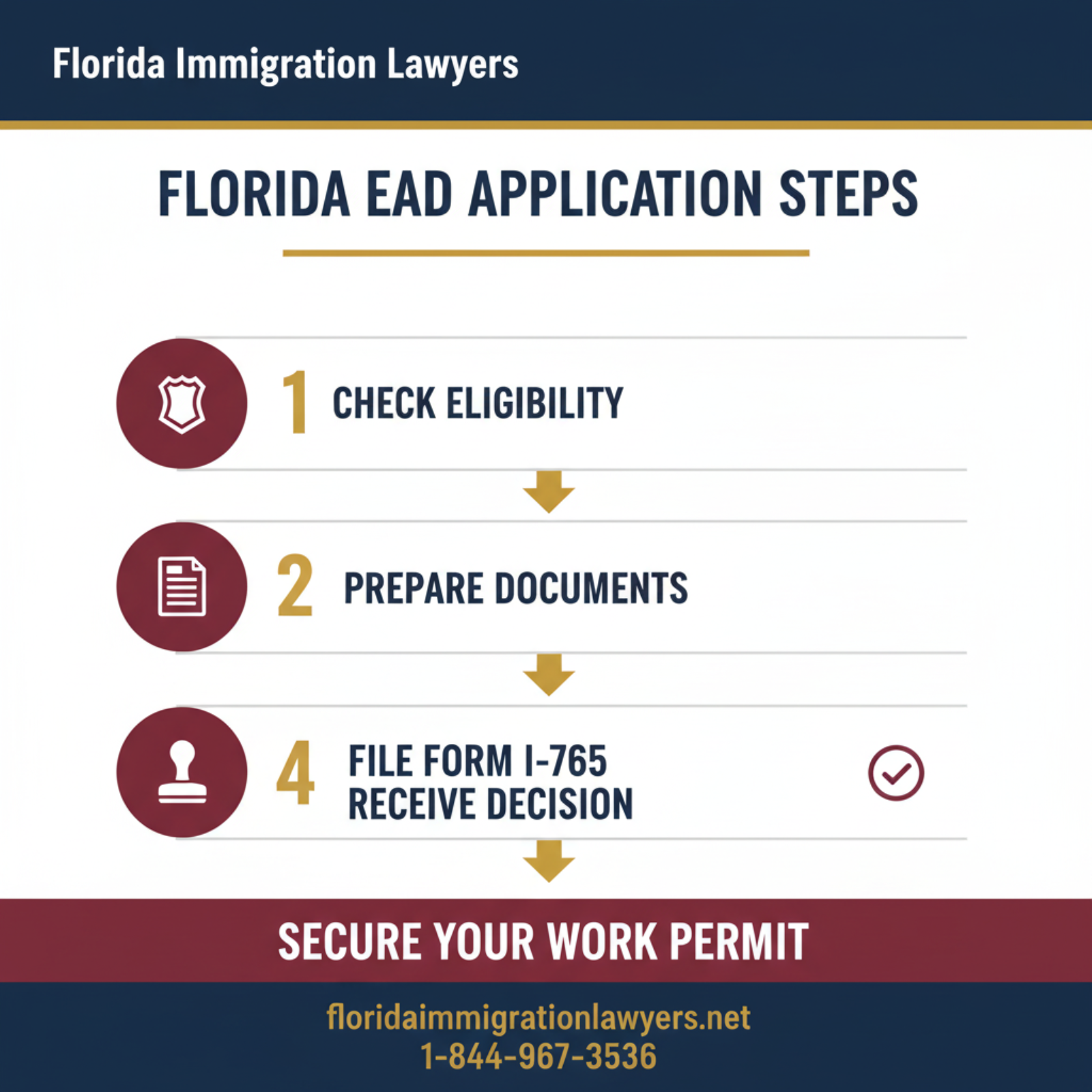
Step-by-Step Process Guide If filing online, you will upload all documents and submit the form electronically. Always keep a copy of your entire application package for your records, regardless of how you file. This is crucial for future reference.
-
Attend Your Biometrics Appointment
After filing, USCIS will typically send you an appointment notice for biometrics collection at an Application Support Center (ASC). This usually involves taking your fingerprints, photograph, and signature. This step is a standard part of the security checks for your employment authorization.
It is vital to attend this appointment on time with the required documents, including your appointment notice and a valid photo ID. Missing this appointment can cause significant delays or even lead to the denial of your work permit application.
-
Respond to Requests for Evidence (RFEs)
During the processing of your I-765 application, USCIS may issue a Request for Evidence (RFE) if they determine that your application is incomplete or lacks sufficient supporting documentation. An RFE will specify what additional information or documents are needed.
You must respond to an RFE within the given timeframe. Failure to provide the requested evidence promptly can lead to delays or denial. If you receive an RFE, it is advisable to seek legal counsel from Florida Immigration Lawyers to ensure a comprehensive and timely response.
-
Receive Your Decision and EAD Card
Once USCIS has processed your application and all checks are complete, you will receive a decision. If approved, your Employment Authorization Document (EAD card) will be mailed to the address you provided. This card is your official proof of authorization to work in the U.S.
Carefully review your EAD card for any errors immediately upon receipt. If you find any discrepancies, contact USCIS promptly. The EAD card will specify its validity period, and it is crucial to monitor this expiration date for timely renewal.
Essential Documents for Your Employment Authorization Application
A complete application package is essential for a successful work permit EAD Florida application. Here is a general checklist of documents you will typically need to include with your Form I-765. Please note that specific requirements can vary based on your eligibility category.
- Form I-765, Application for Employment Authorization: The most current version, properly filled out and signed.
- Two Passport-Style Photographs: Taken within 30 days of filing, meeting USCIS specifications.
- Copy of Your Last EAD Card (if applicable): Front and back, especially for renewals.
- Copy of Your Form I-94, Arrival/Departure Record: Proving your lawful admission and current status. You can retrieve this online from the Customs and Border Protection (CBP) website.
- Copy of Your Visa (if applicable): From your passport.
- Copy of Your Passport Biographical Page: Showing your photo, name, and date of birth.
- Evidence of Your Eligibility Category: This is crucial and varies widely. Examples include:
- Pending Form I-485, Application to Register Permanent Residence or Adjust Status: A copy of your I-485 receipt notice.
- Asylum Application: A copy of your Form I-589, Application for Asylum and for Withholding of Removal, receipt notice or proof of filing.
- Non-immigrant Status: Documentation proving your specific non-immigrant status that grants EAD eligibility (e.g., J-1 visa with specific circumstances).
- DACA Approval Notice: For Deferred Action for Childhood Arrivals recipients.
- Marriage Certificate/Birth Certificates: If your eligibility is based on a family relationship, such as for certain spouses of visa holders.
- Any Other Supporting Documentation: As required by your specific eligibility category or requested by USCIS.
Always review the specific instructions for Form I-765 on the USCIS website for your particular eligibility category. This ensures you include every necessary document for your employment authorization.
Timeline and Processing Expectations for Florida EAD Applications
One of the most common questions we hear at Florida Immigration Lawyers is, "How long will it take to get my work permit EAD Florida application approved?" The processing time for an Employment Authorization Document can vary significantly based on several factors, including the USCIS service center handling your case, your eligibility category, and the current USCIS workload.
USCIS provides estimated processing times on their website for different form types and service centers. You can check these estimates by visiting the USCIS Processing Times page. It is important to note that these are estimates and not guarantees.
Factors that can influence your EAD processing time:
- Filing Volume: High volumes of applications can lead to longer wait times.
- Service Center: Different USCIS service centers (e.g., Nebraska, Texas) may have varying backlogs.
- Eligibility Category: Some categories are processed faster than others. For example, EADs based on a pending adjustment of status (I-485) are often processed concurrently.
- Requests for Evidence (RFEs): If USCIS issues an RFE, your processing time will be extended while you gather and submit additional information.
- Biometrics Appointment: Delays in attending or scheduling your biometrics can impact the overall timeline.
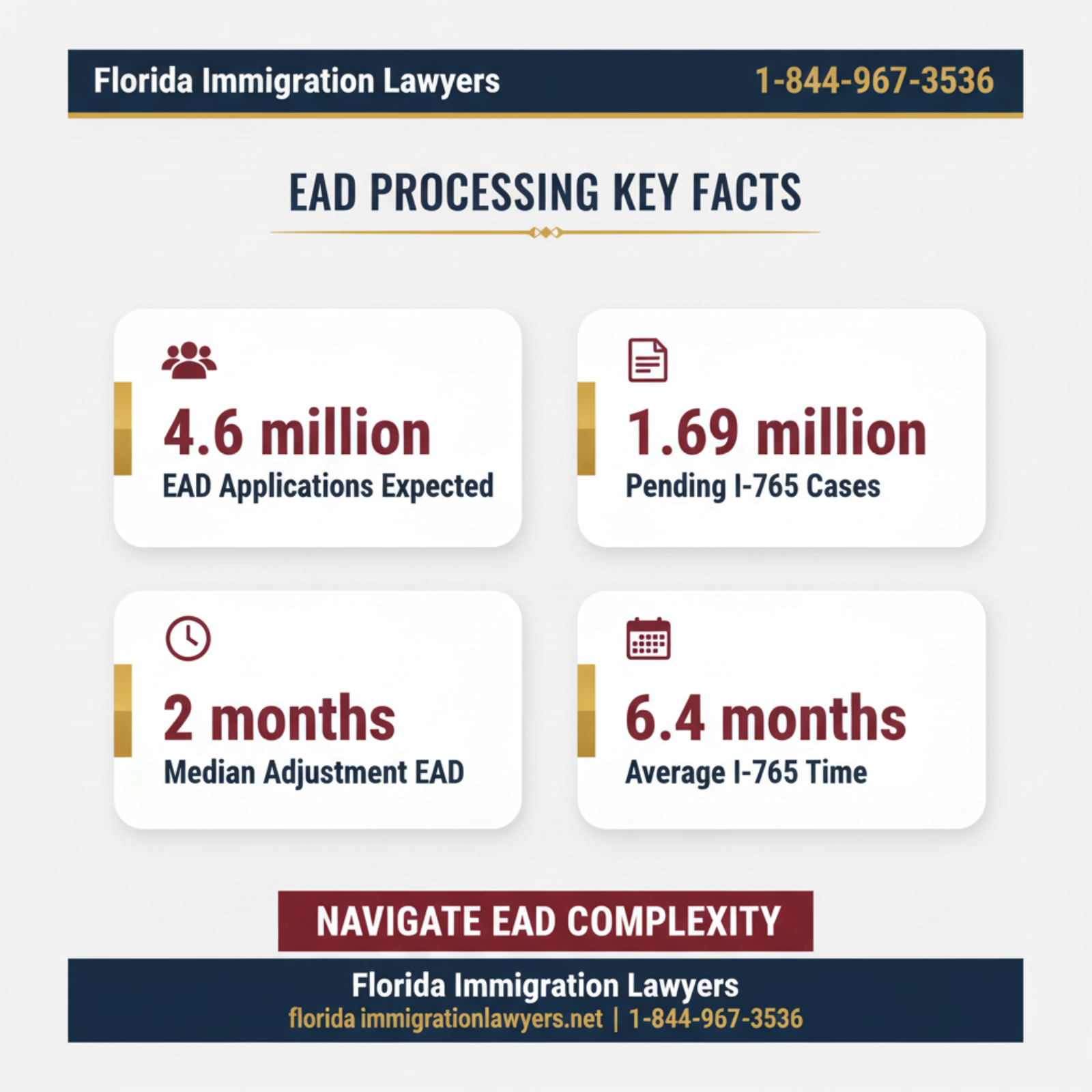
For individuals in Florida, including Kissimmee, while there are USCIS field offices (e.g., Orlando, Miami, Tampa) for interviews and biometrics, EAD applications are generally processed at national service centers. Therefore, your location within Florida does not directly determine which service center processes your application, but it does affect biometrics scheduling.
You can monitor the status of your I-765 application online using the USCIS Case Status Online tool with your receipt number. This tool provides real-time updates on your application's progress. If your case is outside normal processing times, you may be able to submit an inquiry with USCIS.
Cost Factors and Fee Breakdown for Your Work Permit Application
Understanding the costs associated with your work permit EAD Florida application is crucial for proper planning. The primary cost is the USCIS filing fee for Form I-765. This fee is set by USCIS and is subject to change, so always verify the current amount directly on the USCIS website.
In addition to the filing fee, some applicants may also incur a biometrics services fee. This fee covers the cost of collecting your fingerprints, photograph, and signature. Check the Form I-765 instructions or the USCIS fee schedule to confirm if this fee applies to your specific eligibility category.
Other potential costs include:
- Attorney Fees: While not mandatory, hiring an experienced immigration attorney from Florida Immigration Lawyers can significantly increase your chances of a successful application and reduce stress. Our fees cover expert legal advice, document preparation, and representation.
- Translation Costs: If any of your supporting documents are not in English, you will need to pay for certified translations.
- Postage/Shipping Fees: If you mail your application, you will incur costs for secure shipping.
- Passport Photos: The cost of obtaining USCIS-compliant passport-style photographs.
As mentioned earlier, certain low-income applicants may be eligible for a fee waiver by filing Form I-912. Eligibility for a fee waiver is strict and typically requires demonstrating that you are receiving a means-tested public benefit, your household income is at or below 150% of the Federal Poverty Guidelines, or you are experiencing financial hardship. We can help you determine if you qualify.
Planning for these expenses is an important part of your employment authorization journey. Being prepared financially helps prevent delays in your application process.
Do not navigate this process alone. Contact Florida Immigration Lawyers today for comprehensive assistance with your work permit EAD Florida application. We are committed to helping you achieve your immigration goals.
Common Mistakes to Avoid When Applying for a Work Permit in Florida
The work permit EAD Florida application process can be complex, and even minor errors can lead to significant delays or even denial. Avoiding these common mistakes is crucial for a smooth journey toward your employment authorization.
- Submitting an Incomplete Form I-765: Failing to answer all questions or leaving required sections blank. Consequences: USCIS will likely reject your application or issue an RFE, causing delays.
- Using an Outdated Form Version: USCIS frequently updates its forms. Consequences: Your application will be rejected, and you will have to restart the process, losing valuable time.
- Incorrect Filing Fee or Payment Method: Sending the wrong amount or an unacceptable payment type (e.g., cash). Consequences: Your application will be rejected, or processing will be delayed until the correct payment is received.
- Missing or Insufficient Supporting Documents: Not including all required evidence for your eligibility category. Consequences: An RFE will be issued, extending processing times, or your application may be denied.
- Failure to Sign the Form: Forgetting to sign Form I-765 in the designated area. Consequences: Your application will be rejected immediately as unsigned forms are invalid.
- Not Attending the Biometrics Appointment: Missing your scheduled appointment without proper rescheduling. Consequences: Significant delays, or potentially the denial of your application.
- Working Without Authorization: Beginning employment before receiving your EAD card. Consequences: This is a serious immigration violation that can lead to deportation and future inadmissibility.
- Not Updating Your Address with USCIS: Failing to inform USCIS of a change of address. Consequences: You might miss important notices, RFEs, or even your EAD card, leading to application delays or abandonment.
- Misunderstanding Your Eligibility Category: Applying under a category for which you do not qualify. Consequences: Your application will be denied, and you will lose the filing fee and precious time.
- Not Renewing Your EAD on Time: Waiting until your current EAD expires to apply for renewal. Consequences: A lapse in your employment authorization, potentially leading to job loss and a period of unauthorized work if you continue employment.
- Providing Inconsistent Information: Submitting information that contradicts previous immigration applications or records. Consequences: Can raise red flags with USCIS, leading to deeper scrutiny, RFEs, or even fraud allegations.
- Ignoring RFEs: Not responding to a Request for Evidence within the specified timeframe. Consequences: Almost certain denial of your work permit application.
These mistakes are entirely preventable with careful attention to detail and, ideally, the guidance of an experienced immigration attorney.
When to Call Florida Immigration Lawyers for Your EAD Application
While this guide provides a comprehensive overview, the immigration process is rarely straightforward. There are specific scenarios where the expertise of an immigration lawyer from Florida Immigration Lawyers becomes invaluable for your work permit EAD Florida application. We serve clients across Florida, including Kissimmee, Orlando, and Miami.
Consider contacting us if you encounter any of the following:
- Complex Eligibility: If your immigration history is complicated, you have multiple pending applications, or you are unsure which EAD category applies to you.
- Prior Denials or Immigration Violations: Any past issues, such as previous visa denials, deportations, or criminal history, can significantly complicate your EAD application. Our deportation defense expertise is relevant here.
- Receipt of a Request for Evidence (RFE): Responding to an RFE accurately and comprehensively is critical. We can help you gather the necessary documentation and draft a robust response.
- Unexplained Delays: If your application is pending beyond the normal USCIS processing times, we can help inquire about the status and escalate your case if appropriate.
- Need for Urgent Processing: In certain rare situations, it may be possible to expedite an EAD application. We can assess if your case meets the stringent criteria for expedited processing.
- Language Barriers or Difficulty with Paperwork: If you are struggling to understand the forms, instructions, or legal terminology, our bilingual team can provide clear assistance.
- General Anxiety or Confusion: The immigration process can be stressful. Having a knowledgeable advocate can provide peace of mind and ensure your application is handled correctly.
At Florida Immigration Lawyers, we specialize in various immigration practice areas, including citizenship, family immigration, and business immigration. Our attorneys are dedicated to protecting your rights and helping you achieve your goals. Visit our attorneys page to learn more about our team.
About Florida Immigration Lawyers
Florida Immigration Lawyers is a leading law firm dedicated to providing exceptional immigration legal services across the entire state of Florida. With years of experience and a deep understanding of U.S. immigration law, our firm is committed to helping individuals, families, and businesses navigate the complexities of the immigration system.
We pride ourselves on our client-focused approach, offering personalized attention and strategic legal solutions tailored to your unique circumstances. Our team is passionate about assisting immigrants in achieving their American dreams, whether that involves obtaining a work permit, securing a visa, or pursuing citizenship.
Why Choose Florida Immigration Lawyers?
- Expertise: Our attorneys possess extensive knowledge of immigration law and stay updated on the latest policy changes.
- Compassion: We understand the challenges and anxieties associated with immigration matters and provide empathetic support.
- Bilingual Services: Our team is fluent in English and Spanish, ensuring clear communication and culturally appropriate assistance.
- Statewide Reach: We serve clients in all Florida counties, from Kissimmee to Miami, Tampa, Jacksonville, and beyond.
- Free Consultations: We offer a free initial consultation to discuss your case and outline your options.
Your immigration journey is important to us. Let us be your trusted legal partner. You can reach Florida Immigration Lawyers 24/7 at 1-844-967-3536 or visit our website at www.floridaimmigrationlawyers.net to learn more and schedule your free consultation.
Sources and References
- U.S. Citizenship and Immigration Services (USCIS) - Form I-765, Application for Employment Authorization
- USCIS Policy Manual
- USCIS Processing Times
- USCIS Filing Fees
- 8 U.S.C. Chapter 12 - Immigration and Nationality Act (INA)
- 8 CFR Part 274a - Control of Employment of Aliens
- Executive Office for Immigration Review (EOIR)
- U.S. Department of Labor (DOL) - Foreign Labor Certification
This article provides general legal information and is not intended as legal advice. Every case is unique, and outcomes depend on specific facts and circumstances. Contact an attorney for advice about your particular situation.
Secure Your Florida Work Permit: Contact Us Today
Obtaining your work permit in Florida is a significant step towards achieving your personal and professional goals in the United States. While the process for the I-765 application can seem daunting, you do not have to face it alone. Florida Immigration Lawyers is here to provide the expert legal guidance and support you need.
Our experienced team is ready to assist you with every aspect of your employment authorization application, ensuring accuracy, timeliness, and compliance with all immigration laws. From initial eligibility assessment to document preparation and responding to USCIS inquiries, we stand by your side.
Take the first step towards securing your future in Florida. Call Florida Immigration Lawyers today for a free consultation at 1-844-967-3536. Se Habla Español - Estamos aquí para ayudarle.
Need help with Immigration?
Our Florida immigration attorneys offer free consultations. Call today or schedule online.
Frequently Asked Questions
Florida Immigration Lawyers
Legal Team
Our experienced attorneys at Florida Immigration Lawyers have been serving clients across Florida for over 20 years. We specialize in immigration, personal injury, criminal defense, workers compensation, and family law.