Public Charge Rule Florida Immigrants: What You Need to...
For Florida immigrants, understanding the public charge rule is essential for securing your future in the U.S. In 2026, this rule assesses whether you are likely to rely on specific government benefits, impacting green card and visa applications. Florida Immigration Lawyers provides crucial insights into what benefits are considered, who is exempt, and how the 'totality of circumstances' test works. We help you prepare for the assessment process, gather necessary documents, and avoid common mistakes that could jeopardize your case. Learn how to protect your immigration status and ensure a smooth journey to permanent residency in Florida.

The public charge rule is a critical aspect of U.S. immigration law that assesses whether non-citizens are likely to become primarily dependent on specific government benefits. A finding of public charge inadmissibility can prevent individuals from obtaining green cards or visas. The 2026 rule employs a "totality of circumstances" test, evaluating factors like age, health, family status, assets, resources, education, and skills.
- The rule applies to most immigrants seeking permanent residency or certain visas.
- It primarily considers specific cash and long-term institutional care benefits.
- Many common benefits like WIC, SNAP, or emergency Medicaid are not included.
- A comprehensive "totality of circumstances" test is used, not just benefit use.
- Seeking experienced legal assistance is crucial to navigate these complexities effectively.
Imagine building a new life for yourself and your family in Florida, pursuing your American dream. This journey is often filled with hope and excitement, but it also involves navigating complex legal hurdles. One significant concern that many immigrants face is the public charge rule.
This comprehensive guide from Florida Immigration Lawyers will demystify the public charge rule as it stands in 2026. We will explain what it means for you and your family in Florida, which specific government benefits are considered, and how to navigate this crucial aspect of immigration law to protect your future. If you have questions or need personalized guidance, do not hesitate to Call Florida Immigration Lawyers at 1-844-967-3536 for a free consultation.
Understanding the Public Charge Rule for Florida Immigrants
The public charge rule is rooted in the Immigration and Nationality Act (INA) section 212(a)(4), which states that an individual is inadmissible to the United States if they are "likely at any time to become a public charge." This provision aims to ensure that immigrants are self-sufficient and do not primarily rely on government assistance.
While the concept of public charge has existed for decades, its interpretation and enforcement have evolved. As of 2026, the current public charge rule focuses on a "totality of circumstances" analysis. This means immigration officials consider various factors related to an applicant's life, not just their past or potential use of benefits.
For immigrants in Florida, whether you are in Hialeah, Miami-Dade, Orlando, or Tampa, understanding this rule is paramount. The USCIS field offices in Florida, such as those in Miami or Orlando, will apply this standard when reviewing applications for adjustment of status to lawful permanent resident status. We understand that this process can feel daunting, but you do not have to face it alone.
The rule primarily applies to individuals seeking admission to the U.S. or applying for lawful permanent resident status (a green card). It is designed to evaluate an individual's likelihood of becoming primarily dependent on the government for subsistence. Our firm, Florida Immigration Lawyers, regularly assists clients across Florida with these complex immigration matters. Learn more about our immigration services here.
What Benefits Are Considered Public Charge?
It is crucial to understand that not all government benefits are considered under the public charge rule. The current rule focuses on a narrow set of benefits that directly provide cash assistance for income maintenance or support for long-term institutional care at government expense.
- Cash Assistance for Income Maintenance: This includes Supplemental Security Income (SSI), Temporary Assistance for Needy Families (TANF), and state, tribal, or local cash assistance programs for income maintenance.
- Long-Term Institutional Care: This refers to Medicaid for long-term institutional care, such as care in a nursing home or mental health institution, paid for by the government.
Many widely used public benefits are NOT considered for public charge determinations. These include, but are not limited to, the Supplemental Nutrition Assistance Program (SNAP, formerly food stamps), housing assistance, child care services, Head Start, WIC, school lunch programs, emergency medical assistance (including emergency Medicaid), Children's Health Insurance Program (CHIP), and foster care and adoption assistance. Utilizing these vital programs for your family's well-being in Florida generally does not negatively impact your public charge assessment. This clarification helps alleviate many common fears surrounding "what benefits are considered public charge" and "is Medicaid a public charge."
Who is Exempt from the Public Charge Rule?
Not everyone applying for immigration benefits is subject to the public charge rule. Certain categories of immigrants are specifically exempt by law. These exemptions recognize the unique circumstances and humanitarian protections afforded to these groups.
Exempt categories typically include, but are not limited to, refugees, asylees, applicants for asylum or refugee status, certain nonimmigrants and applicants for adjustment of status under the Cuban Adjustment Act, and individuals applying for or holding U visas (victims of criminal activity), T visas (victims of human trafficking), or VAWA (Violence Against Women Act) self-petitions. Additionally, certain special immigrant juveniles and other specific categories may also be exempt.
If you fall into one of these exempt categories, the public charge inadmissibility ground will generally not apply to your application. This provides an important layer of protection for vulnerable individuals seeking safety and new beginnings in Florida. Our firm can help you determine if you qualify for these exemptions. Explore our asylum services for more information.
Navigating the Public Charge Assessment Process
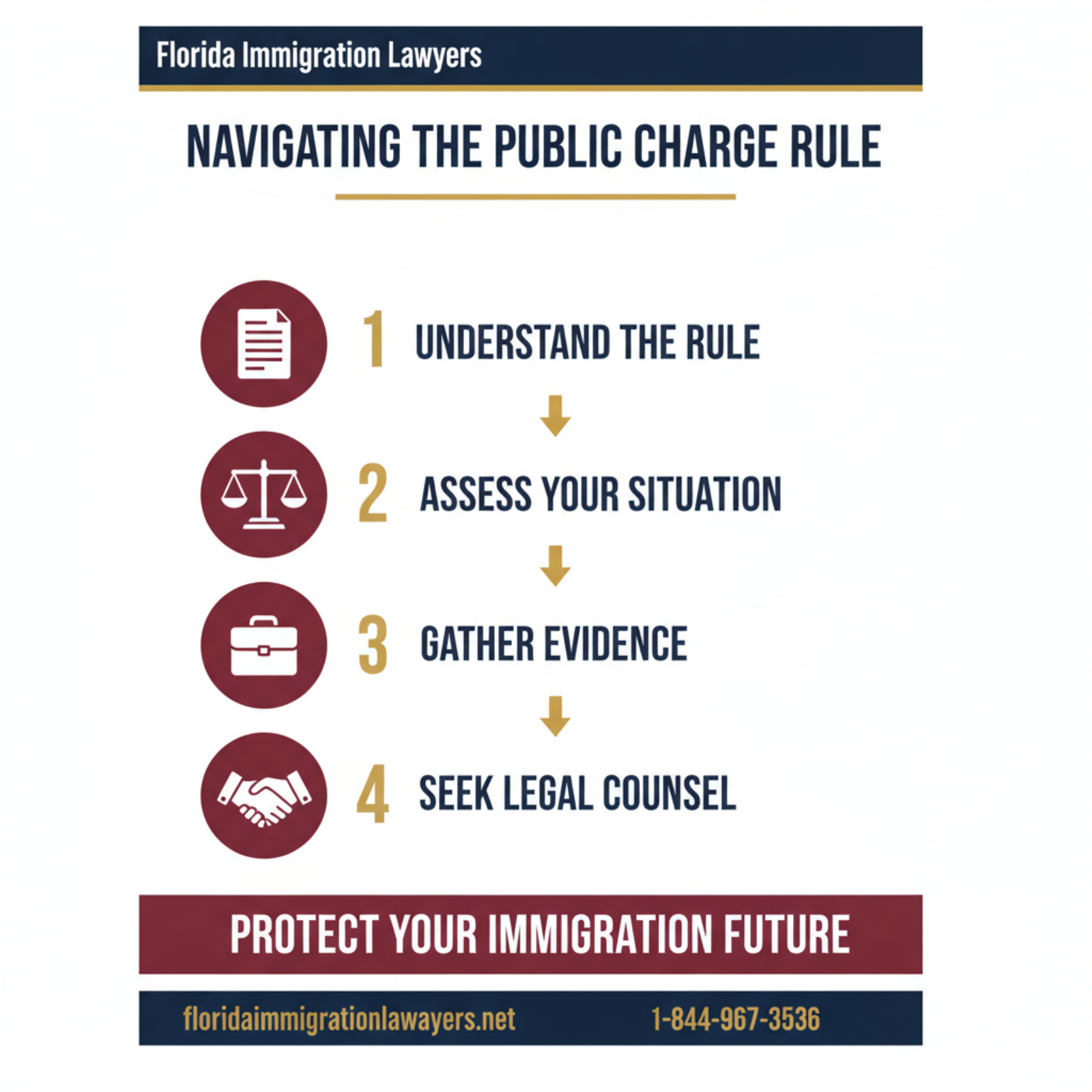
The public charge assessment is a thorough review of an applicant's circumstances. Here's a step-by-step guide to understanding what the process generally entails:
-
Understand Applicability: First, determine if the public charge rule applies to your specific immigration path. It typically applies to those seeking adjustment of status to a green card or certain immigrant visas. Not all visa types or immigration categories are subject to this rule.
-
Gather Financial Documentation: You will need to provide comprehensive evidence of your financial stability. This includes proof of income (pay stubs, tax returns), assets (bank statements, property deeds), and any other resources that demonstrate your ability to support yourself and your family in Florida.
-
Review Benefit Usage: Be prepared to honestly disclose any past or current receipt of public benefits. Remember, only specific cash assistance and long-term institutional care benefits are considered. Most other common benefits do not count against you.
-
Consider an Affidavit of Support (Form I-864): For many family-based immigration cases, a U.S. citizen or lawful permanent resident sponsor must file Form I-864, Affidavit of Support. This legally binding document demonstrates that the sponsor can support the immigrant and ensure they do not become a public charge.
-
Seek Legal Counsel: Navigating the nuances of the public charge rule can be complex. An experienced immigration attorney can help you understand your specific situation, prepare your application, and address any potential concerns. This is particularly vital for "public charge rule 2026" updates.
-
Prepare for Interview: If an interview is required, whether at a USCIS field office in Florida or a U.S. embassy/consulate abroad, be ready to discuss your financial stability, resources, and any benefit usage. Be truthful and provide consistent information.
-
Address Inadmissibility Concerns: If there is a potential finding of public charge inadmissibility, an attorney can help explore possible waivers or other strategies to overcome this ground of inadmissibility, if applicable to your case.
Essential Documents for Public Charge Review
When preparing your immigration application, particularly Form I-485 (Application to Register Permanent Residence or Adjust Status), you will need to compile a robust set of documents to demonstrate that you are not likely to become a public charge. This checklist is crucial for anyone seeking a "public charge rule green card" in Florida.
- Financial Documents: Recent federal income tax returns (e.g., Form 1040), pay stubs, employment verification letters, bank statements, and evidence of any other regular income.
- Affidavit of Support (Form I-864): If applicable, the completed and signed Form I-864 from your sponsor, along with their financial documentation.
- Proof of Assets: Documentation of significant assets such as property deeds, investment statements, or retirement accounts.
- Evidence of Health Insurance: Proof of current or prospective health insurance coverage.
- Educational Background and Skills Documentation: Diplomas, degrees, professional licenses, and certifications that demonstrate your education, skills, and employability.
- Any Evidence of Private Financial Support: Letters or statements from individuals providing consistent financial support, if applicable.
- Medical Examination Results: A completed and signed Form I-693, Report of Medical Examination and Vaccination Record, from a USCIS-approved civil surgeon.
Public Charge Processing: What to Expect in 2026
The processing timeline for immigration applications involving public charge considerations can vary significantly. Factors such as the complexity of your case, the volume of applications at the relevant USCIS field office (like Miami or Jacksonville), and the thoroughness of your initial submission all play a role.
Generally, after filing your application, you will receive a receipt notice. This is followed by a biometrics appointment, and then potentially an interview. During the interview, an immigration officer will review all your submitted documentation and may ask questions regarding your financial stability and any benefit usage. USCIS aims for efficiency, but it is always wise to anticipate potential delays. You can always check official USCIS processing times on their website for general estimates. Visit USCIS.gov for the latest processing information.
It is not uncommon to receive a Request for Evidence (RFE) if USCIS requires additional documentation or clarification regarding your public charge assessment. Responding promptly and thoroughly to an RFE is critical to avoid delays or potential denial. Maintaining open communication with your attorney and promptly providing any requested information will help streamline the process.
Understanding Costs Associated with Public Charge
While there isn't a separate "public charge fee," there are several costs associated with the immigration process that are relevant to the public charge determination. These fees are subject to change, so it is always best to check the most current USCIS fee schedule.
The primary costs typically include the filing fees for your main immigration application, such as Form I-485 (Application to Register Permanent Residence or Adjust Status) and Form I-130 (Petition for Alien Relative), if applicable. There is also a fee for Form I-864, Affidavit of Support, when required. Additionally, all applicants must undergo a medical examination by a USCIS-approved civil surgeon, which incurs a separate fee paid directly to the doctor's office.
Beyond government fees, a significant cost factor can be legal representation. While not mandatory, hiring an experienced immigration attorney can be invaluable. Legal fees cover the attorney's expertise in preparing your application, gathering necessary evidence, responding to RFEs, and representing you during interviews. Investing in legal counsel can often prevent costly mistakes and increase the likelihood of a favorable outcome in your "current public charge rule" assessment.
Common Concerns for Florida Immigrants
Beyond the direct public charge rule, immigrants in Florida often have other pressing questions. For instance, "Can cops ask for immigration status in Florida?" While law enforcement officers may inquire about immigration status, you generally have the right to remain silent and should not provide false information. Knowing your rights is crucial. Another common question, "Can an undocumented immigrant get a driver's license in Florida?" As of early 2026, Florida law generally does not permit undocumented immigrants to obtain standard driver's licenses. These issues, while not directly tied to public charge inadmissibility, highlight the complex legal landscape for immigrants in Florida and the importance of professional legal advice.
Do not navigate this process alone. The complexities of the public charge rule can be overwhelming, and a single mistake could jeopardize your immigration future. **Contact Florida Immigration Lawyers today** for expert guidance and peace of mind.
Common Mistakes to Avoid Regarding the Public Charge Rule
Navigating the public charge rule requires careful attention to detail. Avoiding these common mistakes can significantly improve your chances of a successful outcome:
-
Failing to Disclose All Relevant Benefits: Some applicants mistakenly believe that if a benefit is not explicitly listed, they do not need to disclose it. Consequences: Intentional misrepresentation can lead to severe penalties, including a finding of inadmissibility for fraud, and can jeopardize your entire immigration case.
-
Misunderstanding Exemptions: Assuming the rule applies to everyone or, conversely, that you are exempt without verifying. Consequences: Unnecessary anxiety or, more critically, failing to prepare adequately for a public charge assessment that does apply to you.
-
Ignoring the "Totality of Circumstances" Test: Focusing solely on benefit usage and neglecting to highlight other strong positive factors like education, skills, and assets. Consequences: Presenting a weak case that does not fully represent your self-sufficiency.
-
Not Providing Sufficient Financial Documentation: Submitting an application without robust proof of income, assets, and financial stability. Consequences: Receiving a Request for Evidence (RFE) or a Notice of Intent to Deny, causing significant delays and added stress.
-
Submitting an Incomplete or Incorrect Affidavit of Support (Form I-864): Errors or omissions on this form, or a sponsor who does not meet income requirements. Consequences: The application may be denied, or you may be required to find a new, qualifying sponsor, leading to substantial delays.
-
Underestimating the Impact of Past Benefit Use: Believing that past use of a "public charge" benefit will automatically lead to denial. Consequences: Not preparing a strong counter-argument or documentation to demonstrate current self-sufficiency and future prospects.
-
Attempting to Hide Information: Deliberately concealing past benefit usage or financial information. Consequences: This can be considered immigration fraud, leading to severe legal repercussions, permanent inadmissibility, and even deportation.
-
Not Seeking Legal Counsel: Attempting to navigate the complex public charge rule without the guidance of an experienced attorney. Consequences: Critical errors, missed opportunities to present a strong case, and a significantly increased risk of denial.
-
Assuming the Rule Applies to All Benefits: Avoiding necessary health or food assistance due to fear of the public charge rule, even for benefits not considered. Consequences: Undue hardship and deprivation of critical support for your family's well-being.
-
Delaying Application Due to Misinformation: Postponing your immigration application because of incorrect information about the public charge rule. Consequences: Missing filing windows, prolonged uncertainty, and potential negative impacts on your immigration timeline.
-
Failing to Update Information: Not informing USCIS of significant changes in your financial situation or address. Consequences: Outdated records leading to RFEs, lost communications, and potential processing delays or issues.
When to Call Florida Immigration Lawyers for Public Charge Assistance
While this guide provides general information, the public charge rule's application is highly individualized. There are specific scenarios where calling an experienced immigration attorney at Florida Immigration Lawyers is not just helpful, but essential.
You should contact us if you have a complex financial history, have previously received any public benefits, or if you are concerned about finding a qualifying sponsor for your Affidavit of Support. If you receive a Request for Evidence (RFE) or a Notice of Intent to Deny related to public charge, immediate legal intervention is critical. We can help you understand the specific concerns and formulate a comprehensive, persuasive response.
Furthermore, if you are facing any deportation or removal proceedings, or if you have questions about how the public charge rule might impact your ability to adjust status, our deportation defense team is ready to assist. We offer personalized legal strategies for individuals throughout Florida, including those in Hialeah, Miami, and surrounding areas. Do not wait for a problem to arise; proactive legal advice can save you significant stress and protect your future.
About Florida Immigration Lawyers
Florida Immigration Lawyers is a leading law firm dedicated to providing comprehensive and compassionate immigration legal services across all of Florida. Our team of experienced attorneys understands the profound impact immigration matters have on individuals and families, and we are committed to achieving the best possible outcomes for our clients.
We offer a wide range of services, including assistance with family-based immigration, employment visas, deportation defense, asylum applications, and naturalization. Our firm prides itself on offering personalized attention, strategic legal advice, and unwavering support throughout every step of the immigration process. We serve clients in major Florida cities such such as Miami, Orlando, Tampa, and Jacksonville, including the vibrant community of Hialeah.
When you choose Florida Immigration Lawyers, you choose a partner who will fight tirelessly for your rights and your future. We are available 24/7 to answer your questions and offer **free consultations** to discuss your unique situation. Visit our website at www.floridaimmigrationlawyers.net to learn more about how we can help you achieve your American dream.
Sources and References
- U.S. Citizenship and Immigration Services (USCIS) - Policy Manual, Volume 8, Part G, Chapter 3 (Public Charge)
- USCIS Public Charge Resources
- U.S. Department of State - The Public Charge Rule
- 8 U.S.C. § 1182(a)(4) - Inadmissible aliens (Immigration and Nationality Act Section 212(a)(4))
- 8 CFR Part 212 - Documentary Requirements: Nonimmigrants; Waivers; Admission of Certain Inadmissible Aliens; Parole
This article provides general legal information and is not intended as legal advice. Every case is unique, and outcomes depend on specific facts and circumstances. Contact an attorney for advice about your particular situation. Immigration laws are subject to change.
Navigating the public charge rule requires precision and a deep understanding of immigration law. Let Florida Immigration Lawyers be your trusted partner. Protect your future and ensure your American dream. **Call us today at 1-844-967-3536 for a free, confidential consultation.** Se Habla Español - Estamos aquí para ayudarle.
Do Not Navigate This Process Alone
Our experienced immigration attorneys are ready to fight for you. Get a free, confidential consultation today.
Se Habla Español
Frequently Asked Questions
Florida Immigration Lawyers
Immigration Attorney | Founder, Vasquez Law Firm
U.S. Air Force veteran and immigration attorney with thousands of cases resolved. J.D., NCCU School of Law. AILA member. Admitted to the 4th, 5th, and 11th Circuit Courts.
Available 24/7 - Free Evaluations
Related Legal Services
Our Florida immigration attorneys can help you with business immigration, asylum protection and deportation defense. Call today at 1-844-967-3536 for a free consultation.
Related Links
Related Topics
Free Legal Consultation
Discuss your case with our experienced attorneys. We're available 24/7.
Se Habla Español - Estamos aquí para ayudarle.
Related Articles
Stokes Interview: Navigating Marriage Fraud in Florida
A Stokes interview is a specialized, separate interview conducted by USCIS when there are suspicions of marriage fraud in a green card application. This rigorous process involves individual questioning of spouses, focusing on inconsistencies in their testimonies to determine the authenticity of their marital bond. For couples in Florida, navigating this high-stakes interview requires meticulous preparation, extensive documentation, and often the strategic guidance of an experienced immigration lawyer. Understanding the process, preparing for detailed questions, and presenting a strong case are crucial for overcoming marriage fraud allegations and securing your immigration future. Florida Immigration Lawyers stands ready to assist you.
Immigration Attorney Gainesville: North Florida Legal Help
For those in Gainesville, Alachua County, and throughout North Florida, navigating U.S. immigration law requires expert guidance. An experienced immigration attorney can simplify complex processes, from family-based petitions and employment visas to critical asylum claims and deportation defense. This comprehensive guide outlines the essential services provided by an immigration attorney, details necessary documentation, clarifies processing timelines, and discusses associated costs. We also highlight common mistakes to avoid and crucial scenarios where legal counsel is indispensable. Florida Immigration Lawyers serves all of Florida, including Gainesville and St. Petersburg, providing dedicated legal support to help you achieve your immigration goals. Contact us for a free consultation to discuss your specific needs.
Military Naturalization Expedited at Florida Bases
Explore expedited military naturalization processes for service members at Florida bases like MacDill. Learn about eligibility, steps, and common mistakes. Contact Florida Immigration Lawyers for a free consultation.
Protect Yourself from Immigration Scams in Florida
Learn how to protect against immigration scams in Florida, focusing on St. Petersburg. This guide covers identifying scams, verifying credentials, and getting legal help. Call Florida Immigration Lawyers at 1-844-967-3536 for assistance.