Public Charge Rule Florida Immigrants: 2026 Updates for Green Cards
For Florida immigrants, understanding the public charge rule is crucial for green card and visa applications. This rule assesses if you are likely to become primarily dependent on specific government benefits, impacting your eligibility. Our guide clarifies the 2026 policy, detailing which benefits count and which do not. Learn about the 'totality of the circumstances' test, essential documentation, and common mistakes to avoid. Florida Immigration Lawyers provides expert guidance across the state, ensuring you navigate these complex requirements with confidence. Contact us today for a free consultation to secure your future in Florida.
The public charge rule assesses whether a non-citizen is likely to become primarily dependent on government benefits. For Florida immigrants, understanding the current rule, especially as it applies in 2026, is crucial for green card and visa applications. It evaluates factors like age, health, income, and education, focusing on specific cash benefits and long-term institutionalization at government expense.
- The rule assesses the likelihood of primary dependence on public benefits.
- It applies to many individuals seeking green cards or certain visas.
- Only specific cash benefits and long-term institutionalization are considered.
- Not all benefits count; emergency aid and non-cash programs are generally exempt.
- Consulting an experienced Florida immigration attorney is vital for complex cases.
Public Charge Rule Florida Immigrants: 2026 Updates for Your Green Card
Navigating the complex landscape of U.S. immigration law can feel overwhelming, especially when rules like the public charge policy come into play. If you are an immigrant living in Florida, or aspiring to live here, understanding how the public charge rule impacts your future is essential. This rule can directly affect your eligibility for a green card or certain visas, influencing whether you can build your new life in the Sunshine State.
At Florida Immigration Lawyers, we understand the anxieties and questions you may have about your immigration journey. Our firm is dedicated to providing clear, compassionate legal guidance to individuals and families across Florida, including communities like Hollywood. We are here to help you understand the current public charge rule, its 2026 context, and how to successfully navigate its requirements.
This comprehensive guide will explain the public charge rule, detail which benefits are considered, outline the application process, and highlight common pitfalls to avoid. We will also discuss when it is crucial to seek legal counsel to protect your immigration prospects. Do not face this challenge alone. Call Florida Immigration Lawyers at 1-844-967-3536 for a free consultation today.
Understanding the Public Charge Rule for Florida Immigrants in 2026
The public charge rule is a fundamental principle in U.S. immigration law, codified in the Immigration and Nationality Act (INA) at Section 212(a)(4). This provision states that a non-citizen who is likely to become a "public charge" is inadmissible to the United States. In simpler terms, if the government believes you might primarily depend on certain public benefits, your application for a green card or visa could be denied.
The definition and application of the public charge rule have evolved significantly over the years. The current policy, which has been in effect since December 23, 2022, and continues to guide decisions in 2026, focuses on a "totality of the circumstances" assessment. This means that U.S. Citizenship and Immigration Services (USCIS) or a Consular Officer will look at all relevant factors in your life, not just one.
For green card holders and those applying for adjustment of status in 2026, understanding this rule is paramount. It aims to ensure that individuals seeking to immigrate to the U.S. are self-sufficient or have a robust support system. This policy impacts thousands of Florida immigrants each year, from those in bustling Miami to the quiet communities of the Panhandle.
Who Does the Public Charge Rule Apply To?
The public charge rule applies to most individuals seeking to adjust their status to a lawful permanent resident (green card holder) within the United States, as well as those applying for immigrant visas from abroad. This includes family-based immigrants, certain employment-based immigrants, and diversity visa lottery winners. If you are applying for a green card in Hollywood, Fort Lauderdale, or anywhere else in Florida, this rule will likely apply to you.
However, important exemptions exist. The public charge rule generally does not apply to: refugees, asylees, certain non-citizens granted humanitarian parole, U visa applicants, T visa applicants, VAWA (Violence Against Women Act) self-petitioners, and certain special immigrant juveniles. If you fall into one of these categories, you may be exempt from this specific ground of inadmissibility.
Key Factors in a Public Charge Determination
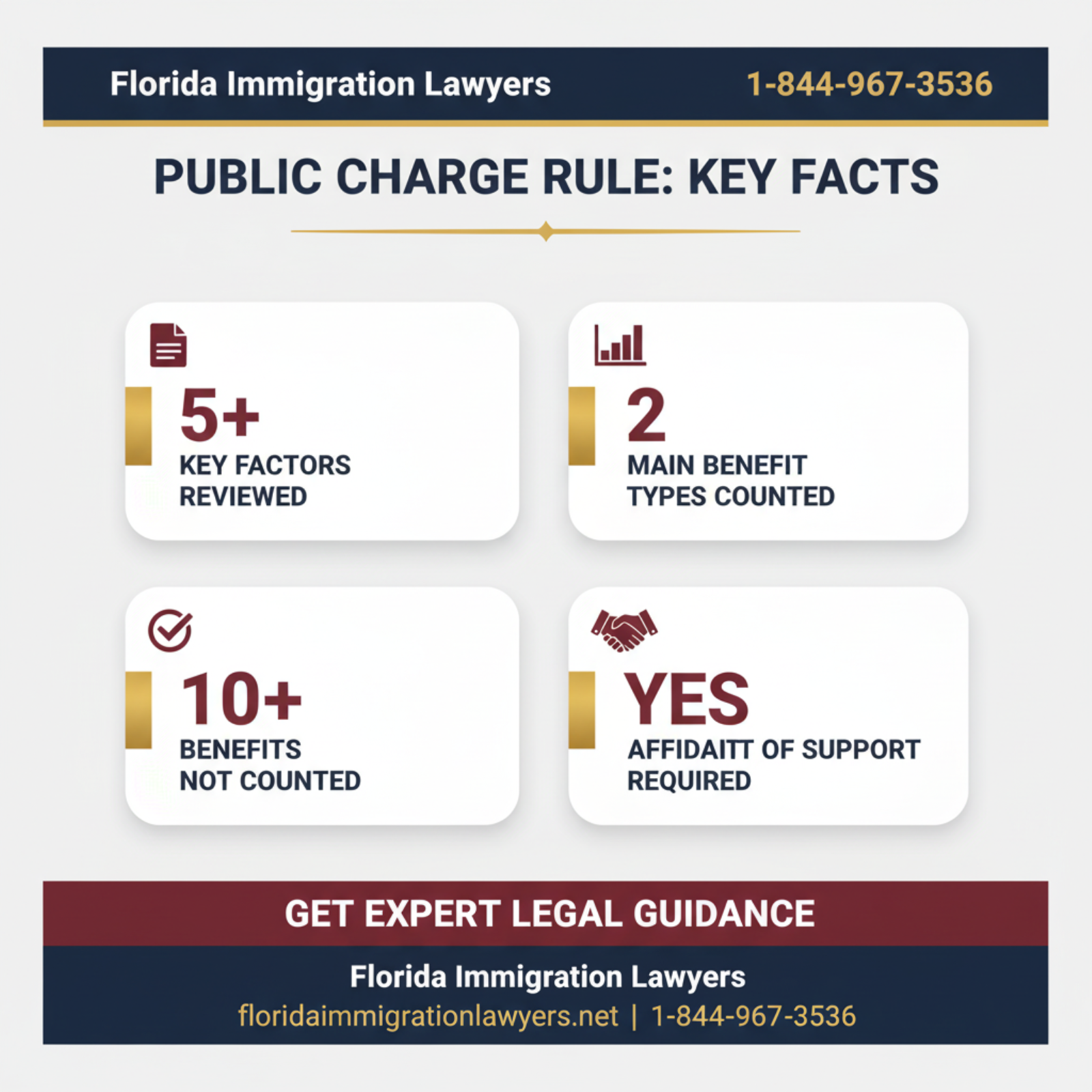
When assessing whether you are likely to become a public charge, USCIS considers a range of factors under the "totality of the circumstances" test. These factors include:
- Age: Your age can indicate your ability to work and support yourself.
- Health: Any medical conditions that might require extensive public care.
- Family Status: The size of your household and the number of dependents.
- Assets, Resources, and Financial Status: Your income, savings, property, and any debts. This is a critical component for demonstrating self-sufficiency.
- Education and Skills: Your educational background and job skills, which indicate your earning potential.
- Affidavit of Support (Form I-864): For many family-based immigrants, a U.S. citizen or lawful permanent resident must file an Affidavit of Support, promising to financially support the immigrant. This is a crucial factor in overcoming public charge concerns.
USCIS officers will weigh all these factors together to make a determination. No single factor is decisive on its own. For instance, being young and healthy with a strong education can offset concerns about limited current assets. Our experienced Florida immigration attorneys can help you present the strongest possible case.
What Benefits Are Considered Under the Public Charge Rule in Florida?
It is a common misconception that using any government benefit will trigger the public charge rule. This is not true. The current public charge rule, as implemented for 2026, specifically identifies a limited set of benefits that are considered in the determination of inadmissibility. Understanding these specific benefits is crucial for immigrants in Florida.
The benefits that are considered are:
- Supplemental Security Income (SSI): A federal program providing cash assistance to low-income individuals who are aged, blind, or disabled.
- Temporary Assistance for Needy Families (TANF): A federal program, often administered by states like Florida, that provides cash assistance to families with children.
- State, Tribal, Territorial, or Local Cash Assistance Programs for Income Maintenance: Any similar cash programs designed to help individuals or families meet basic needs.
- Long-Term Institutionalization at Government Expense: This refers to long-term care in a nursing home or other institution, paid for by the government.
It is important to note that the rule considers the receipt of these benefits by the applicant. In some cases, the receipt of these benefits by a dependent family member might also be considered, particularly if the applicant is the primary beneficiary or decision-maker for the family's finances.
Benefits NOT Considered Under the Public Charge Rule
Many essential and widely used public benefits are NOT considered for public charge purposes. This is a critical distinction that often alleviates significant concerns for immigrants. These include:
- Medicaid (except for long-term institutionalization): Routine medical care, including emergency services, doctor visits, and prescription drugs, is not counted. This also includes children's health insurance programs (CHIP).
- Supplemental Nutrition Assistance Program (SNAP) / Food Stamps: Food assistance programs are not considered.
- Housing Assistance: Programs like Section 8 or public housing are generally not counted.
- Special Supplemental Nutrition Program for Women, Infants, and Children (WIC): Nutritional support for pregnant women, new mothers, and young children is exempt.
- School Lunch Programs: Free or reduced-price school meals are not considered.
- Emergency Medical Care: Treatment for emergency conditions, even if publicly funded, is not counted.
- Disaster Relief: Assistance provided in response to natural disasters is exempt.
- Foster Care and Adoption Assistance: Benefits related to child welfare are not considered.
- Immunizations and Testing for Communicable Diseases: Public health services are exempt.
- Job Training Programs and Educational Assistance: Programs designed to enhance skills or provide education are not counted.
This extensive list of exempt benefits means that many Florida immigrants can access crucial support without jeopardizing their immigration applications. For example, using Medicaid for a child's check-up in Hollywood, Florida, generally will not make you a public charge.
Navigating the Public Charge Assessment: A Step-by-Step Guide for Florida Immigrants
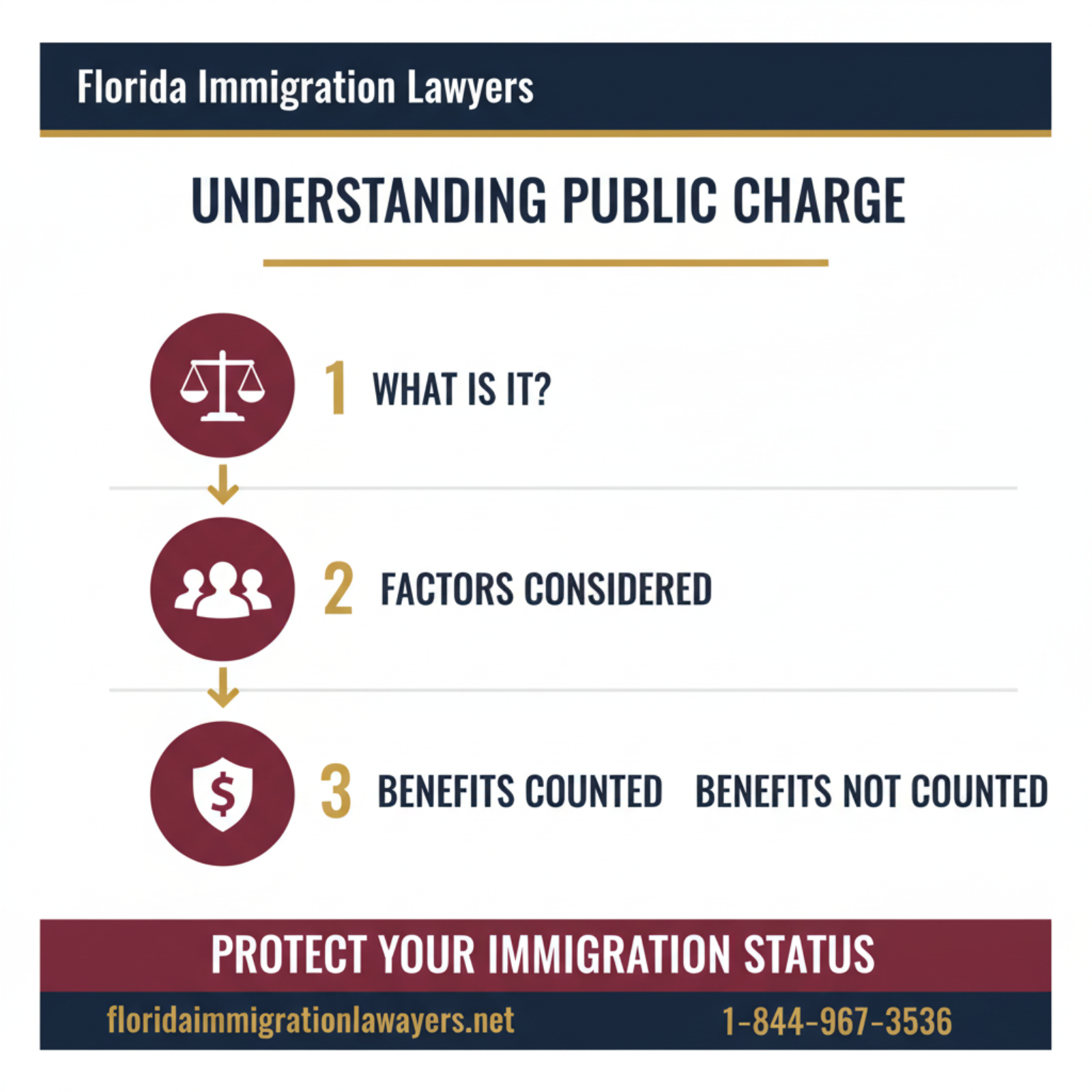
Successfully addressing the public charge rule requires careful preparation and attention to detail. Here is a step-by-step guide for Florida immigrants:
-
Understand Applicability to Your Case: First, determine if the public charge rule applies to your specific immigration pathway. Are you applying for a green card through family, employment, or another category? Confirm if you fall under any of the exemptions. Our firm, Florida Immigration Lawyers, can help you clarify this crucial initial step.
-
Gather Comprehensive Financial Documentation: Collect all documents that demonstrate your financial stability and resources. This includes recent pay stubs, federal income tax returns for the past three years, bank statements, property deeds, investment statements, and any other proof of assets. The more evidence you have of self-sufficiency, the stronger your case.
-
Review Your Public Benefit Usage History: Honestly assess whether you or your dependent family members have received any of the *considered* public benefits (SSI, TANF, state/local cash assistance, or long-term institutionalization). If you have, be prepared to explain the circumstances, duration, and amount. Remember, many benefits are exempt.
-
Prepare a Strong Affidavit of Support (Form I-864) If Required: If your application requires an Affidavit of Support, ensure your sponsor meets the income requirements (typically 125% of the Federal Poverty Guidelines) and provides all necessary documentation. A robust I-864 is often the cornerstone of overcoming public charge concerns for family-based cases. Our family immigration attorneys frequently assist with this complex form.
Step-by-Step Process Guide -
Address Potential Issues Proactively: If there are factors that might raise public charge concerns – for example, a period of unemployment, a health condition, or past use of considered benefits – prepare clear explanations and mitigating evidence. This could include proof of private health insurance, educational achievements, or job offers.
-
Consult an Experienced Immigration Attorney: The public charge rule is complex, and its application is highly fact-specific. An attorney can review your entire case, identify potential red flags, help you gather and organize documentation, and prepare you for interviews. This legal guidance is invaluable for ensuring your application is as strong as possible.
Essential Document Checklist for Public Charge Review
Preparing a thorough set of documents is critical for demonstrating that you are not likely to become a public charge. Here is a checklist of documents typically needed:
- Proof of Income and Employment:
- Recent pay stubs (last 6-12 months)
- Employment verification letters
- Federal income tax returns (Form 1040) for the past three years
- W-2 forms or 1099 forms
- Business licenses and tax returns (if self-employed)
- Proof of Assets and Resources:
- Bank statements (checking, savings, investment accounts)
- Property deeds or real estate appraisals
- Stocks, bonds, or other investment portfolios
- Retirement account statements
- Health Documentation:
- Proof of private health insurance coverage
- Medical records for any significant health conditions, demonstrating management and treatment plans
- Results of your immigration medical examination (Form I-693)
- Education and Skills Documentation:
- Diplomas, degrees, or certificates of vocational training
- Professional licenses or certifications
- Resumes or CVs highlighting work experience and skills
- Affidavit of Support (Form I-864) and Sponsor's Documents (if applicable):
- Completed and signed Form I-864
- Sponsor's federal income tax returns (past three years)
- Sponsor's employment verification letter and pay stubs
- Proof of sponsor's U.S. citizenship or lawful permanent residency
- Public Benefits Information (if any received):
- Documentation of any *considered* public benefits received (SSI, TANF, cash assistance, long-term institutionalization)
- Statements explaining the circumstances and duration of benefit receipt
Public Charge Timeline and Processing Expectations in 2026
There isn't a separate "public charge" timeline; rather, the assessment is integrated into the overall processing of your immigration application. For most Florida immigrants, this means it's part of the Form I-485 (Application to Register Permanent Residence or Adjust Status) process. The timeline for your application will depend on several factors, including the specific USCIS field office handling your case (e.g., Miami, Orlando, Tampa), the completeness of your application, and the current USCIS caseload.
USCIS processing times can fluctuate significantly. You can check the USCIS website for current estimates for your specific form and field office. Generally, a well-prepared application with all necessary documentation and a strong showing against public charge concerns tends to proceed more smoothly. Delays often occur due to Requests for Evidence (RFEs) or incomplete information, which is why meticulous preparation is key.
Cost Factors and Fee Breakdown for Immigration Applications
While there isn't a specific "public charge fee," there are several costs associated with the immigration application process that indirectly relate to demonstrating self-sufficiency. These include:
- USCIS Filing Fees: The primary costs are for the application forms themselves. For instance, the Form I-485 filing fee can be substantial. Other forms, like Form I-130 (Petition for Alien Relative) or biometrics fees, also apply. These fees are subject to change, so always check the latest USCIS fee schedule.
- Medical Examination Fees: All adjustment of status applicants must undergo a medical examination by a USCIS-approved civil surgeon. The cost of this exam varies by provider but is a mandatory expense.
- Legal Fees: Hiring an experienced immigration attorney, such as those at Florida Immigration Lawyers, is an investment in your future. While this is an additional cost, it significantly increases the likelihood of a successful application and can prevent costly mistakes or delays. Attorney fees vary based on the complexity of your case and the services required.
- Document Preparation and Translation Costs: If you need to obtain official documents or have them translated into English, there may be associated costs.
These costs are important to budget for as you plan your immigration journey in Florida. Demonstrating financial capability to cover these expenses can also implicitly support your case against public charge concerns.
Do not navigate this complex process alone. Contact Florida Immigration Lawyers today for expert guidance and support. We offer free consultations to help you understand your options and develop a strong legal strategy.
Common Mistakes to Avoid Regarding the Public Charge Rule
Immigrants in Florida often make critical errors when dealing with the public charge rule. Avoiding these common mistakes can significantly improve your chances of a successful application:
-
Misunderstanding the "Public Charge" Definition: Many applicants mistakenly believe that using any public benefit, such as SNAP or Medicaid, will automatically make them a public charge. This is incorrect. Only specific cash benefits and long-term institutionalization are considered. Incorrect assumptions can lead to unnecessary fear or withholding of crucial, exempt benefits.
-
Failing to Disclose Past Benefit Use: If you have received a "considered" public benefit, attempting to hide this information can be detrimental. Immigration applications require honesty and full disclosure. Non-disclosure can lead to findings of misrepresentation or fraud, which carry severe immigration consequences.
-
Inadequate Financial Documentation: Submitting insufficient proof of income, assets, or resources is a major pitfall. A lack of comprehensive financial records can make it difficult for USCIS to assess your self-sufficiency, potentially leading to a Request for Evidence (RFE) or denial. Gather all supporting documents diligently.
-
Weak or Incomplete Affidavit of Support (Form I-864): For family-based petitions, a poorly prepared or financially insufficient Affidavit of Support from your sponsor can be a deal-breaker. Ensure your sponsor meets the income threshold and provides all required documentation, including tax returns and employment verification. A deficient I-864 can result in significant delays.
-
Ignoring the "Totality of the Circumstances" Test: Focusing only on one negative factor (e.g., a brief period of unemployment) while ignoring strong positive factors (e.g., high education, job skills, significant assets) is a mistake. USCIS considers everything; present a balanced and complete picture of your situation.
-
Assuming Exemptions Apply When They Don't: Do not assume you are exempt from the public charge rule without verifying your specific immigration category. Incorrectly believing you are exempt can lead to an unprepared application and potential denial. Always confirm your status with an expert.
-
Not Updating USCIS on Changes in Circumstances: If your financial situation, health, or family status changes significantly during the application process, it is crucial to inform USCIS. Failure to provide updated information can lead to decisions based on outdated data, potentially harming your case.
-
Delaying Legal Consultation: Waiting until you receive an RFE or a denial notice to seek legal help is often too late. Proactive consultation with a Florida immigration lawyer can identify potential issues early and allow for strategic planning, preventing costly mistakes before they occur.
-
Relying on Outdated Information: Immigration law, especially the public charge rule, can change. Relying on information from several years ago or from unofficial sources can lead to critical errors. Always ensure you are using the most current USCIS policies and guidelines, especially for 2026 updates.
-
Not Preparing for the Interview: The immigration interview is where your public charge assessment will often be finalized. Failing to prepare for questions about your financial history, employment, and benefit usage can lead to miscommunication or an inability to present your case effectively.
When to Call Florida Immigration Lawyers for Public Charge Concerns
While this article provides general information, every immigration case is unique. The complexities of the public charge rule, especially with its historical changes and nuanced application, often require expert legal guidance. Our team at Florida Immigration Lawyers is here to help you through every step.
You should consider contacting an attorney if:
- You Have Received Public Benefits: If you or your dependent family members have received any of the "considered" public benefits, an attorney can help you assess the impact and prepare mitigating explanations.
- Your Sponsor's Income is Borderline: If your Affidavit of Support sponsor's income is close to the poverty guidelines, an attorney can advise on additional evidence or potential joint sponsors.
- You Have Health Concerns: Significant medical conditions, especially those requiring ongoing care, might raise questions. An attorney can help present medical records and health insurance information effectively.
- You Have a Complex Financial History: If your income is irregular, you have significant debts, or a complicated employment history, legal counsel can help organize and explain your financial situation clearly.
- You Are Unsure if the Rule Applies to You: It is crucial to confirm if your specific immigration category is subject to the public charge rule or if you are exempt.
- You Need Help Gathering Documentation: Our firm can assist you in identifying, collecting, and organizing all necessary financial, health, and educational documents.
- You Are Preparing for an Interview: We can prepare you for the types of questions you might face regarding your public charge assessment during your USCIS or consular interview.
- You Received a Request for Evidence (RFE): An RFE indicates that USCIS needs more information. Responding effectively to an RFE, especially one related to public charge, is critical and often requires legal expertise.
- You Have Questions About Broader Immigration Rights: While separate from public charge, questions like "Can ICE ask for immigration status in public?" or "Does local county jail have jurisdiction to charge an illegal immigrant?" are common concerns. Our attorneys can provide general guidance on your rights and direct you to relevant resources for these distinct legal issues.
Our dedicated attorneys specialize in various areas, including deportation defense, asylum claims, and citizenship applications. We are committed to protecting your rights and helping you achieve your immigration goals in Florida.
About Florida Immigration Lawyers
Florida Immigration Lawyers is a leading immigration law firm dedicated to serving individuals and families across the entire state of Florida. With years of experience and a deep understanding of U.S. immigration law, our compassionate and skilled attorneys are committed to providing exceptional legal representation.
We offer a comprehensive range of immigration services, including family-based petitions, employment visas, green card applications, naturalization, deportation defense, and humanitarian relief. Our firm prides itself on its client-centered approach, ensuring that you receive personalized attention and strategic advice tailored to your unique circumstances.
When you choose Florida Immigration Lawyers, you are choosing a team that is available 24/7 to address your urgent needs. We offer free consultations to discuss your case and provide clear insights into your options. Our attorneys are fluent in multiple languages, including Spanish, ensuring effective communication and culturally sensitive support. We serve all Florida communities, from Hollywood to Jacksonville, and are here to be your trusted legal partners on your immigration journey. Contact us today at 1-844-967-3536 or visit our website at https://www.floridaimmigrationlawyers.net.
Sources and References
- U.S. Citizenship and Immigration Services (USCIS) - INA Section 212(a)(4)
- U.S. Citizenship and Immigration Services (USCIS) Policy Manual, Volume 8, Part G - Public Charge
- Federal Register - Public Charge Ground of Inadmissibility Final Rule (8 CFR § 212.22)
- U.S. Citizenship and Immigration Services (USCIS) - Form I-864, Affidavit of Support
- U.S. Department of State - The Public Charge Rule
- 8 U.S.C. § 1182(a)(4) - Immigration and Nationality Act, Section 212(a)(4)
- 8 CFR § 212.22 - Public Charge Final Rule
This article provides general legal information and is not intended as legal advice. Every case is unique, and outcomes depend on specific facts and circumstances. Contact an attorney for advice about your particular situation. Immigration laws are subject to change, and this content reflects the policy as of 2026.
Your immigration journey in Florida deserves careful attention and expert legal support. The public charge rule does not have to be a barrier to your dreams. With the right guidance, you can navigate these complex requirements successfully.
For a free, confidential consultation about your public charge concerns and other immigration needs, contact Florida Immigration Lawyers today at 1-844-967-3536. Se Habla Español - Estamos aquí para ayudarle.
Frequently Asked Questions
Florida Immigration Lawyers
Legal Team
Our experienced attorneys at Florida Immigration Lawyers have been serving clients across Florida for over 20 years. We specialize in immigration, personal injury, criminal defense, workers compensation, and family law.