USCIS Processing Times Florida 2026: What to Expect in Naples
Navigating USCIS processing times in Florida for 2026 requires understanding various factors affecting wait times for different petitions. For residents of Naples and across Florida, applications like I-130, I-485, and N-400 can involve significant waiting periods. This guide provides an overview of expected timelines, a step-by-step application process, and essential documentation. We also highlight common mistakes to avoid and when it is crucial to seek legal counsel. Florida Immigration Lawyers offers expert guidance to help you navigate these complexities, ensuring your application is handled with precision and care. Get a free consultation to discuss your specific immigration needs.
USCIS processing times in Florida for 2026 are subject to various factors including caseloads, form type, and specific USCIS field office. While exact predictions are difficult, applicants in Naples and across Florida can expect general timelines for common petitions like I-130, I-485, and N-400 to range from several months to a few years. It is crucial to monitor the official USCIS website for the most current data.
- Processing times vary by form type and service center.
- Expect potential fluctuations due to demand and resources.
- Official USCIS tools provide estimated timelines.
- Legal guidance can help navigate complex cases.
- Proactive application management is essential.
USCIS Processing Times Florida 2026: What to Expect in Naples
Waiting for an immigration decision can be one of the most stressful periods in your life. The uncertainty surrounding USCIS processing times often adds to this anxiety. If you are in Florida, particularly in Naples or the surrounding areas, understanding these timelines is crucial for planning your future.
At Florida Immigration Lawyers, we understand the profound impact that these wait times have on individuals and families. This comprehensive guide will explain what you can generally expect regarding USCIS processing times Florida 2026, offering insights into various petitions and helpful strategies.
Navigating the complexities of immigration law requires precision and patience. We are here to support you every step of the way. Call Florida Immigration Lawyers at 1-844-967-3536 for a free consultation today. Our experienced team is ready to help you understand your options and manage your expectations.
Understanding USCIS Processing Times Florida 2026
USCIS processing times refer to the period it takes for U.S. Citizenship and Immigration Services to process an application or petition from the date it is received until a decision is made. These times are not static; they fluctuate based on numerous factors.
Several elements influence how long your case might take. These include the specific type of form filed, the volume of applications received by USCIS, staffing levels, the complexity of your individual case, and the particular service center or field office handling your petition. For residents of Naples, your local field office or designated service center will play a significant role.
Is USCIS going to speed up in 2026? While USCIS continuously works to improve efficiency, it is challenging to predict a universal speed-up. Processing times are often influenced by legislative changes, budget allocations, and global events. USCIS aims for efficiency, but applicants should prepare for realistic timelines rather than expecting drastic accelerations.
The agency’s commitment to reducing backlogs is ongoing. However, high demand for immigration benefits, especially in populous states like Florida, often means that wait times remain substantial. Understanding these dynamics is the first step in managing your expectations.
For petitions like the I-130, Petition for Alien Relative, USCIS must determine eligibility based on the relationship. This process is governed by laws such as the Immigration and Nationality Act (INA) Section 204, codified at 8 U.S.C. § 1154. Our firm specializes in general immigration matters and can provide clarity on your specific situation.
Navigating the USCIS Application Process: A Step-by-Step Guide
The immigration process can seem daunting, but breaking it down into manageable steps can help. This general guide outlines the typical stages of a USCIS application, providing a framework for what to expect in Florida.
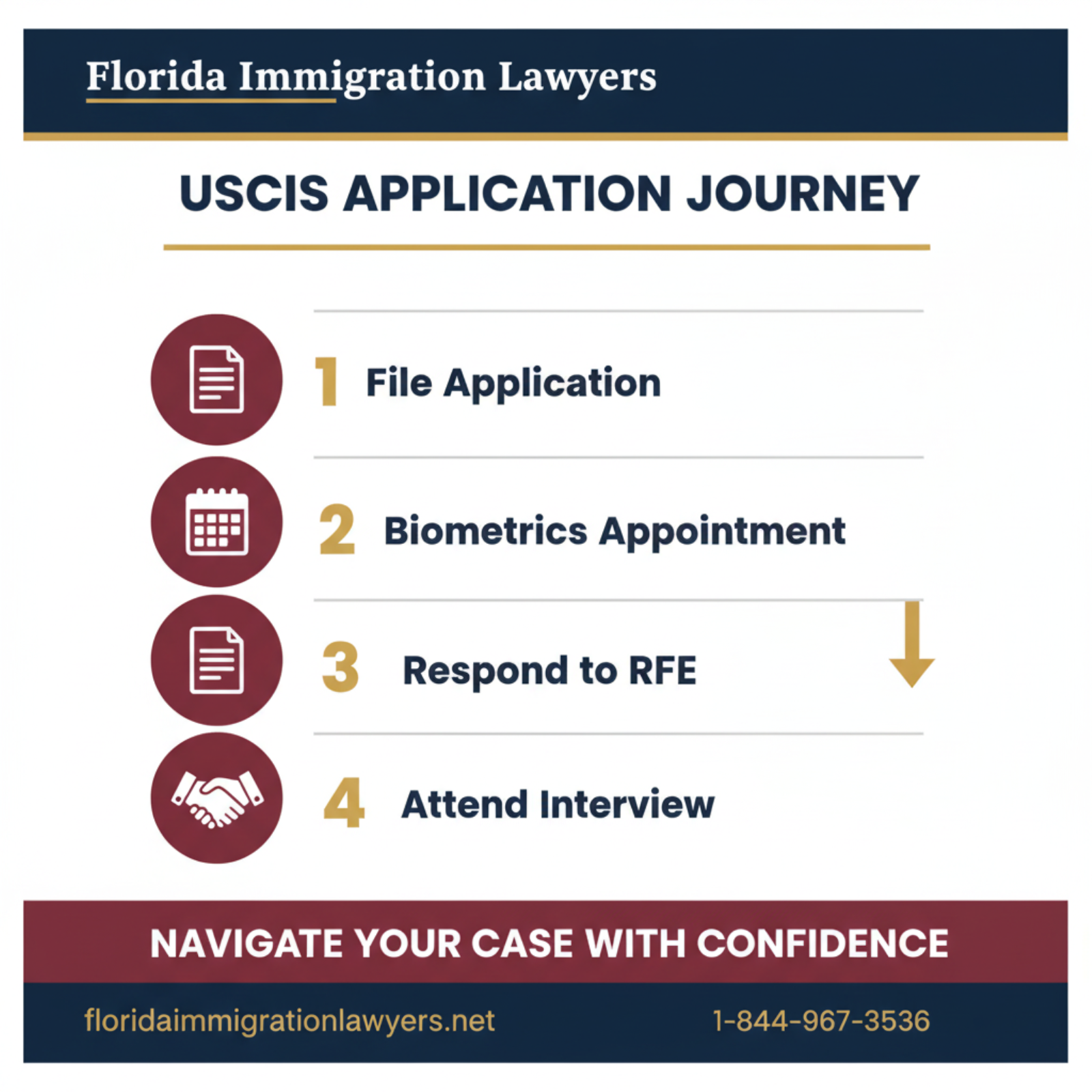
- Determine Eligibility and Select the Correct Form: Before filing, ensure you meet all eligibility criteria for the specific immigration benefit you seek. This involves a thorough review of your personal circumstances and immigration history. Choosing the right form, such as an I-130 for family petitions or an N-400 for naturalization, is critical.
- Gather All Required Documents: Compile all necessary supporting evidence. This often includes identity documents, birth certificates, marriage certificates, financial records, and police clearances. Missing documents are a primary cause of delays, so meticulous preparation is key.
- Complete and File the Application/Petition: Fill out the chosen USCIS form accurately and completely. Attach all supporting documents and pay the required filing fees. You can find official forms and fee information on the USCIS website. Make copies of everything you submit for your records.
- Receive Receipt Notice and Attend Biometrics Appointment: Once USCIS receives your application, you will get a receipt notice (Form I-797C). Shortly after, you will likely receive an appointment notice for biometrics, which involves fingerprinting, photographs, and a signature. This appointment is mandatory for most applications.
- Attend Interview (If Applicable): Many applications, especially for adjustment of status (Green Card) or naturalization, require an interview at a local USCIS field office. For Naples residents, this may be the USCIS Miami or Tampa Field Office, depending on jurisdiction. Prepare thoroughly for your interview, bringing all original documents.
- Receive Decision: After the interview, or once all evidence is reviewed, USCIS will issue a decision. This could be an approval, a request for additional evidence (RFE), or a denial. An approval means your immigration benefit has been granted.
Each step requires careful attention to detail. Any misstep can lead to delays or even denial. Our family immigration lawyers can guide you through each stage, ensuring accuracy and compliance.
Essential Documents for Your Immigration Petition
The success of your immigration application heavily relies on the completeness and accuracy of your supporting documentation. While specific requirements vary by form, certain documents are almost universally needed. Always provide certified translations for any non-English documents.
- Proof of Identity and Nationality: Valid passports, birth certificates, national identity cards.
- Proof of Lawful Status (if applicable): I-94 arrival/departure record, previous visa stamps, Green Card (if adjusting status).
- Relationship Evidence (for family-based petitions): Marriage certificates, birth certificates of children, divorce decrees, shared financial documents, photos, affidavits from third parties.
- Financial Documentation: Tax returns, W-2s, employment letters, bank statements, Form I-864 Affidavit of Support (for many family-based cases).
- Medical Examination Report: Form I-693, completed by a USCIS-approved civil surgeon.
- Police Clearances and Court Records: For any arrests or convictions, even if expunged.
- Photographs: Passport-style photographs meeting USCIS specifications.
- Completed USCIS Forms: The primary application form (e.g., I-130, I-485, N-400) and any supplementary forms.
Organizing these documents systematically can prevent common errors. We recommend keeping multiple copies of everything you submit. This meticulous approach is key to a smoother process and avoiding requests for further evidence (RFEs).
USCIS Processing Times Florida 2026: What to Expect for Key Petitions
Understanding specific processing times is often the most pressing concern for applicants. While 2026 predictions remain estimates, we can discuss general ranges based on historical data and current trends for common applications relevant to Florida residents, including those in Naples.
To check USCIS case processing times, always refer to the official USCIS processing times tool. This tool provides the most up-to-date estimates by form type and field office or service center. Remember that these are averages, and your case may take more or less time.
I-130 Petitions: Family Reunification in Florida
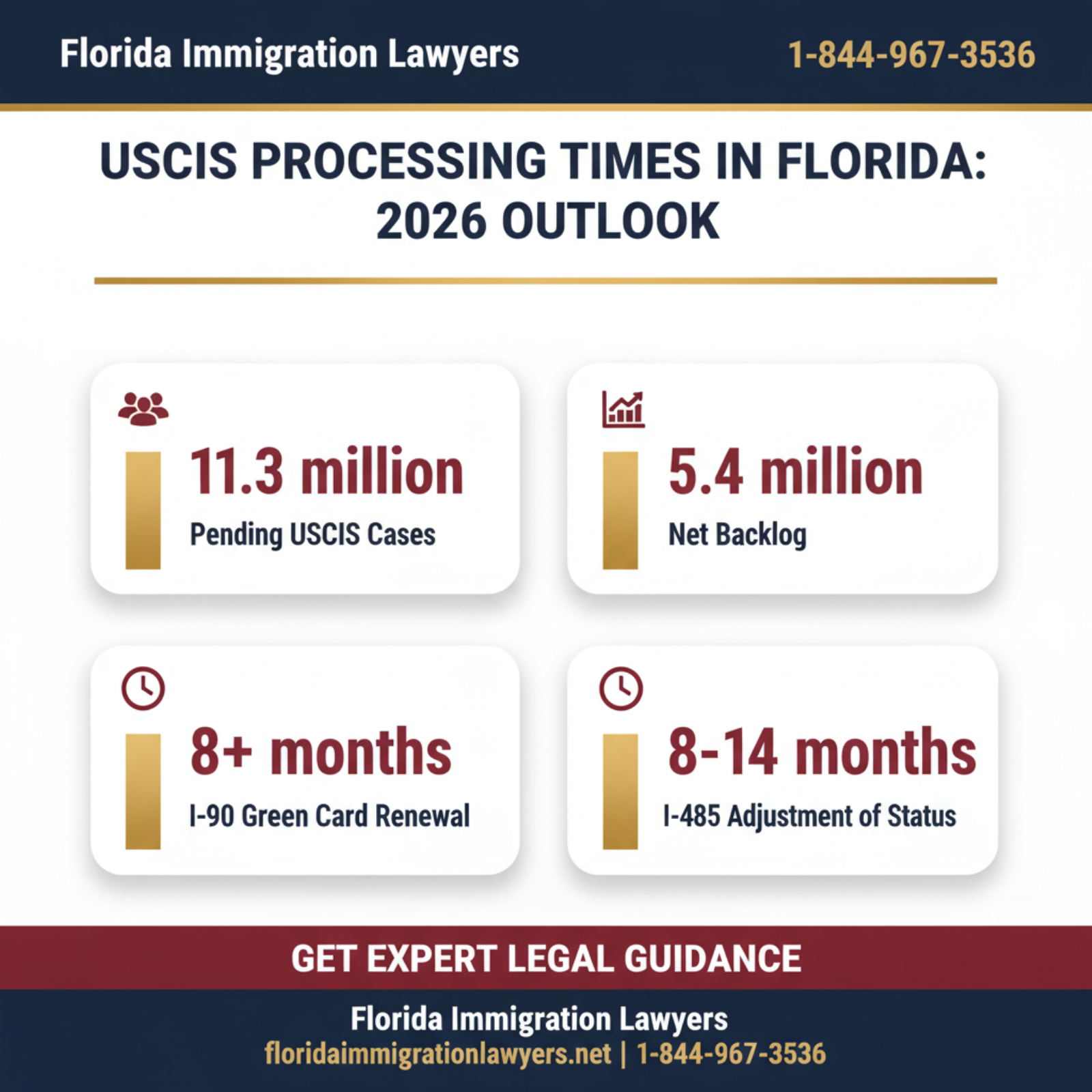
What is the processing time for I-130 in 2026? For many family-based petitions, especially those for immediate relatives (spouses, minor children, parents of U.S. citizens), the I-130 processing time for spouse 2026 can range from 6 to 24 months. This varies significantly based on the service center. For preference categories (e.g., adult children, siblings), the wait can be much longer due to annual visa limits set by the Visa Bulletin from travel.state.gov.
What is the processing time for I-130 in Florida? While there isn't a specific 'Florida' processing time, your petition will be processed by one of the USCIS service centers (e.g., California, Nebraska, Texas, Vermont). The specific service center assigned depends on where you reside and the form type. For example, an I-130 filed by a Florida resident might go to the Nebraska Service Center. Always check the USCIS website for the most accurate current data for your specific service center.
Adjustment of Status (I-485) Timelines
The Green Card processing time USCIS for Adjustment of Status (Form I-485) can be highly variable. For immediate relatives of U.S. citizens who are already in the U.S., processing can take anywhere from 8 to 24 months or more. Employment-based I-485s can also have similar or longer timelines, depending on visa availability and priority dates.
The local USCIS field office, such as those serving Southwest Florida, plays a significant role in I-485 processing, as interviews often occur there. Factors like the complexity of your background, the need for RFEs, and interview scheduling can all impact the overall timeline.
Naturalization (N-400) for Florida Residents
How long is the wait for naturalization in Florida? For Form N-400, Application for Naturalization, residents of Florida, including Naples, can typically expect processing times ranging from 6 to 18 months. This includes the biometrics appointment, interview, and oath ceremony. The specific USCIS field office (e.g., Miami, Tampa, Orlando) where your interview is scheduled largely dictates the timeline.
Eligibility for naturalization requires meeting specific criteria, including continuous residence and physical presence in the U.S., good moral character, and an understanding of U.S. history and government. These requirements are outlined in INA Section 316 (8 U.S.C. § 1427). Delays can occur if there are issues with your background check or if additional documentation is required to prove your eligibility.
Cost Factors and Fee Breakdown for USCIS Applications
Understanding the financial aspect of your immigration journey is as important as knowing the processing times. USCIS fees are subject to change, so always verify the latest amounts directly on the USCIS website or consult with an attorney. These fees are regulated by 8 CFR § 103.7.
- USCIS Filing Fees: Each form has an associated filing fee. For example, an I-130, I-485, or N-400 each have separate fees. These fees are non-refundable, even if your application is denied.
- Biometrics Services Fee: Most applications require a separate biometrics fee, which covers fingerprinting and background checks. This fee is often combined with the main filing fee for certain forms.
- Medical Examination Fee: For adjustment of status applications, you must undergo a medical examination by a USCIS-approved civil surgeon. The cost of this exam is paid directly to the doctor and varies.
- Attorney Fees: While not mandatory, retaining an experienced immigration attorney can be invaluable. Our fees cover legal advice, document preparation, representation, and communication with USCIS.
- Translation Fees: If any of your supporting documents are not in English, you will need to pay for certified translations.
USCIS does offer fee waivers for certain forms for individuals who can demonstrate an inability to pay. Eligibility for fee waivers is strict and requires specific documentation. Discussing your financial situation with an attorney can help determine if you qualify.
Do not navigate this process alone. The financial and legal complexities of immigration can be overwhelming. Contact Florida Immigration Lawyers today to discuss your case and understand the full scope of costs involved. We are committed to providing transparent and effective legal representation.
Common Mistakes to Avoid in Your Immigration Journey
Making mistakes on your immigration application can lead to significant delays, requests for evidence, interviews, or even denial. Avoid these common pitfalls to ensure a smoother process.
- Incomplete or Inaccurate Forms: Failing to answer all questions or providing incorrect information is a frequent issue. Consequences: Delays, RFEs, or outright rejection.
- Missing Supporting Documentation: Not submitting all required evidence as specified by USCIS. Consequences: RFEs, leading to significant delays while you gather and submit additional proof.
- Failing to Disclose Criminal History: Omitting any arrests, charges, or convictions, even minor ones or those expunged. Consequences: Accusations of misrepresentation, denial, or even deportation proceedings.
- Missing Deadlines: Not responding to RFEs or interview notices by the specified date. Consequences: Abandonment of your application or denial.
- Not Updating Your Address: Failing to inform USCIS of any change of address within 10 days. Consequences: Missing important notices, leading to delays or missed appointments.
- Submitting Uncertified Translations: Providing documents in a foreign language without a proper certified English translation. Consequences: Rejection of documents and delays.
- Not Keeping Copies of Everything: Discarding or failing to make copies of your submitted application and supporting documents. Consequences: Inability to reference your application during interviews or to respond to RFEs effectively.
- Using Outdated Forms: Submitting an older version of a USCIS form when a newer one is required. Consequences: Rejection of your application.
- Assuming Eligibility: Not thoroughly reviewing eligibility criteria before applying. Consequences: Wasted time and money on an application that will be denied.
- Ignoring Public Charge Rule Changes: Not understanding how current public charge rules might affect your eligibility for a Green Card. Consequences: Denial if deemed likely to become a public charge.
- Misrepresenting Facts: Intentionally providing false information or documents. Consequences: Permanent bars to immigration benefits and criminal penalties.
When to Call Florida Immigration Lawyers
While some immigration processes appear straightforward, many situations benefit immensely from professional legal guidance. Knowing when to seek help from Florida Immigration Lawyers can save you time, money, and emotional distress.
Consider contacting us if you encounter any of these scenarios:
- Complex Case History: If you have previous immigration violations, criminal history, or a prior denial.
- Requests for Evidence (RFEs) or Notices of Intent to Deny (NOIDs): These indicate USCIS has concerns about your application, and a detailed legal response is crucial.
- Longer-Than-Expected Processing Times: If your case falls significantly outside the posted USCIS processing times, we can help inquire about the status.
- Asylum or Refugee Claims: These are highly complex and sensitive cases requiring specialized legal expertise. Our asylum attorneys are ready to assist.
- Deportation or Removal Proceedings: If you or a loved one is facing deportation defense, immediate legal intervention is critical.
- Uncertainty About Eligibility: Before filing, we can help you determine the best path forward and assess your eligibility for various benefits.
- Business or Employment-Based Immigration: These cases often involve intricate regulations and substantial documentation. Learn more about our business immigration services.
- Changes in Law or Policy: Immigration laws are constantly evolving. An attorney stays updated on the latest changes that might affect your case.
Our experienced attorneys at Florida Immigration Lawyers are dedicated to protecting your rights and helping you achieve your immigration goals. We offer personalized attention and strategic advice tailored to your unique situation. We serve clients across all of Florida, including Naples and Southwest Florida.
About Florida Immigration Lawyers
Florida Immigration Lawyers is a premier law firm dedicated to providing exceptional legal representation to immigrants across the Sunshine State. With a deep understanding of U.S. immigration law and a compassionate approach, we stand ready to assist individuals, families, and businesses navigate the often-complex immigration system.
Our comprehensive services cover a wide range of immigration matters, including family-based visas, employment-based visas, adjustment of status, naturalization, asylum, deportation defense, and more. We pride ourselves on offering personalized strategies and diligent advocacy for every client, from initial consultation to the final resolution of their case.
Why choose us? Our firm is built on a foundation of trust, expertise, and unwavering commitment to our clients' success. We understand the challenges and aspirations of immigrants because we are passionate about helping you achieve your American dream. Our bilingual team ensures clear communication and cultural understanding, making your legal journey as smooth as possible.
We are available 24/7 to address your urgent needs and offer free consultations to help you understand your options without financial commitment. Serving all of Florida, including Naples, Miami, Orlando, and Jacksonville, Florida Immigration Lawyers is your trusted partner in immigration. Contact us today.
Sources and References
- U.S. Citizenship and Immigration Services (USCIS)
- USCIS Forms
- USCIS Check Case Processing Times
- U.S. Department of State - Visa Bulletin
- Executive Office for Immigration Review (EOIR)
- 8 U.S.C. Chapter 12 - Immigration and Nationality Act (INA)
- INA Section 204 (8 U.S.C. § 1154) - Petition for Alien Relative
- INA Section 316 (8 U.S.C. § 1427) - Requirements for Naturalization
- 8 CFR § 103.7 - Fees for immigration benefits
This article provides general legal information and is not intended as legal advice. Every case is unique, and outcomes depend on specific facts and circumstances. Contact an attorney for advice about your particular situation.
Do not let the complexities of USCIS processing times in Florida overwhelm you. Our dedicated team is here to provide the clarity and support you need. Contact Florida Immigration Lawyers for a free consultation at 1-844-967-3536. Se Habla Español - Estamos aquí para ayudarle.
Frequently Asked Questions
Florida Immigration Lawyers
Legal Team
Our experienced attorneys at Florida Immigration Lawyers have been serving clients across Florida for over 20 years. We specialize in immigration, personal injury, criminal defense, workers compensation, and family law.