Parole in Place for Military Families Miami Guide 2026
Parole in Place (PIP) offers a vital path to lawful presence and green card eligibility for undocumented spouses, parents, and children of U.S. military members and veterans. This comprehensive guide details the eligibility requirements, the step-by-step application process, necessary documents, and typical timelines for military families in Miami and across Florida in 2026. Understanding PIP can prevent deportation and unite families who have sacrificed so much for our nation. Learn about common mistakes to avoid and when to seek expert legal counsel to navigate this complex immigration relief. Florida Immigration Lawyers is dedicated to assisting military families throughout Florida with free consultations.

Quick Answer: Parole in Place for Military Families
Parole in Place (PIP) is a critical humanitarian immigration relief available to certain undocumented family members of U.S. service members and veterans. It grants temporary lawful presence in the United States, protecting individuals from deportation and allowing them to apply for adjustment of status to become lawful permanent residents without leaving the country. This process is a lifeline for many military families in Florida, providing stability and peace of mind.
- Eligibility: Undocumented spouses, parents, or children of active duty, reserve, National Guard personnel, or veterans.
- Application: Involves filing Form I-131, Application for Travel Document, with supporting evidence to USCIS.
- Benefit: Grants lawful presence, which can enable adjustment of status to a green card.
- Legal Help: Strongly recommended due to the complexity and potential for severe consequences if mistakes are made.
Parole in Place for Military Families Miami Guide 2026
For military families in Florida, the challenges of immigration status can be particularly stressful. Imagine dedicating your life to serving the United States, only to worry constantly about the immigration status of a beloved spouse, child, or parent. Many service members and veterans face this difficult reality, with family members living in the U.S. without legal status. Fortunately, a vital immigration program known as Parole in Place offers a pathway to stability and lawful permanent residency for these deserving families.
Parole in Place (PIP) provides a humanitarian relief that can transform the lives of undocumented family members of U.S. military personnel. It allows these individuals to obtain a temporary lawful presence in the U.S., which is often a prerequisite for applying for a green card without having to leave the country. This guide is designed to help military families in Miami, Tampa, and across Florida understand the complexities of PIP, its eligibility requirements, the application process, and what to expect in 2026.
Understanding Parole in Place is crucial for securing your family's future. The process can be intricate, and even minor errors can lead to significant delays or denials. If you are a military family in Florida navigating these waters, do not hesitate to seek expert legal guidance. Call Florida Immigration Lawyers at 1-844-967-3536 for a free consultation to discuss your specific situation and explore your options.
What is Parole in Place for Military Families in Florida?
As of 2026, Parole in Place (PIP) is an discretionary immigration remedy authorized by the U.S. Citizenship and Immigration Services (USCIS) under Section 212(d)(5) of the Immigration and Nationality Act (INA). It allows certain foreign nationals who are already physically present in the United States without inspection or admission to be 'paroled' into the country. For military families, this means an undocumented spouse, parent, or child of a U.S. service member or veteran can gain lawful presence, making them eligible to apply for adjustment of status to a lawful permanent resident (green card holder) without leaving the U.S. This prevents the need for a provisional waiver and consular processing abroad, which can trigger a 3-year or 10-year bar to re-entry.
The primary purpose of PIP is to keep military families together and alleviate the unique hardships faced by those who serve our nation. When a foreign national is granted parole, they are considered to have been 'inspected and admitted,' thereby overcoming a critical hurdle in the adjustment of status process. This relief is particularly vital for families in Florida, where a significant military presence means many service members and veterans are impacted by complex immigration issues. PIP offers a path to stability, allowing families to build their lives without the constant fear of separation or deportation.
It is important to understand that Parole in Place is not an immigration status itself, but rather a temporary authorization to remain in the U.S. and a prerequisite for other immigration benefits. Once granted, the individual receives an I-94 Arrival/Departure Record, which serves as proof of their lawful presence. This document is essential for the next step, which is often filing Form I-485, Application to Register Permanent Residence or Adjust Status. The discretion involved in granting PIP means that each case is evaluated individually, emphasizing the need for a meticulously prepared application.
Who is Eligible for Parole in Place in Florida in 2026?
To be eligible for Parole in Place in Florida as of 2026, applicants must meet specific criteria related to their relationship with a qualifying U.S. service member or veteran. The core requirement is that the applicant must be the spouse, parent, or child (unmarried and under 21) of an individual who is currently serving in the U.S. armed forces (active duty, Selected Reserve, or Ready Reserve), or who previously served in the U.S. armed forces and received an honorable discharge. This provision extends to qualifying veterans, acknowledging their service to the nation.
The service member or veteran must be a U.S. citizen. The applicant must also be physically present in the United States at the time of filing. A crucial aspect of eligibility is demonstrating good moral character. USCIS will review the applicant's background, including any criminal history, immigration violations, and other relevant factors. Certain derogatory information, such as serious criminal convictions, can disqualify an applicant. Even minor infractions should be disclosed and properly addressed with legal counsel.
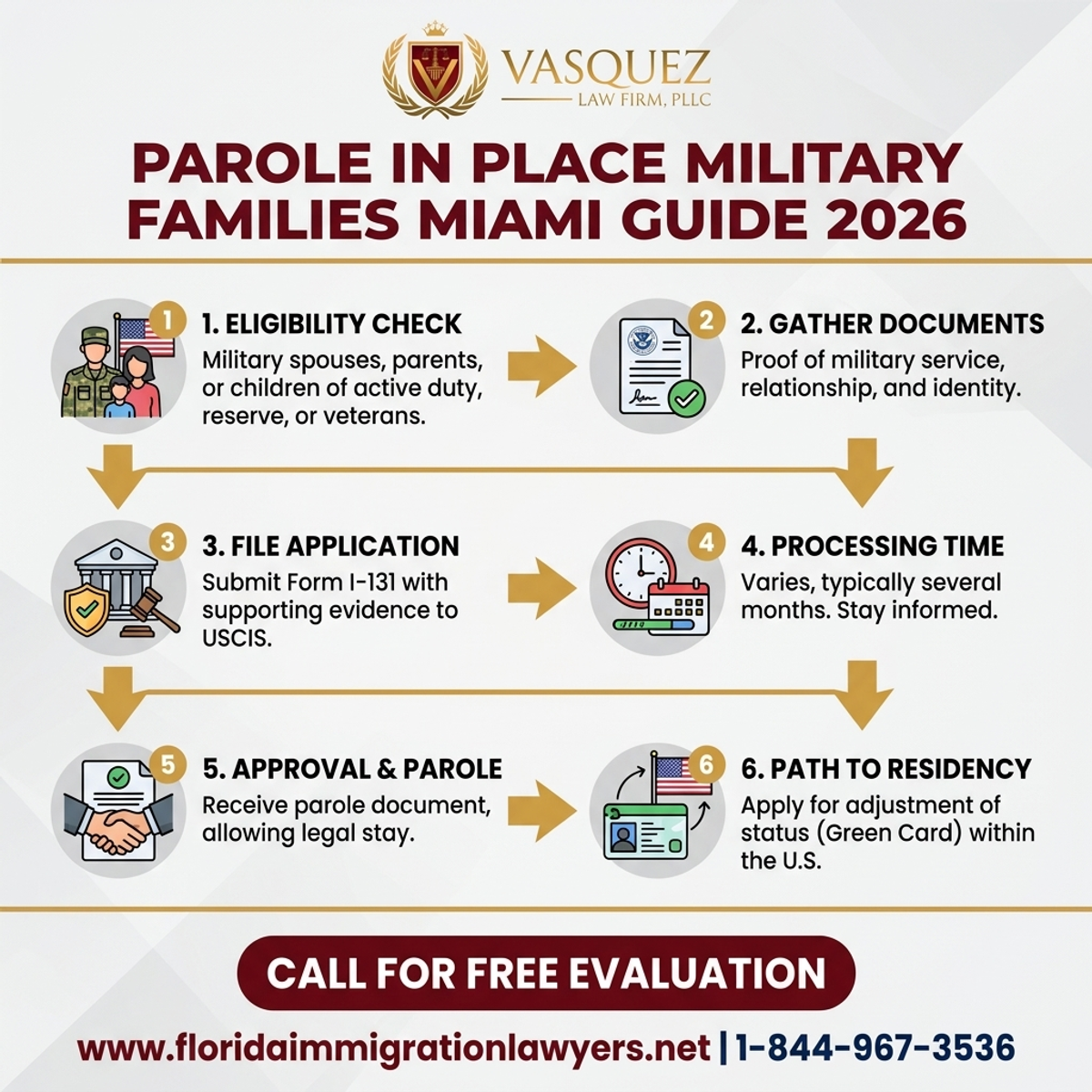
Step-by-Step Process — Parole in Place for Military Families Miami Guide 2026
For families residing in Florida, such as those in the Tampa Bay area near MacDill Air Force Base or in Miami with its large veteran population, understanding these specific criteria is paramount. It is not enough to simply be related to a service member; the relationship must fit the defined categories. For instance, a sibling of a service member would not typically qualify for PIP. Furthermore, the service member or veteran must provide a letter from their commanding officer or a copy of their Certificate of Release or Discharge from Active Duty (DD Form 214) to prove their service and status. Learn more about family-based immigration options on our Family Immigration page.
How to Apply for Parole in Place: A Step-by-Step Guide
Applying for Parole in Place involves submitting a comprehensive application package to USCIS. The primary form for this process is Form I-131, Application for Travel Document, even though PIP does not involve travel. This form is used to request the discretionary grant of parole. A well-prepared application is essential for a favorable outcome, especially for military families in Florida seeking this vital relief. The steps below outline the general process for 2026:
- Gather Necessary Documents: Collect all required evidence, including proof of relationship, military service, identity, and good moral character. This is the most time-consuming but critical step. Ensure all documents are current and accurately reflect your situation.
- Complete Form I-131: Fill out Form I-131 carefully. Although it is titled 'Application for Travel Document,' it is correctly used for PIP requests. Indicate in Part 2, Question 1.d. 'Parole,' and clearly state 'Parole in Place' in Part 2, Question 3.
- Prepare Supporting Evidence: This includes a letter from the service member/veteran's commanding officer or DD Form 214, proof of the qualifying relationship (marriage certificate, birth certificates), applicant's identity documents (passport, birth certificate), proof of physical presence in the U.S., and evidence of good moral character (e.g., police clearances, affidavits).
- Draft a Cover Letter: A detailed cover letter explaining the request for Parole in Place, outlining eligibility, and listing all enclosed documents can be very helpful for USCIS adjudicators. This letter should highlight the humanitarian reasons for the request.
- File the Application: Mail the complete application package to the appropriate USCIS Lockbox facility. There is no filing fee for Form I-131 when requesting Parole in Place for military family members. Ensure you keep a copy of everything submitted for your records.
- Attend Biometrics Appointment: After filing, USCIS will send a notice for a biometrics appointment at an Application Support Center (ASC). This involves fingerprinting and photographing for background checks.
- Interview (Optional): While not always required, USCIS may request an interview to clarify information or address any concerns. If an interview is scheduled, preparing thoroughly with an attorney is vital.
- Receive Decision: USCIS will issue a decision. If approved, you will receive an I-94 document as proof of parole. This I-94 will typically be valid for one year.
For detailed instructions and the latest version of the form, always refer to the official USCIS website for Form I-131. Navigating this process, particularly for military families in metropolitan areas like Miami or Tampa, can be complex, and legal assistance is highly recommended to ensure all requirements are met and the application is as strong as possible.
Required Documents and Evidence for Your PIP Application
A successful Parole in Place application hinges on providing comprehensive and accurate documentation. USCIS requires specific evidence to confirm eligibility and to exercise its discretion favorably. For military families in Florida, meticulously gathering these documents is a critical step towards securing lawful presence. Incomplete applications are a leading cause of delays and denials.
The following is a list of key documents typically required for a Parole in Place application:
- Proof of Qualifying Relationship:
- Marriage Certificate for spouses.
- Birth Certificates for children (showing parent-child relationship).
- Birth Certificates for parents (showing child-parent relationship), along with the service member's birth certificate.
- Proof of Military Service:
- Letter from the appropriate military authority (e.g., commanding officer) confirming the service member's active duty status, Selected Reserve, or Ready Reserve status. This letter should also confirm the service member is a U.S. citizen.
- For veterans, a copy of the Certificate of Release or Discharge from Active Duty (DD Form 214) showing honorable service.
- Proof of Applicant's Identity and Nationality:
- Copy of passport biographic page.
- Copy of birth certificate.
- Any government-issued identification (e.g., foreign national ID, driver's license from Florida).
- Proof of Physical Presence in the U.S.:
- Utility bills, lease agreements, bank statements, school records, or other documents showing continuous physical presence.
Key Statistics — Parole in Place for Military Families Miami Guide 2026
- Evidence of Good Moral Character:
- Police clearance certificates from all places of residence in the U.S.
- Affidavits from reputable persons attesting to the applicant's good moral character.
- Court dispositions for any arrests or convictions, demonstrating rehabilitation or minor nature of offenses.
- Photos:
- Two passport-style photographs of the applicant.
- Form I-131:
- Completed and signed Form I-131, Application for Travel Document.
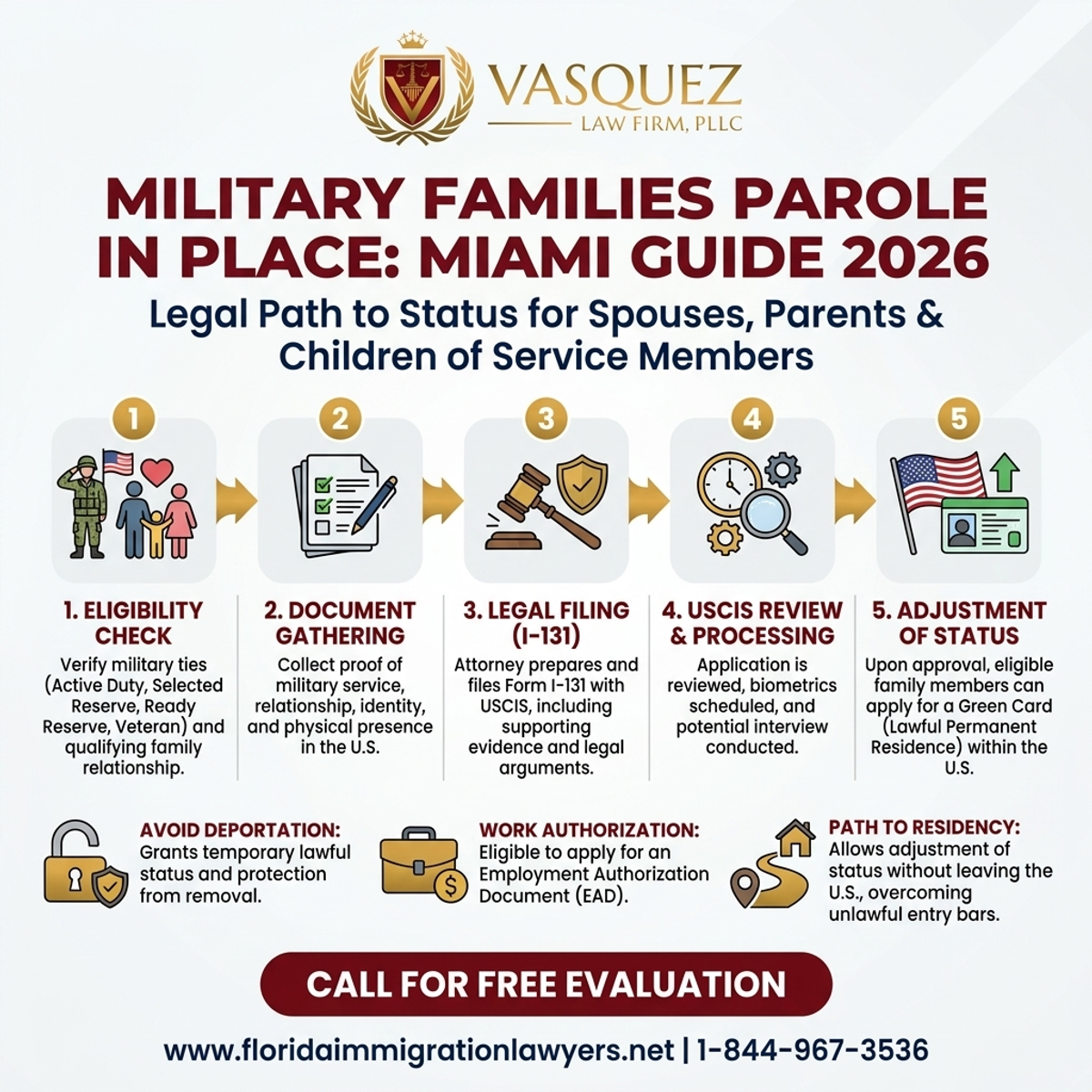
It is crucial to submit copies of all documents, not originals, unless specifically requested by USCIS. Any documents not in English must be accompanied by a certified English translation. For comprehensive guidance on preparing your application, our Immigration Services page provides further insights into general immigration requirements.
What is the Typical Timeline for Parole in Place Applications in 2026?
As of 2026, the typical timeline for Parole in Place applications can vary significantly, depending on factors such as the specific USCIS service center processing the application, the completeness of the submission, and the volume of cases. While there is no guaranteed timeframe, applicants in Florida can generally expect the process to take several months from submission to decision. It is important to manage expectations and prepare for potential delays.
Here is a general overview of the expected stages and typical timeframes:
| Stage | Typical Timeframe | Notes |
|---|---|---|
| Application Preparation | 2-4 weeks | Gathering documents, completing forms, writing cover letter. Can vary based on document availability. |
| USCIS Receipt Notice | 1-3 weeks after filing | Confirmation that USCIS has received your application (Form I-131). |
| Biometrics Appointment | 3-8 weeks after receipt notice | Scheduled at an Application Support Center (ASC) near your Florida residence, e.g., Miami, Orlando, or Tampa. |
| Case Review & Decision | 3-9 months after biometrics | USCIS reviews all evidence. May involve a Request for Evidence (RFE) or an interview, which adds time. |
| Total Estimated Time | 6-12 months | This is an average. Some cases may be faster, others may take longer, especially if complex issues arise. |
It is vital for military families in Florida to regularly check their case status online using the receipt number provided by USCIS. While awaiting a decision, it is generally not advisable to travel outside the U.S. without consulting an immigration attorney, as this could jeopardize your application. Delays can occur due to various reasons, including incomplete applications, requests for additional evidence, or administrative backlogs at USCIS. Consulting with an attorney from Florida Immigration Lawyers can help you understand the most current processing times and prepare for potential delays. For immediate assistance, contact us today.
Understanding the Costs of Parole in Place and Adjustment of Status
When considering Parole in Place, military families in Florida must understand the financial aspects involved, both for the PIP application itself and the subsequent adjustment of status to a green card. While the initial Parole in Place application (Form I-131) for military families does not typically incur a filing fee, there are other costs associated with the overall immigration process that applicants should budget for.
Here is a breakdown of typical costs you might encounter:
| Item | Typical Fee (as of 2026) | Notes |
|---|---|---|
| Form I-131 (Parole in Place) | $0 | No USCIS filing fee for military family PIP requests. |
| Form I-485 (Adjustment of Status) | Variable (e.g., $1,225) | This fee is for the green card application filed after PIP approval. Includes biometric services fee. Fee waivers may be available for eligible low-income applicants. |
| Form I-765 (Employment Authorization) | Included with I-485 | Filed concurrently with I-485, no separate fee if included in I-485 package. |
| Form I-130 (Petition for Alien Relative) | Variable (e.g., $535) | If not already filed by the U.S. citizen spouse/parent for the relative. |
| Medical Examination (Form I-693) | $200 - $500 | Required for adjustment of status, performed by a USCIS-approved civil surgeon. Costs vary by provider. |
| Translation Services | Variable | If any documents are not in English, certified translations are required. |
| Attorney Fees | Variable | Highly recommended for navigating the complex process. Fees vary based on case complexity and firm. |
While the initial PIP application does not have a USCIS fee, the subsequent steps to obtain a green card do. It is crucial to factor in these costs when planning your immigration journey. USCIS fees are subject to change, so always check the official USCIS website for current fee information. For military families in Florida, understanding and planning for these expenses, with the help of an experienced immigration attorney, can prevent unexpected financial burdens and ensure a smoother path to permanent residency.
Do not navigate this process alone. The complexities of immigration law, particularly for Parole in Place and subsequent adjustment of status, require experienced legal guidance. Contact Florida Immigration Lawyers today for a free consultation to ensure your family's future is protected.
Common Mistakes to Avoid in Parole in Place Applications
Applying for Parole in Place is a significant opportunity for military families, but the process is fraught with potential pitfalls. Avoiding common mistakes is crucial for a successful outcome. Here are some key errors to watch out for:
- Incomplete Application or Missing Documents: Submitting an application without all required forms or supporting evidence is a frequent mistake. USCIS will issue a Request for Evidence (RFE) or even deny the application, causing significant delays.
- Failure to Prove Qualifying Relationship: Not providing sufficient, clear evidence of the marital, parental, or child relationship with the service member/veteran can lead to denial. Ensure all certificates are official and translated if necessary.
- Inadequate Proof of Military Service: A vague or incomplete letter from a commanding officer, or an unverified DD Form 214 for veterans, will not suffice. The proof must explicitly state the service member's status and U.S. citizenship.
- Undisclosed Criminal History or Immigration Violations: Attempting to hide any past arrests, convictions, or prior immigration issues (like previous deportations or overstays) is a grave error. USCIS conducts thorough background checks, and misrepresentation can lead to permanent bars.
- Lapses in Good Moral Character: PIP is discretionary, and USCIS will deny applications if the applicant fails to demonstrate good moral character. This includes recent criminal activity, false statements, or certain immigration fraud.
- Not Filing Form I-131 Correctly: Using the wrong form or failing to specify 'Parole in Place' in the correct section can lead to confusion and rejection by USCIS.
- Failure to Update Address: Moving without notifying USCIS of a new address can result in missed notices, RFEs, or interview appointments, potentially leading to denial without the applicant's knowledge. This is especially critical in a state like Florida where people move frequently.
- Traveling Outside the U.S. Without Legal Advice: Leaving the U.S. after filing for PIP but before receiving approval or without proper advance parole can abandon your application or trigger re-entry bars.
- Not Seeking Legal Counsel: Navigating complex immigration laws without an experienced attorney significantly increases the risk of errors and missed opportunities. An attorney can help identify potential issues and strengthen your case. Visit our Attorneys page to learn about our legal team.
- Ignoring Deadlines: Failing to respond to RFEs or interview notices within the specified timeframe will almost certainly lead to a denial.
When to Call a Florida Immigration Lawyer for Parole in Place
While the concept of Parole in Place offers hope, the application process is far from straightforward. Even seemingly minor issues can derail an application, leading to stress, delays, and potentially devastating denials. It is highly advisable for military families in Florida to consult with an experienced immigration attorney at Florida Immigration Lawyers, especially in the following situations:
- Complex Eligibility Questions: If you are unsure whether your family member meets the specific criteria for PIP, particularly regarding the service member's status, the nature of the relationship, or the applicant's good moral character.
- Criminal History: Any past arrests, charges, or convictions, even minor ones, can significantly complicate your case. An attorney can assess the impact, advise on necessary documentation, and help mitigate potential issues.
- Previous Immigration Violations: If the applicant has prior deportations, removal orders, unlawful entries, or other immigration infractions, legal expertise is crucial to determine eligibility and address these concerns effectively.
- Previous Denials: If a previous PIP application or other immigration benefit was denied, an attorney can help understand the reasons for denial and strategize a stronger re-application.
- Difficulties Obtaining Documents: If you are struggling to obtain military records, birth certificates from foreign countries, or other crucial evidence, an attorney can guide you on alternative forms of proof.
- Requests for Evidence (RFEs): If USCIS sends an RFE, it means your initial application was incomplete or unclear. An attorney can help you respond comprehensively and accurately within the strict deadlines.
- Deportation Concerns: If your family member is currently in removal proceedings or has an outstanding deportation order, seeking immediate legal counsel is paramount. PIP can sometimes be a defense in these situations. Learn more about Deportation Defense.
- General Peace of Mind: Even in seemingly straightforward cases, the reassurance of having an expert review your application and guide you through each step can be invaluable.
Florida Immigration Lawyers has extensive experience assisting military families across Florida, from Miami to Tampa, navigate the intricate landscape of immigration law. We understand the unique sacrifices military families make and are dedicated to providing compassionate, effective legal representation.
About Florida Immigration Lawyers
Florida Immigration Lawyers is a leading immigration law firm dedicated to serving military families and individuals throughout the state of Florida. With a deep understanding of both immigration law and the unique challenges faced by service members and veterans, our firm provides comprehensive and compassionate legal representation. We are committed to helping you achieve your immigration goals, whether it's through Parole in Place, family-based petitions, or other complex immigration matters.
Our experienced attorneys offer a wide range of immigration services, including family immigration, green cards, citizenship, deportation defense, and asylum. We pride ourselves on offering personalized attention, strategic advice, and aggressive advocacy for every client. Our team is available 24/7, providing free consultations to assess your situation and outline the best path forward. We serve all of Florida, ensuring that military families across the state have access to expert legal support.
Choosing Florida Immigration Lawyers means partnering with a team that values your family's stability and future. We are here to simplify complex legal processes and guide you every step of the way. Contact us today at 1-844-967-3536 or visit our website at https://www.floridaimmigrationlawyers.net to learn how we can assist you.
Sources and References
- U.S. Citizenship and Immigration Services (USCIS)
- USCIS Fee Schedule
- USCIS Form I-131, Application for Travel Document
- Executive Office for Immigration Review (EOIR)
- 8 U.S.C. § 1182(d)(5) - Immigration and Nationality Act (INA) Section 212(d)(5)
- 8 C.F.R. § 212.5 - Parole of aliens into the United States
- USCIS Policy Manual, Volume 7, Part B, Chapter 2 - Parole of Aliens
Related services: immigration practice areas, family immigration services, citizenship and naturalization.
This article provides general legal information and is not intended as legal advice. Every case is unique, and outcomes depend on specific facts and circumstances. Contact an attorney for advice about your particular situation.
Securing your family's future in the U.S. is a profound step, and Parole in Place offers a beacon of hope for military families in Florida. Do not face this journey alone. Our dedicated team at Florida Immigration Lawyers is ready to provide the expert guidance and support you need. Call us today at 1-844-967-3536 for a free, confidential consultation. Se Habla Español - Estamos aqui para ayudarle.
Do Not Navigate This Process Alone
Our experienced immigration attorneys are ready to fight for you. Get a free, confidential case review today.
Se Habla Español
Or leave your details and we’ll call you:
Free Evaluation in 24 Hours
Or talk to us right now

AI voice assistant — available 24/7
FreeFrequently Asked Questions

William J. Vásquez
Founding Attorney · Vasquez Law Firm
U.S. Air Force veteran and immigration attorney with years of hands-on U.S. immigration experience. J.D., NCCU School of Law. AILA member. Admitted to the 4th, 5th, and 11th Circuit Courts.
Available 24/7 - Free Evaluations
Reviewed for legal accuracy by William J. Vásquez
Licensed in North Carolina; U.S. immigration is federal practice.
Related Legal Services
Our Florida immigration attorneys can help you with experienced immigration attorneys, asylum protection and citizenship and naturalization. Call today at 1-844-967-3536 for a free case review.
Related Links
Related Topics
Free Legal Case Review
Discuss your case with our experienced attorneys. We're available 24/7.
Se Habla Español - Estamos aquí para ayudarle.
Related Articles
Immigration Lawyer Orlando Free Consultation in Florida
For individuals and families in Orlando, Florida, navigating the complexities of U.S. immigration law requires expert guidance. An immigration lawyer in Orlando offers crucial support for everything from visa applications and green card processes to naturalization and deportation defense. This comprehensive guide details what a free consultation covers, providing a step-by-step overview of immigration pathways, essential document checklists, and expected timelines in 2026. We also highlight common mistakes to avoid, discuss the critical role of legal counsel in deportation and asylum cases, and explain why choosing a local Orlando immigration attorney is beneficial. Florida Immigration Lawyers is dedicated to serving the diverse community of Orlando with compassionate, effective legal solutions, ensuring you receive personalized advice and robust representation for a successful immigration journey.
Application for Re-Entry Permit in Florida: A Guide
Learn how to apply for a re-entry permit in Florida to prevent green card abandonment. Understand the process, costs, and common mistakes. Contact Florida Immigration Lawyers for a free consultation today.
Immigration Appeal BIA Orlando: Steps and Tips
Learn how to navigate the immigration appeal process with the Board of Immigration Appeals in Orlando, Florida. Understand the steps, timelines, and costs involved. Contact Florida Immigration Lawyers for expert assistance.
TN Visa for USMCA Professionals: Florida Guide 2026
For Canadian and Mexican professionals seeking temporary employment in Florida's thriving sectors, the TN visa offers a unique and efficient pathway. Established under NAFTA and continued by USMCA, this nonimmigrant visa allows qualified individuals to work in specific professional occupations in the U.S. This comprehensive guide details eligibility criteria, including nationality, a pre-arranged job offer, and necessary educational qualifications, as well as the application processes for both Canadian and Mexican citizens. It covers essential documentation, provides tables for typical processing times and costs in 2026, and offers crucial advice on maintaining and extending your TN status. Learn about common mistakes to avoid and understand when expert legal assistance from Florida Immigration Lawyers can be invaluable for navigating the complexities of U.S. immigration law. We serve all of Florida, offering free case reviews and dedicated support.