Naturalization Ceremony ICE Concerns Florida: Your Guide to Safety
Navigating the naturalization process can be exciting, but concerns about ICE at the naturalization ceremony are common for many aspiring citizens in Florida. This comprehensive guide from Florida Immigration Lawyers addresses your questions about ICE presence, your rights as an applicant, and how to prepare for your Oath of Allegiance ceremony. We cover the step-by-step process, essential document checklists, and crucial mistakes to avoid. Understand why naturalization ceremony cancellations occur and when to seek legal counsel. Our team is dedicated to providing clarity and support, ensuring your path to U.S. citizenship is as smooth and secure as possible. Contact us for a free consultation.
While naturalization ceremonies are typically celebratory, some individuals may have naturalization ceremony ICE concerns due to past immigration issues or evolving enforcement policies. Generally, ICE does not target individuals at these events unless there are specific, serious criminal warrants or fraud allegations. Understanding your rights and preparing thoroughly with legal counsel can alleviate anxieties.
- ICE presence at naturalization ceremonies is rare for routine checks.
- Naturalized citizens are protected from deportation.
- Always carry proof of identity and immigration status.
- Seek legal advice if you have any past issues before your ceremony.
- Cancellations can occur for various reasons, including administrative reviews.
Naturalization Ceremony ICE Concerns Florida: Your Guide to Safety
Imagine the profound joy and relief of reaching the final step in your journey to U.S. citizenship: the naturalization ceremony. This momentous occasion marks the culmination of years of hard work, dedication, and dreams.
However, for many aspiring citizens in Florida, a shadow of concern can linger. The thought of potential encounters with Immigration and Customs Enforcement (ICE) at such a significant event raises valid questions and anxieties.
At Florida Immigration Lawyers, we understand these concerns deeply. Our mission is to provide clear, accurate information and unwavering legal support to help you navigate the path to citizenship with confidence.
This comprehensive guide addresses your naturalization ceremony ICE concerns specifically for Florida residents. We will explore your rights, discuss common scenarios, and offer practical advice to ensure your ceremony is a joyful and secure experience.
Do not let uncertainty overshadow your American dream. For personalized legal guidance, call Florida Immigration Lawyers at 1-844-967-3536 for a free consultation today.
Understanding Naturalization Ceremony ICE Concerns in Florida
The naturalization ceremony, also known as the Oath of Allegiance Ceremony, is a solemn and celebratory event where eligible applicants officially become U.S. citizens. It’s a moment of immense pride for individuals and their families across Florida, from Coral Springs to Miami, Orlando, and Tampa.
Despite the celebratory nature, reports of immigration enforcement actions in various locations have caused anxiety among some applicants. These concerns, while understandable, often stem from a misunderstanding of ICE’s role and jurisdiction at these specific events.
It is important to differentiate between routine immigration enforcement and targeted actions. Generally, USCIS and ICE operate under distinct mandates, and naturalization ceremonies are typically considered sensitive locations.
ICE's policy generally discourages enforcement actions at sensitive locations like courthouses, schools, and places of worship, which often host naturalization ceremonies. However, exceptions exist, particularly if there is a serious criminal warrant or a national security concern.
ICE Enforcement Policies and Naturalization Events
Historically, naturalization ceremonies have been safe havens, allowing individuals to complete their final step towards citizenship without fear. However, there have been isolated incidents reported where individuals with specific legal issues were intercepted.
These situations are typically not random checks but rather targeted actions based on pre-existing warrants or information indicating potential fraud or serious criminal offenses. It is crucial to understand that becoming a U.S. citizen offers robust protections against deportation.
If you have concerns about your past, such as minor offenses or a complex immigration history, addressing them proactively with an experienced immigration lawyer before your ceremony is paramount. Our team can help assess your situation and provide appropriate legal counsel.
For more detailed information on immigration policies, you can always refer to official sources like U.S. Citizenship and Immigration Services (USCIS).
The Naturalization Process: A Step-by-Step Guide for Florida Residents
The journey to becoming a U.S. citizen through naturalization is a multi-step process. Understanding each stage can help alleviate anxiety and prepare you for the final ceremony.
- Determine Your Eligibility: Before applying, ensure you meet all requirements, including age, continuous residency, physical presence, good moral character, English language proficiency, and knowledge of U.S. history and government. Most applicants must be a lawful permanent resident (green card holder) for at least five years, or three years if married to a U.S. citizen.
- File Form N-400, Application for Naturalization: This is the official application form. It requires detailed personal information, residency history, employment, travel, and criminal record disclosure. Accuracy is vital.
- Attend Biometrics Appointment: After filing, you will receive a notice to attend a biometrics appointment at a local Application Support Center (ASC) in Florida, such as those serving Coral Springs, Fort Lauderdale, or West Palm Beach. This involves fingerprinting, photographs, and signature collection for background checks.
- Complete Interview with USCIS Officer: You will be scheduled for an interview at a USCIS field office (e.g., Miami, Orlando, Tampa). During this interview, an officer will review your N-400, test your English and civics knowledge, and assess your eligibility.
- Receive a Decision: Following your interview, USCIS will issue a decision: approved, continued (requiring more information), or denied. If approved, you will typically receive a notice for your Oath of Allegiance ceremony.
- Attend the Oath of Allegiance Ceremony: This is the final step where you take the Oath, surrender your Green Card, and receive your Certificate of Naturalization, officially becoming a U.S. citizen.
Preparing for Your USCIS Oath Ceremony
Once your N-400 is approved, you will receive Form N-445, Notice of Naturalization Oath Ceremony, detailing the date, time, and location. This notice also includes important instructions regarding what to bring and what to do.
On the day of the ceremony, arrive early. You will be asked to sign your N-445, affirming that you have not committed any disqualifying acts since your interview. You will also surrender your Permanent Resident Card (Green Card).
Dress appropriately for this formal occasion. Many ceremonies allow family and friends to attend, making it a truly special event for everyone involved. Remember, this is a celebration of your new citizenship.
Essential Document Checklist for Your Naturalization Journey
Thorough preparation of documents is critical for a smooth naturalization process. Missing or incorrect documents can lead to delays or even denials.
- Your Green Card (Permanent Resident Card).
- Your N-445, Notice of Naturalization Oath Ceremony.
- State-issued identification (e.g., Florida driver's license or state ID card).
- Any immigration documents issued by USCIS, such as Form I-94 Arrival/Departure Record.
- Travel documents, including all passports, for the past five years (or three years if applying based on marriage to a U.S. citizen).
- Certified copies of court dispositions for any arrests or citations, even if dismissed or expunged.
- Marriage certificate, divorce decrees, or death certificates if applicable, particularly if applying based on marriage to a U.S. citizen.
- Proof of selective service registration, if applicable.
- Tax returns for the past five years (or three years).
- Children's birth certificates, if applicable.
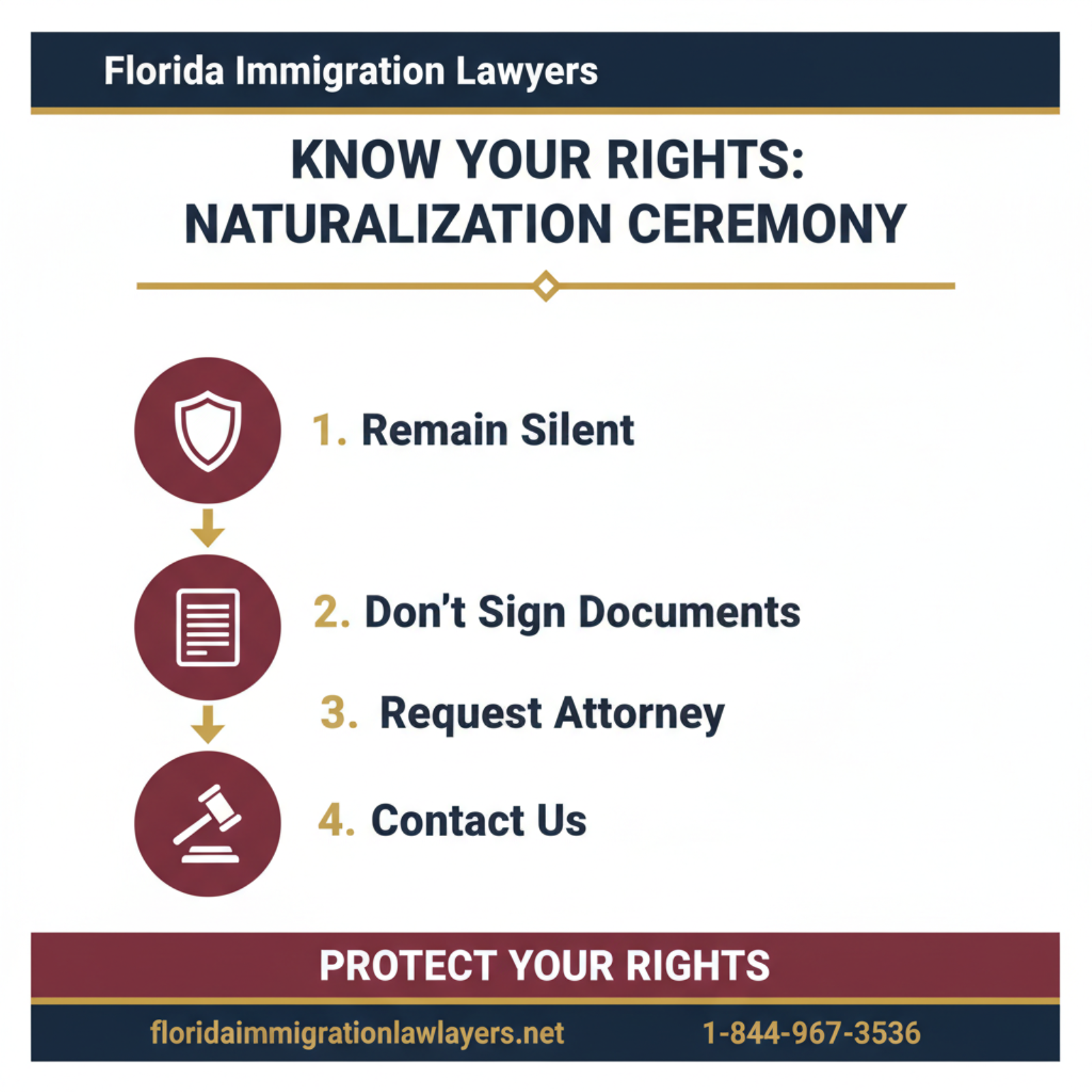
Always review your N-445 instructions carefully, as specific requirements may vary. It is always best to bring originals of all relevant documents to your interview and ceremony.
Timeline and Processing Expectations for Florida Naturalization Applicants (2026)
The naturalization process timeline can vary significantly based on several factors, including the specific USCIS field office handling your application and the complexity of your case. For Florida residents, offices in Miami, Orlando, and Tampa process a high volume of applications.
Typically, the entire process from filing Form N-400 to attending the oath ceremony can take anywhere from 8 to 18 months, or even longer in some instances. You can check current processing times on the USCIS website for your specific field office.
Factors that can influence your timeline include the efficiency of background checks, the volume of applications at your local field office, and whether USCIS requires additional information or interviews.
What Causes Naturalization Ceremony Cancellations?
Occasionally, a naturalization ceremony may be cancelled or rescheduled. This can happen for several reasons, and it does not automatically indicate a problem with your case.
Common reasons include administrative issues, unforeseen circumstances at the ceremony venue, or a need for USCIS to conduct further review of your file. In some rare cases, new derogatory information might emerge from background checks requiring additional scrutiny.
If your ceremony is cancelled, USCIS will typically send you a new notice with updated information. If you have concerns about a cancellation, it is advisable to contact an immigration attorney to understand the specific reasons and next steps.
Cost Factors and Fee Breakdown for U.S. Citizenship
Applying for U.S. citizenship involves certain fees that applicants must pay to USCIS. These fees are subject to change, so it is crucial to check the most current fee schedule on the USCIS website before filing.
The primary fee is for filing Form N-400, Application for Naturalization. There may also be a separate biometrics services fee. In some cases, applicants may be eligible for a fee waiver, which can significantly reduce or eliminate these costs.
Legal fees for assistance from an experienced immigration lawyer are an additional cost factor. While not mandatory, legal representation can be invaluable, especially for complex cases or if you have naturalization ceremony ICE concerns.
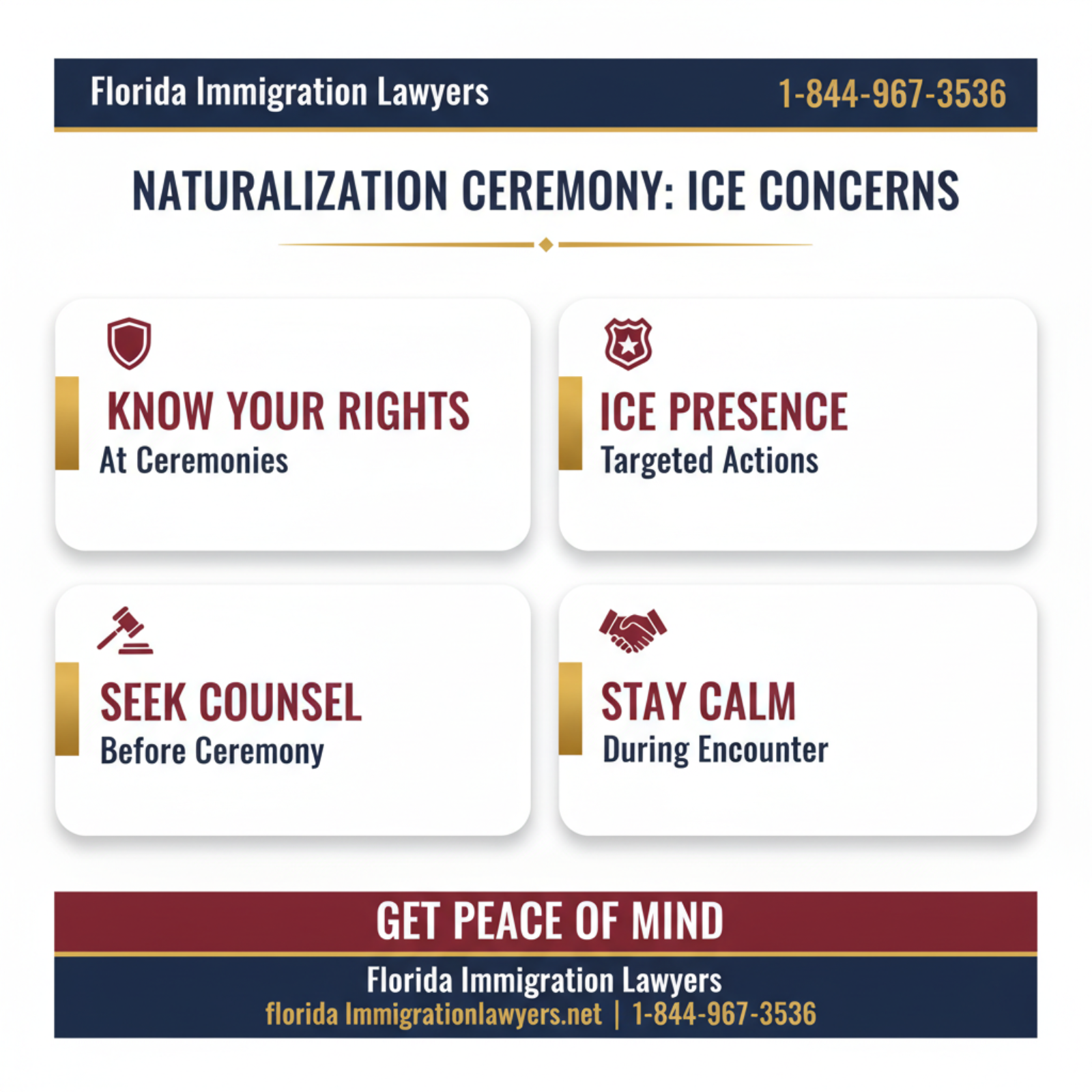
Investing in legal guidance can help ensure your application is complete and accurate, minimizing delays and increasing your chances of a successful outcome. Our firm, Florida Immigration Lawyers, offers transparent fee structures and free initial consultations.
Do not navigate this process alone. Contact Florida Immigration Lawyers today to secure your future.
Common Mistakes to Avoid During Your Naturalization Process
The naturalization process can be complex, and even minor errors can lead to significant delays or even denial. Avoiding these common pitfalls is crucial for a successful outcome:
- Failing to Disclose All Arrests or Citations: Even minor infractions, dismissed charges, or expunged records must be disclosed. USCIS has access to extensive databases, and omissions can be considered misrepresentation, leading to denial and potential legal consequences.
- Providing Inaccurate or Inconsistent Information: All information on your N-400 must be truthful and consistent with previous immigration applications. Discrepancies can raise red flags and lead to intensive scrutiny.
- Not Updating Your Address with USCIS: If you move, you must notify USCIS within 10 days using Form AR-11. Failing to do so can result in missed notices, interview appointments, or even a denial due to abandonment of your application.
- Poor English Language Proficiency: Applicants must demonstrate the ability to read, write, and speak basic English. Inadequate preparation for the English test can lead to a failed interview and delay your naturalization.
- Failing the Civics Test: You must correctly answer a certain number of questions about U.S. government and history. Insufficient study for this test can also result in a failed interview.
- Excessive Travel Outside the U.S.: Long periods outside the U.S. can break your continuous residency requirement. Generally, absences of six months or more can be problematic, and one year or more will likely break continuity.
- Not Seeking Legal Advice for Complex Cases: If you have a criminal record, previous immigration violations, or a complex travel history, attempting to navigate the process alone can be risky. An attorney can identify potential issues and devise strategies to overcome them.
- Ignoring USCIS Notices: Always respond promptly and accurately to Requests for Evidence (RFEs) or Notices of Intent to Deny (NOIDs). Ignoring these can lead to automatic denial of your application.
- Missing Your Oath Ceremony: Failing to attend your scheduled naturalization ceremony without proper notification to USCIS can be seen as abandoning your application, requiring you to refile.
- Assuming Minor Infractions are Irrelevant: Even seemingly minor issues like traffic tickets or old charges can impact your good moral character assessment if not properly disclosed and explained.
- Not Bringing Required Documents to Interview/Ceremony: Forgetting crucial documents like your Green Card or N-445 can cause delays or prevent you from taking the Oath of Allegiance.
- Not Understanding the Oath of Allegiance: You must understand and be willing to take the Oath of Allegiance. Any reservations about allegiance to the U.S. can lead to denial.
When to Call a Florida Immigration Lawyer for Naturalization Assistance
While some naturalization cases are straightforward, many benefit significantly from legal counsel. If you have any naturalization ceremony ICE concerns or encounter any of the following scenarios, contacting an attorney is highly recommended:
- You have a criminal record, even if charges were dismissed, expunged, or occurred long ago.
- You have a complex immigration history, including previous denials, deportation proceedings, or multiple entries into the U.S.
- You have spent significant periods outside the U.S. that might affect your continuous residency.
- You have received a Request for Evidence (RFE) or a Notice of Intent to Deny (NOID) from USCIS.
- You are unsure about your eligibility requirements or specific answers on Form N-400.
- Your naturalization ceremony has been cancelled, and you don't understand why.
- You have concerns about your good moral character assessment due to past actions.
- You need assistance preparing for the interview, especially with the English and civics tests.
Our experienced attorneys at Florida Immigration Lawyers specialize in all aspects of U.S. citizenship and naturalization law. We can review your case, address potential issues, and represent you throughout the process, including providing deportation defense if needed.
Addressing People Also Ask (PAA) Questions on ICE and Naturalization
Do naturalized citizens have to worry about ICE?
No, generally naturalized citizens do not have to worry about ICE. Once you become a U.S. citizen, you are afforded the full rights and protections of citizenship, including protection from deportation. Your status is permanent and cannot be revoked unless it was obtained through fraud or misrepresentation, which is a rare and complex legal process.
Can ICE deport you if you are a naturalized citizen?
It is extremely difficult for ICE to deport a naturalized U.S. citizen. Denaturalization, the process of revoking citizenship, is a rare and serious legal action. It can only occur if the government proves that citizenship was obtained illegally or through intentional misrepresentation or concealment of material facts. This process is governed by stringent legal standards outlined in 8 U.S.C. § 1451.
Can ICE ask for your citizenship status?
Yes, ICE officers, like any law enforcement officer, can ask about your citizenship status. While you are generally required to truthfully state your citizenship status, you are not required to answer all questions or sign any documents without legal counsel. It is always wise to carry proof of your citizenship, such as your Certificate of Naturalization or U.S. passport, once you have them.
Why did USCIS cancel the oath ceremony?
USCIS may cancel an oath ceremony for various reasons. These can include administrative errors, unforeseen circumstances at the ceremony location, or a need for further review of your case. Occasionally, new information might emerge during final background checks that requires USCIS to reassess your eligibility. A cancellation does not automatically mean there is a problem with your application, but it is important to understand the reason.
About Florida Immigration Lawyers
Florida Immigration Lawyers is a leading law firm dedicated to providing exceptional legal services to immigrants across the Sunshine State. With extensive experience in all facets of immigration law, our team is committed to helping individuals and families achieve their American dreams.
We offer comprehensive legal assistance, including family immigration, business immigration, asylum claims, deportation defense, and citizenship applications. Our attorneys are known for their compassionate approach, meticulous attention to detail, and unwavering advocacy for our clients.
Choosing Florida Immigration Lawyers means partnering with a team that understands the unique challenges faced by immigrants in Florida, including those in Coral Springs and surrounding communities. We are available 24/7 for free consultations, offering peace of mind and expert guidance every step of the way.
Visit our website at https://www.floridaimmigrationlawyers.net or call us at 1-844-967-3536 to learn how our experienced attorneys can assist you.
Sources and References
- U.S. Citizenship and Immigration Services (USCIS) - Citizenship
- Executive Office for Immigration Review (EOIR) - Immigration Courts
- 8 U.S.C. Chapter 12 - Immigration and Nationality Act (INA)
- 8 U.S.C. § 1427 - Requirements for naturalization
- 8 U.S.C. § 1451 - Revocation of naturalization
- 8 CFR Part 337 - Oath of Allegiance
This article provides general legal information and is not intended as legal advice. Every case is unique, and outcomes depend on specific facts and circumstances. Contact an attorney for advice about your particular situation.
Your journey to U.S. citizenship is a significant milestone. Don't let naturalization ceremony ICE concerns overshadow this achievement. For expert legal guidance and peace of mind in Florida, call Florida Immigration Lawyers at 1-844-967-3536 for a free, confidential consultation. Se Habla Español - Estamos aquí para ayudarle.
Florida Immigration Lawyers
Legal Team
Our experienced attorneys at Florida Immigration Lawyers have been serving clients across Florida for over 20 years. We specialize in immigration, personal injury, criminal defense, workers compensation, and family law.