Immigration Appeal BIA Florida: Challenging Decisions in 2026
Facing an adverse immigration decision in Florida? Learn how to navigate the complex process of an immigration appeal to the Board of Immigration Appeals (BIA). This guide covers eligibility, the step-by-step filing process, essential documents, timelines, and cost factors. Discover common mistakes to avoid and understand when expert legal representation from Florida Immigration Lawyers is crucial for challenging unfavorable rulings and protecting your future in 2026. Get a free consultation today.
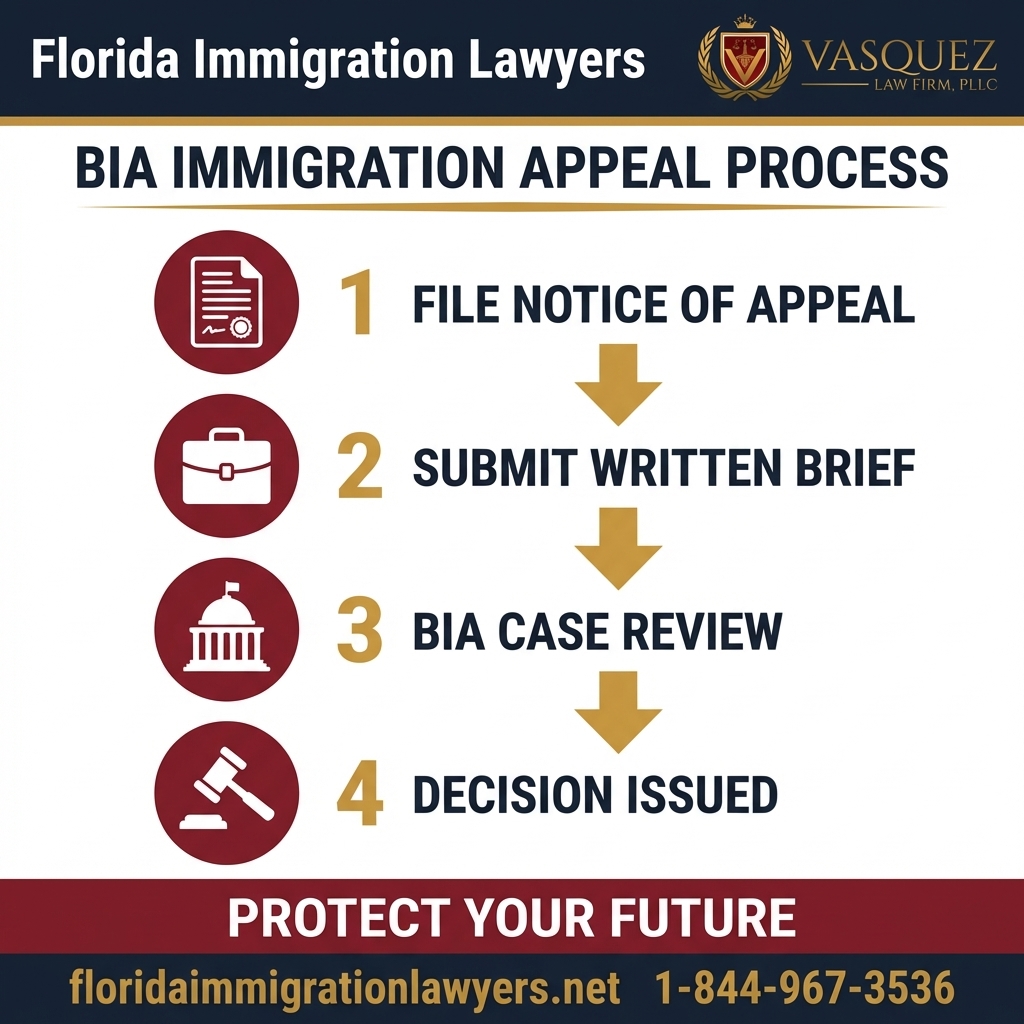
The Board of Immigration Appeals (BIA) is the highest administrative body for reviewing decisions made by U.S. Immigration Judges and certain USCIS officers. An immigration appeal BIA Florida allows individuals to challenge adverse rulings, such as deportation orders or petition denials, seeking a reversal or remand. This process is complex and requires strict adherence to deadlines and legal procedures.
- Challenges adverse immigration decisions.
- Filed with the Board of Immigration Appeals (BIA).
- Strict deadlines, typically 30 days from decision.
- Requires legal arguments in a brief.
- Often needs experienced legal counsel.
Receiving an unfavorable decision from an Immigration Judge or USCIS can be a devastating blow, especially when your future in Florida hangs in the balance. The thought of deportation or a denied visa can feel overwhelming, leaving you searching for viable options. Fortunately, the U.S. immigration system provides avenues for review, including the crucial process of an immigration appeal BIA Florida. This article serves as your comprehensive guide to understanding and navigating an appeal to the Board of Immigration Appeals (BIA) from anywhere in Florida, including Jacksonville. We will explore the steps involved, common pitfalls to avoid, and how experienced legal representation can significantly strengthen your case in 2026. Do not face this complex challenge alone. Call Florida Immigration Lawyers at 1-844-967-3536 for a free consultation to discuss your options.
Understanding the Board of Immigration Appeals (BIA) in Florida
The Board of Immigration Appeals (BIA) stands as the highest administrative body in the U.S. Department of Justice responsible for interpreting and applying immigration laws. Located in Falls Church, Virginia, the BIA reviews decisions made by Immigration Judges across the country, including those in Florida's immigration courts in Miami, Orlando, and Jacksonville. It also reviews certain decisions made by U.S. Citizenship and Immigration Services (USCIS) District Directors.
The BIA's Role in Florida Immigration Cases
When an Immigration Judge issues an order of removal or denies a form of relief, or when USCIS makes an adverse decision, the BIA provides a critical layer of review. This administrative appellate process is often the first step in challenging an unfavorable outcome. Pursuing an immigration appeal BIA Florida is a fundamental right for many individuals seeking to protect their residency, family unity, or asylum claims. Our firm is dedicated to assisting clients with all aspects of immigration law, including challenging adverse rulings.
Why Consider an Appeal to the BIA?
An appeal can be your last administrative hope to prevent deportation, obtain a visa, or achieve residency. It allows for the correction of legal or factual errors that may have occurred in the initial decision. It is a vital opportunity to present your case anew before a higher authority.
Who Can File an Immigration Appeal in Florida?
Both the government and individuals (respondents or petitioners) can file an appeal with the BIA. Typically, an appeal is initiated by a foreign national who has received an adverse decision from an Immigration Judge. This could be an order of removal, a denial of asylum, or a rejection of an application for adjustment of status. Similarly, a U.S. citizen or lawful permanent resident who has filed a petition for a family member may appeal a USCIS District Director's denial of that petition.
The grounds for appeal must demonstrate a clear error of law or fact by the Immigration Judge or USCIS officer. It is crucial to identify these errors accurately and present a compelling legal argument. The deadline for filing a Notice of Appeal (Form EOIR-26) is 30 calendar days from the date of the Immigration Judge's oral decision or the mailing date of a written decision. Missing this critical deadline almost always results in the dismissal of your appeal.
Step-by-Step Guide to Filing a BIA Appeal from Florida
Navigating the BIA appeal process requires meticulous attention to detail and strict adherence to procedural requirements. Here is a general step-by-step guide for individuals in Florida pursuing an immigration appeal BIA Florida:
- Review the Immigration Judge's Decision and Order: Carefully read the written decision or transcript of the oral decision. Identify the specific findings of fact and conclusions of law that you believe were erroneous. This forms the basis of your appeal.
- Determine Eligibility and Grounds for Appeal: Confirm that you have the legal standing to appeal and that there are valid legal or factual errors to challenge. Appeals cannot simply be based on dissatisfaction with the outcome; they must demonstrate reversible error.
- File Form EOIR-26, Notice of Appeal to the Board of Immigration Appeals: This form must be filed with the BIA within 30 calendar days of the Immigration Judge's decision. It requires you to state the specific reasons for your appeal. Failure to adequately state these reasons may lead to the BIA summarily dismissing your appeal.
- Submit the Filing Fee or a Fee Waiver Request: A fee is generally required to file an appeal. If you cannot afford the fee, you may submit a Form EOIR-26A, Fee Waiver Request. Ensure all required documentation demonstrating financial hardship is included.
- Prepare and File a Legal Brief: After filing the Notice of Appeal, you will typically be given a deadline, often 21 days, to submit a written brief. This brief is your primary opportunity to present detailed legal arguments, cite relevant case law, and explain why the Immigration Judge's decision should be reversed. This is a critical component of any successful deportation defense strategy.
- BIA Review Process: The BIA will review the record of proceedings, including the Immigration Judge's decision and your legal brief. In most cases, the BIA reviews appeals "on the papers," meaning there is no oral argument. A single Board Member typically reviews the case, though a three-member panel may be assigned for complex or precedent-setting issues.
- Receive the BIA Decision: The BIA will issue a written decision affirming the Immigration Judge's ruling, reversing it, or remanding the case back to the Immigration Judge for further proceedings. If the BIA affirms the decision, you may have options to appeal to a federal circuit court.
For more detailed information on the BIA's procedures, you can visit the Executive Office for Immigration Review (EOIR) website.
Essential Documents for Your BIA Appeal Checklist
A successful immigration appeal BIA Florida hinges on submitting a complete and accurate set of documents. Here is a general checklist of materials typically required:
- Completed Form EOIR-26, Notice of Appeal to the Board of Immigration Appeals.
- A copy of the Immigration Judge's decision and order you are appealing.
- A copy of the hearing transcript, if available and necessary for your arguments.
- A comprehensive legal brief detailing your arguments, citing relevant statutes, regulations, and case law.
- Proof of service of the Notice of Appeal and brief on the opposing party (DHS counsel).
- Payment of the required filing fee or a completed and approved Form EOIR-26A, Fee Waiver Request.
- Any relevant exhibits or evidence from the original proceedings that support your appeal.
- If you are seeking to introduce new evidence, a separate motion to reopen with strict evidentiary requirements.
- A G-28, Notice of Entry of Appearance as Attorney or Accredited Representative, if you are represented by counsel.
Ensuring every document is correctly prepared and submitted by the deadline is paramount.
Navigating the Timeline and Processing Expectations for a Florida BIA Appeal
The processing time for an immigration appeal BIA Florida can vary significantly, often depending on the complexity of your case and the BIA's current caseload. While some appeals may be resolved in a few months, others can take a year or even longer. Generally, the BIA aims to resolve appeals within a reasonable timeframe, but there are no strict guarantees.
Factors that can influence the timeline include: the type of case (e.g., asylum, family-based petition, removal), whether a legal brief is filed, the need for a transcript, and whether the government files a response brief. It is important to remember that during the appeal process, a final order of removal may be stayed, allowing you to remain in the U.S. while your appeal is pending. However, this is not always automatic, and separate requests may be needed. Many individuals pursuing asylum cases rely on this stay.
Regarding the question, "How long does a BIA appeal take?", while there's no fixed answer, staying informed and having legal counsel can help you manage expectations.
Cost Factors and Fee Breakdown for an Immigration Appeal
Understanding the financial implications is an important part of preparing for an immigration appeal BIA Florida. The costs typically involve two main components: filing fees and legal fees.
The Board of Immigration Appeals charges a filing fee for most appeals, which is subject to change. It is crucial to check the most current fee schedule on the EOIR website. If you demonstrate financial hardship, you may be eligible to request a fee waiver using Form EOIR-26A. Beyond government fees, attorney fees constitute a significant portion of the cost. These fees reflect the extensive legal expertise, time, and resources required to prepare a compelling appeal brief, research complex legal issues, and manage the procedural aspects.
While we cannot provide specific fee amounts here as they are subject to change, Florida Immigration Lawyers offers free consultations to discuss your case and provide an estimate of legal costs. We believe in transparency and helping you understand all financial aspects involved in your citizenship or immigration appeal journey. Regarding "How much does a BIA appeal cost?", it primarily includes the BIA filing fee and attorney's professional fees.
Do not navigate this complex and critical process alone. An adverse immigration decision can have profound consequences for your life and your family. Contact Florida Immigration Lawyers today to gain the experienced legal representation you need to fight for your future.
Common Mistakes to Avoid in Your Florida Immigration Appeal
The BIA appeal process is fraught with potential pitfalls that can jeopardize your case. Avoiding these common mistakes is crucial for a successful immigration appeal BIA Florida:
- Missing the Appeal Deadline: The 30-day deadline to file Form EOIR-26 is jurisdictional and strictly enforced. Missing it almost always results in dismissal, with very limited exceptions.
- Failing to State Adequate Grounds for Appeal: Simply stating "I disagree" is insufficient. You must specify the precise errors of law or fact made by the Immigration Judge.
- Not Filing a Comprehensive Legal Brief: The brief is your opportunity to present detailed arguments and legal authority. A weak or absent brief significantly reduces your chances of success.
- Incorrectly Filing Paperwork: Errors in filling out forms, improper service on the opposing party, or sending documents to the wrong address can lead to rejection or dismissal.
- Lack of Legal Representation: Navigating complex immigration law, BIA regulations (see 8 C.F.R. Part 1003), and precedent decisions without an attorney is extremely challenging and often leads to unfavorable outcomes.
- Improperly Submitting New Evidence: The BIA generally reviews the existing record. Introducing new evidence usually requires a separate motion to reopen, with stringent requirements, not just attaching it to the appeal brief.
- Ignoring the Immigration Judge's Reasoning: Your appeal brief must directly address the Immigration Judge's findings and conclusions, demonstrating why they were incorrect.
- Assuming the BIA Will Automatically Reverse: The BIA often defers to an Immigration Judge's factual findings. You must present compelling legal arguments to overcome this deference.
- Not Understanding the Standard of Review: The BIA applies different standards (e.g., clear error for facts, de novo for law). Misunderstanding these can lead to ineffective arguments.
- Failing to Address All Issues on Appeal: If you have multiple grounds for appeal, ensure each is thoroughly argued in your brief.
- Inadequate Record Review: Not thoroughly reviewing the record of proceedings for errors or omissions before preparing your appeal.
- Ignoring the Potential for Further Appeals: A BIA decision can sometimes be appealed to a U.S. Circuit Court of Appeals, but this requires a different set of legal expertise and understanding of federal court procedures.
When to Call a Florida Immigration Lawyer for Your Appeal
The decision to pursue an immigration appeal BIA Florida is significant, and the process is intricate. While it's technically possible to self-represent, the complexities of immigration law, strict deadlines, and the need for persuasive legal arguments make professional legal counsel almost indispensable. You should strongly consider contacting an attorney from Florida Immigration Lawyers if:
Warning Signs and Complex Scenarios
- You have received an adverse decision from an Immigration Judge or USCIS and believe there were legal or factual errors.
- You are facing a deportation order and wish to challenge it.
- The 30-day appeal deadline is fast approaching, and you need immediate assistance.
- Your case involves complex legal issues, such as novel interpretations of law, constitutional challenges, or the interplay of criminal and immigration law.
- You need to file a motion to reopen or reconsider, which have even stricter requirements than a standard appeal.
- You are unsure about the grounds for your appeal or how to articulate them effectively.
- You are considering a federal court appeal after a BIA decision.
- You are seeking to protect your right to family immigration or business immigration benefits.
The Advantage of Legal Representation
Regarding "Can you appeal a BIA decision?", yes, a final BIA decision can often be appealed to a U.S. Circuit Court of Appeals, a process that absolutely requires an attorney. While we cannot provide specific success rates for the question "What percentage of appeals are successful in Florida?", your chances are significantly enhanced with an experienced attorney who can identify the strongest legal arguments and prepare a meticulous case. We invite you to explore our attorneys' profiles and learn about their expertise. Contact us for a free consultation.
Florida Immigration Lawyers is a leading immigration law firm dedicated to serving individuals and families across the entire state of Florida. With offices strategically located to assist clients from Jacksonville to Miami, Orlando to Tampa, we bring unparalleled expertise and a compassionate approach to every case. Our highly experienced team specializes in a wide range of immigration matters, including deportation defense, asylum claims, visa applications, family-based petitions, business immigration, and appeals to the Board of Immigration Appeals. We understand the profound impact immigration issues have on your life and are committed to providing aggressive, effective, and ethical legal representation. Choosing Florida Immigration Lawyers means partnering with a firm that prioritizes your future. We offer free consultations and are available 24/7 to provide guidance and support. Let us put our knowledge and dedication to work for you. Call us today at 1-844-967-3536 or visit our website at https://www.floridaimmigrationlawyers.net.
Sources and References
- U.S. Citizenship and Immigration Services (USCIS)
- Executive Office for Immigration Review (EOIR) - Board of Immigration Appeals
- 8 U.S.C. Chapter 12 - Immigration and Nationality Act (INA)
- 8 C.F.R. Part 1003 - Executive Office for Immigration Review
- 8 U.S.C. § 1229a - Removal Proceedings
This article provides general legal information and is not intended as legal advice. Every case is unique, and outcomes depend on specific facts and circumstances. Contact an attorney for advice about your particular situation.
Do not let an unfavorable immigration decision dictate your future. Take decisive action and seek the professional legal guidance you deserve. Florida Immigration Lawyers is ready to assist you with your immigration appeal BIA Florida, offering dedicated support and strategic advocacy. Call us now at 1-844-967-3536 for a free, confidential consultation. Se Habla Español - Estamos aquí para ayudarle.
Do Not Navigate This Process Alone
Our experienced immigration attorneys are ready to fight for you. Get a free, confidential consultation today.
Se Habla Español
Frequently Asked Questions
Florida Immigration Lawyers
Immigration Law Team
Our team of experienced immigration attorneys has helped thousands of families across Florida. We offer free consultations and bilingual services for all immigration matters.
Available 24/7 - Free Consultations
Related Legal Services
Our Florida immigration attorneys can help you with asylum protection, deportation defense and citizenship and naturalization. Call today at 1-844-967-3536 for a free consultation.
Related Links
Related Topics
Free Legal Consultation
Discuss your case with our experienced attorneys. We're available 24/7.
Se Habla Español - Estamos aquí para ayudarle.
Related Articles
Immigration Attorney West Palm Beach: Your Guide for Florida Cases
Navigating immigration law in West Palm Beach, Florida, can be a complex and challenging process. This comprehensive guide highlights the crucial role an immigration attorney plays in securing your future. From family-based visas and green card applications to citizenship and deportation defense, expert legal guidance is invaluable. Discover how an experienced immigration attorney West Palm Beach can help you avoid common mistakes, understand intricate legal requirements, and represent your interests effectively. Learn about the step-by-step process, essential documentation, and typical timelines. With Florida Immigration Lawyers, you gain a dedicated advocate committed to your success. Contact us for a free consultation to discuss your specific needs.
Green Card Holders Issued New Warning: Florida Immigration 2026
Green card holders in Florida are currently navigating a period of increased immigration scrutiny and potential policy shifts, often referred to as a 'new warning' for 2026. This comprehensive guide from Florida Immigration Lawyers provides essential information on what this means for lawful permanent residents (LPRs) across the state, including West Palm Beach. Learn about critical steps to protect your status, including carrying your green card, understanding travel implications, and avoiding common mistakes. We detail a step-by-step guide, a document checklist, and crucial advice on when to seek legal counsel to ensure compliance and safeguard your future in the U.S.
Kilmar Abrego Garcia Deportation Florida: Expert Legal Defense Guide
Understanding the complexities of deportation in Florida is crucial for non-citizens. High-profile cases, such as the deportation of Kilmar Abrego Garcia Florida, highlight the intense legal challenges and the absolute necessity of expert legal representation. This comprehensive guide details the step-by-step deportation process, essential documentation, expected timelines, and cost factors specific to Florida. We also outline common mistakes to avoid and provide clear guidance on when to consult a Florida immigration lawyer. Florida Immigration Lawyers offers compassionate, skilled defense throughout the state, available 24/7 for free consultations. Protect your rights and your future.
2026 Winter Olympics Ice Hockey Immigration: Florida Legal Guide
For individuals connected to the 2026 Winter Olympics Ice Hockey, understanding U.S. immigration law is vital, particularly for those with ties to Florida. While the Games are in Italy, athletes, coaches, and support staff often train or reside in Florida, requiring specific visas like O-1 or P-1. This guide from Florida Immigration Lawyers provides a comprehensive overview of the immigration process, necessary documentation, timelines, and common pitfalls. We emphasize the importance of securing the correct visa, preparing meticulous documentation, and adhering to strict deadlines. With Florida's significant role in international sports, our firm is uniquely positioned to assist. Contact us for a free consultation to navigate these complexities.