Change of Status to F-1 Student Visa in Florida: Your 2026
Considering a change of status to an F-1 student visa in Florida? This detailed guide from Florida Immigration Lawyers provides essential information for 2026 applicants. Learn about eligibility, the step-by-step application process involving Form I-539, required documentation, and critical timelines. We explain the '90-day rule,' financial requirements, and how to maintain legal status throughout processing. Discover common mistakes to avoid and understand when professional legal assistance is indispensable. Whether you're in Fort Lauderdale or elsewhere in Florida, our firm is ready to help you navigate the complexities of U.S. immigration law to achieve your academic dreams. Contact us for a free consultation.
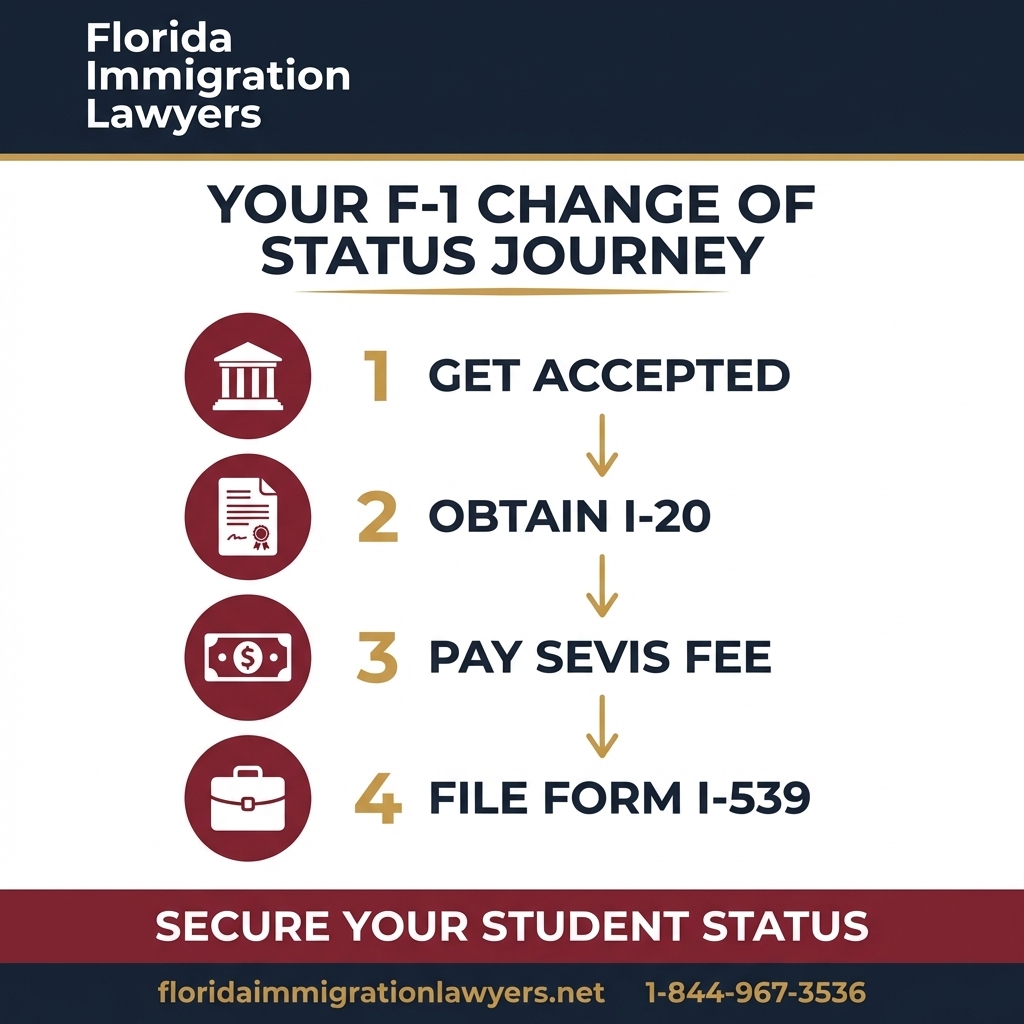
Changing your nonimmigrant status to an F-1 student visa in Florida involves several critical steps. You must gain acceptance from an SEVP-approved school, obtain a Form I-20, and then file Form I-539 with USCIS. Demonstrating financial capability and nonimmigrant intent is crucial, all while meticulously maintaining your current legal status.
- Secure admission to an SEVP-certified educational institution.
- Obtain your Certificate of Eligibility for Nonimmigrant Student Status (Form I-20).
- File Form I-539, Application to Extend/Change Nonimmigrant Status, with USCIS.
- Provide comprehensive financial documentation and evidence of nonimmigrant intent.
- Maintain your current legal status throughout the entire application process.
Florida, with its vibrant culture and diverse educational landscape, attracts countless individuals seeking academic opportunities. Perhaps you initially arrived in Fort Lauderdale on a tourist visa, only to discover a profound passion for a new field of study. Or maybe you are already here on a different nonimmigrant visa and wish to pursue higher education.
The journey to transition from one nonimmigrant status to an F-1 student visa can seem daunting. It involves understanding complex regulations, preparing extensive documentation, and adhering to strict deadlines. This comprehensive guide from Florida Immigration Lawyers is designed to illuminate the path for those looking to achieve a change of status to an F-1 student visa in Florida for 2026.
We will walk you through the eligibility criteria, the step-by-step application process, and key considerations to ensure a smooth transition. Our goal is to empower you with the knowledge needed to navigate this important immigration process successfully. If you have questions or need personalized guidance, please do not hesitate to call Florida Immigration Lawyers at 1-844-YO-PELEO for a free consultation.
Understanding Change of Status to an F-1 Student Visa in Florida
What is Change of Status?
A change of status allows an individual already present in the United States on a valid nonimmigrant visa to switch to another nonimmigrant visa category without leaving the country. For instance, if you are currently in Florida on a B-2 tourist visa or an H-1B professional visa, you may be eligible to apply to change your status to an F-1 student visa. This process is governed by specific regulations outlined in the Immigration and Nationality Act (INA).
The primary benefit of a change of status is convenience, as it avoids the need to return to your home country to apply for a new visa stamp at a U.S. embassy or consulate. However, it is crucial to understand that a change of status to F-1 only grants you F-1 status within the U.S. If you travel outside the U.S. after your change of status is approved, you will need to obtain an F-1 visa stamp from a U.S. embassy or consulate abroad before returning.
Eligibility for F-1 Student Status
To qualify for an F-1 student visa, you must first meet several fundamental requirements. These include being accepted by a school that has been approved by the Student and Exchange Visitor Program (SEVP). The school must issue you a Form I-20, Certificate of Eligibility for Nonimmigrant Student Status.
Additionally, you must demonstrate that you have sufficient funds to cover your tuition, living expenses, and other costs for your entire period of study. You must also prove that you have a residence abroad that you do not intend to abandon, demonstrating your nonimmigrant intent. This means you plan to return to your home country after completing your studies.
The "90-Day Rule" and Your Intent
One critical aspect to consider when applying for a change of status is the so-called "90-day rule." While not a formal law, it is a USCIS guideline used to assess an applicant's intent. If you apply for a change of status within 90 days of your entry into the U.S. on a B-1/B-2 visa, USCIS may presume that you misrepresented your true intent upon entry.
For example, if you entered Florida on a tourist visa and immediately applied for an F-1 change of status a week later, USCIS might suspect you always intended to study, rather than genuinely visit. This presumption can lead to a denial of your application. It is generally advisable to wait at least 90 days after entry before submitting a change of status application, demonstrating a consistent nonimmigrant intent.
The Step-by-Step Process for F-1 Change of Status in Florida
Navigating the change of status process requires careful attention to detail and adherence to a specific sequence of actions. Below is a comprehensive guide to help you through each step, ensuring you meet all requirements for your F-1 student visa in Florida.
-
Step 1: Get Admitted to an SEVP-Approved School
Your first crucial step is to apply and be accepted by an academic institution or language program that is approved by the Student and Exchange Visitor Program (SEVP). Most accredited colleges, universities, and language schools in Florida are SEVP-approved. Ensure the school you choose is authorized to enroll international students.
This admission is fundamental, as it forms the basis of your F-1 student status. Without an acceptance letter from an SEVP-approved school, you cannot proceed with the change of status application.
-
Step 2: Obtain Your Form I-20
Once accepted, your designated school official (DSO) will issue you a Form I-20, Certificate of Eligibility for Nonimmigrant Student Status. This document confirms your enrollment, outlines your program of study, and details the estimated costs. It also includes your unique SEVIS ID number, which is essential for your application.
Review your I-20 carefully for any errors. Any discrepancies could delay your application or lead to issues later. Ensure that the start date on your I-20 is realistic and gives you ample time to complete the change of status process.
-
Step 3: Prepare and File Form I-539
The core of your change of status application is Form I-539, Application to Extend/Change Nonimmigrant Status. You will complete this form and submit it to U.S. Citizenship and Immigration Services (USCIS). This application requests that USCIS change your current nonimmigrant status to F-1 student status.
Accompanying Form I-539, you must include all required supporting documents. This typically involves copies of your passport, current visa, I-94 arrival/departure record, Form I-20, financial evidence, and a personal statement explaining your reasons for changing status. The USCIS filing fee must also be included.
-
Step 4: Attend Biometrics Appointment (If Required)
After filing Form I-539, USCIS may send you an appointment notice for a biometrics services appointment. This appointment is typically held at an Application Support Center (ASC) in Florida, such as those near Fort Lauderdale or Miami. During this appointment, your fingerprints and photograph will be taken.
It is mandatory to attend this appointment if you receive a notice. Failure to do so without proper rescheduling can lead to a denial of your application. Ensure you bring the appointment notice and a valid photo ID.
-
Step 5: Await USCIS Decision
Once all documents are submitted and biometrics (if required) are completed, you will enter a waiting period for USCIS to process your application. During this time, it is crucial to maintain your current nonimmigrant status, if possible. You can generally remain in the U.S. while your application is pending, even if your initial visa expires, as long as you filed on time.
USCIS will send you a written decision, either approving or denying your change of status. If approved, you will receive an I-797 approval notice indicating your new F-1 status. If denied, USCIS will provide reasons for the denial, and you may need to consult with an immigration attorney immediately to discuss your options, which could include departing the U.S. or exploring other avenues.
Essential Documents for Your F-1 Change of Status Application
A successful change of status application hinges on the submission of a complete and accurate set of documents. Gathering these materials carefully is paramount to avoid delays or requests for additional evidence from USCIS. Here is a checklist of the essential documents you will typically need:
-
Personal Identification and Immigration Documents
- Copy of your valid passport (biographical page and visa stamp page).
- Copy of your current nonimmigrant visa (if applicable).
- Copy of your Form I-94 Arrival/Departure Record (print from CBP website).
- Copies of any previous Forms I-20, I-797 approval notices, or other immigration documents.
- Two passport-style photographs meeting USCIS specifications.
-
Academic and Financial Evidence
- Original Form I-20, Certificate of Eligibility for Nonimmigrant Student Status, issued by your SEVP-approved school.
- Proof of payment for the SEVIS I-901 fee.
- Official acceptance letter from your SEVP-approved school.
- Official transcripts and diplomas from previous educational institutions.
- Bank statements or other financial documents proving sufficient funds for your studies (e.g., personal savings, sponsor's bank statements, scholarship letters).
- Affidavit of Support (Form I-134) if a sponsor is providing financial assistance.
change of status - Step-by-Step Process -
Supporting Statements and Letters
- A personal statement (cover letter) explaining your reasons for changing status, your academic goals, and your intent to return to your home country after completing your studies.
- Letters from your current school or employer (if applicable) confirming your current status and good standing.
- Evidence of strong ties to your home country (e.g., property deeds, family ties, job offers after graduation) to demonstrate nonimmigrant intent.
Timeline and Processing Expectations for Florida F-1 Applications
The processing time for an F-1 change of status application can vary significantly. It depends on various factors, including the USCIS service center handling your case and the current caseload. Understanding these timelines is crucial for planning your academic journey in Florida.
USCIS Processing Times
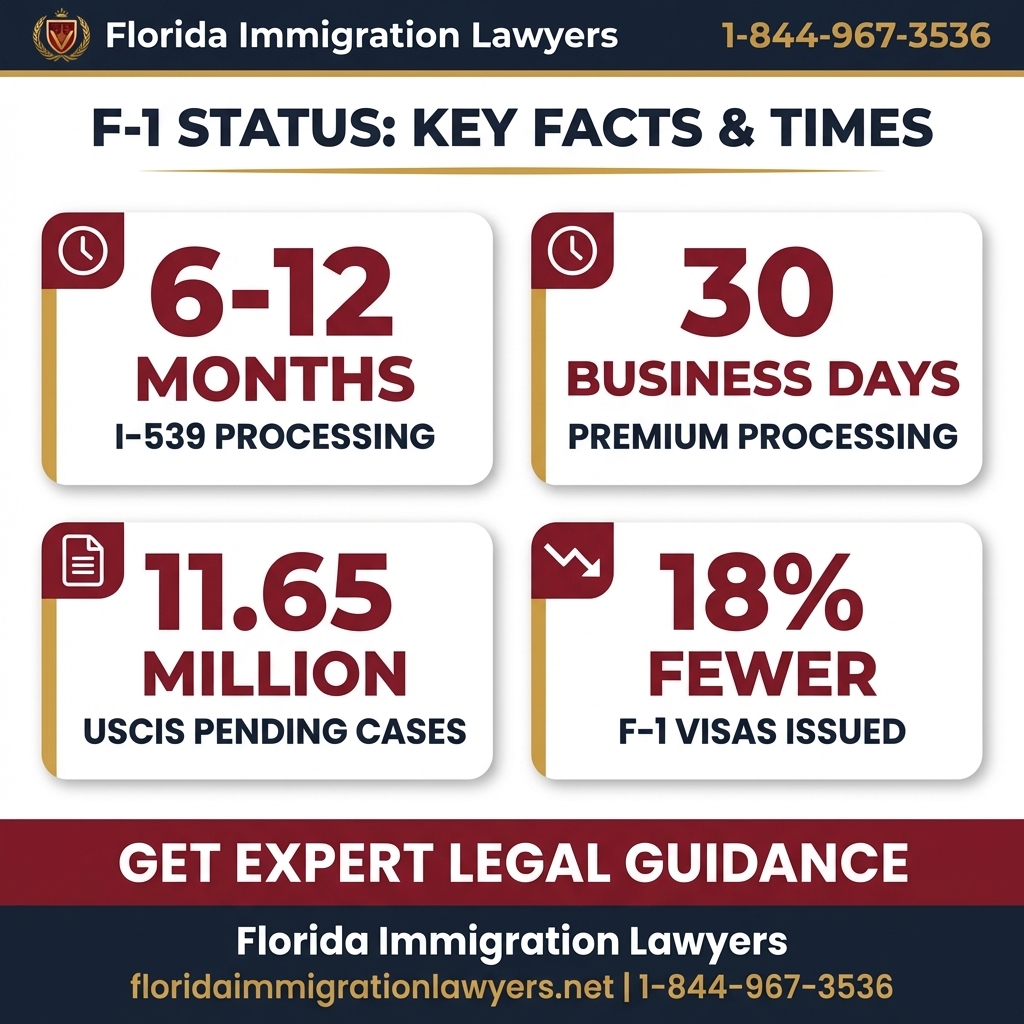
USCIS provides estimated processing times on its website, which are updated regularly. For Form I-539, these times can range from a few months to over a year. It is important to check the specific processing times for the service center that will process your application (typically based on where you reside in Florida).
While your application is pending, you are generally allowed to remain in the U.S. in a period of authorized stay, even if your previous nonimmigrant status expires. However, you cannot begin your F-1 studies until your change of status is approved. This can sometimes lead to deferring your start date with your school.
Maintaining Status During Processing
It is paramount to maintain your current nonimmigrant status until your F-1 change of status is approved. This means continuing to comply with the terms and conditions of your existing visa. For example, if you are on a B-2 visa, you should not enroll in classes or engage in unauthorized employment.
If your current status expires while your I-539 application is still pending, you are generally considered to be in a "period of authorized stay." This period ends when USCIS makes a decision on your I-539. If denied, you must depart the U.S. immediately to avoid accruing unlawful presence.
Can F-1 Students Become Residents After 5 Years?
A common misconception is that F-1 students automatically become U.S. residents after a certain period, such as five years. This is not true. An F-1 visa is a nonimmigrant visa, meaning it is temporary and does not directly lead to permanent residency (a Green Card).
To become a U.S. resident, an F-1 student would need to apply for a separate immigrant visa category, such as through family sponsorship, employment sponsorship, or the Diversity Visa Lottery. This requires a completely new application process and meeting different eligibility criteria. Maintaining F-1 status for an extended period does not confer any special advantage for obtaining permanent residency.
Cost Factors and Fee Breakdown for Change of Status
Understanding the financial aspects of an F-1 change of status is crucial for proper planning. There are several fees associated with the application process, which can add up. These fees are subject to change, so always verify the current amounts on the official USCIS and SEVP websites.
USCIS Filing Fees
The primary fee is for filing Form I-539, Application to Extend/Change Nonimmigrant Status. This fee is paid directly to USCIS. If you are applying with dependents (e.g., F-2 spouses or children), they may be included on the same I-539 application, but each dependent may also incur an additional fee. Always check the latest fee schedule on USCIS.gov before filing.
SEVIS I-901 Fee
In addition to the USCIS filing fee, you must also pay the SEVIS I-901 fee. This fee supports the Student and Exchange Visitor Information System (SEVIS), which tracks F-1 students and J-1 exchange visitors. You must pay this fee before filing your Form I-539. Proof of payment is required as part of your application package.
Legal Fees for Immigration Assistance
While you can file the application yourself, many individuals choose to hire an experienced immigration attorney, especially given the complexities of the process. Legal fees will vary depending on the complexity of your case and the services provided. Investing in legal counsel can help ensure your application is prepared correctly and submitted with all necessary documentation, minimizing the risk of denial.
Do not navigate this process alone. The complexities of immigration law, especially a change of status application, can be overwhelming. Contact Florida Immigration Lawyers today to discuss your specific situation and get guidance.
Common Mistakes to Avoid During Your F-1 Change of Status Process
The F-1 change of status process is fraught with potential pitfalls that can lead to delays or outright denial. Being aware of these common mistakes can help you avoid them and improve your chances of a successful outcome for your student visa in Florida.
-
Overstaying Your Current Visa: Filing your I-539 application after your current authorized period of stay has expired is a critical error. This can result in a denial and potentially make you inadmissible to the U.S. for several years.
-
Failing to Maintain Current Status: You must comply with the conditions of your current visa (e.g., B-2 visitor, H-1B worker) until your F-1 change of status is approved. Engaging in unauthorized activities, such as enrolling in a full course of study or working without permission, can lead to denial.
-
Not Having Sufficient Funds: USCIS requires proof that you can cover your tuition and living expenses for your entire program of study without needing to work illegally. Inadequate financial evidence is a frequent reason for denial.
-
Lack of Nonimmigrant Intent: You must convince USCIS that you intend to return to your home country after completing your studies. Weak ties to your home country or strong indications of immigrant intent can lead to a denial, especially if you apply too soon after entry.
-
Incorrectly Filling Out Forms: Errors or omissions on Form I-539 or supporting documents can result in a Request for Evidence (RFE) or outright denial. Always double-check all information for accuracy.
-
Missing Deadlines: Filing your application too late, or failing to respond to an RFE by the specified deadline, will almost certainly lead to a denial. Keep track of all dates and ensure timely submission.
-
Not Disclosing All Relevant Information: Hiding previous immigration violations, arrests, or other pertinent information can be considered misrepresentation and result in a permanent bar from the U.S.
-
Traveling Outside the U.S. During Processing: If you leave the U.S. while your I-539 change of status application is pending, USCIS will consider your application abandoned. This will require you to apply for an F-1 visa at a U.S. consulate abroad to re-enter.
-
Beginning Studies Before Approval: You cannot start your F-1 program of study until your change of status to F-1 has been officially approved by USCIS. Engaging in studies before approval is a violation of your nonimmigrant status.
-
Misunderstanding the Grace Period for OPT Change of Status: If you are on Optional Practical Training (OPT) and wish to change status, remember that OPT has a limited grace period after its expiration. Filing within this period is crucial, but you must cease employment on the OPT end date. Consult an attorney for specific advice on timing your application to avoid issues with unauthorized employment or accruing unlawful presence.
When to Call a Florida Immigration Lawyer for Your Change of Status
While the information provided here is comprehensive, every immigration case has unique circumstances. The complexities of immigration law mean that individual situations often require personalized legal advice. Knowing when to seek professional help can make a significant difference in the outcome of your F-1 change of status application in Florida.
You should consider contacting Florida Immigration Lawyers if any of the following scenarios apply to you:
- Complex Immigration History: If you have had previous visa denials, overstays, or any immigration violations, your case will be more complicated and benefit from expert legal review.
- Criminal Record: Even minor arrests or convictions can impact your eligibility. An attorney can assess the implications and advise on the best course of action.
- Tight Deadlines or Expiring Status: If your current visa is nearing its expiration date, or you have a limited window to file, an attorney can help expedite the process and ensure timely submission.
- Uncertainty About Eligibility: If you are unsure whether you meet all the requirements for an F-1 change of status (e.g., financial proof, nonimmigrant intent), a lawyer can provide a thorough assessment.
- Receiving a Request for Evidence (RFE): If USCIS sends an RFE, it means they need more information. Responding correctly and comprehensively is critical, and an attorney can help you gather and present the necessary evidence effectively.
- Previous Denials: If your change of status application has been denied in the past, an attorney can review the reasons for denial and advise on potential remedies or alternative strategies.
- Desire for Peace of Mind: Even in straightforward cases, having an attorney guide you through the process can reduce stress and ensure all steps are correctly followed.
Florida Immigration Lawyers has extensive experience helping individuals across Florida, including Fort Lauderdale, navigate complex immigration processes like the change of status to an F-1 student visa. We understand the nuances of USCIS regulations and can provide the strategic guidance you need.
About Florida Immigration Lawyers
Florida Immigration Lawyers is a leading law firm dedicated to providing exceptional immigration legal services across the entire state of Florida. With a deep understanding of U.S. immigration law and a commitment to our clients, we strive to achieve the strongest possible outcomes for individuals, families, and businesses.
Our experienced attorneys offer a wide range of services, including assistance with visa applications, deportation defense, family-based petitions, citizenship applications, and complex change of status cases. We pride ourselves on our client-focused approach, offering personalized attention and strategic advice tailored to your unique situation.
Choosing Florida Immigration Lawyers means partnering with a firm that values integrity, professionalism, and effective communication. We are available 24/7 to answer your questions and offer free consultations to help you understand your options. Visit our website at https://www.floridaimmigrationlawyers.net or call us at 1-844-YO-PELEO to learn how we can assist you with your immigration needs.
Sources and References
- U.S. Citizenship and Immigration Services (USCIS)
- USCIS Filing Fees Information
- USCIS Check Case Processing Times
- Study in the States (SEVP)
- U.S. Customs and Border Protection (CBP) I-94 Website
- 8 U.S.C. § 1101(a)(15)(F) - Definition of Nonimmigrant F-1 Student
- 8 U.S.C. § 1258 - Change of Nonimmigrant Status (INA Section 248)
- 8 CFR Part 248 - Change of Nonimmigrant Status
This article provides general legal information and is not intended as legal advice. Every case is unique, and outcomes depend on specific facts and circumstances. Contact an attorney for advice about your particular situation.
Embarking on a new academic chapter in Florida through a change of status to an F-1 student visa is an exciting prospect. Do not let the complexities of the immigration system deter you. With the right legal support, you can navigate this process with confidence. Our dedicated team at Florida Immigration Lawyers is here to provide the guidance and representation you deserve.
We are committed to helping you achieve your educational and immigration goals in Florida. For assistance and a free, confidential consultation, call us today at 1-844-YO-PELEO. Se Habla Español - Estamos aquí para ayudarle.
Do Not Navigate This Process Alone
Our experienced immigration attorneys are ready to fight for you. Get a free, confidential case review today.
Se Habla Español
Or leave your details and we’ll call you:
Free Evaluation in 24 Hours
Or talk to us right now
AI voice assistant — available 24/7
FreeFrequently Asked Questions

William J. Vásquez
Founding Attorney · Vasquez Law Firm
U.S. Air Force veteran and immigration attorney with years of hands-on U.S. immigration experience. J.D., NCCU School of Law. AILA member. Admitted to the 4th, 5th, and 11th Circuit Courts.
Available 24/7 - Free Evaluations
Reviewed for legal accuracy by William J. Vásquez
Licensed in North Carolina; U.S. immigration is federal practice.
Related Legal Services
Our Florida immigration attorneys can help you with citizenship and naturalization, immigration practice areas and free immigration consultation. Call today at 1-844-YO-PELEO for a free case review.
Related Links
Related Topics
Free Legal Case Review
Discuss your case with our experienced attorneys. We're available 24/7.
Se Habla Español - Estamos aquí para ayudarle.
Related Articles
DUI Immigration Consequences in Florida 2026
A DUI conviction in Florida can have severe immigration consequences, potentially leading to inadmissibility, deportation, or denial of immigration benefits. For non-citizens, a DUI is not just a traffic offense but a serious criminal matter that federal immigration law scrutinizes closely. Factors like multiple offenses, injury, or property damage can escalate a simple DUI to a Crime Involving Moral Turpitude (CIMT) or even an aggravated felony, triggering mandatory detention and removal proceedings. Understanding the specific nature of your Florida conviction and its interpretation under the Immigration and Nationality Act (INA) is crucial. This article outlines how DUIs impact immigration status, the grounds for inadmissibility and deportation, a step-by-step guide to navigating the process, essential documentation, and expected timelines for 2026. We also highlight common mistakes to avoid and when to seek legal counsel from an experienced immigration attorney. Florida Immigration Lawyers offers comprehensive support for individuals facing these challenging situations, providing expert guidance through complex legal landscapes.
Dual Citizenship Lawyer in Florida: What You Need to Know
For Florida residents, the concept of dual citizenship, or holding two passports, offers a compelling blend of opportunities and challenges. While the U.S. generally permits dual nationality, the path to achieving this status requires a meticulous understanding of both U.S. immigration laws and the citizenship policies of your country of origin. This guide explores the definition of dual citizenship, the detailed step-by-step process for U.S. naturalization, and the significant benefits and potential pitfalls involved. We cover essential documentation, typical timelines, and cost considerations for 2026, providing crucial insights for anyone in Orlando, Miami, or across Florida considering this important legal step. Learn about common mistakes to avoid and understand when to seek professional legal counsel to navigate this complex process successfully. Florida Immigration Lawyers is here to provide expert, bilingual support for your dual citizenship journey.
Immigration Lawyer Orlando Free Consultation in Florida
For individuals and families in Orlando, Florida, navigating the complexities of U.S. immigration law requires expert guidance. An immigration lawyer in Orlando offers crucial support for everything from visa applications and green card processes to naturalization and deportation defense. This comprehensive guide details what a free consultation covers, providing a step-by-step overview of immigration pathways, essential document checklists, and expected timelines in 2026. We also highlight common mistakes to avoid, discuss the critical role of legal counsel in deportation and asylum cases, and explain why choosing a local Orlando immigration attorney is beneficial. Florida Immigration Lawyers is dedicated to serving the diverse community of Orlando with compassionate, effective legal solutions, ensuring you receive personalized advice and robust representation for a successful immigration journey.
EAD Advance Parole Combo Card in Florida: What You Need
An EAD advance parole combo card allows individuals with pending adjustment applications to both work and travel abroad without jeopardizing their green card application. Learn how to apply in Florida, what documents you need, and common mistakes to avoid.