I-601 Waiver Florida Guide: Overcoming Inadmissibility in
Facing inadmissibility for your green card in Florida? Our 2026 guide demystifies the I-601 waiver process, covering eligibility, documentation, timelines, and costs. Learn how to prove extreme hardship to a qualifying relative and navigate complex immigration laws. We highlight common mistakes to avoid and emphasize when legal counsel is crucial. With Florida Immigration Lawyers, you gain a strategic partner dedicated to helping you overcome obstacles. Discover the steps to building a strong I-601 waiver case and securing your future in the U.S. Contact us for expert guidance and a free consultation.

The I-601 waiver, officially the Application for Waiver of Grounds of Inadmissibility, allows certain individuals to overcome specific immigration bars and proceed with their green card or visa applications. This process is crucial for those in Florida facing issues like past immigration violations or criminal offenses. It typically requires demonstrating extreme hardship to a qualifying U.S. citizen or lawful permanent resident relative.
- An I-601 waiver addresses various grounds of inadmissibility.
- Extreme hardship to a qualifying relative is often the core requirement.
- The process involves detailed documentation and legal arguments.
- Timelines and approval rates can vary significantly by case.
- Legal assistance is highly recommended for navigating this complex waiver.
I-601 Waiver Florida Guide: Overcoming Inadmissibility in 2026
Are you an aspiring immigrant in Florida, perhaps in Kissimmee or a surrounding community, hoping to build a new life in the United States? You might find your path blocked by what immigration law calls "grounds of inadmissibility." These legal obstacles can arise from various past actions or circumstances, ranging from certain criminal convictions to prior immigration violations. Fortunately, for many, there's a potential solution: the I-601 waiver.
Navigating the complex world of U.S. immigration law can feel overwhelming, especially when facing a notice of inadmissibility. Understanding what an I-601 waiver is, who qualifies, and how to apply is crucial for your immigration journey. This comprehensive guide will walk you through the process, offering insights tailored for individuals and families across Florida in 2026. We'll cover everything from eligibility requirements to common pitfalls and how to build a strong case.
If you believe you may need an I-601 waiver or have questions about your eligibility, do not hesitate to seek professional guidance. Call Florida Immigration Lawyers at 1-844-967-3536 for a free consultation. Our experienced team is ready to help you understand your options and develop a strategic plan.
Understanding the I-601 Waiver Process for Florida Residents
The I-601, Application for Waiver of Grounds of Inadmissibility, is a vital tool within the U.S. immigration system. It allows individuals who are otherwise ineligible for a visa or adjustment of status due to specific inadmissibility grounds to request an exception. These grounds can be diverse, encompassing health-related issues, certain criminal offenses, security concerns, prior immigration fraud, or unlawful presence.
For many Florida families, particularly those with deep roots in diverse communities like Kissimmee, understanding this waiver is key to keeping loved ones together. The law acknowledges that strict adherence to inadmissibility rules can cause undue suffering, and thus provides avenues for relief. The I-601 waiver is not a universal solution for all inadmissibility grounds, but it covers a significant number of them, offering hope to many.
What is Inadmissibility and Why Does it Matter?
Inadmissibility refers to specific conditions or actions that make a foreign national ineligible to enter the United States or obtain a visa or green card. These grounds are outlined in Section 212 of the Immigration and Nationality Act (INA). Common examples include certain criminal convictions, misrepresentations to immigration officials, or having been unlawfully present in the U.S. for extended periods.
If you are found inadmissible, your application for a visa or adjustment of status will likely be denied unless you successfully obtain a waiver. This is where the hardship waiver component of the I-601 waiver becomes critical. It allows you to argue that your inadmissibility would cause extreme hardship to a qualifying U.S. citizen or lawful permanent resident spouse, parent, or sometimes child.
Who Qualifies for an I-601 Waiver?
Eligibility for an I-601 waiver is not automatic and depends heavily on the specific ground of inadmissibility you are trying to overcome. Generally, you must be the beneficiary of an immigrant petition and be inadmissible under one of the sections for which an I-601 waiver is available. Critically, you must usually demonstrate that your U.S. citizen or lawful permanent resident spouse or parent (and in some cases, a U.S. citizen son or daughter) would suffer "extreme hardship" if you were denied admission to the U.S. or forced to depart.
This "extreme hardship" standard is not easily met. It requires compelling evidence that goes beyond the normal difficulties associated with separation or relocation. USCIS considers various factors, including the health of the qualifying relative, financial impact, educational disruption, and psychological effects. Each case is unique, and a successful application relies on a thorough presentation of your personal circumstances.
Step-by-Step Guide to Filing Your I-601 Waiver Application
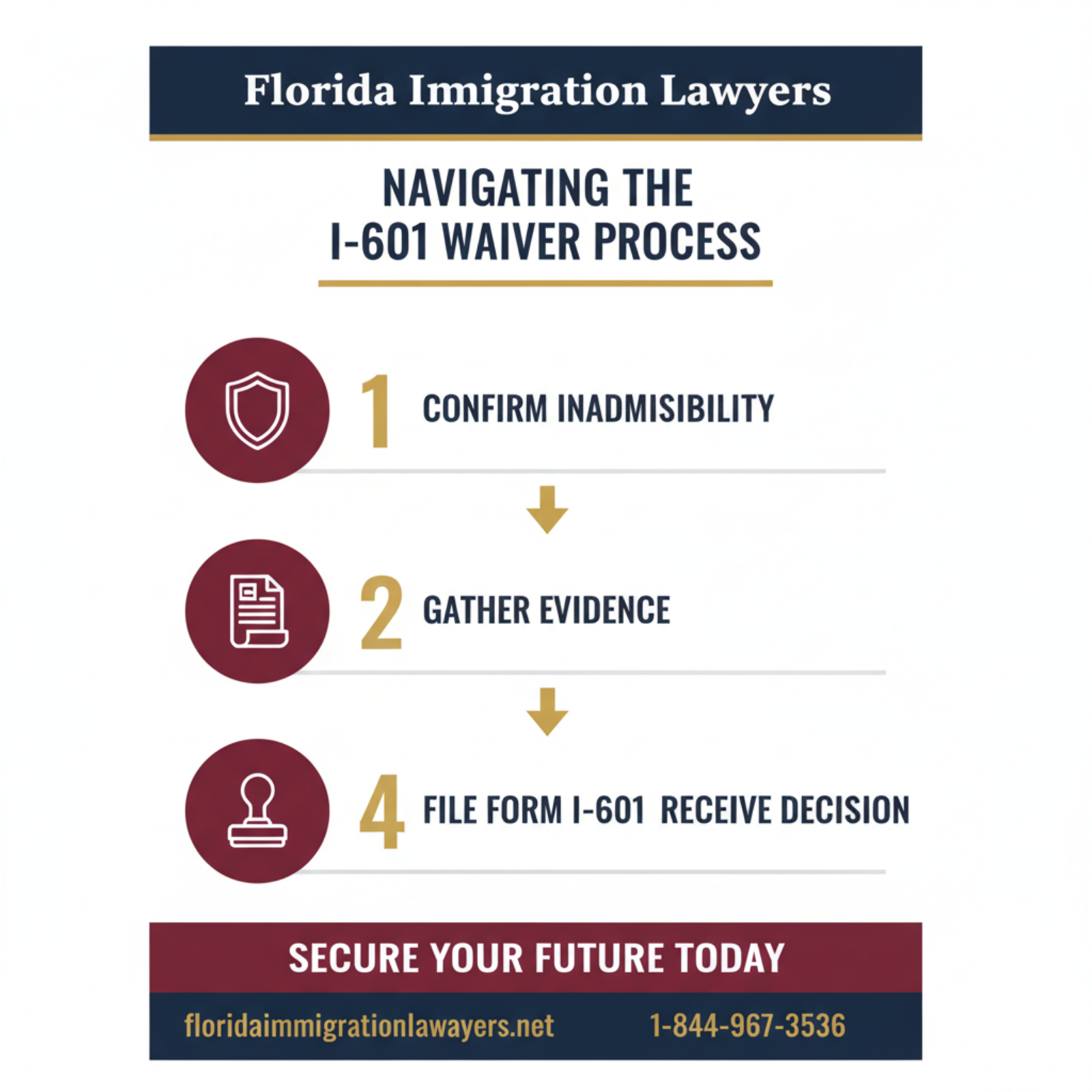
Filing an I-601 application is a detailed process that demands precision and a comprehensive understanding of immigration law. Here's a general step-by-step guide:
- Determine Eligibility and Inadmissibility Ground: First, confirm the specific ground of inadmissibility that applies to your situation. This is often identified during an interview at a U.S. consulate abroad or during an adjustment of status application within the U.S. Ensure that an I-601 waiver is the correct waiver for your specific ground. For example, individuals seeking a waiver for unlawful presence while applying for a visa abroad might need an I-601A provisional waiver instead, which is filed before departing the U.S.
- Gather Comprehensive Documentation: The success of your I-601 waiver hinges on robust evidence. Collect all documents proving your relationship to the qualifying relative, evidence of their U.S. citizenship or LPR status, and extensive documentation demonstrating the "extreme hardship" they would face. This includes medical records, psychological evaluations, financial statements, employment letters, educational records, and country condition reports if relocation is considered.
- Prepare Your Affidavit and Qualifying Relative's Affidavit: You will need to write a detailed personal statement explaining your situation, your positive contributions, and why you deserve the waiver. Crucially, your qualifying relative must also provide a compelling affidavit detailing the extreme hardship they would suffer without you in the U.S. These statements are central to your case.
- Complete Form I-601 Accurately: Fill out Form I-601, Application for Waiver of Grounds of Inadmissibility, meticulously. Any errors or omissions can lead to delays or denial. Ensure all sections are completed, and you sign the form correctly. Attach all supporting evidence as required.
- Pay the Filing Fee: As of 2026, USCIS fees are subject to change, so always check the most current fee schedule on the USCIS website. Do not send cash. Submit a check, money order, or pay online if applicable.
- File Your Application: The filing location for Form I-601 depends on whether you are applying for a visa abroad (consular processing) or adjusting your status within the U.S. (adjustment of status). For consular processing cases, the I-601 is typically filed with USCIS Lockbox facilities or a USCIS international office. For adjustment of status cases, it is filed with the USCIS service center processing your I-485 application. Always refer to the Form I-601 instructions for the most current filing address.
- Attend Interviews (if required): While not always required for the waiver itself, you may need to attend an interview for your underlying immigration benefit (e.g., green card interview). Be prepared to discuss your application and the hardship claim.
- Receive a Decision: After review, USCIS will issue a decision. If approved, you can proceed with your immigration process. If denied, you may have options for appeal or reconsideration, though these are often complex and require further legal strategy.
Document Checklist for Your I-601 Waiver
A robust application for an immigration waiver depends on comprehensive documentation. Here’s a general checklist:
- Completed and signed Form I-601, Application for Waiver of Grounds of Inadmissibility.
- Copy of your birth certificate and qualifying relative's birth certificate.
- Copy of marriage certificate (if applicable).
- Copies of U.S. passport or green card for the qualifying relative.
- Evidence of your relationship to the qualifying relative (e.g., photos, joint bank accounts).
- Your personal affidavit detailing your background and reasons for the waiver.
- Qualifying relative's detailed affidavit describing the extreme hardship they would face.
- Medical records and psychological evaluations for the qualifying relative (if applicable).
- Financial documents: tax returns, bank statements, pay stubs, evidence of debts.
- Employment letters and evidence of job loss if the qualifying relative would relocate.
- Educational records for children, demonstrating potential disruption.
- Country condition reports for your home country, if arguing relocation hardship.
- Police clearances from all countries where you have lived.
- Court dispositions and rehabilitation evidence for any criminal grounds.
- Expert letters (from doctors, therapists, economists) supporting hardship claims.
- Any other evidence demonstrating specific factors contributing to extreme hardship.
I-601 Waiver Timeline and Processing Expectations in 2026
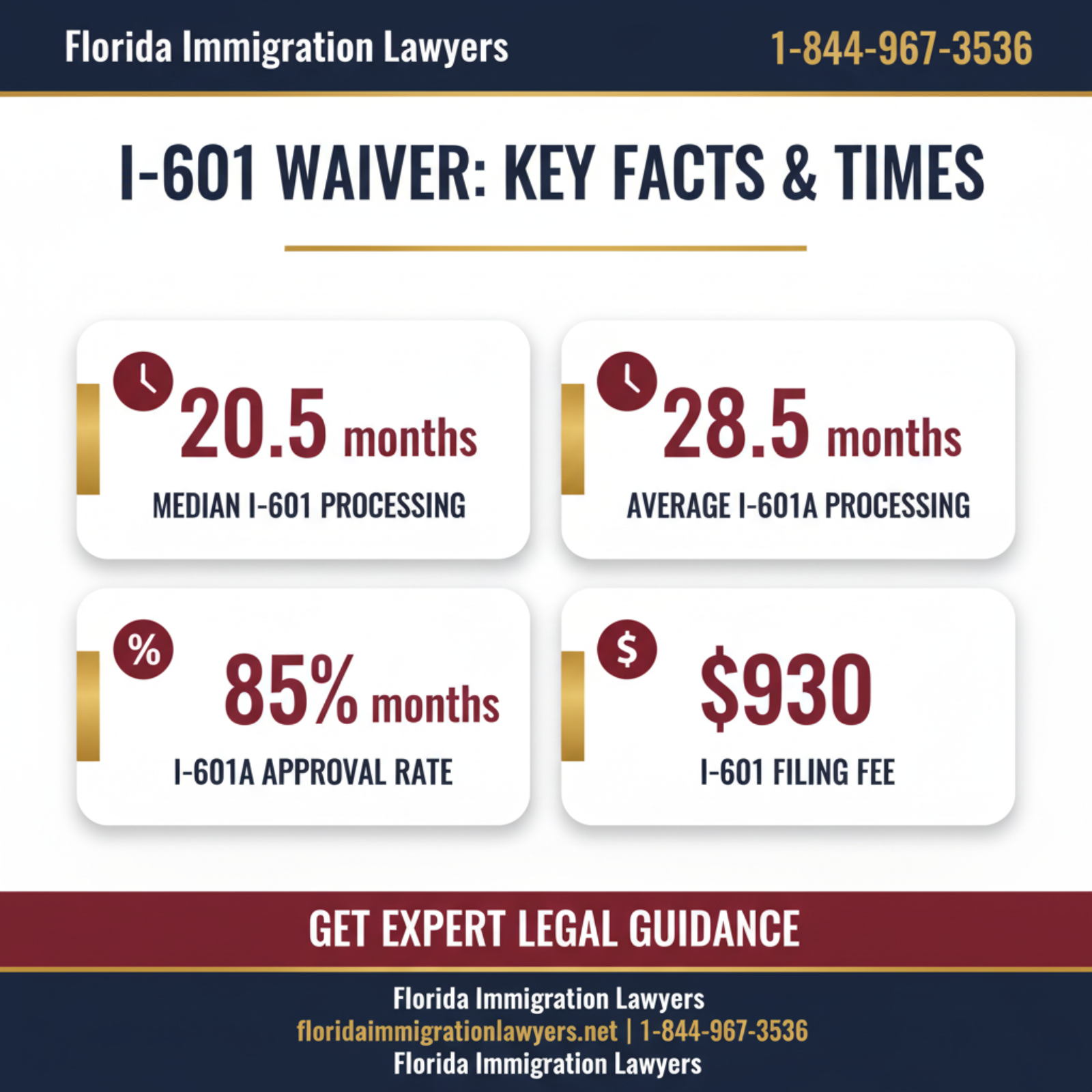
The I-601 waiver processing time can vary significantly based on several factors, including the specific USCIS service center or international office handling your case, the complexity of your application, and current caseloads. As of 2026, processing times can range from several months to over a year. It is crucial to monitor the USCIS website for the most up-to-date processing timeframes for Form I-601.
For applicants in Florida, whether you're filing from Kissimmee or elsewhere, patience is a virtue. USCIS aims to process applications efficiently, but the thorough review required for hardship claims naturally takes time. While there isn't a guaranteed I-601 waiver approval rate publicly disclosed for all cases, a well-prepared application with strong evidence significantly increases your chances of success. Historically, cases demonstrating compelling extreme hardship have a higher likelihood of approval.
What to Expect After Filing Your I-601 Application
After filing your I-601 application, USCIS will typically send you a receipt notice acknowledging that they have received your petition. This notice will contain a receipt number, which you can use to track your I-601 waiver status check online via the USCIS website. You may also receive requests for additional evidence (RFEs) if USCIS determines that more information is needed to make a decision. Responding promptly and thoroughly to RFEs is critical.
In some cases, USCIS may schedule you for an interview to clarify aspects of your application or hardship claim. This is more common in complex cases or when there are inconsistencies. Preparing for a potential interview by reviewing your application and supporting documents is always advisable. For those filing from abroad, the waiver decision typically comes before the final consular interview for the visa.
Cost Factors and Fee Breakdown for the I-601 Waiver
Applying for an I-601 waiver involves various costs, primarily the USCIS filing fee. This fee is subject to change, so it is essential to check the official USCIS website for the most current amount before filing. USCIS fees are non-refundable, regardless of the outcome of your application.
Beyond the government filing fee, you should also account for potential legal fees if you choose to hire an immigration attorney. While not legally required, securing legal representation is highly recommended for I-601 waivers due to their complexity and the high standard of proof required for extreme hardship. An attorney can help you gather evidence, draft compelling affidavits, and present your case effectively. Additional costs may include fees for obtaining documents like birth certificates, marriage licenses, police records, medical evaluations, psychological assessments, and expert witness letters.
Understanding these potential costs upfront will help you budget effectively for your immigration journey. Investing in a strong application, potentially with legal assistance, can often save you time and money in the long run by avoiding denials and appeals.
Common Mistakes to Avoid When Applying for an I-601 Waiver
- Misidentifying the Ground of Inadmissibility: Applying for an I-601 when another waiver (like an I-601A or I-212) is appropriate for your specific ground can lead to immediate denial and wasted time and money. Always confirm the correct waiver form.
- Failing to Prove "Extreme Hardship": This is the most common reason for denial. Many applicants underestimate the high standard required. Merely showing separation is not enough; you must demonstrate hardship beyond what is typical in family separations.
- Insufficient or Unorganized Documentation: A weak application lacks comprehensive evidence. Submitting disorganized or incomplete documents makes it difficult for USCIS to understand and approve your case.
- Not Providing a Detailed Affidavit: Your personal statement and your qualifying relative's affidavit are critical. Generic or brief statements fail to convey the depth of hardship. They should be personal, detailed, and consistent with other evidence.
- Ignoring Country Conditions: If you're arguing that relocation to your home country would cause extreme hardship, failing to provide current, relevant country condition reports can weaken your case significantly.
- Missing Deadlines or Filing Incorrectly: Late submissions or filing the I-601 waiver at the wrong location can result in rejection. Always adhere to filing instructions and deadlines.
- Not Disclosing All Relevant Information: Attempting to hide past criminal history or immigration violations, even minor ones, can lead to fraud allegations and permanent bars to immigration. Transparency is essential.
- Underestimating the Value of Legal Counsel: Many applicants try to navigate the I-601 process alone, only to face denial. The complexity of proving extreme hardship often requires the expertise of an experienced immigration attorney.
- Failing to Address All Inadmissibility Grounds: If you have multiple grounds of inadmissibility, you must address each one for which an I-601 waiver is available. Overlooking even one can lead to denial.
- Submitting Outdated Information: Ensure all documents, especially medical evaluations or financial statements, are current and reflect the most recent circumstances.
When to Call a Lawyer for Your I-601 Waiver
While technically possible to file an immigration waiver on your own, the complexities of the I-601 waiver make legal representation highly advisable. Here are specific scenarios and warning signs that strongly indicate you should consult with an experienced attorney:
- Complex Grounds of Inadmissibility: If your inadmissibility stems from criminal convictions, multiple immigration violations, or misrepresentation, legal expertise is crucial.
- Difficulty Proving "Extreme Hardship": If you are struggling to identify or articulate compelling reasons for extreme hardship to your qualifying relative, an attorney can help you build a strong evidentiary case.
- Prior Denials or Immigration Issues: If you have had previous visa denials, deportation proceedings, or other negative immigration history, a lawyer can assess the impact and strategize accordingly. Consider our firm for deportation defense if you are facing removal.
- Uncertainty About Which Waiver to File: There are various types of waivers. An attorney can determine if the I-601 is the correct form for your situation or if an asylum application or other relief might be more appropriate.
- Language Barriers or Difficulty Understanding Legal Terminology: If English is not your first language or you find legal jargon confusing, an attorney can ensure your application is accurate and well-understood.
- Tight Deadlines: If you are facing a deadline to file your waiver, an attorney can help expedite the process and ensure all documents are submitted on time.
- Seeking Adjustment of Status: If you are applying for family immigration or business immigration and need to adjust status, the I-601 waiver integrates with that process. An attorney can manage the entire application.
Florida Immigration Lawyers has extensive experience with I-601 waiver cases across Florida, including Kissimmee and surrounding areas. Our attorneys are dedicated to helping individuals overcome inadmissibility and achieve their immigration goals. We understand the nuances of the law and the profound impact these decisions have on families. Our goal is to provide comprehensive legal support and strategic guidance, ensuring your application is as strong as possible. We also assist with citizenship applications and other general immigration matters.
About Florida Immigration Lawyers
Florida Immigration Lawyers is a leading law firm dedicated to providing exceptional immigration legal services to individuals and families throughout Florida. With a deep understanding of U.S. immigration law and a commitment to our clients, we strive to make the complex immigration process as smooth and stress-free as possible. Our experienced team is passionate about helping you achieve your American dream, whether it's through family-based petitions, employment visas, or navigating complex waivers.
We offer a wide range of services, including assistance with green cards, citizenship, deportation defense, visas, and various waivers like the I-601 waiver. Our client-focused approach means we take the time to understand your unique situation, offering personalized strategies and diligent representation. We pride ourselves on clear communication, ethical practice, and unwavering advocacy for our clients.
Choose Florida Immigration Lawyers for compassionate, knowledgeable, and effective legal counsel. We are available 24/7 for free consultations and proudly serve all of Florida. Visit our website at https://www.floridaimmigrationlawyers.net or call us at 1-844-967-3536 to learn how we can assist you.
Sources and References
- U.S. Citizenship and Immigration Services (USCIS)
- USCIS Filing Fees
- Form I-601, Application for Waiver of Grounds of Inadmissibility
- Executive Office for Immigration Review (EOIR)
- 8 U.S.C. § 1182 (Section 212 of the Immigration and Nationality Act - INA)
- 8 CFR § 212.7 (Waiver of certain grounds of inadmissibility)
- USCIS Policy Manual, Volume 9, Part A, Chapter 2 (Waivers of Inadmissibility)
This article provides general legal information and is not intended as legal advice. Every case is unique, and outcomes depend on specific facts and circumstances. Contact an attorney for advice about your particular situation. Immigration laws are subject to change, and this content reflects information current as of 2026-04-01.
Are you ready to take the next step in your immigration journey and address grounds of inadmissibility? Don't let uncertainty or fear hold you back. The experienced immigration attorneys at Florida Immigration Lawyers are here to provide the guidance and representation you need. Contact us today for a free, confidential consultation to discuss your I-601 waiver case. Call 1-844-967-3536 now to schedule your appointment. Se Habla Español - Estamos aquí para ayudarle.
Do Not Navigate This Process Alone
Our experienced immigration attorneys are ready to fight for you. Get a free, confidential consultation today.
Se Habla Español
Frequently Asked Questions
Florida Immigration Lawyers
Immigration Attorney | Founder, Vasquez Law Firm
U.S. Air Force veteran and immigration attorney with thousands of cases resolved. J.D., NCCU School of Law. AILA member. Admitted to the 4th, 5th, and 11th Circuit Courts.
Available 24/7 - Free Evaluations
Related Legal Services
Our Florida immigration attorneys can help you with immigration practice areas, free immigration consultation and experienced immigration attorneys. Call today at 1-844-967-3536 for a free consultation.
Related Links
Related Topics
Free Legal Consultation
Discuss your case with our experienced attorneys. We're available 24/7.
Se Habla Español - Estamos aquí para ayudarle.
Related Articles
L-1 Visa Transfer for Florida Companies | VLF Florida
Learn about L-1 visa intracompany transfers for Florida companies. Ensure a smooth transition for your employees to Tampa. Call 1-844-967-3536 for expert advice.
H-2A Visa Opportunities for Florida Agricultural Workers
Explore opportunities for Florida agricultural workers under the H-2A visa program. Learn about application steps, costs, and common mistakes.
Derived Citizenship Through Parents in Florida | VLF Florida
Discover how children born abroad can gain U.S. citizenship through their parents in Florida. Learn about eligibility, the application process, and common pitfalls. Contact Florida Immigration Lawyers at 1-844-967-3536 for expert assistance.
Understanding Immigration Bond Hearings in Florida
Navigating an immigration bond hearing in Florida can be complex. Learn about the process, necessary documents, and common mistakes. Call Florida Immigration Lawyers for assistance.