H-1B Visa Florida Employers Guide 2026: Sponsoring Talent
Florida employers, navigate the H-1B visa process for 2026 with our guide. Learn about requirements, compliance, and how to sponsor talent. Contact Florida Immigration Lawyers for a free consultation.

H-1B Visa Florida Employers Guide 2026: Sponsoring Talent
As Florida continues to grow as a hub for innovation and specialized industries, the demand for highly skilled foreign talent is more critical than ever. For businesses looking to maintain a competitive edge, the H-1B visa program offers a vital pathway to recruit and retain the best global professionals. Navigating the complexities of U.S. immigration law, especially the H-1B process, can be daunting. This comprehensive guide for Florida employers aims to demystify the H-1B visa for the 2026 fiscal year, covering everything from eligibility and application procedures to crucial compliance requirements. Understanding these nuances is essential for any Florida employer seeking to sponsor foreign workers and avoid potential legal pitfalls. Our experienced team at Florida Immigration Lawyers is dedicated to providing expert guidance through every step of this intricate journey. Learn more about our comprehensive immigration services.
Understanding the H-1B Visa Program for Florida Businesses
The H-1B visa is a non-immigrant visa that allows U.S. employers to temporarily employ foreign workers in specialty occupations. These occupations generally require a bachelor's degree or higher in a specific field. For Florida businesses, the H-1B program is not just about filling vacancies; it's about accessing a global talent pool that can drive innovation, expand market reach, and foster economic growth within the state. From tech startups in Miami to aerospace companies in Orlando and healthcare providers across the state, the H-1B visa is a cornerstone for many industries reliant on specialized expertise not readily available in the domestic labor market.
What is the H-1B Visa?
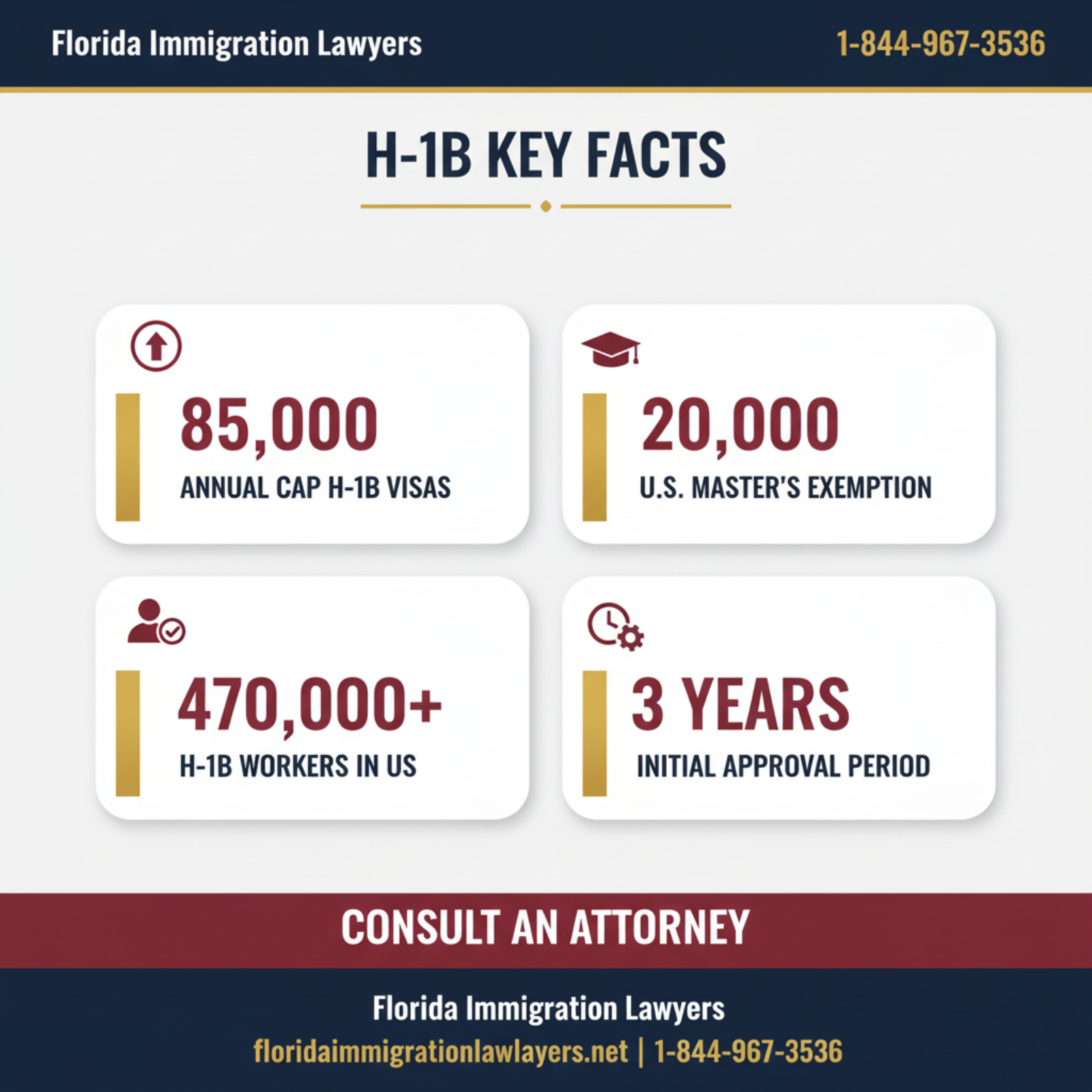
The H-1B visa is specifically designed for individuals working in specialty occupations, which means the theoretical and practical application of a body of highly specialized knowledge, and the attainment of a bachelor's or higher degree in the specific specialty (or its equivalent) as a minimum for entry into the occupation in the United States. The program is subject to an annual cap, currently 85,000 visas per fiscal year, with 20,000 reserved for those with a U.S. master's degree or higher. Due to high demand, a lottery system is often implemented, making strategic planning crucial for employers. This competitive environment underscores the need for meticulous preparation and expert legal counsel.
Benefits for Florida Employers
Sponsoring H-1B workers offers numerous advantages for Florida businesses. It provides access to a diverse pool of highly skilled professionals, often with advanced degrees and international experience, who can bring fresh perspectives and specialized knowledge to your organization. This influx of talent can significantly boost innovation, productivity, and competitiveness. For industries such as technology, engineering, healthcare, and finance, where specific skills are in high demand, H-1B visas are indispensable for maintaining operational excellence and driving future growth. Furthermore, it helps Florida businesses compete globally by attracting the best minds from around the world.
Key Challenges and Considerations
Despite its benefits, the H-1B program comes with its share of challenges. The annual cap and lottery system mean that securing an H-1B visa is not guaranteed, requiring employers to plan well in advance. The application process itself is complex, involving multiple government agencies and strict deadlines. Employers must also adhere to stringent compliance regulations, including prevailing wage requirements and public access file obligations, to avoid penalties. Navigating these complexities demands a thorough understanding of immigration law and often necessitates the guidance of experienced legal professionals. For comprehensive legal support, consider consulting our team of expert attorneys.
Eligibility Requirements for Employers and Employees
To successfully sponsor an H-1B worker, both the employer and the prospective employee must meet specific eligibility criteria set forth by U.S. Citizenship and Immigration Services (USCIS) and the Department of Labor (DOL). Understanding these requirements is the first critical step in initiating the H-1B petition process. Failure to meet any of these criteria can lead to significant delays or even denial of the petition, making careful review and preparation paramount.
Employer Eligibility
A U.S. employer must demonstrate that they have a valid Federal Employer Identification Number (FEIN) and that they offer a bona fide job in a specialty occupation. The employer must also agree to pay the H-1B worker the higher of the actual wage paid to other employees with similar experience and qualifications, or the prevailing wage for the occupation in the area of intended employment. Furthermore, the employer must attest that they will provide working conditions that will not adversely affect the working conditions of workers similarly employed. These attestations are made on the Labor Condition Application (LCA), which is a prerequisite for filing the H-1B petition.
Employee Eligibility
For an individual to qualify for an H-1B visa, they must meet the definition of a specialty occupation worker. This typically means holding a bachelor's degree or its equivalent in a field directly related to the offered position. In some cases, extensive work experience coupled with professional achievements can be deemed equivalent to a bachelor's degree. Additionally, the employee must possess any necessary state licenses required to practice their occupation in Florida. The job duties themselves must be complex enough to require a professional with such a degree. It is crucial to gather all academic credentials, professional licenses, and experience documentation meticulously.
The Lottery System Explained for 2026
Given the annual cap on H-1B visas, USCIS often conducts a lottery to select petitions when demand exceeds availability. For the 2026 fiscal year, employers will likely participate in the electronic registration process, typically held in March of the preceding year (March 2025 for FY2026). During this period, employers submit basic information about their company and the prospective H-1B worker. Only those registrations selected in the lottery are then eligible to file a full H-1B petition. This system underscores the importance of timely registration and having all preliminary information ready well in advance of the registration window. Detailed information can be found on the USCIS website.
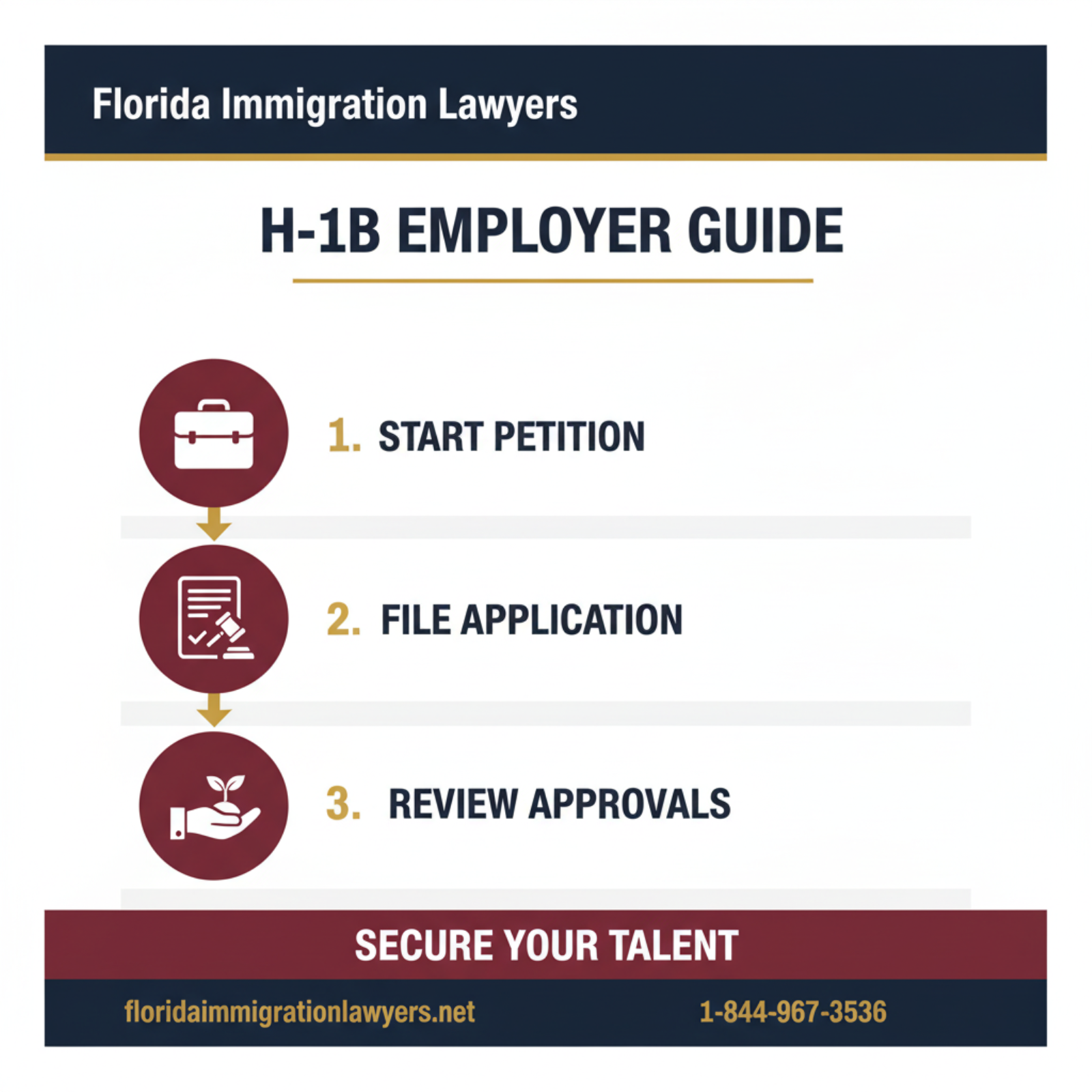
The H-1B Application Process: A Step-by-Step Guide
The H-1B application process is multi-faceted and requires careful attention to detail at each stage. From initial labor condition attestations to final visa stamping, employers must navigate various governmental agencies and strict timelines. A misstep at any point can lead to delays or even denial, making a structured approach and expert guidance invaluable. This section outlines the typical steps involved in securing an H-1B visa for your foreign talent.
Initial Steps: LCA Filing
Before an H-1B petition can be filed with USCIS, the employer must first obtain a certified Labor Condition Application (LCA) from the U.S. Department of Labor (DOL). The LCA attests that the employer will pay the H-1B worker at least the prevailing wage for the occupation in the geographic area of employment, and that the employment of the H-1B worker will not adversely affect the working conditions of U.S. workers similarly employed. The LCA also requires public notice of the intention to employ an H-1B worker. This step is critical and must be completed accurately to avoid issues later in the process.
USCIS Petition Filing (Form I-129)
Once the LCA is certified, the employer can then file Form I-129, Petition for a Nonimmigrant Worker, with USCIS. This petition includes extensive supporting documentation, such as evidence of the employee's qualifications (degrees, transcripts), a detailed job description, organizational charts, and evidence of the employer's ability to pay the offered wage. If the H-1B cap applies and a lottery is conducted, only selected registrations can proceed to this filing stage. Premium processing is available for an additional fee, potentially expediting the USCIS decision.
Visa Interview and Entry
If the H-1B petition is approved, foreign nationals residing outside the U.S. must attend a visa interview at a U.S. embassy or consulate in their home country. During the interview, a consular officer will review the approved petition and ascertain the applicant's eligibility for the visa. Upon successful interview and visa stamping, the individual can then travel to the U.S. and present their visa at a port of entry. Information on visa interviews and consular processing can be found on the Department of State's website at travel.state.gov.
Post-Approval Obligations
An employer's responsibilities do not end with the H-1B approval. Ongoing compliance is crucial. Employers must maintain a Public Access File (PAF) containing specific documents related to the LCA, ensure the H-1B worker is paid the promised wage, and notify USCIS of any material changes in employment (e.g., job location, significant changes in duties). Failure to adhere to these post-approval obligations can lead to severe penalties, including fines and debarment from future immigration programs. Proactive management and legal oversight are essential for sustained compliance.
Navigating H-1B Compliance and Avoiding Pitfalls
H-1B compliance is a complex and continuously evolving area of immigration law. For Florida employers, understanding and strictly adhering to all regulatory requirements is paramount to avoid costly penalties, audits, and potential legal challenges. The Department of Labor (DOL) and USCIS actively monitor H-1B employers for compliance, conducting site visits and investigations. Proactive measures and a robust internal compliance framework are not just good practice; they are essential for protecting your business and ensuring the smooth employment of your H-1B workforce. This section delves into critical compliance areas that Florida businesses must master.
Wage and Working Condition Compliance
One of the most critical aspects of H-1B compliance is ensuring that the sponsored employee is paid the correct wage. Employers must pay the H-1B worker at least the higher of the actual wage paid to other employees with similar experience and qualifications, or the prevailing wage for the occupation in the area of intended employment. This wage must be paid for non-productive time due to a decision by the employer (e.g., lack of work). Employers must also ensure that the working conditions for H-1B workers do not adversely affect those of U.S. workers. This includes providing benefits and working conditions similar to those offered to U.S. employees in comparable positions. Any deviation can trigger DOL investigations and significant fines.
Public Access File Requirements
Every H-1B employer must maintain a Public Access File (PAF) for each LCA filed. This file must be available for public inspection within one working day after the date on which the LCA is filed with the DOL. The PAF must contain specific documents, including a copy of the certified LCA, documentation of the wage rate to be paid to the H-1B worker, documentation of the prevailing wage determination, and evidence of the employer's compliance with the LCA posting requirements. Keeping this file meticulously organized and readily accessible is a non-negotiable requirement for all H-1B employers. Failure to maintain a complete and accurate PAF is a common compliance pitfall.
Employer Site Visits and Audits
USCIS and the DOL conduct unannounced site visits to H-1B employers to verify information provided in petitions and ensure ongoing compliance. During these visits, officers may interview H-1B employees, their managers, and HR personnel, and review payroll records, public access files, and other relevant documentation. Employers must be prepared for such visits by having all records in order and ensuring that employees are aware of the company's H-1B policies. A proactive approach to compliance and record-keeping can significantly mitigate risks associated with audits and investigations. Employers must also be aware of anti-discrimination provisions enforced by the Department of Justice. More details are available at justice.gov.
Amendments and Extensions
H-1B employment is tied to specific conditions. If there are material changes to the H-1B worker's employment, such as a change in job duties, work location, or employer, an H-1B amendment petition may be required. Furthermore, H-1B visas are typically granted for an initial period of up to three years and can be extended for a total maximum stay of six years. Employers must file for extensions well in advance of the current visa's expiration date. Understanding when an amendment is necessary versus when a new LCA or extension is sufficient is a critical aspect of ongoing compliance and requires careful legal analysis.
Strategic Planning for H-1B Success in Florida
Given the competitive nature and complex regulations of the H-1B visa program, strategic planning is indispensable for Florida employers. A proactive and well-thought-out approach can significantly increase your chances of securing the talent you need while ensuring full compliance with U.S. immigration laws. This involves more than just filling out forms; it requires foresight, meticulous organization, and often, the expertise of seasoned legal professionals.
Early Preparation and Timelines
The H-1B process operates on strict annual timelines, particularly concerning the cap-subject lottery. Employers should begin their planning for the 2026 fiscal year well in advance, ideally in late 2024 or early 2025. This includes identifying potential H-1B candidates, assessing job roles for specialty occupation eligibility, gathering necessary documentation, and preparing for the electronic registration period (typically March). Early preparation allows ample time to address any potential issues and ensures that your petition is robust and complete when submitted. Missing a deadline can mean waiting another year to sponsor talent.
Alternative Visa Options
While the H-1B is a popular option, it is not the only pathway for bringing foreign talent to Florida. Depending on the employee's nationality, qualifications, and the nature of the employment, other non-immigrant visas might be suitable. These include the L-1 visa for intracompany transferees, the O-1 visa for individuals with extraordinary ability, or the TN visa for Canadian and Mexican professionals under NAFTA. Exploring these alternatives can provide flexibility, especially if an H-1B petition is not selected in the lottery or if the H-1B cap is a significant concern. Our firm also assists with a wide range of immigration matters, including asylum claims and deportation defense.
The Role of Experienced Legal Counsel
Navigating the intricate H-1B visa process without expert legal guidance can be fraught with risks. An experienced immigration attorney can provide invaluable assistance by: assessing eligibility, preparing and filing all necessary documentation, ensuring compliance with DOL and USCIS regulations, responding to Requests for Evidence (RFEs), and representing your interests throughout the process. For Florida employers, partnering with a knowledgeable immigration law firm is not just a convenience; it's a strategic advantage that minimizes errors, saves time, and significantly increases the likelihood of a successful outcome. Our dedicated team is here to help.
The H-1B visa program remains a cornerstone for Florida businesses seeking to attract and retain top global talent. While the process is complex and demands meticulous attention to detail and stringent compliance, the benefits of accessing a diverse and highly skilled workforce are undeniable. By understanding the eligibility requirements, navigating the application process strategically, and committing to ongoing compliance, Florida employers can successfully leverage the H-1B program to foster innovation and drive economic growth. Don't let the complexities deter you; with expert legal guidance, your business can confidently secure the talent it needs. For personalized assistance with your H-1B petitions or any other immigration matter, do not hesitate to contact Florida Immigration Lawyers for a consultation.
Do Not Navigate This Process Alone
Our experienced immigration attorneys are ready to fight for you. Get a free, confidential consultation today.
Se Habla Español
Frequently Asked Questions
Florida Immigration Lawyers
Immigration Attorney | Founder, Vasquez Law Firm
U.S. Air Force veteran and immigration attorney with thousands of cases resolved. J.D., NCCU School of Law. AILA member. Admitted to the 4th, 5th, and 11th Circuit Courts.
Available 24/7 - Free Evaluations
Related Legal Services
Our Florida immigration attorneys can help you with business immigration, asylum protection and deportation defense. Call today at 1-844-967-3536 for a free consultation.
Related Links
Related Topics
Free Legal Consultation
Discuss your case with our experienced attorneys. We're available 24/7.
Se Habla Español - Estamos aquí para ayudarle.
Related Articles
EB-5 Investor Green Card in Florida: Key Insights | VLF Florida
Explore how the EB-5 investor green card program can help you start a new life in Florida. Learn about the benefits, processes, and common pitfalls of this investment immigration path. Call 1-844-967-3536 for expert guidance.
E-2 Visa for Florida Business Investors | VLF Florida
Learn how the E-2 investor visa can help you start a business in Naples, Florida. We cover eligibility, application steps, common mistakes, and when to seek legal help. Contact Florida Immigration Lawyers for a free consultation.
VAWA Immigration Relief: Support in Florida | VLF Florida
Explore VAWA immigration relief options for abuse victims in Hollywood, Florida. Learn about eligibility, application steps, and common mistakes to avoid. Contact Florida Immigration Lawyers for a free consultation.
EB-5 Investor Green Card in Florida: A Comprehensive Guide
Learn how the EB-5 investor green card program can help you gain U.S. residency through investment in Florida. Discover key steps, common mistakes, and when to seek legal advice. Call Florida Immigration Lawyers at 1-844-967-3536 for a free consultation.
