H-1B Visa 100K Fee: Florida Immigration Guide for 2026
The H-1B visa program is crucial for skilled professionals and employers in Florida. However, the potential $100,000 fee introduced in recent years adds significant complexity. This fee, often debated and legally challenged, targets specific types of employers, making it essential for businesses in Hialeah and across Florida to understand its applicability and exemptions for 2026. Our comprehensive guide covers the step-by-step application, required documents, processing timelines, and cost factors, including the various H1B visa fees for 2026. Avoid common mistakes and learn when to seek professional legal help to ensure a successful H-1B petition. Florida Immigration Lawyers offer guidance for all your H-1B needs.
The H-1B visa 100K fee, initially proposed to impact certain H-1B petitions, adds a significant cost layer for employers in Florida and nationwide. This fee, if applicable, targets specific employers and scenarios, making guidance crucial. Understanding its exemptions and legal status is vital for a successful H-1B application in 2026.
- The $100,000 fee primarily affects new H-1B petitions for specific employers.
- Exemptions may apply based on employer type or beneficiary status.
- Legal challenges to this fee have been significant and continue to evolve.
- Proper preparation and legal counsel are essential to navigate these complex H-1B visa fees.
- Florida employers and H-1B hopefuls must stay informed about 2026 H-1B new rules.
H-1B Visa 100K Fee: Florida Immigration Guide for 2026
Are you an employer in Florida considering hiring a foreign professional, or an international talent hoping to work in the Sunshine State? The H-1B visa program is a vital pathway for skilled workers, but recent developments, particularly concerning a potential $100,000 fee, have added layers of complexity.
Navigating these H-1B visa changes, especially in vibrant areas like Hialeah and Miami, requires precise knowledge and strategic planning. You need to understand who might be affected by the H-1B visa 100K fee and what steps to take.
This comprehensive guide from Florida Immigration Lawyers will walk you through the H-1B visa process for 2026, focusing on the $100,000 fee, its implications for Florida, and how our firm can assist you. Do not face these challenges alone. Call Florida Immigration Lawyers at 1-844-YO-PELEO for a free consultation today.
Understanding the H-1B Visa Program and New Fee Structure
The H-1B visa is a nonimmigrant visa that allows U.S. employers to temporarily employ foreign workers in specialty occupations. These occupations generally require a bachelor's degree or higher in a specific field. Many professionals across Florida, from technology to healthcare, rely on this visa.
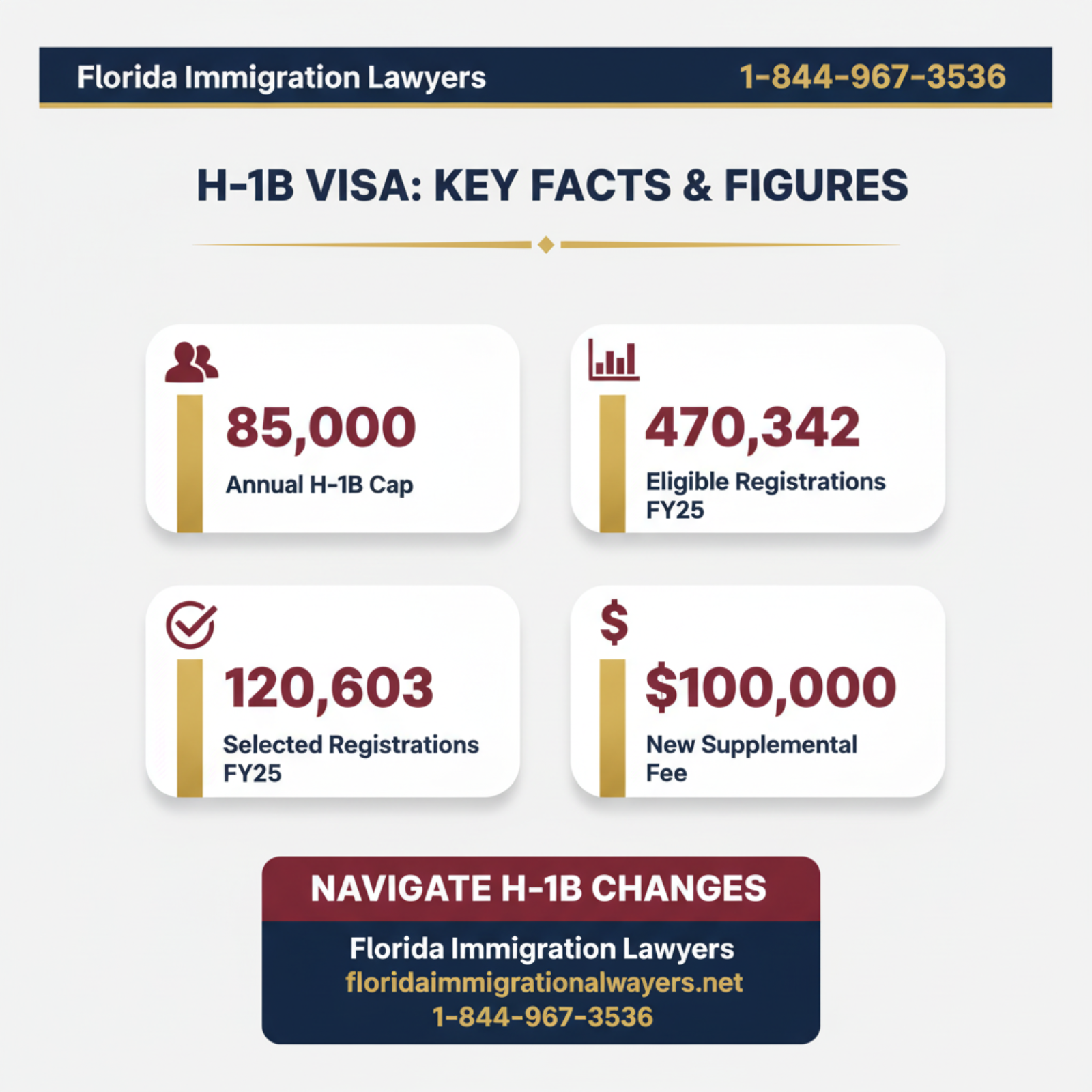
In recent years, the H-1B program has seen various proposals for reform and changes to its fee structure. One of the most significant and debated proposals has been the potential implementation of a $100,000 fee for certain H-1B visa petitions.
Origin and Status of the H-1B Visa 100K Fee
The concept of a $100,000 H-1B visa fee emerged from executive actions aimed at prioritizing U.S. workers and adjusting immigration policies. While initially introduced, its full implementation has faced considerable legal challenges and ongoing debate. As of 2026, its applicability is highly specific and subject to court rulings and regulatory clarifications.
This fee is generally not a universal charge for all H-1B petitions. Instead, it typically targets employers who meet certain criteria, often involving a high percentage of H-1B workers or specific business models. Understanding these criteria is paramount for any Florida business or individual seeking an H-1B.
Who Has to Pay the $100,000 for an H-1B Visa?
The $100,000 H-1B fee, where applicable, is typically levied on employers, not the individual beneficiary. It generally applies to employers who are considered 'H-1B dependent employers' or those with a significant number of H-1B and L-1 visa holders. Specific thresholds and definitions apply, which can change based on current regulations.
An H-1B dependent employer is generally defined by having a certain percentage of their workforce on H-1B visas. For instance, companies with 50 or more employees where 15% or more are H-1B or L-1 nonimmigrants might be subject to additional fees. This is a critical factor for many tech companies and large corporations in Florida.
Is Anyone Paying 100K for H-1B? Will H-1B 100K Be Challenged?
Yes, some employers may be subject to this fee if their circumstances align with the specific regulatory criteria. However, the fee's implementation has been met with significant legal challenges. Many immigration advocacy groups and business organizations have filed lawsuits, arguing against its legality and impact on U.S. competitiveness.
The legal landscape surrounding the H-1B visa 100K fee is dynamic. Courts have weighed in, and further challenges or legislative actions are always possible. This makes staying informed about H1B $100k lawsuit updates crucial for all stakeholders in Florida.
H-1B Visa 100K Fee Exemption: Who Qualifies?
There are typically exemptions to the $100,000 H-1B fee. These exemptions often relate to the nature of the employer or the qualifications of the beneficiary. For example, some non-profit organizations, educational institutions, or government research organizations may be exempt from certain H-1B fees.
Additionally, beneficiaries with advanced degrees from U.S. institutions or those being paid significantly above the prevailing wage might also fall under exemption categories for some fees. Understanding these H1B visa 100k fee exemption criteria is vital for cost management.
Step-by-Step Guide to the H-1B Visa Application Process with the $100K Fee
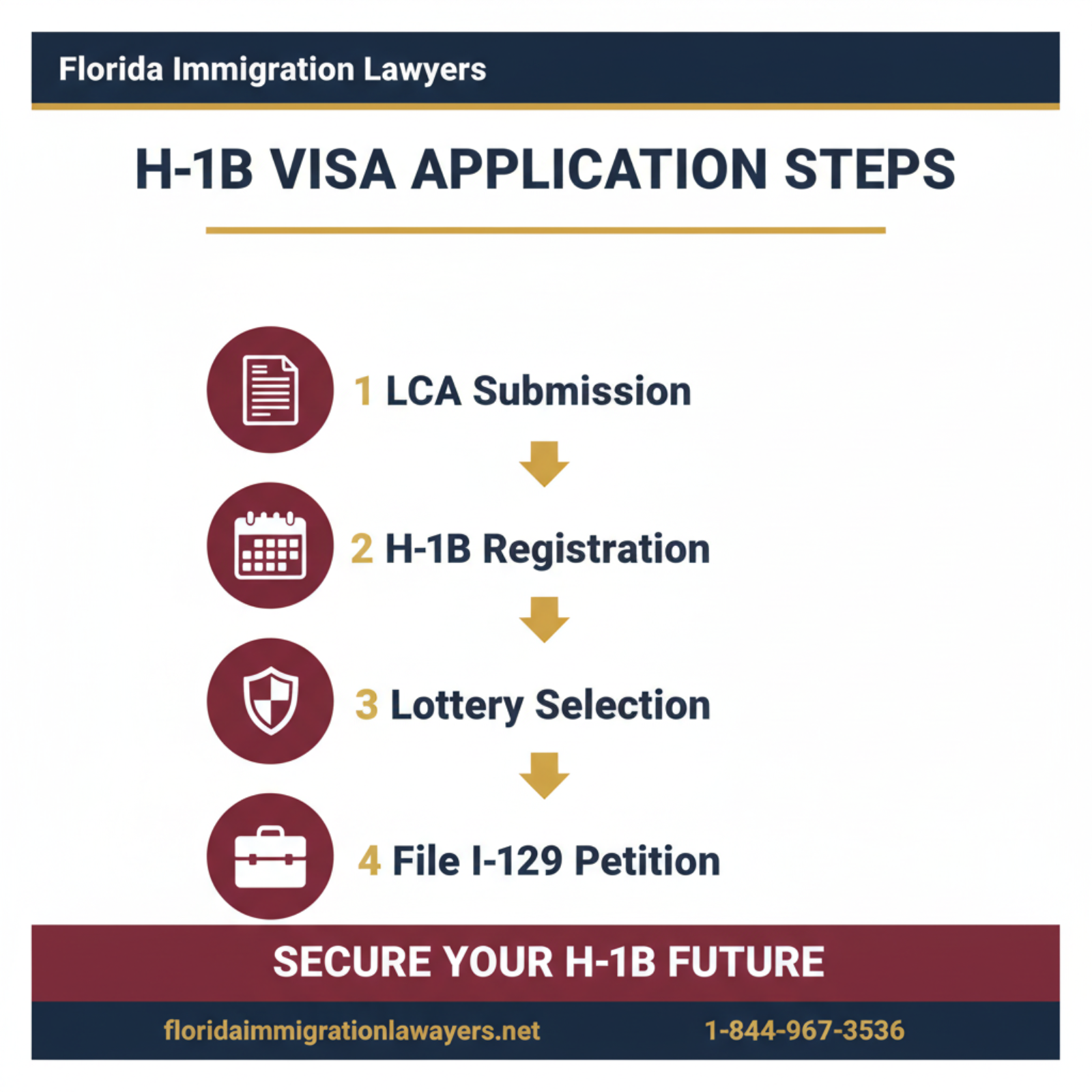
Applying for an H-1B visa, especially with the complexities of the $100,000 fee, requires meticulous attention to detail. Here is a general step-by-step overview of the process for 2026:
-
Determine Eligibility and Prevailing Wage: The employer must first confirm the position qualifies as a specialty occupation and the beneficiary meets the educational requirements. They must then obtain a certified Labor Condition Application (LCA) from the U.S. Department of Labor. This LCA confirms the employer will pay at least the prevailing wage for the occupation in the specific geographic area, such as Hialeah, Florida.
-
H-1B Cap Registration (If Applicable): For cap-subject H-1B visas, employers must register electronically with USCIS during a specified registration period. This is typically in March for the fiscal year starting October 1st. If selected, the employer receives an invitation to file a petition.
-
Prepare and File Form I-129 Petition: The employer files Form I-129, Petition for a Nonimmigrant Worker, with U.S. Citizenship and Immigration Services (USCIS). This petition includes all supporting documentation, the certified LCA, and applicable fees, including the $100,000 fee if determined to be required based on the employer's profile.
-
Respond to Requests for Evidence (RFE): USCIS may issue an RFE if they need more information or clarification on the petition. Prompt and thorough responses are critical for a successful outcome. This is where an experienced Florida H-1B lawyer can be invaluable.
-
Petition Approval: If the petition is approved, USCIS sends an I-797 Approval Notice. For beneficiaries already in the U.S. and changing status, this typically means they can begin employment on the H-1B start date. For those abroad, it allows them to proceed to visa stamping.
-
Visa Interview and Stamping (for those abroad): Beneficiaries outside the U.S. must attend an interview at a U.S. Embassy or Consulate in their home country. Upon successful interview, the H-1B visa is stamped in their passport. More information can be found on travel.state.gov.
-
Entry into the U.S.: Once the visa is stamped, the beneficiary can enter the U.S. and begin working for the petitioning employer. They will typically receive an I-94 Arrival/Departure Record reflecting their H-1B status.
Essential Document Checklist for Your H-1B Visa Petition (Including $100K Fee Considerations)
A complete and accurate submission of documents is crucial for any H-1B visa petition. Ensure you have the following ready, especially when considering the H-1B visa 100K fee:
- Certified Labor Condition Application (LCA) Form ETA 9035/9035E.
- Form I-129, Petition for a Nonimmigrant Worker, and its supplements.
- Employer's Federal Employer Identification Number (FEIN).
- Copies of the beneficiary's passport, birth certificate, and any previous U.S. visas.
- Beneficiary's educational documents: degrees, transcripts, and foreign degree evaluations if applicable.
- Evidence of work experience, including letters from previous employers.
- Beneficiary's resume or CV.
- Employer's company profile, including financial statements, tax returns, and articles of incorporation.
- Detailed job description for the specialty occupation position.
- Evidence of employer's H-1B dependent status, if applicable, to determine if the $100,000 fee applies.
- Proof of payment for all required USCIS fees, including the base filing fee, ACWIA fee, fraud prevention and detection fee, and the $100,000 fee if applicable.
- Any additional documentation requested by USCIS to establish eligibility for the H-1B visa requirements.
H-1B Visa Timeline, Processing Expectations, and Cost Factors in Florida 2026
The H-1B visa process involves several stages, each with its own timeline. Understanding these expectations is vital for planning, especially for businesses in Florida's competitive market.
Typical H-1B Processing Timeline
The H-1B cap registration typically occurs in March. If selected, the filing window for petitions usually opens in April. USCIS processing times for Form I-129 can vary significantly, often ranging from several months to over a year, depending on the service center and caseload.
Premium processing is available for an additional fee, which guarantees a decision within 15 calendar days. This option is often utilized by Florida employers needing to fill critical positions quickly. However, it does not guarantee approval, only expedited review.
Cost Factors and H1B Visa Fees 2026
The H-1B visa cost to employer involves several components beyond the potential $100,000 fee. These fees are set by USCIS and are subject to change. It is crucial not to confuse the various fees when preparing your petition.
- Base Filing Fee: This is a standard fee for Form I-129.
- ACWIA Fee (American Competitiveness and Workforce Improvement Act of 1998): This fee varies based on the number of employees the company has.
- Fraud Prevention and Detection Fee: A mandatory fee for all initial H-1B petitions.
- Public Law 114-113 Fee (if applicable): This is the fee category where the $100,000 fee would fall, applying to specific H-1B dependent employers or those with high H-1B/L-1 ratios.
- Premium Processing Fee: An optional fee for expedited processing.
- Attorney Fees: Legal fees for guidance and representation from a Florida H-1B lawyer.
It is important to remember that specific fee amounts are not provided here as they are subject to change by USCIS. You should always consult the official USCIS website or an immigration attorney for the most current fee schedule.
Do not navigate this complex process alone. The stakes are too high for your career or your business. Contact Florida Immigration Lawyers today to ensure your H-1B visa petition is handled with precision and experience.
Common Mistakes to Avoid When Applying for an H-1B Visa with the $100K Fee
The H-1B visa application process is intricate, and mistakes can lead to costly delays or even denials. When the $100,000 fee is a factor, accuracy becomes even more critical. Here are common pitfalls to avoid:
-
Incorrectly Determining H-1B Dependent Status: Many employers misinterpret the criteria for being an H-1B dependent employer. This can lead to either an underpayment (resulting in an RFE or denial) or an unnecessary overpayment of the $100,000 fee. Thorough analysis is required.
-
Failing to Pay the Correct Fees: Beyond the $100,000 fee, there are several other required H1b visa fees 2026. Missing any component, or sending an incorrect amount, will cause the petition to be rejected or delayed. Always double-check the USCIS fee schedule.
-
Incomplete or Inaccurate LCA: The Labor Condition Application (LCA) is the foundation of an H-1B petition. Errors in prevailing wage determination, job duties, or location can lead to a denial. Ensure the LCA accurately reflects the job offer in Florida.
-
Insufficient Evidence of Specialty Occupation: USCIS rigorously evaluates whether a position qualifies as a specialty occupation. Failing to provide robust documentation proving the job requires a bachelor's degree in a specific field can be a major setback. Generalist roles are often scrutinized.
-
Lack of Comprehensive Beneficiary Qualifications: The beneficiary must clearly demonstrate they possess the required degree or its equivalent for the specialty occupation. Inadequate transcripts, evaluations, or experience letters can lead to an RFE or denial.
-
Missing the H-1B Cap Registration Deadline: For cap-subject petitions, failing to register during the brief window in March means you miss the opportunity for that fiscal year. There are no exceptions for late registrations.
Key Statistics & Data -
Inadequate Response to Requests for Evidence (RFEs): RFEs from USCIS are common. A weak, incomplete, or untimely response can result in a denial. Each RFE must be addressed thoroughly and with additional supporting evidence.
-
Not Maintaining H-1B Status: For beneficiaries already in the U.S., any lapse in employment, unauthorized work, or failure to adhere to visa conditions can jeopardize their status and future immigration prospects. Always consult an attorney before making changes.
-
Assuming the $100K Fee is Universal: Not every H-1B petition is subject to the $100,000 fee. Incorrectly assuming it applies when an exemption exists can lead to unnecessary costs. Conversely, failing to plan for it if it does apply is a significant oversight.
-
Ignoring H1B New Rules 2026: Immigration laws and policies, especially regarding fees and eligibility, can change. Relying on outdated information can be detrimental. Always verify the latest regulations from official sources or an attorney.
When to Call a Florida H-1B Immigration Lawyer
The complexities of the H-1B visa, amplified by the potential $100,000 fee and evolving H1B new rules 2026, make legal counsel almost indispensable. Florida Immigration Lawyers are here to guide you through every step.
You should contact us if:
- You are an employer unsure if your company is subject to the H-1B visa 100K fee or qualifies for an H1B visa 100k fee exemption.
- You need assistance with the H-1B cap registration process or preparing a robust Form I-129 petition.
- You receive a Request for Evidence (RFE) from USCIS and need guidance to respond effectively.
- You are concerned about prevailing wage determinations or LCA compliance for your Florida-based position.
- You need help navigating the H-1B visa cost to employer, including all applicable fees for 2026.
- You have a unique or complex H-1B scenario, such as concurrent H-1B employment or a change of employer.
- You wish to discuss the implications of the H1B $100k lawsuit updates and how they might affect your case.
- You are an individual seeking to understand your rights and options as an H-1B beneficiary in Florida.
Our experienced team at Florida Immigration Lawyers serves clients across Florida, including Orlando. We understand the specific challenges faced by businesses and individuals in our state.
About Florida Immigration Lawyers
Florida Immigration Lawyers is an immigration law firm dedicated to serving individuals, families, and businesses across all of Florida. Our team of skilled attorneys possesses extensive knowledge of U.S. immigration law and a deep commitment to our clients' success.
We offer a comprehensive range of immigration services, including general immigration matters, business and employment visas like the H-1B, family-based immigration, asylum, deportation defense, and citizenship applications. We pride ourselves on providing personalized, compassionate, and effective legal representation.
Why choose Florida Immigration Lawyers? We are available 24/7, offer free consultations, and have experience helping clients achieve their immigration goals. Our attorneys are passionate advocates, ready to stand by your side. Learn more about our attorneys and contact us today.
Sources and References
- U.S. Citizenship and Immigration Services (USCIS)
- Executive Office for Immigration Review (EOIR)
- U.S. Department of Labor (DOL) - Foreign Labor Certification
- U.S. Department of State - H-1B Specialty Occupations
- 8 U.S.C. § 1101 et seq. - Immigration and Nationality Act (INA)
- 8 U.S.C. § 1182(n) - Requirements for petitions for H-1B nonimmigrants
- 8 CFR Part 214.2(h) - Regulations for H nonimmigrants
- Public Law 114-113 - Consolidated Appropriations Act, 2016 (relevant sections for specific fees)
This article provides general legal information and is not intended as legal advice. Every case is unique, and outcomes depend on specific facts and circumstances. Contact an attorney for advice about your particular situation.
Navigating the H-1B visa process, especially with the potential $100,000 fee and the latest H1B new rules 2026, requires legal guidance. Do not risk your future or your business's growth by going it alone. Florida Immigration Lawyers are standing by to provide the clear, effective representation you deserve. Call us now for a free consultation at 1-844-YO-PELEO. Se Habla Español - Estamos aquí para ayudarle.
Do Not Navigate This Process Alone
Our experienced immigration attorneys are ready to fight for you. Get a free, confidential case review today.
Se Habla Español
Or leave your details and we’ll call you:
Free Evaluation in 24 Hours
Or talk to us right now

AI voice assistant — available 24/7
FreeFrequently Asked Questions

William J. Vásquez
Founding Attorney · Vasquez Law Firm
U.S. Air Force veteran and immigration attorney with years of hands-on U.S. immigration experience. J.D., NCCU School of Law. AILA member. Admitted to the 4th, 5th, and 11th Circuit Courts.
Available 24/7 - Free Evaluations
Reviewed for legal accuracy by William J. Vásquez
Licensed in North Carolina; U.S. immigration is federal practice.
Related Legal Services
Our Florida immigration attorneys can help you with asylum protection, citizenship and naturalization and immigration practice areas. Call today at 1-844-YO-PELEO for a free case review.
Related Links
Related Topics
Free Legal Case Review
Discuss your case with our experienced attorneys. We're available 24/7.
Se Habla Español - Estamos aquí para ayudarle.
Related Articles
EAD Advance Parole Combo Card in Florida: What You Need
An EAD advance parole combo card allows individuals with pending adjustment applications to both work and travel abroad without jeopardizing their green card application. Learn how to apply in Florida, what documents you need, and common mistakes to avoid.
PERM Labor Certification in Florida: A 2026 Guide
Learn all about the PERM labor certification process in Florida, essential for employers sponsoring green card applicants. Understand the steps, document requirements, and common mistakes to avoid in this 2026 guide.
Dual Citizenship Lawyer in Florida: What You Need to Know
For Florida residents, the concept of dual citizenship, or holding two passports, offers a compelling blend of opportunities and challenges. While the U.S. generally permits dual nationality, the path to achieving this status requires a meticulous understanding of both U.S. immigration laws and the citizenship policies of your country of origin. This guide explores the definition of dual citizenship, the detailed step-by-step process for U.S. naturalization, and the significant benefits and potential pitfalls involved. We cover essential documentation, typical timelines, and cost considerations for 2026, providing crucial insights for anyone in Orlando, Miami, or across Florida considering this important legal step. Learn about common mistakes to avoid and understand when to seek professional legal counsel to navigate this complex process successfully. Florida Immigration Lawyers is here to provide expert, bilingual support for your dual citizenship journey.
Immigration Lawyer Orlando Free Consultation in Florida
For individuals and families in Orlando, Florida, navigating the complexities of U.S. immigration law requires expert guidance. An immigration lawyer in Orlando offers crucial support for everything from visa applications and green card processes to naturalization and deportation defense. This comprehensive guide details what a free consultation covers, providing a step-by-step overview of immigration pathways, essential document checklists, and expected timelines in 2026. We also highlight common mistakes to avoid, discuss the critical role of legal counsel in deportation and asylum cases, and explain why choosing a local Orlando immigration attorney is beneficial. Florida Immigration Lawyers is dedicated to serving the diverse community of Orlando with compassionate, effective legal solutions, ensuring you receive personalized advice and robust representation for a successful immigration journey.