H-1B Visa Fee Increase Florida 2026: New Costs & Your
The H-1B visa fee increase in Florida for 2026 will bring new financial considerations for employers and skilled professionals. Understanding these updated costs and navigating the complex application process is crucial for success. This comprehensive guide from Florida Immigration Lawyers breaks down the changes, offers a step-by-step approach, highlights essential documents, and outlines common mistakes to avoid. We emphasize the importance of legal guidance to ensure compliance and efficiency amidst these regulatory adjustments. Learn how to prepare effectively and protect your H-1B petition in Florida.

The H-1B visa fee increase in Florida for 2026 introduces new costs for employers and applicants, impacting the overall process. These changes, enacted by USCIS, aim to adjust for inflation and operational expenses. Understanding these updated fees is crucial for any business or professional seeking an H-1B visa in Florida.
- New H-1B fees are effective in 2026, impacting all petitions.
- Employers typically bear the majority of H-1B visa costs.
- Careful preparation and legal guidance are vital to navigate these changes.
- Fee increases reflect adjustments for inflation and agency operational needs.
- Consulting an immigration lawyer can help mitigate risks and ensure compliance.
Are you a Florida employer or a skilled professional considering an H-1B visa? The landscape of U.S. immigration is constantly evolving, and 2026 brings significant changes to the H-1B visa fee increase structure. These adjustments by U.S. Citizenship and Immigration Services (USCIS) can impact your plans and budget, making careful preparation more critical than ever.
Navigating these new regulations can be complex, particularly when your career or business depends on securing essential talent. This comprehensive guide will break down the upcoming H-1B visa fee increase in Florida for 2026, explain what to expect, and offer actionable advice for a smooth application process. We are here to help you understand these critical updates.
Do not let fee changes derail your immigration goals. Call Florida Immigration Lawyers at 1-844-967-3536 for a free consultation to discuss your specific H-1B visa needs and strategy.
Understanding the H-1B Visa Fee Increase in Florida for 2026
The H-1B visa program is a cornerstone for U.S. companies seeking to employ foreign workers in specialty occupations. These roles typically require a bachelor's degree or higher in a specific field. For many businesses in Florida, from tech startups in Miami to healthcare providers in Hialeah, the H-1B program is vital for attracting global talent.
What is the H-1B Visa Program?
The H-1B visa allows U.S. employers to temporarily employ foreign workers in occupations that require theoretical and practical application of a body of highly specialized knowledge. Examples include IT professionals, engineers, doctors, and scientists. The program is subject to an annual cap, making the competition intense.
Each year, USCIS conducts a lottery if the number of petitions exceeds the allocated cap. This competitive environment, coupled with the new fee structure, emphasizes the need for meticulous application preparation. Your eligibility and application strength are paramount for success.
Why Are Fees Increasing?
USCIS periodically adjusts its fees to recover the costs of processing immigration applications and petitions. These adjustments ensure the agency can maintain efficient operations and implement new technologies. The H-1B visa fee increase for 2026 reflects these operational needs and inflationary pressures.
These fee adjustments are typically published in the Federal Register and become effective after a public comment period. For detailed information on fee changes, you can always refer to the official USCIS website. Staying informed directly from official sources is crucial.
The impact of these increases will be felt by employers across Florida. Businesses in vibrant economic hubs like Orlando, Tampa, and especially Hialeah, which has a significant immigrant population, will need to factor these new costs into their hiring strategies. Planning ahead is key to managing these financial adjustments effectively.
Step-by-Step Guide to Navigating H-1B Petitions Amidst New Fees
The H-1B visa process can be intricate, and the upcoming fee changes add another layer of complexity. Here is a general step-by-step guide to help you understand the journey, especially with the H-1B visa fee increase in mind.
-
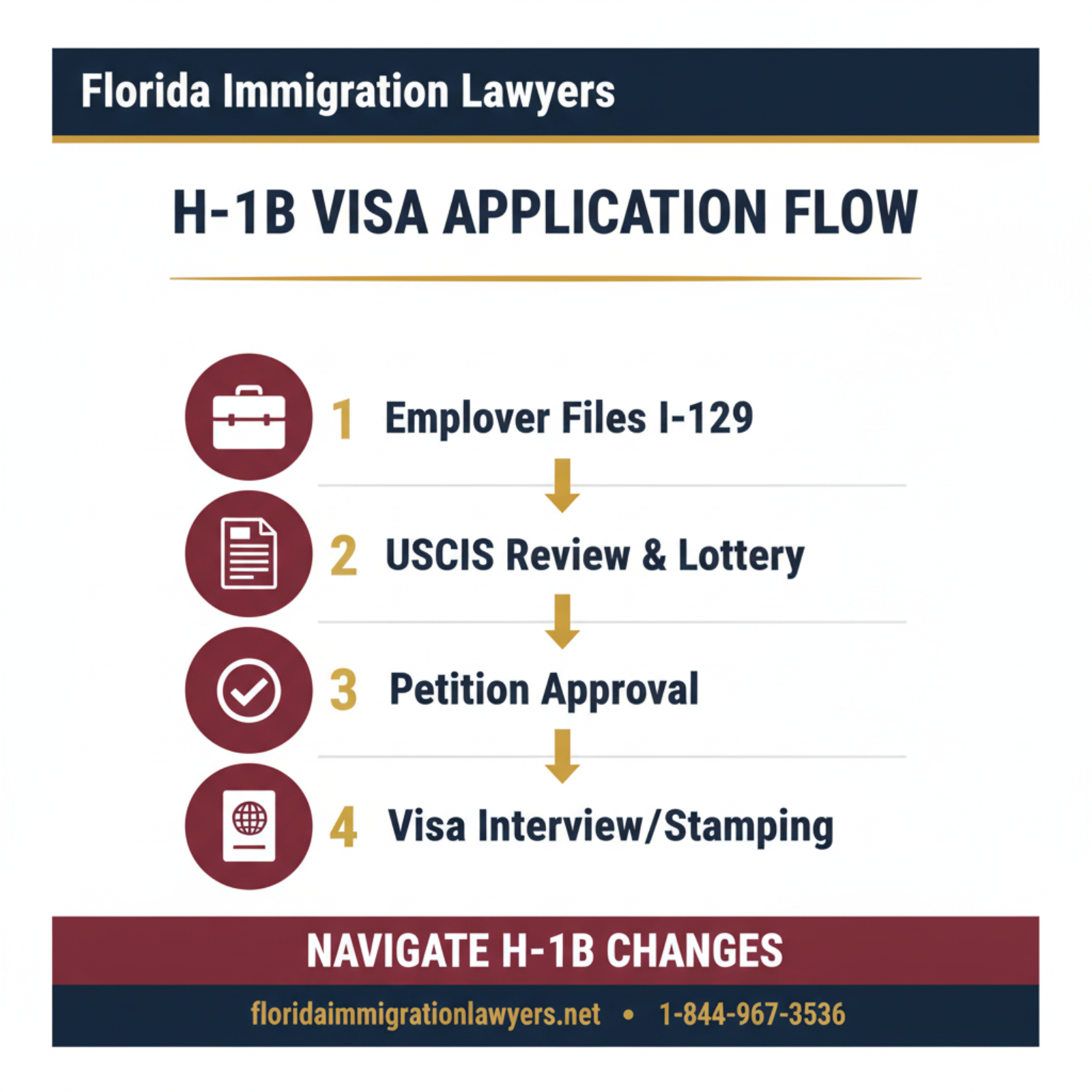
Employer Registration and Lottery: The employer must first register electronically with USCIS during a designated period. If more registrations are received than available visas, USCIS conducts a lottery to select eligible registrations. This step is critical for cap-subject petitions.
-
Labor Condition Application (LCA) Filing: If selected in the lottery, or for cap-exempt petitions, the employer must file a Form ETA-9035, Labor Condition Application, with the Department of Labor (DOL). This certifies that the employer will pay the H-1B worker at least the prevailing wage for the occupation in the area of intended employment. This protects both U.S. and foreign workers.
-
Form I-129 Petition Filing: Once the LCA is certified, the employer files Form I-129, Petition for a Nonimmigrant Worker, with USCIS. This petition includes all supporting documentation and the newly adjusted filing fees. Accuracy and completeness are paramount at this stage.
-
Petition Processing and Adjudication: USCIS reviews the petition and supporting evidence. They may issue a Request for Evidence (RFE) if more information is needed. This stage can take several months, depending on USCIS caseloads and whether premium processing is utilized.
-
Consular Processing or Adjustment of Status: If the petition is approved, the beneficiary either attends an interview at a U.S. consulate abroad (consular processing) to obtain the H-1B visa stamp or, if already in the U.S. in another valid status, files Form I-485 to adjust their status to H-1B. This final step brings the process to completion.
Essential Document Checklist for Your H-1B Application
A successful H-1B petition hinges on submitting a complete and accurate set of documents. Missing or incorrect paperwork is a common reason for RFEs or denials. Pay close attention to these requirements to navigate the H-1B visa fee increase and secure your visa.
- Certified Labor Condition Application (LCA) Form ETA-9035.
- Form I-129, Petition for a Nonimmigrant Worker, completed and signed.
- Employer's letter of support detailing the job offer, duties, salary, and necessity of the position.
- Beneficiary's educational credentials: diplomas, transcripts, and foreign degree evaluations.
- Evidence of beneficiary's professional experience and specialized skills.
- Copies of beneficiary's passport, visa, and I-94 arrival/departure record (if applicable).
- Resumé or curriculum vitae of the beneficiary.
- Employer's financial statements, tax returns, and business licenses to demonstrate ability to pay the prevailing wage.
- Photographs of the beneficiary (if required for consular processing).
- Any relevant professional licenses or certifications required for the occupation in Florida.
H-1B Visa Timeline and Processing Expectations in 2026
Understanding the timeline for an H-1B visa is crucial for both employers and beneficiaries. The process can vary significantly based on several factors, including whether the petition is cap-subject or cap-exempt, and the current USCIS processing backlogs. The H-1B visa fee increase does not directly shorten processing times, but efficient submission can prevent delays.
For cap-subject H-1B visas, the registration period typically opens in early March, with the lottery results announced by the end of March. Petitions can then be filed from April 1st for an October 1st start date. This annual cycle is very competitive.
USCIS processing times for Form I-129 can range from several months to over a year, depending on the service center and case complexity. You can check current processing times on the USCIS website. Premium processing, which guarantees a 15-day response for an additional fee, remains an option for those needing faster adjudication.
Cost Factors and Fee Breakdown for H-1B Visas
The H-1B visa fee increase for 2026 introduces new financial considerations. It is important to understand that H-1B fees are generally paid by the petitioning employer, not the employee, as per U.S. labor laws. However, certain legal and premium processing fees might be an exception.
The total cost of an H-1B petition involves several components. These typically include the base filing fee, the American Competitiveness and Workforce Improvement Act (ACWIA) fee, the Fraud Prevention and Detection Fee, and potentially a Public Law 114-113 fee for certain employers. Each of these fees will see adjustments in 2026.
Additionally, employers may opt for premium processing for an expedited decision, which incurs a separate, substantial fee. Attorney fees for legal assistance are also a significant cost factor, providing invaluable expertise and peace of mind. For businesses in Florida seeking to sponsor foreign talent, understanding these evolving costs is critical for financial planning. Our business immigration services can help you navigate these financial complexities.
Do not navigate this process alone. Contact Florida Immigration Lawyers today to ensure your H-1B petition is compliant and cost-effective. We can help you understand the specific impacts of the H-1B visa fee increase on your case.
Common Mistakes to Avoid with Your H-1B Petition
Applying for an H-1B visa, especially with the new fee structure, can be fraught with potential pitfalls. Avoiding common mistakes is crucial for a successful outcome. Here are some key errors to watch out for:
-
Incomplete or Inaccurate Forms: Submitting forms with missing information or errors can lead to immediate rejections or Requests for Evidence (RFEs), significantly delaying the process. Double-check every field.
-
Insufficient Supporting Documentation: Failing to provide all required evidence, such as educational transcripts, employment letters, or company financial records, weakens your petition. Ensure every claim is backed by solid proof.
-
Not Meeting Prevailing Wage Requirements: Employers must pay the H-1B worker at least the prevailing wage for the occupation in the geographic area of employment. Failure to do so can result in significant penalties and denial. The Department of Labor sets these standards.
-
Missing Deadlines or Registration Periods: The H-1B process has strict timelines, especially for cap-subject petitions. Missing the annual registration window or filing deadlines means waiting another year. Timeliness is critical.
-
Lack of Specialty Occupation Proof: The H-1B position must clearly qualify as a specialty occupation, requiring a bachelor's degree or higher in a specific field. Vague job descriptions or insufficient evidence of specialty can lead to denial. Strengthen your case by clearly outlining the specialized nature of the role.
-
Employer-Employee Relationship Issues: USCIS scrutinizes the bona fide employer-employee relationship, especially for third-party placements. Clear contracts and control over the employee are essential. Ensure your documentation clearly establishes this relationship.
-
Ignoring Previous Immigration History: Any prior immigration violations, denials, or overstays by the beneficiary can significantly impact eligibility. Full disclosure and addressing these issues proactively are vital. Transparency is always the best approach.
-
Incorrectly Calculating or Submitting Fees: With the H-1B visa fee increase, ensuring you submit the correct, updated fees is paramount. Incorrect payments can lead to returned petitions and delays. Always verify current fee schedules on the USCIS website.
-
Not Responding Adequately to RFEs: If USCIS issues an RFE, a thorough and timely response is critical. A weak or incomplete response will likely result in a denial. Seek legal counsel to craft a strong response.
-
Misrepresentation or Fraud: Providing false information or engaging in fraudulent activities will lead to immediate denial, severe penalties, and potential bars from future immigration benefits. Honesty and integrity are non-negotiable.
When to Call a Lawyer for Your H-1B Visa Process
While this guide provides general information, the H-1B visa process, particularly with the new H-1B visa fee increase, can be highly complex and specific to individual circumstances. There are many scenarios where the expertise of an experienced immigration attorney is not just helpful but essential.
You should consider contacting Florida Immigration Lawyers if you:
- Are an employer unfamiliar with the H-1B process or new to sponsoring foreign workers.
- Have a complex case, such as a beneficiary with a prior visa denial or an unusual educational background.
- Need assistance responding to a Request for Evidence (RFE) or Notice of Intent to Deny (NOID).
- Are a beneficiary seeking to change employers or adjust your status from another visa category.
- Require guidance on the prevailing wage determination or compliance with Department of Labor regulations.
- Are concerned about the financial implications of the new fee structure and want to ensure cost-efficiency.
- Operate a business in Florida, especially in areas like Hialeah, and want local, specialized legal advice.
Our team at Florida Immigration Lawyers specializes in immigration law, including H-1B visas. We can help you navigate the intricacies of the application, prepare robust documentation, and represent your interests before USCIS. Do not risk your future or your business's ability to thrive. Visit our attorneys page or contact us directly for expert assistance.
About Florida Immigration Lawyers
Florida Immigration Lawyers is a leading law firm dedicated to providing exceptional immigration legal services across the entire state of Florida. With a deep understanding of U.S. immigration laws and policies, we are committed to helping individuals, families, and businesses achieve their immigration goals.
Our experienced attorneys offer a wide range of services, including H-1B visas, family-based petitions, green cards, naturalization, and deportation defense. We pride ourselves on offering personalized, compassionate, and effective legal representation. We understand the challenges and anxieties that come with immigration processes, and we are here to provide clear guidance and strong advocacy.
Why choose Florida Immigration Lawyers? We offer free consultations, are available 24/7, and provide bilingual services (English and Spanish) to better serve Florida's diverse communities. Our commitment is to your success and peace of mind. Call us today at 1-844-967-3536 or visit www.floridaimmigrationlawyers.net to learn how we can assist you.
Sources and References
- U.S. Citizenship and Immigration Services (USCIS)
- Executive Office for Immigration Review (EOIR)
- U.S. Department of State
- 8 U.S.C. Chapter 12 - Immigration and Nationality Act (INA)
- INA § 214(g) - Numerical limitations on H-1B visas
- 8 CFR Part 214 - Nonimmigrant Classes
- 20 CFR Part 655 - Temporary Employment of H-1B Nonimmigrants
This article provides general legal information and is not intended as legal advice. Every case is unique, and outcomes depend on specific facts and circumstances. Contact an attorney for advice about your particular situation.
The upcoming H-1B visa fee increase in Florida for 2026 demands careful planning and expert guidance. Do not face these changes alone. Florida Immigration Lawyers is ready to assist you. Call us now for a free consultation at 1-844-967-3536. Se Habla Español - Estamos aquí para ayudarle.
Do Not Navigate This Process Alone
Our experienced immigration attorneys are ready to fight for you. Get a free, confidential consultation today.
Se Habla Español
Frequently Asked Questions
Florida Immigration Lawyers
Immigration Attorney | Founder, Vasquez Law Firm
U.S. Air Force veteran and immigration attorney with thousands of cases resolved. J.D., NCCU School of Law. AILA member. Admitted to the 4th, 5th, and 11th Circuit Courts.
Available 24/7 - Free Evaluations
Related Legal Services
Our Florida immigration attorneys can help you with business immigration, asylum protection and deportation defense. Call today at 1-844-967-3536 for a free consultation.
Related Links
Related Topics
Free Legal Consultation
Discuss your case with our experienced attorneys. We're available 24/7.
Se Habla Español - Estamos aquí para ayudarle.
Related Articles
Protecting Against Immigration Scams in Florida | VLF Florida
Learn how to protect yourself from immigration scams in Florida, including notario fraud. Discover actionable steps and legal resources. Call Florida Immigration Lawyers at 1-844-967-3536.
L-1 Visa Transfer for Florida Companies | VLF Florida
Learn about L-1 visa intracompany transfers for Florida companies. Ensure a smooth transition for your employees to Tampa. Call 1-844-967-3536 for expert advice.
H-2A Visa Opportunities for Florida Agricultural Workers
Explore opportunities for Florida agricultural workers under the H-2A visa program. Learn about application steps, costs, and common mistakes.
Derived Citizenship Through Parents in Florida | VLF Florida
Discover how children born abroad can gain U.S. citizenship through their parents in Florida. Learn about eligibility, the application process, and common pitfalls. Contact Florida Immigration Lawyers at 1-844-967-3536 for expert assistance.