Green Card Through Marriage in Florida: Your 2026 Guide
Discover the essential steps to obtain a green card through marriage in Florida in 2026. This comprehensive guide from Florida Immigration Lawyers covers eligibility, the application process, required documents, and what to expect regarding timelines and costs. Learn about common mistakes to avoid and when professional legal assistance is crucial for your marriage-based green card. Whether you are in Gainesville or elsewhere in Florida, understanding these details is vital for a successful application. We emphasize the importance of proving a bona fide marriage and navigating the complexities of Adjustment of Status versus Consular Processing. Contact our expert team for a free consultation to secure your future in the U.S. with confidence.
Obtaining a green card through marriage in Florida involves demonstrating a bona fide marital relationship with a U.S. citizen or lawful permanent resident. The process typically includes filing Form I-130, followed by either Adjustment of Status (for applicants in the U.S.) or Consular Processing (for those abroad). Timelines vary based on specific circumstances and USCIS workloads.
- Requires a legally valid, bona fide marriage.
- Two main pathways: Adjustment of Status or Consular Processing.
- Initial green card may be conditional, requiring a second petition.
- Legal assistance is highly recommended for complex cases.
- Processing times can range from months to over a year.
Is your spouse a U.S. citizen or lawful permanent resident, and are you dreaming of building a life together in the Sunshine State? Navigating the U.S. immigration system to secure a green card through marriage can feel overwhelming. The process is intricate, demanding meticulous attention to detail and a thorough understanding of ever-evolving immigration laws.
This comprehensive guide from Florida Immigration Lawyers is designed to demystify the journey for couples in Gainesville and across Florida. We will walk you through each critical step, explain the requirements, and help you understand what to expect in 2026. Our goal is to empower you with the knowledge needed to pursue your immigration goals confidently.
Do not embark on this significant journey alone. For personalized guidance and expert legal representation, call Florida Immigration Lawyers at 1-844-967-3536 for a free consultation. We are here to help you every step of the way.
Understanding the Green Card Through Marriage Process in Florida
A green card through marriage allows foreign nationals to become lawful permanent residents of the United States based on their marital relationship with a U.S. citizen or a lawful permanent resident (LPR). This pathway is one of the most common routes to permanent residency, reflecting the U.S. government's commitment to family unity.
The core principle behind marriage-based immigration is establishing a bona fide marriage. This means your marriage must be legitimate, entered into for love and companionship, not solely for immigration benefits. USCIS scrutinizes these petitions carefully to prevent fraud.
Eligibility Requirements for Marriage-Based Green Cards
To be eligible for a marriage green card, several key requirements must be met by both the petitioner (U.S. citizen or LPR spouse) and the beneficiary (immigrant spouse). Understanding these criteria is crucial before initiating your application.
First, you must have a legally valid marriage. This means your marriage must be recognized by the state or country where it took place, and all prior marriages for both spouses must have been legally terminated. Bigamy is a significant bar to eligibility.
Second, the petitioner must be a U.S. citizen or a lawful permanent resident. The processing times and categories differ based on the petitioner's status. U.S. citizens can petition for immediate relatives, which generally means no visa quota limitations, leading to faster processing.
If your spouse is a lawful permanent resident (green card holder), you may still be eligible for a green card. However, you will be categorized under the F2A family preference category, which is subject to annual visa quotas. This typically results in longer waiting times compared to petitions filed by U.S. citizens.
Third, you must prove your marriage is bona fide. This is perhaps the most critical aspect of the application. USCIS wants to see evidence that your marriage is real and not just a convenience to gain immigration benefits. We will discuss specific types of evidence later.
Finally, the immigrant spouse must be admissible to the United States. Certain factors can make an applicant inadmissible, such as criminal history, past immigration violations, or specific health conditions. Waivers may be available in some situations.
Adjustment of Status vs. Consular Processing
There are two primary pathways for obtaining a green card through marriage, depending on where the immigrant spouse resides:
- Adjustment of Status (AOS): This process is for immigrant spouses who are already physically present in the United States and entered lawfully. It allows them to apply for lawful permanent resident status without leaving the country. The entire application, including the interview, typically takes place at a USCIS field office, such as those serving Gainesville in Orlando or Miami.
- Consular Processing: This pathway is for immigrant spouses who reside outside the United States or are ineligible for Adjustment of Status. The application is processed through a U.S. Embassy or Consulate in the immigrant spouse's home country. After the initial petition is approved by USCIS, the case is transferred to the National Visa Center (NVC), and then to the embassy or consulate for an interview.
Choosing the correct pathway is vital, as errors can cause significant delays or even denial. Our team at Florida Immigration Lawyers can help you determine the most appropriate route for your specific situation.
Navigating the Marriage Green Card Application: A Detailed 2026 Guide
The application process for a green card through marriage involves several distinct stages, each requiring specific forms and documentation. While the exact steps can vary slightly between Adjustment of Status and Consular Processing, the core framework remains similar.
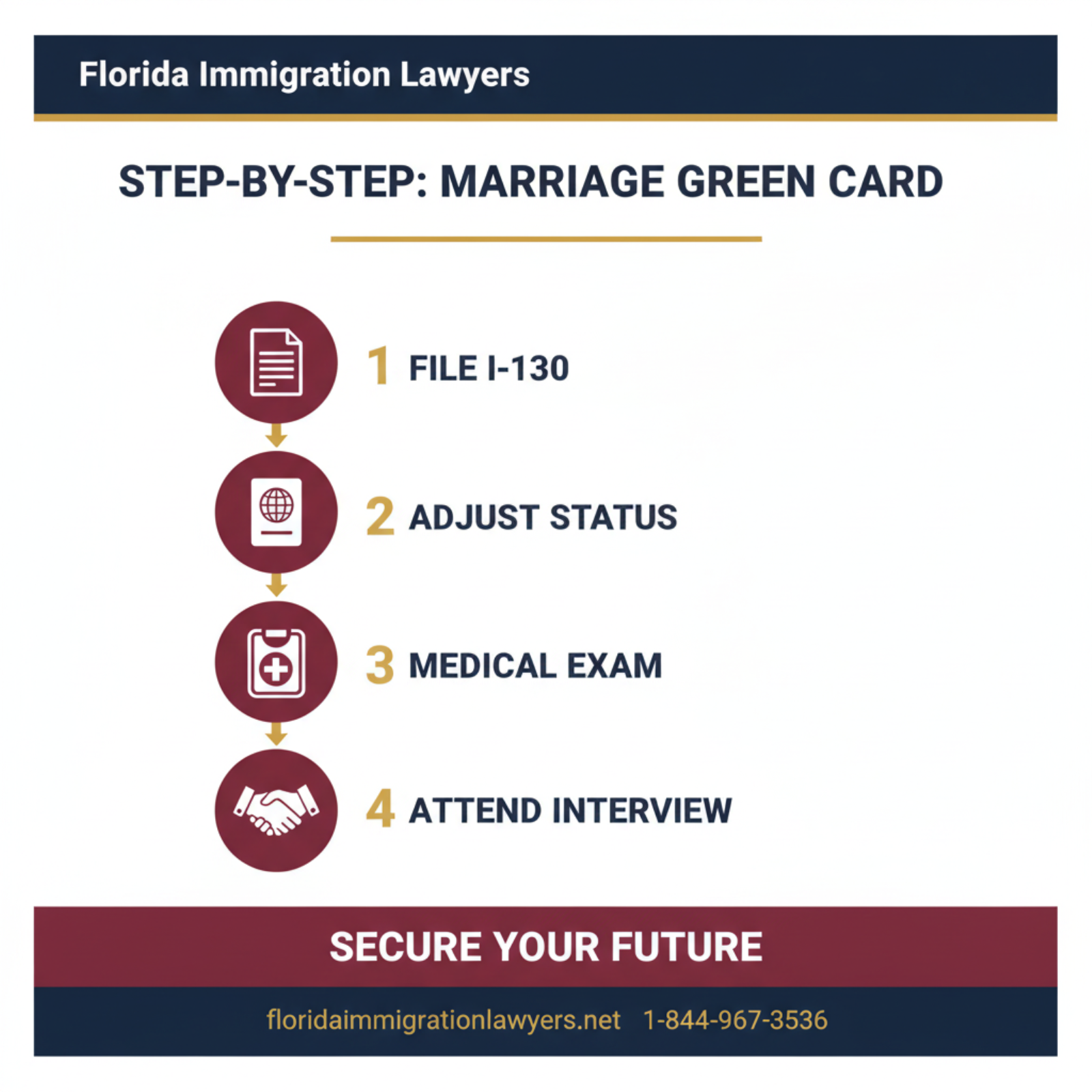
- Step 1: File Form I-130, Petition for Alien Relative.
The U.S. citizen or LPR spouse (petitioner) initiates the process by filing Form I-130 with U.S. Citizenship and Immigration Services (USCIS). This form establishes the qualifying relationship between the petitioner and the beneficiary. You must submit supporting documents, including proof of the petitioner's status (e.g., birth certificate, naturalization certificate, green card), proof of a legally valid marriage (marriage certificate), and evidence that the marriage is bona fide.
- Step 2: USCIS Processes Form I-130.
Once submitted, USCIS reviews the I-130 petition. They will send a receipt notice (Form I-797C) acknowledging receipt of your application. If more information is needed, they may send a Request for Evidence (RFE). An approval notice indicates that USCIS recognizes your marital relationship as legitimate.
- Step 3 (AOS): File for Adjustment of Status (Form I-485).
If the immigrant spouse is in the U.S. and eligible for Adjustment of Status, they can often file Form I-485, Application to Register Permanent Residence or Adjust Status, concurrently with Form I-130, or after the I-130 is approved. Alongside Form I-485, applicants typically file Form I-765 (Application for Employment Authorization) and Form I-131 (Application for Travel Document, Advance Parole). These allow the applicant to work and travel while the green card application is pending. A medical examination by a USCIS-approved civil surgeon is also required, submitted on Form I-693.
- Step 3 (Consular Processing): National Visa Center (NVC) Processing.
If the immigrant spouse is outside the U.S., once the I-130 is approved, the case is forwarded to the National Visa Center (NVC). The NVC collects additional fees and required documents, including civil documents (birth certificates, marriage certificates, police certificates) and financial support documents (Form I-864, Affidavit of Support). The NVC ensures the file is complete before scheduling an interview at the appropriate U.S. Embassy or Consulate.
- Step 4: Biometrics Appointment.
For AOS applicants, after filing Form I-485, USCIS will schedule a biometrics appointment at an Application Support Center (ASC). At this appointment, your fingerprints, photograph, and signature are collected for background checks.
- Step 5: Interview.
Both AOS and Consular Processing cases typically require an interview. For AOS, the interview is held at a local USCIS field office in Florida (e.g., Orlando, Miami, Tampa). Both spouses must attend and be prepared to answer questions about their relationship to confirm its authenticity. For Consular Processing, the interview takes place at a U.S. Embassy or Consulate abroad, usually with only the immigrant spouse present, though the petitioner may attend.
- Step 6: Decision and Green Card Issuance.
If the interview is successful and all requirements are met, the application will be approved. For AOS, the immigrant spouse will receive their green card by mail. For Consular Processing, the immigrant spouse will receive an immigrant visa stamp in their passport, allowing them to enter the U.S. as a permanent resident. The physical green card is then mailed to their U.S. address after entry.
Essential Documents for Your Green Card Application
Gathering the correct documents is paramount for a successful marriage green card application. Missing or incorrect documents are common reasons for delays or RFEs. Here is a general checklist of essential documents; however, your specific case may require additional items.
- Proof of Petitioner's U.S. Citizenship or LPR Status: U.S. birth certificate, U.S. passport, naturalization certificate, Certificate of Citizenship, or copy of permanent resident card (Form I-551).
- Proof of Marriage: Certified copy of your marriage certificate.
- Proof of Termination of Prior Marriages: Divorce decrees or death certificates for all previous marriages of both spouses.
- Identity Documents: Copies of passports, birth certificates, and government-issued IDs for both spouses.
- Financial Support Documents: Form I-864, Affidavit of Support, along with the petitioner's federal income tax returns (most recent three years), W-2s, and pay stubs.
- Evidence of Bona Fide Marriage: This is critical. Provide as much evidence as possible to demonstrate your marriage is real. Examples include:
- Joint bank accounts, credit card statements, or financial statements.
- Joint leases, mortgages, or property deeds.
- Utility bills in both names at the same address.
- Birth certificates of children born to the marriage.
- Affidavits from friends and family who know your relationship.
- Photographs of the couple together over time, especially at significant events.
- Travel itineraries and tickets for trips taken together.
- Joint insurance policies (health, life, auto).
- Correspondence addressed to both spouses.
- Any other documentation proving commingling of lives and assets.
- Medical Examination Report: Form I-693, completed by a USCIS-approved civil surgeon (for AOS applicants).
- Police Certificates: Required for Consular Processing and sometimes for AOS if you have a criminal history.
- Passports and Visa Information: For the immigrant spouse, including current and expired passports, visa stamps, and I-94 arrival/departure records.
- Photographs: Passport-style photos for both petitioner and beneficiary.
Organizing these documents can be daunting. Florida Immigration Lawyers can help you compile a robust application package, ensuring all necessary evidence is included.
Green Card Through Marriage Timeline in Florida: What to Expect in 2026
One of the most common questions we receive is, "How long will it take to get a green card through marriage?" The timeline for a marriage green card can vary significantly based on several factors, including the petitioner's status (U.S. citizen vs. LPR), the processing pathway (AOS vs. Consular Processing), the specific USCIS service center or embassy handling the case, and current caseloads.
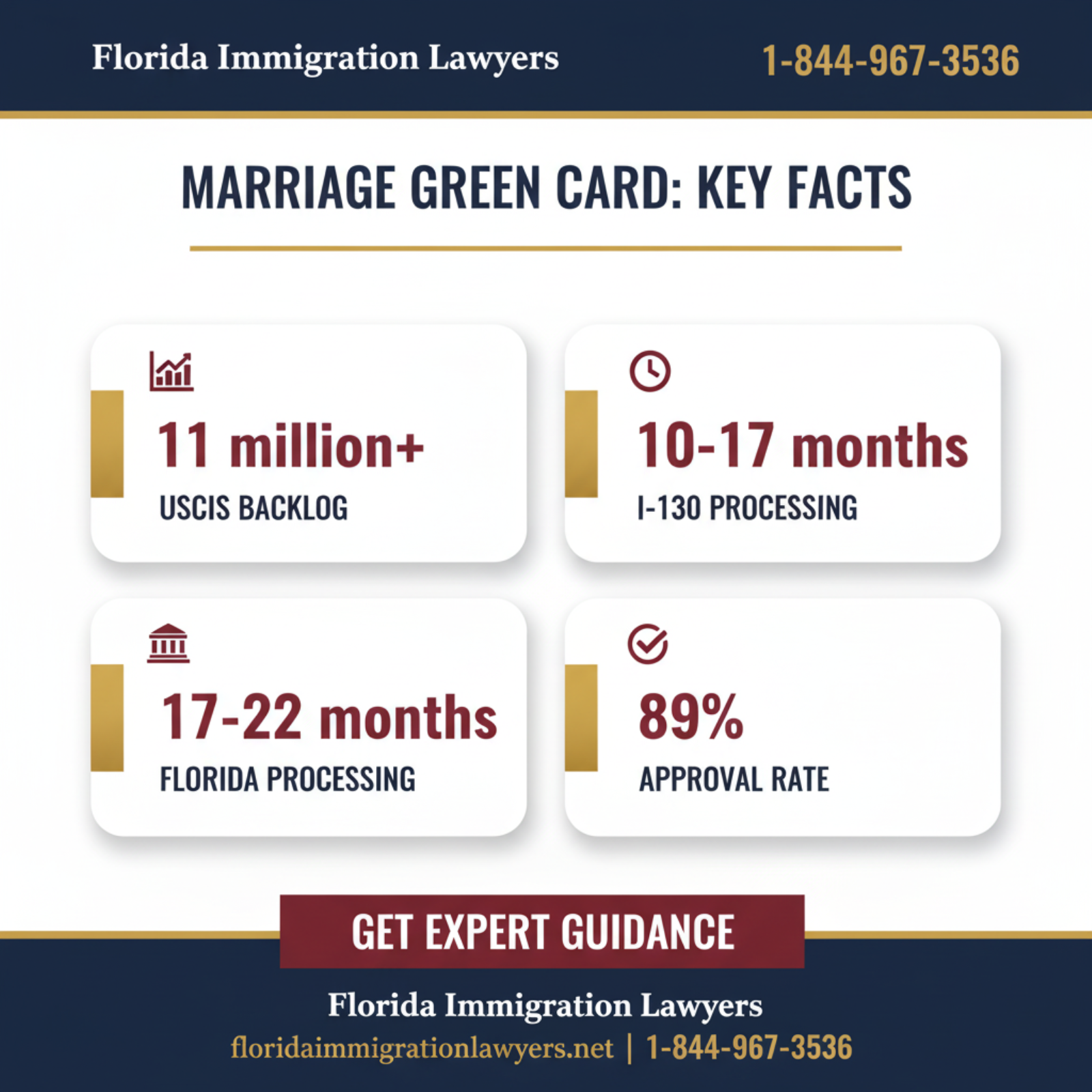
For U.S. citizen petitioners, the process for an immediate relative (spouse) generally moves faster because there are no annual visa quotas. An Adjustment of Status case for a U.S. citizen's spouse in Florida might take anywhere from 10 to 24 months from initial filing to green card approval. This can fluctuate based on the specific USCIS field office where the interview takes place, such as those serving Gainesville in Orlando or Miami.
For lawful permanent resident petitioners, the process typically takes longer due to visa availability in the F2A family preference category. After the I-130 petition is approved, the immigrant spouse must wait for a visa number to become available according to the Visa Bulletin. This wait can add several months or even years to the overall timeline, often ranging from 24 to 36 months or more.
Consular Processing timelines are also influenced by visa availability and the efficiency of the specific U.S. Embassy or Consulate. While the NVC processing stage can take several months, the overall timeline from I-130 filing to visa issuance can be similar to or slightly longer than AOS for immediate relatives, and considerably longer for F2A cases.
It is important to remember that these are general estimates for 2026. USCIS processing times can change without notice. You can check the latest processing times on the official USCIS website.
Conditional vs. Permanent Green Cards
The "2-year rule" for green cards is a critical aspect of marriage-based immigration. If your marriage is less than two years old on the day your green card is approved, you will be granted a conditional green card (Form I-551) valid for two years. This is to further verify the legitimacy of the marriage.
To remove the conditions and receive a 10-year permanent green card, you and your spouse must file Form I-751, Petition to Remove Conditions on Residence, within the 90-day period before your conditional green card expires. Failure to file this petition on time can result in the termination of your conditional resident status and initiation of removal (deportation) proceedings.
If the marriage ends in divorce or if you are a victim of abuse, you may be able to file Form I-751 with a waiver of the joint filing requirement. This is a complex area of law where experienced legal counsel from Florida Immigration Lawyers is invaluable.
Understanding the Costs of a Marriage Green Card Application
The financial aspect of applying for a green card through marriage is an important consideration. The total cost typically includes government filing fees, medical examination fees, and potentially attorney fees. It is important to note that government fees are subject to change by USCIS.
Here's a breakdown of common cost factors:
- USCIS Filing Fees: These include fees for Form I-130, Form I-485 (for AOS), biometrics services, and Form I-751 (for conditional residents). For Consular Processing, fees typically include Form I-130, NVC processing fees, and the immigrant visa application fee.
- Medical Examination Fees: All applicants for Adjustment of Status and Consular Processing must undergo a medical examination by a USCIS-approved civil surgeon or a panel physician abroad. The cost for this examination is separate from USCIS fees and varies by provider.
- Document Translation Fees: If any of your supporting documents are not in English, they must be translated by a certified translator. This will incur additional costs.
- Attorney Fees: While not legally required, hiring an experienced immigration attorney from Florida Immigration Lawyers can be a wise investment. Legal fees cover professional guidance, preparation of forms, organization of documents, representation at interviews, and handling any complexities that arise.
It is crucial to budget for these expenses. USCIS does offer fee waivers for certain low-income applicants for some forms, but eligibility is strict and not available for all applications. Always verify current fees directly on the USCIS website before submitting your application. Do not send cash to USCIS; always use checks or money orders as instructed.
Do not navigate this process alone. Contact Florida Immigration Lawyers today for expert assistance with your marriage green card application.
Common Mistakes to Avoid in Your Marriage Green Card Application
The green card through marriage process is complex, and even minor errors can lead to significant delays, Requests for Evidence (RFEs), or even denial. Avoiding these common pitfalls can greatly improve your chances of success.
- Failing to Prove a Bona Fide Marriage: This is the most frequent reason for denials. Many couples underestimate the amount and type of evidence required to show their marriage is real. Simply submitting a marriage certificate is not enough. You must provide compelling evidence of shared life and commingled assets.
- Submitting Incomplete or Incorrect Forms: Every question on every form must be answered accurately and completely. Leaving fields blank or making careless errors can trigger RFEs or rejections. Double-check all forms before submission.
- Missing Deadlines: Strict deadlines apply, especially for filing Form I-751 to remove conditions on a conditional green card. Missing these deadlines can lead to loss of status and potential deportation.
- Not Disclosing All Information: Failing to disclose past immigration violations, criminal history, or other relevant personal information can be considered misrepresentation and lead to severe consequences, including permanent bars from immigration benefits. Transparency is key.
- Lack of Financial Support Documentation: The petitioner must demonstrate the ability to financially support the immigrant spouse by meeting specific income thresholds. Failing to provide a complete Form I-864 (Affidavit of Support) and supporting tax documents is a common issue.
- Incorrectly Choosing Adjustment of Status vs. Consular Processing: Attempting to adjust status when ineligible (e.g., unlawful entry) can have dire consequences, leading to denial and placement in removal proceedings. Always confirm your eligibility for the chosen pathway.
- Ignoring Medical Exam Requirements: Forgetting to obtain a medical exam from a USCIS-approved civil surgeon or submitting an outdated report can delay your application. Ensure the Form I-693 is correctly completed and sealed.
- Traveling Without Advance Parole (for AOS Applicants): If you are applying for Adjustment of Status and travel outside the U.S. without an approved Advance Parole document (Form I-131), your I-485 application may be considered abandoned. This can be a devastating mistake.
- Inadequate Preparation for the Interview: Many couples take the interview lightly. Be prepared to answer questions about your relationship, how you met, daily life, and future plans. Inconsistent answers between spouses can raise red flags.
- Not Seeking Legal Counsel for Complex Cases: While some straightforward cases might be manageable without an attorney, situations involving prior deportations, criminal records, unlawful presence, or previous immigration denials almost always require professional legal assistance.
- Assuming Marriage to a U.S. Citizen Guarantees a Green Card: Marriage to a U.S. citizen does not automatically guarantee a green card. The marriage must be bona fide, and the immigrant spouse must be admissible to the U.S. and meet all eligibility criteria.
- Not Updating USCIS of Address Changes: If you move, you must notify USCIS within 10 days using Form AR-11. Failure to do so can result in missed notices and significant problems with your case.
When to Call a Lawyer for Your Marriage Green Card
While some couples attempt to navigate the green card through marriage process independently, the complexities of immigration law often necessitate the expertise of a qualified attorney. Florida Immigration Lawyers are dedicated to providing comprehensive support for families across Florida, including Gainesville.
You should strongly consider contacting an attorney if any of the following scenarios apply to your situation:
- Complex Immigration History: If the immigrant spouse has previous immigration violations, such as overstaying a visa, unlawful entry, prior deportations, or multiple visa denials.
- Criminal Record: Any arrests, charges, or convictions for either spouse can significantly complicate the case and may require waivers of inadmissibility.
- Previous Marriages or Divorces: If either spouse has been married multiple times, or if the validity of a prior divorce is questionable, legal review is crucial.
- Short Marriage Duration: While not a disqualifier, a very new marriage might face higher scrutiny from USCIS, making strong evidence of a bona fide relationship even more critical.
- Prior Denials: If you have had previous immigration applications denied, an attorney can help analyze the reasons for denial and strategize a new approach.
- Age or Cultural Differences: Significant age differences or cultural backgrounds can sometimes lead to increased scrutiny, making it essential to present a well-documented case.
- Issues with Financial Sponsorship: If the U.S. citizen or LPR spouse does not meet the income requirements for the Affidavit of Support, a joint sponsor may be needed, which adds complexity.
- Fear of Deportation: If you are concerned about potential deportation (removal) proceedings, especially if you are out of status, legal counsel is paramount. A green card holder can be deported for certain criminal offenses or immigration violations, even if married to a U.S. citizen. Our deportation defense attorneys are here to protect your rights.
- Need for Waivers: If the immigrant spouse is inadmissible for any reason, an attorney can determine if a waiver is available and assist with its preparation and submission.
- Desire for Peace of Mind: Even in seemingly straightforward cases, the peace of mind that comes from knowing your application is professionally handled can be invaluable.
Our experienced family immigration lawyers at Florida Immigration Lawyers understand the nuances of marriage-based green card applications. We will meticulously prepare your petition, gather all necessary evidence, and represent you effectively at interviews. We are committed to helping you achieve your dream of permanent residency in Florida.
About Florida Immigration Lawyers
Florida Immigration Lawyers is a leading immigration law firm dedicated to serving individuals and families across the entire state of Florida. With a deep understanding of U.S. immigration law and a compassionate approach, we provide expert legal representation for a wide range of immigration matters.
Our firm specializes in various practice areas, including general immigration, family-based petitions like the green card through marriage, asylum, deportation defense, and citizenship applications. We pride ourselves on offering personalized strategies tailored to each client's unique circumstances, ensuring the best possible outcome.
Why choose Florida Immigration Lawyers? Our team of dedicated attorneys is available 24/7 to answer your questions and provide support. We offer free consultations, allowing you to discuss your case without financial commitment. Our commitment to client success and our comprehensive knowledge of Florida's diverse communities make us the trusted choice for your immigration needs.
We believe that everyone deserves fair and just representation. Let us be your advocate in the complex world of immigration. Visit our website at https://www.floridaimmigrationlawyers.net or call us directly at 1-844-967-3536 to schedule your free consultation today.
Sources and References
- U.S. Citizenship and Immigration Services (USCIS) - Green Card Through Marriage
- U.S. Department of State - Family-Based Immigrant Visas
- Executive Office for Immigration Review (EOIR)
- Immigration and Nationality Act (INA) Section 201 (8 U.S.C. § 1151) - Numerical Limitations on Immigrant Visas
- Immigration and Nationality Act (INA) Section 204 (8 U.S.C. § 1154) - Petition for Immigrant Status
- Immigration and Nationality Act (INA) Section 216 (8 U.S.C. § 1186a) - Conditional Permanent Resident Status for Certain Alien Spouses and Sons and Daughters
- 8 Code of Federal Regulations (CFR) Part 204 - Petitions for Immigrant Classification
- 8 Code of Federal Regulations (CFR) Part 216 - Conditional Basis of Lawful Permanent Residence
This article provides general legal information and is not intended as legal advice. Every case is unique, and outcomes depend on specific facts and circumstances. Contact an attorney for advice about your particular situation.
Your journey to a green card through marriage in Florida is a significant step towards a new life. Do not leave your future to chance. Let the experienced and compassionate team at Florida Immigration Lawyers guide you through every stage of the process.
We offer personalized attention and strategic legal solutions to ensure your application is as strong as possible. For a free, confidential consultation, call us today at 1-844-967-3536. Se Habla Español - Estamos aquí para ayudarle.
Need help with Immigration?
Our Florida immigration attorneys offer free consultations. Call today or schedule online.
Frequently Asked Questions
Florida Immigration Lawyers
Legal Team
Our experienced attorneys at Florida Immigration Lawyers have been serving clients across Florida for over 20 years. We specialize in immigration, personal injury, criminal defense, workers compensation, and family law.