Fiance Visa K-1 Process in Florida: Your 2026 Guide
For U.S. citizens in Florida, particularly in areas like Pembroke Pines, bringing a foreign fiancé(e) to the U.S. involves navigating the K-1 fiance visa process. This comprehensive guide for 2026 details the step-by-step application, essential document requirements, typical processing timelines, and associated costs. We also highlight common mistakes to avoid and explain when legal assistance from Florida Immigration Lawyers is crucial. Our firm is dedicated to helping you understand and successfully complete the K-1 visa journey, leading to marriage and eventual adjustment of status for your loved one in Florida. Contact us for a free consultation to discuss your specific case.

The fiance visa (K-1 visa) allows a U.S. citizen's foreign national fiancé(e) to enter the United States to marry within 90 days of arrival. After marriage, the foreign spouse can apply for lawful permanent resident status. The process involves filing a petition with USCIS, an interview at a U.S. embassy abroad, and subsequent adjustment of status within Florida.
- K-1 visas require a U.S. citizen petitioner.
- Marriage must occur within 90 days of the fiancé(e)'s entry.
- The process typically takes 1-2 years to complete.
- Adjustment of Status is required after marriage for a Green Card.
- Legal assistance is highly recommended for complex cases.
Fiance Visa K-1 Process in Florida: Your 2026 Guide
Are you a U.S. citizen living in Florida, perhaps in the vibrant community of Pembroke Pines, dreaming of bringing your international love to the United States? The fiance visa, officially known as the K-1 nonimmigrant visa, is often the first step in uniting international couples on U.S. soil. This process allows your foreign fiancé(e) to travel to the U.S. with the explicit intent to marry you.
Navigating U.S. immigration law can be complex and overwhelming. This comprehensive guide from Florida Immigration Lawyers will walk you through the K-1 visa process for 2026, offering clarity on requirements, timelines, and common pitfalls. Our goal is to empower you with the knowledge to pursue your dream of building a life together in Florida.
Do not embark on this journey alone. Call Florida Immigration Lawyers at 1-844-967-3536 for a free consultation. We are here to provide the expert guidance you need.
Understanding the K-1 Fiance Visa Overview
The K-1 fiance visa is a nonimmigrant visa specifically designed for the foreign national fiancé(e) of a U.S. citizen. Its primary purpose is to allow the foreign fiancé(e) to enter the United States to marry their U.S. citizen petitioner within 90 days of entry. Once married, the foreign spouse can then apply for adjustment of status to become a lawful permanent resident.
This visa category is unique because it anticipates an immigrant intent, meaning the K-1 visa holder intends to become a U.S. permanent resident after marrying the petitioner. Unlike other nonimmigrant visas, the K-1 visa pathway directly leads to the possibility of a Green Card, making it a popular choice for binational couples.
Eligibility Criteria for the K-1 Fiance Visa
To be eligible for a fiance visa, both the U.S. citizen petitioner and the foreign national fiancé(e) must meet specific requirements:
- U.S. Citizen Petitioner: You must be a U.S. citizen. Legal permanent residents (Green Card holders) are not eligible to file a K-1 petition.
- Intent to Marry: Both you and your fiancé(e) must have a genuine intent to marry each other within 90 days of your fiancé(e)'s entry into the U.S.
- Legal Capacity to Marry: Both parties must be legally free to marry. This means any previous marriages must have been legally terminated through divorce, annulment, or death.
- Meeting in Person: You and your fiancé(e) must have met in person at least once within the two years immediately preceding the filing of the petition. Limited exceptions exist for cultural practices or extreme hardship, but these are rare and require strong evidence.
These criteria are strictly enforced by U.S. Citizenship and Immigration Services (USCIS) and consular officers. Providing clear and compelling evidence for each requirement is crucial for a successful K-1 visa process.
The Role of Florida in Your Fiance Visa Journey
Florida is a melting pot of cultures and a popular destination for immigrants. Cities like Pembroke Pines, Miami, Orlando, and Tampa have diverse communities, making Florida a common choice for international couples to settle. While the initial K-1 petition is filed nationally with USCIS, your journey will involve specific Florida resources.
After your fiancé(e) arrives and you marry, the subsequent step of adjusting status to a Green Card will typically involve an interview at a USCIS field office in Florida. Depending on your residence, this could be in Miami, Orlando, or Tampa. Our firm, Florida Immigration Lawyers, is intimately familiar with the local landscape and can guide you through every step, ensuring a smooth transition for your loved one into life in Florida.
Step-by-Step K-1 Visa Process: A Detailed Guide for 2026
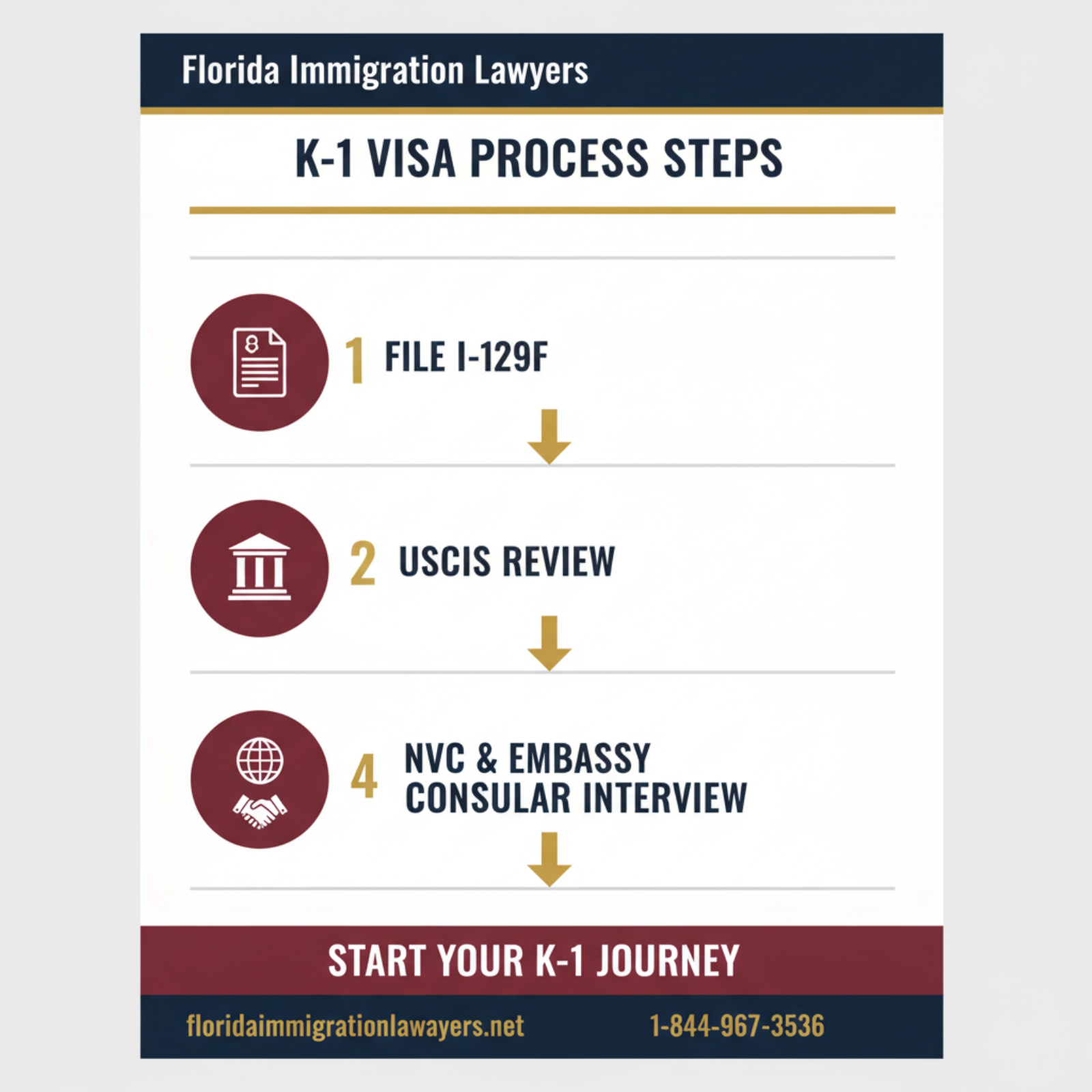
The K-1 visa process involves several distinct stages, each requiring careful attention to detail and timely submission of documents. Understanding each step is vital for a successful outcome.
-
Step 1: File Form I-129F, Petition for Alien Fiancé(e)
The U.S. citizen petitioner initiates the process by filing Form I-129F with USCIS. This petition establishes that the relationship is bona fide and that both parties meet the basic eligibility requirements for a fiance visa. You must include compelling evidence of your relationship, your intent to marry, and that you have met in person.
This initial filing is critical. Any errors or omissions can lead to delays or a Request for Evidence (RFE), prolonging the overall K-1 visa process. Ensure all supporting documents are accurate and complete.
-
Step 2: USCIS Processing and Approval
After submitting Form I-129F, USCIS will send a receipt notice (Form I-797C, Notice of Action). This is often referred to as NOA1. USCIS then reviews your petition. If approved, you will receive an approval notice (Form I-797, Notice of Action), known as NOA2.
Once approved, USCIS forwards the approved petition to the National Visa Center (NVC). The NVC assigns a case number and then forwards the petition to the U.S. Embassy or Consulate in your fiancé(e)'s country of residence.
-
Step 3: NVC to U.S. Embassy/Consulate
The NVC acts as a liaison, ensuring your approved petition reaches the correct U.S. Embassy or Consulate. Once the embassy receives the petition, they will send instructions to your foreign fiancé(e) on how to proceed with the visa application. This typically includes guidance on completing the DS-160 online nonimmigrant visa application.
It is crucial for your fiancé(e) to follow these instructions precisely and respond promptly to avoid delays in the K-1 visa process. Keep track of all correspondence.
-
Step 4: Complete DS-160 and Medical Examination
Your fiancé(e) must complete the online DS-160, Application for a Nonimmigrant Visa. This form collects detailed personal and background information. Accuracy is paramount.
Concurrently, your fiancé(e) must undergo a medical examination by a physician authorized by the U.S. Embassy or Consulate. This exam assesses their health and ensures they do not have any inadmissible medical conditions. The results are sealed and presented at the visa interview.
-
Step 5: Attend the Visa Interview
The foreign fiancé(e) will attend an interview at the designated U.S. Embassy or Consulate. During the interview, a consular officer will review the application, supporting documents, and ask questions about the relationship to determine its authenticity and ensure all K1 visa requirements are met.
Preparation is key for this interview. Both parties should be ready to discuss their relationship, how they met, future plans, and provide consistent information. Any discrepancies can raise red flags.
-
Step 6: Visa Issuance and Travel to the U.S.
If the interview is successful and the consular officer approves the visa, the K-1 visa will be stamped into your fiancé(e)'s passport. Your fiancé(e) can then make travel arrangements to the United States. The K-1 visa is typically valid for six months, allowing a single entry.
Upon arrival at a U.S. port of entry, a Customs and Border Protection (CBP) officer will inspect the visa holder and admit them into the U.S. for 90 days. This 90-day period begins on the date of entry.
-
Step 7: Marriage and Adjustment of Status (Green Card Application)
Once your fiancé(e) arrives in the U.S., you must marry within 90 days. Failure to do so will result in your fiancé(e) falling out of status and potentially facing deportation. After marriage, the foreign spouse must file Form I-485, Application to Register Permanent Residence or Adjust Status, with USCIS to apply for a Green Card.
This adjustment of status process is a separate application, often requiring an additional interview at a USCIS field office in Florida, such as the one in Miami or Orlando. Our firm can assist you with this crucial next step in your Florida immigration journey.
Essential Documents for Your Fiance Visa Application
Gathering the correct documentation is a critical component of a successful K-1 visa process. Organize your documents meticulously to avoid delays.
Documents Required from the U.S. Citizen Petitioner:
- Proof of U.S. Citizenship: Copy of your U.S. passport, birth certificate, or naturalization certificate.
- Proof of Intent to Marry: Signed statements from both you and your fiancé(e) indicating your intent to marry within 90 days of entry.
- Proof of Meeting in Person: Photos together, passport stamps, flight itineraries, hotel bookings, and sworn statements from third parties.
- Evidence of Bona Fide Relationship: Photos of you together over time, communication records (emails, chat logs, call logs), affidavits from friends and family.
- Proof of Legal Termination of Prior Marriages: If either party has been previously married, certified copies of divorce decrees or death certificates.
- Financial Support Evidence: Form I-134, Affidavit of Support, along with proof of income (tax returns, employment letters, pay stubs) to show you can financially support your fiancé(e) and prevent them from becoming a public charge.
- Form I-129F Petition: The completed and signed Form I-129F itself.
Documents Required from the Foreign National Fiancé(e):
- Valid Passport: Must be valid for at least six months beyond the intended period of stay in the U.S.
- Birth Certificate: Certified copy.
- Police Clearances: From all countries where they have lived for specified periods since age 16.
- Medical Examination Results: Sealed envelope from the authorized physician.
- Proof of Legal Termination of Prior Marriages: Certified copies of divorce decrees or death certificates, if applicable.
- Photos: Passport-style photographs.
- DS-160 Confirmation Page: Printed confirmation of the online nonimmigrant visa application.
This is not an exhaustive list. Specific embassies or consulates may request additional documentation. It is always wise to consult the official U.S. Department of State website for the specific requirements of the embassy where your fiancé(e) will be interviewed.
K-1 Visa Timeline and Processing Expectations for 2026
One of the most common questions regarding the fiance visa is, "How long does it take?" The K-1 visa timeline can vary significantly based on several factors, including USCIS caseloads, the efficiency of the National Visa Center, and the specific U.S. Embassy or Consulate involved.
Current Processing Times:
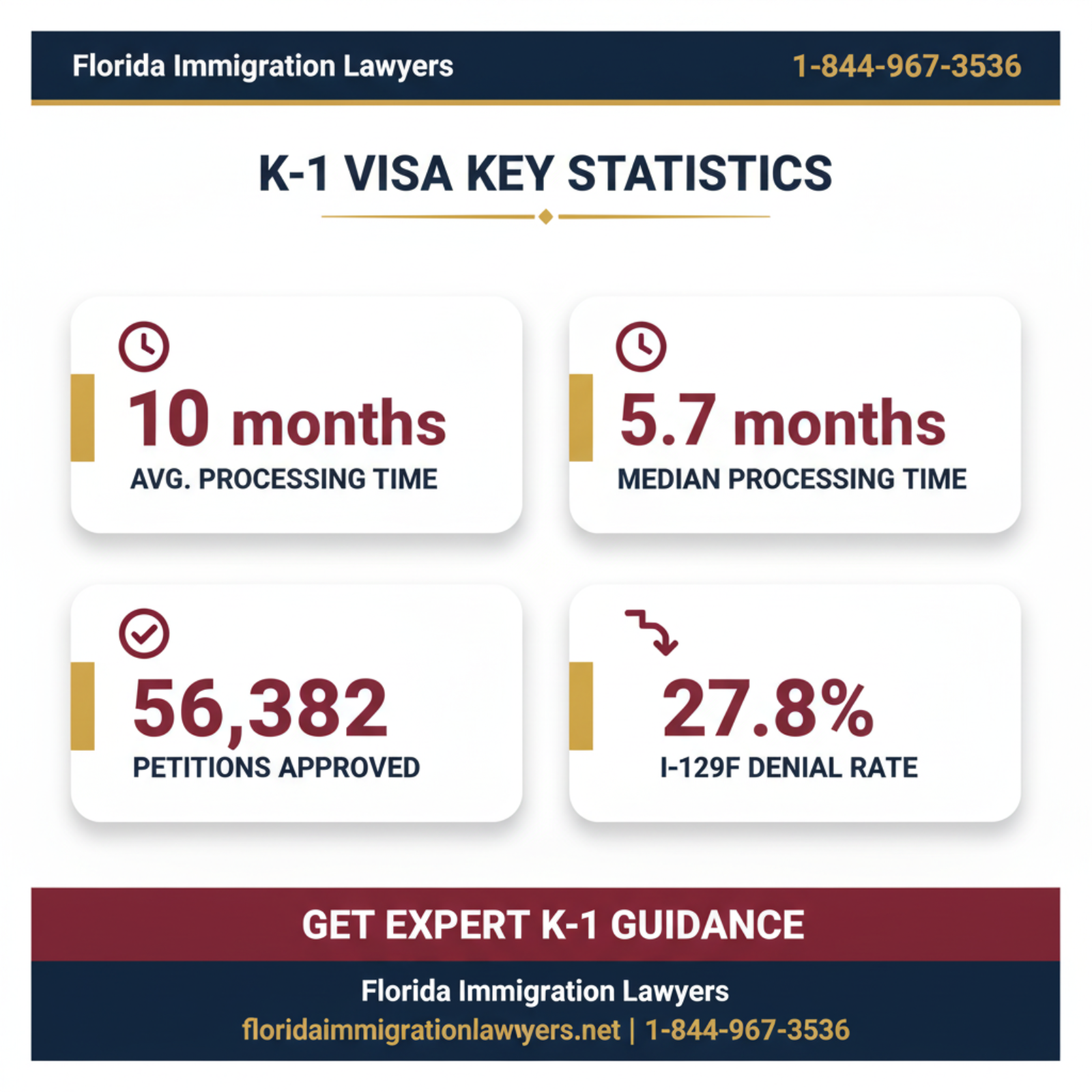
- USCIS I-129F Petition Processing: As of early 2026, the processing time for Form I-129F can range from 10 to 18 months, or even longer, depending on the service center handling your petition. You can check current processing times on the USCIS website.
- NVC and Embassy/Consulate Processing: After USCIS approval, the transfer to the NVC and then to the embassy, along with scheduling the interview, typically adds another 3 to 6 months to the process. This stage largely depends on the specific embassy's workload and scheduling availability.
Overall, from filing the initial I-129F petition to your fiancé(e)'s arrival in the U.S., the entire K-1 visa process can take anywhere from 1 to 2 years. It is important to manage expectations and understand that these are estimates, not guarantees. Unforeseen circumstances, such as Requests for Evidence (RFEs) or administrative processing, can extend these timelines.
For those in Pembroke Pines and across Florida, remember that patience is key. While waiting, ensure all documentation is ready for the subsequent adjustment of status application once your fiancé(e) arrives and you are married. This next step will involve a USCIS field office in Florida.
Understanding K-1 Visa Costs and Fee Breakdown
Pursuing a fiance visa involves various government fees and potential legal costs. It is essential to budget for these expenses throughout the process.
Government Filing Fees (Subject to Change):
- Form I-129F Petition Fee: This is the initial filing fee paid to USCIS when you submit your petition.
- DS-160 Visa Application Fee: This fee is paid to the Department of State for the K-1 nonimmigrant visa application.
- Medical Examination Fee: Paid directly to the authorized physician. This fee varies by country and provider.
- Adjustment of Status (Form I-485) Fee: After marriage, when your spouse applies for a Green Card, there will be a separate, significant filing fee for Form I-485, which includes biometric services.
Please note that government fees are subject to change without notice. Always verify the most current fees on the official USCIS website and the Department of State website before submitting any applications.
Other Potential Costs:
- Travel Expenses: Costs associated with the petitioner meeting the fiancé(e) in person and the fiancé(e)'s travel to the U.S.
- Document Translation Fees: If any supporting documents are not in English, certified translations will be required.
- Legal Fees: Hiring an experienced immigration attorney, like those at Florida Immigration Lawyers, can be a significant investment but often proves invaluable in navigating the complexities of the K-1 visa process and avoiding costly mistakes.
While the costs can accumulate, viewing them as an investment in your future together can help. Careful financial planning is a vital part of your Florida immigration journey.
Do not navigate this process alone. Contact Florida Immigration Lawyers today. Our team is ready to provide the dedicated support you deserve.
Common Mistakes to Avoid in the K-1 Fiance Visa Process
The K-1 visa process is detail-oriented, and even minor errors can lead to significant delays or denials. Being aware of common pitfalls can help you avoid them:
-
Incomplete or Inaccurate Forms: Failing to fill out every section of the I-129F or DS-160, or providing inconsistent information, is a frequent cause of RFEs and delays. Always double-check all entries for accuracy.
-
Insufficient Proof of Relationship: USCIS and consular officers scrutinize the authenticity of relationships. Relying solely on a few photos is not enough. Provide extensive evidence like communication records, travel itineraries, joint financial statements (if any), and affidavits from friends and family.
-
Not Meeting in Person (or Lack of Proof): The requirement to meet in person within two years is strict. If you haven't met, or cannot adequately prove you have, your petition will likely be denied. Document all meetings thoroughly.
-
Failure to Disclose Prior Marriages or Criminal History: Attempting to conceal past marriages or any criminal record, no matter how minor, is a serious offense. Full disclosure is mandatory, and you must provide proof of termination for all prior marriages.
-
Missing Deadlines or Ignoring RFEs: Immigration processes have strict deadlines. Failing to respond to an RFE by the specified date, or not responding adequately, can lead to denial. Prompt and thorough responses are essential.
-
Not Providing Sufficient Financial Support Evidence: The U.S. citizen petitioner must demonstrate they can support their fiancé(e) at 125% of the poverty guideline. Insufficient income or lack of proper documentation for Form I-134 can lead to denial.
-
Traveling to the U.S. on a Tourist Visa with Intent to Marry: Using a B-2 tourist visa with the preconceived intent to marry and adjust status is considered visa fraud and can lead to inadmissibility. The K-1 visa is the appropriate path for this purpose.
-
Lying During the Interview: Any misrepresentation or false statement during the consular interview can result in a permanent ban from the U.S. Always be truthful and consistent.
-
Not Marrying Within 90 Days: The 90-day marriage requirement after K-1 entry is absolute. Failure to marry within this timeframe means your fiancé(e) will fall out of status and must leave the U.S. or face severe immigration consequences.
-
Delaying Adjustment of Status Application: After marriage, promptly filing Form I-485 to adjust status is crucial. Unnecessary delays can complicate the process and raise questions about intent.
When to Call a Lawyer for Your K-1 Fiance Visa
While this guide provides extensive information, the K-1 visa process can be intricate and fraught with legal complexities. Knowing when to seek professional legal assistance can make a significant difference in the success of your application. Florida Immigration Lawyers are here to help.
Consider consulting our experienced attorneys if any of the following scenarios apply to your case:
- Previous Denials or Immigration Issues: If either you or your fiancé(e) have a history of visa denials, overstays, or other immigration violations, navigating the K-1 process becomes significantly more challenging.
- Criminal History: Any past criminal convictions for either party can trigger inadmissibility issues, requiring waivers or specific legal strategies.
- Not Meeting in Person: If you believe you qualify for an exception to the in-person meeting requirement, demonstrating this to USCIS requires strong legal arguments and evidence.
- Complex Financial Situations: If the petitioner's income is borderline or involves complex sources, proving financial eligibility for the family immigration process can be difficult without legal guidance.
- Received a Request for Evidence (RFE): An RFE indicates that USCIS needs more information. Responding effectively and comprehensively requires a deep understanding of immigration law.
- Concerns About the Interview: If your fiancé(e) is anxious about the consular interview or has specific circumstances that might raise questions, our lawyers can provide thorough preparation and guidance.
- Need for Peace of Mind: Even in seemingly straightforward cases, the peace of mind that comes from knowing an expert is overseeing your application is invaluable. Our firm handles K-1 petitions and subsequent immigration matters regularly.
Florida Immigration Lawyers has a proven track record of assisting individuals and families throughout Florida with their K-1 fiance visa applications. We understand the nuances of immigration law, including relevant sections of the Immigration and Nationality Act (INA), such as 8 U.S.C. § 1101(a)(15)(K), which defines the K nonimmigrant category. Our dedicated team can help you prepare a robust petition, gather all necessary documents, and guide you through every stage, including the eventual adjustment of status to a Green Card.
Frequently Asked Questions About the K-1 Fiance Visa
How long does it take to get a K-1 visa in Florida?
The overall K-1 fiance visa process, from filing the initial petition to your fiancé(e)'s arrival in Florida, typically takes between 1 to 2 years. This includes USCIS processing of the I-129F petition (often 10-18+ months) and subsequent NVC and consular processing (usually 3-6 months). Times can vary based on USCIS caseloads and the specific embassy.
Can my fiancé come to the U.S. while waiting for a K-1 visa?
Generally, no. Your fiancé(e) cannot enter the U.S. on a tourist visa (B-2) with the preconceived intent to marry you and remain in the U.S. while the K-1 petition is pending. Doing so can be considered visa fraud and lead to severe immigration consequences, including inadmissibility. The K-1 visa is specifically designed for this purpose.
Is the K-1 fiancee process difficult?
The K-1 visa process can be challenging due to its detailed requirements, extensive documentation, and multi-stage nature. It demands meticulous attention to detail and a thorough understanding of immigration regulations. While not impossible to navigate alone, many applicants find the assistance of an experienced immigration attorney invaluable in avoiding common mistakes and ensuring a smoother process.
About Florida Immigration Lawyers
Florida Immigration Lawyers is a leading immigration law firm dedicated to serving individuals and families across the entire state of Florida. With a deep understanding of U.S. immigration law and a compassionate approach, we are committed to helping our clients achieve their immigration goals, whether it's obtaining a fiance visa, securing a Green Card, or defending against deportation.
Our experienced attorneys provide personalized legal strategies tailored to your unique circumstances. We pride ourselves on clear communication, diligent representation, and unwavering support throughout every stage of your immigration journey. From family-based petitions to business immigration and citizenship applications, we offer a full spectrum of immigration services.
Why Choose Florida Immigration Lawyers?
- Expertise: Our team possesses extensive knowledge of U.S. immigration laws and policies.
- Client-Centered Approach: We prioritize your needs, concerns, and goals, offering empathetic and effective legal solutions.
- Statewide Service: We represent clients in Pembroke Pines, Miami, Orlando, Tampa, and all other communities throughout Florida.
- Accessibility: Our firm is available 24/7, ensuring you can reach us when you need us most.
- Free Consultations: We offer free initial consultations to discuss your case and outline your options.
Let us be your trusted partner in navigating the complexities of Florida immigration. Visit our website at https://www.floridaimmigrationlawyers.net or call us directly.
Sources and References
- U.S. Citizenship and Immigration Services (USCIS)
- U.S. Department of State - Fiancé(e) Visa (K-1)
- 8 U.S.C. Chapter 12 - Immigration and Nationality Act (INA)
- 8 U.S.C. § 1101(a)(15)(K) - Definition of K nonimmigrant visa
- 8 CFR 214.2(k) - Regulations pertaining to K nonimmigrants
This article provides general legal information and is not intended as legal advice. Every case is unique, and outcomes depend on specific facts and circumstances. Contact an attorney for advice about your particular situation.
Embarking on the K-1 fiance visa journey to bring your loved one to Florida is a significant step. With the right legal support, you can navigate the process with confidence. Our team at Florida Immigration Lawyers is ready to assist you every step of the way.
Do not delay your future together. Call Florida Immigration Lawyers today at 1-844-967-3536 for a free consultation. Se Habla Español - Estamos aquí para ayudarle.
Do Not Navigate This Process Alone
Our experienced immigration attorneys are ready to fight for you. Get a free, confidential consultation today.
Se Habla Español
Frequently Asked Questions
Florida Immigration Lawyers
Immigration Attorney | Founder, Vasquez Law Firm
U.S. Air Force veteran and immigration attorney with thousands of cases resolved. J.D., NCCU School of Law. AILA member. Admitted to the 4th, 5th, and 11th Circuit Courts.
Available 24/7 - Free Evaluations
Related Legal Services
Our Florida immigration attorneys can help you with asylum protection, deportation defense and citizenship and naturalization. Call today at 1-844-967-3536 for a free consultation.
Related Links
Related Topics
Free Legal Consultation
Discuss your case with our experienced attorneys. We're available 24/7.
Se Habla Español - Estamos aquí para ayudarle.
Related Articles
Immigration Attorney in Gainesville, North Florida
Navigating immigration law in Gainesville and North Florida can be challenging, especially with recent legal changes. Discover how Florida Immigration Lawyers can assist you. Call 1-844-967-3536 for a free consultation.
Refugee Status Florida Resettlement: Your 2026 Guide
Navigating refugee status and resettlement in Florida requires a thorough understanding of U.S. immigration law and available support systems. This 2026 guide covers eligibility, the step-by-step resettlement process, essential documents, timelines, and financial considerations for refugees seeking to build a new life in Florida, particularly in areas like Homestead. It highlights the critical role of organizations like UNHCR and USCIS, and the importance of avoiding common mistakes. Florida Immigration Lawyers offers expert legal assistance, ensuring a smoother transition and helping refugees adjust status to lawful permanent residents. Learn how to secure your future and access vital resources in the Sunshine State.
Dual Citizenship in Florida: What You Need to Know
Explore the benefits and legal steps of obtaining dual citizenship in Florida. Understand the process, avoid common mistakes, and learn when to seek legal help. Contact Florida Immigration Lawyers at 1-844-967-3536 for guidance.
Understanding Immigration Bond Hearings in Florida
Immigration bond hearings in Florida are critical for those detained by ICE. Understand the process, avoid common mistakes, and learn when to contact a lawyer for assistance. Call Florida Immigration Lawyers for a free consultation.
