F-1 Visa for Florida Universities: Your Guide to Study
Dreaming of studying in Florida? This comprehensive guide for 2026 explains the F-1 visa process for international students. Learn about eligibility, required documents, application steps, processing times, and costs for Florida universities. Avoid common mistakes and understand when to seek legal help to secure your F-1 student visa. Florida Immigration Lawyers offers guidance to navigate the complexities and ensure a smooth journey to your academic goals in the Sunshine State. Get a free consultation today.
An F-1 visa is a non-immigrant visa for individuals wishing to pursue academic studies or language training at U.S. institutions certified by the Student and Exchange Visitor Program (SEVP). For international students dreaming of Florida's vibrant academic scene and diverse universities, securing an F-1 visa is the essential first step. It allows you to legally reside in the U.S. for the duration of your academic program.
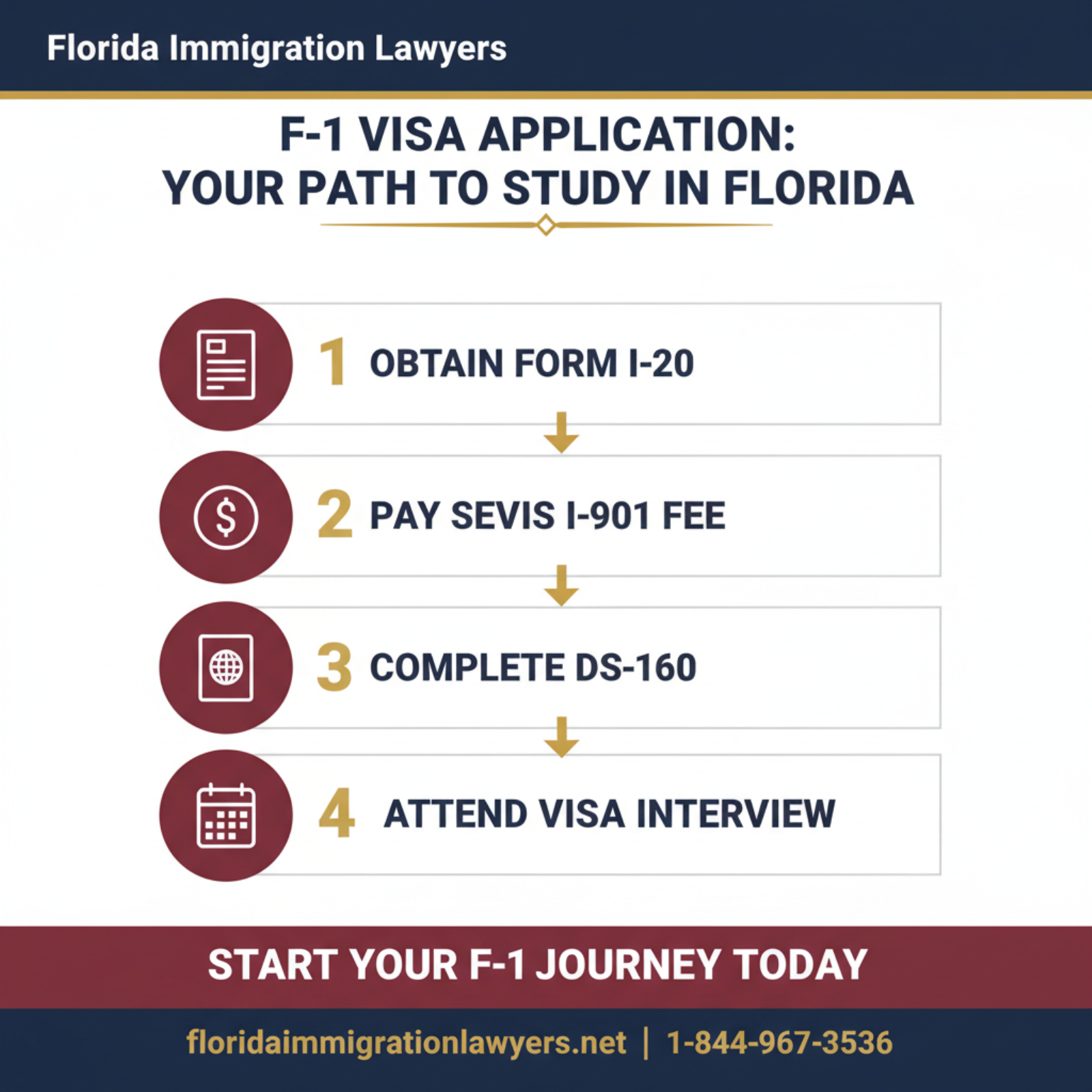
- Obtain admission and an I-20 from an SEVP-approved Florida university.
- Pay the SEVIS I-901 fee and complete the DS-160 visa application.
- Attend a mandatory visa interview at a U.S. Embassy or Consulate.
- Demonstrate sufficient funds and intent to return to your home country.
- Strictly adhere to F-1 visa regulations to maintain legal status.
Are you an aspiring international student with dreams of pursuing higher education amidst the sunny skies and diverse culture of Florida? The journey to study at a prestigious Florida university, from Naples to Miami, often begins with understanding and securing an F-1 visa. This essential non-immigrant visa opens the doors to academic opportunities across the Sunshine State.
Navigating the complex U.S. immigration system can feel daunting, especially when your academic future hangs in the balance. This comprehensive guide will walk you through every step of the F-1 student visa process for Florida universities, outlining requirements, potential challenges, and crucial timelines for 2026 applicants. We will help you understand what it takes to transform your dream into a reality.
Don't let immigration complexities deter your academic ambitions. For personalized guidance and legal support, call Florida Immigration Lawyers at 1-844-YO-PELEO for a free consultation. Our experienced team is ready to assist you.
Understanding the F-1 Student Visa for Florida
The F-1 student visa is specifically designed for international students who wish to engage in a full-time academic or language training program at a U.S. institution. Florida, with its world-renowned universities and colleges, attracts thousands of such students each year. From the bustling campuses of Miami to the research hubs near Gainesville, Florida offers unparalleled educational opportunities.
This visa category requires you to maintain a full course of study and adhere to strict regulations set by U.S. Citizenship and Immigration Services (USCIS) and the Department of Homeland Security. Understanding these rules from the outset is crucial for a successful academic journey in Florida.
Eligibility Criteria for the F-1 Visa
To be eligible for an F-1 visa, you must meet several key criteria. First, you must be enrolled in an academic program at an institution approved by the Student and Exchange Visitor Program (SEVP). This program ensures that schools are equipped to educate international students and comply with federal regulations.
Secondly, you must demonstrate proficiency in English or be enrolled in courses to achieve it. You also need to prove you have sufficient funds to cover your tuition, living expenses, and other costs for your entire period of study. Critically, you must intend to return to your home country upon completion of your studies, demonstrating non-immigrant intent.
Finally, you must maintain a residence abroad with no intention of abandoning it. These requirements are outlined in U.S. immigration law, specifically 8 U.S.C. § 1101(a)(15)(F) (INA § 101(a)(15)(F)), which defines the F-1 non-immigrant classification.
Finding SEVP-Approved Schools in Florida
Florida boasts a wide array of SEVP-approved educational institutions, ranging from major research universities to specialized colleges. When considering your options, it's vital to ensure your chosen school is certified to enroll international students. This certification is a non-negotiable requirement for obtaining an F-1 visa.
You can search for certified schools using the official Study in the States website, managed by the U.S. Immigration and Customs Enforcement (ICE). Institutions like the University of Florida, Florida State University, Florida International University, the University of South Florida, and Florida Gulf Coast University (near Naples) are popular choices for international students. Each institution will have its own specific Florida university requirements for admission, so careful research is essential.
Choosing an SEVP-approved school is the first concrete step in your F-1 visa journey. You can explore options and confirm certification at Study in the States - School Search.
Step-by-Step Guide to Obtaining Your F-1 Visa in Florida
The process of securing an F-1 visa involves several distinct stages, each requiring careful attention to detail. Follow these steps to maximize your chances of success and begin your academic journey in Florida:
-
Gain Admission to an SEVP-Approved School: Your journey begins by applying to and being accepted by a college or university in Florida that is certified by SEVP. Once accepted, the school will issue you a Form I-20, Certificate of Eligibility for Nonimmigrant Student Status. This document is crucial as it proves your enrollment and eligibility for F-1 status.
-
Pay the SEVIS I-901 Fee: After receiving your Form I-20, you must pay the Student and Exchange Visitor Information System (SEVIS) I-901 fee. This fee supports the SEVIS system, which tracks F-1 students throughout their stay in the U.S. You must pay this fee before your visa interview, and you will need the receipt for your application.
-
Complete the DS-160 Online Nonimmigrant Visa Application: The DS-160 is the primary application form for nonimmigrant visas. You must complete it online at the Department of State's Consular Electronic Application Center website. Be thorough and accurate, as any discrepancies can cause delays or denials. Once completed, print the confirmation page.
-
Pay the Nonimmigrant Visa Application (MRV) Fee: In addition to the SEVIS fee, you must pay a Machine Readable Visa (MRV) fee, which is the actual visa application fee. The amount and payment methods vary by country and U.S. Embassy/Consulate. Keep your payment receipt as proof.
-
Schedule and Attend Your Visa Interview: After paying the fees, schedule an interview at a U.S. Embassy or Consulate in your home country. Visa interview wait times can vary significantly, so schedule as early as possible. During the interview, a consular officer will review your application and documents, and assess your eligibility and intent.
-
Prepare for Your Departure to Florida: If your visa is approved, your passport will be stamped with the F-1 visa. You may enter the U.S. up to 30 days before the start date listed on your Form I-20. Ensure all your documents are organized for presentation upon arrival at a U.S. port of entry.
Essential Documents for Your F-1 Student Visa Application
A well-organized collection of documents is critical for a smooth F-1 visa application process. Ensure you have all required items before your interview. Missing or incorrect documents can lead to significant delays or even denial of your F-1 visa.
- Passport: Valid for at least six months beyond your intended period of stay in the U.S.
- Form I-20, Certificate of Eligibility for Nonimmigrant Student Status: Issued by your SEVP-approved Florida university.
- DS-160 Confirmation Page: Printed confirmation page from your online nonimmigrant visa application.
- MRV Fee Payment Receipt: Proof that you paid the nonimmigrant visa application fee.
- SEVIS I-901 Fee Payment Receipt: Proof of payment for the SEVIS fee.
- Photographs: One or more passport-style photos meeting U.S. visa requirements.
- Academic Transcripts and Diplomas: Official copies of your academic records, including degrees, diplomas, and certificates from previous institutions.
- Proof of Financial Support: Bank statements, scholarship letters, or sponsor affidavits demonstrating sufficient funds to cover your tuition and living expenses. This is a crucial aspect of your application.
- Proof of Ties to Home Country: Documents like property deeds, job offers, family ties, or bank accounts in your home country to demonstrate your intent to return after your studies.
- Test Scores: Official scores from standardized tests like TOEFL, IELTS, SAT, or GRE, if required by your Florida university.
F-1 Visa Processing Times and Expectations for Florida Applicants
Understanding the typical timelines for the F-1 visa process is vital for planning your academic journey to Florida. While specific processing times can vary, having realistic expectations helps manage your application effectively. Factors such as the time of year, the volume of applications, and the specific U.S. Embassy or Consulate can all influence how long your application takes.
Generally, after you receive your I-20 from a Florida university, you should pay the SEVIS fee and complete your DS-160 as soon as possible. Scheduling your visa interview can be the most variable part of the process. In peak seasons (summer months before fall enrollment), wait times for interview appointments can be several weeks or even months. It is always advisable to apply well in advance of your program start date, ideally three to five months ahead.
After a successful interview, the consular officer will typically inform you of their decision on the spot. If approved, your passport with the F-1 visa stamp will usually be mailed to you within a few business days to a week. However, some cases may require additional administrative processing, which can extend the timeline significantly. Always check the specific embassy or consulate's website for their current processing times.
Maintaining Your F-1 Status in Florida
Once you arrive in Florida on your F-1 visa, maintaining your legal status is paramount. This involves adhering to several key regulations, as outlined in 8 CFR § 214.2(f). Failure to do so can lead to serious consequences, including termination of your F-1 status and potential deportation defense issues.
You must maintain a full course of study at your SEVP-approved school. Any changes to your enrollment, program, or personal information (like a change of address) must be communicated to your Designated School Official (DSO). The duration of your F-1 status is tied to your academic program, plus any authorized Optional Practical Training (OPT) or Curricular Practical Training (CPT) and a 60-day grace period. There isn't a universal "5-year rule" for all F-1 students; rather, your I-20 indicates your expected program completion date, and you must complete your studies by then or apply for an extension.
Navigating F-1 Student Visa Costs and Fees
The financial aspect of studying in Florida as an international student can be substantial. Beyond tuition, you must account for various fees and living expenses. Understanding the full scope of F-1 student visa cost is crucial for your financial planning.
The primary costs include:
- SEVIS I-901 Fee: This is a one-time fee paid to the U.S. Department of Homeland Security.
- DS-160 (MRV) Application Fee: This fee is paid to the U.S. Department of State for processing your visa application.
- University Tuition and Fees: These vary widely by institution and program. Public universities in Florida, such as the University of South Florida or Florida Gulf Coast University, may have different tuition rates for in-state, out-of-state, and international students. Community colleges often present a more affordable option for initial studies.
- Living Expenses: This includes housing, food, transportation, health insurance, and personal expenses. Costs can vary significantly depending on the city (e.g., Naples and Miami tend to be more expensive than smaller towns).
- Travel Expenses: Airfare to and from your home country.
Understanding SEVIS Fees and Their Impact
The SEVIS I-901 fee is a mandatory payment for all prospective F-1 students. This fee helps fund the Student and Exchange Visitor Program (SEVP), which manages the SEVIS database. The database tracks F-1 students and ensures compliance with U.S. immigration laws. You must pay this fee and obtain a receipt before your visa interview.
Failure to pay the SEVIS fee will result in your F-1 visa application not being processed. It's a critical step that validates your record in the SEVIS system, linking you to your chosen Florida university.
F-2 Dependent Visas Explained
If you plan to bring your spouse and/or minor children (under 21) with you to Florida, they may be eligible for an F-2 student visa. This dependent visa category allows family members to accompany the primary F-1 visa holder. F-2 visa holders cannot engage in full-time study or accept employment in the U.S.
Applying for an F-2 visa involves a separate application process, though it is tied to the F-1 principal applicant. Each F-2 applicant will need their own Form I-20 (issued by the F-1 student's school) and will go through a similar visa application and interview process. Our firm can assist with family immigration matters, including F-2 visa applications.
Do not navigate this process alone. The complexities of immigration law, especially for international students, require careful attention to detail. Contact Florida Immigration Lawyers today to ensure your application is accurate and complete, safeguarding your academic future.
Common Mistakes to Avoid During Your F-1 Visa Journey
Applying for an F-1 visa requires precision and adherence to strict guidelines. Even minor errors can lead to significant delays or denial. Here are some common pitfalls international students often encounter:
-
Not Maintaining Full-Time Enrollment: F-1 students are required to maintain a full course of study at their SEVP-approved Florida university. Dropping below full-time enrollment without proper authorization from your DSO can lead to a violation of your F-1 status, as specified in 8 CFR § 214.2(f)(6).
-
Unauthorized Employment: Working off-campus without explicit authorization (like Curricular Practical Training (CPT) or Optional Practical Training (OPT)) is a serious violation. Even on-campus employment has specific rules. Engaging in unauthorized work can result in immediate termination of your F-1 visa status.
-
Ignoring I-20 Expiration or Transfer Rules: Your Form I-20 has an end date, and if you need more time to complete your program or wish to transfer to another Florida university, you must apply for an extension or transfer your SEVIS record correctly and on time. Failing to do so can result in being out of status.
-
Failing to Update Personal Information: Any change in your residential address must be reported to your DSO within 10 days. Additionally, changes to your academic program or funding sources should also be communicated promptly. USCIS requires current information to maintain your record.
-
Lack of Strong Ties to Home Country: During the visa interview, consular officers assess your intent to return home after your studies. If you cannot convincingly demonstrate strong ties to your home country (e.g., family, property, job prospects), your application may be denied due to perceived immigrant intent.
-
Insufficient Financial Proof: You must prove you have sufficient funds to cover your tuition and living expenses for the entire duration of your program. Submitting incomplete or questionable financial documents is a common reason for F-1 visa denials.
-
Delaying Your Application: Visa processing times vary. Waiting until the last minute to apply for your F-1 visa can mean missing your program's start date if there are unexpected delays or requests for additional information.
On-Campus Employment for F-1 Students
F-1 students are generally permitted to work on-campus for up to 20 hours per week while school is in session and full-time during breaks, without needing specific USCIS authorization. However, this employment must be at your attending Florida university or an affiliated educational institution. Any off-campus employment requires prior authorization, typically through CPT or OPT, which your DSO must approve and USCIS must authorize. Working without proper authorization is a severe violation of your F-1 status.
When to Seek Legal Assistance for Your F-1 Visa
While the information provided here offers a comprehensive overview, the F-1 visa process can be complex and highly individualized. There are specific situations where the guidance of an experienced immigration attorney becomes invaluable. Florida Immigration Lawyers focuses on helping international students navigate these challenges, ensuring your application is robust and compliant with all regulations.
Consider contacting us if:
- You have a complicated academic background or previous visa issues: Past rejections or unusual study patterns can raise red flags.
- You've received a Request for Evidence (RFE) or a Notice of Intent to Deny (NOID): These indicate that USCIS has concerns about your application, and a legal response is critical.
- You are seeking a change of status to F-1: If you are already in the U.S. on another non-immigrant visa and wish to change to F-1 status, the process has its own unique complexities.
- You need assistance with F-2 dependent visas: Bringing family members requires careful planning and separate applications.
- You have concerns about demonstrating non-immigrant intent: If your ties to your home country are not immediately obvious or easily documented, an attorney can help you prepare a stronger case.
- Your F-1 status has been violated or is at risk: If you've unintentionally fallen out of status, immediate legal action may be necessary to explore options like reinstatement to avoid deportation defense proceedings.
- You are considering post-completion work options like OPT or CPT: While DSOs provide guidance, an attorney can offer additional insights into long-term immigration strategies.
Our firm, Florida Immigration Lawyers, is dedicated to assisting students like you throughout Florida, including those in Orlando. We provide strategic advice and robust representation for all aspects of your immigration journey, from initial application to maintaining status and exploring future options like business immigration or even citizenship pathways.
About Florida Immigration Lawyers
Florida Immigration Lawyers is an immigration law firm committed to providing exceptional legal services to individuals and families across the entire state of Florida. Our dedicated team of attorneys understands the profound impact immigration matters have on our clients' lives and is passionate about achieving favorable outcomes.
We offer a comprehensive range of immigration services, including but not limited to, family-based petitions, employment visas, deportation defense, asylum claims, naturalization, and student visas like the F-1. Our firm prides itself on its client-centered approach, ensuring that each case receives personalized attention and strategic counsel.
Why choose us? We combine extensive legal knowledge with a deep understanding of the unique challenges faced by immigrants in Florida. Our attorneys are available 24/7, offering free consultations to assess your situation and outline the best path forward. We are committed to transparency, integrity, and vigorous advocacy for our clients' rights.
For trusted legal advice and representation, contact us today. Call 1-844-YO-PELEO or visit our website at https://www.floridaimmigrationlawyers.net. We are here to help you achieve your immigration goals in Florida.
Sources and References
- U.S. Citizenship and Immigration Services (USCIS) - F-1 Student Visa
- U.S. Department of State - Student Visa (F and M)
- Study in the States - School Search (ICE SEVP)
- 8 U.S.C. § 1101(a)(15)(F) - Immigration and Nationality Act (INA) defining F-1 non-immigrants
- 8 CFR § 214.2(f) - Code of Federal Regulations pertaining to F-1 students
This article provides general legal information and is not intended as legal advice. Every case is unique, and outcomes depend on specific facts and circumstances. Contact an attorney for advice about your particular situation.
Your dream of studying at a Florida university is within reach, but the path to an F-1 visa requires careful planning and execution. Don't leave your academic future to chance. Call Florida Immigration Lawyers today at 1-844-YO-PELEO for a free, confidential consultation. Se Habla Español - Estamos aquí para ayudarle.
Do Not Navigate This Process Alone
Our experienced immigration attorneys are ready to fight for you. Get a free, confidential case review today.
Se Habla Español
Or leave your details and we’ll call you:
Free Evaluation in 24 Hours
Or talk to us right now

AI voice assistant — available 24/7
FreeFrequently Asked Questions

William J. Vásquez
Founding Attorney · Vasquez Law Firm
U.S. Air Force veteran and immigration attorney with years of hands-on U.S. immigration experience. J.D., NCCU School of Law. AILA member. Admitted to the 4th, 5th, and 11th Circuit Courts.
Available 24/7 - Free Evaluations
Reviewed for legal accuracy by William J. Vásquez
Licensed in North Carolina; U.S. immigration is federal practice.
Related Legal Services
Our Florida immigration attorneys can help you with experienced immigration attorneys, asylum protection and citizenship and naturalization. Call today at 1-844-YO-PELEO for a free case review.
Related Links
Related Topics
Free Legal Case Review
Discuss your case with our experienced attorneys. We're available 24/7.
Se Habla Español - Estamos aquí para ayudarle.
Related Articles
Dual Citizenship Lawyer in Florida: What You Need to Know
For Florida residents, the concept of dual citizenship, or holding two passports, offers a compelling blend of opportunities and challenges. While the U.S. generally permits dual nationality, the path to achieving this status requires a meticulous understanding of both U.S. immigration laws and the citizenship policies of your country of origin. This guide explores the definition of dual citizenship, the detailed step-by-step process for U.S. naturalization, and the significant benefits and potential pitfalls involved. We cover essential documentation, typical timelines, and cost considerations for 2026, providing crucial insights for anyone in Orlando, Miami, or across Florida considering this important legal step. Learn about common mistakes to avoid and understand when to seek professional legal counsel to navigate this complex process successfully. Florida Immigration Lawyers is here to provide expert, bilingual support for your dual citizenship journey.
Immigration Lawyer Orlando Free Consultation in Florida
For individuals and families in Orlando, Florida, navigating the complexities of U.S. immigration law requires expert guidance. An immigration lawyer in Orlando offers crucial support for everything from visa applications and green card processes to naturalization and deportation defense. This comprehensive guide details what a free consultation covers, providing a step-by-step overview of immigration pathways, essential document checklists, and expected timelines in 2026. We also highlight common mistakes to avoid, discuss the critical role of legal counsel in deportation and asylum cases, and explain why choosing a local Orlando immigration attorney is beneficial. Florida Immigration Lawyers is dedicated to serving the diverse community of Orlando with compassionate, effective legal solutions, ensuring you receive personalized advice and robust representation for a successful immigration journey.
EAD Advance Parole Combo Card in Florida 2026
For individuals with a pending Form I-485, Application to Register Permanent Residence or Adjust Status, the EAD Advance Parole Combo Card is an essential document. This single card combines the authorization to work legally in the U.S. (Employment Authorization Document - EAD) with permission to travel internationally and re-enter without abandoning your green card application (Advance Parole). This guide from Florida Immigration Lawyers provides a comprehensive overview for applicants in Florida in 2026, covering eligibility, the step-by-step application process, required documents, expected processing times, and associated costs. We also highlight common mistakes to avoid and when to seek legal counsel to ensure a smooth and successful immigration journey. Understanding this vital card is key to maintaining stability while awaiting your permanent residency approval.
Credible Fear Interview Lawyer in Florida
Facing a credible fear interview in Florida can be daunting. Understand the process, prepare effectively, and know when to seek legal help. Florida Immigration Lawyers are here to assist you with expert guidance throughout your asylum process.