Expungement Immigration Consequences in Florida 2026
Expungement in Florida may not provide full immigration protection. Sealed records can still affect your immigration status. Learn more about the complex interaction between state expungement and federal immigration law. Contact Florida Immigration Lawyers for guidance.
Expungement in Florida may impact immigration status, but a sealed record does not guarantee protection from immigration consequences. Consult legal experts for guidance.
- Expungement does not erase a criminal record for immigration purposes.
- Sealed records might still be accessible to immigration authorities.
- Legal consultation is crucial for understanding specific impacts.
- Florida laws differ from federal immigration rules.
Introduction
Imagine living in Kissimmee, Florida, with a criminal record that haunts your immigration status. You’ve heard about expungement, but will it really clear your path to becoming a lawful resident? This post explores the effects of expungement on immigration in Florida, focusing on the unique challenges faced by residents in areas like Kissimmee. We’ll also guide you through potential legal pitfalls and when to seek professional assistance. Call Florida Immigration Lawyers at 1-844-YO-PELEO for a free consultation.
The fear and uncertainty surrounding a criminal record, especially for immigrants, can be overwhelming. Many believe that once a record is expunged or sealed at the state level, it vanishes completely, offering a clean slate for all aspects of life. However, for those navigating the intricate world of U.S. immigration law, this assumption can lead to significant and often devastating consequences. The disconnect between state criminal justice procedures and federal immigration policies creates a complex legal minefield.
Understanding this critical distinction is paramount for anyone in Florida, particularly in diverse communities like Kissimmee, where a significant immigrant population resides. A state expungement might protect you from certain background checks for employment or housing, but it offers no such guarantee when dealing with federal agencies like USCIS or ICE. These federal entities operate under their own set of rules, which often grant them access to records that state courts have deemed "expunged" or "sealed." This means that an old mistake, even one you thought was long behind you, could resurface during a green card application, a naturalization interview, or even lead to deportation proceedings.
Navigating these dual legal systems requires specialized knowledge. This article aims to demystify the process, highlight potential dangers, and underscore the absolute necessity of legal counsel. Don't let a misunderstanding jeopardize your future in the United States. Florida Immigration Lawyers are here to provide clarity and robust defense; call us at 1-844-YO-PELEO for a free consultation to discuss your unique situation.
What Are the Immigration Consequences of Expungement in Florida?
Expungement may not eliminate immigration consequences because U.S. immigration authorities often have access to sealed records. Sealed or expunged records in Florida can still affect your immigration status, especially in proceedings such as deportation or when applying for a green card.
Florida law allows individuals to seal or expunge criminal records, but this state-level action does not necessarily influence how federal immigration authorities view your record. The U.S. Citizenship and Immigration Services (USCIS) and Immigration and Customs Enforcement (ICE) may still consider expunged offenses during immigration evaluations.
For example, a Kissimmee resident with an expunged theft charge might think they are safe, yet during a green card application, this sealed record could still surface, affecting the outcome. Therefore, understanding both state and federal implications is crucial.
The reason for this persistent federal access lies in the different definitions of "conviction" and "criminal record" used by state and federal statutes. While Florida law might consider an expunged record as non-existent for most purposes, federal immigration law, specifically the Immigration and Nationality Act (INA), often has a broader definition. Under the INA, an expunged record may still be considered a "conviction" if there was a formal judgment of guilt, a plea of guilty or nolo contendere, or if the individual admitted sufficient facts to warrant a finding of guilt, and a penalty was imposed. This federal interpretation means that even if a state court has removed the record from public view, USCIS or ICE can still view it as a basis for inadmissibility or deportability.
Consider the case of Maria, a long-time Kissimmee resident applying for naturalization. Years ago, she had a minor shoplifting charge expunged from her record in Florida. When she submitted her N-400 application, she believed she had a clean slate. However, during her naturalization interview, the USCIS officer brought up the expunged theft charge. Although it was expunged, under federal law, it was still considered a "crime involving moral turpitude" (CIMT), making her potentially inadmissible or ineligible for naturalization, depending on the specifics and any potential waivers. This scenario highlights the critical need to disclose all past offenses, even expunged ones, to immigration authorities and, most importantly, to an experienced immigration attorney.
Furthermore, the impact isn't limited to green card applications or naturalization. Expunged records can also affect applications for DACA (Deferred Action for Childhood Arrivals), asylum, or even simple visa renewals. Any interaction with federal immigration authorities can trigger a deeper look into your criminal history, regardless of state-level expungements. The stakes are incredibly high, ranging from denial of immigration benefits to outright deportation. Therefore, before initiating any immigration process, it is absolutely vital to consult with legal professionals who understand these intricate federal nuances. Florida Immigration Lawyers are well-versed in these complexities and can help you anticipate and address potential issues.
How Does Florida Handle Expungement and Sealing of Records?
In Florida, expungement involves physically destroying the record, while sealing makes it inaccessible to the public. However, both processes allow some government agencies, including immigration authorities, to access these records.
To qualify for expungement in Florida, certain criteria must be met, such as having no prior convictions and completing all sentence requirements. The process typically involves petitioning the court and can take several months to finalize.
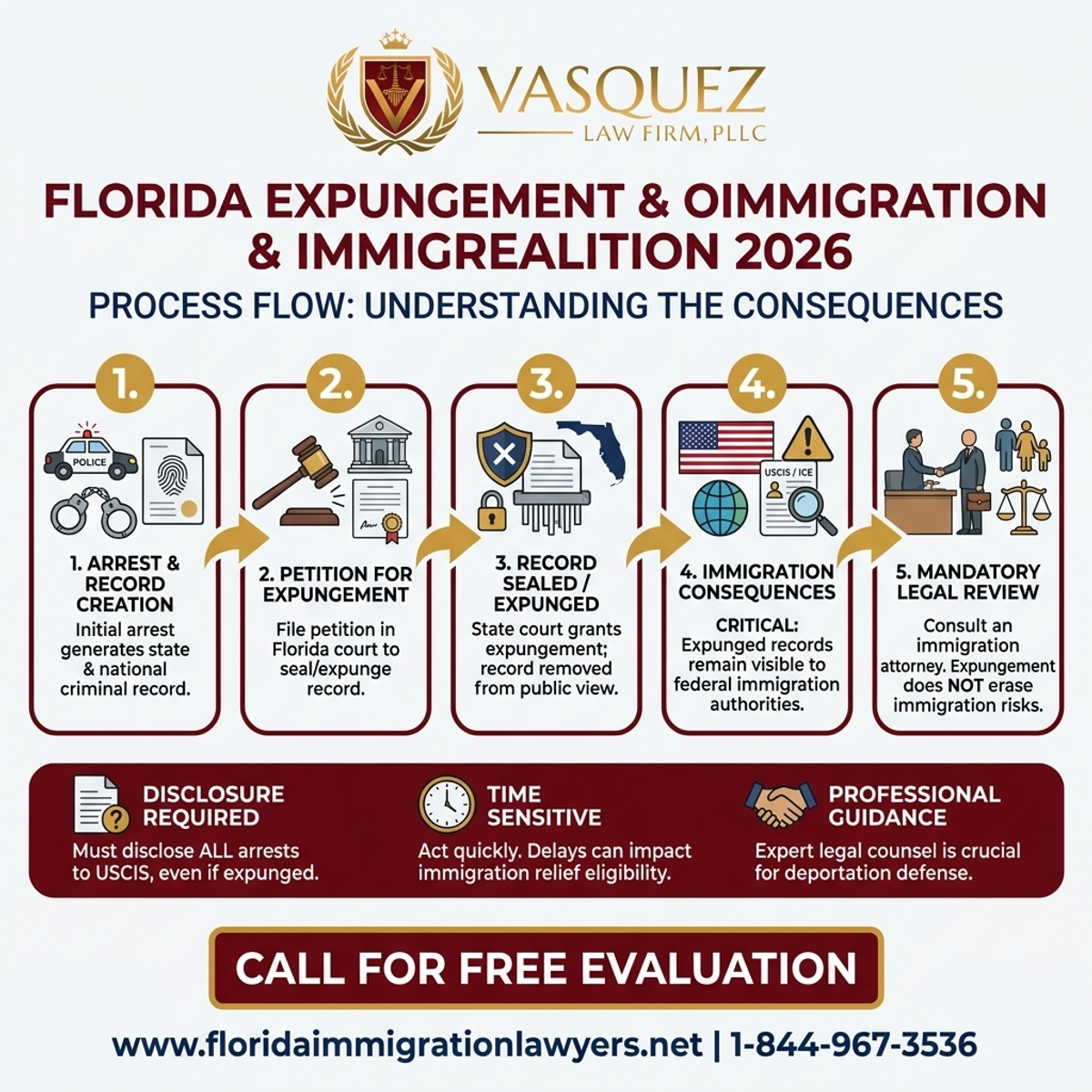
Step-by-Step Process — Expungement Immigration Consequences in Florida 2026
Despite these measures, expunged or sealed records may still be visible to federal agencies. Therefore, if you're an immigrant in Kissimmee, understanding this distinction is vital.
Florida's expungement and sealing laws are primarily designed to give individuals a second chance within the state's jurisdiction. They aim to help people reintegrate into society, secure employment, and move past minor infractions without the lifelong stigma of a public criminal record. For instance, a sealed record means that employers, landlords, and the general public cannot typically view the details of an arrest or conviction. An expunged record goes a step further, theoretically deleting the record from most state databases. However, this "second chance" is specifically tailored to state-level interactions and does not extend its protective umbrella to federal immigration matters.
The specific government agencies that retain access to sealed or expunged records in Florida include law enforcement agencies, state attorney's offices, and, critically for immigrants, federal agencies like the FBI, USCIS, and ICE. When you apply for an immigration benefit, USCIS conducts thorough background checks, often requesting information from various federal and state databases. Even if Florida has expunged a record, the underlying arrest and judicial proceedings may still be present in federal databases, such as those maintained by the FBI, which are readily accessible to immigration authorities. This is why a "clean slate" at the state level does not equate to a clean slate in the eyes of federal immigration law.
Furthermore, Florida's criteria for expungement or sealing are quite specific. Generally, you must not have been adjudicated guilty of any criminal offense, or if you were, the charge must have been dismissed, nolle prossed, or resulted in an acquittal. You also cannot have previously sealed or expunged a criminal record. Meeting these state-level requirements is just the first hurdle. The critical second step, especially for immigrants, is to understand how that state-level relief interacts with federal immigration definitions of "conviction" and "crime." An experienced immigration attorney at Florida Immigration Lawyers can help you navigate these complex layers, ensuring you understand the full implications of your record on your immigration journey.
Step-by-Step Guide to Expungement in Florida
Successfully navigating the Florida expungement process is a significant undertaking that requires meticulous attention to detail and a comprehensive understanding of state laws. While the steps appear straightforward, each stage carries its own set of legal requirements and potential pitfalls. For immigrants, this process is doubly critical, as any misstep could have unforeseen consequences for their federal immigration status. Therefore, securing legal guidance is not just advisable; it's often essential to ensure the process is handled correctly and strategically.
- Check Eligibility: Verify if your case qualifies for expungement or sealing under Florida statutes. This involves reviewing the specific charges, the disposition of your case, and your overall criminal history. Certain serious offenses, or having prior expungements, can disqualify you.
- Gather Documentation: Collect necessary documents, including your certified copy of arrest record, final case disposition, and a letter of eligibility from the Florida Department of Law Enforcement (FDLE). Accuracy and completeness are paramount to avoid delays.
- File a Petition: Submit a formal request for expungement to the court, including supporting documents and a notarized affidavit. This petition must meticulously follow court procedures and state specific grounds for expungement.
- Attend a Hearing: A court hearing may be required to discuss your petition's merits. During this hearing, you or your attorney will present your case to the judge, addressing any objections from the State Attorney's Office.
- Receive a Decision: The court will issue an order of expungement or denial, which can be appealed if necessary. If granted, the order directs state agencies to seal or expunge your record, though remember this doesn't guarantee federal protection.
Even after a state-level expungement, understanding its limited scope for immigration purposes is crucial. For detailed guidance and support throughout this process, and to understand how it impacts your immigration goals, contact Florida Immigration Lawyers. Our team can help you prepare every document and navigate every hearing with confidence.
Document Checklist for Expungement
A complete and accurate document checklist is the backbone of a successful expungement application. Missing or incorrect paperwork is one of the most common reasons for delays or outright denial. Each document serves a crucial purpose in proving your eligibility and presenting a clear case to the court. Ensuring that every item is certified, up-to-date, and precisely matches the court's requirements is paramount.
- Certified Copy of Arrest Record: This document provides official proof of your arrest and is essential for identifying the specific charges you wish to expunge.
- Final Case Disposition: This court document details the outcome of your case, such as dismissal, acquittal, or nolle prosequi, which is critical for demonstrating eligibility.
- Letter of Eligibility from Florida Department of Law Enforcement: This official letter confirms that your record meets the state's criteria for expungement or sealing, a mandatory step before filing your petition.
- Completed Petition for Expungement Form: This is the formal request to the court, which must be filled out accurately and completely, outlining your personal information and the details of the record you wish to expunge.
- Notarized Affidavit: A sworn statement affirming that you meet all legal requirements for expungement and that you have not previously sealed or expunged another record. This adds legal weight to your petition.
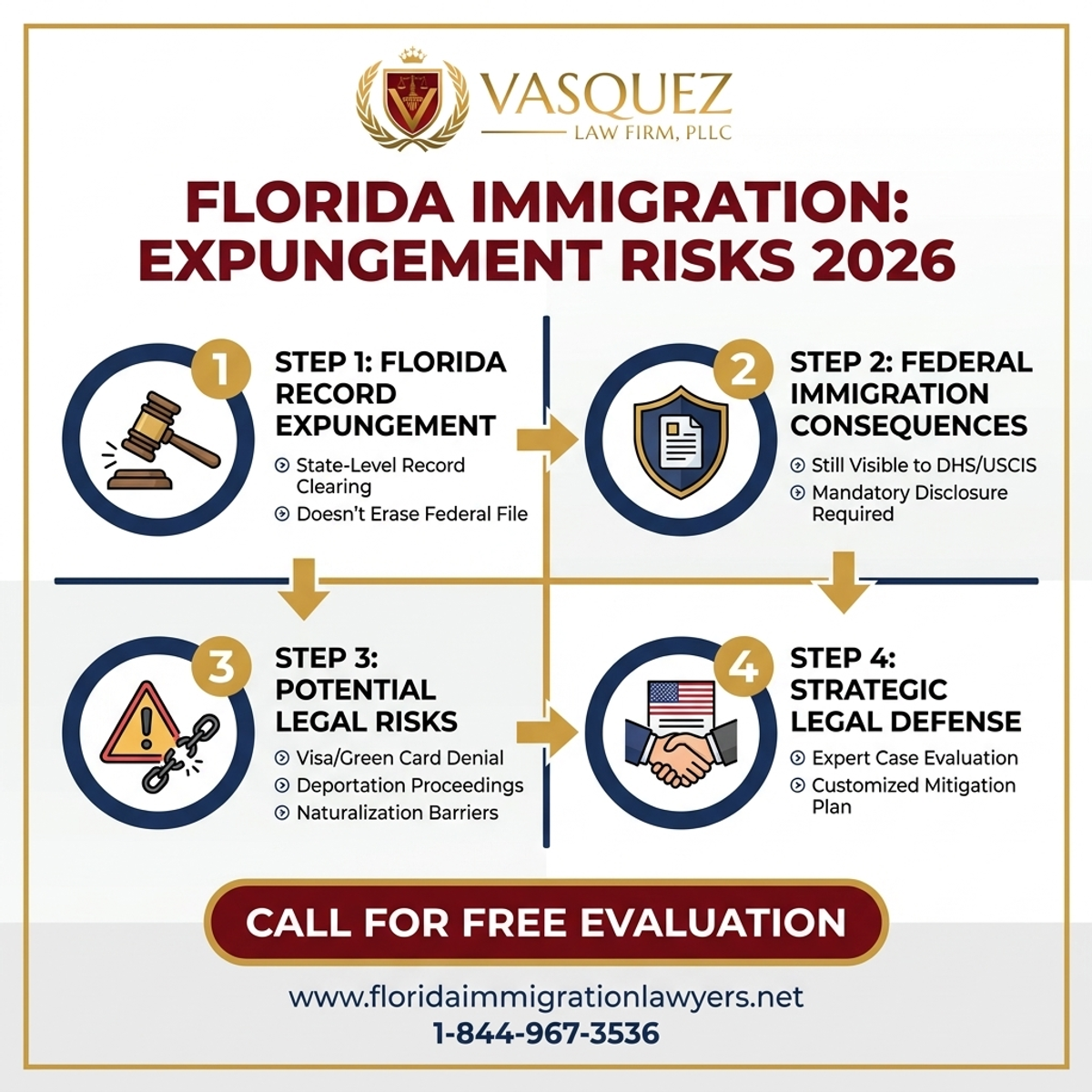
Key Statistics — Expungement Immigration Consequences in Florida 2026
Beyond these core documents, your attorney may advise gathering additional supporting evidence, such as character references or proof of rehabilitation, depending on the specifics of your case. Florida Immigration Lawyers can help you meticulously compile and review all necessary documentation to strengthen your petition.
Timeline and Processing Expectations
The expungement process, while beneficial, is not a quick fix. It requires patience and a realistic understanding of the timeframes involved. These estimates are typical, but individual cases can vary significantly based on factors like court backlogs, the complexity of your record, and the efficiency of various agencies. It's crucial to prepare for potential delays and maintain open communication with your legal team throughout the journey.
| Stage | Typical Timeframe | Notes |
|---|---|---|
| Eligibility Check | 2-4 weeks | Verify with FDLE. This step is crucial for determining if your case meets state criteria and to obtain the necessary Certificate of Eligibility. |
| Document Preparation | 1-2 months | Ensure all paperwork is accurate and complete. This often involves requesting certified copies from various courts and agencies, which can take time. |
| Filing and Hearing | 3-6 months | Depends on court schedule and the specific judicial circuit. Some courts have heavier dockets than others, potentially extending this phase. |
| Final Decision | 1-2 months | May be subject to appeal. Once the judge issues an order, it must be processed and distributed to relevant agencies. |
These timelines underscore the importance of starting the process early, especially if you anticipate future immigration applications. Proactive planning with Florida Immigration Lawyers can help streamline
Sources and References
- U.S. Citizenship and Immigration Services (USCIS)
- Executive Office for Immigration Review (EOIR)
- U.S. Department of State - Bureau of Consular Affairs
- Immigration and Nationality Act (INA), 8 U.S.C. Chapter 12
Do Not Navigate This Process Alone
Our experienced immigration attorneys are ready to fight for you. Get a free, confidential case review today.
Se Habla Español
Or leave your details and we’ll call you:
Free Evaluation in 24 Hours
Or talk to us right now

AI voice assistant — available 24/7
FreeFrequently Asked Questions

William J. Vásquez
Founding Attorney · Vasquez Law Firm
U.S. Air Force veteran and immigration attorney with years of hands-on U.S. immigration experience. J.D., NCCU School of Law. AILA member. Admitted to the 4th, 5th, and 11th Circuit Courts.
Available 24/7 - Free Evaluations
Reviewed for legal accuracy by William J. Vásquez
Licensed in North Carolina; U.S. immigration is federal practice.
Related Legal Services
Our Florida immigration attorneys can help you with experienced immigration attorneys, asylum protection and citizenship and naturalization. Call today at 1-844-YO-PELEO for a free case review.
Related Links
Related Topics
Free Legal Case Review
Discuss your case with our experienced attorneys. We're available 24/7.
Se Habla Español - Estamos aquí para ayudarle.
Related Articles
Immigration Lawyer Orlando Free Consultation in Florida
For individuals and families in Orlando, Florida, navigating the complexities of U.S. immigration law requires expert guidance. An immigration lawyer in Orlando offers crucial support for everything from visa applications and green card processes to naturalization and deportation defense. This comprehensive guide details what a free consultation covers, providing a step-by-step overview of immigration pathways, essential document checklists, and expected timelines in 2026. We also highlight common mistakes to avoid, discuss the critical role of legal counsel in deportation and asylum cases, and explain why choosing a local Orlando immigration attorney is beneficial. Florida Immigration Lawyers is dedicated to serving the diverse community of Orlando with compassionate, effective legal solutions, ensuring you receive personalized advice and robust representation for a successful immigration journey.
Fiance Visa in Miami: 2026 Process Guide for Florida
For U.S. citizens in Florida, bringing a foreign fiancé(e) to the U.S. requires navigating the K-1 Fiance Visa process. This guide details the 2026 requirements, step-by-step application, essential documents, and expected timelines. Learn about filing Form I-129F with USCIS, consular interviews, and the crucial Adjustment of Status after marriage. We cover typical fees, common mistakes to avoid, and when to seek legal assistance. Florida Immigration Lawyers offers expert guidance for couples in Miami, Orlando, and across Florida, ensuring a smooth path to uniting with your loved one. Get a free case review today.
Immigration Lawyer Services in Orlando, Florida
Explore immigration consultation services in Orlando, Florida, with a qualified immigration lawyer. Learn what to expect and understand your options for family and business immigration needs.
Fraud Prevention and Detection Fee: What to Know in Florida
Explore the fraud prevention and detection fee essential for immigration processes in Florida. Discover how it impacts applications like the I-601 waiver and learn key steps to navigate this requirement effectively.