Exclusive Citizenship Act of 2025: Florida Immigration
The Exclusive Citizenship Act of 2025 (S.3283) is a proposed U.S. Senate bill aiming to restrict dual citizenship and mandate sole allegiance to the United States. As of March 2026, this bill has not passed and is considered unlikely to become law, meaning current U.S. citizenship laws and dual nationality practices remain unchanged. This comprehensive guide from Florida Immigration Lawyers clarifies the bill's status, its potential impact on Floridians, and the existing pathways to U.S. citizenship. We detail the naturalization process, document requirements, and common mistakes to avoid. For expert guidance on your citizenship journey or concerns about legislative changes, contact our experienced immigration attorneys in West Palm Beach and across Florida for a free consultation.

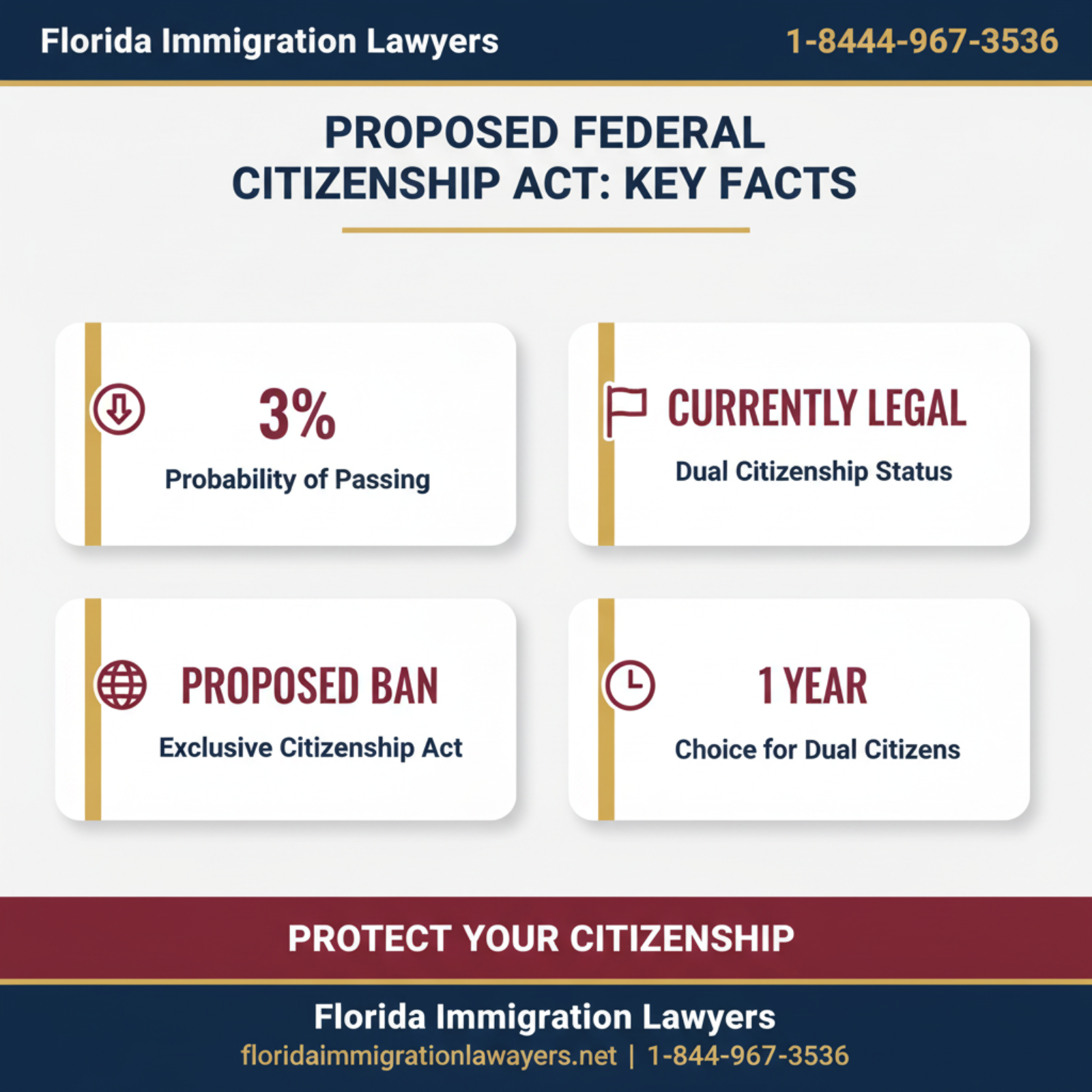
The Exclusive Citizenship Act of 2025 (S.3283) is a proposed bill in the U.S. Congress that aims to establish sole allegiance for U.S. citizens, potentially restricting dual citizenship. As of March 2026, this bill remains proposed, has not passed, and is considered to have a low likelihood of becoming law. Current U.S. citizenship laws and dual nationality practices remain unchanged, and individuals can still pursue naturalization.
- S.3283 is a proposed bill, not current law.
- It seeks to restrict dual citizenship and mandate sole allegiance.
- The bill has a low probability of passing as of March 2026.
- Current U.S. citizenship laws remain in effect.
- Consult an attorney for updates on legislative changes.
Navigating the complexities of U.S. immigration law can feel like a constant challenge, especially with new legislative proposals frequently emerging. Many Florida residents, particularly those in diverse communities like West Palm Beach, often wonder how potential changes might affect their status or their path to citizenship. One such proposal that has garnered attention is the Exclusive Citizenship Act of 2025.
This article aims to clarify what the Exclusive Citizenship Act of 2025 entails, its current status, and what it could potentially mean for you and your family in Florida. It is crucial to understand that this is a *proposed* bill, not enacted law, and its passage is highly uncertain. We will also outline the existing pathways to U.S. citizenship and provide essential guidance.
If you have questions about your citizenship status, the impact of proposed legislation, or need assistance with any immigration matter in Florida, do not hesitate to seek expert legal guidance. Call Florida Immigration Lawyers at 1-844-967-3536 for a free consultation today.
Understanding the Exclusive Citizenship Act of 2025 and Its Current Status
The Exclusive Citizenship Act of 2025, formally introduced as Senate Bill S.3283 in the 119th Congress, is a piece of proposed legislation that has sparked considerable discussion. Its primary objective, as outlined in the bill's text, is to establish that citizens of the United States shall owe sole and exclusive allegiance to the United States.
In essence, if passed, this act would seek to eliminate or severely restrict dual citizenship for U.S. nationals. This could mean that individuals who are currently citizens of both the United States and another country might be forced to choose one. Furthermore, those seeking naturalization could be required to explicitly renounce all other allegiances in a more stringent manner than currently practiced.
The Legislative Journey of S.3283
As of March 2026, the Exclusive Citizenship Act of 2025 remains a proposed bill. It was introduced in the Senate in December 2025 and referred to the Committee on the Judiciary. For a bill to become law, it must pass both the Senate and the House of Representatives, and then be signed by the President. This process involves committee hearings, debates, and votes.
Currently, S.3283 has not progressed beyond the committee stage. Many legislative analysts and immigration experts consider the likelihood of this particular bill passing in its current form to be very low. The U.S. has a long-standing history of largely tolerating dual nationality, and any significant change would face substantial constitutional and political challenges.
Historical Context of Dual Citizenship in the U.S.
The United States generally permits dual nationality, meaning a person can be a citizen of both the U.S. and another country. U.S. law does not explicitly prohibit it, and the Supreme Court has affirmed the right to hold dual citizenship in various cases. For example, the Department of State acknowledges that dual nationality exists.
When naturalizing as a U.S. citizen, applicants take an Oath of Allegiance that includes renouncing allegiance to any foreign state. However, this renunciation is generally interpreted by U.S. courts as an expression of loyalty to the U.S., not necessarily a legal severing of ties with another country unless explicitly required by that foreign nation's laws. The Exclusive Citizenship Act of 2025 seeks to alter this interpretation significantly.
Potential Impact on Florida Residents and Immigration
Florida is one of the most diverse states in the nation, home to a vast population of immigrants, naturalized citizens, and individuals with strong ties to their countries of origin. Communities from West Palm Beach to Miami, Orlando, and Tampa include many residents who hold or are eligible for dual citizenship. The passage of the Exclusive Citizenship Act of 2025 would introduce unprecedented complexities.
Implications for Naturalized Citizens
If S.3283 were to become law, naturalized U.S. citizens who also hold citizenship in another country could face difficult choices. They might be compelled to formally renounce their foreign citizenship to retain their U.S. citizenship. This could have profound personal, economic, and familial consequences for hundreds of thousands of Floridians.
The bill's language would need to be carefully scrutinized to understand its retroactive application or any grace periods provided. Such a requirement could also impact travel, property ownership, and inheritance rights in their country of origin. This uncertainty underscores the importance of staying informed and seeking legal counsel.
Impact on U.S. Citizens Born Abroad and Their Children
The proposed act could also affect U.S. citizens born abroad who automatically acquire foreign citizenship by virtue of their birth country's laws (jus soli) or through their non-U.S. citizen parent (jus sanguinis). While the 14th Amendment protects birthright citizenship for those born on U.S. soil, the scope of S.3283 might extend to requiring individuals to choose allegiance upon reaching adulthood.
Families with children born outside the U.S. to one U.S. citizen parent and one foreign citizen parent could also be affected. Currently, these children can often hold dual citizenship. The act could force these families to make decisions about their children's national identity and future legal status. This would be a significant shift from current U.S. policy regarding citizenship acquisition.
Current Paths to U.S. Citizenship (Unaffected by S.3283 - For Now)
It is vital to reiterate that the Exclusive Citizenship Act of 2025 is not law. Therefore, the existing pathways to U.S. citizenship remain fully in effect. For many Florida residents, the most common path to becoming a U.S. citizen is through naturalization.
Naturalization Through Residency: A Step-by-Step Guide
Naturalization is the process by which a lawful permanent resident (Green Card holder) becomes a U.S. citizen. The requirements are set forth in the Immigration and Nationality Act (INA) Section 316 (8 U.S.C. 1427).
- Determine Eligibility: Generally, you must be 18 years old, a lawful permanent resident for at least five years (or three years if married to a U.S. citizen and living with them), have continuous residence and physical presence in the U.S., demonstrate good moral character, and have a basic understanding of English and U.S. civics.
- Prepare Form N-400, Application for Naturalization: This comprehensive form requires detailed personal information, residency history, employment history, and answers to questions about your moral character. Accurate and complete information is paramount.
- Gather Supporting Documents: Collect all necessary documents, such as your Green Card, marriage certificate (if applicable), divorce decrees, tax returns, selective service registration, and any court or police records.
- Submit Application and Fees: File your Form N-400 along with the required filing fee and biometrics fee to U.S. Citizenship and Immigration Services (USCIS). Fees change, so always check the latest amounts on the USCIS website.
- Attend Biometrics Appointment: USCIS will send you an appointment notice to capture your fingerprints, photograph, and signature. This is used for background checks.
- Attend Interview with USCIS Officer: You will be scheduled for an interview at a local USCIS field office, such as the one in West Palm Beach. During the interview, an officer will review your application, ask questions about your eligibility, and administer the English and civics tests.
- Receive a Decision: After the interview, USCIS will issue a decision. This could be an approval, a request for more evidence, or a denial.
- Attend Oath of Allegiance Ceremony: If approved, you will attend a naturalization ceremony where you take the Oath of Allegiance to the United States. Upon taking the oath, you officially become a U.S. citizen.
Citizenship Through Parents (Acquisition or Derivation)
Children can also acquire U.S. citizenship through their U.S. citizen parents. This can happen at birth (acquisition) or after birth but before age 18 (derivation). INA Sections 320 and 322 (8 U.S.C. 1431 and 1433) govern these processes.
For example, a child born outside the U.S. to two U.S. citizen parents, or one U.S. citizen parent who has met certain residency requirements, may acquire citizenship at birth. A child living in the U.S. as a lawful permanent resident may derive citizenship automatically when their U.S. citizen parent naturalizes, provided certain conditions are met.
Document Checklist for Naturalization (Form N-400)
A complete application package is critical for a smooth naturalization process. While the exact documents may vary based on your specific circumstances, a typical checklist includes:
- Copy of your Green Card (Form I-551) front and back.
- Copies of all passports (U.S. and foreign) held in the last 5 years (or 3 years, if applicable).
- Certified copies of marriage certificates and divorce decrees (if applicable).
- Evidence of termination of prior marriages for you and your spouse (if applicable).
- Tax transcripts or returns for the past 3-5 years.
- Proof of selective service registration (if you are a male applicant between ages 18-26).
- Certified court dispositions for any arrests or citations, even if charges were dropped or expunged.
- Evidence of child support or alimony payments (if applicable).
- Travel records, including dates of all trips outside the U.S.
- Any other documents requested by USCIS or relevant to your eligibility.
Navigating Potential Legislative Changes: Timelines and Expectations
Understanding the legislative process helps manage expectations regarding bills like the Exclusive Citizenship Act of 2025. Bills typically go through multiple committees, floor votes, and potentially reconciliation between the two chambers of Congress. This process can take months or even years, and many bills never become law.
Given the current status of S.3283, there is no immediate impact on existing citizenship applications or dual nationality. However, staying informed about legislative developments is always wise. Florida Immigration Lawyers actively monitors these changes to provide the most up-to-date advice to our clients.
Current USCIS Processing Times for Naturalization
For current citizenship applications, USCIS processing times can vary significantly based on the field office and the complexity of the case. In Florida, offices like the West Palm Beach Field Office have specific timelines. You can check the estimated processing times on the USCIS website using your receipt number or form type.
Typically, the naturalization process from filing to oath ceremony can take anywhere from 6 months to over 2 years. Factors like application completeness, background check results, and USCIS workload all play a role. These timelines are for the *current* process and would likely be subject to change if a major legislative overhaul like the Exclusive Citizenship Act of 2025 were to pass.
Understanding Costs and Fees for Citizenship Applications
Pursuing U.S. citizenship involves various costs, primarily filing fees charged by USCIS. These fees are subject to change, so it is always essential to verify the current amounts directly on the official USCIS website before filing your application.
The main fees associated with naturalization include the application fee for Form N-400 and the biometrics services fee. In some cases, applicants may be eligible for a fee waiver or a reduced fee, depending on their income and other eligibility criteria. Always check the USCIS guidelines for fee waiver eligibility.
The Value of Legal Fees
While hiring an immigration attorney incurs additional costs, the value of expert legal guidance throughout the naturalization process is often invaluable. An experienced lawyer can help you:
- Determine your eligibility and identify any potential issues.
- Prepare and review your Form N-400 to ensure accuracy and completeness.
- Gather all necessary supporting documents.
- Prepare you for your USCIS interview, including civics and English tests.
- Represent you during the interview, if permitted.
- Respond to Requests for Evidence (RFEs) or Notices of Intent to Deny (NOIDs).
These services can significantly reduce the risk of delays or denials, especially if your case has complexities like a criminal record, extensive travel, or questions about good moral character. Investing in legal counsel can save you time, stress, and potential future expenses.
Do not navigate this process alone. The stakes are too high to risk common errors or misunderstandings of complex laws. Contact Florida Immigration Lawyers today for personalized assistance.
Common Mistakes to Avoid in Your Citizenship Journey
- Misinterpreting the Status of Proposed Legislation: Many individuals become anxious about bills like the Exclusive Citizenship Act of 2025, mistakenly believing they are already law. This can lead to unnecessary panic or premature actions. Always verify the current legal status of any proposed bill through reliable sources.
- Failing to Meet Residency Requirements: Naturalization requires continuous residence and physical presence in the U.S. Overlooking extended trips abroad or not maintaining your residence can jeopardize your application. Keep meticulous records of all travel.
- Providing Incomplete or Inaccurate Information: Any omissions or false statements on your Form N-400 can lead to delays, denials, or even accusations of misrepresentation. Be honest and thorough in every section of your application.
- Not Disclosing All Legal Issues: Even minor arrests, citations, or interactions with law enforcement must be disclosed, regardless of whether charges were dropped or expunged. USCIS conducts thorough background checks, and non-disclosure is a serious offense.
- Failing the English or Civics Test: Applicants must demonstrate a basic ability to read, write, and speak English, and pass a civics test on U.S. history and government. Inadequate preparation for these tests is a common reason for application delays or denials.
- Not Updating USCIS About Address Changes: You are legally required to notify USCIS of any address change within 10 days of moving. Failure to do so can result in missed notices, appointments, and even the termination of your application.
- Traveling Excessively Outside the U.S.: Long absences can break your continuous residency requirement. While some exceptions exist, it's crucial to understand the rules regarding trips abroad before you travel.
- Missing Deadlines or Appointments: USCIS provides specific deadlines for responding to requests for evidence and strict appointment schedules. Missing these can lead to your application being denied or closed.
- Assuming Dual Citizenship is Universally Banned: As of March 2026, dual citizenship is generally permitted under U.S. law. Do not make decisions based on the assumption that the Exclusive Citizenship Act of 2025 has changed this.
- Not Preparing Adequately for the Interview: The naturalization interview is a critical step. Being unprepared for questions about your application, U.S. history, or your character can lead to issues.
- Failing to Seek Legal Counsel for Complex Cases: If you have any doubts about your eligibility, past legal issues, or questions about legislative changes, attempting to navigate the process alone is a significant risk.
When to Call Florida Immigration Lawyers for Expert Guidance
While the path to U.S. citizenship may seem straightforward for some, many situations warrant the expertise of an experienced immigration attorney. This is especially true when dealing with the uncertainty surrounding proposed legislation like the Exclusive Citizenship Act of 2025.
You should consider contacting Florida Immigration Lawyers if any of the following scenarios apply to you:
- You have questions about the current status or potential impact of S.3283 or other legislative proposals.
- You have a criminal record, even a minor one, that might affect your good moral character requirement.
- You have had long or frequent absences from the U.S. that could impact your continuous residency.
- You have received a Request for Evidence (RFE) or a Notice of Intent to Deny (NOID) from USCIS.
- You are concerned about maintaining dual nationality or how changes might affect your foreign citizenship.
- You need assistance preparing for your naturalization interview or understanding complex legal questions.
- Your application has been delayed significantly, or you believe it has been unfairly denied.
- You need personalized advice on your specific eligibility for citizenship in West Palm Beach or anywhere else in Florida.
Our team at Florida Immigration Lawyers is dedicated to helping individuals and families throughout Florida achieve their immigration goals. We understand the nuances of immigration law and are committed to providing compassionate, effective representation.
About Florida Immigration Lawyers
Florida Immigration Lawyers is a leading immigration law firm serving clients throughout Florida, including West Palm Beach, Miami, Orlando, and Tampa. Our dedicated team of attorneys specializes in a wide range of immigration services, from family-based petitions and business immigration to asylum and deportation defense.
We pride ourselves on our client-focused approach, offering personalized legal strategies tailored to your unique circumstances. We understand the challenges and anxieties that come with immigration matters, and we are here to provide clear, honest, and effective legal counsel. Our firm is available 24/7 to address your urgent needs and offers free consultations to help you understand your options.
Choose Florida Immigration Lawyers for our expertise, our commitment to our clients, and our proven track record of success. Your immigration journey is our priority. Visit our website at https://www.floridaimmigrationlawyers.net or call us at 1-844-967-3536 to schedule your free consultation.
Sources and References
- U.S. Citizenship and Immigration Services (USCIS)
- Executive Office for Immigration Review (EOIR)
- U.S. Department of State - Dual Nationality
- S.3283 - Exclusive Citizenship Act of 2025 (Congress.gov)
- Immigration and Nationality Act (INA) Section 316 - General Requirements for Naturalization (8 U.S.C. 1427)
- Immigration and Nationality Act (INA) Section 301 - Nationals and Citizens of United States at Birth (8 U.S.C. 1401)
- Immigration and Nationality Act (INA) Section 320 - Children Born Outside United States of One Citizen Parent (8 U.S.C. 1431)
- Immigration and Nationality Act (INA) Section 322 - Children Born Outside United States of Citizen Parents (8 U.S.C. 1433)
- 8 CFR Part 316 - General Requirements for Naturalization
- USCIS Policy Manual, Volume 12 - Citizenship and Naturalization
This article provides general legal information and is not intended as legal advice. Every case is unique, and outcomes depend on specific facts and circumstances. Contact an attorney for advice about your particular situation.
The landscape of immigration law is constantly evolving, and proposed legislation like the Exclusive Citizenship Act of 2025 can create significant concern and confusion. It is imperative to rely on accurate, up-to-date information and professional legal guidance to protect your future. Florida Immigration Lawyers is here to be your trusted partner, providing the clarity and representation you need.
Don't let uncertainty jeopardize your immigration goals. Contact Florida Immigration Lawyers today at 1-844-967-3536 for a free consultation. Se Habla Español - Estamos aquí para ayudarle.
Do Not Navigate This Process Alone
Our experienced immigration attorneys are ready to fight for you. Get a free, confidential consultation today.
Se Habla Español
Frequently Asked Questions
Florida Immigration Lawyers
Immigration Attorney | Founder, Vasquez Law Firm
U.S. Air Force veteran and immigration attorney with thousands of cases resolved. J.D., NCCU School of Law. AILA member. Admitted to the 4th, 5th, and 11th Circuit Courts.
Available 24/7 - Free Evaluations
Related Legal Services
Our Florida immigration attorneys can help you with family immigration services, immigration practice areas and free immigration consultation. Call today at 1-844-967-3536 for a free consultation.
Related Links
Related Topics
Free Legal Consultation
Discuss your case with our experienced attorneys. We're available 24/7.
Se Habla Español - Estamos aquí para ayudarle.
Related Articles
Immigration Attorney in Gainesville: Your North Florida Guide
Finding an immigration attorney in Gainesville, North Florida, can be crucial for your immigration journey. Learn how experienced lawyers can guide you through complex processes and help you avoid common pitfalls. Call Florida Immigration Lawyers at 1-844-967-3536 for expert assistance.
E-2 Visa Guide for Investors in Florida | VLF Florida
Discover how to obtain an E-2 investor visa for your business in St. Petersburg, Florida. Learn the steps, requirements, and how Florida Immigration Lawyers can assist you.
Immigration Attorney Orlando Florida: Expert Visa Help
Facing immigration challenges in Orlando, Florida? Discover how an experienced immigration attorney can assist with visas, green cards, and deportation defense. Call Florida Immigration Lawyers at 1-844-967-3536 for a free consultation.
Green Card Renewal Process in Florida Explained | VLF Florida
Renew your green card in Naples, Florida, by understanding the essential steps and avoiding common mistakes. Learn more about the process and get professional assistance from Florida Immigration Lawyers.
