Dual Citizenship Lawyer in Florida: Your 2026 Legal Guide
Understanding dual citizenship in Florida requires navigating complex U.S. and international laws. This comprehensive guide, authored by Florida Immigration Lawyers, explores what dual nationality means, how it works in the U.S., and the critical role a skilled attorney plays in the process. Learn about naturalization requirements, the steps involved in becoming a U.S. citizen while potentially retaining foreign citizenship, and the associated timelines and costs. We delve into the benefits and challenges of dual nationality, common mistakes to avoid, and when it's essential to seek legal counsel. Our firm, serving all of Florida including Naples, Miami, and Orlando, is dedicated to providing expert guidance and support for your dual citizenship journey.

Navigating dual citizenship requires understanding intricate U.S. and international laws, making the guidance of a dual citizenship lawyer in Florida invaluable. Dual nationality allows individuals to be citizens of two countries simultaneously, a status recognized by the U.S. under specific circumstances. This often involves acquiring U.S. citizenship through naturalization while retaining citizenship from one's birth country, provided that country's laws permit it. An attorney helps assess eligibility, manage complex applications, and ensures compliance with all legal requirements, especially concerning renunciation or retention of foreign citizenship.
- Dual citizenship is recognized by the U.S. but requires careful navigation of both U.S. and foreign laws.
- A lawyer helps assess eligibility, manage the naturalization process, and avoid common pitfalls.
- The process typically involves acquiring U.S. citizenship without formally renouncing previous nationality.
- Understanding tax obligations, travel restrictions, and military service requirements is crucial.
- Legal counsel is essential to ensure compliance and protect your rights in Florida and abroad.
Florida, a state with a rich tapestry of international residents and strong ties to countries worldwide, often sees individuals considering or pursuing dual citizenship. The idea of holding legal allegiance to two nations can be appealing, offering various benefits from enhanced travel freedom to property ownership rights. However, the path to achieving or maintaining dual nationality is rarely straightforward. It involves a detailed understanding of both U.S. immigration law and the laws of the other country in question. Many people seeking to become U.S. citizens through naturalization, or those already U.S. citizens by birth, wonder how this impacts their existing or potential foreign citizenship.
At Florida Immigration Lawyers, we understand the complexities and nuances involved in dual citizenship. Our dedicated team of immigration attorneys serves individuals across Florida, including Naples, Miami, Orlando, and Tampa, providing expert guidance on eligibility, application processes, and potential challenges. We are here to help you understand your options and ensure a smooth journey. Call Florida Immigration Lawyers at 1-844-967-3536 for a free consultation to discuss your specific situation today.
What is Dual Citizenship, and How Does it Work in Florida?
Dual citizenship, also known as dual nationality, is the legal status of a person who is a citizen of two countries simultaneously. The United States generally permits dual nationality, meaning that a U.S. citizen may also be a citizen of another country. This is often misunderstood, as many believe the U.S. requires a formal renunciation of foreign citizenship upon naturalization. However, U.S. law does not explicitly prohibit or endorse dual nationality. Instead, it focuses on ensuring that individuals who naturalize as U.S. citizens intend to be loyal to the United States. This intent is primarily assessed during the naturalization oath ceremony, where applicants swear allegiance to the U.S.
For residents in Florida, understanding how dual citizenship works involves looking at both U.S. law and the laws of their country of origin. Some countries automatically revoke citizenship upon acquiring a foreign one, while others permit or even encourage dual nationality. For example, countries like Mexico, Colombia, and the Philippines commonly allow their citizens to also hold U.S. citizenship. Conversely, some nations, such as India or China, generally do not permit dual nationality, though exceptions or specific pathways might exist. A key principle in U.S. law regarding dual nationality is that a person who is a U.S. citizen is treated solely as a U.S. citizen when in the United States or dealing with U.S. authorities. This is codified in various sections of the Immigration and Nationality Act (INA), specifically sections like INA 349 (8 U.S.C. 1481) which addresses loss of nationality, but generally requires a voluntary act with the intent to relinquish U.S. citizenship.
In Florida, the practical implications of dual citizenship can affect various aspects of life, including travel, taxes, and legal rights. Dual citizens typically use their U.S. passport to enter and exit the United States. When traveling to their other country of citizenship, they may be required to use that country's passport. Tax obligations can also become more complex, as U.S. citizens are subject to worldwide taxation, regardless of where they reside. This means dual citizens must often file tax returns in both countries, potentially requiring specialized tax advice in addition to immigration counsel. Understanding these intricacies is critical for anyone in Florida considering or holding dual nationality.
How Can a Dual Citizenship Lawyer in Florida Assist You?
Navigating the complex landscape of dual citizenship can be overwhelming, and a dual citizenship lawyer in Florida offers indispensable support. Our attorneys at Florida Immigration Lawyers provide expert guidance tailored to your unique situation, whether you are seeking to naturalize as a U.S. citizen while retaining foreign citizenship, or if you are a U.S. citizen exploring the possibility of acquiring another nationality. We help clients understand the legal implications, assess their eligibility, and prepare all necessary documentation. This is particularly crucial given that the laws governing citizenship can vary significantly between countries, and a misstep could lead to unforeseen complications or even the unintended loss of citizenship.
Specifically, our services include evaluating your current citizenship status and that of your country of origin to determine the feasibility of dual nationality. We assist with the entire U.S. naturalization process, including the preparation and filing of Form N-400, Application for Naturalization, and preparing you for the USCIS civics test and English proficiency interview. Our team ensures that your intent during the naturalization oath is clearly understood within the context of U.S. law, which generally does not require you to explicitly renounce your prior citizenship unless you have a specific intent to do so. We also advise on the potential consequences of dual nationality, such as military service obligations in your other country or specific travel restrictions that might apply.
Furthermore, a lawyer can be critical in situations involving complex scenarios, such as birth abroad to U.S. citizen parents, or cases where a U.S. citizen wishes to regain a lost foreign citizenship. We stay updated on changes in immigration law and international treaties that may impact dual nationality. For individuals in Naples and across Florida, our firm provides localized support, understanding the specific needs and concerns of our diverse community. We ensure that you are fully informed of your rights and responsibilities, helping you make sound decisions throughout the process and protecting your long-term interests. Our goal is to make the process as clear and stress-free as possible.
What Are the Requirements and Steps for Obtaining Dual Citizenship?
Obtaining dual citizenship typically involves acquiring U.S. citizenship through naturalization without explicitly renouncing your original citizenship, provided your home country's laws allow for dual nationality. The fundamental requirements for U.S. naturalization are consistent across the nation, including for applicants in Florida. As of 2026, these generally include being at least 18 years old, holding a Green Card for a specific period (usually five years, or three years if married to a U.S. citizen), demonstrating continuous residence and physical presence in the U.S., showing good moral character, and passing English and civics tests. It is essential to understand that the U.S. does not require you to formally renounce your previous citizenship when taking the Oath of Allegiance, as long as your intent is to be loyal to the U.S.
The Naturalization Process
The journey to U.S. citizenship, a common path to dual nationality, involves several crucial steps:
- Determine Eligibility: Confirm you meet the basic requirements, including age, residency, physical presence, and good moral character. For instance, living in Naples, Florida, for the required period is part of establishing continuous residence.
- Prepare and File Form N-400: Complete the Application for Naturalization accurately. This detailed form requires extensive personal, residential, and employment history. Any discrepancies or omissions can lead to delays or denials.
- Attend Biometrics Appointment: USCIS will schedule an appointment to collect your fingerprints, photograph, and signature for background checks.
- Complete Interview: A USCIS officer will interview you to verify the information on your N-400, test your English proficiency (reading, writing, and speaking), and administer the civics test. The civics test covers U.S. history and government.
- Receive Decision: USCIS will mail you a decision notice. If approved, you will receive an invitation to the Oath of Allegiance ceremony.
- Take Oath of Allegiance: This is the final step where you pledge allegiance to the United States. Upon taking the oath, you officially become a U.S. citizen. At this point, you will typically receive your Certificate of Naturalization.
Throughout this process, it's vital to maintain good moral character, which means avoiding certain criminal offenses and demonstrating adherence to U.S. laws. Legal citations such as INA 316 (8 U.S.C. 1427) outline the general requirements for naturalization, while INA 312 (8 U.S.C. 1423) details the educational requirements, including the English and civics tests. A dual citizenship lawyer in Florida can help you navigate these complex requirements, particularly if you have unique circumstances or a criminal record.
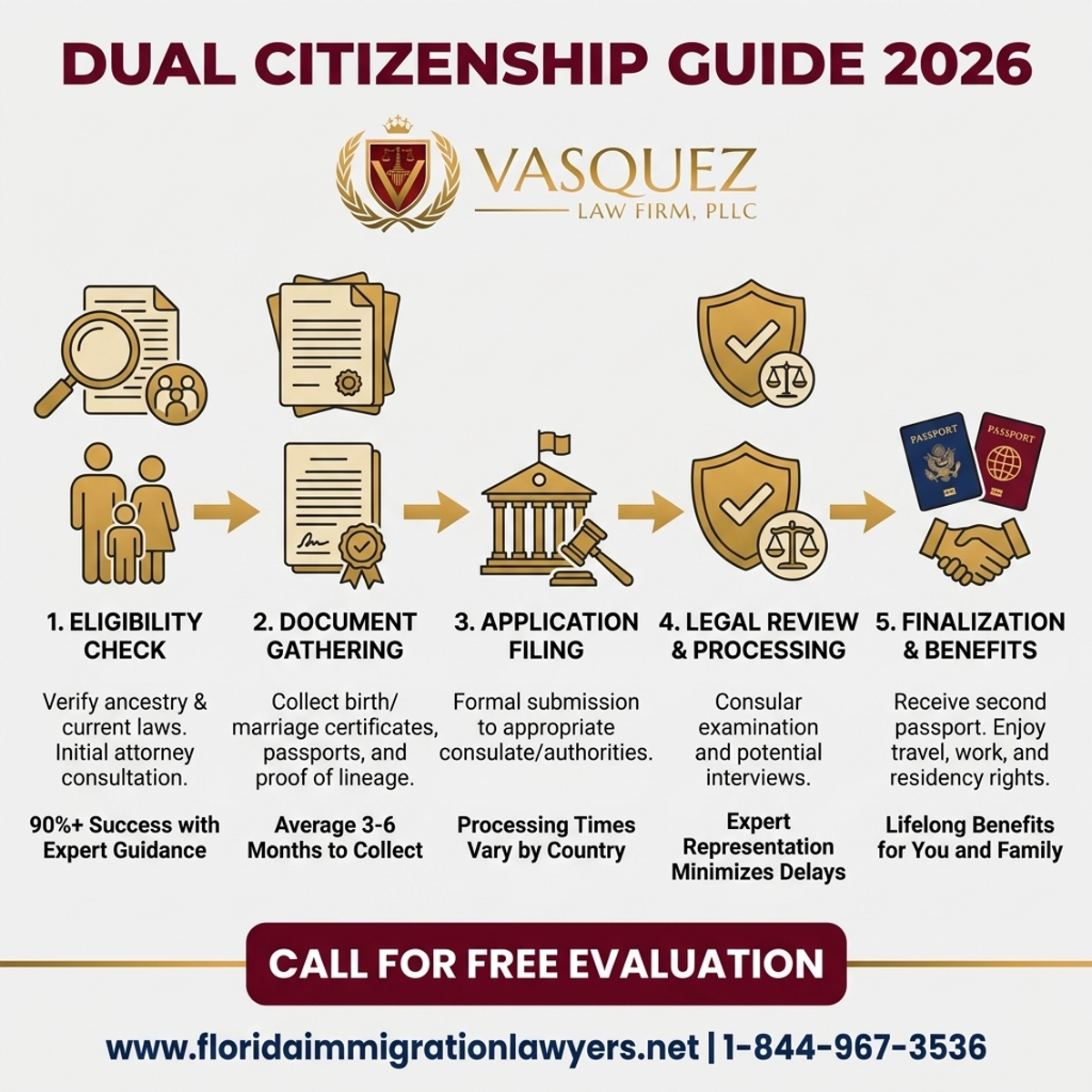
Step-by-Step Process — Dual Citizenship Lawyer in Florida: Your 2026 Legal Guide
Essential Document Checklist
Gathering the correct documents is paramount for a successful naturalization application, which is a key step towards dual citizenship. Ensure you have the following:
- Your Green Card (Permanent Resident Card)
- State-issued identification (e.g., Florida driver's license or state ID)
- All passports (U.S. and foreign) you have held
- Marriage certificate (if applicable, for 3-year residency rule)
- Divorce decrees or annulment certificates (if applicable)
- Birth certificates of your children (if applicable)
- Proof of selective service registration (for males 18-26)
- Tax returns for the past five years (or three years if married to a U.S. citizen)
- Records of trips outside the U.S. (dates of departure and return)
- Court disposition documents for any arrests, citations, or detentions
- Certified copies of any legal name change documents
Having an organized and complete set of documents will streamline your application process and demonstrate your preparedness to USCIS. Our firm can assist you in compiling and reviewing these critical items.
How Long Does the Dual Citizenship Process Typically Take in 2026?
The overall timeline for achieving dual citizenship, primarily through U.S. naturalization, can vary significantly based on several factors, including the specific USCIS field office processing your application (e.g., Miami, Orlando, or Tampa for Florida residents), the complexity of your case, and current agency workloads. As of 2026, USCIS processing times for Form N-400, Application for Naturalization, generally range from 8 to 18 months from the filing date to the Oath of Allegiance ceremony. This duration does not include the time it takes to prepare your application or the initial period required to meet the continuous residency requirements for a Green Card holder.
Delays can occur due to incomplete applications, issues with background checks, or scheduling backlogs for interviews and oath ceremonies. For example, a USCIS office in a high-volume area like Miami might have slightly different processing times than a smaller office. Additionally, if there are questions about your good moral character or continuous residence, your case may take longer to review. It's also important to remember that some individuals may need to obtain their original country's citizenship first or ensure its retention, which adds another layer of complexity and time. Monitoring processing times on the USCIS website is always recommended.
Here is a typical timeline breakdown for the naturalization process leading to U.S. citizenship:
| Stage | Typical Timeframe | Notes |
|---|---|---|
| Eligibility & Application Prep | 1-3 months | Gathering documents, attorney review. |
| Form N-400 Filing to Biometrics | 1-2 months | Appointment notice issued after filing. |
| Biometrics to Interview | 6-12 months | Varies by USCIS field office (e.g., Tampa, Orlando). |
| Interview to Oath Ceremony | 1-4 months | Can be same day or several weeks later. |
| Total USCIS Processing (N-400) | 8-18 months | Average, excluding initial prep time. |
Do not navigate this process alone. Contact Florida Immigration Lawyers today.
What Are the Costs Involved in Pursuing Dual Citizenship?
The costs associated with pursuing dual citizenship primarily stem from the U.S. naturalization process and potential legal fees for expert guidance. While USCIS fees are standardized across the country, attorney fees can vary depending on the complexity of your case and the services required. As of 2026, the Form N-400 filing fee is a significant component. It's important to budget for these mandatory government fees, which are subject to change by USCIS.
Beyond the direct application fees, other potential costs include fees for obtaining necessary documents like birth certificates, marriage licenses, or criminal record checks from your home country or U.S. jurisdictions. If documents are not in English, certified translations will be required, incurring additional expense. For residents in Florida, especially those in diverse communities like Naples, Miami, or Orlando, access to these services is readily available but should be factored into your financial planning. While USCIS offers fee waivers for certain low-income applicants, eligibility criteria are strict and must be carefully reviewed.
Engaging a dual citizenship lawyer in Florida is an investment that can save you time, stress, and potential pitfalls. Legal fees cover comprehensive services, including eligibility assessment, meticulous preparation of your N-400 application, review of supporting documents, preparation for your USCIS interview, and representation if complex issues arise. An experienced attorney ensures that all forms are correctly completed, deadlines are met, and you are fully prepared for every stage of the process, significantly reducing the risk of denial or delays. This expertise is particularly valuable when dealing with nuanced questions of intent regarding foreign citizenship retention.
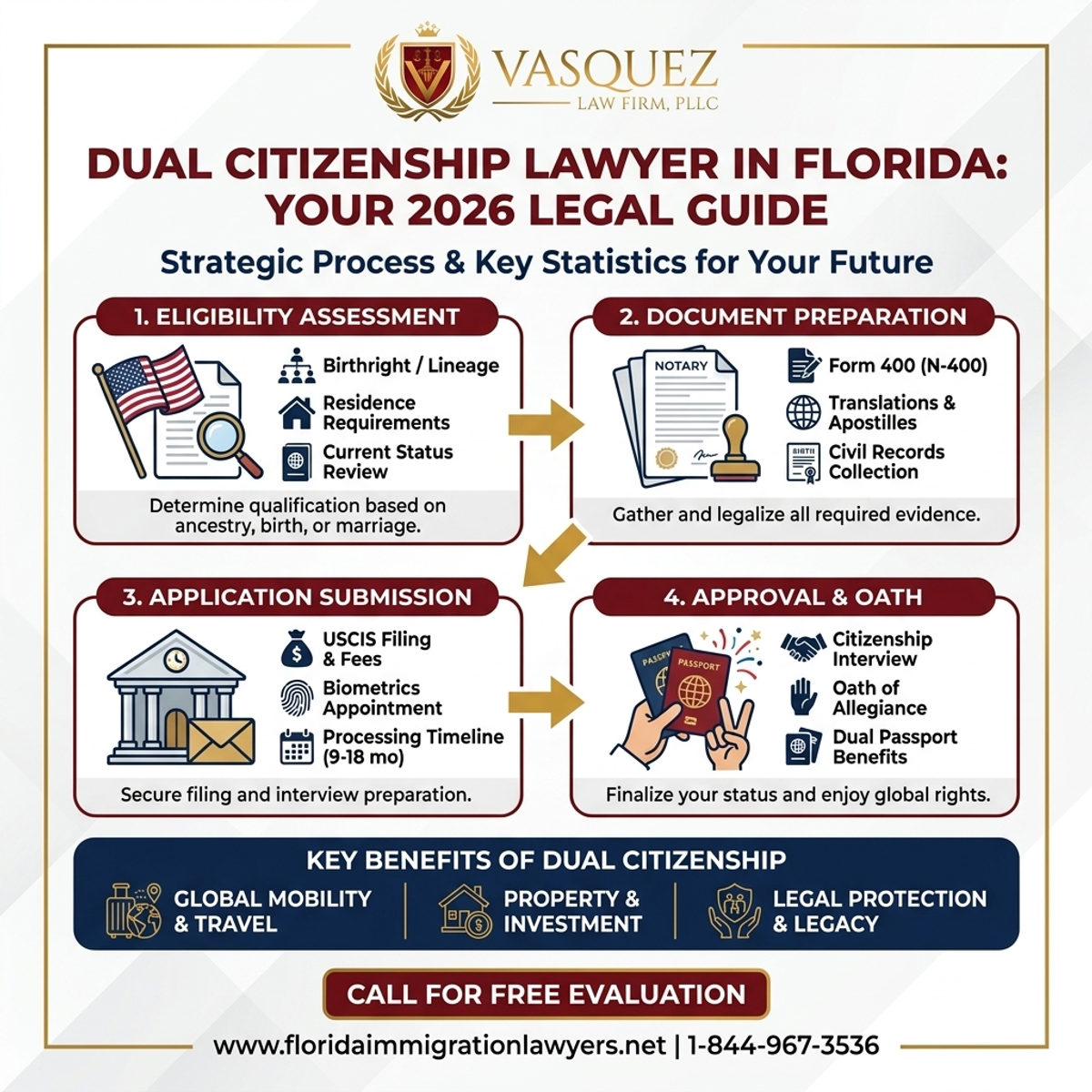
Key Statistics — Dual Citizenship Lawyer in Florida: Your 2026 Legal Guide
| Item | Typical Fee (Approx.) | Notes |
|---|---|---|
| Form N-400 Filing Fee | ~$725 | Includes biometrics fee. Subject to change by USCIS. |
| Attorney Legal Fees | Varies (e.g., $2,500 - $5,000+) | Depends on case complexity and services. Flat fees common. |
| Document Translation Fees | ~$20 - $50 per page | For non-English documents requiring certified translation. |
| Travel Expenses | Varies | For appointments at USCIS field offices (e.g., Miami, Orlando). |
| Passport Application Fees | ~$130 - $195 | For U.S. passport after naturalization. |
What Are the Benefits and Potential Challenges of Dual Nationality?
Dual nationality offers a range of compelling benefits that can significantly enhance an individual's personal and professional life. One of the most prominent advantages is increased global mobility. Dual citizens often enjoy easier travel between their two countries, potentially avoiding visa requirements and benefiting from expedited entry processes. This can be particularly advantageous for individuals with family, business interests, or property in both nations. For example, a dual citizen living in Naples, Florida, with business ties to a Latin American country, could find travel and business operations much smoother. Additionally, dual citizenship can provide greater political and economic rights, including the ability to vote, hold public office, own land, and work in either country without needing a separate visa or work permit. It also offers a sense of cultural connection and belonging to two distinct national identities.
However, dual nationality also comes with potential challenges and complexities that require careful consideration. One significant aspect is tax obligations. U.S. citizens, including dual citizens, are subject to worldwide taxation, meaning they must report their income to the IRS regardless of where it was earned or where they reside. This can lead to complex tax filing requirements in both countries, potentially necessitating the expertise of tax professionals specializing in international tax law. Another challenge relates to military service. Some countries may require their citizens, including dual nationals, to fulfill military service obligations, which could create conflicts for individuals holding U.S. citizenship. Furthermore, holding two passports can sometimes lead to confusion or scrutiny at borders, although this is generally manageable with proper documentation.
Legal complexities can also arise, especially concerning the laws of the other country. While the U.S. generally permits dual nationality, the other country might have different rules regarding retention or acquisition of foreign citizenship. For instance, some countries may impose restrictions on dual nationals holding certain government positions or accessing specific benefits. It's also important to understand that when a dual national is in their other country of citizenship, the U.S. government's ability to provide consular assistance may be limited. These potential challenges underscore the importance of seeking advice from a knowledgeable dual citizenship lawyer in Florida who can help you understand the full scope of implications and navigate them effectively.
Common Mistakes to Avoid in Dual Citizenship Cases
Navigating dual citizenship can be complex, and certain missteps can lead to significant delays, denials, or even unintended loss of citizenship. Being aware of these common mistakes can help you avoid them.
- Assuming Your Home Country Allows Dual Nationality: Many individuals mistakenly believe that if the U.S. permits dual citizenship, their country of origin does too. Some countries automatically revoke your original citizenship upon acquiring a new one. Always research your home country's laws or consult with an attorney specializing in that country's nationality law to confirm.
- Failing to Disclose All Information on Form N-400: Omitting details about arrests, lengthy trips abroad, or previous marriages, even if you deem them minor, can be considered misrepresentation. This can lead to a denial of naturalization and potentially severe immigration consequences. Honesty and completeness are paramount.
- Inadequate Preparation for the Naturalization Interview: Many applicants underestimate the interview's importance. Failing the English or civics test, or being unable to clearly articulate answers about your application, can result in delays or a request for re-examination. Practice is crucial.
- Misunderstanding the Oath of Allegiance: While the U.S. does not typically require explicit renunciation of foreign citizenship, the Oath of Allegiance requires you to swear allegiance solely to the U.S. Misinterpreting this or expressing intent to retain allegiance to another country can jeopardize your naturalization.
- Neglecting Tax Obligations as a U.S. Citizen: Once you become a U.S. citizen, you are subject to worldwide taxation. Failing to file U.S. tax returns (including FBAR for foreign bank accounts) can lead to severe penalties, even if you live abroad and pay taxes in another country.
- Not Updating USCIS with Address Changes: Moving without notifying USCIS on Form AR-11 can cause you to miss important notices, interview appointments, or requests for evidence, leading to application abandonment or delays. This is particularly important for Florida residents who might move frequently within the state.
- Traveling Outside the U.S. for Extended Periods During Naturalization Process: Long trips abroad can break your continuous residency requirement, especially if you spend more than six months outside the U.S. during the statutory period. This can reset your eligibility clock.
- Failing to Seek Legal Counsel for Complex Cases: If you have a criminal record, significant travel history, or questions about your good moral character, attempting to navigate the process alone can be detrimental. A lawyer can identify potential issues and strategize solutions.
When to Call a Dual Citizenship Lawyer in Florida
While some naturalization cases are straightforward, the complexities surrounding dual citizenship often necessitate professional legal guidance. You should strongly consider contacting a dual citizenship lawyer in Florida if any of the following scenarios apply to you. If your country of origin has unclear or restrictive laws regarding dual nationality, an attorney can help clarify the implications and advise on the best course of action. Similarly, if you have a criminal record, even for minor offenses, it can impact your good moral character assessment for naturalization; a lawyer can help prepare your case and present it effectively to USCIS, especially with Florida courts having specific procedures.
Furthermore, if you have spent significant time outside the U.S. during your Green Card period, a lawyer can assess whether your continuous residency requirement has been met. This is a common issue for individuals who travel frequently for work or family. If you've previously been denied naturalization or have had any other immigration issues, legal counsel is crucial to address past problems and strengthen your current application. If you're unsure about the required documents, how to answer specific questions on Form N-400, or how to prepare for your interview, an attorney provides invaluable support and preparation. For U.S. citizens contemplating acquiring foreign citizenship, a lawyer can advise on potential renunciation implications, though the U.S. generally permits dual status.
Florida Immigration Lawyers has extensive experience in handling complex dual citizenship and naturalization cases across Florida, including for residents of Naples and surrounding areas. We can provide peace of mind by ensuring your application is accurate, complete, and resilient to potential challenges. Our team is dedicated to protecting your rights and helping you achieve your citizenship goals efficiently and effectively.
About Florida Immigration Lawyers
Florida Immigration Lawyers is a leading immigration law firm dedicated to serving individuals and families across the entire state of Florida. Our experienced team of attorneys specializes in a wide range of immigration matters, including naturalization, family immigration, business immigration, asylum, and deportation defense. We understand that immigration law can be complex and emotionally challenging, which is why we approach every case with empathy, professionalism, and a commitment to achieving the best possible outcome for our clients. Our firm is known for its meticulous attention to detail, comprehensive legal strategies, and unwavering advocacy.
We pride ourselves on providing accessible and high-quality legal services. We offer free consultations to help you understand your legal options without any initial financial burden. Our firm is available 24/7 to address urgent concerns and provide timely support. With offices strategically located to serve all of Florida, we are uniquely positioned to assist clients from Naples to Jacksonville, Miami to Pensacola, and everywhere in between. Our bilingual staff ensures that language is never a barrier to receiving exceptional legal representation. When you choose Florida Immigration Lawyers, you choose a partner dedicated to your success.
Contact us today at 1-844-967-3536 or visit our website at https://www.floridaimmigrationlawyers.net to schedule your free consultation. Let us help you navigate your immigration journey with confidence.
Sources and References
- U.S. Citizenship and Immigration Services (USCIS)
- U.S. Department of State - Dual Nationality
- 8 U.S.C. Chapter 12 - Immigration and Nationality Act (INA)
- INA 312 (8 U.S.C. 1423) - English literacy and knowledge of U.S. history and government
- INA 316 (8 U.S.C. 1427) - General requirements for naturalization
- INA 349 (8 U.S.C. 1481) - Loss of nationality
- 8 CFR Part 316 - General Requirements for Naturalization
Related services: citizenship test preparation, dual citizenship guidance, family-based immigration.
This article provides general legal information and is not intended as legal advice. Every case is unique, and outcomes depend on specific facts and circumstances. Contact an attorney for advice about your particular situation.
Ready to explore your dual citizenship options or begin your naturalization journey? Don't leave your future to chance. Contact Florida Immigration Lawyers today for a free, confidential consultation. Call us at 1-844-967-3536. Se Habla Espanol - Estamos aqui para ayudarle.
If you need legal assistance, learn more about get citizenship help today, or call us at 1-844-967-3536 for a free consultation.
Do Not Navigate This Process Alone
Our experienced immigration attorneys are ready to fight for you. Get a free, confidential consultation today.
Se Habla Español
Frequently Asked Questions

William J. Vásquez
Founding Attorney · Vasquez Law Firm
U.S. Air Force veteran and immigration attorney with thousands of cases resolved. J.D., NCCU School of Law. AILA member. Admitted to the 4th, 5th, and 11th Circuit Courts.
Available 24/7 - Free Evaluations
Reviewed for legal accuracy by William J. Vásquez
Licensed in North Carolina; U.S. immigration is federal practice.
Related Legal Services
Our Florida immigration attorneys can help you with experienced immigration attorneys, business immigration and asylum protection. Call today at 1-844-967-3536 for a free consultation.
Related Links
Related Topics
Free Legal Consultation
Discuss your case with our experienced attorneys. We're available 24/7.
Se Habla Español - Estamos aquí para ayudarle.
Related Articles
RFE Response in Florida: How to Proceed in 2026
Receiving a Request for Evidence from USCIS can be challenging, especially when your current firm is unresponsive. Learn the steps to respond effectively and when it might be time to seek new legal assistance in Miami, Florida.
Immigration Lawyer Orlando Free Consultation 2026
Discover how a free consultation with an immigration lawyer in Sarasota or Bradenton can help you navigate complex immigration laws. Learn what services are available and common issues faced in Manatee County.
Immigration Lawyer Orlando Free Consultation
Looking for an immigration lawyer in Orlando offering free consultations? Discover how a consultation can clarify your legal options and guide you through the complex immigration process. Learn how to prepare for your consultation and what to expect, ensuring a productive and informative session.
Immigration Lawyer Orlando Free Consultation Services
Explore the vital role of immigration lawyers in Orlando and how they offer free consultations to assist with your immigration journey. Discover services available and how to prepare for your legal needs.