DACA News 2026 Florida: Navigating Renewals & Legal Updates
Stay informed on DACA news 2026 in Florida, including critical updates on renewals and legal challenges. This guide from Florida Immigration Lawyers provides a step-by-step renewal process, a comprehensive document checklist, and crucial advice on avoiding common mistakes. Learn about eligibility, processing times, and cost factors specific to Florida Dreamers. Understand the restrictions on international travel and when to seek expert legal counsel. With ongoing legal battles, timely and accurate renewal is essential to maintain your deferred action status and employment authorization. Our firm is dedicated to helping you navigate these complexities and ensuring your rights are protected.

DACA (Deferred Action for Childhood Arrivals) is still active for renewals in 2026, despite ongoing legal challenges that prevent new applications. Florida Dreamers must prioritize timely renewals and seek legal counsel for complex cases. USCIS continues to process renewals, but the program's long-term future remains uncertain, necessitating vigilance and expert guidance.
- DACA renewals are crucial for continued protection.
- New DACA applications remain halted by court orders.
- The legal landscape for DACA continues to evolve.
- Seeking legal guidance is vital for navigating the process.
DACA News 2026 Florida: Navigating Renewals & Legal Updates
For thousands of young people across Florida, including those in Coral Springs and surrounding communities, the Deferred Action for Childhood Arrivals (DACA) program represents a pathway to live and work in the United States without constant fear of deportation. As we move into 2026, the DACA program continues to face significant legal and political uncertainty. Many Dreamers and their families are understandably anxious about what the future holds.
This comprehensive guide from Florida Immigration Lawyers aims to provide clarity on the latest DACA news 2026 Florida residents need to know. We will cover the current status of the program, the essential steps for DACA renewal, common challenges, and how our experienced immigration lawyers can assist you. Understanding these updates is crucial for maintaining your deferred action status and employment authorization.
Do not face this complex situation alone. For personalized advice and assistance with your DACA renewal or any other immigration matter, call Florida Immigration Lawyers at 1-844-967-3536 for a free consultation. Our team is dedicated to supporting Dreamers throughout Florida.
DACA News 2026 Florida: Understanding the Current Landscape
The Deferred Action for Childhood Arrivals (DACA) program, established in 2012, has provided protection to eligible undocumented immigrants who came to the U.S. as children. While it offers temporary relief from deportation and work authorization, it does not provide a path to permanent residency or U.S. citizenship. The program has been subject to numerous legal challenges over the years, leading to its current, somewhat constrained, status.
As of 2026, the primary update concerning DACA is the continued halt on new applications. Federal court orders have largely prevented U.S. Citizenship and Immigration Services (USCIS) from accepting initial DACA requests. This means that individuals who have never held DACA status are generally unable to apply for it at this time. This situation creates significant stress for many eligible young people in Florida.
However, it is critical to understand that **DACA renewals are still being processed and accepted by USCIS**. If you are a current DACA recipient in Florida, you must continue to file your renewal applications in a timely manner. Maintaining your DACA status is paramount to your ability to live and work in the country legally. The legal basis for DACA, while contested, continues to allow for renewals under the U.S. Citizenship and Immigration Services (USCIS) guidelines.
The legal battles surrounding DACA are ongoing, with cases moving through federal courts. These challenges often focus on the legality of DACA's creation and implementation. The outcome of these cases could significantly impact the program's future. Florida Immigration Lawyers closely monitors these developments to provide the most current and accurate advice to our clients.
Eligibility for DACA Renewal in 2026
While new DACA applications are paused, the eligibility criteria for DACA renewals remain largely consistent with the original requirements. If you are a current DACA recipient, you must demonstrate that you continue to meet these conditions to renew your status. Understanding these requirements is the first step in a successful renewal process.
To be eligible for DACA renewal, you must generally:
- Have received DACA previously and not had it terminated.
- Have not departed the United States on or after August 15, 2012, without advance parole.
- Have continuously resided in the United States since you submitted your most recent DACA request that was approved.
- Not have been convicted of a felony, a significant misdemeanor, or three or more other misdemeanors. You must also not pose a threat to national security or public safety.
The requirement for **continuous residence** is particularly important for Florida Dreamers. This means you must prove that you have maintained your primary home in the U.S. since your last DACA approval. Any significant periods outside the U.S. without proper authorization, such as advance parole, could jeopardize your renewal. Our firm can help you assess your continuous residence eligibility.
Additionally, any encounters with law enforcement, even minor ones, must be carefully reviewed. A criminal record, even for offenses that seem minor, can lead to a DACA renewal denial. It is always best to consult with an attorney if you have any doubts about your eligibility due to past incidents. We can review your record and advise you on the best course of action.
Step-by-Step Guide to DACA Renewal for Florida Residents
Renewing your DACA status in Florida involves a precise application process with USCIS. Following these steps carefully can help ensure a smooth and timely renewal. Our team at Florida Immigration Lawyers is here to guide you through each stage.
-
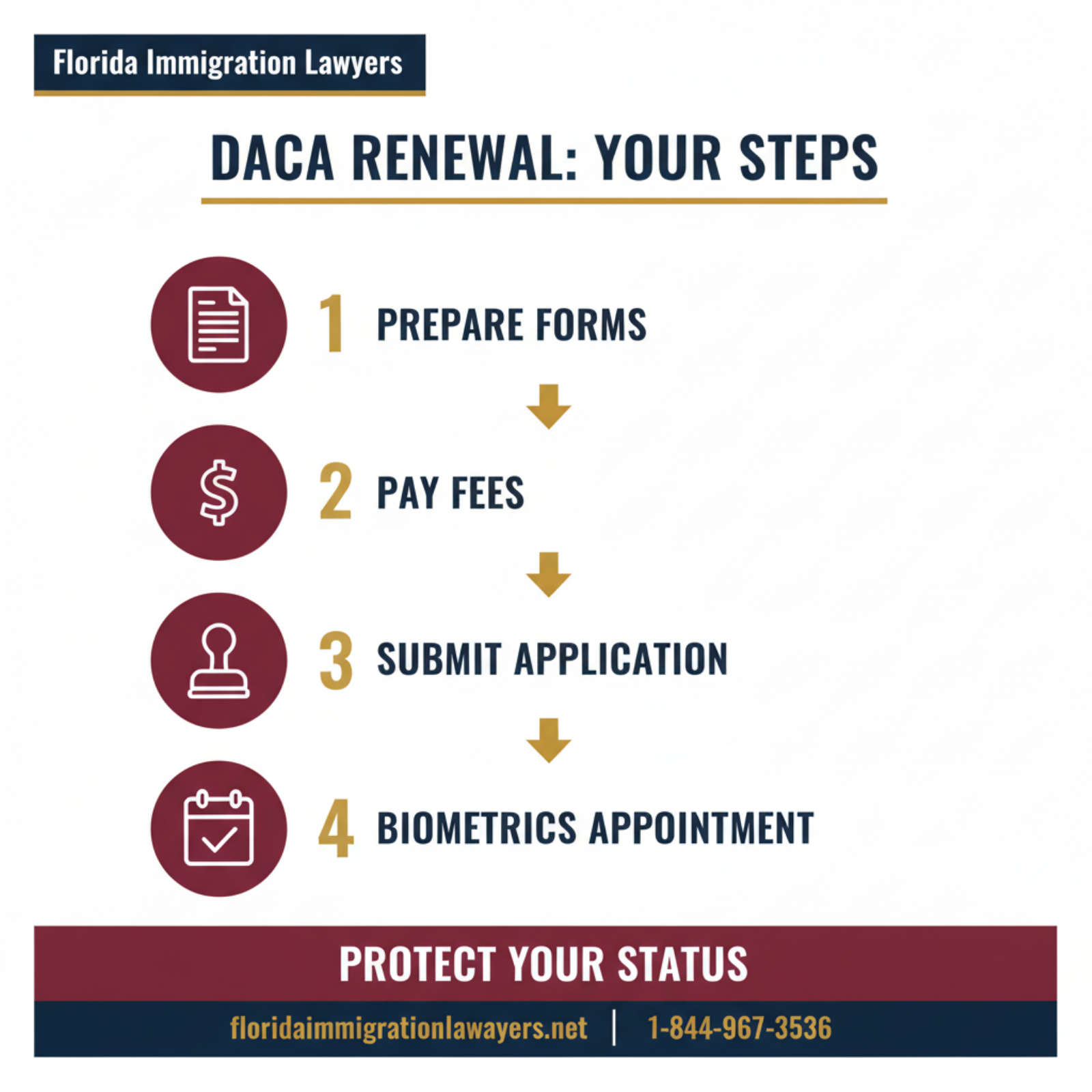
Gather Required Documents: Before you begin filling out forms, collect all necessary supporting documents. This includes copies of your previous DACA approval notices, your current Employment Authorization Document (EAD), proof of identity, and evidence of continuous residence in Florida. A detailed checklist is provided in the next section.
-
Complete USCIS Forms: You will need to complete Form I-821D, Consideration for Deferred Action for Childhood Arrivals; Form I-765, Application for Employment Authorization; and Form I-765 Worksheet. It is crucial to use the most current versions of these forms, which can be found on the USCIS website. Ensure all sections are filled out accurately and completely, as any errors can cause delays or denials.
-
Pay Filing Fees: There are government filing fees associated with the DACA renewal application, which include fees for Form I-765 and biometrics services. These fees are subject to change, so always verify the current amounts on the USCIS website before submitting your application. Fee waivers are generally not available for DACA renewals, but you may be eligible for a fee exemption in very limited circumstances. Our immigration practice area includes general immigration services that can help with fee-related questions.
-
Submit Your Application to USCIS: Once all forms are completed and documents are gathered, mail your application package to the correct USCIS Lockbox facility. The specific address depends on your state of residence; for Florida residents, it is typically a Chicago Lockbox address. Double-check the USCIS website for the precise mailing address to avoid misdirection and delays. We recommend sending your application via certified mail with a return receipt.
Step-by-Step Process Guide -
Attend Biometrics Appointment (If Required): After submitting your application, USCIS may send you an appointment notice for biometrics (fingerprints, photos, and signature) at an Application Support Center (ASC). This appointment is mandatory. Failing to attend can lead to delays or denial of your DACA renewal. Be sure to bring the appointment notice and a valid photo ID.
-
Receive Decision: USCIS will process your application and mail you a decision notice. If approved, you will receive a new I-797 approval notice and a new Employment Authorization Document (EAD). If your application is denied, you will receive a denial notice explaining the reasons. A denial can be devastating, which is why proper preparation is so important.
Essential Document Checklist for Your DACA Renewal
A well-organized and complete application package is critical for a successful DACA renewal. Missing documents or insufficient evidence can lead to Requests for Evidence (RFEs) or even denial. Use this checklist to ensure you have everything ready for your DACA news 2026 Florida renewal.
- Copy of your most recent DACA approval notice (Form I-797).
- Copy of your current Employment Authorization Document (EAD).
- Copy of your birth certificate (with certified English translation if not originally in English).
- Copy of your passport or other government-issued photo identification.
- Two passport-style photographs taken within 30 days of filing.
- Proof of continuous residence in the U.S. since your last DACA approval. This can include:
- School transcripts or enrollment records from Florida schools.
- Employment records, pay stubs, or tax returns.
- Utility bills (electric, water, gas) in your name.
- Bank statements showing Florida addresses.
- Medical records or doctor's visits.
- Rental agreements or mortgage statements.
- Any criminal records, disposition documents, or court records (if applicable).
- Proof of educational history, such as high school diplomas or GED certificates.
- Any previous USCIS correspondence or notices related to your DACA.
Remember that the more evidence you can provide, the stronger your case for continuous residence will be. If you have any questions about what constitutes sufficient evidence, our Florida Immigration Lawyers are here to help. We can review your documents to ensure completeness.
DACA Renewal Timeline and Processing Expectations in 2026
Understanding the processing timeline for DACA renewals is crucial for avoiding gaps in employment authorization and maintaining your legal status. USCIS processing times can vary significantly based on the service center, workload, and individual case complexities. For DACA news 2026 Florida, it's important to file well in advance.
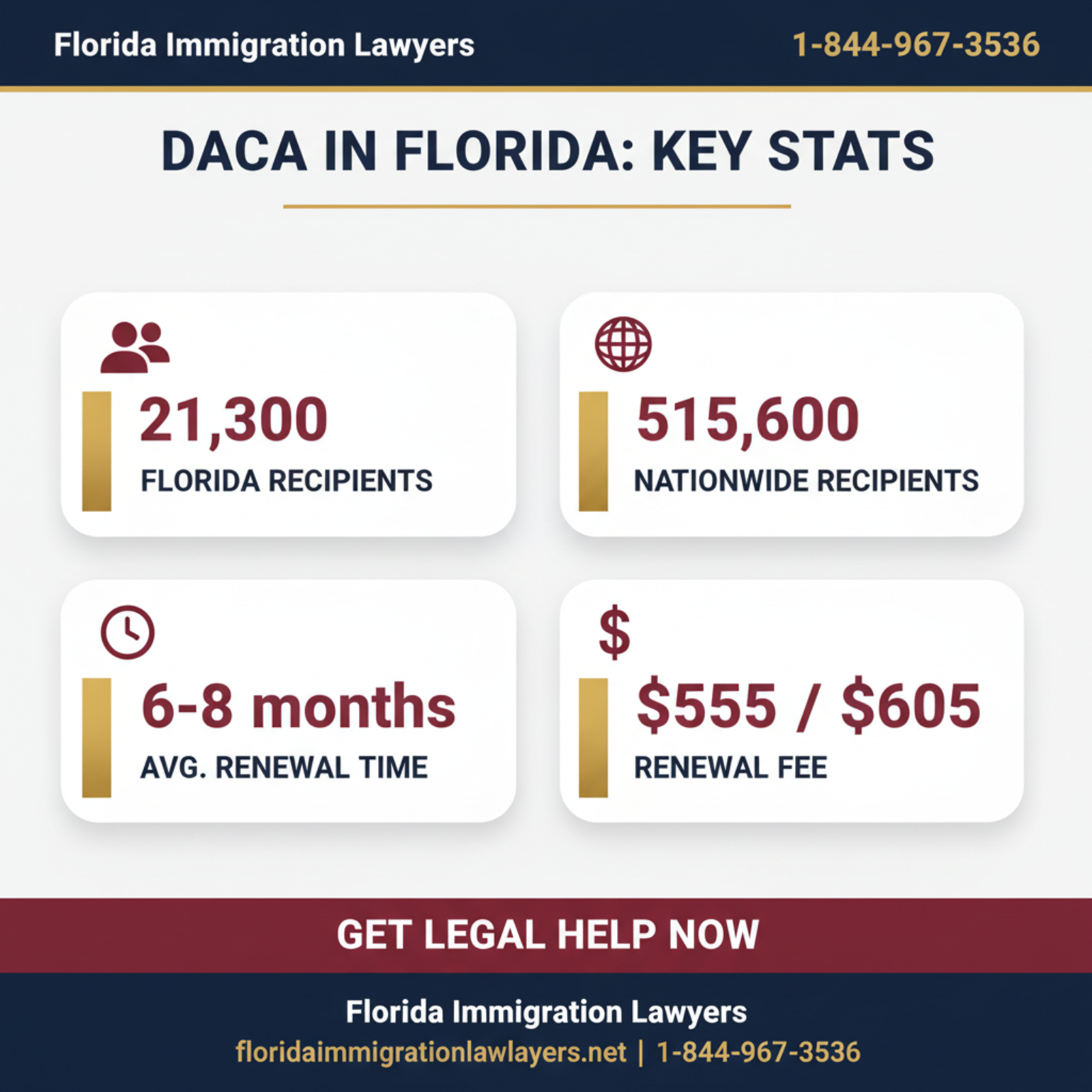
Generally, USCIS recommends filing your DACA renewal application 120 to 150 days (approximately 4 to 5 months) before your current DACA and EAD expire. This timeframe allows for potential delays in processing and helps ensure that you receive your new EAD before your current one expires. An expired EAD means you cannot legally work, which can have severe financial consequences.
Factors that can affect your DACA renewal processing time include:
- The specific USCIS Service Center handling your case.
- The volume of applications USCIS is currently receiving.
- Whether USCIS issues a Request for Evidence (RFE) for your application.
- Any changes in DACA policy or court orders that may impact processing.
You can check the current estimated processing times for Form I-821D and Form I-765 on the USCIS website's processing times page. Additionally, you can track the status of your specific application online using the receipt number provided by USCIS. Our firm can help you monitor your case status and respond to any USCIS inquiries promptly.
Understanding DACA Cost Factors and Fees
The financial aspect of DACA renewal is an important consideration for many Dreamers and their families in Florida. There are several costs involved, primarily government filing fees and potentially legal fees for attorney assistance. It is essential to budget for these expenses to ensure a smooth renewal process.
The main government fees associated with DACA renewal include:
- Form I-765, Application for Employment Authorization: This fee covers the processing of your work permit.
- Biometrics Services Fee: This fee covers the cost of your fingerprinting and background check.
It is crucial to remember that **USCIS filing fees are subject to change**. Always check the official USCIS website for the most current fee schedule before submitting your application. Florida Immigration Lawyers does not advise on specific fee amounts in this general information, as they can fluctuate. Payments must be made by money order, personal check, cashier's check, or credit card using Form G-1450, Authorization for Credit Card Transactions.
Beyond government fees, many DACA recipients choose to hire an experienced immigration attorney to assist with their renewal. Legal fees cover the expertise, guidance, and support provided by a lawyer, including:
- Reviewing your eligibility and documents.
- Preparing and reviewing all USCIS forms.
- Responding to any Requests for Evidence (RFEs).
- Providing legal advice on complex issues, such as criminal history or travel.
- Exploring alternative immigration pathways.
While legal fees are an additional cost, the peace of mind and increased likelihood of a successful renewal often outweigh the expense. Our firm offers transparent fee structures and free initial consultations to discuss your specific needs. Do not let financial concerns prevent you from seeking expert legal help, especially given the complexities of DACA news 2026 Florida.
Do not navigate this complex process alone. Contact Florida Immigration Lawyers today to ensure your DACA renewal is handled with precision and care. Our dedicated team is ready to provide the support you need.
Common Mistakes Florida Dreamers Must Avoid During DACA Renewal
Renewing DACA can be a straightforward process for many, but certain mistakes can lead to significant delays or even denial. Being aware of these common pitfalls can help Florida Dreamers avoid unnecessary complications, especially with the ongoing DACA news 2026 Florida.
-
Late Filing: Failing to submit your renewal application well before your current DACA and EAD expire is a critical mistake. An expired DACA means you lose your work authorization and deferred action protection, potentially leading to job loss and increased risk of deportation. USCIS advises filing 120-150 days in advance.
-
Incomplete Applications: Submitting forms with missing information or required documents will almost certainly result in a Request for Evidence (RFE) or a denial. RFEs significantly delay processing and add stress. Double-check every field and include all supporting evidence.
-
Incorrect Information: Providing inaccurate or inconsistent information on your application can raise red flags with USCIS. This includes discrepancies in dates, addresses, or personal details. Always ensure your information is truthful and matches previous submissions.
-
Failure to Disclose Criminal History: Even minor arrests or convictions, including traffic offenses beyond a simple ticket, must be fully disclosed. Hiding this information can lead to a finding of misrepresentation and a DACA denial, potentially with severe immigration consequences. Always provide certified court dispositions.
-
Not Updating Address with USCIS: If you move, you are legally required to notify USCIS of your new address within 10 days. Failure to do so can result in missing important notices, RFEs, or even a denial if USCIS cannot reach you.
-
Traveling Internationally Without Advance Parole: For DACA recipients, international travel is generally not recommended or available. Attempting to re-enter the U.S. without a valid advance parole document can lead to being barred from re-entry and a termination of your DACA status. Consult an attorney before any international travel.
-
Ignoring Legal Changes: The DACA program is constantly subject to legal challenges and policy updates. Failing to stay informed about these changes can leave you unprepared for new requirements or opportunities. Rely on reputable sources like USCIS or experienced legal counsel.
-
Not Seeking Legal Counsel for Complex Cases: If you have a criminal record, a previous DACA denial, or questions about continuous residence, attempting to renew DACA without legal help is risky. An attorney can assess your specific situation and strategize the best approach.
-
Missing Biometrics Appointment: If USCIS schedules you for a biometrics appointment, it is mandatory to attend. Missing this appointment without a valid reason and rescheduling can lead to your application being considered abandoned and subsequently denied.
-
Using Outdated Forms: USCIS regularly updates its forms. Always download the latest version directly from the USCIS website. Using an outdated form can result in your application being rejected or delayed.
-
Poor Documentation of Continuous Residence: Providing insufficient or weak evidence of continuous residence since your last DACA approval can be problematic. Ensure you have a robust collection of documents spanning the entire period, especially for those in Coral Springs or other Florida locations.
-
Forgetting to Sign Forms: This simple oversight is surprisingly common. USCIS will reject any unsigned forms, causing immediate delays. Ensure all required signatures are present on Forms I-821D, I-765, and any other submitted documents.
When to Call a Florida Immigration Lawyer for DACA
While some DACA renewals may seem straightforward, the program's precarious legal status and the potential for severe consequences make legal counsel invaluable. Florida Immigration Lawyers are here to help you navigate the complexities of DACA news 2026 Florida. Here are specific scenarios where contacting an attorney is highly recommended:
- You Have a Criminal Record: Even minor arrests, citations, or convictions can impact your DACA eligibility. Our deportation defense attorneys can assess your record and advise on the best strategy to prevent denial or adverse immigration actions.
- You Have Had a Previous DACA Denial: If your DACA application or renewal was previously denied, understanding the reasons for denial and addressing them properly is crucial for a successful re-application.
- Questions About Continuous Residence: If you have spent significant time outside the U.S. or have gaps in your documentation, an attorney can help you gather evidence and demonstrate continuous residence.
- Uncertainty About Eligibility: If you are unsure whether you meet all the DACA renewal criteria, especially concerning educational requirements or age, a lawyer can provide a thorough assessment.
- Your DACA Has Already Expired: While it's best to renew early, if your DACA has already expired, an attorney can advise on the possibility of late renewal and the increased risks involved.
- You Want to Explore Other Immigration Pathways: DACA is temporary. Our attorneys can discuss potential avenues for permanent residency or U.S. citizenship for which you may be eligible, such as through family or employment visas.
- You Received a Request for Evidence (RFE) or Notice of Intent to Deny (NOID): These are serious communications from USCIS that require a timely and well-reasoned response. An attorney can help you formulate the strongest possible reply.
Our firm, Florida Immigration Lawyers, is committed to providing compassionate and effective legal representation to Dreamers across Florida. We understand the unique challenges faced by the immigrant community in Coral Springs and beyond. Contact us today for expert guidance.
Navigating Travel for DACA Recipients in 2026
Many DACA recipients in Florida often wonder about their ability to travel, both domestically and internationally. Understanding the rules is vital to avoid jeopardizing your DACA status. The DACA news 2026 Florida landscape still presents significant restrictions for travel outside the U.S.
Domestic Travel: Generally, DACA recipients can travel freely within the United States, including by air, without issues related to their immigration status. You should carry your government-issued photo identification, such as your Employment Authorization Document (EAD) or a state-issued driver's license. While domestic travel is generally safe, it is always wise to be prepared and carry relevant documents.
International Travel (Advance Parole): This is where caution is paramount. Under current court orders, USCIS is generally not granting new advance parole documents for DACA recipients. Advance parole is the document that allows certain non-citizens to travel outside the U.S. and return lawfully. Without it, attempting to re-enter the U.S. after international travel can lead to being denied re-entry and the termination of your DACA status. The U.S. Department of State provides general travel advisories, but DACA-specific travel rules are governed by USCIS policy.
It is crucial to consult with an immigration attorney before making any plans for international travel if you are a DACA recipient. Even if you previously had advance parole, the rules are constantly changing, and the risks are extremely high. Florida Immigration Lawyers can provide the most up-to-date advice on DACA and travel.
Frequently Asked Questions About DACA in Florida
Below are answers to common questions Florida Dreamers have about DACA, especially concerning DACA news 2026 Florida.
What will happen with DACA in 2026?
As of 2026, DACA renewals continue to be processed by USCIS. However, new DACA applications remain halted due to ongoing federal court injunctions. The program's long-term future is still subject to legal challenges and potential legislative action, creating continued uncertainty for Dreamers across the country, including Florida.
Can DACA recipients travel within the U.S. in 2026?
Yes, DACA recipients can generally travel within the U.S., including by air, without issues related to their immigration status. It is advisable to carry your Employment Authorization Document (EAD) or a state-issued photo ID. International travel, however, remains highly restricted and generally not advised without valid advance parole, which is currently not being issued for DACA recipients.
Is DACA accepted in Florida?
DACA is a federal program, and its benefits, such as deferred action and employment authorization, are recognized federally and throughout all U.S. states, including Florida. DACA recipients in Florida can obtain state-issued driver's licenses and work legally with their EADs, provided they maintain their DACA status.
How long is it taking to renew DACA in 2026?
DACA renewal processing times vary by USCIS service center and the volume of applications. While USCIS advises filing 120-150 days before expiration, actual processing can take anywhere from a few weeks to several months. You can check current estimated processing times on the USCIS website. Filing early is crucial to avoid gaps in work authorization.
About Florida Immigration Lawyers
Florida Immigration Lawyers is a leading immigration law firm dedicated to serving individuals and families across the entire state of Florida, including the vibrant community of Coral Springs. We understand the profound impact immigration laws have on people's lives and are committed to providing compassionate, effective, and results-driven legal representation.
Our team of experienced attorneys specializes in a wide range of immigration services, including DACA renewals, family-based immigration, business immigration, deportation defense, asylum claims, and naturalization. We pride ourselves on offering personalized attention to each client, ensuring that your unique situation is understood and your legal strategy is tailored to your specific needs.
When you choose Florida Immigration Lawyers, you gain a dedicated advocate who will navigate the complexities of immigration law on your behalf. We offer free consultations to discuss your case and are available 24/7 to answer your questions and provide support. Our mission is to help you achieve your immigration goals with confidence and peace of mind.
For expert legal assistance with DACA news 2026 Florida, or any immigration matter, trust the experienced team at Florida Immigration Lawyers. Visit our website at https://www.floridaimmigrationlawyers.net or call us directly at 1-844-967-3536.
Sources and References
- U.S. Citizenship and Immigration Services (USCIS)
- Executive Office for Immigration Review (EOIR)
- U.S. Department of State
- 8 U.S.C. Chapter 12 - Immigration and Nationality Act (INA)
- 8 CFR Part 274a - Control of Employment of Aliens
- USCIS Policy Manual
This article provides general legal information and is not intended as legal advice. Every case is unique, and outcomes depend on specific facts and circumstances. Contact an attorney for advice about your particular situation.
The landscape of DACA news 2026 Florida can be challenging to navigate, but you don't have to do it alone. The dedicated team at Florida Immigration Lawyers is here to provide the expert guidance and support you need. Contact us today at 1-844-967-3536 for a free, confidential consultation. We are available 24/7 to assist you.
Se Habla Español - Estamos aquí para ayudarle.
Do Not Navigate This Process Alone
Our experienced immigration attorneys are ready to fight for you. Get a free, confidential consultation today.
Se Habla Español
Or leave your details and we’ll call you:
Free Evaluation in 24 Hours
Or talk to us right now

AI voice assistant — available 24/7
FreeFrequently Asked Questions

William J. Vásquez
Founding Attorney · Vasquez Law Firm
U.S. Air Force veteran and immigration attorney with years of hands-on U.S. immigration experience. J.D., NCCU School of Law. AILA member. Admitted to the 4th, 5th, and 11th Circuit Courts.
Available 24/7 - Free Evaluations
Reviewed for legal accuracy by William J. Vásquez
Licensed in North Carolina; U.S. immigration is federal practice.
Related Legal Services
Our Florida immigration attorneys can help you with citizenship and naturalization, family immigration services and immigration practice areas. Call today at 1-844-967-3536 for a free consultation.
Related Links
Related Topics
Free Legal Consultation
Discuss your case with our experienced attorneys. We're available 24/7.
Se Habla Español - Estamos aquí para ayudarle.
Related Articles
Immigration Lawyer Orlando Free Consultation 2026
Discover how to find an immigration lawyer in Orlando offering a free consultation. Understand the services available and why choosing Florida Immigration Lawyers can make a difference in your case.
Military Naturalization Expedited in Florida Bases
Explore military naturalization options for families at Florida bases, including parole in place benefits in Miami. Learn how to expedite your application with expert guidance from Florida Immigration Lawyers.
K-3 Visa Timeline in Florida: What to Expect
Learn the K-3 visa timeline process in Florida, including steps, costs, and documentation. Understand your options in 2026 with guidance from Florida Immigration Lawyers.
Immigration Lawyer Orlando Free Consultation: Document
Discover the essential document checklist for immigration processes in Florida. Whether you're in Hialeah or elsewhere in Florida, this guide will help you prepare for your immigration journey. Contact Florida Immigration Lawyers for a free consultation and expert guidance today.