Criminal Waiver Immigration Florida: Overcoming Inadmissibility
A criminal waiver immigration Florida allows individuals with certain criminal convictions to overcome inadmissibility and pursue immigration benefits. Forms like I-601 and I-601A are used to demonstrate extreme hardship to a qualifying U.S. citizen or LPR relative. The process is complex, requiring meticulous documentation, legal briefs, and understanding of various inadmissibility grounds, including crimes involving moral turpitude. It is crucial to avoid common mistakes like non-disclosure or insufficient evidence. Florida Immigration Lawyers offers expert guidance for those in Orlando and across Florida, ensuring a strategic approach to secure your future. Consult an attorney for your specific situation.
A criminal waiver immigration Florida allows certain individuals deemed inadmissible due to past criminal convictions to still pursue immigration benefits like green cards or visas. These waivers, such as the I-601 or I-601A, require demonstrating extreme hardship to a qualifying relative or meeting specific statutory criteria. Navigating these complex requirements is crucial for a successful outcome.
- Criminal waivers overcome inadmissibility for past offenses.
- Forms like I-601 and I-601A are commonly used.
- Proving extreme hardship to a U.S. citizen or LPR relative is often key.
- Legal guidance is essential due to the complexity of immigration law.
- Eligibility depends on the specific crime and individual circumstances.
Have you been dreaming of a life in Florida, reunited with your loved ones, or building a future in the Sunshine State, only to find your path blocked by a past criminal conviction? Many individuals in Orlando and across Florida face the daunting challenge of immigration inadmissibility due to prior legal issues. Understanding how a criminal waiver immigration Florida works is your first step towards overcoming these barriers.
This comprehensive guide from Florida Immigration Lawyers will walk you through the complexities of criminal waivers, explaining who qualifies, the application process, and what to expect. We understand the stress and uncertainty you may be experiencing, and we are here to provide clarity and support. Do not let a past mistake define your future. Call Florida Immigration Lawyers at 1-844-967-3536 for a free consultation today.
Understanding Criminal Waivers for Florida Immigrants: An Overview
A criminal waiver is a legal mechanism that allows an individual, otherwise inadmissible to the United States due to certain criminal convictions, to be granted a visa, green card, or other immigration benefit. In Florida, as elsewhere, these waivers are critical for many seeking legal status.
The U.S. immigration system is strict regarding criminal history, classifying certain offenses as grounds for inadmissibility. Without a successful waiver, these convictions can permanently bar you from entering or remaining in the country. Our firm specializes in helping clients in Orlando and throughout Florida navigate these challenging situations.
What is a Criminal Waiver of Inadmissibility?
A criminal waiver, formally known as an Application for Waiver of Grounds of Inadmissibility (typically Form I-601 or I-601A), asks the U.S. government to overlook specific reasons that would otherwise make you ineligible for immigration benefits. These reasons often include certain criminal convictions, but can also encompass health-related grounds, prior immigration violations, or misrepresentation.
The decision to grant a waiver is discretionary, meaning the government has the power to approve or deny it based on the totality of your circumstances. This is why presenting a compelling case, often demonstrating extreme hardship, is so vital. Your ability to overcome inadmissibility with a criminal waiver immigration Florida case depends heavily on strong legal advocacy.
Common Grounds of Inadmissibility in Florida
Several types of criminal convictions can render an individual inadmissible. These commonly include crimes involving moral turpitude (CIMTs), controlled substance violations, and multiple criminal convictions with an aggregate sentence of five years or more. Even minor offenses can sometimes lead to significant immigration challenges.
Specific examples of CIMTs can vary but often include theft, fraud, assault with intent to harm, and certain domestic violence offenses. It is crucial to have your criminal record thoroughly reviewed by an immigration attorney to determine if your specific convictions trigger inadmissibility. Many Florida residents are surprised by what constitutes a CIMT under immigration law.
Types of Waivers: I-601, I-601A, and 212(h)
There are several types of waivers, each designed for different situations. The most common for criminal grounds are:
- Form I-601, Application for Waiver of Grounds of Inadmissibility: This waiver is broad and applies to various grounds of inadmissibility, including many criminal offenses, health-related grounds, and certain immigration violations. It is typically filed by applicants who are outside the U.S. or by those already in the U.S. but applying through consular processing.
- Form I-601A, Application for Provisional Unlawful Presence Waiver: This waiver specifically addresses inadmissibility due to unlawful presence in the U.S. It allows certain eligible individuals who are immediate relatives of U.S. citizens or lawful permanent residents to apply for a waiver while still in the U.S. This avoids long separations from family during consular processing abroad.
- Section 212(h) Waiver (part of Form I-601): This specific waiver is for certain criminal grounds of inadmissibility, including CIMTs, multiple criminal convictions, and prostitution. To qualify, you generally must show extreme hardship to a U.S. citizen or lawful permanent resident spouse, parent, son, or daughter. For some offenses, you might also need to demonstrate rehabilitation.
Understanding which waiver applies to your situation is a critical first step in your immigration journey. Our immigration lawyers in Florida can help you determine the correct path. For more detailed information, you can visit the official USCIS website.
The Step-by-Step Process for Obtaining a Criminal Waiver in Florida
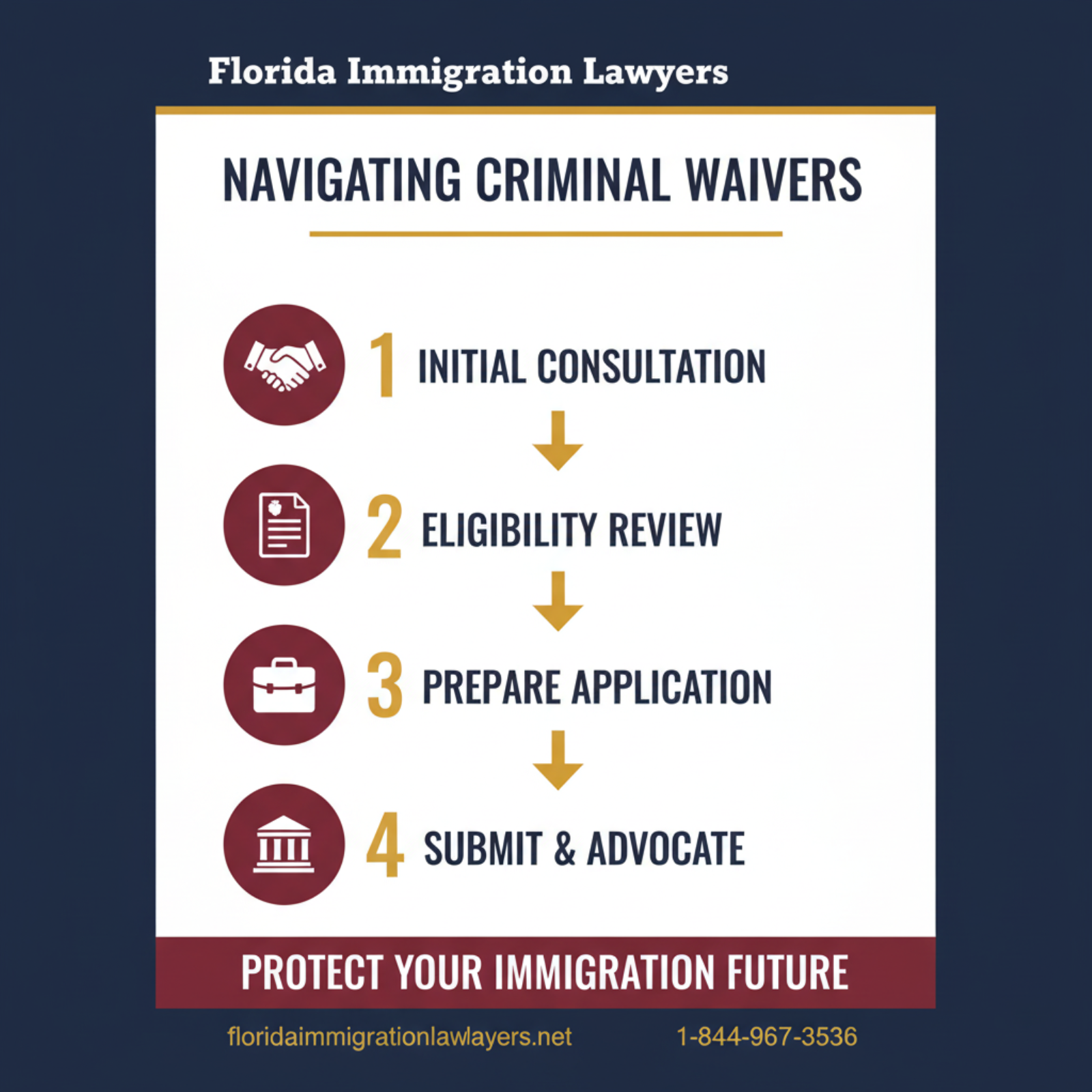
Obtaining a criminal waiver immigration Florida can be a lengthy and intricate process. It requires meticulous preparation, a thorough understanding of immigration law, and strong advocacy. Here is a general step-by-step guide to help you understand what is involved.
-
Determine Eligibility and Grounds of Inadmissibility: The first step is to accurately identify all grounds of inadmissibility that apply to your case. This requires a comprehensive review of your criminal record, immigration history, and any other relevant factors. An experienced attorney can help you understand the specific immigration consequences of your past actions.
-
Identify the Appropriate Waiver Form: Based on your grounds of inadmissibility and your immigration goal (e.g., green card through family), you will need to determine which waiver form is applicable. For criminal grounds, this is often Form I-601 or involves a Section 212(h) waiver. The I-601A is for unlawful presence, but can be combined with other waivers depending on the circumstances.
-
Gather Comprehensive Supporting Documentation: This is perhaps the most crucial stage. You must collect all necessary documents to prove your eligibility for the waiver. This includes certified court documents for all criminal convictions, evidence of rehabilitation, and compelling evidence of extreme hardship to your qualifying U.S. citizen or lawful permanent resident family member. The stronger your evidence, the better your chances.
-
Prepare a Detailed Legal Brief: Your attorney will prepare a persuasive legal brief that argues why your waiver should be approved. This brief will connect your evidence to the legal standards for the waiver, emphasizing the positive equities in your case and the extreme hardship that would result from a denial. This is where legal expertise truly shines.
-
File the Waiver Application with USCIS: Once all documents and the legal brief are meticulously prepared, the waiver application is filed with U.S. Citizenship and Immigration Services (USCIS). The filing location and specific procedures depend on the type of waiver and whether you are applying from within the U.S. or abroad.
-
Attend Biometrics Appointment (if required): Most applicants will need to attend a biometrics appointment at a local Application Support Center (ASC) in Florida. This involves submitting fingerprints, photographs, and a signature for background checks.
-
Respond to Requests for Evidence (RFE) or Interview Notices: USCIS may send an RFE if they need additional information or clarification. It is vital to respond promptly and thoroughly. In some cases, an interview may also be required, particularly for consular processing. Our team can help you prepare for any interview.
-
Receive a Decision: After review, USCIS will issue a decision on your waiver application. If approved, you can then proceed with the next steps in your immigration process, such as attending a visa interview at a U.S. Embassy or Consulate abroad, or continuing with your adjustment of status application in the U.S. If denied, there may be options for appeal or reconsideration, though these are complex. If you face deportation proceedings, our deportation defense lawyers are ready to assist.
Essential Documents for Your Criminal Waiver Application
A successful criminal waiver immigration Florida application hinges on providing comprehensive and accurate documentation. Missing or incorrect documents can lead to delays or even denial. Here is a general checklist of documents commonly required:
- Certified Court Dispositions: For every arrest and conviction, you must provide certified copies of court records, including the charging document, plea agreement, sentencing order, and proof of completion of probation or parole. These are critical for the immigration officer to understand the exact nature of your offense.
- Police Records: Obtain certified copies of police reports related to your arrests. These reports provide details about the incident that may be relevant to your waiver.
- Evidence of Rehabilitation: This can include certificates of completion for drug or alcohol counseling, anger management courses, community service records, letters from employers or community leaders attesting to your good character, and proof of consistent employment.
- Affidavits from Family Members: Statements from your qualifying U.S. citizen or LPR spouse, parent, or child detailing the extreme hardship they would suffer if your waiver is denied. These should be detailed and personal.
- Financial Documentation: Evidence of your qualifying relative's financial stability and dependence on you, or your financial contributions to the household. This can include tax returns, pay stubs, bank statements, and property deeds.
- Medical and Psychological Records: If the qualifying relative has health issues that would be exacerbated by your absence or relocation, provide medical records, doctor's letters, and psychological evaluations. This helps demonstrate extreme hardship.
- Marriage Certificate and Birth Certificates: To prove your relationship to the qualifying relative.
- Proof of U.S. Citizen or LPR Status of Qualifying Relative: Copy of passport, birth certificate, or green card.
- Personal Statement from Applicant: A detailed letter from you explaining your past mistakes, demonstrating remorse, and outlining your rehabilitation efforts and future plans.
- Character References: Letters from friends, family, clergy, or community members who can attest to your good character and positive contributions.
- Photographs: Recent passport-style photographs.
- Translations: Any documents not in English must be accompanied by a certified English translation.
Always consult with an attorney to ensure you gather all specific documents relevant to your unique case. Incomplete applications are a common reason for delays and denials in Florida immigration cases.
Criminal Waiver Processing Times and Expectations in Florida
Understanding the timeline for a criminal waiver immigration Florida is important for managing expectations, but it is also one of the most unpredictable aspects of the process. Processing times can vary significantly based on several factors, including the specific USCIS service center or field office handling your case, the complexity of your application, and current caseloads.
Generally, I-601 and I-601A waivers can take anywhere from several months to over two years to process. This timeline does not include any potential delays from Requests for Evidence (RFEs) or the time it takes to complete the underlying immigration benefit application (e.g., adjustment of status or consular processing).
Factors that can influence processing times include:
- Type of Waiver: Some waivers, like the I-601A, might have different average processing times than the I-601.
- Completeness of Application: A well-prepared, comprehensive application with all necessary supporting documents is less likely to face delays due to RFEs.
- USCIS Workload: Processing times fluctuate based on the volume of applications USCIS receives.
- Interview Requirements: If an interview is required, scheduling can add several months to the overall timeline.
- Security Checks: Background and security checks are mandatory and can sometimes take an extended period.
While we cannot provide exact dates, Florida Immigration Lawyers will help you track your case status and keep you informed throughout the process. You can monitor general processing times on the USCIS website, but remember these are estimates and not guarantees. Patience and preparedness are key when pursuing a criminal waiver.
Cost Factors and Legal Fees for Criminal Waivers
The financial aspect of pursuing a criminal waiver immigration Florida involves several components. It is important to budget for both government filing fees and legal representation. While we cannot provide specific filing fee amounts here (as they are subject to change), we can outline the general cost factors.
Government Filing Fees:
- USCIS Filing Fee: Each waiver application (e.g., Form I-601, Form I-601A) requires a non-refundable filing fee paid directly to USCIS. This fee must be submitted with your application.
- Biometrics Fee: There may be a separate fee for biometrics services, which covers the collection of your fingerprints, photograph, and signature.
- Other Associated Fees: Depending on your overall immigration process, there might be additional fees for underlying petitions (like Form I-130 for family-based immigration) or for visa applications if you are processing abroad.
It is crucial to check the most current fees directly on the USCIS website or consult with your attorney, as these amounts can change. USCIS does not typically refund fees, even if your application is denied.
Legal Fees for Representation:
Hiring an experienced immigration attorney is a significant investment, but one that can greatly increase your chances of success. Legal fees for a criminal waiver case can vary based on several factors:
- Complexity of Your Case: Cases involving multiple convictions, severe offenses, or complicated legal histories will typically require more attorney time and expertise, leading to higher fees.
- Attorney Experience: Highly experienced attorneys who specialize in complex waiver cases may charge higher fees, reflecting their expertise and track record.
- Scope of Services: Fees will depend on whether the attorney is only preparing the waiver, or also handling the underlying immigration petition, responding to RFEs, and preparing you for interviews.
Florida Immigration Lawyers offers transparent fee structures and will discuss all costs with you during your initial consultation. We believe in providing clear guidance so you can make informed decisions about your future. We serve clients across Florida, including Orlando, Miami, and Tampa, and are committed to making quality legal representation accessible.
FAQs About Criminal Waivers and Florida Immigration
Navigating the intersection of criminal history and immigration law often leads to many questions. Here are answers to some frequently asked questions relevant to a criminal waiver immigration Florida.
How much does an I-601A waiver cost?
The cost for an I-601A waiver primarily includes the USCIS filing fee and the biometrics fee. These fees are set by USCIS and are subject to change. It is important to check the official USCIS website for the most current fee schedule. Additionally, you should factor in legal fees if you choose to hire an attorney, which is highly recommended for such complex applications.
Is ICE deporting green card holders with a criminal record?
Yes, lawful permanent residents (green card holders) with certain criminal records can be placed into removal (deportation) proceedings by U.S. Immigration and Customs Enforcement (ICE). The types of crimes that trigger deportation vary, but often include aggravated felonies, crimes involving moral turpitude, and controlled substance offenses. Even after obtaining a green card, a criminal conviction can lead to severe immigration consequences. Consulting with a deportation defense attorney is crucial if you are a green card holder facing criminal charges.
Who qualifies for a 601A waiver?
The I-601A Provisional Unlawful Presence Waiver is generally available to individuals who are physically present in the United States, are at least 17 years old, and are seeking an immigrant visa based on an immediate relative petition (Form I-130) filed by a U.S. citizen spouse, parent, or child. The applicant must be inadmissible only on the ground of unlawful presence and demonstrate that a denial would result in extreme hardship to their U.S. citizen spouse or parent. There are strict eligibility requirements, and not all individuals with unlawful presence will qualify.
What crimes are eligible for deportation near Florida?
In Florida, as throughout the U.S., many crimes can make a non-citizen deportable. Common categories include aggravated felonies (a broad term under immigration law that includes many serious offenses like murder, rape, drug trafficking, and theft offenses with a sentence of at least one year), crimes involving moral turpitude committed within five years of admission or with a sentence of one year or more, and controlled substance offenses. Even relatively minor offenses can sometimes lead to deportation if they fall under certain immigration definitions. It is critical to consult an immigration attorney immediately if you are a non-citizen facing any criminal charges in Florida, as the outcome can have profound immigration consequences.
Do not navigate this process alone. The complexities of establishing extreme hardship and presenting a compelling case require expert legal guidance. Contact Florida Immigration Lawyers today.
Common Mistakes to Avoid in Your Criminal Waiver Case
Applying for a criminal waiver immigration Florida is a detailed legal process where small errors can lead to significant setbacks or even denial. Avoiding common pitfalls is crucial for a successful outcome. Here are some mistakes to watch out for:
-
Failing to Disclose All Criminal History: Attempting to hide arrests or convictions, even minor ones or those that were expunged, is a grave mistake. Immigration authorities have access to extensive databases. Undisclosed information can lead to a finding of misrepresentation, which is a separate ground of inadmissibility and much harder to waive.
-
Not Obtaining Certified Court Documents: Providing only photocopies or incomplete court records is insufficient. USCIS requires certified copies of all charging documents, plea agreements, and final dispositions for every criminal incident. Without these, your application will be deemed incomplete.
-
Misunderstanding Grounds of Inadmissibility: Incorrectly identifying which specific ground of inadmissibility applies to you, or missing one, can result in filing the wrong waiver form or submitting an application that fails to address all issues. This leads to wasted time and money.
-
Insufficient Evidence of Extreme Hardship: The legal standard of "extreme hardship" is high and requires substantial, well-documented evidence. Many applicants fail by submitting vague or general statements instead of concrete proof of financial, medical, psychological, or educational hardship to their qualifying relative.
-
Filing the Wrong Waiver Form: There are different waiver forms for different grounds of inadmissibility (e.g., I-601, I-601A). Filing the incorrect form will lead to rejection or denial, causing significant delays and requiring you to restart the process.
-
Waiting Too Long to Address Criminal Issues: Delaying the process can be detrimental. Immigration laws and policies can change, and the longer you wait, the more difficult it might become to gather necessary evidence or for witnesses to recall details.
-
Not Consulting an Attorney: Attempting to navigate the complex waiver process without legal counsel is one of the biggest mistakes. An experienced Florida immigration lawyer can identify all grounds of inadmissibility, select the correct waiver, prepare a compelling case, and avoid common pitfalls.
-
Incomplete Rehabilitation Evidence: While demonstrating remorse is important, it must be backed by tangible evidence of rehabilitation. Simply stating you have changed is not enough; USCIS looks for proof of counseling, community involvement, stable employment, and a crime-free record since the offense.
-
Poorly Written Personal Statement: Your personal statement should be sincere, take responsibility for past actions, express remorse, and clearly articulate your rehabilitation and positive contributions. A poorly written or defensive statement can undermine your entire application.
-
Ignoring USCIS Requests for Evidence (RFEs): If USCIS sends an RFE, it means they need more information. Failing to respond adequately or on time will almost certainly lead to a denial. Each RFE must be taken seriously and addressed thoroughly.
When to Call a Florida Immigration Lawyer for a Criminal Waiver
The decision to pursue a criminal waiver immigration Florida is rarely straightforward. Given the high stakes and the complexity of immigration law, consulting with an experienced attorney from Florida Immigration Lawyers is not just recommended, it is often essential. You should contact us immediately if any of the following apply to your situation:
- You Have Any Criminal History: Even a minor arrest or conviction could have unforeseen immigration consequences. Do not assume it is insignificant.
- You Have Been Deemed Inadmissible: If USCIS or a consular officer has informed you that you are inadmissible, you need legal help to explore waiver options.
- You Are Facing Deportation Proceedings: A criminal conviction can lead to removal proceedings. Our deportation defense team can assess your eligibility for waivers or other relief.
- You Believe You Qualify for "Extreme Hardship": Proving extreme hardship is a highly subjective and legally intricate process. An attorney can help you gather and present compelling evidence.
- You Are Confused About Which Waiver to Apply For: With multiple waiver types (I-601, I-601A, 212(h)), choosing the correct one is critical.
- You Received a Request for Evidence (RFE) from USCIS: An RFE indicates a deficiency in your application that needs expert attention.
- You Are a Green Card Holder with New Criminal Charges: Even lawful permanent residents can be deported for certain crimes. Protect your status immediately.
- You Need to Understand the Immigration Consequences of a Plea Bargain: If you are currently facing criminal charges, an attorney can advise on how a plea bargain might impact your immigration status, potentially helping you avoid deportable offenses.
Florida Immigration Lawyers has a proven track record of helping individuals in Orlando and across Florida navigate complex immigration challenges. Whether you need assistance with asylum applications, citizenship, family immigration, or business immigration, our attorneys are dedicated to protecting your rights and pursuing your American dream. Contact us today to schedule your free consultation.
About Florida Immigration Lawyers
Florida Immigration Lawyers is a leading immigration law firm dedicated to serving individuals and families throughout Florida. With a deep understanding of U.S. immigration laws and policies, our experienced attorneys provide compassionate and effective legal representation for a wide range of immigration matters.
We believe every client deserves personalized attention and a strategic approach tailored to their unique circumstances. Our commitment extends to providing clear communication, honest advice, and vigorous advocacy at every stage of your immigration journey. We are proud to serve the diverse communities of Florida, offering bilingual services (Se Habla Español) to ensure everyone has access to quality legal support.
Our services include, but are not limited to, family-based petitions, employment visas, deportation defense, asylum claims, naturalization, and complex waiver applications like the criminal waiver immigration Florida. We are available 24/7 to answer your urgent questions and offer free consultations to help you understand your options. Choose Florida Immigration Lawyers for dedicated legal support that stands with you. Call us at 1-844-967-3536 or visit https://www.floridaimmigrationlawyers.net.
Sources and References
- U.S. Citizenship and Immigration Services (USCIS)
- Executive Office for Immigration Review (EOIR)
- Immigration and Nationality Act (INA) Section 212(a)(2) - Criminal and Related Grounds
- Immigration and Nationality Act (INA) Section 212(h) - Criminal Waivers
- 8 U.S. Code Section 1182 - Inadmissible aliens
- 8 Code of Federal Regulations (CFR) 212.7 - Waiver of certain grounds of inadmissibility
- USCIS Check Case Processing Times
This article provides general legal information and is not intended as legal advice. Every case is unique, and outcomes depend on specific facts and circumstances. Contact an attorney for advice about your particular situation.
Do not let a past criminal conviction prevent you from achieving your immigration goals in Florida. The path to a successful criminal waiver immigration Florida can be complex, but with the right legal guidance, it is achievable. Our dedicated team at Florida Immigration Lawyers is ready to assist you every step of the way.
Contact Florida Immigration Lawyers today at 1-844-967-3536 for your free consultation. Se Habla Español - Estamos aquí para ayudarle.
Need help with Immigration?
Our Florida immigration attorneys offer free consultations. Call today or schedule online.
Frequently Asked Questions
Florida Immigration Lawyers
Legal Team
Our experienced attorneys at Florida Immigration Lawyers have been serving clients across Florida for over 20 years. We specialize in immigration, personal injury, criminal defense, workers compensation, and family law.