Exclusive Citizenship Act of 2025: What Florida Immigrants Need to Know
The proposed Exclusive Citizenship Act of 2025 (S.3283) seeks to restrict dual citizenship, causing concern among Florida's immigrant communities. As of March 2026, this bill is in its early stages with a low likelihood of immediate passage, meaning current U.S. citizenship laws, which generally permit dual nationality, remain in effect. This comprehensive guide explains the Act's potential implications, outlines the U.S. naturalization process, and highlights key considerations for Florida residents. Learn about eligibility, required documents, timelines, and common pitfalls to avoid. Florida Immigration Lawyers is dedicated to providing clarity and expert legal assistance throughout your citizenship journey. Contact us for a free consultation to understand how these developments might affect you.
The Exclusive Citizenship Act of 2025 (S.3283) is a proposed federal bill that, if passed, would significantly alter U.S. citizenship law, primarily by restricting or eliminating dual citizenship. As of March 2026, this bill remains in early stages, with a low likelihood of immediate passage. It is crucial for Florida residents, especially those in West Palm Beach, to understand its potential implications for their immigration status and future naturalization plans.
- The Act is a proposed bill, not current law.
- It aims to restrict dual citizenship for future naturalizations.
- Current U.S. citizens are generally not affected retroactively.
- Consult an attorney for personalized advice on your citizenship path.
Navigating the complexities of U.S. immigration law can be challenging, especially when new legislation is proposed. The discussion around the Exclusive Citizenship Act of 2025 has created significant concern and confusion among immigrant communities across Florida, from Miami to West Palm Beach and beyond. You may be wondering how this proposed bill could impact your journey to becoming a U.S. citizen or your current dual citizenship status.
At Florida Immigration Lawyers, we understand your concerns. Our goal is to provide clear, reliable information about potential changes to immigration law and guide you through the naturalization process. This comprehensive guide will explain the proposed Act, its potential implications, and provide a detailed overview of the citizenship application process in Florida. For personalized advice, do not hesitate to call Florida Immigration Lawyers at 1-844-967-3536 for a free consultation.
Understanding the Exclusive Citizenship Act of 2025 and Its Current Status
The Exclusive Citizenship Act of 2025, identified as S.3283 in the 119th Congress (2025-2026), is a legislative proposal that seeks to establish a framework for exclusive U.S. citizenship. This means it aims to prevent individuals from holding both U.S. citizenship and citizenship of another country, a practice commonly known as dual citizenship. The bill's introduction has sparked considerable debate regarding its constitutionality and practical implications for millions of Americans and aspiring citizens.
As of March 2026, it is important to emphasize that the Exclusive Citizenship Act of 2025 is merely a proposed bill. It has not been passed into law and faces significant hurdles in Congress. Legislative trackers indicate a low probability of immediate passage, as the bill is currently stalled with no hearings scheduled. This means that while discussions are ongoing, the current legal framework for U.S. citizenship, which generally permits dual nationality, remains in effect.
Many individuals ask, "What is the citizenship bill of 2025?" It is this specific proposal, S.3283, aiming to make U.S. citizenship exclusive. Historically, the U.S. has recognized dual nationality under certain circumstances, allowing individuals to maintain ties to their country of origin while enjoying the rights and responsibilities of U.S. citizenship. This proposed Act seeks to fundamentally alter that long-standing policy.
Regarding the question, "How likely is the Exclusive Citizenship Act of 2025 to pass?" Based on its current legislative progress and the significant opposition it faces, its likelihood of becoming law in the near future is minimal. However, the political landscape can shift, and it is always prudent to stay informed about such developments.
Another common concern is, "Has any U.S. citizen had their citizenship revoked?" While extremely rare, U.S. citizenship can be revoked, typically in cases where it was obtained through fraud or misrepresentation. This is distinct from the intent of the Exclusive Citizenship Act of 2025, which aims to prevent future dual citizenship, not retroactively revoke existing citizenship unless acquired fraudulently. Current U.S. citizens who also hold foreign citizenship are generally not at risk of losing their U.S. citizenship due to this proposed legislation, unless they acquired it fraudulently.
Potential Impact on Dual Citizenship and Florida Residents
If the Exclusive Citizenship Act of 2025 were to pass, its impact on individuals seeking to become U.S. citizens and those currently holding dual nationality could be profound. For new naturalization applicants, it could mean being required to formally renounce all other citizenships as a condition of becoming a U.S. citizen. This would be a significant departure from current policy, which often allows individuals to retain their previous citizenship.
For current dual citizens in Florida, particularly those in diverse communities like West Palm Beach, the implications could be complex. While the bill is not designed to retroactively strip citizenship from individuals who already hold dual nationality legally, it could create uncertainty. Future generations or those with strong ties to other countries might face difficult choices if this proposed legislation were to become law. Understanding the nuances of your citizenship status is critical.
The concept of dual citizenship has allowed many Floridians to maintain cultural, economic, and familial connections with their countries of origin. This has benefited Florida's diverse economy and social fabric. A shift to exclusive citizenship could alter these dynamics, potentially forcing individuals to choose between their U.S. nationality and their heritage. Our firm, Florida Immigration Lawyers, is dedicated to helping you understand these complex issues.
Navigating the Citizenship Application Process in Florida
Even with discussions surrounding the Exclusive Citizenship Act of 2025, the standard naturalization process remains unchanged. Becoming a U.S. citizen is a significant milestone, offering numerous rights and benefits. The process requires careful attention to eligibility criteria, documentation, and interviews. The Immigration and Nationality Act (INA) outlines the general requirements for naturalization, primarily found in INA Section 316 (8 U.S.C. § 1427).
Step-by-Step Guide to Naturalization
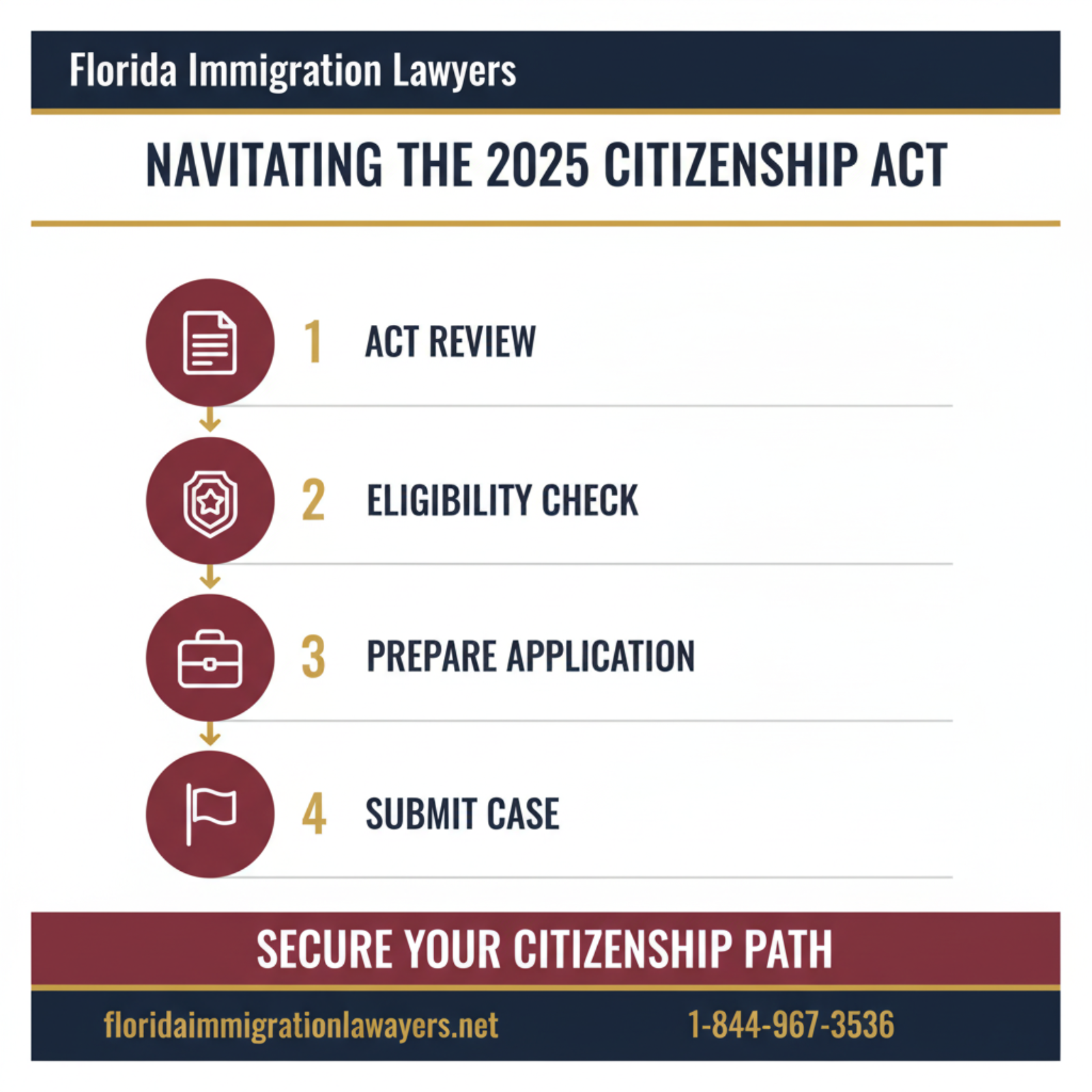
The path to U.S. citizenship typically involves several key stages. Here is a general overview of the process:
- Determine Eligibility: You must meet specific requirements, including age (18 or older), continuous residency in the U.S. as a lawful permanent resident (Green Card holder) for a certain period (typically 5 years, or 3 years if married to a U.S. citizen), physical presence, good moral character, ability to read, write, and speak basic English, and knowledge of U.S. history and government (civics).
- Prepare Form N-400, Application for Naturalization: This is the primary application form. It requires detailed personal information, residency history, employment, travel, and any criminal history. Accuracy is paramount.
- Gather Supporting Documents: Collect all necessary documents as outlined by USCIS. This includes your Green Card, passports, marriage certificates, tax records, and any court documents if applicable.
- Attend Biometrics Appointment: After filing Form N-400, you will receive an appointment notice for a biometrics screening. This involves fingerprinting and a photograph for background checks.
- Complete the Interview: A USCIS officer will interview you to verify the information on your N-400, test your English proficiency, and assess your knowledge of U.S. civics. These interviews often take place at USCIS field offices located throughout Florida, such as in Miami, Orlando, Tampa, or sometimes at smaller satellite offices serving areas like West Palm Beach.
- Receive a Decision: After the interview, USCIS will make a decision on your application. This could be an approval, a request for more evidence, or a denial.
- Take the Oath of Allegiance: If approved, you will attend a naturalization ceremony to take the Oath of Allegiance, officially becoming a U.S. citizen.
Many applicants wonder, "Is the citizenship test changing in 2026?" While USCIS periodically reviews and updates the civics test and English requirements, there are no specific, major changes slated for 2026 directly related to the Exclusive Citizenship Act of 2025. Any updates to the test are usually announced well in advance and implemented nationwide. You can find current test materials on the USCIS website.
Our firm also assists with other immigration matters, ensuring a holistic approach to your legal needs.
Essential Documents for Your USCIS Citizenship Application
A successful USCIS citizenship application hinges on providing accurate and complete documentation. Missing or incorrect documents can significantly delay your process or even lead to a denial. Here is a general checklist of documents you will typically need:
- Your Permanent Resident Card (Green Card).
- Your state-issued identification, such as a Florida driver's license or ID card.
- All valid and expired passports, including travel documents.
- Marriage certificate, if you are applying based on marriage to a U.S. citizen.
- Divorce decrees or death certificates for any previous marriages, if applicable.
- Birth certificates of your children, whether they are U.S. citizens or not.
- Tax transcripts or returns for the past five years (or three years if applying under the spouse of a U.S. citizen rule).
- Proof of Selective Service Registration for males between ages 18 and 26.
- Certified court dispositions for any arrests, citations, or criminal charges, even if expunged or dismissed.
- Proof of continuous residency in Florida, such as utility bills, leases, or mortgage statements, especially relevant for applicants in areas like West Palm Beach.
- Any documents proving your good moral character, if requested by USCIS.
Timeline and Processing Expectations for Naturalization in Florida
The processing time for a naturalization application (Form N-400) can vary significantly. Factors include the specific USCIS field office handling your case, the completeness of your application, and the volume of applications. In Florida, offices like Miami, Orlando, and Tampa typically have their own processing timeframes, which can fluctuate.
You can check the estimated processing times for your local USCIS field office on the USCIS website. Generally, the entire process, from filing your N-400 to taking the Oath of Allegiance, can take anywhere from 8 to 24 months, or sometimes even longer. It is crucial to monitor your citizenship status update online regularly.
Delays can occur due to extensive background checks, requests for additional evidence, or scheduling backlogs for interviews and oath ceremonies. Maintaining continuous residency in Florida and promptly responding to all USCIS requests can help streamline your process. For applicants in West Palm Beach, your case may be processed through the Miami field office or a local satellite, impacting your specific timeline.
Cost Factors and Legal Fees for Citizenship Cases
Applying for U.S. citizenship involves several costs. The primary cost is the USCIS filing fee for Form N-400, which also typically includes the biometrics service fee. It is important to note that these fees are subject to change by USCIS, so we do not list specific amounts here. You should always check the most current fee schedule on the USCIS website for Form N-400.
In some cases, individuals with low incomes may be eligible for a fee waiver, which can significantly reduce the financial burden. Eligibility for fee waivers is strict and requires providing documentation of your financial situation. Our team can help assess your eligibility for such waivers.
Beyond government fees, you may incur costs for obtaining necessary documents, such as birth certificates, marriage licenses, or certified court records. These can vary depending on where and when the documents were issued. Investing in legal representation from an experienced Florida immigration lawyer, while an additional cost, can be invaluable. A lawyer can ensure your application is complete, accurate, and properly presented, significantly increasing your chances of success and avoiding costly mistakes or delays.
Do not navigate this process alone. Contact Florida Immigration Lawyers today.
Common Mistakes to Avoid in Your Citizenship Journey
The naturalization process is detailed, and even small errors can lead to significant delays or even denial. Here are some common mistakes applicants make and their potential consequences:
- Submitting an Incomplete or Inaccurate N-400: Filling out the application incorrectly or leaving sections blank can lead to USCIS rejecting your application or issuing a Request for Evidence (RFE), delaying your case.
- Failing to Disclose Criminal History: Any past arrests, charges, or convictions, even if expunged or dismissed, must be disclosed. Failure to do so is considered misrepresentation and can result in denial and potential deportation proceedings.
- Lack of Continuous Residency Proof: You must prove you have maintained continuous residency in the U.S. for the required period. Extended trips outside the U.S. can break this continuity, impacting your eligibility.
- Poor English or Civics Knowledge: Inadequate performance on the English or civics test during the interview can lead to a re-test or denial. Prepare thoroughly using official USCIS materials.
- Missing Your Biometrics Appointment or Interview: Failing to attend scheduled appointments without proper rescheduling can lead to your application being considered abandoned and denied.
- Ignoring Selective Service Registration: Males between 18 and 26 years old must register for Selective Service. Failure to register can negatively impact your good moral character assessment and citizenship eligibility.
- Travel Outside the U.S. Impacting Physical Presence: While continuous residency is important, so is physical presence. Long trips can affect the total number of days you must be physically present in the U.S., especially if you travel from Florida often.
- Voting as a Non-Citizen: Registering to vote or actually voting as a non-citizen is a serious offense that can lead to denial of naturalization and removal from the U.S.
- Not Updating Your Address with USCIS: Moving without informing USCIS can result in missed notices and appointments, leading to delays or denial. Always file Form AR-11 promptly.
- Misunderstanding the Implications of the Exclusive Citizenship Act of 2025: While not law, being uninformed about legislative proposals could lead to future missteps if the legal landscape changes.
- Failing to Understand Good Moral Character Requirements: Certain actions, such as habitual drunkenness, illegal gambling, or false testimony, can demonstrate a lack of good moral character, leading to denial.
- Not Seeking Legal Advice: Trying to navigate a complex immigration process alone, especially with unique circumstances, increases the risk of errors. An experienced Florida immigration lawyer can provide invaluable guidance.
When to Call a Florida Immigration Lawyer
While many individuals successfully apply for citizenship on their own, certain situations warrant the expertise of a seasoned immigration lawyer. If you find yourself in any of the following scenarios, contacting Florida Immigration Lawyers is highly recommended:
- You have a criminal record, no matter how minor or old. This includes arrests, charges, or convictions, which can affect your good moral character assessment.
- You have spent significant time outside the U.S. during your permanent residency period, raising questions about continuous residency or physical presence.
- You have prior immigration violations or a history of deportation proceedings.
- You are concerned about the proposed Exclusive Citizenship Act of 2025 and how it might specifically affect your dual citizenship status or future plans.
- Your previous naturalization application was denied.
- You have a complex marital history or issues with child support.
- You are applying for a fee waiver and need assistance with the documentation.
- You have received a Request for Evidence (RFE) or a Notice of Intent to Deny (NOID) from USCIS.
- You need assistance with family-based immigration or business immigration matters that intersect with your citizenship goals.
- You are unsure about any aspect of the N-400 application or the interview process.
Our firm also specializes in deportation defense and asylum cases, providing comprehensive support for all your immigration needs. We serve clients throughout Florida, including West Palm Beach, with dedication and expertise.
About Florida Immigration Lawyers
Florida Immigration Lawyers is a premier immigration law firm dedicated to serving individuals and families across the entire state of Florida. With offices conveniently located, we are committed to providing compassionate, effective, and results-driven legal representation for all immigration matters.
Our experienced team of attorneys understands the intricate and often challenging nature of immigration law. We offer a wide range of services, including naturalization and citizenship, visa applications, green cards, family-based immigration, business immigration, deportation defense, and asylum claims. We pride ourselves on offering personalized attention, clear communication, and strategic legal solutions tailored to your unique circumstances.
Why choose us? We are available 24/7 to address your urgent legal needs and offer free, no-obligation consultations to discuss your case. Our firm is founded on principles of integrity, professionalism, and a deep commitment to our clients' success. We are proud to offer bilingual services, ensuring that language is never a barrier to accessing high-quality legal counsel. Trust Florida Immigration Lawyers to be your steadfast advocates throughout your immigration journey.
Contact us today: Phone: 1-844-967-3536 | Website: https://www.floridaimmigrationlawyers.net
Sources and References
- U.S. Citizenship and Immigration Services (USCIS)
- USCIS Form N-400, Application for Naturalization
- USCIS Policy Manual - Volume 12, Part D, Chapter 2 (Continuous Residence)
- Executive Office for Immigration Review (EOIR)
- S.3283 - Exclusive Citizenship Act of 2025 (119th Congress)
- 8 U.S.C. Chapter 12 - Immigration and Nationality Act (INA), specifically INA 316 (8 U.S.C. § 1427)
- 8 CFR Part 316 - General Requirements for Naturalization
- U.S. Department of State - Dual Nationality
This article provides general legal information and is not intended as legal advice. Every case is unique, and outcomes depend on specific facts and circumstances. Contact an attorney for advice about your particular situation. Immigration laws are subject to change.
The discussions surrounding the Exclusive Citizenship Act of 2025 highlight the dynamic nature of immigration law. While the proposed Act is not currently law, staying informed and prepared is your best defense against uncertainty. Whether you are beginning your naturalization journey in West Palm Beach or have questions about how potential legislative changes could affect your family, Florida Immigration Lawyers is here to help.
We invite you to reach out to our dedicated team for expert guidance and unwavering support. Your path to U.S. citizenship is important to us, and we are committed to helping you navigate it successfully. Call us today for a free consultation.
Call Florida Immigration Lawyers at 1-844-967-3536 for a free consultation. Se Habla Español - Estamos aquí para ayudarle.
Need help with Immigration?
Our Florida immigration attorneys offer free consultations. Call today or schedule online.
Frequently Asked Questions
Florida Immigration Lawyers
Legal Team
Our experienced attorneys at Florida Immigration Lawyers have been serving clients across Florida for over 20 years. We specialize in immigration, personal injury, criminal defense, workers compensation, and family law.