Citizenship Test Questions 2026: Your Florida Guide to
Prepare for your U.S. citizenship test questions 2026 in Florida with this comprehensive guide from Florida Immigration Lawyers. Learn about eligibility, the step-by-step naturalization process, essential documents, and what to expect regarding timelines and costs. We cover the civics and English test components, including common questions and updates for 2026. Discover crucial tips to avoid common mistakes that could delay your application and understand when professional legal assistance is indispensable. Our firm serves all of Florida, offering expert guidance for your path to naturalization.

Preparing for the U.S. citizenship test questions 2026 in Florida involves understanding the civics, English, and interview components. The test assesses your knowledge of U.S. history and government, and your ability to read, write, and speak basic English. While the core test generally remains consistent, staying updated on any USCIS policy changes is crucial for a successful naturalization journey.
- The civics test covers 100 questions, but you only answer 10-20.
- The English test includes reading, writing, and speaking sections.
- Study materials are available from USCIS and other resources.
- An experienced Florida immigration lawyer can provide invaluable guidance.
Citizenship Test Questions 2026: Your Florida Guide to Naturalization
Are you dreaming of becoming a U.S. citizen and making Florida your permanent home? The journey to naturalization is a significant step, and understanding the U.S. citizenship test questions 2026 is a critical part of that process. For many hopeful immigrants in Fort Lauderdale, Miami, Orlando, and across the Sunshine State, preparing for this exam can feel overwhelming.
This comprehensive guide from Florida Immigration Lawyers is designed to demystify the naturalization test, providing you with essential information, study tips, and a clear roadmap for success in 2026. We understand the unique challenges and opportunities faced by immigrants in Florida, and our goal is to empower you with the knowledge needed to confidently approach your citizenship interview.
Before you dive into the specifics, remember that navigating immigration law can be complex. For personalized legal advice and support tailored to your unique situation, do not hesitate to call Florida Immigration Lawyers at 1-844-967-3536 for a free consultation. We are here to help you every step of the way.
Navigating the U.S. Citizenship Test Questions 2026 in Florida: An Overview
The naturalization test is a crucial component of the U.S. citizenship application process. It ensures that applicants have a basic understanding of American civics, history, and the English language. For residents across Florida, from Jacksonville to Key West, preparing for this test means focusing on three main areas: English proficiency, knowledge of U.S. government and history (civics), and your overall interview performance.
In 2026, the structure of the citizenship test is expected to largely follow the current format. This includes a civics test, a reading test, a writing test, and an oral interview. While there have been discussions and temporary changes to the civics test in recent years, the standard 2008 version of the civics test and the English proficiency requirements remain the foundation for most applicants. It's important to prepare for the official USCIS 100 civics questions.
The civics portion of the test is oral. During your naturalization interview, a USCIS officer will ask you up to 10 questions from a predefined list of 100 civics questions. You must answer at least six of these questions correctly to pass this section. The English test assesses your ability to read, write, and speak basic English, which is vital for daily life and civic participation in Florida.
Is the Citizenship Test Changing in 2026? What are the new citizenship questions?
As of early 2026, the U.S. Citizenship and Immigration Services (USCIS) has largely reverted to the 2008 version of the civics test. While USCIS continually reviews its policies and procedures, significant changes to the core format or the 100 civics questions list are not anticipated for 2026 without ample public notice. Applicants should primarily focus on studying the official 100 civics questions provided by USCIS.
It is always wise to check the official USCIS website for the most current information regarding the naturalization test. Any updates or new citizenship questions would be announced well in advance. Our team at Florida Immigration Lawyers monitors these developments closely to provide our clients with the most up-to-date guidance.
Your Step-by-Step Guide to the Naturalization Process in Florida
The path to becoming a U.S. citizen through naturalization involves several key stages. Understanding each step can help you prepare thoroughly and reduce anxiety, especially for those in vibrant Florida communities like Tampa, Miami, and Fort Lauderdale. This guide outlines the typical process for applicants seeking citizenship in 2026.
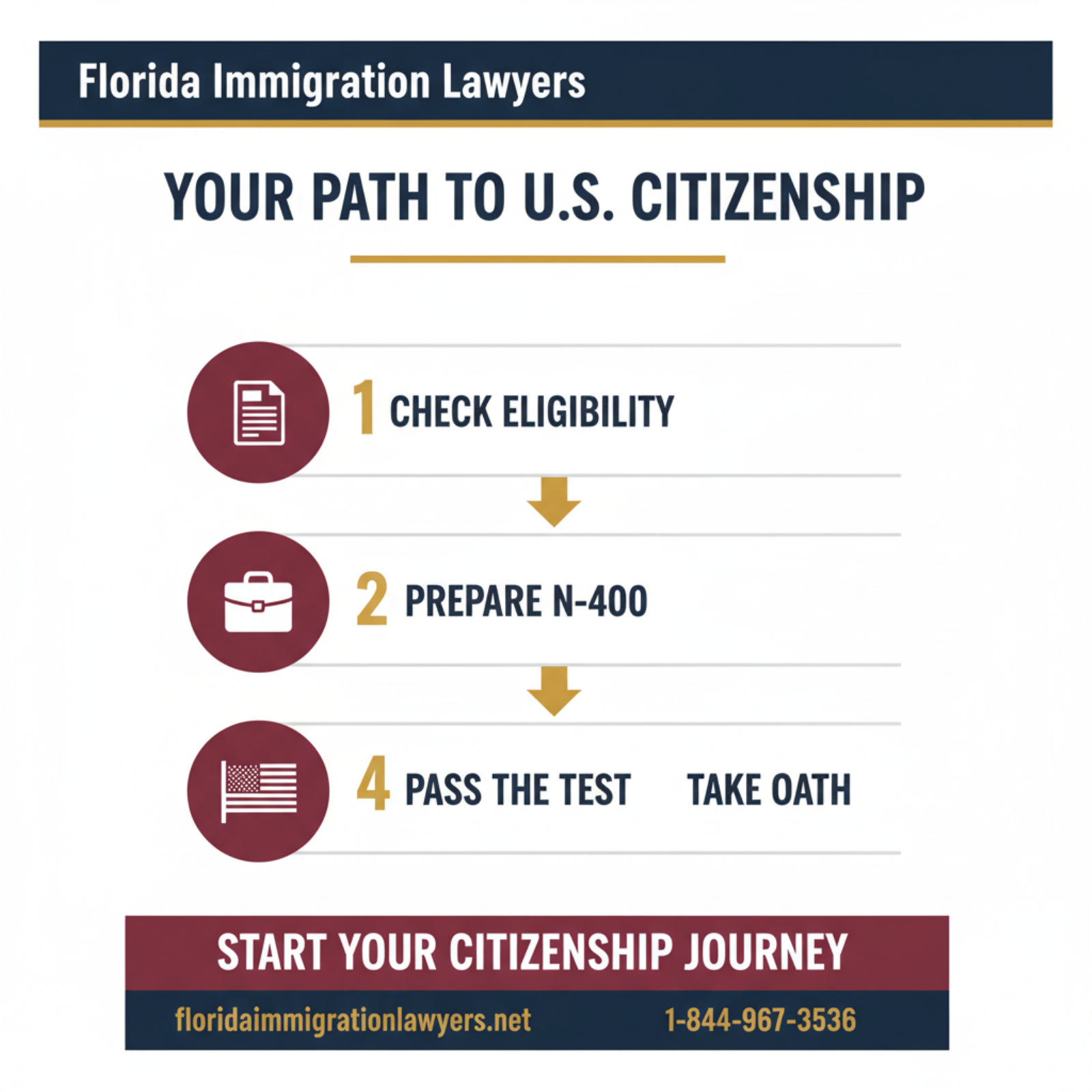
- Determine Your Eligibility: Before applying, you must meet specific eligibility requirements. Generally, you must be at least 18 years old, be a lawful permanent resident (Green Card holder) for at least five years (or three years if married to a U.S. citizen), have continuous residence and physical presence in the U.S., demonstrate good moral character, and be willing to take the Oath of Allegiance. There are also specific residency requirements for your state, meaning you must have resided in Florida for at least three months prior to filing your application.
- Prepare and File Form N-400, Application for Naturalization: This is the official application form for U.S. citizenship. You will need to gather extensive personal information, employment history, travel records, and other biographical data. Accuracy is paramount. Ensure all sections are completed truthfully and thoroughly.
- Attend the Biometrics Appointment: After filing Form N-400, USCIS will send you an appointment notice for biometrics. This appointment typically involves taking your fingerprints, photograph, and signature. These are used for background checks and identity verification.
- Complete the Naturalization Interview: This is where the citizenship test questions 2026 come into play. A USCIS officer will review your N-400 application with you, ask questions about your background, and administer the English and civics tests. Be prepared to answer questions about your application, your eligibility, and your commitment to the U.S.
- Receive a Decision from USCIS: After your interview, USCIS will make a decision on your application. You may receive a decision immediately, or a notice will be mailed to you. If approved, you will be scheduled for an Oath of Allegiance Ceremony.
- Take the Oath of Allegiance: This is the final step to becoming a U.S. citizen. At the ceremony, you will take an oath to renounce allegiance to any foreign state, support the U.S. Constitution, and faithfully discharge the duties of a U.S. citizen. Once you take the oath, you will receive your Certificate of Naturalization.
Essential Documents for Your Naturalization Application
A successful naturalization application, particularly when preparing for citizenship test questions 2026, relies heavily on submitting a complete and accurate set of supporting documents. Missing or incorrect documentation can lead to delays or even denial. Here's a general checklist of documents you will typically need:
- Your Green Card (Permanent Resident Card).
- Your state-issued identification (driver's license or state ID).
- All passports, current and expired.
- Marriage certificate (if applicable).
- Divorce decrees (if applicable).
- Birth certificates for your children (if applicable).
- Proof of selective service registration (for male applicants aged 18-26).
- Tax returns for the past five years (or three years if married to a U.S. citizen).
- Proof of continuous residence and physical presence (e.g., utility bills, leases, mortgage statements, employment records).
- Court disposition documents for any arrests, citations, or detentions, even if charges were dropped or expunged.
- If you have ever been placed in deportation proceedings, copies of all relevant court documents.
- Any USCIS correspondence related to your Green Card or other immigration benefits.
- Certified translations for any documents not in English.
This list is not exhaustive, and your specific circumstances may require additional documents. Consulting with a Florida immigration lawyer can help ensure you gather everything necessary for your application.
Understanding the Naturalization Timeline and Processing Expectations
The naturalization process timeline can vary significantly based on several factors, including the USCIS field office processing your application (e.g., Miami, Orlando, Tampa), the current caseload, and the completeness of your application. While there's no fixed duration, understanding general expectations can help you plan.
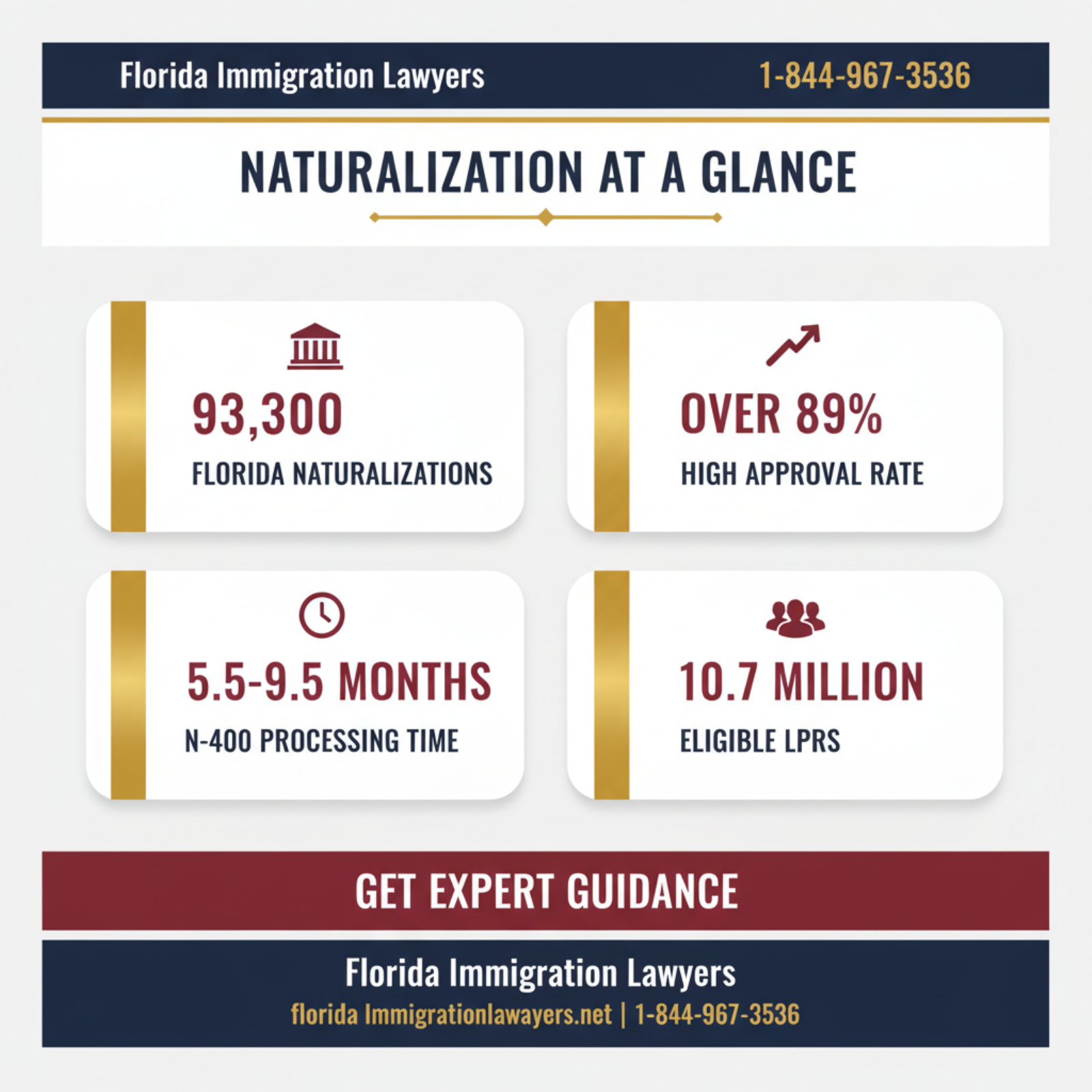
Typically, the entire naturalization process, from filing Form N-400 to taking the Oath of Allegiance, can take anywhere from 8 to 18 months, or even longer in some complex cases. USCIS provides estimated processing times on their website for each service center and field office. For example, applicants in Fort Lauderdale would check the processing times for the USCIS Miami Field Office or other relevant Florida offices.
Factors that can influence your timeline include:
- Application Volume: High volumes of applications can lead to longer wait times.
- Accuracy of Application: Errors or missing information will cause delays as USCIS requests further evidence.
- Background Checks: Extensive background checks can sometimes take longer to clear.
- Interview Scheduling: The availability of interview slots at your local field office.
It is important to remain patient and monitor your case status online using the receipt number provided by USCIS. While waiting, focus on preparing for the citizenship test questions 2026 and your interview.
Cost Factors and Fee Breakdown for U.S. Citizenship
Applying for U.S. citizenship involves certain government filing fees. These fees are set by USCIS and are subject to change, so it's critical to check the most current fee schedule on the USCIS website before submitting your application. Generally, the cost includes the application fee for Form N-400 and the biometrics services fee.
As of 2026, applicants typically face a combined fee for the N-400 application and biometrics. Fee waivers may be available for eligible low-income applicants. To qualify for a fee waiver, you generally need to demonstrate that your household income is at or below 150% of the Federal Poverty Guidelines, or that you receive a means-tested benefit, or that you are experiencing financial hardship. This option can be very helpful for many Florida families.
Beyond government fees, you may also incur other expenses:
- Legal Fees: Hiring an experienced Florida immigration lawyer to assist with your application, prepare you for the interview, and represent you can be a significant investment, but often invaluable.
- Document Translation Fees: If any of your supporting documents are not in English, you will need to pay for certified translations.
- Travel Expenses: Costs associated with traveling to your biometrics appointment, interview, and Oath Ceremony.
- Study Materials: While many resources are free (like those on uscis.gov), some applicants choose to purchase additional study guides or attend preparation classes.
Understanding these potential costs upfront helps you budget and plan for your naturalization journey. Florida Immigration Lawyers offers transparent fee structures and can discuss all potential costs during your free consultation.
Do not navigate this process alone. The complexities of immigration law, especially concerning the naturalization test and eligibility requirements, can be daunting. Contact Florida Immigration Lawyers today to ensure your application is strong and your preparation is thorough. We are ready to assist you.
Commonly Asked Citizenship Test Questions and Updates for 2026
Preparing for the civics portion of the naturalization interview means familiarizing yourself with the official 100 civics questions. While the USCIS officer will only ask you up to 10 questions, and you need to answer 6 correctly, it's best to study all 100. Here are some examples of the types of questions you might encounter, often covering the U.S. Constitution, American government, and history. Remember, these are examples, and the full list is available from USCIS, often with answers.
How many questions are on the citizenship test in 2026? For most applicants, the USCIS officer will ask up to 10 questions from the list of 100 civics questions. You must answer at least 6 correctly to pass. For applicants aged 65 or older who have been a lawful permanent resident for at least 20 years, the test is simplified; they are only asked 10 questions from a special list of 20, and must answer 6 correctly.
What are the 10 most common questions asked for the citizenship test?
While USCIS does not publish a list of "most common" questions, certain foundational questions are frequently covered during interviews. These often include:
- What is the supreme law of the land? (The Constitution)
- What does the Constitution do? (Sets up the government, defines the government, protects basic rights of Americans)
- The idea of self-government is in the first three words of the Constitution. What are these words? (We the People)
- What is an amendment? (A change to the Constitution, an addition to the Constitution)
- What do we call the first ten amendments to the Constitution? (The Bill of Rights)
- What is one right or freedom from the First Amendment? (Speech, religion, assembly, press, petition the government)
- How many amendments does the Constitution have? (Twenty-seven)
- What did the Declaration of Independence do? (Announced our independence from Great Britain, declared our independence from Great Britain, said that the United States is free from Great Britain)
- What are two rights in the Declaration of Independence? (Life, liberty, pursuit of happiness)
- What is freedom of religion? (You can practice any religion, or not practice a religion)
These examples illustrate the type of knowledge expected. Comprehensive study of all 100 questions and their answers is the best preparation for your interview in Fort Lauderdale or any other Florida location.
Common Mistakes to Avoid During Your Naturalization Journey
The naturalization process, including the citizenship test questions 2026, can be intricate. Avoiding common pitfalls is essential for a smooth application. Here are some frequent mistakes applicants make and their potential consequences:
- Failing to Meet Residency Requirements: Not meeting the continuous residence or physical presence requirements can lead to denial. You must reside in the state or USCIS district for at least three months before filing.
- Providing Inaccurate or Incomplete Information: Any false statements or omissions on Form N-400 can result in denial, accusations of misrepresentation, and even removal proceedings.
- Insufficient Preparation for the Civics Test: Underestimating the civics test can lead to failure. You must correctly answer 6 out of 10 questions.
- Lack of English Proficiency: Failing the English reading, writing, or speaking tests (unless exempt) will result in a failed interview and potential denial.
- Having a Criminal Record: Certain criminal convictions can prevent you from demonstrating good moral character, a key eligibility requirement. Always disclose any arrests, even if expunged.
- Failure to Register for Selective Service: Male applicants who resided in the U.S. between ages 18 and 26 must register for Selective Service. Failure to do so can impact good moral character.
- Extensive Travel Outside the U.S.: Long absences can break continuous residence. If you travel frequently, consult an attorney to understand the impact on your eligibility.
- Missing Deadlines or Appointments: Failing to respond to USCIS requests for evidence or missing scheduled appointments can lead to your application being denied or abandoned.
- Not Disclosing All Marriages/Divorces: Full disclosure of marital history is crucial, even if it seems irrelevant. Inconsistencies can raise red flags.
- Misunderstanding the Oath of Allegiance: You must genuinely intend to take the Oath without mental reservations. A lack of understanding can cause issues at the ceremony.
- Attempting to Conceal Information: Never attempt to hide any negative information from USCIS. Transparency, even with past issues, is always the best approach.
- Not Seeking Legal Counsel: Navigating the complex immigration system without expert guidance can lead to costly errors and delays.
These mistakes can set back your naturalization journey significantly. Professional legal advice from a Florida immigration lawyer can help you avoid these pitfalls.
When to Call a Lawyer for Your Naturalization Application
While many applicants successfully navigate the naturalization process independently, certain situations strongly warrant the expertise of an immigration attorney. For residents throughout Florida, including Fort Lauderdale, Miami, and Orlando, seeking legal counsel can make a significant difference in your application's outcome, especially when dealing with the intricacies of citizenship test questions 2026.
You should consider contacting Florida Immigration Lawyers if any of the following apply to your situation:
- Complex Eligibility Issues: If you have doubts about meeting continuous residence, good moral character, or other eligibility criteria.
- Criminal History: Even minor arrests or convictions can impact your eligibility. An attorney can assess your record and advise on potential waivers or strategies.
- Previous Denials or Deportation Proceedings: If you've had past immigration applications denied, or if you've ever been in removal proceedings, legal guidance is crucial.
- Extensive Travel History: If you have taken long trips outside the U.S. or have numerous international travels, an attorney can help determine if your continuous residence has been broken.
- Medical Waivers for English/Civics Test: If you believe you qualify for a medical waiver due to a physical or developmental disability or mental impairment, an attorney can help prepare the necessary documentation (Form N-648).
- Marital History Complications: If you have multiple marriages, divorces, or a marriage to a U.S. citizen that ended, an attorney can help clarify how this impacts your application.
- Concerns About the Interview: If you are particularly nervous about the interview, or have difficulty communicating in English, an attorney can prepare you and even attend the interview with you.
- Questions About the Oath of Allegiance: If you have religious or other objections to the standard Oath, an attorney can explore alternative options.
- Any Specific Legal Questions: If you have any doubts or questions about your unique case, it is always best to consult with an expert.
Florida Immigration Lawyers provides comprehensive support for naturalization applications, including preparing clients for the citizenship test questions 2026, compiling robust documentation, and representing them during interviews. Our goal is to make your path to U.S. citizenship as smooth and successful as possible. We serve clients across all of Florida, offering accessible and reliable legal assistance.
Do not leave your future to chance. Contact Florida Immigration Lawyers today for a free consultation. Our experienced attorneys are here to protect your rights and guide you through every stage of the citizenship application process.
About Florida Immigration Lawyers
Florida Immigration Lawyers is a leading law firm dedicated to providing exceptional immigration legal services across the entire state of Florida. With a deep understanding of U.S. immigration law and a commitment to our clients, we strive to achieve the best possible outcomes for individuals and families pursuing their American dream.
Our experienced team specializes in a wide range of immigration matters, including family-based petitions, employment visas, deportation defense, asylum claims, and the naturalization process. We pride ourselves on offering compassionate, personalized, and effective legal representation to every client.
Why choose Florida Immigration Lawyers?
- Expertise: Our attorneys possess extensive knowledge of complex immigration laws and procedures.
- Client-Centered Approach: We listen to your unique story and tailor strategies to your specific needs.
- Accessibility: We are available 24/7 to answer your urgent questions and provide support.
- Bilingual Services: Our team offers services in English and Spanish to ensure clear communication.
- Free Consultations: We provide free initial consultations to discuss your case and outline your options.
Whether you are in Fort Lauderdale, Miami, Orlando, Tampa, or any other city in Florida, we are here to assist you. Call us today at 1-844-967-3536 or visit our website at https://www.floridaimmigrationlawyers.net to learn more about how we can help you achieve your immigration goals.
Sources and References
- U.S. Citizenship and Immigration Services (USCIS)
- USCIS: Study Materials for the Naturalization Test
- USCIS: Civics Questions and Answers for the Naturalization Test (PDF)
- USCIS: Form N-400, Application for Naturalization
- 8 U.S.C. Chapter 12 - Immigration and Nationality Act (INA Section 312 - English Language and Civics Requirements)
- 8 CFR Part 312 - English Literacy and Knowledge of History and Government of the United States
- 8 U.S.C. § 1423 - Requirements as to understanding of English language, history, principles and form of government of United States
This article provides general legal information and is not intended as legal advice. Every case is unique, and outcomes depend on specific facts and circumstances. Contact an attorney for advice about your particular situation.
Your journey to U.S. citizenship is a profound one, and preparing for the citizenship test questions 2026 is a key milestone. Do not face this process alone. Florida Immigration Lawyers is here to provide the expert guidance and support you need to navigate every step successfully. We are committed to helping you achieve your American dream in Florida. Call us today for a free consultation at 1-844-967-3536.
Se Habla Español - Estamos aquí para ayudarle.
Do Not Navigate This Process Alone
Our experienced immigration attorneys are ready to fight for you. Get a free, confidential consultation today.
Se Habla Español
Frequently Asked Questions
Florida Immigration Lawyers
Immigration Attorney | Founder, Vasquez Law Firm
U.S. Air Force veteran and immigration attorney with thousands of cases resolved. J.D., NCCU School of Law. AILA member. Admitted to the 4th, 5th, and 11th Circuit Courts.
Available 24/7 - Free Evaluations
Related Legal Services
Our Florida immigration attorneys can help you with experienced immigration attorneys, business immigration and asylum protection. Call today at 1-844-967-3536 for a free consultation.
Related Links
Related Topics
Free Legal Consultation
Discuss your case with our experienced attorneys. We're available 24/7.
Se Habla Español - Estamos aquí para ayudarle.
Related Articles
U Visa for Crime Victims: Florida Immigration Relief
Learn about U visas for crime victims in Florida and how they provide relief to those who assist law enforcement. Discover eligibility requirements, application steps, and the benefits of the U visa. Call Florida Immigration Lawyers for expert guidance.
Motion to Reopen Immigration Case in Florida | VLF Florida
Learn how to file a motion to reopen your immigration case in Florida. Discover eligibility, steps, and common mistakes. Call us for a free consultation.
Immigration Attorney in Gainesville: Your North Florida Guide
Finding an immigration attorney in Gainesville, North Florida, can be crucial for your immigration journey. Learn how experienced lawyers can guide you through complex processes and help you avoid common pitfalls. Call Florida Immigration Lawyers at 1-844-967-3536 for expert assistance.
E-2 Visa Guide for Investors in Florida | VLF Florida
Discover how to obtain an E-2 investor visa for your business in St. Petersburg, Florida. Learn the steps, requirements, and how Florida Immigration Lawyers can assist you.