Change of Status to F-1 Student Visa in Florida: Your Guide
Are you currently in Florida on a nonimmigrant visa and dreaming of pursuing higher education? Our comprehensive guide explains how to navigate the complex process of changing your status to an F-1 student visa. Learn about eligibility requirements, the step-by-step application process, essential documents, and critical mistakes to avoid. Whether you're in Orlando, Miami, or Tampa, understanding these immigration rules is vital for your academic future. Florida Immigration Lawyers offers expert guidance for your change of status application, ensuring you meet all USCIS requirements. Don't let immigration complexities deter your educational goals; get the legal support you need today.
Changing your nonimmigrant status to an F-1 student visa in Florida allows you to pursue academic studies legally within the U.S. This process involves submitting Form I-539 to USCIS, demonstrating a valid nonimmigrant status, intent to study, and sufficient financial resources. It is a complex procedure requiring careful attention to deadlines and documentation.
- Submit Form I-539 to USCIS.
- Maintain current nonimmigrant status throughout.
- Demonstrate academic intent and financial stability.
- Strict adherence to deadlines is critical.
- Consult a Florida immigration lawyer for guidance.
Imagine you're in sunny Orlando, Florida, on a tourist visa, and you discover a passion for a local university program. Or perhaps you're here on a work visa, and your career path is shifting towards advanced education. The dream of studying in the U.S. doesn't always start with an F-1 visa obtained from abroad.
For many nonimmigrants already in the United States, the path to academic pursuits involves a change of status. This allows you to transition from one nonimmigrant category to another without leaving the country. For those aspiring to study in Florida, understanding this process is crucial.
This comprehensive guide will walk you through the intricate process of changing your nonimmigrant status to an F-1 student visa while remaining in Florida. We will cover eligibility, required documents, the application timeline, potential costs, and crucial mistakes to avoid. Our goal is to empower you with the knowledge to navigate this journey successfully.
For personalized assistance with your change of status application, call Florida Immigration Lawyers at 1-844-967-3536 for a free consultation. Our experienced team serves individuals across all of Florida, including Orlando, Miami, and Tampa.
Understanding F-1 Change of Status in Florida
A change of status allows you to switch your immigration classification while staying within the United States. For example, if you entered Florida on a B-2 tourist visa, you might be eligible to apply for an F-1 student status without having to return to your home country to apply for a new visa at a U.S. consulate.
This is distinct from obtaining an F-1 visa at a U.S. embassy or consulate abroad. While a change of status grants you F-1 status within the U.S., it does not grant you an F-1 visa stamp in your passport. You would need to apply for that visa stamp if you travel outside the U.S. and wish to re-enter as an F-1 student.
Florida boasts a vibrant academic environment, with numerous SEVP-approved institutions across cities like Orlando, Miami, Tampa, and Gainesville. This makes it an attractive destination for international students. Navigating the immigration system to become an F-1 student in this diverse state requires precise adherence to regulations.
Key Eligibility Requirements for an F-1 Student Visa
To be eligible for a change of status to an F-1 student visa, you must meet several critical criteria. First, you must have been lawfully admitted to the United States in a nonimmigrant status. This means you entered the country legally and have not overstayed your initial authorized period of stay.
Second, you must maintain your current nonimmigrant status until the date USCIS makes a decision on your I-539 application. This is a crucial point; any violation of your current status, such as unauthorized employment, could lead to a denial of your change of status request.
Third, you must not have committed any acts that would make you ineligible for an F-1 visa. This includes certain criminal offenses or immigration violations. You must also demonstrate a genuine intent to pursue a full course of study at a Student and Exchange Visitor Program (SEVP)-approved school in Florida.
Finally, you must possess sufficient funds to cover your tuition, living expenses, and other costs for the duration of your studies. This financial stability is a cornerstone of the F-1 visa requirements, ensuring you will not become a public charge or need to work illegally. Typically, those on B-1/B-2 visitor visas, E, H, L, or J visas (with specific waivers) are common applicants for this status change.
Step-by-Step Guide to Applying for F-1 Change of Status
The process of applying for an F-1 change of status can seem daunting, but breaking it down into manageable steps makes it clearer. It requires meticulous preparation and adherence to USCIS guidelines. Our team at Florida Immigration Lawyers can guide you through each stage.
-
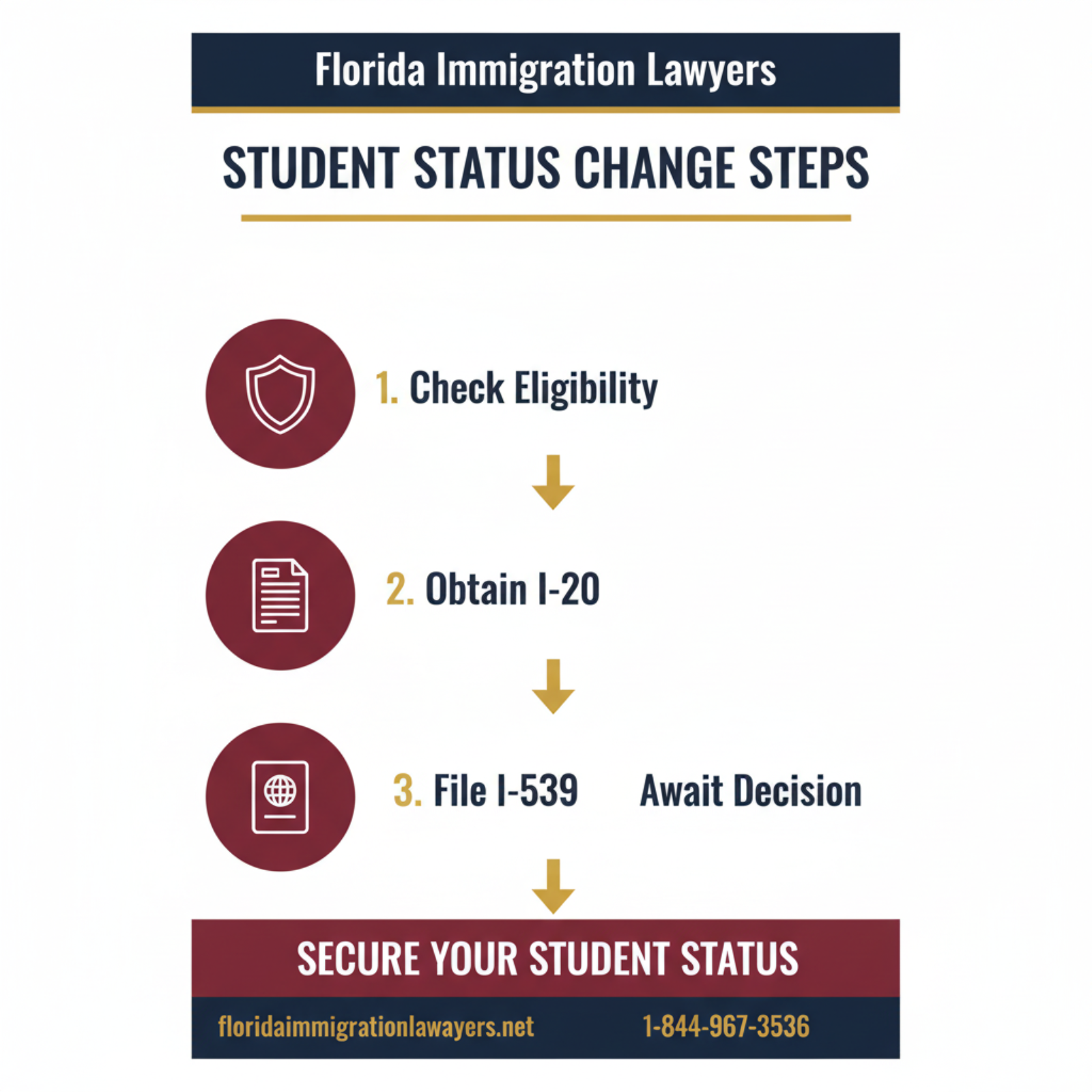
Gain Admission to a SEVP-Approved School: Your first step is to apply to and be accepted by a U.S. school approved by the Student and Exchange Visitor Program (SEVP). Once accepted, the Designated School Official (DSO) at your chosen institution will issue you a Form I-20, Certificate of Eligibility for Nonimmigrant Student Status. This document is vital for your application.
-
Pay the SEVIS I-901 Fee: After receiving your Form I-20, you must pay the SEVIS I-901 fee. This fee supports the Student and Exchange Visitor Information System (SEVIS), which tracks F-1 students. You must print your payment receipt as proof for your application. You can find more information about this fee on the official Study in the States website.
-
Prepare Form I-539, Application to Extend/Change Nonimmigrant Status: This is the primary form for your change of status request. Complete all sections accurately and thoroughly. If you have dependents (spouse or children) who also need to change to F-2 status, they can be included on the same Form I-539. Ensure all questions are answered honestly and completely.
-
Gather Supporting Documentation: Collect all necessary documents as outlined in the checklist below. This includes financial proof, academic records, and evidence of your current lawful status. Organize these documents clearly and logically, as a well-presented application can aid in faster processing. For help compiling your documents, visit our immigration practice area page.
-
Mail Your Application to USCIS: Once all forms and supporting documents are prepared, mail your complete application package to the appropriate USCIS Lockbox facility. The correct mailing address depends on the type of form and whether you are filing alone or with dependents. Always check the USCIS website for the most current filing addresses to avoid delays.
-
Attend Biometrics Appointment (If Required): USCIS may require you to attend a biometrics appointment at an Application Support Center (ASC). At this appointment, your fingerprints, photograph, and signature will be collected. You will receive a notice with the date, time, and location of your appointment. Missing this appointment without rescheduling can lead to a denial.
-
Receive Decision: After USCIS reviews your application, you will receive a decision notice. This could be an approval, a Request for Evidence (RFE), or a denial. If an RFE is issued, you must respond promptly with the requested information. An approval notice will confirm your new F-1 status and its effective date.
Essential Documents for Your F-1 Change of Status Application
A successful change of status application hinges on a complete and well-organized submission of supporting documents. Missing or incorrect documentation is a common reason for delays or denials. Ensure you have originals and copies as needed, and always keep a full copy of your entire application package for your records.
- Form I-539, Application to Extend/Change Nonimmigrant Status: The completed and signed form, along with the appropriate filing fee.
- Form I-20, Certificate of Eligibility for Nonimmigrant Student Status: Original Form I-20 issued by your SEVP-approved school in Florida.
- Proof of SEVIS I-901 Fee Payment: A copy of your payment receipt for the SEVIS fee.
- Copy of Passport and Visa: A clear copy of your passport biographic page and any current U.S. visa stamp.
- Copy of I-94 Arrival/Departure Record: Printout of your electronic I-94 record from the CBP website, showing your lawful entry and authorized period of stay.
- Financial Documentation: Evidence of sufficient funds to cover your tuition and living expenses for at least one academic year. This may include bank statements, letters of financial support from sponsors, scholarship letters, or other verifiable assets.
- Academic Transcripts and Diplomas: Copies of your academic records from previous institutions, demonstrating your educational background.
- Letter of Explanation: A personal letter explaining your reasons for seeking a change of status, your academic goals, and how you will financially support yourself. This letter should also address your intent to return to your home country after completing your studies.
- Proof of Current Nonimmigrant Status: Copies of any approval notices (e.g., I-797 for previous extensions or changes of status) or other documents proving your current lawful status.
- Marriage Certificate (if applicable): If applying with a spouse for F-2 status, provide a copy of your marriage certificate.
- Birth Certificates (if applicable): If applying with children for F-2 status, provide copies of their birth certificates.
Financial Requirements for F-1 Student Status
Demonstrating adequate financial resources is a fundamental component of your change of status application. USCIS wants assurance that you can cover all educational and living costs without needing to work illegally. The exact amount required will be stated on your Form I-20, as it varies by institution and program.
Acceptable sources of funds include personal savings, parental or sponsor support, scholarships, or government funding. All financial documents, such as bank statements, must be recent and clearly show the availability of liquid funds. If a sponsor is supporting you, they will need to provide an affidavit of support along with their financial documentation.
Timeline and Processing Expectations for Change of Status
The processing time for an F-1 change of status application can vary significantly. USCIS processing times are subject to many factors, including the volume of applications, the specific service center handling your case, and the completeness of your submission. It is essential to check the USCIS website for current processing times for Form I-539.
Typically, these applications can take anywhere from several months to over a year. During this period, you must maintain your current nonimmigrant status. This means if your original visa or authorized stay expires while your change of status is pending, you are generally permitted to remain in the U.S. until a decision is made, provided you filed your application before your I-94 expiration date.
However, you cannot begin your studies until your change of status to F-1 has been officially approved. Starting classes before approval is a violation of immigration law and can lead to severe consequences, including denial of your application and potential deportation. This is a critical rule to remember for all aspiring students in Florida.
Understanding USCIS Processing Times
USCIS processing times are estimates and can change without notice. You can check the average processing times for Form I-539 on the USCIS website by selecting the form and the appropriate service center. These times are crucial for planning your academic start date and managing your expectations.
Factors that can influence processing speed include the accuracy and completeness of your application, whether USCIS issues a Request for Evidence (RFE), and the overall workload at the service center. There is generally no premium processing option available for Form I-539 for a change of status to F-1, meaning you cannot pay an extra fee to expedite the decision.
Cost Factors and USCIS Fees for F-1 Change of Status
Applying for an F-1 change of status involves several financial considerations. These costs typically include government filing fees, SEVIS fees, and potentially legal fees if you choose to hire an attorney. It is important to budget for these expenses to ensure a smooth application process.
The primary government fee is for Form I-539, Application to Extend/Change Nonimmigrant Status. USCIS fees are subject to change, so always verify the current fee on the official USCIS website before filing. Do not send an incorrect fee amount, as this can lead to your application being rejected and returned.
Additionally, you must pay the SEVIS I-901 fee. This fee is separate from the I-539 filing fee and is mandatory for all F-1 students. Other potential costs include mailing fees for sending your application, translation fees if any documents are not in English, and fees for obtaining official academic transcripts or financial statements. Investing in professional legal counsel from a dedicated Florida immigration law firm can also be a significant cost, but it often provides invaluable peace of mind and increases your chances of success.
Do not navigate this complex change of status process alone. The stakes are high, and even minor errors can lead to delays or denials. Contact Florida Immigration Lawyers today for expert guidance and peace of mind. Our dedicated team is ready to assist you.
Common Mistakes to Avoid During Your F-1 Change of Status Application
Applying for a change of status can be tricky, and many applicants make common errors that could jeopardize their chances. Avoiding these pitfalls is key to a successful outcome. Our experienced Orlando immigration lawyer team regularly helps clients prevent these issues.
-
Falling Out of Status Before Filing: You must file your I-539 application before your current authorized period of stay expires. If you overstay your visa even by one day, you become unlawfully present, making you ineligible for a change of status and potentially subject to deportation or future bars from re-entry.
-
Applying Too Soon After Entry (The 90-Day Rule): If you entered the U.S. on a B-1/B-2 visitor visa and apply for a change of status to F-1 within 90 days of your arrival, USCIS may presume you misrepresented your true intent upon entry. This is known as the 90-day rule and can lead to a denial based on preconceived intent. It is generally safer to wait at least 90 days before filing.
-
Insufficient Funds: Not providing adequate proof of funds to cover your tuition and living expenses is a common reason for RFE or denial. Ensure your financial documentation clearly demonstrates you can support yourself without unauthorized employment. The amount specified on your I-20 is the minimum required.
-
Incomplete or Inaccurate Documentation: Submitting an application with missing forms, unsigned documents, or incorrect information will undoubtedly cause delays. USCIS will likely issue a Request for Evidence (RFE), which extends processing times and adds stress. Double-check every detail before mailing.
-
Failure to Maintain Nonimmigrant Status During Processing: You must continue to abide by the terms of your current nonimmigrant status while your change of status application is pending. For example, if you are on a B-2 visa, you cannot enroll in classes or work during this period. Any violation can result in denial.
-
Traveling Outside the U.S. While Application is Pending: If you leave the U.S. while your I-539 application is pending, USCIS considers your application abandoned. You would then need to apply for an F-1 visa at a U.S. embassy or consulate abroad to re-enter the country as a student.
-
Beginning Studies Before Approval: It is strictly prohibited to begin your F-1 program of study before your change of status to F-1 is officially approved by USCIS. Engaging in unauthorized study is a serious violation of immigration law and will lead to a denial of your application and potential removal proceedings.
-
Not Updating USCIS with Address Changes: If you move while your application is pending, you must inform USCIS of your new address within 10 days. Failure to do so can result in missed notices, RFEs, or even a denial because you did not receive critical communications.
-
Misrepresenting Intent: Providing false information or misrepresenting your true intentions to USCIS is considered immigration fraud. This has severe consequences, including permanent bars from receiving future immigration benefits. Always be truthful in your application.
-
Ignoring the Five-Month Rule: While primarily for F-1 students transferring schools, understanding the rule's intent is important. It generally states that an F-1 student must resume studies within five months of transferring or the previous program's end. For a change of status, ensuring timely enrollment after approval is crucial to maintain status.
-
Not Consulting an Attorney: The complexity of immigration law means that even seemingly minor details can have significant impacts. Attempting to navigate the change of status process without legal counsel can lead to costly mistakes, delays, or denials that could have been avoided with professional help.
Frequently Asked Questions About F-1 Change of Status
Prospective students often have questions about the nuances of changing status to an F-1 visa. Here, we address some common inquiries to provide further clarity.
What is the 90 day rule for status change?
The 90-day rule is an informal guideline used by USCIS to assess whether a nonimmigrant misrepresented their intent upon entering the U.S. If you enter on a B-1/B-2 visitor visa and then apply for a change of status to F-1 within 90 days, USCIS may presume you always intended to study, which contradicts the temporary visitor nature of the B visa. This presumption can lead to a denial. It is generally advisable to wait at least 90 days after entry before filing for a change of status.
Are F-1 students considered residents after 5 years?
For tax purposes, F-1 students are generally considered non-residents for their first five calendar years in the U.S. However, this is a tax residency distinction and does not change their immigration status. F-1 students remain nonimmigrants, meaning they are in the U.S. for a temporary, specific purpose (education) and are expected to return to their home country upon completion of their studies. This status does not automatically lead to permanent residency or citizenship.
Who qualifies for change of status?
Generally, individuals lawfully present in the U.S. in a nonimmigrant status may qualify for a change of status. Common eligible categories include B-1/B-2 visitors, E treaty traders/investors, H-1B temporary workers, L-1 intracompany transferees, and J-1 exchange visitors (though J-1s may be subject to a two-year home residency requirement that needs to be waived). Certain statuses, like C (transit), D (crewmember), K (fiancé), or parolees, typically do not qualify for a change of status to F-1 without specific waivers or exceptional circumstances. It is crucial to consult with an attorney to assess your specific eligibility.
What is the 5 month rule for F-1 students?
The five-month rule primarily applies to F-1 students who are transferring between SEVP-approved schools or who have completed a program. It generally states that an F-1 student must resume studies within five months of transferring or within five months of the program end date on their I-20, whichever is earlier. For those undergoing a change of status, this rule reinforces the need for continuous enrollment once F-1 status is granted. Failing to re-enroll within this period can lead to a loss of F-1 status.
When to Call a Lawyer for Your F-1 Change of Status in Florida
While this guide provides comprehensive information, the process of changing your immigration status is complex and carries significant implications. There are specific scenarios where seeking legal counsel from an experienced Florida immigration lawyer is not just helpful, but essential. Our firm, Florida Immigration Lawyers, is dedicated to assisting clients throughout the state.
You should consider calling an attorney if your case involves any complexities, such as a previous visa denial, a criminal history, or any period of overstay. These factors can significantly complicate your application and often require expert legal strategy. Our attorneys are skilled in handling challenging cases.
If you are uncertain about your eligibility for an F-1 visa, or if you have received a Request for Evidence (RFE) or a Notice of Intent to Deny (NOID) from USCIS, immediate legal intervention is critical. An attorney can help you understand the issues and prepare a robust response, potentially saving your application. We also offer services for deportation defense, which can be relevant if status issues arise.
Furthermore, if you are considering travel outside the U.S. while your application is pending, or if you need to understand the implications of your `change of status` on future immigration plans, a lawyer can provide crucial advice. We also assist with family immigration and business immigration matters, offering a holistic approach to your immigration needs.
Don't face the U.S. immigration system alone. The stakes are too high. Let the knowledgeable team at Florida Immigration Lawyers provide the guidance and advocacy you deserve. We serve clients in Orlando, Miami, Tampa, and throughout Florida, offering peace of mind through complex legal processes. Visit our contact page to schedule your free consultation.
About Florida Immigration Lawyers
Florida Immigration Lawyers is a leading immigration law firm dedicated to serving individuals and families across the entire state of Florida. With a deep understanding of U.S. immigration law, our experienced attorneys provide compassionate and effective legal representation for a wide range of immigration matters.
Our firm specializes in various practice areas, including visa applications, family-based petitions, employment-based immigration, asylum claims, deportation defense, and citizenship applications. We pride ourselves on offering personalized attention and strategic solutions tailored to meet the unique needs of each client. Our commitment is to guide you through every step of your immigration journey with clarity and confidence.
Choosing Florida Immigration Lawyers means choosing a team that is available 24/7 to address your concerns. We offer free consultations to help you understand your options and develop a strong legal strategy. Our dedication to client success, combined with our extensive knowledge of Florida's diverse communities, makes us the trusted choice for your immigration needs. Call us today at 1-844-967-3536 or visit our website at https://www.floridaimmigrationlawyers.net.
Sources and References
- U.S. Citizenship and Immigration Services (USCIS) - Form I-539
- Study in the States - Paying Your I-901 SEVIS Fee
- USCIS Policy Manual - Volume 2, Part D, Chapter 3: Change of Nonimmigrant Status
- 8 U.S.C. § 1101(a)(15)(F)(i) - Definition of F-1 student
- 8 CFR § 214.2(f) - Requirements for F-1 students
- Immigration and Nationality Act (INA) Section 248 (8 U.S.C. 1258) - Change of Nonimmigrant Status
- U.S. Department of State - Student Visas
This article provides general legal information and is not intended as legal advice. Every case is unique, and outcomes depend on specific facts and circumstances. Contact an attorney for advice about your particular situation.
Don't let the complexities of the change of status process overwhelm your academic dreams in Florida. The skilled Orlando immigration lawyer team at Florida Immigration Lawyers is here to provide the support and expertise you need.
Call us today at 1-844-967-3536 for a free, confidential consultation. Se Habla Español - Estamos aquí para ayudarle.
Need help with Immigration?
Our Florida immigration attorneys offer free consultations. Call today or schedule online.
Frequently Asked Questions
Florida Immigration Lawyers
Legal Team
Our experienced attorneys at Florida Immigration Lawyers have been serving clients across Florida for over 20 years. We specialize in immigration, personal injury, criminal defense, workers compensation, and family law.