Canada Immigration News Today: What Florida Residents Need to Know
For Florida residents, staying updated on Canada immigration news today is vital for those considering opportunities north of the border. This comprehensive guide details popular Canadian immigration pathways, essential document checklists, and insights into processing times and costs. We also cover crucial cross-border travel considerations for U.S. citizens and common mistakes to avoid. Florida Immigration Lawyers provides expert guidance for your journey from Florida to Canada. Call us for a free consultation to navigate these complex processes with confidence.
Staying informed about Canada immigration news today is crucial for Florida residents considering a move north. Canada offers various pathways, including Express Entry and Provincial Nominee Programs, designed to attract skilled workers, families, and students. Understanding eligibility, documentation, and processing times is key to a successful application process.
- Canada offers multiple immigration pathways for U.S. residents.
- Eligibility often depends on skills, education, language proficiency, and family ties.
- Thorough documentation and adherence to application guidelines are essential.
- Processing times and costs vary significantly by program.
- Consulting an experienced immigration lawyer is highly recommended for complex cases.
Are you a Florida resident, perhaps in St. Petersburg or a surrounding area, contemplating opportunities north of the border? The dynamic landscape of Canada immigration news today often sparks interest among individuals and families seeking new horizons. Whether you are exploring skilled worker programs, family reunification, or simply curious about cross-border possibilities, staying current with policy changes is vital.
This comprehensive guide from Florida Immigration Lawyers provides essential insights into Canadian immigration for those living in Florida. We will cover popular pathways, critical requirements, and common pitfalls to avoid. Our goal is to equip you with the knowledge needed to make informed decisions about your potential move to Canada, as of early 2026.
Navigating international immigration can be complex and overwhelming. Do not embark on this journey alone. Call Florida Immigration Lawyers at 1-844-967-3536 for a free consultation to discuss your specific situation and explore your options.
Understanding Canada Immigration News Today for Florida Residents
For many Floridians, especially those in diverse cities like St. Petersburg, Canada represents a land of opportunity and a different lifestyle. The relationship between the United States and Canada is unique, with significant cross-border movement for work, study, and leisure. Keeping up with Canada immigration news today is therefore a priority for many.
As of 2026, Canada continues its commitment to welcoming immigrants, largely to address labor shortages and support economic growth. Recent IRCC updates today have focused on streamlining processes for certain skilled occupations and enhancing regional immigration programs. These updates can significantly impact eligibility for applicants from Florida.
Florida's proximity to Canada and its large immigrant population mean many residents have connections or aspirations related to Canadian residency. Understanding the nuances of Canadian immigration policy while living in Florida requires expert guidance. Our firm, Florida Immigration Lawyers, specializes in helping individuals like you navigate these intricacies, ensuring you have the most current information.
While the U.S. and Canada share a border, their immigration systems are distinct. What applies for U.S. immigration may not apply for Canadian pathways. It is essential to research and understand the specific requirements set by Immigration, Refugees and Citizenship Canada (IRCC).
The Appeal of Canada for Floridians
Many Floridians are drawn to Canada for various reasons, including its robust job market in specific sectors, universal healthcare, and diverse cultural landscape. For some, it offers a change of pace from Florida's vibrant, fast-paced environment. Others seek educational opportunities or a stable environment for their families.
The Canadian government regularly adjusts its immigration targets and program criteria based on economic needs and social objectives. This means that opportunities can shift, making continuous monitoring of Canada immigration news today crucial. Our firm tracks these changes to provide you with timely and accurate advice.
If you are considering Canadian immigration, it is important to assess how your skills and qualifications align with Canada's current needs. Programs like Express Entry prioritize candidates who can readily contribute to the Canadian economy. We can help you evaluate your profile against these criteria.
Exploring Canadian Immigration Pathways: A Step-by-Step Guide
Canada offers numerous avenues for permanent residency and temporary status, each with its own set of requirements. For Florida residents, identifying the most suitable pathway is the first critical step. Our team at Florida Immigration Lawyers can help you understand these programs in detail.
Common pathways include Express Entry, Provincial Nominee Programs (PNPs), Family Sponsorship, and various work and study permits. Each program targets different categories of immigrants, from skilled workers to family members of Canadian citizens or permanent residents.
- Determine Your Eligibility: Research different Canadian immigration programs to see which ones match your qualifications, work experience, education, language proficiency (English and/or French), and financial resources. Tools like the IRCC's "Come to Canada" wizard can provide an initial assessment.
- Gather Essential Documents: Collect all necessary personal, educational, professional, and financial documents. This often includes passports, birth certificates, marriage certificates, educational credential assessments (ECA), and language test results (IELTS or CELPIP for English, TEF or TCF for French).
- Complete Language Proficiency Tests: Most economic immigration programs require proof of language proficiency. Schedule and complete an approved English or French language test. Your scores are crucial for your application and points-based systems like Express Entry.
- Obtain Educational Credential Assessment (ECA): If you completed your education outside Canada, you will need an ECA to verify that your foreign credentials are valid and equal to a Canadian credential. This is a mandatory step for many programs, including Express Entry.
- Create an Express Entry Profile (If Applicable): For skilled workers, creating an Express Entry profile is a key step. You will enter information about your skills, work experience, language ability, education, and other details. You will then receive a Comprehensive Ranking System (CRS) score.
- Receive an Invitation to Apply (ITA): If your Express Entry CRS score is high enough in a given draw, or if you are nominated by a province through a PNP, you may receive an Invitation to Apply (ITA) for permanent residence. This is a significant milestone in the process.
- Submit Your Complete Application: Once you receive an ITA, you have a limited time (typically 60 days) to submit a complete application for permanent residence. This includes all supporting documents, medical examinations, and police certificates. Accuracy and completeness are paramount.
- Undergo Background Checks and Medical Exams: All applicants and their accompanying family members must undergo security background checks and medical examinations to ensure they are admissible to Canada.
- Receive a Decision: After processing, IRCC will make a decision on your application. If approved, you will receive a Confirmation of Permanent Residence (COPR) and a permanent resident visa (if required).
- Land in Canada: Upon receiving your COPR, you must land in Canada before its expiry date to finalize your permanent resident status. This is the final step in your journey from Florida to Canada.
Key Immigration Programs for Florida Residents
Florida residents often find Express Entry to be a popular choice due to its speed and efficiency for skilled workers. It manages applications for the Federal Skilled Worker Program, Federal Skilled Trades Program, and Canadian Experience Class. Your eligibility under these programs can be assessed by our dedicated team.
Provincial Nominee Programs (PNPs) offer another excellent route, allowing provinces and territories to nominate individuals who meet specific local labor market needs. Many Florida residents find success through PNPs if they have connections or job offers in particular Canadian provinces. Our firm can help you explore these provincial streams.
For individuals with family members who are Canadian citizens or permanent residents, Family Sponsorship programs provide a path to reunification. This pathway is particularly relevant for those in Florida with close ties to Canada. Learn more about family immigration options.
Business immigration programs also exist for entrepreneurs and investors looking to establish or purchase businesses in Canada. These programs can be complex and require significant planning. Our expertise extends to business immigration matters, guiding you through the requirements for Canadian business visas.
Essential Document Checklist for Canadian Immigration Applicants
A successful Canadian immigration application hinges on providing a complete and accurate set of documents. Even minor omissions or errors can lead to significant delays or even refusal. This checklist outlines the typically required documents for most programs.
Before submitting your application, organize all your paperwork meticulously. This proactive approach can save you considerable stress and time during the process. Always ensure your documents are current and valid.
- Valid Passport: A current passport for yourself and all accompanying family members. Ensure it has sufficient validity remaining.
- Birth Certificates: For all applicants and family members.
- Marriage Certificate (if applicable): If you are married and applying with your spouse.
- Educational Credential Assessment (ECA) Report: For all post-secondary education obtained outside Canada.
- Language Test Results: Official scores from an approved English (IELTS, CELPIP) or French (TEF, TCF) language test.
- Work Experience Letters: Detailed letters from previous employers, outlining your job duties, hours worked, and duration of employment.
- Proof of Funds: Documentation demonstrating you have sufficient funds to support yourself and your family upon arrival in Canada. The required amount varies based on family size.
- Police Certificates: From every country or territory where you have lived for six months or more since the age of 18. This includes the United States. Information on obtaining these from the U.S. can sometimes be found via Department of Justice resources or FBI.
- Medical Examination Results: Conducted by an IRCC-approved panel physician.
- Digital Photos: Meeting Canadian immigration photo specifications.
- Application Forms: Duly completed and signed forms specific to the program you are applying for.
- Letters of Invitation/Job Offer (if applicable): If you have a job offer from a Canadian employer or a provincial nomination.
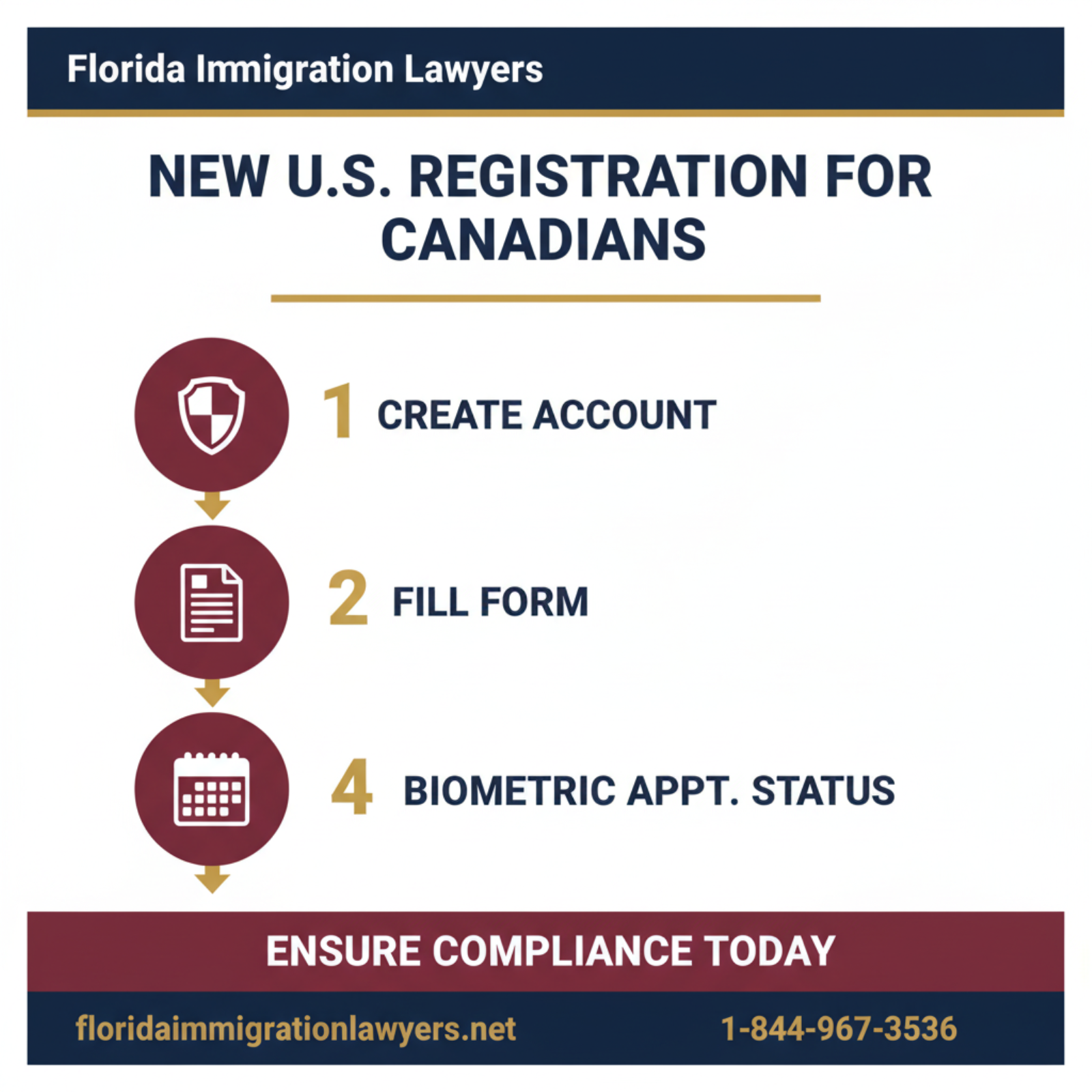
For U.S. citizens and residents in Florida, ensuring smooth travel and compliance with U.S. laws when leaving the country is also important. Information on U.S. travel requirements can be found on official government sites like travel.state.gov. Our immigration practice area covers these and other related concerns.
Canada Immigration Processing Times and Cost Factors
Understanding the potential timeline and financial commitment is essential when planning your move from Florida to Canada. Processing times can vary significantly based on the immigration program, the volume of applications, and the completeness of your submission. As of early 2026, IRCC continues to work on improving processing efficiency.
Express Entry applications, once an Invitation to Apply (ITA) is received, typically have a processing standard of six months or less. However, this timeline does not include the time it takes to receive an ITA. Provincial Nominee Programs (PNPs) can have varying processing times, often involving both provincial and federal stages.
Typical Processing Expectations
Family sponsorship applications generally take longer, often ranging from 12 to 24 months, depending on the relationship and where the sponsored person lives. Study and work permits usually have faster processing times, especially if the application is straightforward and all documents are in order. These timelines are estimates and can change.
Factors that can influence your processing time include the complexity of your case, any inadmissibility issues, or requests for additional information. Submitting an accurate and comprehensive application from the outset is the best way to avoid delays.
Cost Factors and Fee Breakdown
Immigrating to Canada involves several financial considerations beyond just the application fees. It is crucial for Florida residents to budget appropriately for all stages of the process. While specific fee amounts are subject to change, the categories of costs generally remain consistent.
- Government Application Fees: These include the processing fee for permanent residence, the Right of Permanent Residence Fee (RPRF), and fees for accompanying family members.
- Biometrics Fee: A separate fee for providing your fingerprints and photo.
- Educational Credential Assessment (ECA) Fee: Paid to the organization that assesses your foreign education.
- Language Test Fees: Costs associated with taking the IELTS, CELPIP, TEF, or TCF exams.
- Medical Examination Fees: Paid directly to the panel physician.
- Police Certificate Fees: If there are costs associated with obtaining these from various jurisdictions.
- Legal Fees: For the services of an immigration lawyer, such as Florida Immigration Lawyers, who can guide you through the process, prepare your application, and represent your interests.
- Settlement Funds: You must prove you have sufficient funds to support yourself and your family after arriving in Canada, unless you have a valid job offer and are exempt. These funds are not paid to the government but must be available to you.
- Travel and Relocation Costs: Flights, temporary accommodation, and initial living expenses in Canada.
Understanding these costs upfront helps in financial planning. We encourage you to consult with Florida Immigration Lawyers to get a clearer picture of the financial commitment involved in your specific Canadian immigration pathway.
Navigating Cross-Border Travel: U.S. Citizen Considerations
For U.S. citizens residing in Florida, understanding the rules for entering and exiting both the U.S. and Canada is crucial, especially when considering immigration. While U.S. citizens generally enjoy relatively easy access to Canada as visitors, the process changes when permanent residency is sought. This section addresses common concerns for U.S. citizens and residents in Florida.
When traveling to Canada as a U.S. citizen, you typically need a valid U.S. passport. For stays up to six months, a visa is usually not required. However, if your intent is to immigrate, you must follow the specific immigration procedures and obtain the appropriate status before or upon entry as an immigrant.
U.S. Travel Restrictions Update and Border Protocols
While major U.S. travel ban updates today are less frequent regarding Canada, it is always wise to check official sources like travel.state.gov for the latest travel advisories and border protocols. Similarly, Canada travel restrictions update information should be monitored via the official Canadian government website.
For U.S. citizens entering the U.S. from Canada, standard procedures apply. You will need your U.S. passport or other acceptable travel document. Customs and Border Protection (CBP) will process your entry. Be prepared to declare any goods purchased in Canada.
The movement of people, including "snowbirds" from Canada to Florida and vice-versa, is a significant aspect of cross-border relations. Canadians moving to Florida for seasonal stays often face different rules than those seeking permanent U.S. residency. Similarly, U.S. citizens moving to Canada for permanent residency must navigate a distinct set of Canadian immigration laws.
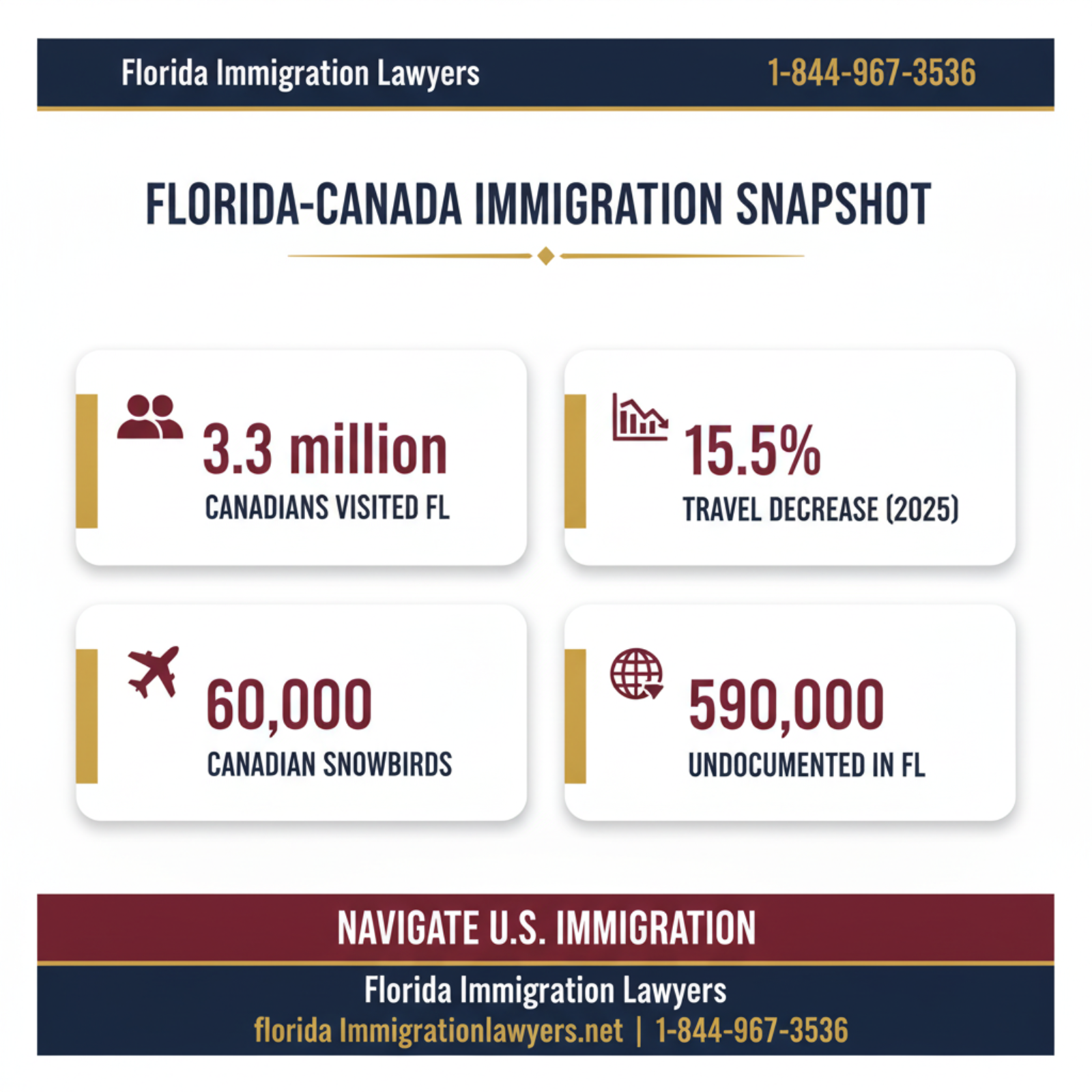
How long are Canadians allowed to stay in Florida? Typically, Canadian visitors can stay in the U.S. for up to six months without a visa. For longer stays, they would need to apply for appropriate U.S. visas. Conversely, U.S. citizens in Canada as visitors are also generally permitted for up to six months. This highlights the temporary nature of visitor status versus permanent immigration intent.
For those considering a permanent move, understanding the legal implications for your U.S. citizenship status and tax obligations is also crucial. This transition requires careful planning and often involves complex legal and financial considerations. Our firm can help you understand these cross-border implications.
Do not navigate this complex and often daunting process alone. The requirements for Canadian immigration are specific and frequently updated. Contact Florida Immigration Lawyers today at 1-844-967-3536 to ensure your application is strong, compliant, and positioned for success.
Common Mistakes to Avoid in Your Canadian Immigration Journey
Immigrating to Canada from Florida, while promising, is fraught with potential pitfalls. Avoiding these common mistakes can significantly improve your chances of a successful outcome. Our experienced Florida immigration lawyers help clients steer clear of these issues.
- Submitting an Incomplete Application: Missing even a single required document or piece of information can lead to your application being returned or refused. Consequences include significant delays and the loss of application fees.
- Misrepresenting Information: Providing false or misleading information on your application can result in a five-year ban from applying to Canada and potential criminal charges. Always be truthful and accurate.
- Missing Deadlines: Strict deadlines apply for submitting documents, responding to requests, and submitting the full application after an ITA. Missing these can lead to the closure of your file and the need to restart the entire process.
- Choosing the Wrong Immigration Program: Applying under a program for which you do not qualify wastes time and money. Thorough research and professional guidance are crucial to identify the best pathway.
- Insufficient Proof of Funds: Failing to demonstrate you have the required settlement funds can lead to refusal. IRCC has specific requirements for the amount and type of funds.
- Not Updating IRCC on Changes: Changes in marital status, family composition, or contact information must be reported to IRCC promptly. Failure to do so can jeopardize your application.
- Ignoring Inadmissibility Issues: Prior criminal convictions, serious medical conditions, or previous immigration violations (even in the U.S.) can make you inadmissible to Canada. Failing to disclose these or seek a waiver is a critical error.
- Poor Language Test Scores: Many programs have minimum language proficiency requirements. Submitting scores below the threshold will result in refusal. Ensure you meet or exceed these requirements.
- Incorrectly Completing Forms: Errors in filling out application forms, even minor ones, can cause delays or rejection. Pay close attention to instructions and double-check all entries.
- Not Seeking Legal Advice: Attempting to navigate the complex Canadian immigration system without professional legal guidance often leads to mistakes. An experienced lawyer can provide invaluable assistance.
When to Seek Professional Legal Assistance from a Florida Immigration Lawyer
While some aspects of Canadian immigration might seem straightforward, many situations warrant the expertise of a seasoned legal professional. Florida Immigration Lawyers are here to provide the guidance you need, whether you are in St. Petersburg, Miami, Orlando, or anywhere else in the state.
You should strongly consider contacting an attorney if your case involves any complexities. This includes situations where you have a history of visa refusals, a criminal record, or a medical condition that might impact your admissibility. Navigating waivers or appeals requires specialized legal knowledge.
Furthermore, if you are unsure which immigration program best suits your profile or if you need assistance preparing a meticulously organized application, our team can help. We ensure all forms are correctly filled, and all supporting documents are present and accurate, significantly reducing the risk of delays or refusals.
Our lawyers are adept at interpreting the latest Canada immigration news today and applying it to your unique circumstances. We can help you understand complex legal texts like sections of the Immigration and Refugee Protection Act (IRPA) or the Canadian Immigration and Refugee Protection Regulations (IRPR). Our goal is to streamline your journey and protect your interests.
Do not wait until you encounter a problem to seek legal help. Proactive consultation can prevent costly mistakes and provide peace of mind. Whether you are just starting your research or have already begun an application, contact Florida Immigration Lawyers for a comprehensive review of your options. Our experienced attorneys are ready to assist you.
About Florida Immigration Lawyers
Florida Immigration Lawyers is a leading law firm dedicated to providing exceptional immigration services to individuals and families across the entire state of Florida. With a deep understanding of both U.S. and international immigration laws, our firm is committed to helping clients achieve their immigration goals, whether they are coming to the U.S. or exploring opportunities in Canada.
Our experienced team offers comprehensive legal representation for a wide range of immigration matters, including visa applications, green cards, citizenship, asylum, deportation defense, family-based immigration, and business immigration. We pride ourselves on offering personalized attention and strategic advice tailored to each client's unique situation.
Why choose Florida Immigration Lawyers? We are available 24/7 to address your urgent concerns and offer free, no-obligation consultations to discuss your case. Our firm is known for its compassionate approach, diligent advocacy, and commitment to achieving the best possible outcomes for our clients. We serve all of Florida, from Jacksonville to Miami, and are proud to offer bilingual services (English and Spanish) to better assist our diverse community.
For trusted legal guidance on your immigration journey, contact us today. Call 1-844-967-3536 or visit our website at https://www.floridaimmigrationlawyers.net. We are here to help you every step of the way.
Sources and References
- U.S. Citizenship and Immigration Services (USCIS)
- U.S. Department of State - Bureau of Consular Affairs (travel.state.gov)
- U.S. Department of Justice - Executive Office for Immigration Review (EOIR)
- Immigration and Nationality Act (INA), 8 U.S.C. Chapter 12
- 8 Code of Federal Regulations (CFR)
- Immigration and Refugee Protection Act (IRPA) (Canada)
- Immigration and Refugee Protection Regulations (IRPR) (Canada)
This article provides general legal information and is not intended as legal advice. Every case is unique, and outcomes depend on specific facts and circumstances. Contact an attorney for advice about your particular situation.
Your journey to Canada from Florida deserves expert legal support. Do not leave your future to chance. Contact Florida Immigration Lawyers today for a free consultation at 1-844-967-3536. Se Habla Español - Estamos aquí para ayudarle.
Need help with Immigration?
Our Florida immigration attorneys offer free consultations. Call today or schedule online.
Frequently Asked Questions
Florida Immigration Lawyers
Legal Team
Our experienced attorneys at Florida Immigration Lawyers have been serving clients across Florida for over 20 years. We specialize in immigration, personal injury, criminal defense, workers compensation, and family law.