Abrego Garcia Deportation: Florida Defense Strategies 2026
Understanding deportation defense in Florida is crucial, especially when facing complex cases like those highlighted by the Abrego Garcia situation. This guide from Florida Immigration Lawyers provides a comprehensive overview of removal proceedings, a step-by-step defense plan, and essential documents. Learn about the grounds for deportation, typical timelines, and cost factors involved. We also address common mistakes to avoid and identify key scenarios when immediate legal counsel is indispensable. Serving Gainesville and all of Florida, our firm offers expert guidance and compassionate support to protect your rights and help you navigate the intricate immigration legal landscape. Schedule your free consultation today.

Navigating potential deportation, particularly in complex cases like those involving the Abrego Garcia situation, requires immediate and expert legal assistance. If you are facing removal proceedings in Florida, it is crucial to understand your rights, explore all available defense strategies, and act swiftly to protect your future. Consulting with an experienced immigration lawyer is the first vital step to building a strong defense.
- Seek immediate legal counsel from an immigration attorney.
- Understand your Notice to Appear (NTA) and charges.
- Gather all relevant personal and immigration documents.
- Explore potential forms of relief from deportation.
- Prepare thoroughly for all court hearings and interviews.
The prospect of deportation can be one of the most frightening experiences for individuals and families in the United States. In Florida, a state with a significant immigrant population, navigating the complexities of immigration law, especially in cases reminiscent of the highly publicized Abrego Garcia situation, demands expert legal guidance. You are not alone in this journey, and understanding your rights is paramount.
At Florida Immigration Lawyers, we recognize the immense stress and uncertainty that deportation proceedings bring. Our dedicated team is committed to providing compassionate and effective legal representation to individuals across Florida, including Gainesville and surrounding areas, who are facing removal. We believe in fighting tirelessly to protect your right to remain in the U.S.
This comprehensive guide will explore the intricacies of deportation defense in Florida, drawing insights from the types of challenges seen in cases like the Abrego Garcia deportation. We will cover everything from understanding the removal process to identifying common mistakes and knowing when to seek professional help. Call Florida Immigration Lawyers at 1-844-967-3536 for a free consultation and let us help you understand your options.
Understanding Deportation Proceedings in Florida: An Overview
Deportation, formally known as removal, is the process by which the U.S. government orders a non-citizen to leave the country. This can occur for various reasons, including visa overstays, certain criminal convictions, or violations of immigration law. Florida, with its diverse communities and proximity to international borders, sees a high volume of such cases.
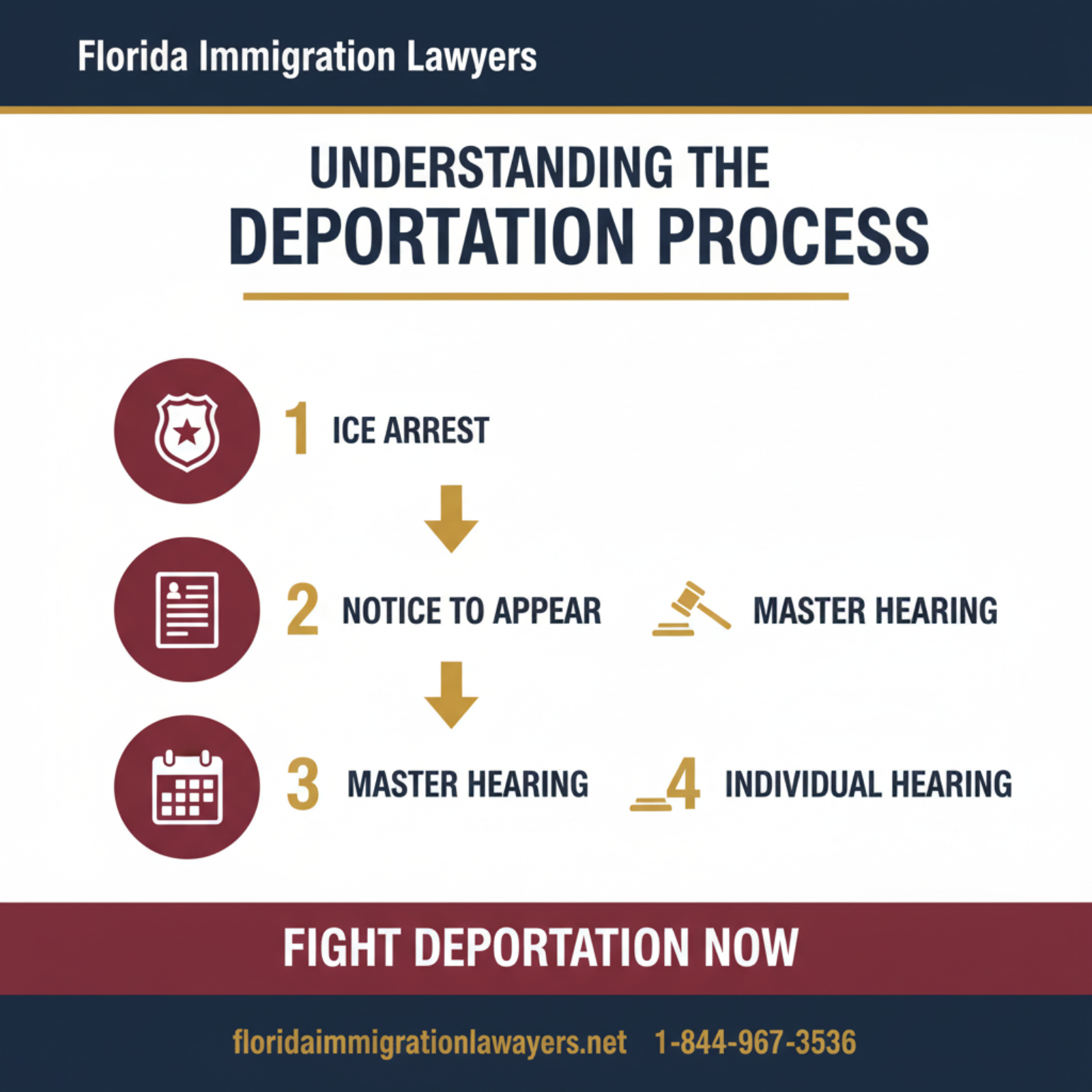
The process typically begins when U.S. Immigration and Customs Enforcement (ICE) issues a Notice to Appear (NTA), Form I-862, which charges an individual with being removable from the United States. This document is your official notification that the government intends to deport you. It outlines the specific legal grounds for your removal and schedules your initial hearing before an Immigration Judge.
Florida is home to several immigration courts, including those in Miami and Orlando, which fall under the jurisdiction of the Executive Office for Immigration Review (EOIR). These courts hear thousands of cases annually, making the landscape complex and often overwhelming for individuals without legal representation. The legal arguments and procedures can be highly technical, emphasizing the need for skilled advocacy.
Grounds for Deportation and Removability
The Immigration and Nationality Act (INA) outlines various grounds for deportability. These can range from relatively minor infractions to serious criminal offenses. Understanding the specific charge against you is crucial for developing an effective defense strategy.
Common grounds for removal include entry without inspection, overstaying a visa, engaging in criminal activity, marriage fraud, or violating the terms of a nonimmigrant visa. Even minor offenses can sometimes trigger removal proceedings depending on the specific circumstances and the individual's immigration history. For more details on these grounds, you can refer to USCIS.gov or Justice.gov/EOIR.
The Abrego Garcia situation highlighted the complexities that can arise, particularly when issues of due process, prior deportation orders, or the interpretation of legal protections are involved. Such cases underscore the importance of meticulous legal review and a robust defense strategy tailored to the unique facts of each situation. Our attorneys at Florida Immigration Lawyers are adept at analyzing these intricate details.
Step-by-Step Guide to Deportation Defense in Florida
Facing removal proceedings can feel like an uphill battle, but a structured approach can make a significant difference. Here is a general step-by-step guide to navigating deportation defense in Florida. Remember, each case is unique, and personalized legal advice is always recommended.
-
Seek Immediate Legal Counsel: As soon as you receive a Notice to Appear (NTA) or are detained by ICE, contact an experienced immigration attorney. Do not wait. Early intervention can preserve your rights and open up more defense avenues. An attorney can help you understand the charges against you and begin preparing your defense.
-
Understand Your NTA and Charges: Your NTA (Form I-862) will detail the specific legal grounds under which the government believes you are removable. An attorney will review this document with you, explaining the allegations and the potential consequences. This is essential for formulating a targeted defense.
-
Gather All Relevant Documents and Evidence: Begin collecting all personal identification documents, immigration records (visas, I-94s, prior applications), birth certificates, marriage certificates, financial records, proof of residence in Florida, and any other evidence supporting your eligibility for relief. Evidence of strong community ties, good moral character, or hardship to U.S. citizen family members can be vital.
-
Attend All Court Hearings: Failure to appear at scheduled immigration court hearings can result in a removal order issued in absentia, making it much harder to fight your case. Always arrive on time and be prepared. Your attorney will represent you and guide you through each hearing, from the master calendar hearing to individual merits hearings.
-
Explore Forms of Relief from Removal: Depending on your specific circumstances, you may be eligible for various forms of relief from deportation. These can include asylum, withholding of removal, protection under the Convention Against Torture, cancellation of removal for certain non-permanent residents (INA 240A(b)), adjustment of status, or waivers of inadmissibility. Your attorney will assess your eligibility for these options.
-
Prepare for Your Individual Merits Hearing: This is where your attorney will present your defense, call witnesses, and submit evidence to the Immigration Judge. You will likely be required to testify. Thorough preparation with your lawyer is critical to effectively present your case and respond to questions from the judge and government counsel.
-
Appeal an Adverse Decision (If Necessary): If the Immigration Judge denies your request for relief or orders you removed, you typically have the right to appeal the decision to the Board of Immigration Appeals (BIA). An appeal must be filed within a strict timeframe, usually 30 days. Your attorney can help you navigate the appeals process, which is often complex and highly technical.
Essential Document Checklist for Deportation Defense
Having your documents organized and readily available is critical for a strong deportation defense. This list is a general guide; your attorney will advise on specific documents pertinent to your case.
- Notice to Appear (NTA), Form I-862
- Any prior immigration applications or petitions (I-130, I-485, I-589, etc.)
- Passport(s) and national identity documents
- Birth certificate(s) for yourself and any family members
- Marriage certificate (if applicable)
- Divorce decrees (if applicable)
- Proof of continuous physical presence in the U.S. (e.g., utility bills, school records, employment records, tax returns)
- Financial records (bank statements, pay stubs, tax returns)
- Medical records, especially if seeking asylum or cancellation of removal based on hardship
- Police clearance certificates from all places of residence in the U.S. and abroad
- Criminal court dispositions for any arrests or convictions
- Letters of support/affidavits from family, friends, employers, or community leaders
- Evidence of hardship to U.S. citizen or LPR spouse, parent, or child (if applicable)
- Any previous immigration court orders or decisions
- Proof of membership in community organizations or religious institutions
Timeline and Processing Expectations for Removal Proceedings
Immigration court proceedings can be lengthy and unpredictable. The timeline for a deportation case in Florida can vary significantly based on the complexity of the case, the specific immigration court, and the judge's caseload. It is important to set realistic expectations and maintain communication with your legal team.
Typically, a case begins with a Master Calendar Hearing, which is a preliminary hearing where the judge addresses procedural matters, confirms the charges, and sets future hearing dates. These initial hearings might be scheduled months after the NTA is issued. Subsequent Individual Merits Hearings, where evidence is presented and testimony is heard, can be scheduled a year or more after the initial hearing.
Appeals to the Board of Immigration Appeals (BIA) can add another year or more to the process. Further appeals to federal circuit courts are also possible but are even more time-consuming. The overall process can easily span several years, during which time you may be required to check in with ICE or wear an ankle monitor, depending on your release status. Patience and consistent legal representation are key.
Cost Factors and Fee Breakdown in Deportation Defense
The financial aspect of deportation defense is a significant concern for many individuals and families. Costs generally fall into two main categories: legal fees for your attorney's services and government filing fees for any applications for relief you may submit. While we cannot provide specific amounts here as they are subject to change, understanding these categories is important.
Attorney fees will vary based on the complexity of your case, the experience of the lawyer, and the amount of work required. Some attorneys charge a flat fee for specific stages of the process, while others may bill hourly. It is crucial to have a clear understanding of the fee structure from the outset. Florida Immigration Lawyers offers transparent fee agreements and discusses all costs upfront during your free consultation.
Government filing fees are paid directly to USCIS or the Executive Office for Immigration Review (EOIR) for various applications for relief, such as an application for adjustment of status (Form I-485) or an application for asylum (Form I-589). These fees are set by the government and are non-refundable. Fee waivers may be available for certain applications if you meet specific poverty guidelines. Your attorney can advise you on potential fee waivers.
Do not navigate this process alone. Contact Florida Immigration Lawyers today.
Common Mistakes to Avoid in Deportation Proceedings
Making even a small error during deportation proceedings can have severe and lasting consequences. Awareness of these common pitfalls can help you avoid jeopardizing your case.
-
Missing Deadlines: Immigration law is strict about deadlines for filing documents, appeals, or responding to requests. Missing a deadline can lead to an automatic denial of your application or even a removal order in absentia. Always adhere to all specified timeframes.
-
Failing to Appear in Court: As mentioned, not showing up for a scheduled hearing will almost certainly result in a deportation order being issued against you without the opportunity to present your defense. This is one of the most serious mistakes you can make.
-
Not Seeking Legal Counsel: Attempting to represent yourself in immigration court is highly risky. Immigration law is incredibly complex, and a non-attorney is unlikely to understand all the nuances, procedures, and available defenses. This often leads to missed opportunities for relief.
-
Providing False Information: Lying or misrepresenting facts on applications or during testimony can lead to severe penalties, including a permanent bar from future immigration benefits. Always be truthful and provide accurate information.
-
Not Understanding the Charges: If you do not fully comprehend the specific grounds for removal listed in your NTA, you cannot effectively defend against them. An attorney ensures you understand every accusation.
-
Failing to Gather Sufficient Evidence: A strong defense relies on compelling evidence. Not collecting all necessary documents, affidavits, or proof of eligibility for relief significantly weakens your case. Your attorney will help you identify what evidence is crucial.
-
Ignoring Previous Immigration Orders: If you have a prior deportation order, it complicates your current situation significantly. Ignoring it or failing to disclose it will work against you. It is vital to address any past immigration history directly.
-
Assuming All Criminal Offenses are the Same: Not all criminal convictions lead to deportation, but many do. Understanding which offenses are considered "crimes involving moral turpitude" or "aggravated felonies" under immigration law is critical. A criminal conviction could have serious immigration consequences.
-
Not Updating Your Address with USCIS/EOIR: If you move, you must update your address with both USCIS and the immigration court. Failure to do so means you might not receive important notices or hearing dates, leading to missed appearances and potential deportation orders.
-
Speaking to ICE Without Counsel: If approached by ICE, you have the right to remain silent and the right to an attorney. Do not answer questions or sign documents without first consulting with legal counsel. What you say can be used against you.
When to Call a Florida Immigration Lawyer
The decision to hire an immigration attorney is critical, especially when facing something as life-altering as deportation. While this article provides general information, your specific situation requires personalized legal advice. Here are clear scenarios when you should immediately contact Florida Immigration Lawyers:
- You have received a Notice to Appear (NTA): This is the official start of removal proceedings. Do not delay in seeking legal help.
- You or a family member has been detained by ICE: We can assist with bond hearings and immediate defense strategies.
- You have a prior deportation order: Re-entering the U.S. after deportation can lead to serious consequences, and you need specialized legal counsel.
- You have criminal charges or convictions: Certain crimes can trigger deportation proceedings, and you need an attorney who understands both criminal and immigration law.
- You are seeking asylum or other forms of relief: These cases are complex and require meticulous preparation and presentation.
- Your case involves complex legal issues, similar to those highlighted in the Abrego Garcia situation: If your case involves due process concerns, constitutional challenges, or intricate legal arguments, our experienced attorneys are equipped to handle such complexities.
- You are unsure of your immigration status or rights: Proactive legal advice can prevent future problems.
At Florida Immigration Lawyers, we offer comprehensive services for individuals facing deportation. Our attorneys have a deep understanding of Florida's immigration courts and USCIS offices, including those serving Gainesville and the wider Florida region. We are prepared to fight for your rights, explore every possible defense, and guide you through every step of the legal process. From asylum claims to cancellation of removal, we provide dedicated advocacy.
About Florida Immigration Lawyers
Florida Immigration Lawyers is a leading law firm dedicated to providing exceptional immigration legal services across the entire state of Florida. Our mission is to protect the rights and futures of immigrants and their families through diligent representation and compassionate advocacy. We understand the profound impact immigration matters have on individuals' lives and are committed to achieving the best possible outcomes for our clients.
We offer a broad range of immigration services, including deportation defense, asylum applications, family-based immigration, citizenship and naturalization, business immigration, and visa petitions. Our experienced attorneys are well-versed in the latest immigration laws and policies, ensuring that our clients receive up-to-date and effective legal strategies. We serve clients in Gainesville, Miami, Orlando, Tampa, and all other Florida communities.
Why choose Florida Immigration Lawyers? We pride ourselves on our client-centered approach, offering personalized attention and clear communication throughout your legal journey. We are available 24/7 to address your urgent concerns and offer free consultations to help you understand your legal options without financial commitment. Your success is our priority, and we are here to provide the support and expertise you need.
Visit our website at https://www.floridaimmigrationlawyers.net or call us directly at 1-844-967-3536 to schedule your free consultation.
Sources and References
- U.S. Citizenship and Immigration Services (USCIS)
- Executive Office for Immigration Review (EOIR)
- U.S. Immigration and Customs Enforcement (ICE)
- 8 U.S.C. Chapter 12 - Immigration and Nationality Act (INA)
- Immigration and Nationality Act Section 208 (8 U.S.C. § 1158) - Asylum
- Immigration and Nationality Act Section 240 (8 U.S.C. § 1229a) - Removal Proceedings
- Immigration and Nationality Act Section 240A(b) (8 U.S.C. § 1229b(b)) - Cancellation of Removal for Nonpermanent Residents
- 8 Code of Federal Regulations (CFR) Part 1240 - Proceedings to Determine Removability of Aliens in the United States
This article provides general legal information and is not intended as legal advice. Every case is unique, and outcomes depend on specific facts and circumstances. Immigration laws are subject to change. Contact an attorney for advice about your particular situation.
Do not face the complexities of deportation defense alone. Whether your situation is straightforward or involves intricate legal challenges, similar to those seen in cases like the Abrego Garcia deportation, Florida Immigration Lawyers is here to provide the experienced and dedicated representation you need. Our team is ready to listen to your story, explain your options, and fight for your future in Florida.
Contact Florida Immigration Lawyers today for your free consultation. Call us at 1-844-967-3536. Se Habla Español - Estamos aquí para ayudarle.
Do Not Navigate This Process Alone
Our experienced immigration attorneys are ready to fight for you. Get a free, confidential consultation today.
Se Habla Español
Frequently Asked Questions
Florida Immigration Lawyers
Immigration Attorney | Founder, Vasquez Law Firm
U.S. Air Force veteran and immigration attorney with thousands of cases resolved. J.D., NCCU School of Law. AILA member. Admitted to the 4th, 5th, and 11th Circuit Courts.
Available 24/7 - Free Evaluations
Related Legal Services
Our Florida immigration attorneys can help you with asylum protection, deportation defense and citizenship and naturalization. Call today at 1-844-967-3536 for a free consultation.
Related Links
Related Topics
Free Legal Consultation
Discuss your case with our experienced attorneys. We're available 24/7.
Se Habla Español - Estamos aquí para ayudarle.
Related Articles
Immigration Attorney in Gainesville, North Florida
Navigating immigration law in Gainesville and North Florida can be challenging, especially with recent legal changes. Discover how Florida Immigration Lawyers can assist you. Call 1-844-967-3536 for a free consultation.
Refugee Status Florida Resettlement: Your 2026 Guide
Navigating refugee status and resettlement in Florida requires a thorough understanding of U.S. immigration law and available support systems. This 2026 guide covers eligibility, the step-by-step resettlement process, essential documents, timelines, and financial considerations for refugees seeking to build a new life in Florida, particularly in areas like Homestead. It highlights the critical role of organizations like UNHCR and USCIS, and the importance of avoiding common mistakes. Florida Immigration Lawyers offers expert legal assistance, ensuring a smoother transition and helping refugees adjust status to lawful permanent residents. Learn how to secure your future and access vital resources in the Sunshine State.
Dual Citizenship in Florida: What You Need to Know
Explore the benefits and legal steps of obtaining dual citizenship in Florida. Understand the process, avoid common mistakes, and learn when to seek legal help. Contact Florida Immigration Lawyers at 1-844-967-3536 for guidance.
Understanding Immigration Bond Hearings in Florida
Immigration bond hearings in Florida are critical for those detained by ICE. Understand the process, avoid common mistakes, and learn when to contact a lawyer for assistance. Call Florida Immigration Lawyers for a free consultation.
