H-1B Visa Fee Increase Florida 2026: Navigating New Costs
Understand the H-1B visa fee increase in Florida for 2026. Learn about new costs, requirements, and how to protect your application. Contact us today.
The **H-1B visa fee increase Florida** in 2026 significantly impacts employers and skilled workers. New filing fees, including potential surcharges, require careful planning and budgeting. Understanding these changes, identifying potential exemptions, and ensuring meticulous application preparation are crucial for a successful outcome in Florida.
- H-1B visa fees are increasing, affecting new and some existing petitions.
- Employers typically bear the primary financial responsibility for these fees.
- Careful documentation and adherence to USCIS guidelines are more critical than ever.
- Consulting an experienced Florida immigration lawyer is highly recommended to navigate complex fee structures and requirements.
Navigating the complex landscape of U.S. immigration law can be challenging, especially when significant changes like the **H-1B visa fee increase Florida** for 2026 come into effect. For businesses and skilled professionals in Gainesville and across the Sunshine State, these updates are not just administrative hurdles; they represent substantial financial considerations and strategic adjustments.
The H-1B visa program is vital for many Florida industries, allowing U.S. employers to temporarily employ foreign workers in specialty occupations. As we approach 2026, understanding the new fee structures, processing timelines, and compliance requirements is paramount. This comprehensive guide from Florida Immigration Lawyers will break down everything you need to know about the upcoming H-1B visa fee increase in Florida.
Do not let new regulations jeopardize your immigration goals. For personalized guidance and to ensure your H-1B application is compliant and robust, **call Florida Immigration Lawyers at 1-844-967-3536 for a free consultation** today. Our dedicated team is here to assist you.
Understanding the H-1B Visa Fee Increase in Florida for 2026
The H-1B visa program is crucial for Florida's economy, attracting global talent in specialty occupations. The year 2026 brings significant changes to associated fees, impacting employers and skilled workers statewide, from Gainesville to Miami.
H-1B fees historically cover processing costs. Recent policy adjustments aim to increase these fees, funding immigration enforcement and improving efficiencies. These changes reflect true adjudication costs and maintain system integrity.
What is the H-1B Visa and its Importance for Florida?
The H-1B visa allows U.S. employers to temporarily hire foreign workers in specialty occupations requiring a bachelor's degree or higher. Professionals like engineers and researchers significantly contribute to Florida's economic growth and innovation.
For Florida's diverse economy, the H-1B visa is vital. It enables companies to fill critical skill gaps, fostering innovation and global competitiveness. Attracting top talent directly impacts job creation and strengthens our economy.
Key Changes to H-1B Visa Fees Expected in 2026
Proposed changes focus on the base filing fee for Form I-129. Expect increases across various fee components, including the Public Law 114-113 fee (the $4,000/$4,500 fee) and the ACWIA fee. While specific amounts are pending, an upward trend is clear.
Past discussions included a substantial $100,000 fee for certain H-1B petitions, primarily for employers with a high percentage of H-1B or L-1 employees. This specific fee, governed by Public Law 114-113, applies under strict criteria and is typically paid by the petitioning employer, not the employee (8 CFR 214.2(h)(10)(iii)(A)).
These new **H-1B visa fee increase Florida** changes directly impact financial planning for employers. Strategic budgeting is essential. Staying informed is key to a successful H-1B program for your Florida company.
Navigating the H-1B Visa Application Process: A Step-by-Step Guide
The H-1B visa application is detailed and requires strict USCIS adherence. With the upcoming **H-1B visa fee increase Florida** in 2026, understanding each step is critical to avoid costly delays.
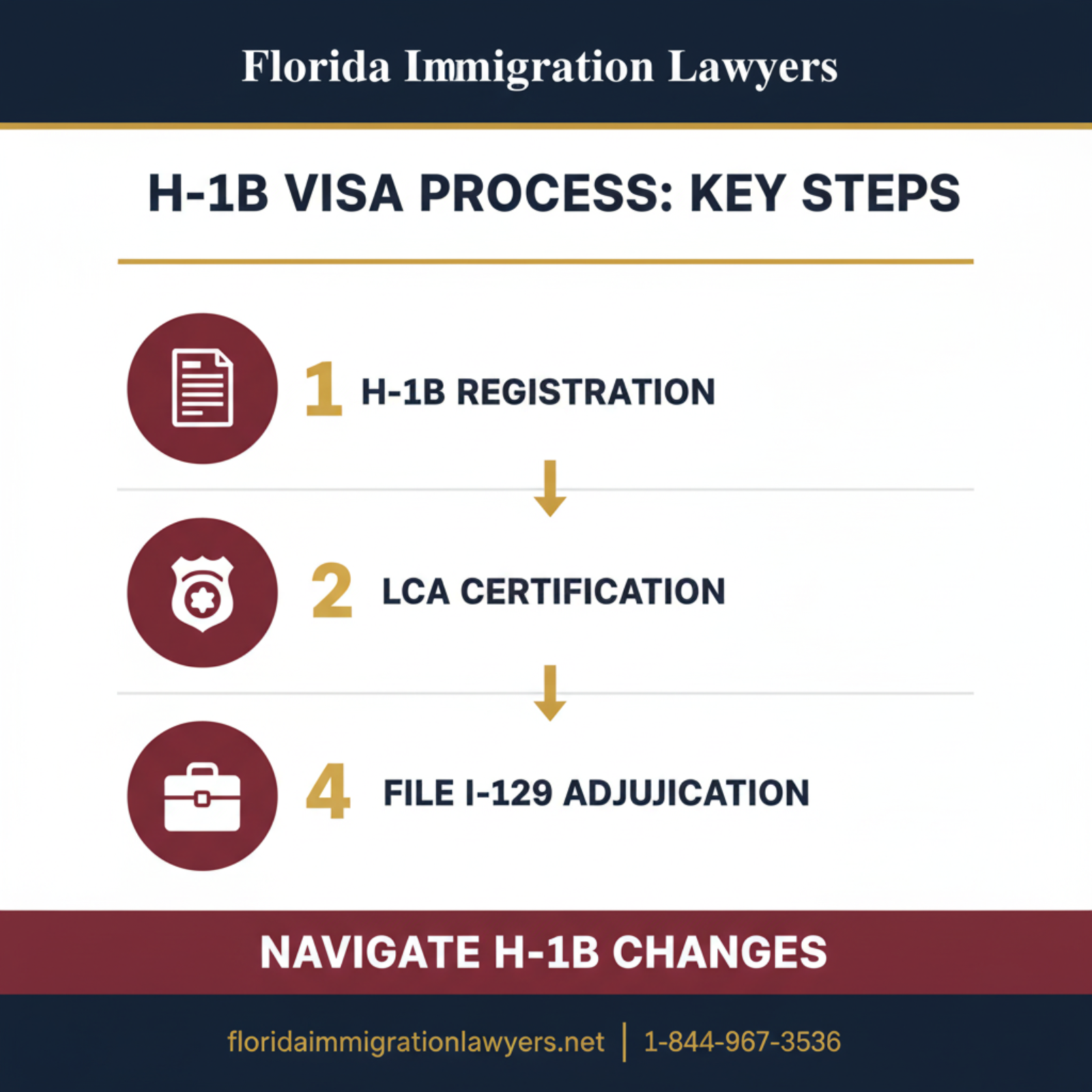
- Employer Files Labor Condition Application (LCA) with DOL: Employer files Form ETA-9035, attesting to prevailing wage and working conditions. DOL typically certifies within 7 business days.
- H-1B Cap Lottery (If Applicable): For cap-subject petitions, employers register for the annual H-1B lottery (usually March). Only selected registrations proceed to file the I-129 petition.
- Employer Files Form I-129 Petition with USCIS: After LCA certification and lottery selection, the employer files Form I-129 with all supporting documents. New **H1B visa fees 2026** are paid here.
- USCIS Adjudicates the Petition: USCIS reviews the I-129 petition, which can take months. Potential Requests for Evidence (RFEs) may occur; prompt response is crucial.
- Premium Processing (Optional): An additional fee guarantees USCIS action within 15 calendar days. This option expedites urgent cases but adds significant cost.
- Visa Interview (for those outside the U.S.): Beneficiaries outside the U.S. attend an interview at an embassy/conulate after I-129 approval.
- Entry to the U.S. and Employment: Upon successful interview and visa stamping, the beneficiary enters the U.S. in H-1B status and begins employment.
Each step demands meticulous attention. Increased fees add complexity, making expert legal guidance invaluable. Florida Immigration Lawyers can help you navigate these stages effectively.
Essential Documents for Your H-1B Visa Application
A successful H-1B visa petition requires comprehensive and accurate documentation. With the **H-1B visa fee increase Florida** in 2026, perfect documentation is vital to avoid delays or denials. Here's a general checklist:
- Certified Labor Condition Application (LCA) Form ETA-9035.
- Form I-129, Petition for a Nonimmigrant Worker.
- Applicant's highest degree certificate and academic transcripts.
- Foreign degree evaluations (if applicable) for U.S. equivalency.
- Letters of experience from previous employers.
- Professional licenses or certifications (if required for Florida occupation).
- Employer's letter of support (job offer, duties, salary, specialty requirement).
- Employer's Federal Employer Identification Number (FEIN).
- Company financial statements, tax returns, and business plans.
- Applicant's resume or CV.
- Copy of applicant's passport (valid for 6+ months beyond requested H-1B).
- Copies of all previous U.S. visa stamps and I-94 records.
- Marriage certificate and birth certificates for H-4 dependent family members.
- Photographs meeting USCIS specifications.
This list is not exhaustive; specific cases may require additional documentation. Cap-exempt institutions, for example, need specific proof. Document quality is paramount, especially with increased **H1B visa fees 2026**.
H-1B Visa Processing Timelines and Expectations for 2026
Understanding H-1B visa processing timelines is crucial for employers and beneficiaries, especially with the new **H-1B visa fee increase Florida** impacting USCIS resources. Exact times vary, but here are general expectations for 2026.
Standard Processing Times
Regular processing for Form I-129 can take several months to over a year. Times depend on USCIS service center workload and case complexity, and are monitored on the USCIS website. The annual H-1B cap lottery also impacts timelines, with registrations in March and selected petitions filed April 1st for an October 1st start.
Premium Processing Option
Employers can opt for premium processing (Form I-907) for an additional fee. This guarantees a USCIS response within 15 calendar days. It expedites urgent cases but adds significant cost, separate from standard H-1B fees.
Impact of Fee Increases on Timelines
Increased fees aim to improve efficiency, but new structures can initially cause temporary delays at USCIS. Long-term, additional revenue should support staffing and technology, leading to more consistent processing. Stay informed via official USCIS announcements.
Applicants in Gainesville and throughout Florida should plan for maximum processing time and potential RFEs. Proactive communication with Florida Immigration Lawyers helps manage expectations and strategize effectively.
Cost Factors and the New H-1B Visa Fee Breakdown
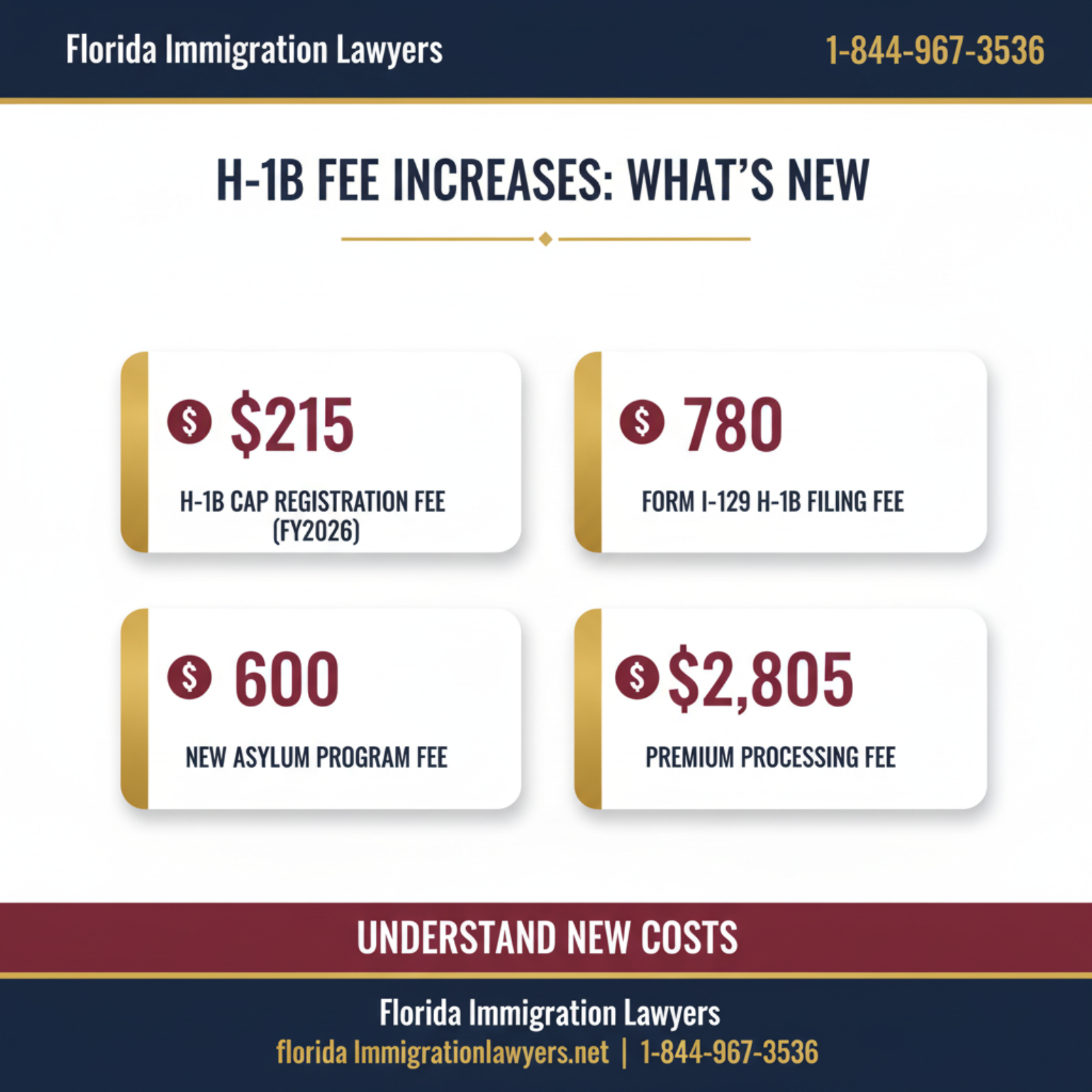
The **H-1B visa fee increase Florida** in 2026 represents a significant financial commitment. Understanding each fee component is essential for accurate budgeting and compliance. Fees are generally the petitioning employer's responsibility, not the foreign worker's (8 CFR 214.2(h)(10)(iii)(A)).
Key H-1B Visa Fee Components
Specific amounts are subject to change, but categories typically include:
- Base Filing Fee for Form I-129: Fundamental fee for filing the Petition for a Nonimmigrant Worker.
- American Competitiveness and Workforce Improvement Act (ACWIA) Fee: Mandated by Congress, varies by employer size. Funds U.S. worker training programs.
- Fraud Prevention and Detection Fee: Mandatory for initial H-1B and new employer petitions. Funds anti-fraud initiatives.
- Public Law 114-113 Fee (H-1B and L-1 Visa Reform Act of 2015): Applies to employers with 50+ employees where over 50% are H-1B or L-1 nonimmigrants. This is the "$4,000" or "$4,500" fee, central to **H1B $100k fee** discussions.
- Premium Processing Fee: Optional, additional fee to expedite processing.
Who Pays the H-1B Fees? Addressing Common Questions
A common question regarding the **H-1B visa fee increase Florida** is, "Who pays the $100,000 for H-1B?" Employers are legally obligated to pay ACWIA, fraud prevention, and Public Law 114-113 fees. The base I-129 fee is also typically employer-paid.
H-1B regulations prohibit employers from passing on visa costs to employees. The specific **H1B $100k fee** (Public Law 114-113) is solely the employer's responsibility.
"Do current H-1B holders have to pay $100,000?" Generally no, unless their employer files a new petition and meets Public Law 114-113 criteria. It usually doesn't apply to extensions with the same employer.
"Who is exempt from h1b $100K fee?" Employers not meeting the "50/50 rule" (50+ employees, >50% H-1B/L-1) are exempt. Non-profits affiliated with higher education are often exempt from certain fees, falling under **USCIS H1B fee exemptions**.
Understanding these financial obligations is paramount for Florida businesses. Mismanagement leads to compliance issues, fines, and future H-1B bars. Florida Immigration Lawyers provide guidance on these fee structures.
The complexities of the **H-1B visa fee increase Florida** and the application process can be overwhelming. Do not navigate this process alone. **Contact Florida Immigration Lawyers today** for expert legal assistance. Our team is ready to provide the guidance you need.
Common Mistakes to Avoid During Your H-1B Visa Application in Florida
The H-1B visa process has many pitfalls, and with the **H-1B visa fee increase Florida** in 2026, errors are even more costly. Avoiding these common mistakes is crucial for a smooth application:
- Inaccurate or Incomplete LCA: Errors in prevailing wage or job duties can lead to rejection. Consequences: DOL audits, fines, I-129 denial.
- Missing Critical Deadlines: H-1B cap registration, filing periods, and RFE responses are strict. Consequences: Petition rejection or inability to participate.
- Insufficient Specialty Occupation Documentation: Vague job descriptions or inadequate degree evidence can lead to issues. Consequences: RFE or denial.
- Employer's Inability to Pay Prevailing Wage: Employer must prove financial ability. Scrutinized for smaller companies. Consequences: Petition denial and penalties.
- Not Understanding H-1B Cap Exemptions: Incorrectly filing under the cap when exempt (e.g., universities) causes delays. Consequences: Wasted resources or missed exemption.
- Failing to Disclose Prior Immigration Issues: Previous visa denials, overstays, or violations must be fully disclosed. Consequences: Visa denial, potential bar from future benefits.
- Assuming Automatic Approval After Lottery Selection: Lottery selection is just the first step; approval is not guaranteed. Consequences: False expectations and unpreparedness for RFEs.
- Incorrectly Calculating or Paying Fees: With increasing **H1B visa fees 2026**, fee errors are common. Consequences: Petition rejection, re-filing, delays.
- Lack of Attorney-Client Relationship: Navigating without experienced legal counsel often leads to errors. Consequences: Increased risk of denial, missed opportunities.
- Not Planning for Potential RFEs: Many H-1B petitions receive RFEs. Inadequate responses can jeopardize the case. Consequences: Delays, or denial.
Partnering with a knowledgeable immigration attorney from Florida Immigration Lawyers is a strategic decision to mitigate these risks for any employer or beneficiary in Florida.
When to Consult a Florida Immigration Lawyer for Your H-1B Visa
The **H-1B visa fee increase Florida** in 2026 and complex U.S. immigration law make expert legal guidance crucial. While some cases seem straightforward, certain scenarios strongly warrant assistance from a qualified Florida immigration lawyer. Florida Immigration Lawyers provide comprehensive support.
Specific Scenarios Requiring Legal Help:
- Complex Specialty Occupation Determinations: If job duties or qualifications don't perfectly align, an attorney articulates the case effectively.
- Prior Denials or Immigration Violations: A history of visa denials or immigration issues requires proactive legal counsel.
- Employer Compliance Concerns: Employers need advice for full DOL and USCIS compliance, including prevailing wage and **H1B $100k fee** criteria.
- Changes in Employment or Employer: If an H-1B worker changes employers or job duties, a new or amended petition may be needed. An attorney guides this seamlessly.
- Requests for Evidence (RFEs) or NOIDs: Receiving an RFE or NOID indicates USCIS concerns. Effective response within strict deadlines is critical.
- Dependents (H-4 Visas): An attorney ensures all H-4 dependent applications are correctly filed with the primary H-1B petition.
- Seeking Green Card Options: H-1B is often a pathway to permanent residency. An attorney advises on green card options (EB-2, EB-3) and transition strategy. Learn more about Business Immigration and Family Immigration.
- Deportation Defense Concerns: If H-1B issues intersect with Deportation Defense, immediate legal counsel is paramount.
Florida Immigration Lawyers offer comprehensive services for all H-1B visa aspects, from consultation to petition filing. Our attorneys are well-versed in the latest USCIS policies and fee structures, including **H1B visa fees 2026**. We serve clients throughout Florida, including Gainesville, protecting your interests. Visit our attorneys page to learn more.
About Florida Immigration Lawyers
Florida Immigration Lawyers is a leading immigration law firm dedicated to serving individuals, families, and businesses across the entire state of Florida. Our mission is to provide compassionate, effective, and results-driven legal representation in all areas of immigration law. We understand the profound impact immigration matters have on our clients' lives and futures.
Our experienced attorneys specialize in a wide range of immigration services, including general immigration, asylum, citizenship, deportation defense, and complex business and family-based immigration cases like the H-1B visa. We pride ourselves on staying abreast of the latest legal developments, including changes to **H-1B visa fee increase Florida** regulations, to offer the most current and strategic advice.
Why Choose Florida Immigration Lawyers?
- Expertise: Our team possesses in-depth knowledge of U.S. immigration law and its intricate processes.
- Client-Centered Approach: We prioritize your needs, providing personalized attention and clear communication throughout your case.
- Bilingual Services: Se Habla Español. Our team is fluent in both English and Spanish, ensuring effective communication for a diverse clientele.
- Accessibility: We are available 24/7 to address your urgent questions and concerns.
- Free Consultations: We offer free, no-obligation consultations to discuss your case and outline your options.
Let us be your trusted legal partner in navigating the complexities of U.S. immigration. Contact us today to schedule your free consultation. Call us at **1-844-967-3536** or visit our website at https://www.floridaimmigrationlawyers.net. We are here to help you achieve your immigration goals.
Sources and References
- U.S. Citizenship and Immigration Services (USCIS)
- U.S. Department of State (travel.state.gov)
- U.S. Department of Labor (DOL) - H-1B Program
- 8 U.S.C. § 1101 et seq. - Immigration and Nationality Act (INA)
- 8 CFR § 214.2(h) - Petitions for Nonimmigrant Workers (H Classification)
- 8 CFR § 214.2(h)(10)(iii)(A) - Limitations on Employer Liability
- Public Law 114-113 (H-1B and L-1 Visa Reform Act of 2015)
- U.S. Citizenship and Immigration Services Policy Manual
This article provides general legal information and is not intended as legal advice. Every case is unique, and outcomes depend on specific facts and circumstances. Contact an attorney for advice about your particular situation.
The upcoming **H-1B visa fee increase Florida** and the evolving immigration landscape demand expert legal counsel. Do not risk your future or your business's ability to thrive in Florida. Reach out to Florida
¿Necesita ayuda con Inmigración?
Nuestros abogados de inmigración en Florida ofrecen consultas gratuitas. Llame hoy o programe en línea.
Preguntas Frecuentes
Vasquez Law Firm
Equipo Legal
Por más de 15 años, Vasquez Law Firm ha estado sirviendo a clientes en Florida. Nos especializamos en inmigración, lesiones personales, defensa criminal, compensación laboral y derecho familiar.